The Diamond Light Source And Malaria
I had to put a link to this page on the Diamond Light Source web site, which is entitled Malaria in Action.
This is the introductory paragraph.
In 2007 Helen Saibil was at a conference in Australia. Amongst the presentations there happened to be talks on the parasites malaria and toxoplasma and how they infect mammalian cells, causing disease. Helen is a structural biologist and whilst listening she began to realise that her newly acquired skills -she was doing electron tomography of cells- might allow the researchers to see things they had never seen before.
The page describes the work of the Diamond Light Source to understand and lead the might against malaria.
What Will Oxford Do For An Encore?
In the UK, I suspect nearly all of us have watched in admiration, as Oxford University have developed a Covid-19 vaccine for the world.
So what will be the University’s next big medical breakthrough.
Antibiotics
Today, this article on the BBC web site, which is entitled Oxford Research Tackles Threat Of Antibiotic Resistance, was published.
This was the introductory sub-heading.
Oxford University is opening a new research institute dedicated to tackling resistance to antibiotics.
To start the funding INEOS has chipped in a cool £100 million.
This paragraph summarises the project.
There will be 50 researchers working in the new Ineos Oxford Institute for Antimicrobial Resistance, addressing the “over-use and mis-use” of antibiotics, which the university warned could cause 10 million excess deaths per year by 2050.
To put that ten million excess deaths into perspective, the Covid-19 pandemic has so far killed 2.05 million worldwide.
It should be remembered that David Cameron warned of this problem back in 2014, as was reported in this article on the BBC, which was entitled Antibiotic Resistance: Cameron Warns Of Medical ‘Dark Ages‘.
This was the introductory paragraph.
The world could soon be “cast back into the dark ages of medicine” unless action is taken to tackle the growing threat of resistance to antibiotics, Prime Minister David Cameron has said.
Will the Ineos Oxford Institute for Antimicrobial Resistance, solve one of the most pressing problems facing the modern world?
Malaria Vaccine
Sometime, this week I either read in The Times or heard someone say on the BBC, that Oxford would soon be starting trials for a malaria vaccine developed by the same team, who developed the AstraZeneca vaccine for Covid-19.
This wasn’t the article in The Times, that I read, as it is dated the 5th of December 2020, but it does have a title of Malaria Vaccine Another Success Story For Jenner Institute Team Behind Covid Jab.
This is the first three paragraphs.
The Oxford team behind the coronavirus jab has taken a big step towards producing a cheap and effective vaccine for malaria.
The Jenner Institute said that it was due to enter the final stage of human trials with its vaccine, which it hopes could combat the almost half a million annual deaths, mainly in children.
“It’s going to be available in very large amounts — it works pretty well. And it’s going to be very low-priced,” Adrian Hill, director of the institute, said.
This looks to me, exactly what the world needs.
I’ve also found this page on the Oxford University web site, which is entitled Designer Malaria Vaccines.
This is the first two paragraphs on the page.
Malaria is one of the deadliest human diseases, killing a child in Africa every two minutes. A vaccine is urgently needed, but this is has proved extremely challenging because the malaria parasite is a master of disguise, able to change its surface coat to escape detection by the human body. However, structural biology is raising hopes for a vaccine against this killer parasite.
In order to replicate and develop, the malaria parasite must get inside human red blood cells – something that depends upon a malaria protein called RH5. Unlike the other variable malaria surface proteins, RH5 does not vary, making it more easily recognised and destroyed.
There is also this YouTube video.
From the video it looks like Oxford have used the Diamond Light Source to help develop the vaccine, just as the facility has been used to investigate Covid-19, as I wrote about in The Diamond Light Source And COVID-19.
I have added a new page called The Diamond Light Source And Malaria, which points to information on the Diamond Light web site.
There is also this Saturday Interview in The Times with Professor Adrian Hill, who is the Director of the Jenner Institute, at the University of Oxford.
This is the first two paragraphs.
Adrian Hill knew that this would be a big year. As head of Oxford’s Jenner Institute, this was the year, if all went well, he would announce a final large-scale trial into a vaccine to prevent a disease that was ravaging swathes of the planet. And this week, he did just that. Just not for the disease you’re thinking of.
A century after scientific research on the topic began, 30 years after he started working on it and eight years after this version was tried he has, he believes, an effective malaria vaccine. Now he is ready to try it at scale.
The interview is a must-read.
This paragraph from the article compares Covid-19 and malaria.
In the past 20 years, conventional public health investment has averted an estimated 1.5 billion malaria cases. Still, in an ordinary year it is one of the world’s biggest killers of children. “Malaria is a public health emergency. A lot more people will die in Africa this year from malaria than will die from Covid,” he says. “I don’t mean twice as many — probably ten times.”
The numbers show why a vaccine for malaria is so important.
Conclusion
Oxford University appears to have tremendous ambition, to see both these projects through to a successful conclusion.
I believe that their success with the Covid-19 vaccine will have major effects.
- People like Jim Ratcliffe and Bill and Melinda Gates, drug companies and charities like Wellcome Trust, will be prepared to fund more research.
- World-class researchers from all over the world will be drawn to work on Oxford’s projects.
- If Oxford or another group needs another powerful research tool, like the Diamond Light Source, the government will look favourably at the project.
People love to support winners! Just look at how kids follow the football team, at the top of the Premier League, when they first get interested in the game.
If the AstraZeneca vaccine is a success in the poorer countries of this world, that can’t afford the more expensive commercial vaccines, that this could change the world in bigger ways, than anybody imagines.
It could be extremely good not just for AstraZeneca, Oxford University and the UK, but the whole world. And not just in 2021, but in the future as well!
Whitechapel Station – 29th December 2020
I took these pictures as I passed through Whitechapel station.







Note.
- The platforms for the Metropolitan and District Lines seem to be almost complete.
- New lighting and seating has been installed.
The stairs down to the platforms from the street, can be seen behind one of the hoardings.
Silicon Roundabout – 6th January 2021
I took these pictures from the top deck of a 21 bus going North from Moorgate to home.







Note.
A Pair Of Class 90 Locomotives Working Through Stratford
I spotted this pair of Class 90 locomotives at Stratford hauling a long but lightly loaded freight train.



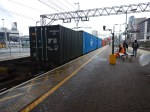

Note.
- I was surprised to see the locomotives working as a pair.
- Was it an experiment, testing or driver training?
- The locomotives were still in the Greater Anglian white livery.
- They still had their names.
I was a bit slow to get my camera out.
Silicon Roundabout – 18th January 2021
I took these pictures in two sets on buses as they navigated the roundabout after the North-East corner was opened and the North-West corner was closed at the weekend.
On A 21 Bus Going South To North




Note.
- I was on the lower deck.
- It was about ten in the morning.
- The bus went to the East side of the station.
The bus was just a big red taxi.
On A 243 Bus Going West












Note.
- I was on the upper deck.
- It was about two in the afternoon.
- The bus went to the South side of the station.
The bus was just another big red taxi.
On Foot




Note.
- You can’t turn right out of Mallow Street.
- The contractors had already started to dig up the North-West corner.
- The traffic seemed to be running reasonably freely.
The whole project is supposed to be completed in Autumn 2022.
This map from Transport for London shows the future layout.
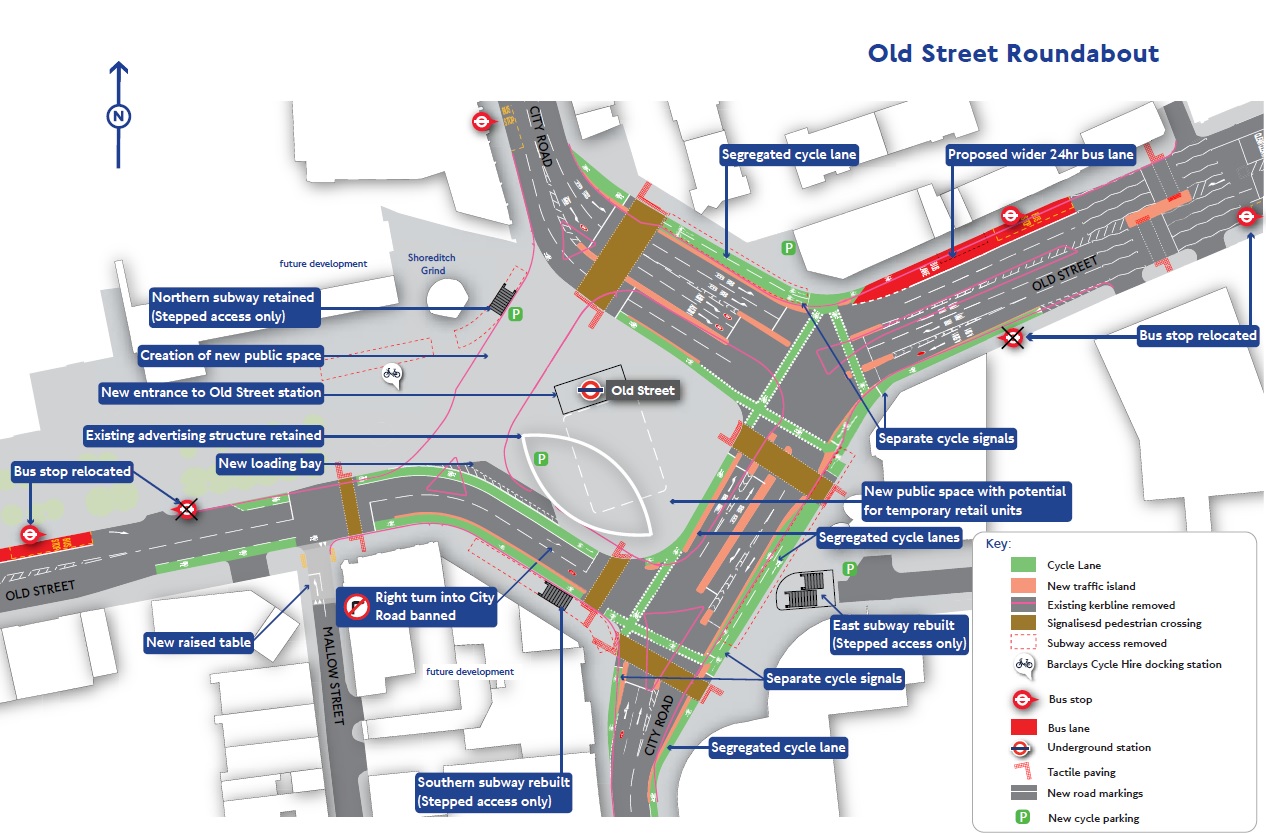
The current status of the four sides of the roundabout are.
- North-East – In Use – Two-way
- North-West – Closed
- South-West – In Use – Two-way
- South-East – In Use – Two-way
Note.
- At least the South-East side is substantially finished, with more space for vehicles.
- The South-West entrance to the station is still open for passengers.
The new road layout appears to be finished. Although, there is still a lot of pavements and road surfacing to complete.
A Class 93 Locomotive Hauling A Train Between The Port Of Felixstowe And Wentloog
I am looking at this trip in detail, to see how a Class 93 locomotive could change this journey.
Where Is Wentloog?
Wentloog is a Rail Freight Interchange, run by Freightliner, a few miles to the East of Cardiff.
This Google Map shows the interchange.
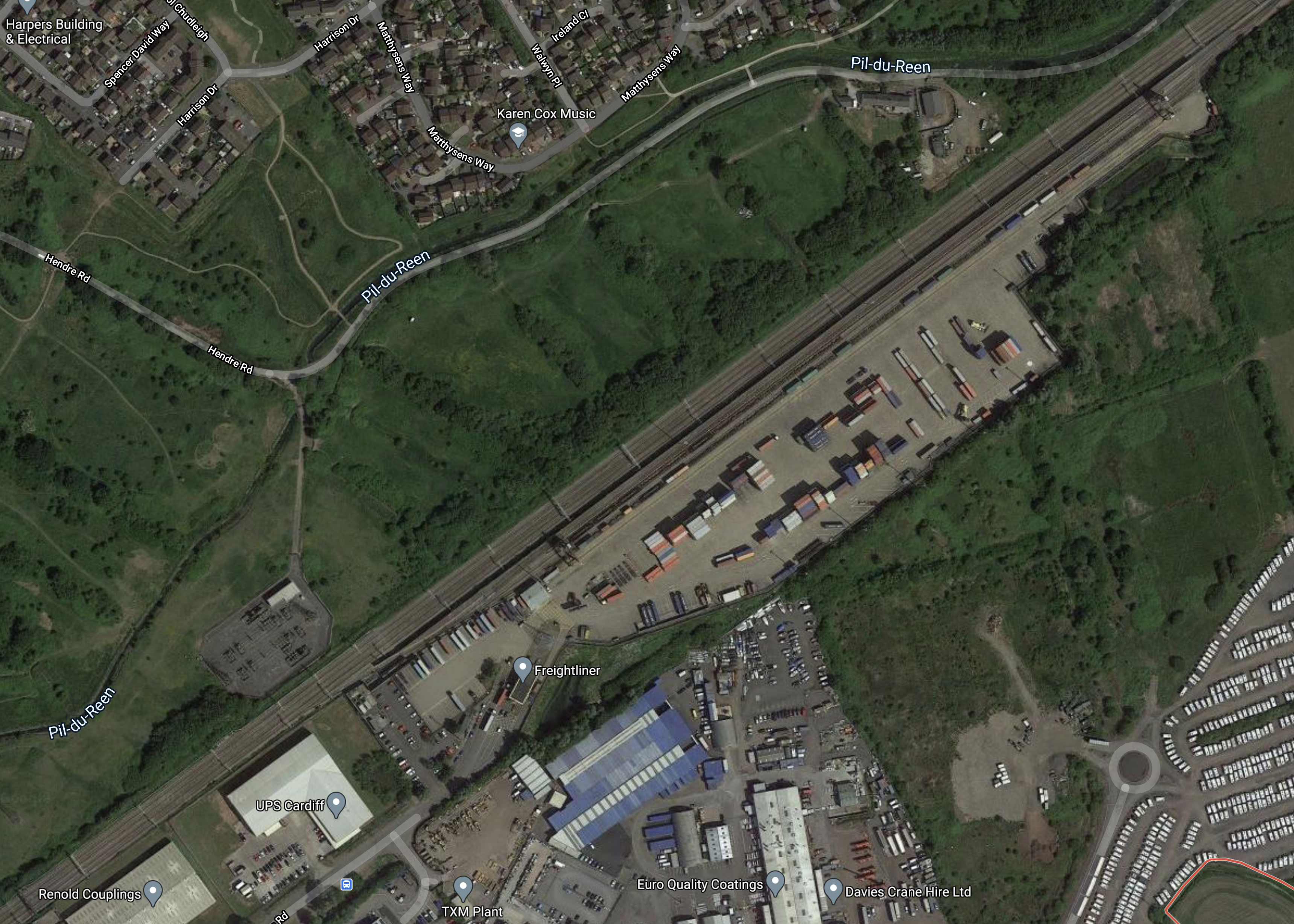
Note the electrified Great Western Main Line between London and Cardiff giving rail access to freight trains.
Sections Of The Route
The route can be divided into these sections.
- Port of Felixstowe and Trimley – 2.3 miles – 7 minutes – 19.7 mph – Not Electrified
- Trimley and Ipswich – 14 miles – 60 minutes -14 mph – Not Electrified
- Ipswich and Stratford – 64.6 miles – 77 minutes – 50.3 mph – Electrified
- Stratford and Acton Wells Junction – 12.5 miles – 72 minutes – 10.4 mph – Electrified
- Acton Wells Junction and Acton Main Line – 0.7 miles – 3 minutes -14 mph – Possibly Electrified
- Acton Main Line and Wentloog – 134.3 miles – 249 minutes -32.4 mph – Electrified
Note.
- Nearly, all the route is electrified.
- I am not sure if between Acton Wells Junction and Acton Main Line is electrified.
The journey takes nearly eight hours.
These are my thoughts on how the various sections would be handled.
Port of Felixstowe And Trimley
As I stated in Rail Access To The Port Of Felixstowe, I would electrify the short section between the Port of Felixstowe And Trimley. This would do the following.
- Charge the batteries on trains entering the Port, so they could operate in the Port without using diesel.
- Charge batteries on trains leaving the Port, so that they could have a power boost to Ipswich.
- The trains could be accelerated to operating speed using the electrification.
There would also be no use of diesel to the East of Trimley, which I’m sure the residents of Felixstowe would like.
Trimley and Ipswich
This section would be on diesel, with any energy left in the battery used to cut diesel running through Ipswich.
Ipswich And Stratford
Consider
- Ipswich and Stratford is a 100 mph fully-electrified line.
- A passenger train can do the route in an hour.
There must be savings to be made! Especially, if all trains between Ipswich and Liverpool Street are 100 mph electrically-hauled trains.
Stratford and Acton Wells Junction
The North London Line is getting increasingly busy and as it goes through the middle of residential areas, there will be increasing pressure for all trains to be electric, to cut noise and pollution.
In A North London Line With Digital Signalling, I wrote about the benefits of adding digital signalling on the North London Line.
I suspect in a few years time all freight trains using the North London Line will be electrically-hauled and will use digital ERTMS signalling, so that more trains can be squeezed onto the North London Line, so that increasing numbers of freight trains can travel between Felixstowe, London Gateway and Tilbury in the East and Birmingham, Cardiff, Liverpool, Manchester, Scotland and other destinations in the North and West.
Locomotives like the Class 93 locomotive will become an increasingly common sight on the line.
Acton Wells Junction and Acton Main Line
This connection between the North London Line and the Great Western Main Line will surely, be electrified, if it has not been done already, so that electric freight trains can go between the two routes.
Acton Main Line and Wentloog
Consider
- Acton Main Line and Wentloog is a fully-electrified line.
- The operating speed is up to 125 mph
- A passenger train can do the route in just under 100 minutes.
There must be savings to be made! Especially, if all trains between London and Cardiff are electrically-hauled trains, capable of upwards of 100 mph.
Conclusion
There would be very worthwhile time and diesel savings, by running the Felixstowe and Wentloog service using a Class 93 locomotive.
How many other services to and from Felixstowe, London Gateway and Tilbury would be improved by being hauled by a Class 93 locomotive?
I suspect, it’s not a small number, that can be counted on your fingers and toes.
Scotland Factory To Produce Valneva Covid Vaccine
The title of this post is the same as that of this article on The Times.
This is the first two paragraphs.
A French-Austrian pharmaceutical company is to start manufacturing millions of doses of what it hopes could be Britain’s fourth vaccine at a plant in Scotland.
Valneva hopes that the serum could be in use in Britain by September. The company has agreed to provide Britain with 60 million doses of its vaccine, compared with 100 million doses of the shot from Oxford University and Astrazeneca.
The vaccine is only in first and second phase trials at present, but the number of does should mean that with other vaccines, we could get everybody vaccinated by the end of the year.
Faraday Battery Challenge Funded Project “Li4UK” Announces The First Domestic Production Of Lithium Carbonate From UK Sources
The title of this post, is the same as that of this press release from Li4UK.
This is the introductory paragraph.
Li4UK (Securing a Domestic Lithium Supply Chain for the UK), the Faraday Battery Challenge-funded project under the patronage of UKRI (UK Research and Innovation), is pleased to announce that the project Consortium, comprising Wardell Armstrong International Limited (WAI), The Natural History Museum (NHM) and Cornish Lithium Ltd (CLL), has successfully produced lithium carbonate from two UK sources – one from Cornish Lithium’s Trelavour project site in Cornwall and another from Scotland. High purity lithium carbonate is a raw material for lithium-ion battery cells, such as those used in electric vehicles.
When I first heard of this project, I wrote How To Go Mining In A Museum and felt that this project deserved to succeed, given the diligence of the founder.
You never know what you will find in the dusty vaults of a museum.
A Class 93 Locomotive Hauling A 1500 Tonne Train Between The Port Of Felixstowe And Nuneaton
I am writing this post to show how I believe the new Class 93 locomotive would haul a freight train between the Port of Felixstowe and Nuneaton, where it would join the West Coast Main Line for Liverpool, Manchester mor Scotland.
Why 1500 Tonnes?
This article on Rail Engineer, which is entitled, Re-Engineering Rail Freight, gives a few more details about the operation of the Class 93 locomotives.
This is said about performance.
As a result, the 86-tonne Class 93 is capable of hauling 1,500 tonnes on non-electrified routes and 2,500 tonnes on electrified routes. With a route availability (RA) of seven, it can be used on most of the rail network.
So as I’m talking about non-electrified routes, I’ll use 1500 tonnes.
Sections Of The Route
The route can be divided into these sections.
- Port of Felixstowe and Trimley – 2.3 miles – 7 minutes – 19.7 mph – Not Electrified
- Trimley and Ipswich Europa Junction – 13.5 miles – 43 minutes -18.8 mph – Not Electrified
- Ipswich Europa Junction and Haughley Junction – 12.1 miles – 24 minutes -30.2 mph – Electrified
- Haughley Junction and Ely – 38.3 miles – 77 minutes -29.8 mph – Not Electrified
- Ely and Peterborough – 30.5 miles – 58 minutes -31.6 mph – Not Electrified
- Peterborough and Werrington Junction – 3.1 miles – 5 minutes -37.2 mph – Electrified
- Werrington Junction and Leicester – 49.1 miles – 97 minutes -30.4 mph – Not Electrified
- Leicester and Nuneaton – 18.8 miles – 27 minutes -41.8 mph – Not Electrified
Note.
- The train only averages around 40 mph on two sections.
- There is electrification at between Europa Junction and Haughley Junction, at Ely and Peterborough, that could be used to fully charge the batteries.
- In Trimode Class 93 Locomotives Ordered By Rail Operations (UK), I calculated that the 80 kWh batteries in a Class 93 locomotive hauling a 1500 tonne load can accelerate the train to 40 mph.
I can see some innovative junctions being created, where electrification starts and finishes, so that batteries are fully charged as the trains pass through.
- There must be tremendous possibilities at Ely, Haughley and Werrington to take trains smartly through the junctions and send, them on their way with full batteries.
- All have modern electrification, hopefully with a strong power supply, so how far could the electrification be continued on the lines without electrification?
- Given that the pantographs on the Class 93 locomotives, will have all the alacrity and speed to go up and down like a whore’s drawers, I’m sure there will be many places on the UK rail network to top up the batteries.
Consider going between Ely and Peterborough.
- Leaving Ely, the train will have a battery containing enough energy to get them to forty mph.
- Once rolling along at forty, the Cat would take them to the East Coast Main Line, where they would arrive with an almost flat battery.
- It would then be a case of pan up and on to Peterborough.
These are my ideas for how the various sections would be handled.
Port of Felixstowe And Trimley
As I stated in Rail Access To The Port Of Felixstowe, I would electrify the short section between the Port of Felixstowe And Trimley. This would do the following.
- Charge the batteries on trains entering the Port, so they could operate in the Port without using diesel.
- Charge batteries on trains leaving the Port, so that they could have a power boost to Ipswich.
- The trains could be accelerated to operating speed using the electrification.
There would also be no use of diesel to the East of Trimley, which I’m sure the residents of Felixstowe would like.
Trimley and Ipswich Europa Junction
This section would be on diesel, with any energy left in the battery used to cut diesel running through Ipswich.
Ipswich Europa Junction and Haughley Junction
Consider.
- This is a 100 mph line.
- It is fully-electrified.
- All the passenger trains will be running at this speed.
If the freight ran at that speed, up to 17 minutes could be saved.
Haughley Junction And Ely
This section would be diesel hauled, with help from the batteries, which could be fully charged when entering the section.
There are also plans to improve Haughley Junction, which I wrote about in Haughley Junction Improvements.
One possibility would be to extend the electrification from Haughley Junction a few miles to the West, to cut down diesel use in both Greater Anglia’s Class 755 trains and any freight trains hauled by Class 93 locomotives.
As there are plans for an A14 Parkway station at Chippenham Junction, which is 25 miles to the West of Haughley Junction, it might be sensible to electrify around Chippenham Junction.
Ely and Peterborough
This section would be diesel hauled, with help from the batteries, which could be fully charged when entering the section.
It should also be noted that the tracks at Ely are to be remodelled.
- Would it not be sensible to have sufficient electrification at the station, so that a Class 93 locomotive leaves the area with full batteries?
- Acceleration to operating speed would be on battery power, thus further reducing diesel use.
It probably wouldn’t be the most difficult of projects at Peterborough to electrify between Peterborough East Junction and Werrington Junction on the Stamford Lines used by the freight trains.
On the other hand, I strongly believe that the route between Ely and Peterborough should be an early electrification project.
- It would give a second electrified route between London and Peterborough, which could be a valuable diversion route.
- It would allow bi-mode trains to work easier to and from Peterborough.
- It would be a great help to Class 93 locomotives hauling freight out of Felixstowe.
As the Ely-Peterborough Line has a 75 mph operating speed, it would Class 73 locomotive-hauled freights would save around thirty ,inutes.
Peterborough and Werrington Junction
This section looks to be being electrified during the building of the Werrington Dive Under.
Werrington Junction and Leicester
This section would be diesel hauled, with help from the batteries, which could be fully charged when entering the section.
Leicester and Nuneaton
This section would be diesel hauled, with help from the batteries,
As there is full electrification at Nuneaton, this electrification could be extended for a few miles towards Leicester.
Conclusion
This has only been a rough analysis, but it does show that Class 93 locomotives can offer advantages in running freight trains between Felixstowe and Nuneaton.
But selective lengths of electrification would bring time and diesel savings.
 The Anonymous Widower