High Speed Rail Link To Lift Baltic Economies By Up To 0.6 Per Cent
The title of this post, is the same as that of this article on Emerging Europe.
This is the first two paragraphs.
A major new report from Swedbank, a Nordic-Baltic banking group based in Stockholm, Sweden, claims that the construction of a high speed rail link between the Estonian capital Tallinn and Lithuania’s border with Poland could lift GDP in each of the three Baltic states by between 0.2 and 0.6 per cent.
In addition to the direct economic impact in terms of public investment and jobs, the ambitious project will also help the region meet its environmental goals and bring in new technology and know-how.
The article is a must-read and has left me thinking, what will High Speed Two do for the UK?
Meet The Futuristic-Looking Electric Arrival Bus
The title of this post, is the same as that of this article on Microsoft News.
The Arrival Bus is by the same company, who are building electric vans for UPS, that I wrote about in UK Electric Van Maker Arrival Secures £340m Order From UPS.
This is a video of the prototype under test.
This article on CNET is entitled Arrival’s Electric Bus Is Designed For Coronavirus-Era Social Distancing and it contains this paragraph.
The British startup company, which focuses on smart electric vehicles, on Wednesday debuted the Arrival Bus, pitched as just the bus for social distancing. That’s because the interior of the bus is customizable, with removable seats, so you can create additional space between passengers. It’s a pretty novel way to increase or decrease seats to meet reopening guidelines
If it works, knowing Sod’s Law, it will probably be rarely used, as someone will come up with an affordable vaccine, that’s bulletproof!
As we’ve also had an electric bus from Norfolk, that I wrote about in Equipmake Opens New Electric Bus Factory In Snetterton, there will be several players helping to decarbonise the bus industry.
£350m Investment For Britain’s First Mainline Digital Railway
The title of this post, is the same as that of this article on Rail Technology Magazine.
This is the introductory paragraph.
The East Coast Main Line will become Britain’s first mainline digital rail link with £350m of new investment to install state-of-the-art electronic signalling designed to cut journey times and prevent delays.
We’re finally going digital!
The Route Of High Speed Two Into Birmingham
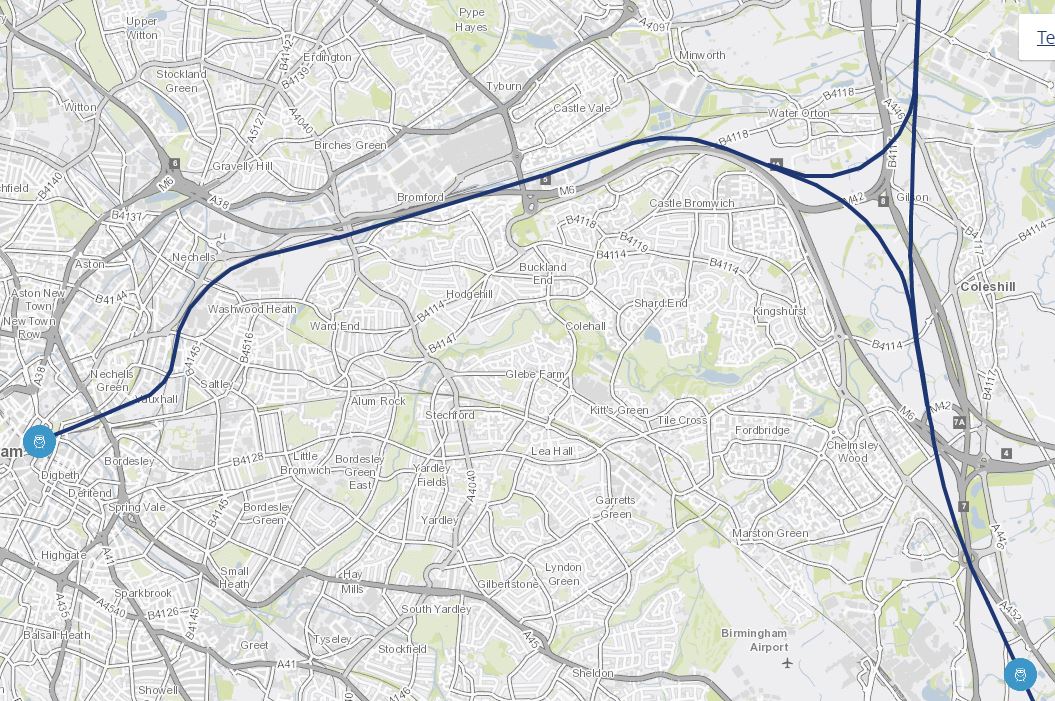
This map clipped from the High Speed Two web site, shows the route of the line to its terminus in Birmingham Curzon Street station.
Note.
- Birmingham Curzon Street station is indicated by the blue dot in the West.
- Interchange station is indicated by the blue dot in the South-East corner of the map.
- There is a large triangular junction connecting the spur to Birmingham Curzon Street to the main North-South route of High Speed Two.
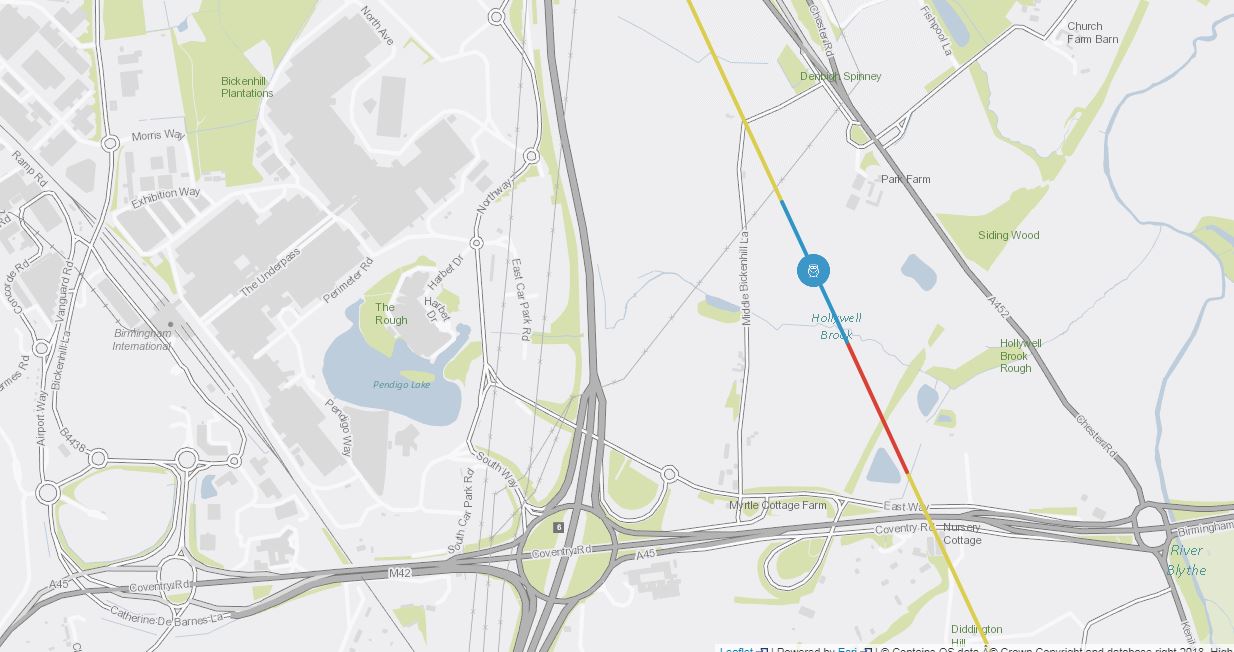
This second map is an enlargement of the South-East corner of the map.
Note.
- The road across the bottom of the map is the A45,
- The large circular roundabout roughly at the halfway [point is where the M42 crosses the A45 at Junction 6.
- The Junction at the Eastern edge of the map is where the A452 crosses the A45.
- High Speed Two goes roughly North-South between the M42 and the A452.
- When shown in red, High Speed Two is on an embankment.
- When shown in yellow, High Speed Two is in a tunnel.
- The large blue dot is the position of the Interchange station.
- The existing Birmingham International station is on the other side of the M42.
- The two stations will be connected by a people mover.
This description of the Interchange station is from this page on the High Speed Two web site.
The Interchange Station itself will be made up of two 415 metre long island platforms, offering 4 platform faces, as well as 2 central high speed through lines for non-stopping services. The station will be linked to the NEC, Birmingham International Station and Birmingham Airport via an automated people mover carrying up to 2,100 passengers per hour in each direction. In addition to the APM, the station will be fully integrated with other local buses, taxis and private vehicle options.
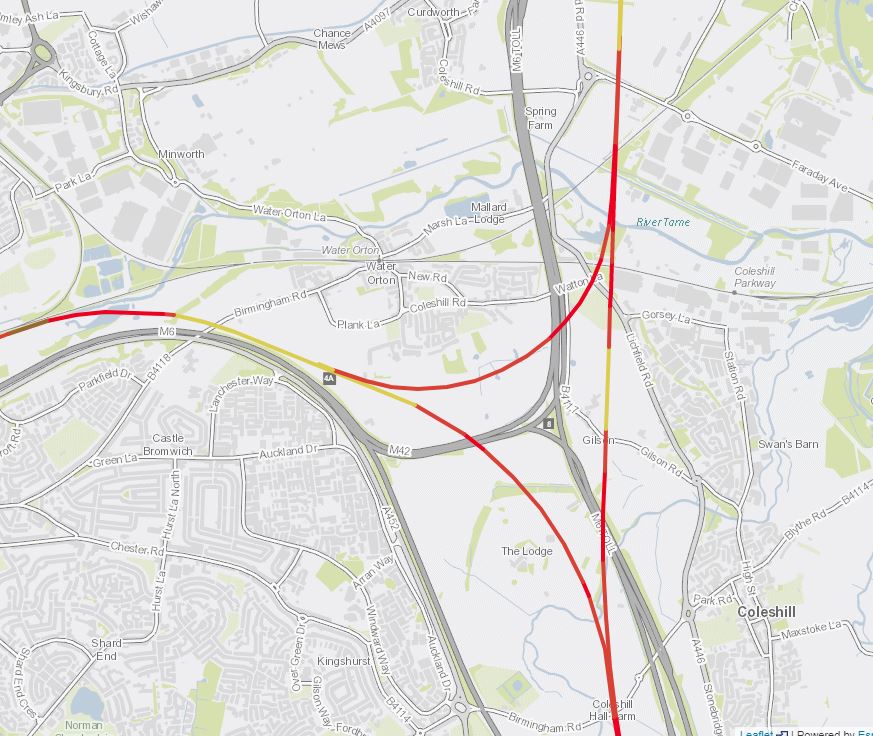
This third map is an enlargement of the triangular junction.
Note.
- The M6 going West to Spaghetti Junction, Birmingham and the North.
- The M42 and the M6 Toll going North-South.
- When shown in red, High Speed Two is on an embankment.
- When shown in yellow, High Speed Two is in a tunnel.
The junction seems to have been fitted around the motorways using a series of embankments and tunnels.
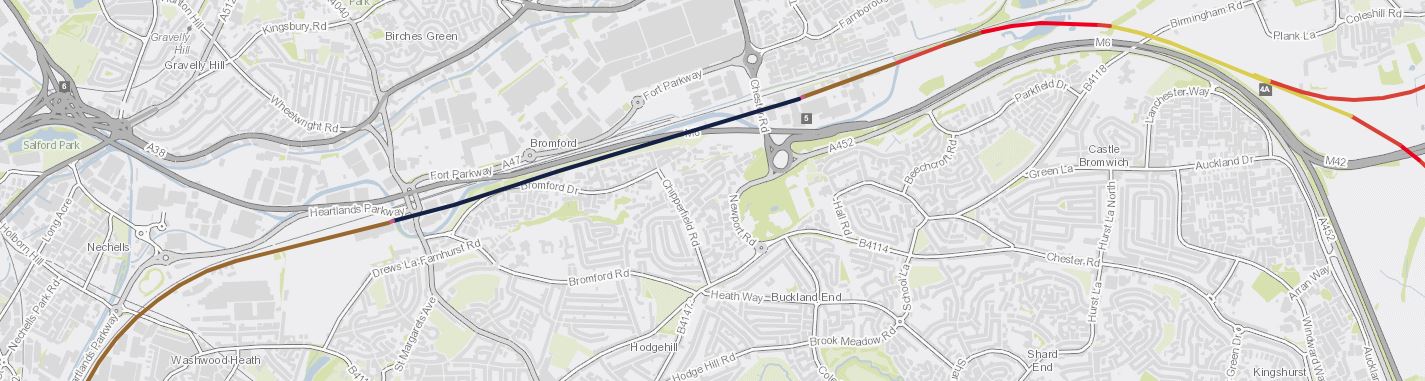
This fourth map shows the approach to the City.
Note.
- The spur appears to run alongside the elevated section of the M6.
- Spaghetti Junction is in the North-West corner of the map.
- The Western junction of the triangular junction is at the Eastern edge of the map.
- When shown in brown, High Speed Two is on the surface.
- When shown in black, High Speed Two is in a cutting.
- Or are black and brown, the other way round, as I can’t find the legend for the map.
The spur seems to have been neatly fitted in alongside the M6.
This fifth map shows the route as it terminates in Birmingham Curzon Street station.

Note.
- The A38 (M) that connects the City Centre to Spaghetti Junction at the top of the map.
- High Speed Two appears to approach the City Centre on a viaduct. But then trains between London and Birmingham New Street and Birmingham Moor Street stations, do the same.
- The three stations are within a reasonable walking distance and there will also be a tram connection.
- The journey time between Birmingham Curzon Street and Interchange stations is planned to be nine minutes.
This page on the High Speed Two web site, gives more details on Birmingham Curzon Street station.
Coronavirus: Over 600 People Test Positive At German Slaughterhouse
The title of this post, is the same as that of this article on DW News.
This is the introductory paragraph.
Yet another German slaughterhouse has registered a massive outbreak of the coronavirus. Roughly two-thirds of the test results so far have come back positive.
Does the author think this is a recurring problem?
There is a sub-heading in the article of By No Means An Isolated Case, where this is said.
Germany’s meat processing sector has come under increasing scrutiny during the pandemic, with several plants reporting massive outbreaks. The sector is plagued with poor working conditions, exploitative contracts and usurious rents in mass housing for eastern European workers.
The company is blaming Bulgarian and Romanian workers going home for the long weekend.
The next paragraph, would appear to debunk that theory.
According to the European Center for Disease Prevention and Control, Germany has had far more confirmed cases of coronavirus than either Romania or Bulgaria. In the past 14 days, Germany registered 4,814 new cases, compared to 2,898 in Romania and 915 in Bulgaria.
By comparison, we have had 14,932 lab-confirmed cases in the last fourteen days.
The article says that this slaughterhouse is in Gutersloh and from a picture in the article, the slaughterhouse seems to process pigs.
Out of curiosity, I looked up the Wikipedia entry for Gutersloh.
It looks to be a typical German town of 100,000 people, but it does have one unusual feature according to Wikipedia; ten percent of the population are Arameans.
I have found these facts on Wikipedia.
- The total number of Arameans in Germany is between 100,000 and 120.000. See Arameans
- There has been a long history of Turkish people migrating to Germany. See Turks In Germany
- The number of Turks in Germany is 2,774,000, making them the largest minority. See Demographics of Germany
- Many of the Turks were brought to Germany in the 1970s to do the jobs the Germans didn’t want to do and to solve a labour crisis, after the building of the Berlin Wall. See Turks In Germany
Turks are Muslim and the Germans produce a lot of pork. So do Turks work in German slaughterhouses handling pork and making sausages?
If they don’t, does this explain the large number of Arameans in Gutersloh? Arameans are Christians and unlike Muslims and Jews, eat pork.
Their diet also contains alcohol and appears to be gluten-rich!
I’d love to have German statistics of COVID-19 by ethnicity!
Honeywell Launches Lightweight Cooling System For Electric Aircraft
The title of this post is the same as that of this article on Flight Global.
This is the introductory paragraph.
Honeywell Aerospace has unveiled a lightweight, low-maintenance cooling system for developers of urban air mobility (UAM) and electric aircraft, and has named the Eviation Alice as launch platform for the energy-efficient feature.
I particularly like the comment of Eviation’s founder Omer Bay-Yohay’s comment of “Every ounce counts!”.
But although weight is important in an electric aircraft, like the Eviation Alice, it is also important in other forms of transport from a family runabout to a high-speed train. Especially, if the vehicle is powered by batteries.
It should also be noted, that Honeywell are setting up a specialist business unit to provide equipment for and help the builders of electric aircraft.
Conclusion
Other companies will follow Honeywell’s lead and produce lightweight equipment for the automotive and rail industries.
Green Light For Revived West Midlands Passenger Service
The title of this post, is the same as that of this article on Rail News.
This is the introductory paragraph.
Passenger trains are set to return to the line between Walsall and Wolverhampton, having been withdrawn 12 years ago. Since then, the line has been used for freight.
These points are made about the proposed service.
- Network Rail have agreed the timetable.
- It will be an hourly service between Walsall and Wolverhampton.
- Trains will call at Darlaston and Willenhall, where plans are in place for new stations, as I wrote in Reopening Of Darlaston And Willenhall Train Stations Moves Closer.
- There will also be a second hourly service between Birmingham New Street and Wolverhampton via Tame Bridge, Darlaston and Willenhall.
- Both routes appear to be electrified.
The West Midlands Mayor; Andy Street is quoted as saying he’s pleased with the scheme.
And well might he be!
This to me is a classic reopening scheme.
- There is a fully-electrified freight route, that runs between Walsall and Wolverhampton.
- There used to be three intermediate stations; Darlaston James Bridge, Willenhall Bilston Lane and Portobello.
- The first two intermediate stations closed in 1965 and the last in 1973.
- Network Rail have said, it will be possible to run the extra trains needed.
- The direct Walsall and Wolverhampton service will complete an hourly or better triangular service between Birmingham, Walsall and Wolverhampton.
- This triangular route is also fully-electrified.
- If extra rolling stock is needed, there are quite a few suitable electric multiple units, that are sitting in sidings or will be replaced by new trains in the next couple of years.
Except for the building of the new intermediate stations, nothing would appear to be high cost.
The project must have a high benefit cost ratio.
A Possible Extension From From Walsall To Aldridge
In the Wikipedia entry for Walsall station, this is said.
There are also plans to reopen a terminus single platform at Aldridge for trains to Birmingham New Street via Walsall but not to Sutton Coldfield and Water Orton.
This service would be on part of the freight-only Sutton Park Line between Walsall and Water Orton stations and is regularly used by freight trains avoiding Birmingham New Street station.
This Google Map shows the Sutton Park Line through Aldridge.
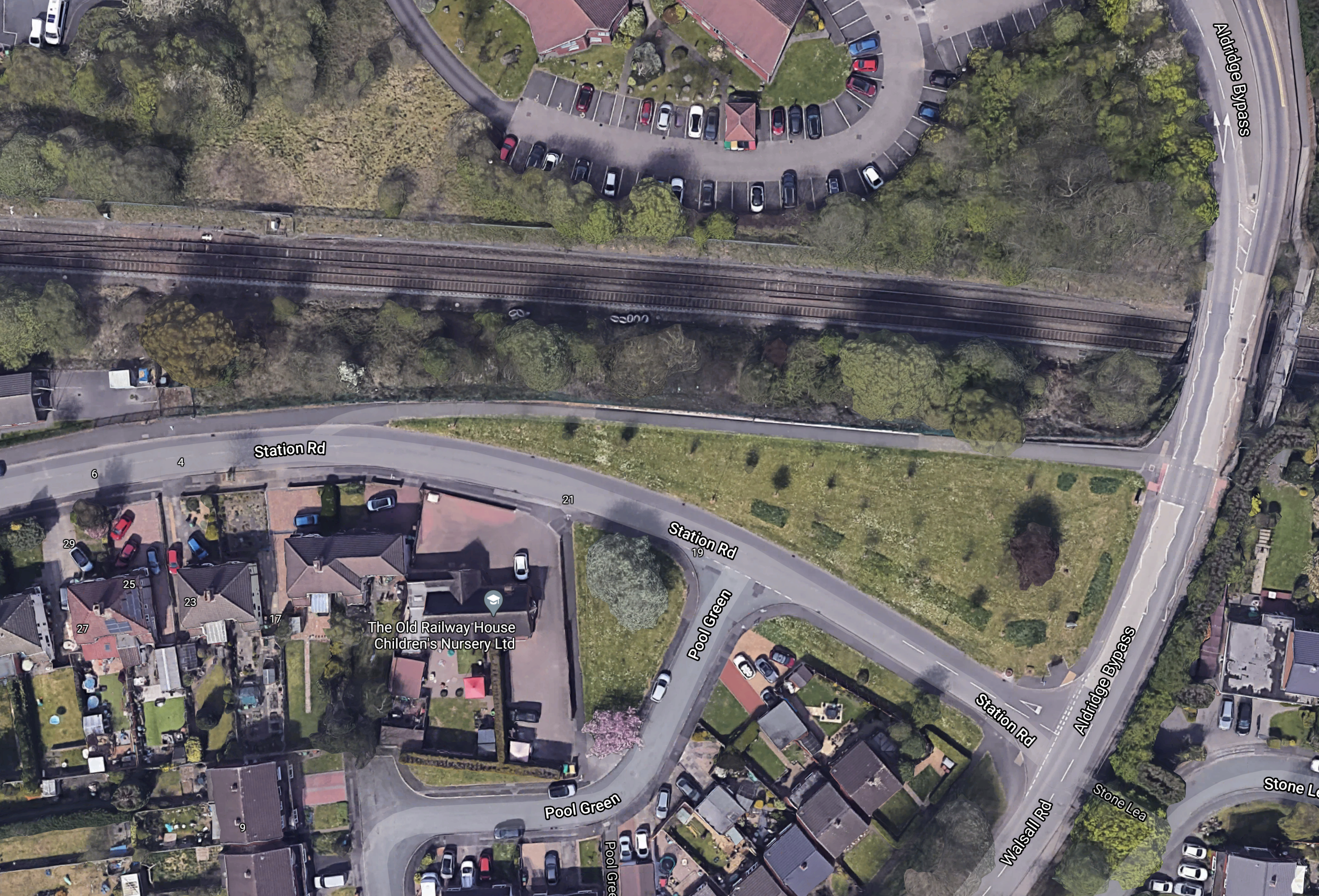
Note.
- The Sutton Park Line is double track and not electrified.
- The road running South of the railway is called Station Road, which is a bit of a giveaway.
- There is a xrossover visible in the image,
There would appear to be space for a reopened station. between the railway and Station Road.
- It could have a single platform.
- There could be adequate car parking.
- There would be no need for an expensive bridge.
- The station could be designed to be converted into a two-platform station if a full service were to be run on the Sutton Park Line at a future date.
As the station would be no more than about five miles from Walsall station and its electrification, the extended service from Walsall could be run by a battery-electric train.
Conclusion
I predict, that if this route is reopened and it is a success, other parts of the UK will want to open more freight lines to passenger traffic.
These similar projects have already been widely mentioned.
- The Leamside Line between Ferryhill and Newcastle stations. See Boris Johnson Backs Station Opening Which Could See Metro Link To County Durham.
- The Ivanhoe Line between Burton-on-Trent and Leicester stations. See Reinstatement Of The Ivanhoe Line.
- Newcastle And Ashington. See Northumberland Unveils £3.5m Rail Project To Bring Back Passenger Services.
- The Camp Hill Line In Birmingham. See First Passenger Train In 80 Years Runs On Camp Hill Line.
- The Barrow Hill Line Between Sheffield and Chesterfield. See Reinstatement Of The Barrow Hill Line Between Sheffield And Chesterfield.
- The Fawley Line Between Totton And Fawley. See Reintroduction Of Passenger Rail Services On The Waterside Line.
Most of these reopening, would just need refurbishment and some new stations.
Hydrogen Freight Trains And Anti-Slip Technology For UK Railways Get Share Of £9.4m Funding
The title of this post is the same as that of this article on Professional Engineering, which is published by the Institute of Mechanical Engineers.
This is the introductory summary.
A zero-emissions machine that removes and replaces rails, a hydrogen-based turbine system for freight trains and ‘cryogenic blasting’ to prevent wheel slip could all be coming to UK railways thanks to a new £9.4m fund.
The article is a good summary of the important projects and it also gives details of what a project in the last round of funding achieved.
I seem increasingly to be reposting articles from professional engineering institutions. Does this mean, that we’re all thinking that good engineering, is one of the ways out of this COVID-19 mess?
I also think, that if I look at the list of twenty-five new projects, that I listed in First Of A Kind Funding Awarded For 25 Rail Innovation Projects, that some will benefit the wider UK population in a world dominated by the remains of the COVID-19 pandemic.
Solar Firm To Develop Novel Electronics For Rail Renewables
The title of this post is the same as that of this article on Engineering and Technology.
This is the introductory paragraph.
Solar energy company Riding Sunbeams has won funding to develop power electronics technology that will enable it to feed renewable electricity directly into railway overhead wires.
Because solar panels and lithium-ion batteries work in DC and overhead electrification works in AC, this sentence describes the main objective of the project.
The Daybreak demonstrator will repurpose existing technology already being used on UK rail networks for other purposes to create a new device that will provide the required power conversion.
Existing technology and equipment will be used to save time and costs and because it is already rail-certified.
The rest of the article fleshes out a few details.
The test system will be installed at Quinton Rail Technology Centre at Long Marston.
This is the closing paragraph.
In particular, Riding Sunbeams hopes its technology will be able to play a part in delivering 70MW of direct-wire renewable generation to help power the soon-to-be-electrified Core Valley Lines in South Wales through a mixture of solar, wind and energy storage.
As electrification in the Core Valley Lines will be discontinuous, it could appear that the technology developed in this project could help connect and reduce costs.
 The Anonymous Widower