Restoring Your Railway Fund
The title of this post, is the same as that of this document on the Government web site.
A section gives the list of the first ten individual projects, that are being backed by the fund.
- Reopening Meir Railway Station Between Stoke-On-Trent And North Staffordshire
- Reinstatement Of The Barrow Hill Line Between Sheffield And Chesterfield
- Reinstatement Of The Ivanhoe Line
- Reinstatement Of Branch Lines On The Isle Of Wight
- Reinstatement Of The Abbey Line Between St Albans Abbey And Watford Junction
- Reopening Of Wellington and Cullompton Stations
- Reinstatement Of The Bury-Heywood-Rochdale Lines
- Reinstatement Of The Clitheroe To Hellifield Railway Line
- Reinstatement Of Rail Access To Devizes Via A New Station At Lydeway
- Reintroduction Of Passenger Rail Services On The Waterside Line
These are a few general thoughts.
Decarbonisation and Climate Change
The Government document does mention decarbonisation or climate-change.
But the Government is committed to be carbon-neutral by 2050, so in my analysis, I will take that into account.
Vivarail
These projects could use versions of Vivarail’s Class 230 trains.
- Reinstatement Of Branch Lines On The Isle Of Wight
- Reinstatement Of The Bury-Heywood-Rochdale Lines
They must be doing something right.
300th Coradia Polyvalent Train Delivered By Alstom
The title of this post is the same as rgar of this article on Rail Advent.
The Polyvalent is a variety of the Alston Coradia, that was first ordered for France.
This is the description of the train in Wikipedia.
As of 2018, the Coradia Polyvalent is the latest variant in the Coradia family. It can operated at a maximum speed of 160 km/h in electric or bi-mode at voltages of 25 kV and 1,500 kV; a cross-border version capable of operating at a voltage of 15 kV, suitable for the German and Swiss rail networks, has also been made available. The low integrated floor of the carriages provides improved accessibility and a high level of visibility to passengers. As a measure to restrict vibrations and noise levels, motorised bogies are placed at both ends of each carriage.
The Rail Advent article adds this.
In response to the hydrogen plan by the French Minister, Alstom is now looking to incorporate a dual-mode hydrogen version of the Coradia Polyvalent range.
I would assume, this means an electric train, that can use hydrogen power, when the electrification stops.
This is how a hydrogen train should work and from reports, it appears the Alstom Breeze based on a rebuilt Class 321 train, will work like this.
The Alstom Coradia iLint may have proved the concept of hydrogen power, but compared to other hydrogen and battery powered buses and trains, I’ve ridden, it scores poorly in terms of noise, vibration and harshness.
Reinstatement Of Rail Access To Devizes Via A New Station At Lydeway
This is one of the successful bids in the First Round of the Restoring Your Railway Fund.
Devizes is a growing town without a railway station.
The Wikipedia entry for the former Devizes station, says this about providing a new station.
Although Devizes was denied a railway station due to its stagnant population, as of 2017 the population had grown to 31,000, which could warrant its re-establishment. However, much of the vital land agreements and rights of way were sold off reducing the chances of reinstatement. An alternative plan has been proposed: to build Devizes Parkway Station at Clock Inn Park, three miles east of Devizes on the Reading–Taunton line, near to the site of the original junction for the branch at Etchilhampton.
It appears to have been taken from Baldrick’s book of cunning plans, where you create a virtual branch line using the A342, travellers’ personal transport and a shuttle bus service.
This Google Map shows the position of the station site at Clock Inn Park, with relation to Devizes.
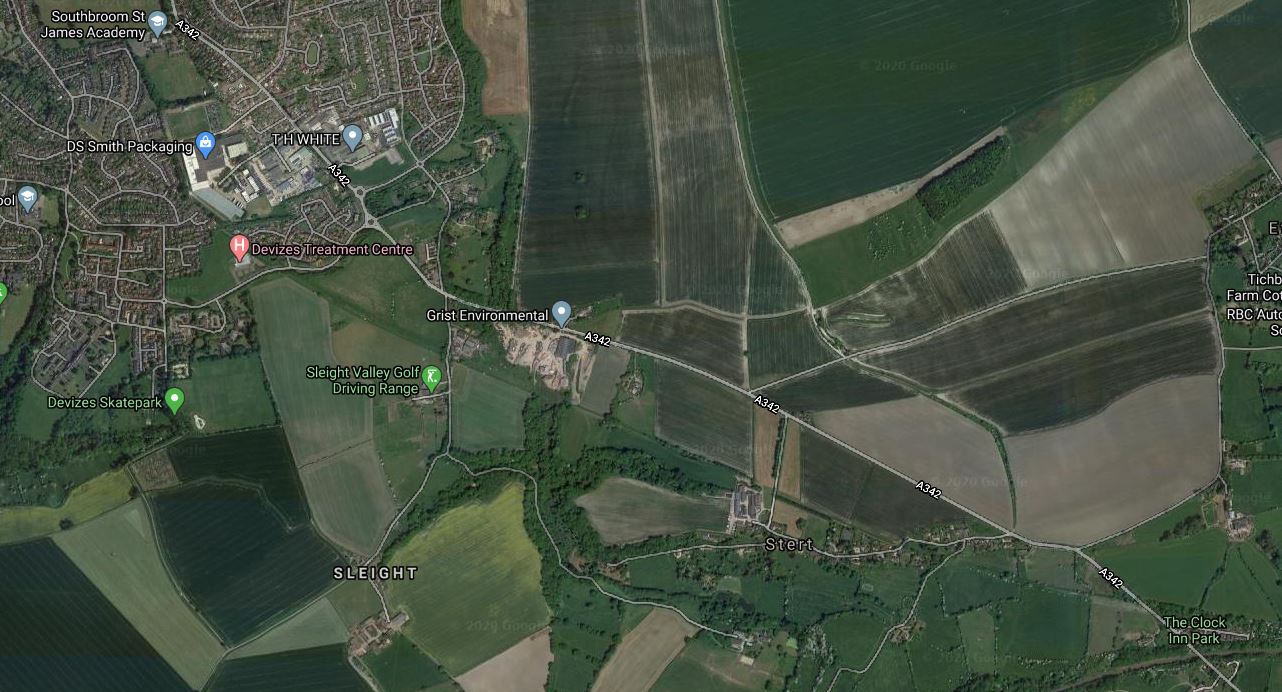
Note.
- Devizes in the North-West corner of the map.
- Clock Inn Park in the South-East corner of the map.
- The A342 road connecting the town with the station site.
This more detailed Google Map shows the station site.
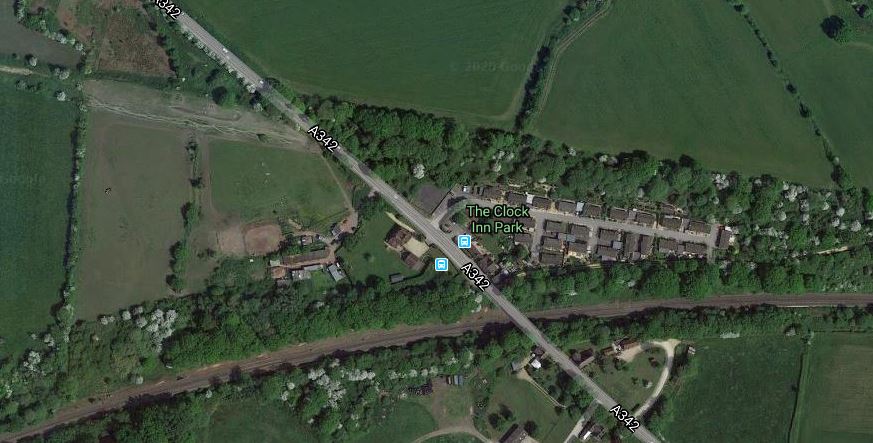
Note.
- The A342 going diagonally across the map.
- The Reading-Taunton Line going across the map.
- There’s even bus stops by the station site.
As the site could be fairly generous, I think a station with adequate parking could be created.
The Train Service
The train service is currently two hourly on this route between Paddington and Exeter St. David’s stations.
Perhaps, with an extra stop and more passengers, the service could be increased to hourly.
Another alternative would be to run battery-electric trains on the route between Paddington and Westbury, that called at all stations West of Newbury.
- Trains would use the electrification between Paddington and Newbury and would leave Newbury with a full battery.
- This service would be an extension of the current hourly service to Bedwyn station.
- Between Newbury and Westbury stations is forty-two miles of unelectrified lines, which should be possible with a battery electric version of the Class 802 train.
- Charging facilities would be needed at Westbury station.
- Between Paddington and Westbury stations takes one hour and thirteen minutes.
- Hitachi are quoting a ten minute charge time for one of their battery-electric trains.
- The trains would turn at Westbury station, which has refreshments and toilets for the crew.
- No extra electrification would be needed to run electric services to Westbury.
I think it could be feasible.
The Concept Of An Electrification Island
Westbury could be what I would call an electrification island.
Consider
- The Reading-Taunton Line passes through the station.
- The Wessex Main Line both passes through the station.
- The town of Westbury has a population of around 17,000 and some substantial heavy industries, so I suspect that it has a robust electricity supply.
- Taunton is 47 miles away.
- Newbury is 42 miles away.
- Weymouth is 59 miles away.
- Bristol Temple Meads is 40 miles away.
- Swindon is 32 miles away.
- Hitachi are claiming a range of between 55 and 65 miles for a battery-electric train.
Suppose the two routes through the station and perhaps for up to ten miles away from the town, were to be electrified.
- A battery-electric train turning back at Westbury would pan-up in the station and charge the battery. Leaving the station, the driver would leave the pantograph up for acceleration and then make sure pan-down was performed before the end of the electrification.
- A through battery-electric express between Paddington and Exeter would pan-up when under the electrification and pan down before it left the electrification.
- It might be prudent that all passing expresses stopped in Westbury station, to make sure, trains didn’t stop with a flat battery in the middle of nowhere, until procedures were seen to be totally reliable.
- A battery-electric train to and from Weymouth would probably need to run for about 45 miles between the electrification island at Westbury and the third-rail electrification at Dorchester Junction.
I believe that a well-designed electrification island at Westbury coupled with perhaps electrification between Exeter and Taunton, would enable battery-electric trains to work the following routes.
- Paddington and Exeter
- Westbury and Bristol
- Westbury and Weymouth
- Westbury and Swubdon
I suspect that Transwilts services could also be run by battery-electric trains, as they could charge at Westbury, Swindon and other electrified stations.
Conclusion
Devizes Parkway station would appear to be a simple way to provide a new station, at a town that has grown substantially since the days of Dr. Beeching.
Did Dr. Beeching and the Government of the day, have a view on population growth in the UK? They certainly didn’t take it into the account in their rail closure program. Or if they did, they got it spectacularly wrong!
Reopening Meir Railway Station Between Stoke-On-Trent And North Staffordshire
This is one of the successful bids in the First Round of the Restoring Your Railway Fund.
Meir station was on the Crewe-Derby Line in the area of Meir.
This Google Map shows the railway line running through the area.
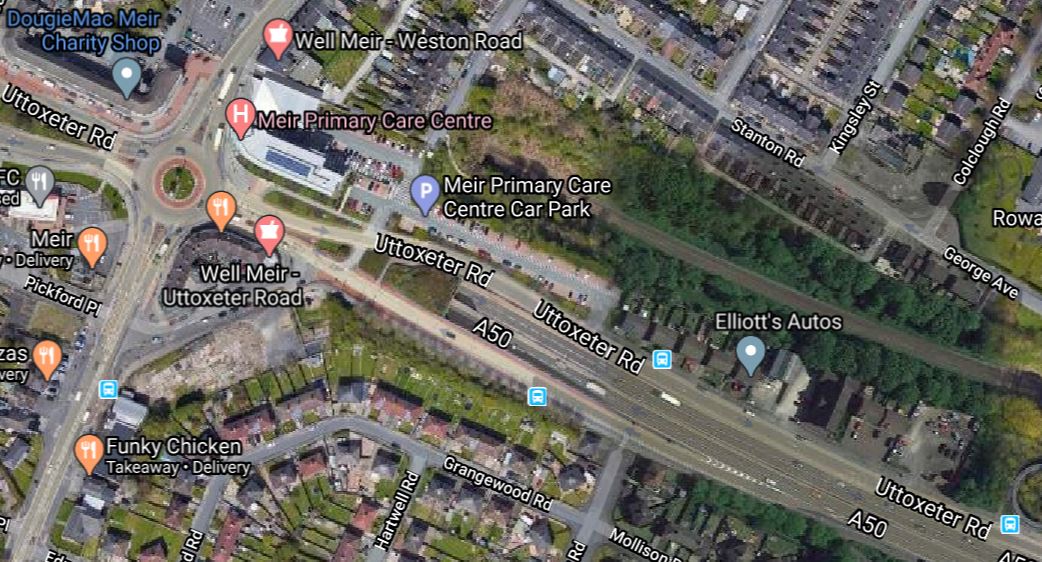
Note.
- The railway is double track and looks to be in a cutting.
- The railway runs in a 744 metre long tunnel under Meir.
- The Eastern portal of the rail tunnel is just above the label indicating the Meir Primary Care Centre Car Park.
- There is also a road tunnel taking the A50 under the roundabout.
The original station was to the East of the tunnel portal.
If you look at this area in higher definition on Google Maps, it looks like space is at a premium and the Primary Care Centre has a parking problem.
I wonder, if the tentative plans for reopening, incorporate innovative ideas to improve the car parking and extend the Primary Care Centre.
The Train Service
These are my thoughts on the train service.
- Currently, the service is an hourly train in both directions and it is run by elderly diesel multiple units.
- The trains will be replaced by more modern Class 170 trains in the near future.
- These faster trains may be able to double the service frequency.
I estimate, the service will take about nine minutes to and from Stoke.
Link To High Speed Two
Stoke will have an hourly high speed service between London and Manchester, when High Speed Two opens. If the high speed and local services connected ay Stoke-on-Trent station, that could be very convenient.
Electric Trains Between Derby And Crewe
The Crewe-Derby Line is not fully-electrified, but the Northern section between Crewe and Stoke is electrified to give more flexibility to trains on the West Coast Main Line, when there is engineering work or other problems.
If a new station is being built at Meir, it would be likely that, the following works will be done at the same time.
- Meir station will be made electrification ready.
- The nearby Meir tunnel will be given a full service and made electrification ready.
Could the electrification be extended to Meir or even Blythe Bridge stations?
Consider.
- The distance between Crewe and Derby is fifty miles.
- Between Crewe and Stoke is fully-electrified and the two stations are fifteen miles apart.
- Extending the electrification to Blythe Bridge station would increase the electrified part of the line to twenty miles.
- Derby station was recently upgraded with extra platforms and other goodies.
- Was Derby station prepared for electrification? If so, charging for battery trains could be installed!
- Hitachi have stated that battery-electric versions of their AT-300 trains will have a range of 55-65 miles on battery power and can be charged in ten minutes.
- Both Avanti West Coast and East Midlands Railway will have trains that could be fitted with batteries
There must come a point, where a battery-electric train could work these services on the Crewe-Derby Line.
- Manchester Piccadilly and Derby via Uttoxeter, Stoke, Crewe and Manchester Airport.
- London St. Pancras and Stoke via Derby and Uttoxeter.
It would also open up valuable diversion routes.
Conclusion
I think this station reopening, has the potential to be very worthwhile.
It does appear to me, that this could be a very convenient project for Network Rail to do some other projects, whilst the new station is built.
Class 88 Locomotive Heads On To The East Coast Main Line
The title of this post, is the same as that of this article on Rail Advent.
This is the first three paragraphs.
Direct Rail Services has confirmed that one of its Class 88 broke new ground last week when it ran the length of the East Coast Main Line.
Last weekend, freight operator, DRS, ran a new diversionary route to enable the Class 88 locomotives to run almost the length of the ECML on electric power, as well as feeder routes that link up Daventry and Mossend.
The route normally follows the West Coast Main Line, but engineering work last weekend required a diversion.
That makes a second Class 88 locomotive story, where the locomotives are serving new routes, after ’88’ Makes Sizewell Debut.
Could it be that with new electrification coming on stream and more being planned, Direct Rail Services are researching what these locomotives can do?
The Route
As the Rail Advent article says, the route is electric all the way from Mossend to Daventry.
Mossend to Edinburgh via the Shotts Line.
- Edinburgh to Stevenage via the East Coast Main Line.
- Stevenage to Alexandra Palace via the Hertford Loop Line.
- Alexandra Palace to Camden Road Central Junction via the East Coast Main Line.
- Xamden Road Central Junction to Camden Junction via the North London Line.
- Camden Junction to Daventry via the West Coast Main Line.
But it does go round the houses!
Note.
- The journey took fifteen hours and it arrived about two-and-a-half hours late.
- Edinburgh to Stevenage was timed to take seven hours, whereas passengers can do that journey in four-and-a half hours with a change.
With some strategic electrification would the train be able to cut across from the East Coast Main Line to reach Daventry?
The Future Of Direct Rail Services
Direct Rail Services have a mixed fleet of locomotives.
- 23 x Class 37 diesel locomotives, which were built in the 1960s.
- 21 x Class 57 diesel locomotives, which were built in the 1960s.
- 19 x Class 66 diesel locomotives
- 34 x Class 68 diesel locomotives
- 10 x Class 88 electro-diesel locomotives
Only the last two types are modern locomotives, that are capable of hauling trains at 100 mph.
The Wikipedia entry also says this.
In September 2017, Direct Rail Services issued a tender for ten brand new diesel-electric locomotives.
Consider.
- As Government policy is a zero-carbon UK by 2050, is that likely to change the tender to electro-diesel locomotives?
- Direct Rail Services is owned by the Government,
- The order from Rail Operations Group for Class 93 locomotives seems to have stalled.
- Rail Operations Group have some ambitious plans for the use of the tri-mode 110 mph Class 93 locomotives, which I wrote about in Rail Operations Group Gets Serious About Thunderbirds Etc.
- As any locomotives delivered in the next few years, will probably still be running in 2060, surely this conflicts with Government policy.
Perhaps, all three parties are working on a cunning plan to jointly order a common design.
One-Hour Covid Test Approved For Rollout
The title of this post, is the same as that of this article in The Times.
This article is more than the title as it details four testing methods, currently being rolled out.
After reading this article, I would not be surprised to see an affordable COVID-19 testing device being developed and available for non-professional use in the coming months.
Getting it right, will bring the team so much of a financial reward, they’ll make Dyson look like pauper. No wonder organisations like Cambridge University, Imperial College, big pharmaceutical companies and hedge funds are backing development.
As these tests are often about measuring the intricate properties of both human and virus DNA, I wonder how many other collateral benefits will aid diagnosis of diseases like cancer.
Oxford And Cambridge Compared On COVID-19
In Is There A Link Between Historic Coal Mining And COVID-19?, I mentioned this article in The Times, which is entitled Pressure To Free London From Lockdown As Cases Fall.
The article gives an interactive table, which is entitled Number Of Cases By Area.
Three figures are given.
- Registered cases
- Cases per 100,000 of the population.
- Cases in the last two weeks.
These figures are for areas around Oxford.
- Oxford – 615, 399, 90
- South Oxfordshire – 358, 255, 36
- West Oxfordshire – 324, 295, 50
And these figures are for areas around Cambridge
- Cambridge – 222, 177, 20
- South Cambridgeshire – 206, 131, 10
- East Cambridgeshire – 111, 124, 12
- West Suffolk – 205, 115, 18
So why are COVID-19 cases in Cambridge so much lower than Oxford?
Consider.
- Both cities and surrounding counties have a similar character.
- Both have well-respected hospitals, medical schools and medical research.
- Air pollution appears to be low in both areas.
- Both cities probably have a similar ethnic mix and large student populations.
As I used to live near Cambridge, I have my own mad personal theory.
Addenbrooke’s Hospital
I have used several hospitals in my life, but only two changed my life totally.
- I had my vasectomy in the old Hackney Hospital.
- Addenbrooke’s, who with a simple blood test decided I was probably coeliac.
So perhaps, I’m biased.
But consider these possible facts.
- My coeliac consultant at Addenbrooke’s told me, that he had more patients with the disease than any other in the UK.
- The manager at Carluccio’s in Cambridge, told me that they sold more gluten-free food, than any other restaurant in the group.
- In 1997, I was diagnosed fast, because Addenbrooke’s were using a new genetic test. I was later checked using an endoscopy.
Could it be that someone at Addenbrooke’s had decided they wanted to find all the coeliacs in and around Cambridge?
What would be the effects of diagnosing as many coeliacs as you could find in an area?
- A doctor of my acquaintance talked of coeliac disease as the many-headed hydra, as it led to so many other medical problems. So extra diagnosed coeliacs might improve health statistics in an area.
- Personally, I have said good-bye to migraines, nail-biting and lots of joint pains, after going gluten-free.
- I also haven’t had a serious dose of flu since diagnosis. Since 2005, I’ve probably had the flu jab.
- Joe West at Nottingham University, has shown that coeliacs on a gluten-free diet have lower cancer rates than the general population.
Consider.
- Immunotherapy is a medical technique, where the patient’s immune system is activated or suppressed to help them fight a disease.
- Coeliac disease is an autoimmune disease, where gluten causes damage to the gut.
So could coeliacs on a gluten-free diet have a more powerful immune system?
Undiagnosed Coeliacs
Coeliac disease is genetic, with mine coming from an Ashkenazi Jewish ancestor from Konigsberg in the Baltic.
- Other roots of coeliac disease are Irish, Italian and black people, who have slaves as ancestors.
- There was no test for coeliac disease in children until 1960.
- There was no genetic test for coeliac disease until the late 1990s.
- Research has shown that coeliacs are at least 1-in-100 of the UK population, but could be higher.
If coeliacs on a gluten-free diet have a good immune system, do undiagnosed coeliacs have a poorer one?
Oxford And Cambridge Compared
Is the large number of diagnosed coeliacs around Cambridge, the reason the area has a lower COVID-19 rate than Oxford?
Conclusion
What do I know?
I’m just a mad engineer and mathematician with coeliac disease.
Is There A Link Between Historic Coal Mining And COVID-19?
In Air Pollution May Be ‘Key Contributor’ To Covid-19 Deaths – Study, I wrote about the link between current pollution and COVID-19, that had been shown by European researchers.
Today, in The Times, there is an article, which is entitled Pressure To Free London From Lockdown As Cases Fall.
It talks about the areas, that are recording the most new cases of confirmed COVID-19 in the last fortnight.
The article says this.
Only one area south of Birmingham is in the 20 local authorities with the most coronavirus cases in the past two weeks, while those with fewest are clustered in the south, an analysis of official figures by The Times shows.
That local authority in the top twenty is Ashford.
i have looked at all the data in The Times and this table shows the number of cases in the last fortnight in decreasing order.
- Birmingham – 266
- County Durham – 209
- Manchester – 184
- Bradford – 168
- Sandwell – 164
- Wigan – 156
- Shropshire – 155
- Cheshire West and Chester – 151
- Sheffield – 144
- Cheshire East – 135
- Leeds – 138
- East Riding Of Yorkshire 129
- Barnsley – 126
- Tameside – 124
- Doncaster – 121
- Ashford – 118
- Stoke – 117
- Wirral – 107
- Trafford – 102
- Folkestone and Hythe – 99
- Leicester – 99
- Bolton – 94
- North Somerset – 94
- Oldham – 93
- Stockton-on-Tees – 93
- Oxford – 90
Note.
- Why is Cheshire in the top half of the list?
- There seem to be a lot of coal mining areas on the list.
- Ashford and Folkestone and Hythe are even close to the former Kent coalfield.
I’d love to see Welsh, Scottish and Northern Irish data added to this list!
Is Coal A Factor?
Given the large number of coal-mining areas featuring in my list, I very much feel that there should be a serious analysis to see if working in the mines or growing up in a coal-mining area, is a factor related to the chances of catching COVID-19.
I should say, that my only personal memories of British coal mines working, was to see the mines in Kent, as we drove to see by uncle in Broadstairs. They were filthy places.
The Cheshire Paradox
Cheshire doesn’t have any coal mining, but it does have a lot of chemical works and oil refineries along the Mersey, many of which use Cheshire’s most valuable natural resource – salt.
When I worked at ICI, I was told that there was enough salt underneath the green fields of Cheshire to last several thousand years, at the current rate of extraction.
There was also the ICI office joke about pensions.
You would get a good pension from ICI, as the pension scheme was well-funded and also because so many pensioners, after a lifetime of working amongst all the smells and dusts of a chemical works, which gave the lungs a good clear out, didn’t live long in the fresh air of normal life and caught every cold, cough and flu doing the rounds.
The three Cheshire areas have these numbers of total confirmed cases per 100,000 residents.
- Cheshire East – 304
- Cheshire West and Chester – 312
- Wirral – 378
These compare closely to nearby Liverpool with 319.
But look at these figures of a similar county around London, that from personal experience is similar to Cheshire.
- East Hertfordshire – 176
- North Hertfordshire – 171
So have all the chemicals in the historic Cheshire air, softened up the population for COVID-19?
I used the word historic, as pollution in the seventies in Cheshire/Merseyside was much higher, than it is today.
New Wolverhampton Train Station Opens This Bank Holiday – After Multi-Million Pound Revamp
The title of this post, is the same as that of this article on Birmingham Live.
The title is the full story, except for the actual date of Monday, the 25th.
Wolverhampton station is getting a £150 million Interchange development to better connect trains, buses and trains and although, this is only the completion of a substantial part, in more normal times, I’d be on the train on Monday to see the new development.
I’ll just add it to a long list of places, I need to visit.
’88’ Makes Sizewell Debut
The title of this post, is the same as that of a news snippet in the June 2020 Edition of Modern Railways.
There is a picture of the electro-diesel Class 88 locomotive moving a nuclear flask from Sizewell on the closed Aldeburgh branch line to Crewe.
Note that is about 27-28 miles from the electrification at Ipswich East Suffolk Junction and the siding close to the power station, where flasks are loaded.
This is a classic use of an electric locomotive, that has a Last Mile-capability using an on-board diesel engine.
Many ports in the UK, like these examples are a few miles from the electrified network.
- Felixstowe – 16 miles
- Liverpool – 5 miles
- London Gateway – 4 miles
- Southampton – 2 miles
How many trains could be hauled to and from these and other ports using a Class 88 locomotive or their similar, but more powerful sibling; the Class 93 locomotive?
Conclusion
I suspect there are a number of routes that could be handled by electro-diesel locomotives.
I would like to see a serious analysis of all duties performed by diesel locomotives, like for example; Classes 66, 67, 68 and 70 locomotives, to see how many could be performed by suitably-sized electro-diesel locomotives.
If there is a gap in the market, then a rolling stock leasing company, should fill it!
Just like Beacon Rail Leasing and Clayton Equipment appear to have done with a diesel shunter, which I wrote about in UK Diesel-Battery Hybrid Locomotive Lease Fleet Ordered.
As Beacon Rail Leasing seem to be heavily involved in the leasing of electro-diesel locomotives, perhaps, they’re working on it?
 The Anonymous Widower