Under Crossrail And The DLR
Walking between the Queen Elizabeth Olympic Park and Pudding Mill Lane DLR station takes you under both Crossrail And The DLR.
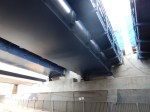
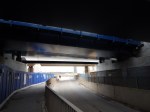

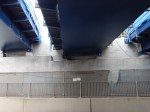
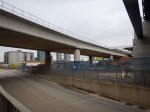


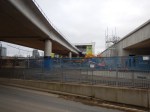
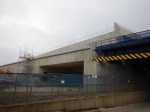
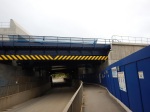
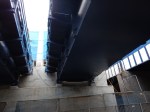
Note that the Crossrail bridge is blue steel and theat for the DLR is concreate.
They are certainly a set of impressive bridges from underneath.
Pudding Mill Lane Pumping Station
Pudding Mill Lane Pumping Station is explained in this press release from Thames Water, which is entitled Olympic sewage site’s ‘Pinky and Perky’ scoop architectural award.
This is said.
The Pudding Mill Lane pumping station, which will take away sewage from the Olympic Park, can deal with up to 1,000 litres of sewage per second.
These pictures show the pumping station.

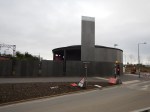
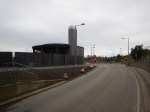
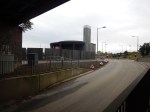
Unfortunately, it is all rather hidden by either wire fences or hoarding for Crossrail.
Pinky and Perky can just be seen in some pictures.
Marshgate Lane Goes Under Northern Outfall Sewer
Marshgate Lane is one of the main routes to get heavy equipment into the Queen Elizabeth Olympic Park.
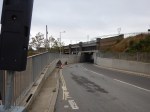


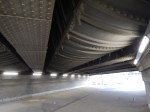
The pictures don’t tell the full story.
Before the construction of the Olympics started, it was a lane under the Northern Outfall Sewer, the massive set of four Victorian pipes which take away an awful lot of North London’s waste water to the pumping station at Abbey Mills before it is pumped to the Beckton works for treatment.
For the Olympics, the lane was not going to be used, but afterwards, it needed to be upgraded to a full height underpass, so that HGVs could get into the site.
So before the Olympics, a contract was negotiated to dig the underpass, through as the name Marshgate Lane suggests, not the best of soils.
I heard rumours from Thames Water engineers, that British contractors were rather pleased that the difficult contract was awarded to a German construction company.
The rumours also said that the Germans lost considerable sums of money on what was one of the more expensive projects for the Olympics.
At least they didn’t make the mistake of damaging the sewer and dumping the proceeds from over a million or so toilets all over the Olympic site.
They’d have really been in the sh*t then!
From The Greenway To Stratford International Station
These are pictures, I took whilst walking and riding from the ~Old Ford Recycling Centre on the Greenway to Stratford station.






Note.
A Design Crime – Ebbsfleet International Station
If there is one station in the UK, that has been deliberately designed to be difficult to use, it is Ebbsfleet #international station.
Take this evening, when I had taken a lift to the station after the football at Ipswich, as the Great Eastern Main Line was having its annual rebuild and I didn’t want to spend an hour in a rickety bus, rather than in a comfortable Mark 3 coach.
Arrive at most stations in the UK or the world for that matter, and the first thing that you see is a ticket office or a ticket machine.
But not at Ebbsfleet International!
You are presented with a departure board, which tells you where trains will be going and if like me, you are going to St. Pancras International station, you notice that alternative trains leave from platform 2 and 5. Platform 2 is to the left on the level and platform 5 is to the right down a set of steps
So if you have just a fewminutes before your train, perhaps it would be a good idea to buy a ticket, as you enter the station.
But you can’t, as the only ticket machines are by the platforms. on either side.
Whose stupid idea was this?
If ever a station needed a ticket machine as you come in, with a sign saying that the next St. Pancras train leaves from platform X, it is Ebbsfleet International.
As it was, after about four minutes, I was able to determine that I had twelve minutes before the next train from platform 5, so I was able to walk down the set of steps, buy a ticket and get to the draughty platform about eight minutes before the train arrived.
Is Ebbsfleet International, the only station in the UK, where to transfer across a concourse between two ends, there is a set of steps in the middle?
It could be considered that Manchester Piccadilly has steps, but it does have fifteen platforms and was designed over a period of well over a hundred years.
The entry problem could be eliminated by more or relocated ticket machines and a small display telling passengers for St. Pancras, where to go.
It is all down to the bizarre layout of the station.
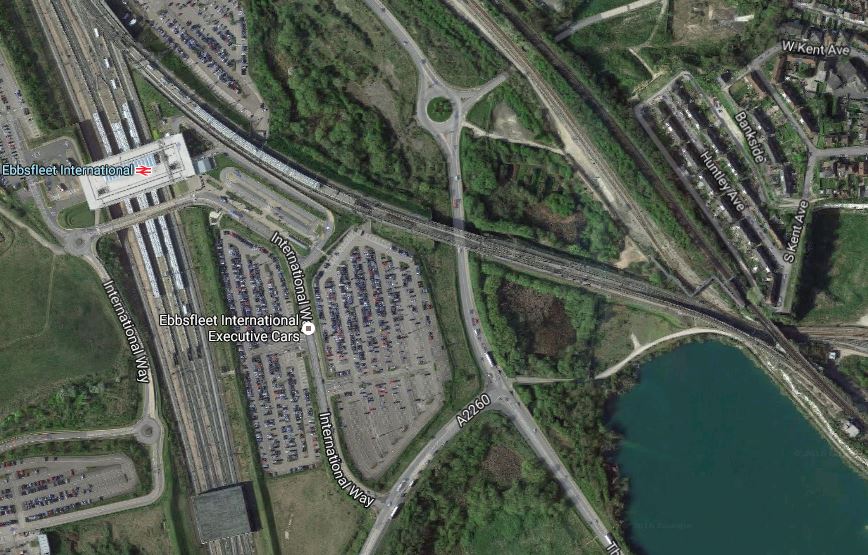
This Google Map shows the two-station layout of the station.
Ebbsfleet International Station
The lines going North South through the station are the Eurostar and the HighSpeed domestic services between St. Pancras International and Ashford International stations. The lines branching off to the South East, take the Highspeed domestic services to Faversham.
The Faversham lines have their own platforms 5 and 6 and there are two other platforms 2 and 3 in the other side of the station, sandwiched in-between the Eurostar lines.
This station was built on a green field site with plenty of space, so surely a better layout of lines could have been provided so that all Highspeed domestic services used the same pair of platforms.
Getting There
Ebbsfleet International was certainly designed to be difficult to get to from other parts of the London and the South East.
Romford is a major station in East London, with this recommended route to Ebbfleet Inyternational.
- TfL Rail to Stratford
- DLR to Stratford International
- Highspeed to Ebbsfleet International.
It may be step-free, but there is certainly quite a distance on the flat.
This is the route from Guildford
- South West Trains to Vauxhall
- Victoria Line to St. Pancras
- Highspeed to Ebbsfleet International
Not a route that I’d recommend to anybody with a heavy case or any difficulty in walking.
This is the route from Greenwich.
- Southeastern to Charlton
- Southeastern to Gravesend
- Highspeed to Ebbsfleet International
That route truly is a corker.
This one might improve as according to Modern Railways for August 2016, that Thameslink will be starting a service between Luton and Rainham via Dartford and Greenwich. Hopefully this would mean a route from Greenwich to Ebbsfleet Internation as follows.
- Thameslink to Gravesend
- Highspeed to Ebbsfleet International
That is only one change, but you’d still need to go over the step-free bridge at Gravesend.
The solution would be to do either of the following.
- Create a proper passenger connection between Northfleet and Ebbsfleet International stations.
- Allow North Kent services that go to and from Dartford to call at Ebbsfleet International station.
Why didn’t the traditional North Kent services call at Ebbsfleet International station from Day 1?
Get the connection right and all those stations between London Bridge and Rainham would have a two trains per hour service to Ebbsfleet International.
Future Expansion
Ebbsfleet International also seems to be designed deliberately to make extension difficult.
Space for extra platforms for these possible services seems not to have been left.
- Termination of Continental services, should St. Pancras get too busy.
- A Crossrail extension from Abbey Wood station.
- An East-West service from Reading and Gatwick.
Expansion can only probably be achieved by adding further complication and difficulties for passengers at this truly dreadful station.
The designer’s dictionary, certainly didn’t include that important word future-proofing.
He certainly gave Eurostar and the Highspeed domestic services, one of the least passenger-friendly stations in the world. that fits well with Eurostar’s other crap stations.
- The extremely passenger-unfriendly St. Pancras.
- The bleak, isolated and draughty Stratford International
Perhaps the airline industry had a hand in its design, in the hope they could strangle the whole enterprise!
Stratford and Ebbsfleet could also have been designed the way they are, so that they didn’t have easy and quick interchanges with Crossrail.
That would have meant, that passengers would use this more affordable service rather than the expensive Highspeed domestic ones, that always seem half-empty, when I use them.
The three stations are all certainly design crimes and taken together they make the Channel Tunnel Rail Link a design crime of the most immense proportions
But given that it is impossible to do much with the station, what should be done now?
- The draughty space between the two separate stations, should be made more welcoming.
- Information should tell passengers the next trains to all stations.
- Ticket machines must be provided as you enter, rather than being hidden away.
- The steps to platforms 5 and 6, should be replaced by short escalators and an inclined lift.
Perhaps most importantly, contactless ticketing using bank cards and Oyster must be available on all Highspeed domestic services. I can use that to get to Gatwick Airport, so why not Ebbsfleet International?
Related Posts
Between Abbey Wood And Belvedere Stations
Connecting North Kent And The Medway Towns To Ebbsfleet International Station
Extending Crossrail To Gravesend
What Do You Do With A Problem Like Sheppey?
London’s New Tube Map For Walking Between Stations
This map from Transport for London may seem a bit unusual, but the aim behind it is probably sound.
This page on the TfL web site, entitled New Tube map launched to help get Londoners walking. This is said.
The new map is the first official version in the world to show the number of steps between stations. It follows TfL’s very popular Walking Tube map, which launched last year and shows the walking times between stations. The new steps Tube map shows how to save time on everyday journeys. It will also help the increasing number of Londoners who set themselves a daily target of steps to take as part of daily exercise and getting fit.
I have always felt that what is needed as well, is more information on the walking short-cuts on the tube. A good place to start is at the list of Out Of Station Interchanges, which are generally a short walk.
Could A Reversing Siding Be Built At Alexandra Palace?
I have recently suggested two new or uprated services.
- In Could Passenger Services Be Run On The Canonbury Curve?, I talked how a Finsbury Park to East Croydon service could be a valuable part of London’s rail infrastructure.
- In A North London Metro, I talked about how Northern City Line services out of Moorgate station could be developed into a high-capacity link to Crossrail.
Both of these services could benefit with the ability to turn trains before the Hertford Loop Line splits from the East Coast Main Line.
A Reversing Siding At Alexandra Palace
One possibility is to create a reversing siding at Alexandra Palace station, which would allow the station to be used as a terminus from services from the South.
This map from carto.metro.free.fr shows the lines at the station.
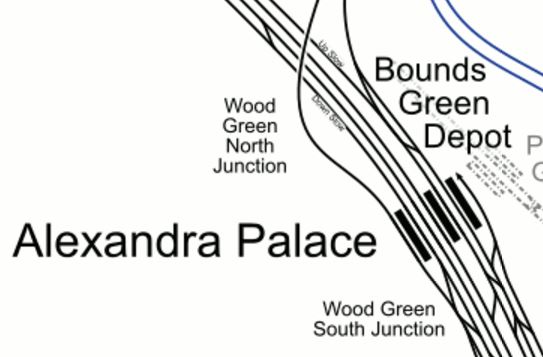
Alexandra Palace Station
Note.
- The fast lines of the East Coast Main Line run through the middle of the station, with the main slow lines on either side.
- The two widely separated tracks going North are the Hertford Loop Line.
- Ignore the blue line, which is the Piccadilly Line.
- The platforms are numbered from East to West and there are four usable faces.
- The most Westerly face is numbered 4 and serves trains going to the Hertford Loop Line.
- Sharing the island with platform 4, is platform 3, which handles direct stopping trains to Welwyn Garden City and the North.
- The layout of platforms 3 an 4 means that there is a step-across interchangebetween trains going on the different routes.
- Platforms 1 and 2 are on the Eastern side of the station and most of the trains from both go to Moorgate.
- Thameslink services will probably use platform 3 going North and one of platform 1 or 2 going South.
- There are a large number of crossovers South of the station to sort the trains between various combinations of routes and platforms.
It is an simple and efficient layout, which keeps local services away from the fast lines in the middle.
But look at this Google Map, which shows Wood Green North Junction, where the East Coast Main Line and the Hertford Loop Line split.
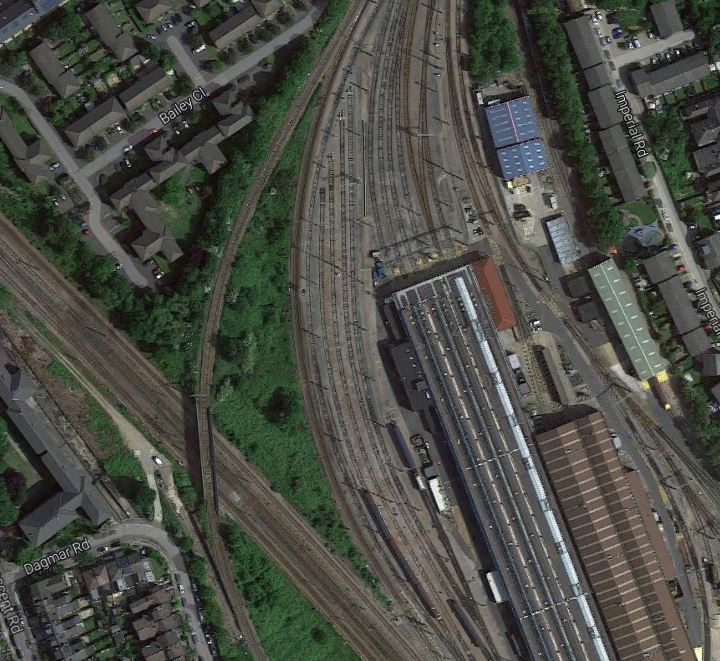
Word Green North Junction
After the down line of the Hertford Loop Line crosses over the East Coast Main Line on a viaduct, it runs through an area of green, with the up line on the other side. Surely, it would be possible to shoe-horn one or even two reversing sidings into this plot, that could at least take six-car trains.
These are some pictures of the area



Probably only the resident wildlife find it attractive.
So a train reversing at Alexandra Palace station would go through the following procedure.
- The train would arrive in the down Hertford Loop Line platform 4 at Alexandra Palace.
- Any passengers still left, would leave the station or catch another train.
- The train would then proceed to the reversing siding between the two lines of the Hertford Loop Line.
- The train would then start its return journey in the up Hertford Loop Line platform 1 or 2 at Alexandra Palace.
Note.
- The train would have been able to reverse without affecting traffic on the fast lines.
- As a maximum of perhaps six trains per hour will be using the Hertford Loop line, there is plenty of spare capacity for extra trains.
- Reversing sidings are always useful when there are problems like failed trains or blockades.
- If it could take an eight-car Class 700 train, it might have uses for Thameslink.
It is one of those small lengths of railway, that if it were properly designed could have a lot more uses than is obvious.
I am also very surprised that as the space is there between the tracks of the Hertford Loop Line, that it hasn’t been used for something productive before.
The Existing Reversing Siding At Bowes Park Station
Bowes Park station is the first station on the Hertford Loop Line. This is said in the Wikipedia entry for the station.
To the north of the station is a single siding in between the two running tracks which is occasionally used to turn around East Coast InterCity 225 and 125 trains heading for Bounds Green Depot just north of Alexandra Palace..
There is a good image on the Railway Herald web site, of an InterCity 125 using the Bowes Park Reversing Siding from August 2016.
Looking at the picture, I wonder if there is space for more than one reversing siding.
The Future Of Bowes Park Station
Bowes Park station is a long wide island platform with rather rudimentary buildings in the middle and stairs up to a bridge over the line.
It must be due a rebuilding to at least add step-free access to the station.
But as it is a valid out-of-station interchange to the Piccadilly Line at Bounds Green station and it has a reversing platform to the North, could this station be in for something more substantial?
Conclusion
I would suspect that Network Rail and the various train operators, are looking at a comprehensive solution in this area that is to everyone’s satisfaction.
At least they start from a good base.
- Alexandra Palace station has a good layout of platforms.
- Interchange between all down services at Alexandra Palace station, uses a single island platform with two faces.
- Up services have two platforms. connected by a bridge.
- There is already a long reversing siding at Bowes Park.
- Trains for the Hertford Loop from the South cross the East Coast Main Line on a flyover.
But above all there is no shortage of space
Related Posts
A Numerical Analysis Of Great Northern’s Class 717 Trains
Could A Reversing Siding Be Built At Alexandra Palace?
Could A Reversing Siding Be Built At Alexandra Palace?
Liverpool Street Crossrail Station Disentangled
A North London Metro
My Memories Of The Lines Out Of Moorgate And Kings Cross
I grew up in North London and I can remember when the suburban services into Kings Cross were hauled by N2 tank engines and later when these were replaced by the Class 105 diesel multiple units.
Around 1970, I used to commute to Welwyn Garden City from Kings Cross and I regularly got Cambridge trains, that were coaches with compartments pulled by the then ubiquitous Class 31 diesel locomotives.
All changed in 1976, when the Northern City Line out of Moorgate and the East Coast Main Line out of Kings Cross were electrified and Class 313 trains started to work the lines.
They still do!
The Current Route
The East Coast Main Line, running North through Finsbury Park is four-tracked with separate fast and slow lines.
There is also the Hertford Loop Line, which effectively gives the route a second set of slow lines between Alexandra Palace and Stevenage.
The two lines have a network of fourteen suburban stations,, where each links with a rather measly three tph into Moorgate.
The line has a few good features.
- The Hertford Loop has grade-separated junctions at both ends and is electrified throughout.
- There are decent termini for the services at Gordon Hill, Hertford North, Letchworth Garden City and Welwyn Garden City.
- There is a flyover at Welwyn Garden City to enable prompt turnaround of the trains.
- The lines allow the trains to use their maximum speed.
- Interchange between the two services at Finsbury Park and Alexandra Palace is generally good.
But the route has the problem of a voltage change between the tunnel to Moorgate and the rest of the line at Drayton Park station, which adds a couple of minutes to every journey.
The Current Service
The current service is three trains per hour (tph) that trundle as fast as their 75 mph top speed and age will allow to the two main destinations of Welwyn Garden City and Hertford North stations. One of the trains from Hertford North in every hour continues to Letchworth Garden City.
This is not the frequent service that attracts new passengers and at least an extra train per hour is needed.
As an example, I can get a direct bus every two or three minutes or so to Essex Road station, from where I can get trains to the North.
But three tph to the two destinations and six tph to Alexandra Palace is not the sort of service on a commuter route out of London. Four trains would reduce my maximum wait for say a Hatfield train from twenty to fifteen minutes.
But there are reasons for this level of service.
- There probably aren’t enough trains.
- Their performance is inadequate.
- The complications of the route, which involves changing voltage at Drayton Park station, slows the service.
Even so they do manage to squeeze 12 tph into Moorgate in the rush hours.
Service Improvements In 2018
In the Wikepedia entry for Bowes Park station, the following is said.
From 2018, the pattern is due to change when Moorgate services via the Hertford loop are curtailed at Stevenage using a new terminating platform there:
- 2 tph Great Northern service Moorgate – Stevenage
- 2 tph Great Northern service Moorgate – Hertford North
This information is not given elsewhere, so I suspect it’s either from someone, who’s got good knowledge or wrong. There is no reference to the source of the information.
But, 2018 is when the new trains will start serving the line. So the Hertford Loop Line could be getting an extra train per hour.
Infrastructure Improvements
There are various infrastructure improvements that need to be done to squeeze the maximum capacity out of the system.
- The archaic voltage change at Drayton Park should be replaced with one using the best modern technology and practice.
- The maximum line-speed on the Hertford Loop Line should be increased to 100 mph wherever possible.
- Platforms should be improved to ease getting on and off trains and facilitate easy interchanges between trains.
- It looks like a bay platform is being built at Stevenage to serve the Hertford Loop Line.
- Would there be any advantage in creating a passing loop or adding a fourth platform at Gordon Hill station?
In addition, I do think that there are opportunities for new stations on the Hertford Loop Line.
The New Class 717 Trains
New Class 717 trains have been ordered to send the Class 313 trains to the scrapyard.
These are similar to the Class 700 and Class 707 trains, so I think we can assume.
- They will have a top speed of 100 mph, where the track allows it.
- They will brake and accelerate faster than the current trains and with better door machinery should save time at every stop.
But I would also suspect that they will handle the voltage change at Drayton Park more efficiently.
It would appear from my calculation in A Numerical Analysis Of Great Northern’s Class 717 Trains, that there are enough Class 717 trains on order for a four tph service to all stations, with 2 tph onwards to Letchworth Garden City or more likely Stevenage.
As the Wikipedia entry for Bowes Park station says 4 tph from 2018, I think it is reasonable to expect that Welwyn Garden City gets the same treatment.
This would produce an eight tph service between Alexandra Palace and Moorgate.
Current timings from Moorgate are.
- Hertford North – 50 minutes
- Welwyn Garden City – 51 minutes
- Stevenage – 63 minutes
So this means one shorter round trip could be done in two hours and a combination of a short and Long one in four.
This would mean.
- 4 tph to Welwyn Garden City would require 8 trains
- 6 tph to Welwyn Garden City would require 12 trains
- 4 tph to Hertford North/Stevenage would require 8 trains
- 6 tph to Hertford North/Stevenage would require 12 trains
But because the Class 717 trains are faster, have a better stopping performance and would probably save time in changing voltages, I wonder if the shorter round trip could be reduced to ninety minutes, with the combined trip at three hours.
This would mean.
- 4 tph to Welwyn Garden City would require 6 trains
- 6 tph to Welwyn Garden City would require 9 trains
- 4 tph to Hertford North/Stevenage would require 6 trains
- 6 tph to Hertford North/Stevenage would require 9 trains
So if the trains and the drivers can perform, it might be possible to have enough trains for a six tph service on both branches with a 12 tph service between Moorgate and Alexandra Palace.
One consequence of running 12 tph into Moorgate all day, might be that there would be no room for extra trains in the Peak. But the service in the Peak of twelve six-car tph would still have the same capacity as the current one
I think that Great Northern’s objective is to run twelve trains into Moorgate all day, with half serving each branch.
The full service to and from Moorgate would probably need 18 trains.
In A Numerical Analysis Of Great Northern’s Class 717 Trains, I said that a 2 tph service between Kings Cross and Foxton would require six trains, that would see the fleet fully utilised.
The Link To Crossrail
In Liverpool Street Crossrail Station Disentangled, I showed that changing between Crossrail and the Northern City Line at Moorgate could be easy.
I have a feeling that with eight or even twelve tph running into Moorgate, many passengers will change at Moorgate to and from Crossrail, even if they want to go to and from places like Hatfield or Potters Bar, for which they can also use Thameslink and a change at Farringdon.
Consider.
- Running twelve tph into a two-platform terminal like Moorgate is way below the frequency of the Victoria Line at Walthamstow Central.
- Half of all trains at Moorgate will go up the East Coast Main Line, with the other half taking the Hertford Loop Line.
- Only one-in-four trains at Farringdon will go up the East Coast Main Line.
- The Moorgate service will stop at all stations to Welwyn Garden City.
- There is a split with suburban trains out of Moorgate and Thameslink out of Farringdon.
- Farringdon to a station on the Hertford Loop Line, would need a second change.
- Canary Wharf to North London and Hertfordshire would be a single change at Moorgate.
Never underestimate the capacity of Londoners to duck and dive to find their best route.
All of this could lead to a lot of passengers on the trains between Moorgate and Alexandra Palace.
The Great North London Metro And Thameslink
If you take the Welwyn Garden City branch of the routes out of Moorgate, it could be running four or possibly six tph between Finsbury Park and Welwyn Garden City. On the same route, according to their latest plans Thameslink will also be running six tph.
Even if they don’t run alternatively, there will certainly be plenty of opportunities to choose to go to Moorgate or take the main Thameslink route.
You might even argue that the Hertford Loop Line and the Northern City Line are just branch lines from Thameslink, with cross- or same-platform interchanges.
But however you put it, the two lines are strongly bound together.
Conclusions
Four tph on both branches with eight tph into Moorgate is certainly possible with the fleet of new trains.
But if the trains can save time at each stop and there are some signalling, voltage-changing and track improvements, I feel it could be possible to run six tph on each branch with twelve tph into Moorgate.
Those sort of frequencies would transform the services out of Moorgate.
They would create a frequent link, which would serve at the Southern end
- Crossrail
- Northern Line
- The City of London
- Canary Wharf
And at the Northern end.
- Thameslink
- Victoria Line
- Piccadilly Line
- North London
- Hertfordshire
It would truly be a Great North Northern Metro.
Related Posts
A Numerical Analysis Of Great Northern’s Class 717 Trains
Could A Reversing Siding Be Built At Alexandra Palace?
Surely The Labour Party Can Do Better Than This!
Just voted in the Hackney Mayor election.
What is the Labour Party’s logo? It doesn’t reproduce well in black and white on a ballot paper.
It looked like a cartoon version of Mr. Punch.
There was no difficulty with the others, especially the One Love Party, who had a heart!
Incidentally, the candidate for the One Love Party was French and their web site was a .eu one!
She’d probably have got nul votes in some parts of the UK.
A Cafe That Doesn’t Take Cash
IKEA have opened a cafe in Shoreditch High Street, which is just a short walk from the station of the same name.

IKEA Cafe, Shoreditch
I was a bit disappointed, as the gluten-free options were non-existent and it didn’t take cash.
So I had a small cappuccino in a paper cup and left to get the train home.
I won’t be bothering to go again!
 The Anonymous Widower