The Midland Metro Is Set For Expansion
This article in Rail News is entitled .Major Midland Metro expansion plans unveiled. It lays out how after a devolution deal for the West Midlands there is going to be new lines on the Midland Metro. The article says this.
A new ‘HS2 connectivity package’ will include new tram lines from the HS2 station at Birmingham Curzon Street to Birmingham Airport via Bordesley Green and Chelmsley Wood, and between Wednesbury and Brierley Hill — a destination which was an aspiration of local Metro planners even before the first section opened in 1999 between Snow Hill and Wolverhampton St George’s.
It is certainly a substantial expansion.
Birmingham Curzon Street to Birmingham Airport
The history of the proposed Line Two linking to Birmingham Curzon Street station for HS2 and Birmingham Airport, is given in Line Two East Side Extension of the Wikipedia entry for the Midland Metro.
There would appear to be no mention of Bordesley Green and Chelmsley Wood, so I would assume that the route has been changed.
Wikipedia also mentions serving Coventry station, but the Rail News article doesn’t. I suspect that as Coventry is part of the devolution plans, that Line Two will go to the city!
Wednesbury To Brierley Hill
This proposal for this line, which links both Birmingham and Wolverhampton to the Merry Hill Shopping Centre, is better developed and some details are given in this section of the Wikipedia entry for the Midland Metro.
The proposal utilises the disused South Staffordshire Line, which to complicate matters Network Rail want to open for freight.
In January I published Will Dudley Get A National Very Light Rail Innovation Centre?, which also throws some extra factors into the knitting.
In the Midland Metro entry for this line, this is said.
Centro has stated that the WBHE would provide 10 trams per hour, alternately serving Wolverhampton and Birmingham. Journey time from Brierley Hill to West Bromwich was stated as 31 minutes.
So if it is intended that this line runs trams to both Birmingham and Wolverhampton and it will also carry freight, then it seems to me, that by using something like Class 399 tram-trains, you can be all things to all stakeholders.
If you look at the South Staffordshire Line north of the proposed junction with the Midland Metro, it is a mass of working and disused railway lines, that ultimately terminate on the West Coast Main Line at Lichfield Trent Valley station.
Given that the article in Rail News talks of improvements to the West Coast Main Line, I can’t believe that in the future the South Staffordshire Line is not developed as a cross city line from Lichfield to Stourbridge.
Conclusion
The West Midlands is going to see a lot of rail and tram development in the next few years.
Councillor David Lawrence, who chair of the West Midlands Integrated Transport Authority, is quoted as saying this about the schemes.
The agreement will see Whitehall make an annual contribution of £40 million for 30 years to support investment worth £8 billion, which it claimed will support the creation of more than half a million jobs.
Will the Brummies go for it?
Walking The Cycle Superhighway CS5 From Oval Station To Pimlico
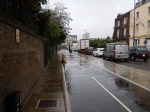
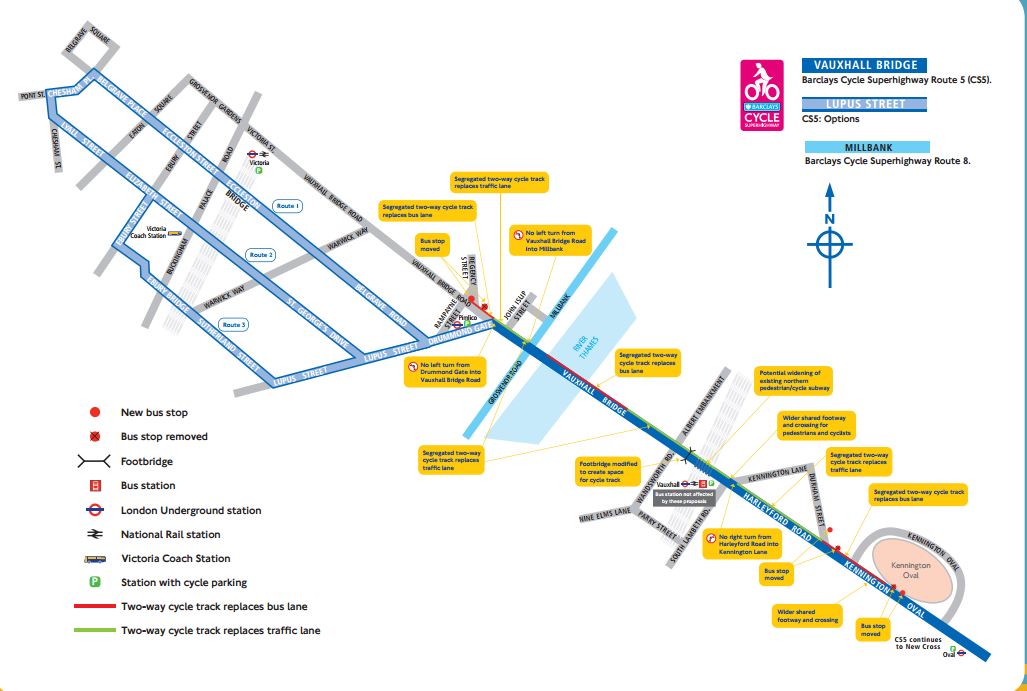
The pictures tell the story, as I walked from Oval tube station to Pimlico along Cycle Superhighway CS5
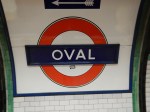


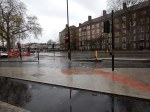


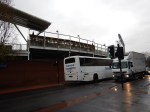


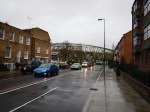



This is the official Transport for London map for CS5.
Cycle Superhighway CS5
This is a Google Map from Oval Station To Pimlico

From Oval Station To Pimlico
Some of my thoughts.
- The route is an easy one to cycle, as it is virtually flat.
- I was impressed with the way that the designers of the Cycle Superhighway had threaded it through the area, with good attention to bus stops, traffic signals and signage.
- Before I walked towards Pimlico, I had a quick walk in the direction of Kennington and checked out the other cycle routes being constructed. The walking routes were good.
- I particularly liked the bike rental station in the dry in a railway arch. How many people like getting on a wet saddle? The Brownlees perhaps!
- The route was also an easy one to walk, as the designers had catered for walkers in the design.
- The builders had done an excellent job in making all the surfaces good for cyclists and walking.
- I was a bit surprised on how fast I was walking.
- I did feel though, that at times, there was a very crowded line of traffic alongside an almost empty cycle lane. The Jeremy Clarksons of this world might say something.
If all the Superhighways are designed and built to this standard, they will be a big asset to London.
I think in areas, where people are objecting to their imposition, they may actually win a few friends.
It’s a long time, since I was the parent of a young child and even longer since I used to cycle about four miles to school in the midst of the traffic.
But I would have no worries about my thirteen-year-old granddaughter cycling on a track like I saw today.
Rail Freight At A Crossroads
I take the headline from this article in Rail Magazine, which is entitled Coal power station closures place rail freight at “important crossroads”.
The article talks about how the closure of coal-fired power stations and the reduction in size of the steel industry, will bring about fundamental changes to the pattern of freight on the railways.
The rail freight industry must develop new markets to take more and more trucks off the roads.
The article says that the industry is looking for government support to improve the East Coast Main Line, the West Coast Main Line and the routes to Felixstowe.
I would also add in the routes that serve the poorly-sited London Gateway, which mean too many noisy and smelly Class 66 locomotives pull freight across North London.
Life is about give-and-take, so it would be wrong to electrify routes that could be used by freight, without the freight companies investing in new electric locomotives.
But Class 66 diesel locomotives are a cheap solution that can go anywhere, that are unloved by those living by rail lines and also by drivers.
Diesel locomotives also mean that they make port and distribution depot operations safer and more efficient. You wouldn’t want idiots with cranes in an area with masses of overhead wires.
Incidentally, the Class 66 locomotives do not meet the current European emission regulations.
But solutions have been designed and are now available.
- The Class 88 locomotive is an electro diesel locomotive, that is primarily an electric locomotive, with a large on-board diesel engine, for use when there is no electrification.
- The TRAXX Last Mile locomotive may also be suitable for some routes, but is probably two big for the small British loading gauge.
I feel that as Vossloh Espana, who make the Class 88, has just been taken over by Stadler, who seem to me to have a reputation for innovation, that the Class 88, may be our best hope for less intrusive freight trains.
It is worth looking at how the Class 88 would help on one route that I know well; Felixstowe to Peterborough and then up the East Coast Main Line to the North.
The route is as follows.
- Felixstowe to Ipswich – A branch line that is not electrified. The Port of Felixstowe have said that they would pay for dualling some of the branch, but they haven’t and have pushed fir the removal of passenger trains from the branch.
- Ipswich to Peterborough – Except for a few miles to Haughley Junction the line is not electrified.
- Peterborough to Doncaster – The East Coast Main Line is electrified, but many freight trains now use the Great Northern Great Eastern Joint Line through Lincoln.
- North of Doncaster – Some routes to Leeds, Newcastle and Scotland are electrified.
So a quick naive look, might say that a Class 88 would be ideal for the route.
But.
- A new Class 88 would probably be more expensive to lease than an old Class 66.
- The Class 66 has a power output of 2,460 kW, whereas the Class 88 has only 700 kW from its diesel.
The freight industry’s preferred option is probably that all routes are electrified, but not at their expense!
But even then there are no new electric locomotives, that fit the UK loading gauge! The freight industry is probably looking jealously at the elderly Class 90 locomotives used for London-Norwich trains and hoping that the line gets electric multiple units.
I’m certain that for cost reasons, the industry would prefer to stick to its beloved Class 66.
I think that London is key to weaning the freight companies away from the dreadful Class 66 locomotives.
When the Gospel Oak to Barking Line has been electrified, London could be in the position to ban Class 66 locomotives from that line and the North London Line, if a few extra pieces of electrification were performed.
But it won’t happen!
I would also like to see the Government make freight companies run locomotives that met the current European regulations.
Good Riddance To Coal-Fired Power Stations
This article on the BBC is entitled UK’s coal plants to be phased out within 10 years. This is said.
The UK’s remaining coal-fired power stations will be shut by 2025 with their use restricted by 2023, Energy Secretary Amber Rudd has proposed.
Ms Rudd wants more gas-fired stations to be built since relying on “polluting” coal is “perverse”.
Because coal is pure carbon, when it burns, if produces carbon dioxide.
On the other hand, natural gas, is a mixture of hydrogen and methane, which is a compound of one carbon atom and four hydrogen atons. So when it burns, it produces a lot of the combustion product of hydrogen, which is water.
I think to get the same amount of heat or produce a given amount of electricity, natural gas creates about half the amount of carbon dioxide, than coal does.
There is another advantage of using gas to generate electricity. You can have small power stations generating electricity, where it is needed.
An interesting small gas-powered power station is the Bunhill Energy Centre in Islington, which is used to generate electricity and heat for some of the Council’s buildings. Phase 2 of this project will capture waste heat from the London Underground and a large electricity sub-station, that will be used to heat more buildings.
These cogeneration systems will become more numerous. For instance, if you had say a large detached house in the country, you might use solar panels or a wind turbine, backed by a microCHP system for dark or still days.
We shouldn’t underestimate, the skill of engineers to design electricity combined heat and power systems matched to all the different markets.
There will come a time, where many of us will generate the electricity we need, either by ourselves or perhaps in a local co-operative. We could even sell the surplus back to the grid.
I will not predict what a system will look like, but it will heat your house and provide you with the electricity you need.
The one thing, I will predict that coal will not have any use for the generation of electricity.
A Video About The Vivarail D-Train
I am sceptical about the Vivarail D-Train, but I do admire companies and organisations that think out of the box.
That is why I’m putting this link to a BBC video about the project.
In the UK, we are in such a great need of new trains, that any idea that works will probably have a niche somewhere. However small!
Of whom does the male BBC presenter remind you?
Crossrail Works Around Pudding Mill Lane Station
I took these pictures as I went through the area on a TfL Rail train to Shenfield and then later, when I took a DLR train!
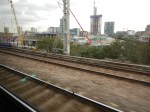
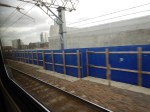

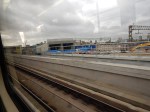

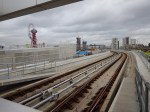
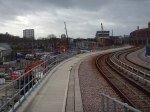
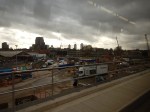
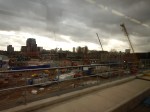


The Crossrail tunnel portal is now recognisable as two holes leading into the ground.
They appear to be building something over the top of the tunnel just before it goes under the water and on into London. Could this be a ventilation shaft?
East Anglia Has Train Problems
One of my Google Alerts found this article from the Ipswich Star, which is entitled Bus replaces rail services between Ipswich and Felixstowe and Marks Tey and Sudbury.
It turns out that the track is damaging the train wheels.
Sounds like it’s the age-old problem of giving crap trains and not maintaining the track in East Anglia.
I can remember Ipswich to Felixstowe trains from the 1960s, when I thought they were truly dreadful.
It seems nothing changes!
My Useless John Lewis Credit Card Statement
I recently bought a winter coat in Marks and Spencer. The zip has gone, so I want to find the store, where I bought it, as I use several of the large ones in London regularly. I probably bought it with my John Lewis credit card, so all I need to find is a transaction at over a £100 for Marks and Spencer to get a date and store.
But I can only get the last statement as a spreadsheet, which just gives dates, values and not the store. It’s not even formatted to the sort of level, that a child of six could program.
Quite frankly it’s utter crap!
Unlike with Amex, which gives you everything you need to trace purchases, in an easy-to-read clickable format.
Do John Lewis expect me to keep paper copies of all my purchases?
Paper is so Nineteenth Century!
Ten London Overground Stations For Upgrade
This article on Rail Magazine is entitled Murphy wins LO station contract. This is said.
J Murphy & Sons has won a £6.5 million contract from Transport for London to upgrade ten London Overground stations with new shelters and seating, upgraded lighting, better paving and new handrails.
It sounds like the work is not of too much of a major nature, but is more about some small important features.
On a personal note, the only station named, that I use regularly is Hackney Downs.
A First Glimpse Of The Planned Hackney Central Station
London Overground are planning an upgrade of Hackney Central station, as I reported in The Redevelopment Of Hackney Central Station.
I went to Hackney Central Library to get a first glimpse of the design.

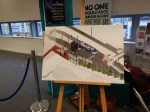


It’s certainly a big improvement on what’s there now. Some points.
- The station is to a modular design, so we’ll be seeing other similar stations.
- There is more space in the station, with the gate line turned through ninety degrees.
- The guys I met from Transport for London (TfL) were referring to the combined station as Hackney Interchange.
- TfL and Hackney Council are working together to get things right in the area.
- There is no entrance on the far side onto Graham Road, which is something I’d like to see.
- There may even be toilets.
- TfL are welcoming comments.
But TfL haven’t created the web site yet. I’ll point to it, when they do.
Improving Bus Connectivity
Like many in London, I don’t live on top of a Underground or mainline rail station. The nearest is Dalston Junction station on the Overground, which gives me good connections to mist the capital with one or more changes.
So I rely heavily on buses to get to and from stations like Angel, Highbury and Islington, Manor House and Moorgate for onward connections.
It is the same with Hackney Central and Hackney Downs stations, which could be united as Hackney Interchange.
The buses are rather chaotic around the two stations and if Hackney Council achieve their laudable aim of creating a proper public space between Hackney Central station, St. Augustine’s Tower and the Narrow Way, using the buses in the area will get more difficult.
Transport for London needs to take a good hard look at buses passing through the area of Mare Street and the proposed Hackney Interchange.
The Dalston Eastern Curve
The lack of an Eastern Curve at Dalston means that westbound passengers on the North London Line needing to go South from Dalston, must change at Canonbury.
I sometimes do this to get to Dalston Junction station, but I also take the 38 bus from Amhurst Road, after crossing the North London Line on the Hackney Central station footbridge.
In The Dalston Eastern Curve, I talked about the curve, but I don’t think it will be rebuilt in the next few years.
A Southern Entrance To Hackney Central Station
Because of its connections to the attractions at Stratford and Crossrail, I suspect that we’ll be seeing more passengers taking the North London Line to and from its Eastern terminus at Stratford station. Especially, when West Ham moves into the Olympic Stadium.
The proposed increase in size and facilities at Hackney Central will be very much needed, for all these passengers.
Many passengers though will need to go South from Hackney Central or along Graham Road, but will be frustrated in having to climb the footbridge to get out of the station on the wrong side of the line.
It is my view that a southern entrance to Hackney Central station would make travel easier for a great many travellers.
In an ideal world, a southern entrance would lead to a light-controlled crossing over Graham Road, to give easier access to the buses.
 The Anonymous Widower