Searching For Food At Edinburgh Waverley
Coming back from Edinburgh Waverley, I booked on-line for the 14:30 train for the princely sum of £64.35. After picking up my ticket, I thought I’d ask if there was any sensible food in First Class. The guy I asked was honest and said, that if he was me, he’d have something before travel. As my friend had said that last time, all she got was sandwiches, I decided to look for a snack. Especially, as I had a cooked sausage and bean casserole in te fridge that just needed heating, so I didn’t need much.
I first tried the First Class Lounge, which was guarded by this notice.

East Coast’s First Class Welcome
There was no food and the coffee machine was broken. So that was a waste of time.
I had plenty of time, so I walked out of the station and to a restaurant I’d eaten in behind Harvey Nicholls. No luck at all!
On my way back to the station, I popped into the Balmoral Hotel and asked if there was anything gluten-free in the bar. The Western European waiter spoke worse English, than all the waiters I’d encountered in Poland. I thought Edinburgh was in Scotland. As he couldn’t understand my dietary needs, I quickly left and went back to the station.
Costa Coffee had what looked like a nice salad, but they’d polluted it with pasta. Why do people ruin perfectly good salads in this way?
I then tried the other coffee outlets and there was nothing I could eat. Even Marks and Spencer were out of gluten-free sandwiches. At least the manager said sorry which is more than anybody else did!
In desperation, I thought I’d look out of the other side of the station and saw this cafe.

The City Art Centre Cafe
So I asked and they said that the beef and red wine casserole was gluten-free.
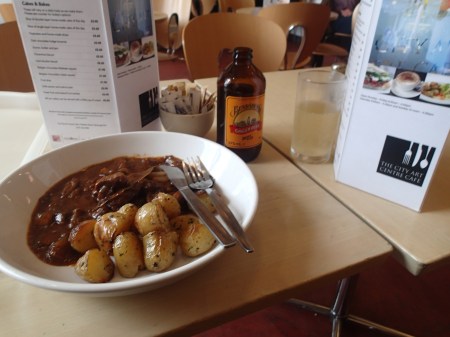
Beef And Red Wine Casserole
It was a choice I didn’t regret.
It would appear that despite eating many good gluten-free meals in Edinburgh, trying to find one by the main station is a lot more difficult.
But I’d certainly go back to The City Art Centre Cafe again
Lunch At Henderson’s
Henderson’s is a long-established restaurant in Edinburgh. My friend and I had lunch there.




My chilli was excellent.
Edinburgh’s Poor Bus Information
In London the bus information is superb, with route and street maps at any stop with a shelter. Even rudimentary stops have a text number and a small map.
But this is all you get in Edinburgh.
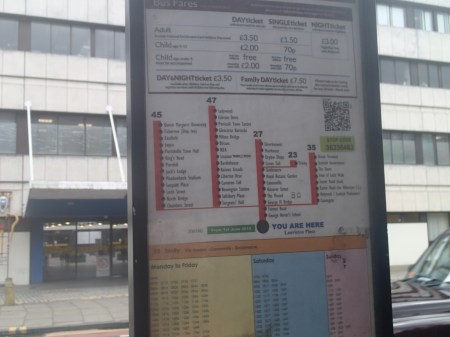
Edinburgh’s Poor Bus Information
If you are not familiar with the city, what possible use is this map, especially as there are no walking maps except for a solitary lith on Princes Street.
As a major tourist city, Edinburgh has to be labelled as Could Do Better.
Especially as the tram stops are a map free zone.
The Edinburgh Trams Finally Arrive
One of the reasons to go to Edinburgh was to see the new trams.

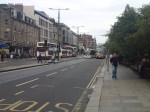
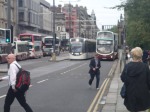
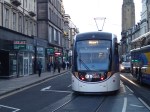
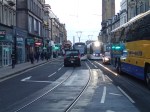
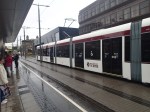


The trams themselves are impressive and are the first I’ve seen with leather seats. Incidentally according to this Wikipedia article, the Edinburgh tram is a special design and unlike any others.
The trams, like many Lothian buses are being fitted with wi-fi, which is something I’d like to see on all public transport.
But I think that the design of the system shows a few shortcomings.
Edinburgh is a World Heritage Site, so why didn’t they use battery or catenary-free technology, through the historic centre, as is done in Bordeaux, Nice and Seville. Incidentally the Seville trams were built by the same manufacturer as those in Edinburgh; CAF. It therefore seems even more surprising that Edinburgh doesn’t use the same technology in the city centre, especially as in addition to not using intrusive and ugly catenary, according to some technical articles, I’ve read they are cheaper to install in heritage areas, as no posts or attachments on buildings are needed.
Even the most patriotic of Scots, will admit that it rains in their country. The ticket machines, like they are in many places I’ve been, are out in the open and buying a ticket without an umbrella wasn’t an easy process. All it needed was to make the shelters a little bit longer, as one of the pictures shows.
The ticketing is something that doesn’t take advantage of modern technology. These days, you shouldn’t need to buy a ticket, as you don’t on London’s buses, where if you haven’t got a ticket or an Oyster, you can use a contactless bank or credit card. I hope Edinburgh has plans to allow these cards, as visitors will demand this, as it gets implimemted in more places across the world.
I also felt the ticketing zones weren’t visitor friendly. You can buy one day tickets, but why don’t they do what I found in one European city and offer twenty-four hour tickets. This helps people who might fly into Edinburgh for business or a concert and then fly back out the next day. Charging people for two separate tickets will just upset visitors.
The tram also failed my map and information standards by a long way. Edinburgh has virtually no maps and surely there should be one on every tram stop.
Skin Cancer Trial Results Exciting
That is the headline on this story on the BBC web site. Here’s the first few paragraphs.
The results of two international trials against advanced skin cancer have been hailed as “exciting and striking”.
Both treatments, for advanced melanoma, are designed to enable the immune system to recognise and target tumours.
The last statement is key. After all one of ourposes of your immune system is to fight infections and any other dangerous things it finds in your body.
Research has shown that coeliacs on a gluten free diet, have a reduced cancer rate compared to the general population.
So should everybody avoid obesity, too much drink, smoking and gluten, if they want to reduce their cancer risk?
I don’t have the data, so I won’t make a prediction. But the man, who helped to identify the link between smoking and lung cancer, Richard Doll, was a coeliac and was obviously on a gluten-free diet.
He lived until he was 92.
He obviously looked at the data and probably massaged his immune system.
HS2 Must Be Right As The C of E Opposes It
This report in the Telegraph and praying that HS2 will be halted. Here’s the first paragraph.
The Church of England has announced its opposition to HS2 – saying the high speed rail line will desecrate graves and shatter peace
This to me proves HS2 must be a good thing as the C of E’s idea of progress seems very much to go in a backwards direction.
Should Network Rail Manage More Stations?
This post was suggested by this article pointed to by Global Rail News, which says that Network Rail is going to take more stations directly under their control. Here’s the first two paragraphs.
Newcastle and York are to become Network Rail-managed stations from the start of the new East Coast franchise in 2015.
The main line stations will join Reading and Bristol Temple Meads, which Network Rail took over on April 1, under a new management model designed to improve long-term planning for the UK’s railway stations.
So what stations do Network Rail actually manage? There is a list of the nineteen stations, they current manage on on their web site.
Living in London, I use a lot of Network Rail managed stations, as all London terminals except for Blackfriars are managed by the company. The signs are consistent and even when the station is only used by one train operating company, like Liverpool Street or Waterloo, the national signs are dominant! As they should be! So a visitor to London, unfamiliar with where they are going, should find navigating around stations easy. Some large Continental stations could do a lot worse than mimic the signs at Euston, Waterloo or Kings Cross.
Generally, I think Network Rail gets it right. They also have a policy of getting better and often healthier food outlets into stations. Stations like Waterloo, Kings Cross, St. Pancras and Manchester Piccadilly have benefited from this policy. I have too, in that in the last couple of seasons, when I went to football at Blackburn, Burnley or Blackpool, I have sometimes arranged one journey with a change at Piccadilly, so I could have lunch or supper.
As someone, who hasn’t even managed a whelk stall, surely if one company manages a lot of stations, then good ideas filter across the group.
I wouldn’t call for all stations to be directly managed, as the vast proportion of smaller ones deal with one company. But even here, they should follow Network Rail’s policy on signs and possibly architecture and station furniture. In the case of the latter, I’ve seen some truly inappropriate designs. To be fair to Network Rail, they have produced this design guide and they are currently responsible for leading the Access for All.
So after Newcastle and York, what other stations, should they manage?
In the article from Global Rail News, one of the comments suggests that Clapham Junction station be directly managed.
The station has been improved and is managed by South West Trains, but used in addition by Southern and London Overground. The station needs further improvement and with Southern becoming part of the new Thameslink franchise, there will be three big beats using the station, which will be managed by a competitor.
It strikes me that there needs to be a policeman sitting about the corporate fights that will break out in one of the UK’s busiest stations. Network Rail are the obvious candidate.
There are other busy stations like Clapham Junction, which could probably need someone to sort out problems, caused by the station manager being the dominant train operating company in the station. In this class, I would name Peterborough, Preston, Derby, Nottingham, Sheffield and Wolverhampton.
And then there’s Cardiff.
Surely, if Glasgow Central and Edinburgh Waverly are managed by Network Rail, Cardiff Central must have string claims, even though it’s in Wales. But the Scots don’t seem to have problems over their two Network Rail managed stations.
I think by the end ofthis decade, more of the larger stations will be under Network Rail’s umbrella.
The Other Side Of Healthcare
According to reports like this, the new boss of the NHS is going to create more smaller community hospitals. Here’s the first few paragraphs
Smaller community hospitals should play a bigger role especially in the care of older patients, the new head of the NHS in England has said.
In an interview in the Daily Telegraph, Simon Stevens signalled a marked change in policy by calling for a shift away from big centralised hospitals.
The health service chief executive said there needed to be new models of care built around smaller local hospitals.
I think there is something, which is just as important, that he doesn’t seem to mention.
That is that all hospitals should be easy to access from most of their catchment area.
When I lived in Suffolk, the only way to get to the excellent local hospital at Addenbrooke’s in Cambridge, was either by a private car or taxi. It certainly couldn’t be done by public transport.
Where I live now, I only have to walk round the corner about fifty metres and every ten or fifteen minutes, there is a 30 bus direct to University College Hospital. The other local hospitals; Royal London, Barts and Homerton are also easy by public transport. I could even get the 30 bus to Harley Street for a private consultation.
But not everybody is so lucky and many hospitals are downright difficult or even impossible to access by public transport. Two hospitals in Suffolk; Ipswich and Bury \St. Edmunds come to mind.
Fixing this problem, will not only help patients, but make it easier for visitors without their own private transport to get to the hospitals.
Hopefully good public transport to hospitals, may also ease parking problems for staff and visitors and hopefully cut down the number of patients who miss their appointments.
Deptford Station Is Almost Finished
In April 2012, I went to see the new Deptford station and I reported on it here. Today after seeing HMS Bulwark I walked along the Thames to the station to get a train to London Bridge station.

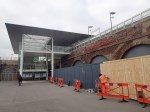
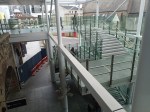

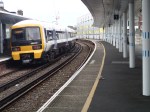

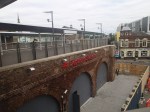

It shouldn’t be long before Deptford has a station of which it can be proud.
 The Anonymous Widower