Algeria
I had a unique insight on Algeria as a child. Next to where we lived in Cockfosters, in about the late 1950s, a family moved in next door. The father was English, but unusually for the time, his wife was a white Algerian of French extraction. I can remember her talking to my mother about life in Algiers during the Second World War and I think my mother was sympathetic to her flight in those years.
The lady had little time for the non-white Algerians and we’d probably say she was racist now, sixty years later.
It must have been about the time of the Front Algerie Francaise, who were trying to keep Algeria part of France.
You do wonder how those bad relations between the two factions in Algeria left a legacy, that we’re seeing worked out in that part of Africa today.
One thing I do remember about my neighbour, was that she wanted their son to be a Roman Catholic priest, a notion that really horrified my mother, who being of Huguenot descent, wasn’t too keen on that branch of the Christian religion. The son’s name was the same, as a well-known actor and I often wonder what he did in later life, when I see a Catholic priest.
The bonus of living next door, was that occasionally when my mother was away, I got a delicious meal sent in from next door, that had been cooked in the French manner.
Is It The Right Maple Leaf?
There’s a bit of a row going on in Canada over whether their new plastic banknotes have the right maple leaf. It’s reported here on the BBC.
I have no opinion about the maple leaf as I’m no biologist, but is that lady on the note supposed to be the Queen?
I’ve never seen a plastic banknote, although I’ve always thought they should work. Checking with Wikipedia, they are more common than you think according to this article.
Meandering Through The Snow
Today, I wanted to do two things.
First, I was going to Broadway Market to track down an old friend of C’s, who I knew had a relative with a shop there.
And then I was intending to go to a restaurant called Pappagone in Stroud Green Road to have lunch with an old friend.
I intended to get to Broadway Market by taking a 236 bus direct from Newington Green, just up the road from my house. As you an see, it was snowy, but the conditions weren’t too difficult.
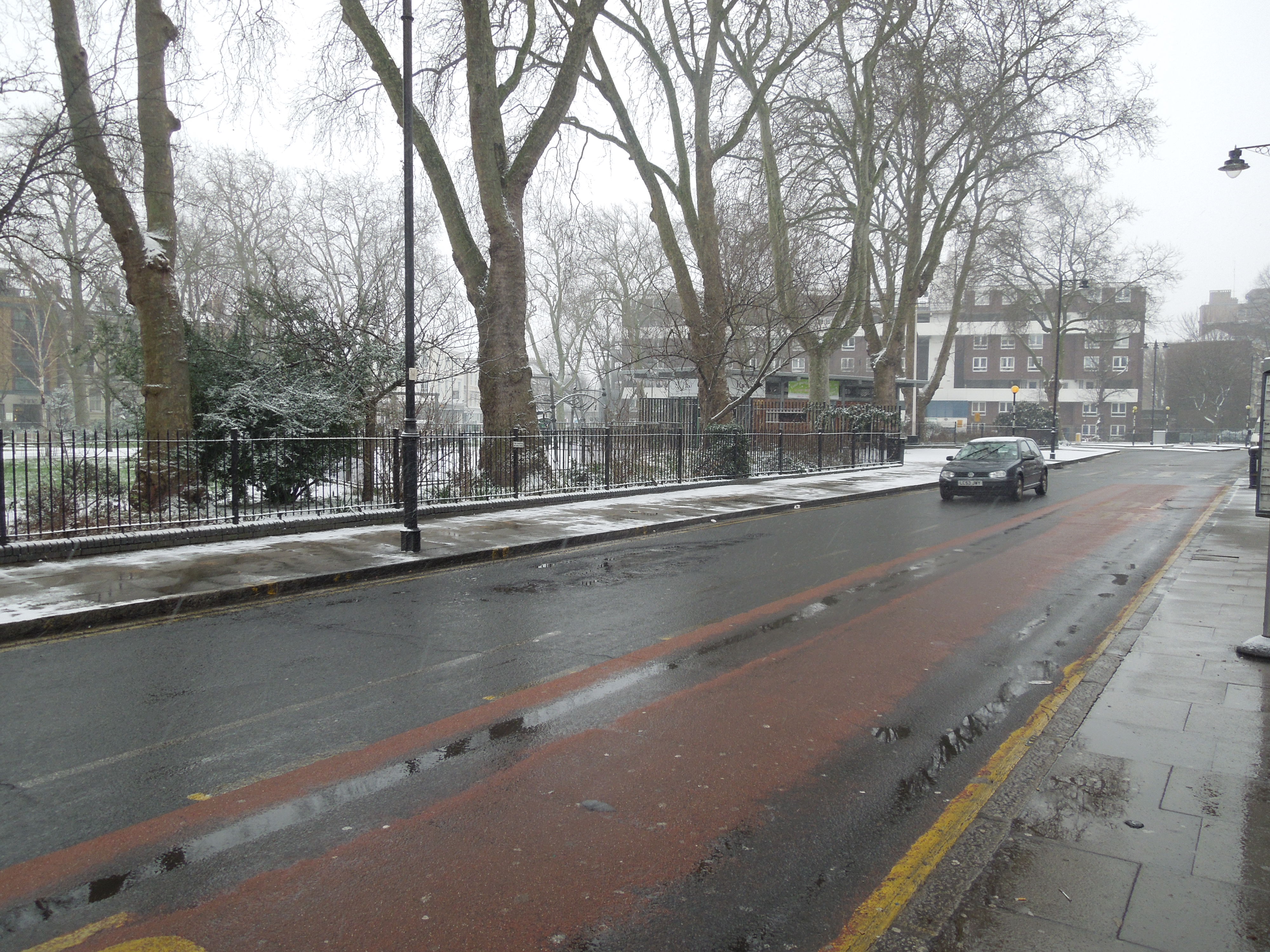
Newington Green In The Snow
The 236 is rather an untypical London bus, as it more like a country bus, that meanders around various communities as it goes on its way. It was full and comfortable an d got me safely to Broadway Market, although it probably took longer than normal due to the weather.
I didn’t find C’s friend, but I met a man who knew her and gave him my card before returning to the bus to take it all the way to its terminus at Finsbury Park station. but the stop was closed due to roadworks and I couldn’t get to the next one, before the 236 bus arrived. Then a 394 bus arrived going the other way and I decided it was better to take this to Angel station. I didn’t get that far, as the roads were slightly blocked and I then swapped to a 271 to take me to Highbury and Islington station, which would enable me to take one stop to Finsbury Park station. From there I intended to walk up Stroud Green Road
If it all sounds complicated, you have to remember that South Hackney is mainly densely packed buildings, with few main roads. Hence the meandering routes of the buses.
It might have been better, if the Chelsea Hackney line had been built after the Jubilee line as was originally planned. But not that much better, as there is no direct Underground connection between Angel and Highbury and Islington stations.
At Finsbury Park station my troubles weren’t over, as there was no staff about to tell me how to get out in Stroud Green Road and the sign had been obscured by a notice board. I also had the disadvantage, in that although I’ve changed trains at the station many times, I’ve never emerged above ground there. Eventually, i found my way and walked up the road to Pappagone.
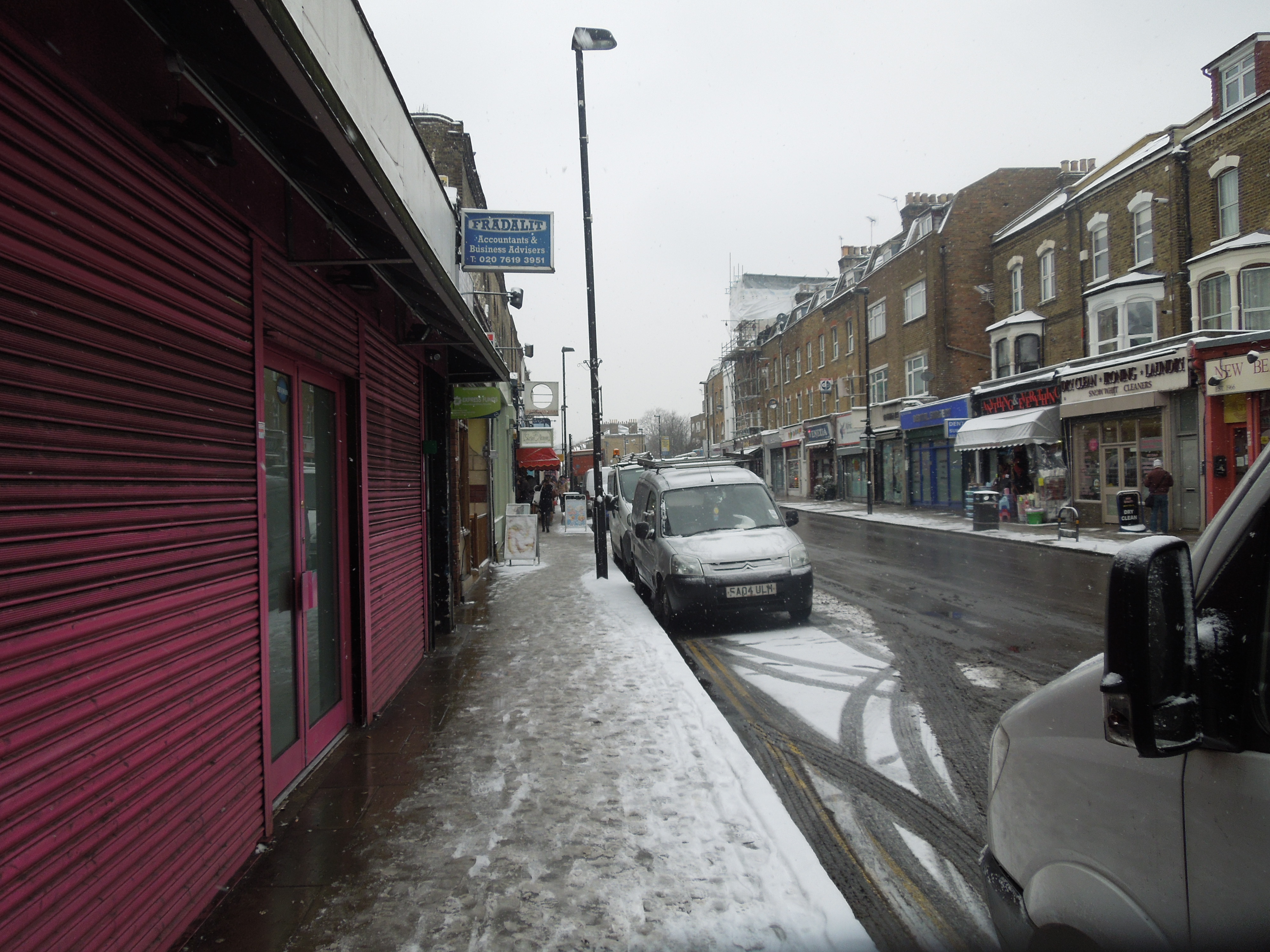
Up Stroud Green Road In The Snow
The weather wasn’t too bad, but I could have taken a bus up the hill if I’d needed to.
I had some very good gluten-free pasta at the restaurant and after a couple of hours or so, we took the 210 bus to Archway, where she went home and I took the Underground.
A quick change at Angel station onto a 38 bus and I was on the last leg home.
This trip illustrates how London or in fact any other city with a decent public transport system generally copes well with snow, as you can change your plans according to circumstances.
I always remember as a child, that the buses then, didn’t perform as well as the modern ones, which have most of the weight over the driving wheels and better tyres to boot. I saw a couple of New Buses for London and they seemed to be coping well, but strangely they had more snow on the roof, despite it being more curvy than the older buses. Perhaps the roof is better insulated!
David Versus Goliath Or ARM Versus Intel
I have just read this article in the Motley Fool about David or ARM Holdings taking on Goliath or Intel.
The article has been given the title The Reason ARM Holdings Is Dominating Intel, but interestingly the web page is called Why ARM Holdings Destined Destroy Intel. This name is chosen by the blogging software, from the first title used for the article taking out the short connecting words, like is and to. Look at the title and web address of this post.
But I suppose someone in management at The Motley Fool felt it was a bit provocative.
I don’t, as I think Intel is doomed.
As we need to process and store more and more data, one of the biggest limitations will be the amount of power needed.
As an example look at the average smart phone. It may have lots of features and processing power, but this often comes at the price of a short period of operation before the phone needs recharging. Now virtually all smart phones are built around ARM chips, as the Intel chips use too much power. This power consumption of ARM chips is one of the main reasons they are dominant in portable devices like smart phones and tablets.
The vast server farms have a similar problem and I’ve read that about ten percent of the world’s electricity consumption could be used to power them in the future. So a low-power route would be to everybody’s advantage. And ARM is the low power processor, although Intel are starting to design processors that are more efficient. Intel might be able to put up a strong fight, but I believe there’s one big reason, why it won’t.
Intel is a conservative company, that sticks to a philosophy that has worked for years. And getting companies with a vast investment in a proven philosophy to change, when the writing appears on the wall is not easy! Especially, when you are selling product to equally conservative companies, who don’t want to change their philosophies.
Let’s say you are a server manufacturer like Hewlett-Packard. You know you have to go with lower powered processors to maintain your market share.
You have two choices; wait for Intel’s product to arrive or design your own low-power processors around the ARM technology and get them manufactured by any one of a number of companies.
The second approach is probably the one with the lowest risk, so you at least have to try it. If it fails, you can still go with Intel’s new low power chips.
If you don’t succeed, then it is absolutely certain that someone else will develop a low power server using ARM technology. So your traditional market will go bang anyway!
It also has the great advantage, that if you do it successfully, Intel will start to worry, that you’ll go down the same route with all the other chips you buy from them. so you may get better prices for the other chips.
If you don’t succeed, then it is absolutely certain that someone else will develop a low power server using ARM technology. So your traditional market will go bang anyway!
The main loser in either scenario is Intel.
You have to remember how dominant IBM was in the 1960s. They had a philosophy that worked well, but where are they now! They’re just a shadow of their former selves where hardware is concerned. Smaller and more innovative companies chipped away at their market.
I would also throw in a view on how hardware designers and programmers think. Basically, ninety percent are anarchists, who believe in destroy and rebuild much better, so they will always decry the architecture of companies like Intel and go for something that appeals to their dark side.
ARM was that forbidden fruit that only a few companies used. But now it is so mainstream, you can satisfy your own preferences and those of management as well.
In five or ten years time, they’ll be writing articles about how the new processor on the block is going to destroy ARM.
The Tragic Fallout Of Doping Cheats
After the mega-cheat, Lance Armstrong’s theatrical performance, last night, Nicole Cooke this morning made an impassioned plea for the victims of those, like the drug-fuelled Texan. She said, that she had lost medals because others cheated by doping when competing against her.
I remember the 1960s, when athletics was ruined by the Soviet Block, who took everything that a chemist could devise. Look at the career of our greatest-ever female sprinter; Kathy Smallwood-Cook, who would be in a totally different league, if competition had been fair and square. It has always puzzled me, how Mary Peters ever won that pentathlon gold in the 1972 Munich Olympics. If you look at the women’s athletics results at that games, few medallists are not from the Soviet Block. There are a few West German medals, but then they had home advantage and London 2012 showed how that helps drammatically. I do remember watching that pentathlon, with C on a terrible black and white television, when Mary Peters, was almost willed over the high jump bar by masses of British troops based in Germany, who somehow had got tickets.
Where would the careers of some retired clean athletes be, if they had competed fair and square?
Cheats like Armstrong have a lot to answer for! He should be prosecuted for fraud and perhaps asked to spend some time in a nice cosy Texas jail.
Delay In Getting Funds Into Zopa
On Monday, I initiated a transfer of £2000 into Zopa from my bank account.
It arrived today, so it took three days, all because that is the speed of our banking system.
Surely, they can do better, after all the pain they’ve put the world through over the last few years.
But then they wouldn’t be able to lend that money overnight at good rates!
Eskimos
It was so cold today, that I joked to one of the driver/conductors on the 38 bus, that they were outsourcing them with Eskimos.
But seriously, on The One Show tonight, a doctor said that Eskimos shake their hands to keep them warm. I shall be trying it, if this weather persists.
I have heard from my friend in The Netherlands, that it could be as low as -13°C in Rotterdam with quite a bit of snow on the ground.
Hopefully, it won’t get that cold here tonight.
The Arches Underneath
I had gone to London Fields station to find the E5 Bakehouse, that delivers bread to the pub next door. I hadn’t expected this line of railway arches, that had been creatively turned into small business units.





The E5 Bakehouse has a rather good cafe and I had an excellent cup of tea before moving on. There was no gluten-free bread or cakes, but there was at the Happy Kitchen.
I bought a cake for later and it was certainly worth the couple of pounds I paid for it. They said it was a bit stale and that they would have some new ones tomorrow, which they were baking for their stall in Broadway Market.
My one problem with the cake, was that if this was a stale one, just how good is a freshly-baked one? I shall go and get another in a few days.
As I look back on my visit to this immaculate row of railway arches, I can imagine C, my late wife, swooning over that bread in the bakehouse and I was almost feeling resentful at being a coeliac. But then I did have that glorious cake!
Good luck to all, who try to run a business in these difficult times! And especially those, in a small niche market like gluten and everything else free cakes. Except of course quality!
 The Anonymous Widower