Kentish Town Station – 30th April 2023
This article on the BBC is entitled Kentish Town Tube Station Set To Close For Year.
This is the sub-heading.
Kentish Town Tube station is set to close for up to a year while its 26-year-old escalators are replaced.
Other works will also be performed during the closure.
- The ticket office will be removed.
- The ticket barriers will be realigned.
- New paintworks, flooring, wall tiling, and new signage will also be fitted.
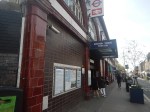
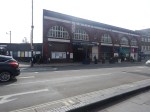
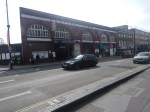
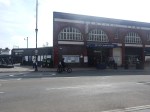
These pictures show the current state of Kentish Town station.
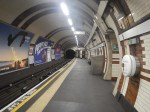
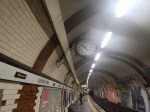
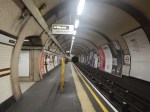
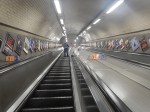
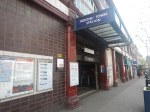
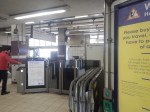
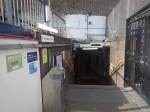
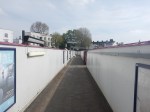
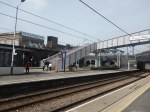
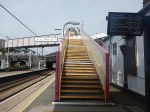
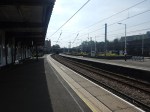

Note.
- The Victorian frontage of the station could do with a refurbishment.
- The platforms need to be restored to be the same standard as the clock.
- The escalators don’t look as bad as the article says, but new ones will give them forty years.
- Information around the gate-line for both the Underground and Thameslink, is not to the standards this passenger expects.
- The stairs connecting the London Underground station to the Thameslink bridge could be improved.
- The Thameslink information is good.
- The bridge needs lifts.
There is even a side-gate to access the Thameslink platforms, if the main entrance is closed.
Are More Trains Needed?
For a Sunday morning, both stations were surprisingly busy.
But there were only two Thameslink trains per hour (tph) between Luton and Rainham.
On all days except Sunday, the four tph Sutton Loop Line is usually running, but on Sunday it appears it’s only the Luton and Rainham service.
I suspect the Sunday service will be boosted for the duration of the closure.
Could The Side Gate Be Used Permanently?
The side-gate to the Thameslink platforms will have to be used during the station closure.
But could some arrangement be designed, so that it could be used all of the time?
Conclusion
With an unlimited budget, there’s a lot that could be done at this station.
Ten-Car Hull Trains
On Friday, about eleven in the morning, I was standing on the platform at Finsbury Park station, when unusually I saw a pair of Hull Trains’s Class 802 trains go through as a ten-car train.
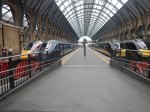
A few minutes later, I took a train to King’s Cross, where I took these pictures.

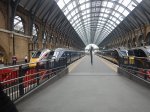
Note.
- The four platforms are numbered from 1 to 4 from the right.
- The Hull Train is in platform 3.
- The fourth picture clearly shows the 11:18 Hull Trains service has ten carriages.
Hull Trains were also selling tickets on the train.
Hull Trains Timetable On April 29th 2023
These trains ran South.
- Beverley-Kings Cross – 0557 – 5 cars
- Hull-Kings Cross – 0824 – 10 cars
- Hull-Kings Cross – 1033 – 5 cars
- Hull-Kings Cross – 1330 – 5 cars
- Hull-Kings Cross – 1531 – 5 cars
- Hull-Kings Cross – 1836 – 5 cars
And these trains ran North
- Kings Cross – 0727-Hull – 5 cars
- Kings Cross – 0948-Hull – 5 cars
- Kings Cross – 1148-Hull – 10 cars
- Kings Cross – 1448-Hull – 5 cars
- Kings Cross – 1748-Beverley – 5 cars
- Kings Cross – 1948-Hull – 5 cars
Note.
- The ten-car trains only run to Hull.
- The daily number of seats between Hull and London has been increased by 16.7 %.
- Four trains are needed to run 5 x five-car and 1 x ten-car trains in each direction.
I can see this timetable being used on other busy days.
World First As HS2 Trials Dual-Fuel Piling Rig On London Site
The title of this post, is the same as that of this news item on HS2.
This is the piling rig.
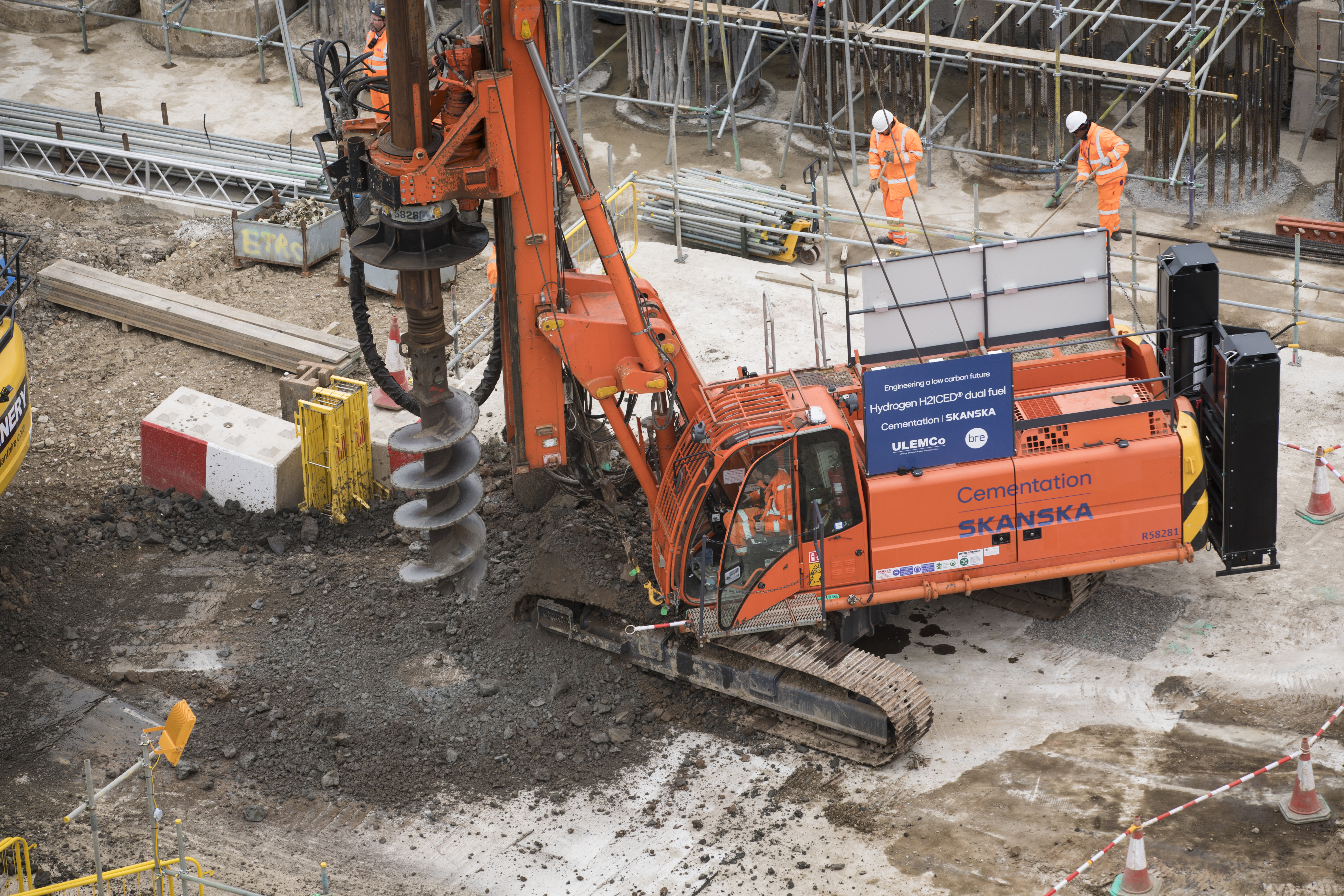
These are the two bullet points.
- Four piles installed using a hydrogen dual-fuel piling rig, cutting the use of traditional fuel by 36%.
- Trial is the first real world use of the technology on a construction site.
These three paragraphs outline the project.
HS2 has taken a further step forward in decarbonising the constructure sector, completing a world first by installing four 30-metre deep piles on a London site using a hydrogen dual-fuel piling rig.
The trial took place as part of work done in partnership by ULEMCo and Cementation Skanska, working with the world-leading Business Research Establishment (BRE), funded through the BEIS Phase 1 Red Diesel Replacement competition.
ULEMCo and Cementation Skanska successfully modified a medium sized CFA piling rig, converting it so that the machine component operated using energy from on-board hydrogen tanks. Using the dual-fuel system, both diesel and biofuels (HVO) can be mixed with hydrogen, displacing the fuel with hydrogen, resulting in a reduction in fuel use and lower CO2 emissions.
Note.
- We’re going to see a lot more large machines converted to dual-fuel and pure hydrogen.
- ULEMCo from Aintree, seem to be one of the leaders in the field of dual-fuel conversions.
You certainly see lots of these machines working around London and other big cities.
Italy’s Energy Dome Raises $44 million To Focus On CO2 Storage In US
The title of this post, is the same as that as this article on Reuters.
This is the opening paragraph.
Energy Dome, an Italian startup focusing on CO2 energy storage solutions, said on Friday it had raised 40 million euros ($44 million) from investors to fund expansion in the U.S.
It looks like another European company chasing Biden’s dollars.
Coeliac Journey Through Covid-19 – Medical Research
Medical Research
I first got involved as a lab-rat in medical research, when I had my second endoscopy to check for coeliac disease at Addenbrooke’s Hospital in 1997. Rebecca Fitzgerald took a sample of fluid from my gut for her Barrett’s oesophagus research.
After my wife died, I asked my contact in Alumni Relations at Liverpool University, if they did widowhood research.
They are one of the few universities that do and I did several interviews for PhD students in the unit, which is in the Psychology Department. It was very much a positive experience and certainly helped with my grieving.
In some ways the most enjoyable piece of research I have been involved in, was at the University of East London, where they were using computers to measure the balance of those recovering from strokes.
My GP also suggested that I get involved in drug tests at Queen Mary University. The tests were abandoned as the drug didn’t have any good or bad effects, but now I’m one of the William Harvey Centre’s lab-rats.
I also help to sponsor pancreatic cancer research at Liverpool University in memory of my son.
In There’s More To Liverpool Than Football And The Beatles!, I detail some research, that I sponsored in a small way.
I may be tempted to do the fund-raising trip again.
I always advise people to get involved in medical or psychological research, as I have found it such a beneficial experience.
One thing that is needed, is an on-line database of all research projects that are looking for volunteers.
Remember, that much medical and psychological research is about as dangerous as meeting someone in a GP’s surgery for a chat or perhaps in a cafe and having a coffee.
Coeliac Journey Through Covid-19 – A Few Bad Years
A Few Bad Years
In 2007, my wife died of what her consultant at Papworth said was one of the worst cancers he’d ever seen. It was a squamous cell carcinoma of the heart.
Her’s was the only occurrence in the UK that year and someone told me, there were four in the United States.
Our youngest son; George, then died of pancreatic cancer in 2009.
When I had been diagnosed as a coeliac in 1997, my wife and I had told our sons to get themselves tested, as is now advised on the NHS web site.
But George was a sound engineer in the music business, who lived the unhealthy rock-and-roll lifestyle.
A year later, I had a serious stroke in Hong Kong.
I had had a warning a year or so before and Addenbrooke’s recommended I go on Warfarin, but my GP in Suffolk, talked me out of it.
Now twelve years later, my GP and myself manage my Warfarin, where I do the testing of my INR on my own meter from Roche.
But then I am a Graduate Control Engineer!
A couple of doctors have said I have made a remarkable recovery, and I’ll go along with that as the only thing I can’t do, that I could before the stroke is drive, as the stroke damaged my eyesight.
On the other hand, the latest therapy for stroke in the United States is B12 injections and I haven’t missed one of my three-monthly injections since 1997.
If anybody is doing serious research into B12 and stroke recovery, then I would be happy to be a lab-rat.
Coeliac Journey Through Covid-19 – Coeliac Diagnosis
Coeliac Diagnosis
My health was very variable as a child.
I would often have months off school and my health only really improved, when my parents bought a second home in Felixstowe, where we spent most of our holidays.
Perhaps it was the sea air, as going to Liverpool University didn’t seem to adversely affect my health.
I had been having gut problems for years and then in Autumn 1997, I didn’t see my GP, but a very elderly locum, who as I had recently had my fiftieth birthday, gave me a present of my first blood test.
It turned out that I was very low on B12 and a course of B12 injections was arranged.
As the injections didn’t raise my levels, an appointment was made to see a consultant at Addenbrooke’s Hospital in Cambridge.
It was a Monday, when I went to the appointment and after a quick chat and no examination, the consultant said that they would take some blood. Which they did!
Within forty-eight hours a letter arrived on my door-mat saying that I was probably coeliac and it would be confirmed by endoscopy.
Two endoscopies without sedative or anaesthetic were performed and I was confirmed as coeliac.
The first was performed by Dr. Richard Hardwick and the second by Dr. Rebecca Fitzgerald.
My gut health has been better since, I’ve been on a gluten-free diet, backed up by three-monthly B12 injections.
A few years later, I was talking to a gastroenterologist in Cambridge and he told me that he thought he had more coeliac patients than any other in England.
The manager of Carluccio’s in the city, also told me that they sold a very high percentage of gluten-free food.
Were Cambridge testing a genetic test for coeliac disease or was it just a Whack-A-Coeliac policy?
They certainly had everything geared up for high-speed diagnosis. They even did the endoscopies without a sedative, so they didn’t need any recovery beds.
Coeliac Journey Through Covid-19 – Introduction
Introduction
I am coeliac and I had an interesting journey through the Covid-19 pandemic.
My experiences will be laid out in this narrative, as I believe they might be of use to someone.
I was born in 1947 and after a good education at Minchenden Grammar School in North London, I read Electrical Engineering and Electronics at Liverpool University, where in addition to getting a B. Eng degree, I met and married my late wife; Celia. We had three boys in the early seventies.
My working life was mainly spent in the solving of mathematical problems and writing software to perform complex calculations mainly in the fields of data analysis, project management, statistics and the solving of simultaneous differential equations.
The Artemis software, that I wrote in the 1970s, controlled the building of the Channel Tunnel, was the software of choice in the development of the North Sea oil and gas fields and was even used by NASA to plan the missions of the Space Shuttles and their refurbishment after each flight.
My business partners and myself sold the company to the American aerospace company; Lockheed in the 1980s.
Since then, I have been involved in various ventures.
The most successful was to back two inventors, who had developed an aerosol valve that used nitrogen as the propellant.
We sold that on to Johnson & Johnson, but the experience led to the development of the Respimat Inhaler for Boehringer Ingelheim.
Coeliac Journey Through Covid-19
I am writing this presentation for a meeting, in the next few days, so there will be several pages with similar titles to this.
Govia Thameslink Railway Issues a Prior Information Notice For New Trains
This article on Railway Gazette is entitled UK Railway News Round-Up and contains this section.
Govia Thameslink Railway has issued a prior information notice seeking the provision of between 21 and 30 four-car 25 kV 50 Hz 160 km/h through-gangwayed EMUs with air-conditioning and toilets for use on existing and/or additional Great Northern services from May 2024. Maintenance would be undertaken in-house at Hornsey depot, supported by a Technical Support & Spares Supply Agreement.
I find this all a bit puzzling.
- The trains that need replacing are surely the eighteen Class 313 trains, that run on the West Coastway Line, as they are some of the oldest trains on the UK network.
- If Govia Thameslink Railway were serious about decarbonisation, they would also replace the Class 171 diesel trains, that work the Marshlink Line and the Uckfield branch, with electric trains with a range of thirty miles on batteries.
How many trains would be needed to replace the Class 313 and Class 171 trains?
- The eighteen three-car Class 313 trains could be replaced with an equal number of new four-car trains and this might result in a rise in passenger numbers.
- I would assume the eighteen trains includes allowances for trains in maintenance and spare trains for when a train fails.
- It may be possible to replace the six four-car Class 171 trains used on the Marshfield Line with three new four-car trains, which have a range of thirty miles on batteries.
- The eleven two-car Class 171 trains used on the Uckfield branch could be replaced with three new four-car trains, which have a range of thirty miles on batteries and would run as four-car trains.
- If eight-car trains were needed on the Uckfield branch, there would be a need for six new four-car trains.
- If twelve-car trains were needed on the Uckfield branch, there would be a need for nine new four-car trains.
Note.
- If four-car trains are needed on the Uckfield branch, this means a total of 18+3+3 or 24 trains.
- If eight-car trains are needed on the Uckfield branch, this means a total of 18+3+6 or 27 trains.
- If twelve-car trains are needed on the Uckfield branch, this means a total of 18+3+9 or 30 trains.
Trains on these Southern routes wouldn’t be stabled at Hornsey depot, but could be moved to Hornsey for maintenance using Thameslink.
But the puzzling bit is that the prior information notice says that the trains will be.
Four-car 25 kV 50 Hz 160 km/h through-gangwayed EMUs with air-conditioning and toilets for use on existing and/or additional Great Northern services from May 2024.
Note.
- There is no mention of the trains being able to run on 750 VDC third-rail infrastructure.
- The trains will run on Great Northern services and the Class 313 and Class 171 trains run on Southern routes.
- The only Great Northern services, that have not been moved to Thameslink are Kings Cross and Cambridge, Ely and King’s Lynn and services to Moorgate.
- The Moorgate services have their own dual-voltage Class 717 trains.
- Govia Thameslink Railway have ambitions to double the frequency of trains to King’s Lynn.
- Two eight-car trains per hour (tph) between King’s Cross and King’s Lynn would need sixteen operational four-car trains.
- Two twelve-car trains per hour (tph) between King’s Cross and King’s Lynn would need twenty-four operational four-car trains.
If Govia Thameslink Railway are thinking of thirty new trains, they must have other destinations in mind.
Could we be seeing a double swap?
- An appropriate number of new trains are procured to run Great Northern services between Kings Cross and Cambridge, Ely and King’s Lynn.
- The Class 387 trains released will be moved to the South to replace the Class 313 and Class 171 trains.
- Some or all of the transferred Class 387 trains will be fitted with batteries to give a range of thirty miles without electrification.
Note.
- Could the new trains be Siemens Desiro City trains like the Class 700 and Class 717 trains, which are already maintained at Hornsey depot? It would surely be more efficient and save money.
- Class 387 trains are dual voltage and would need little or no modification to replace the Class 313 trains.
- Uckfield and Hurst Green junction is 24.7 miles.
- Ashford International and Ore is 25.4 miles
- Adding a battery to a Class 387 train has not been done, but Bombardier converted a near-identical Class 379 train to battery-electric operation over eight years ago.
- Converting a Class 387 train gives a dual-voltage battery-electric train.
- I suspect a charger would be needed at Uckfield. Could it be a short length of 25 KVAC overhead electrification?
Could all the Class 387 trains, that will replace the Class 313 and Class 171 trains be identical to ease the problems, when a train develops a fault?
Conclusion
It looks a good plan.
It also opens up the following possibilities.
- Deployment of 750 VDC battery-electric trains on other routes.
- Deployment of 25 KVAC overhead battery-electric trains on other routes.
- Deployment of tri-mode battery-electric trains on other routes.
- Charging of battery-electric trains using a short length of 25 KVAC overhead electrification.
- Fitting of batteries to Class 379 trains to create a 25 KVAC overhead battery-electric train.
It might be possible to convert other Electrostars to battery-electric operation.
Ignoring Class 387 trains on dedicated services like Heathrow and Gatwick Express, these trains are available for conversion.
- Class 379 trains – Stored – 30 trains
- Class 387 trains – Govia Thameslink Railway – 40 trains
- Class 387 trains – Great Western Railway – 33 trains
Note.
- This gives 103 trains.
- They all have good interiors.
- They are all 100/110 mph trains.
- All trains could be updated to 110 mph.
- All trains can use 25 KVAC overhead electrification.
- The Class 387 trains can also use 750 VDC third-rail electrification.
- The Class 379 trains were built in 2010-2011.
- The Class 387 trains were built from 2014.
I believe both classes will make excellent battery-electric trains.
Where will they be deployed?
These are a selection of routes starting in the South-East of England.
- Ashford International and Eastbourne.
- Gravesend and Hoo.
- London Bridge and Uckfield.
- London Paddington and Bedwyn.
- London Paddington and Oxford.
- Reading and Basingstoke.
- Reading and Gatwick.
- Reading and Redhill.
- Slough and Windsor & Eton Central.
- Twyford and Henley-on-Thames
I’ve only added routes which are less than thirty miles.
 The Anonymous Widower