Raft Of US-UK Nuclear Deals Ahead Of Trump Visit
The title of this post, is the same as that of this article on World Nuclear News.The article is a good summary of all the deals done between the US and UK governments concerning next-generation nuclear power.
This is the introduction.
Several agreements have been signed between UK and US companies to advance the deployment of small modular reactors and advanced reactors in both countries. The deals were signed ahead of the state visit of President Donald Trump to the UK later this week.
The whole article is a must-read.
These are my posts, that are related to the main agreement.
- Centrica And X-energy Agree To Deploy UK’s First Advanced Modular Reactors
- Nuclear Plan For Decommissioned Coal Power Station
- Rolls-Royce Welcomes Action From UK And US Governments To Usher In New ‘Golden Age’ Of Nuclear Energy
I shall finish it later.
Rolls-Royce Welcomes Action From UK And US Governments To Usher In New ‘Golden Age’ Of Nuclear Energy
The title of this post, is the same as that of this press release from Rolls-Royce.
These three paragraphs introduce the press release.
The agreement between the UK and US Governments to deepen cooperation in advanced nuclear technologies and make it quicker for companies to build new nuclear power stations sets the stage for a significant step forward in the energy security and resilience of the two nations. The Atlantic Partnership for Advanced Nuclear Energy will help ensure the accelerated development and deployment of advanced nuclear reactor technologies in the US and UK. Building a bridge between the world’s first and world’s largest civil nuclear power markets.
The global market for advanced nuclear technologies is estimated to be worth many trillions up to 2050. Secure, scalable and reliable power across civil, defence, industrial and maritime sectors is needed to meet growing demands in digital and AI. In the US alone, demand for nuclear power is forecast to grow from 100GWe to 400GWe by 2050.
Rolls-Royce stands ready to seize the opportunity to further innovate and partner in the development of advanced nuclear technologies which will deliver thousands of skilled jobs, attract investment and support the economic growth of both the US and the UK.
Note.
- Rolls-Royce have several partners for the SMR, who include Siemens and a couple of American companies.
- Rolls-Royce are involved with US company; BWXT, in one of the consortia developing a micro-reactor for the US Department of Defense, which I wrote about in Rolls-Royce To Play Key Role In US Department Of Defense Nuclear Microreactor Program.
- Rolls-Royce also has a large design, development and manufacturing presence in the United States.
- The new engines for the B-52s are from Rolls-Royce.
Rolls-Royce has a very strong footprint in the United States.
Nuclear Plan For Decommissioned Coal Power Station
The title of this post, is the same as that of this article on the BBC.
This is the sub-heading.
Nuclear power could be generated on the site of a former coal power station in Nottinghamshire.
These first four paragraphs add details.
Cottam Power Station was decommissioned in 2019, and in August its eight 114m (375ft) cooling towers were demolished.
Three businesses – American energy firm Holtec International, EDF UK, and real estate manager Tritax – have now signed an agreement to set up a small modular reactor (SMR) to power “advanced” data centres at the 900-acre site.
Holtec said the project could create “thousands of high-skilled manufacturing and construction jobs”, as well as “long-term roles”.
The SMR at Cottam would be the second of its kind, following the creation of a plant at Palisades in Michigan, in the US.
Note.
- Cottam was a 2,000 MW power station, that could run on coal, oil and biomass.
- If a nuclear power station is built at Cottam, it will be one of the first nuclear stations not close to the coast.
I asked Google AI for details of the plant at Palisades in Michigan and received this reply.
The Palisades SMR project at the Palisades Nuclear Plant in Michigan will feature two Holtec SMR-300 units, each producing at least 300 megawatts of power, for a combined total of at least 600-640 megawatts of net power. This project aims to have the first US dual-unit SMR 300 system operational by 2030, and the SMRs are designed to produce electricity and provide steam for other industrial purposes.
It does appear that the new generation of reactors from Holtec, Rolls-Royce and X-energy are smaller than many nuclear reactors built in the last twenty years.
This Google Map shows the Cottam site.
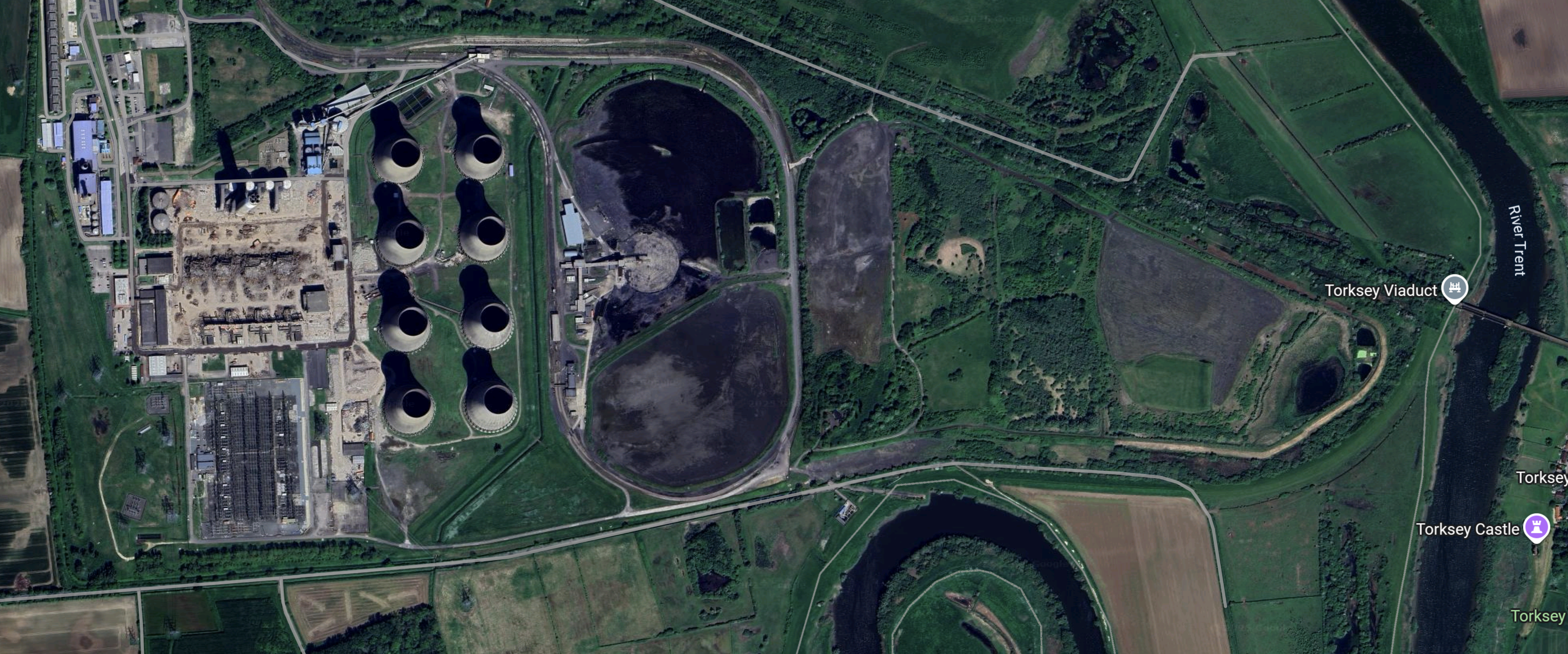
Note.
- The River Trent surrounds the site.
- Could the Trent be used for cooling water?
- The cooling towers are still in place, so the image must have been taken before August.
- The sub-station is in the South-West corner of the site.
- The railway over Torksey viaduct is disused.
It would appear that there is generous space for the SMRs and a few data centres.
The Cottam Solar Project
In DCO Decision On 480MW West Burton Solar NSIP Delayed Until 2025, I wrote about three large solar projects in Eastern England.
The Cottam Solar Project was one of the projects and wants to use the Cottam site.
- The Cottam Solar Project has a web site.
- It will have a capacity of 600 MW, with a battery, with a battery with a 600 MW output and a 600 MWh capacity.
- The solar farm will use the grid connection of the former coal-powered Cottam power station.
- The project is massive and will cover 1270 hectares.
Will this solar project lease space for the SMR, so they can co-exist?
Conclusion
It does appear that there are more than one use for old coal-fired power station sites.
Centrica And X-energy Agree To Deploy UK’s First Advanced Modular Reactors
The title of this post, is the same as that of this press release from Centrica.
This is the sub-heading.
Centrica and X-Energy, LLC, a wholly-owned subsidiary of X-Energy Reactor Company, LLC, today announced their entry into a Joint Development Agreement (JDA) to deploy X-energy’s Xe-100 Advanced Modular Reactors (“AMR”) in the United Kingdom.
These three paragraphs add more details.
The companies have identified EDF and Centrica’s Hartlepool site as the preferred first site for a planned U.K. fleet of up to 6 gigawatts.
The agreement represents the first stage in a new trans-Atlantic alliance which could ultimately mobilise at least £40 billion in economic value to bring clean, safe and affordable power to thousands of homes and industries across the country and substantive work for the domestic and global supply chain.
A 12-unit Xe-100 deployment at Hartlepool could add up to 960 megawatts (“MW”) of new capacity, enough clean power for 1.5 million homes and over £12 billion in lifetime economic value. It would be developed at a site adjacent to Hartlepool’s existing nuclear power station which is currently scheduled to cease generating electricity in 2028. Following its decommissioning, new reactors would accelerate opportunities for the site and its skilled workforce. The site is already designated for new nuclear under the Government’s National Policy Statement and a new plant would also play a critical role in generating high-temperature heat that could support Teesside’s heavy industries.
This is no toe-in-the-water project, but a bold deployment of a fleet of small modular reactors to provide the power for the North-East of England for the foreseeable future.
These are my thoughts.
The Reactor Design
The Wikipedia entry for X-energy has a section called Reactor Design, where this is said.
The Xe-100 is a proposed pebble bed high-temperature gas-cooled nuclear reactor design that is planned to be smaller, simpler and safer when compared to conventional nuclear designs. Pebble bed high temperature gas-cooled reactors were first proposed in 1944. Each reactor is planned to generate 200 MWt and approximately 76 MWe. The fuel for the Xe-100 is a spherical fuel element, or pebble, that utilizes the tristructural isotropic (TRISO) particle nuclear fuel design, with high-assay LEU (HALEU) uranium fuel enriched to 20%, to allow for longer periods between refueling. X-energy claims that TRISO fuel will make nuclear meltdowns virtually impossible.
Note.
- It is not a conventional design.
- Each reactor is only about 76 MW.
- This fits with “12-unit Xe-100 deployment at Hartlepool could add up to 960 megawatts (“MW”) of new capacity” in the Centrica press release.
- The 960 MW proposed for Hartlepool is roughly twice the size of the Rolls-Rpoyce SMR, which is 470 MW .
- Safety seems to be at the forefront of the design.
- I would assume, that the modular nature of the design, makes expansion easier.
I have no reason to believe that it is not a well-designed reactor.
Will Hartlepool Be The First Site?
No!
This page on the X-energy web site, describes their site in Texas, which appears will be a 320 MW power station providing power for Dow’s large site.
There appear to be similarities between the Texas and Hartlepool sites.
- Both are supporting industry clustered close to the power station.
- Both power stations appear to be supplying heat as well as electricity, which is common practice on large industrial sites.
- Both use a fleet of small modular reactors.
But Hartlepool will use twelve reactors, as opposed to the four in Texas.
How Will The New Power Station Compare With The Current Hartlepool Nuclear Power Station?
Consider.
- The current Hartlepool nuclear power station has two units with a total capacity of 1,185 MW.
- The proposed Hartlepool nuclear power station will have twelve units with a total capacity of 960 MW.
- My instinct as a Control Engineer gives me the feeling, that more units means higher reliability.
- I suspect that offshore wind will make up the difference between the power output of the current and proposed power stations.
As the current Hartlepool nuclear power station is effectively being replaced with a slightly smaller station new station, if they get the project management right, it could be a painless exercise.
Will This Be The First Of Several Projects?
The press release has this paragraph.
Centrica will provide initial project capital for development with the goal of initiating full-scale activities in 2026. Subject to regulatory approval, the first electricity generation would be expected in the mid-2030s. Centrica and X-energy are already in discussions with additional potential equity partners, as well as leading global engineering and construction companies, with the goal of establishing a UK-based development company to develop this first and subsequent projects.
This approach is very similar to the approach being taken by Rolls-Royce for their small modular reactors.
Will Centrica Use An X-energy Fleet Of Advanced Modular Reactors At The Grain LNG Terminal?
This press release from Centrica is entitled Investment In Grain LNG Terminal.
This is one of the key highlights of the press release.
Opportunities for efficiencies to create additional near-term value, and future development options including a combined heat and power plant, bunkering, hydrogen and ammonia.
Note.
- Bunkering would be provided for ships powered by LNG, hydrogen or ammonia.
- Heat would be needed from the combined heat and power plant to gasify the LNG.
- Power would be needed from the combined heat and power plant to generate the hydrogen and ammonia and compress and/or liquify gases.
Currently, the heat and power is provided by the 1,275 MW Grain CHP gas-fired power station, but a new nuclear power station would help to decarbonise the terminal.
Replacement Of Heysham 1 Nuclear Power Station
Heysham 1 nuclear power station is part-owned by Centrica and EdF, as is Hartlepool nuclear power station.
Heysham 1 nuclear power station is a 3,000 MW nuclear power station, which is due to be decommissioned in 2028.
I don’t see why this power station can’t be replaced in the same manner as Hartlepool nuclear power station.
Replacement Of Heysham 2 Nuclear Power Station
Heysham 2 nuclear power station is part-owned by Centrica and EdF, as is Hartlepool nuclear power station.
Heysham 2 nuclear power station is a 3,100 MW nuclear power station, which is due to be decommissioned in 2030.
I don’t see why this power station can’t be replaced in the same manner as Hartlepool nuclear power station.
Replacement Of Torness Nuclear Power Station
Torness nuclear power station is part-owned by Centrica and EdF, as is Hartlepool nuclear power station.
Torness nuclear power station is a 1,290 MW nuclear power station, which is due to be decommissioned in 2030.
I don’t see why this power station can’t be replaced in the same manner as Hartlepool nuclear power station.
But the Scottish Nationalist Party may have other ideas?
What Would Be The Size Of Centrica’s And X-energy’s Fleet Of Advanced Modular Reactors?
Suppose.
- Hartlepool, Grain CHP and Torness power stations were to be replaced by identical 960 MW ADRs.
- Heysham 1 and Heysham 2 power stations were to be replaced by identical 1,500 MW ADRs.
This would give a total fleet size of 5,880 MW.
A paragraph in Centrica’s press release says this.
The companies have identified EDF and Centrica’s Hartlepool site as the preferred first site for a planned U.K. fleet of up to 6 gigawatts.
This fleet is only 120 MW short.
 The Anonymous Widower