Do Aventras Use Supercapacitors?
In this article in Global Rail News from 2011, which is entitled Bombardier’s AVENTRA – A new era in train performance, gives some details of the Aventra’s electrical systems. This is said.
AVENTRA can run on both 25kV AC and 750V DC power – the high-efficiency transformers being another area where a heavier component was chosen because, in the long term, it’s cheaper to run. Pairs of cars will run off a common power bus with a converter on one car powering both. The other car can be fitted with power storage devices such as super-capacitors or Lithium-ion batteries if required. The intention is that every car will be powered although trailer cars will be available.
Unlike today’s commuter trains, AVENTRA will also shut down fully at night. It will be ‘woken up’ by remote control before the driver arrives for the first shift
This was published over seven years ago, so I suspect Bombardier have refined the concept.
The extract makes three interesting points.
All Or Most Cars Will Be Powered
In A Detailed Layout Drawing For A Class 345 Train, I give the formation of a Crossrail Class 345 train.
DMS+PMS+MS1+MS3+TS(W)+MS3+MS2+PMS+DMS
Note.
- M signifies a motored car.
- Eight cars have motors and only one doesn’t.
- The train is composed of two identical half-trains, which are separated by the TS(W) car.
- There are four wheelchair spaces in the TS(W) car.
Are the MS!, MS2 and MS3 cars identical?
In addition, I have been told, that all cars in Class 720 trains are motored.
It does seem that Bombardier have fulfilled their statement from 2011.
Remote Wake-Up
This is mentioned in the extract, but there are few other references to it. I quoted a report from the Derby Telegraph, which has since been deleted, in Do Bombardier Aventras Have Remote Wake-Up?.
Supercapacitors And Lithium-Ion Batteries
According to the extract, the trains have been designed to accept supercapacitors or lithium-ion batteries if required.
As the other two statements in the extract appear to be likely, I will continue to believe that all Aventras can have some form of energy storage.
Crossrail
I’ll look first at Crossrail’s Class 345 train.
In How Much Energy Does A Crossrail Class 345 Train Use?, using the train’s data sheet, I came to the conclusion, that electricity usage of the trains is 2.67 KWh per car per kiometre or 3.29 KWh per car per mile.
In the linked post, I also calculate the kinetic energy of a fully-loaded nine-car Crossrail train.
I’ll repeat it.
- If I take a nine-car Class 345 train, this has a mass of less than 350 tonnes and a maximum speed of 145 kph.
- 1500 passengers at 80 kg each works out at another 120 tonnes.
- So for this crude estimate I’ll use 450 tonnes for the mass of a loaded train.
This gives the train a kinetic energy of 101 KWh.
As the Class 345 trains are effectively two half trains, with two PMS cars with pantographs, it is likely that they have at least two cars that are ready for supercapacitors or lithium-ion batteries.
The Design Of Crossrail
Crossrail could best be described as the Victoria Line on steroids.
- Both lines were designed to run in excess of twenty-four trains per hour (tph) across London.
- The Victoria Line was built to deep-level Underground standards, with one of the most advanced-for-its-time and successful train operating systems of all times.
- Crossrail is a modern rail line being built to National Rail standards, with world-leading advanced technology, that takes full account of modern environmental standards and aspirations.
Costs were saved on the Victoria Line by leaving out important parts of the original design..
- The route was cut back to Walthamstow Central, from the proposed terminus at Walthamstow Wood Street or possibly South Woodford or Woodford.
- Some stations like Highbury & Islington were built to a totally inadequate low-cost design.
- Third escalators at stations were changed into stairs.
- Step-free access was non-existent at the opening, but has been added to some stations since.
- Cross platform interchange with the Chingford Branch Line was left out at Walthamstow Central station.
Costs were saved on Crossrail, by using high-quality design.
- Crossrail and the Great Western Main Line electrification share a sub-station to connect to the National Grid.
- The number of ventilation and access shafts was reduced significantly, with one in a new office block; Moor House.
- Electrification uses a simple overhead rail, which is only fed with power at the ends.
I also believe that the Class 345 trains, which were designed specifically for the route, were designed to save energy and increase safety in the tunnels.
Regenerative braking normally saves energy by returning braking energy through the electrification, so it can be used to power other nearby trains.
Batteries For Regenerative Braking
However, in recent years, there has been increasing interest in diverting the braking energy to onboard energy storage devices on the train, so that it can be used when the train accelerates or to power systems on the train.
The system has these advantages.
- Less energy is needed to power the trains.
- Simpler and less costly transformers can be used for the electrification.
- The onboard energy storage can be used to power the train after an electrification failure.
- In tunnels, there is less heat-producing electricity flowing in all the cables.
Obviously, keeping the heat down in the tunnels is a good thing.
A Station Stop On Crossrail Using Regenerative Braking And Energy Storage
Imagine a fully-loaded train approaching a station, at the maximum speed on 145 kph.
- The train will have a kinetic energy of 101 kWh.
- As it approaches the station, the brakes will be applied and the regenerative brakes will turn the train’s energy into electricity.
- This energy will be stored in the onboard energy storage.
- As the train accelerates away from the station, the electricity in the onboard energy storage can be used.
The only problem, is that regenerative braking is unlikely to recover all of the train’s kinetic energy. But this is not a big problem, as the train draws any extra power needed from the electrification.
To make the system as efficient as possible, the following must be fitted.
- The most efficient traction motor.
- Onboard energy storage capable of handling the maximum kinetic energy of the train.
- Onboard energy storage with a fast response time.
The train will probably be controlled by a sophisticated computer system.
What Size Of Onboard Energy Storage Should Be Fitted?
Obviously, this is only speculation and a best guess, but the following conditions must be met.
- The onboard energy storage must be able to capture the maximum amount of energy generated by braking.
- The physical size of the energy storage system must be practical and easily fitted under or on the train.
- The energy storage system should be able to store enough energy to be able to move a stalled train to safety in the event of complete power failure.
Note that an energy storage system with a 100 kWh capacity would probably take the train somewhere around four to five kilometres.
Obviously, a series of computer simulations based on the route, passengers and various other conditions, would indicate the capacity, but I feel a capacity of around 120 kWh might be the place to start.
Where Would The Energy Storage Be Placed?
With nine cars, and with eight of them motored, there are a several choices.
- One energy storage unit in all motored cars.
- One energy storage unit in the three MS cars.
- One energy storage unit in each half train.
I’ve always liked the concept of an energy storage unit in each powered car, as it creates a nice tight unit, with energy stored near to where it is generated and used.
But there is another big advantage in splitting up the energy storage – the individual units are smaller.
Could this mean that supercapacitors could be used?
- The main need for onboard energy storage is to handle regenerative braking.
- The secondary need for onboard energy storage is for emergency power.
- There is no needon Crossrail as yet,to run the trains for long distances on stored power.
- Supercapacitors are smaller.
- Supercapacitors can handle more operating cycles.
- Supercapacitors run cooler.
- Supercapacitors have a fast response.
If running for longer distances were to be required in the future, which might require lithium-ion or some other form of batteries, I’m sure there will be space for them, under all those cars.
I wouldn’t be surprised to find out that Crossrail’s Class 345 trains are fitted with supercapacitors.
Note, that a Bombardier driver-trainer, talked of an emergency power supply, when I asked what happens if the Russians hacked the electrification.
Class 710 Trains
London Overground’s Class 710 trains are a bit of a mystery at the moment as except for a capacity of seven hundred passengers disclosed in this article on the International Railway Journal little has been published.
Here are my best guesses.
Formation
Based on the formation of the Class 345 trains, I think it will be.
DMS+PMS+MS+DMS
Effectively, this is a half-train of a seven-car Class 345 train, with a DMS car on the other end.
Dimensions
I have a Bombardier press release, which says that the car length is twenty metres, which is the same as Class 315, Class 317 and Class 378 trains and a whole load of other trains, as twenty metre cars, were a British Rail standard.
I doubt there will be much platform lengthening for these trains in the next few years.
Weight
The Wikipedia entry for Aventra gives car weight at between thirty and thirty-five tonnes, so the train weight can be anything between 120-140 tonnes.
Passenger Capacity
I wrote about this in The Capacity Of London Overground’s New Class 710 Trains.
This was my conclusion.
It appears that seven hundred is the only published figure and if it is, these new Class 710 trains are going to substantially increase public transport capacity across North London.
They are certainly future-proofed for an outbreak of London Overground Syndrome, where passenger numbers greatly exceed forecasts.
As some of the trains are being delivered as five-car units, there is always the option of adding an extra car. Especially, as the platforms on the line, seem to have been built for five or even six car trains.
London Overground have not made the platform length miscalculations of the North and East London Lines.
For the near future they’ll hold around 700 passengers at 80 Kg. each, which means a passenger weight of fifty-six tonnes.
Full Train Weight
For various train weights, the fully-loaded trains will be.
- 120 tonnes – 176 tonnes
- 130 tonnes – 186 tonnes
- 140 tonnes – 196 tonnes
Until I get a better weight for the train, I think I’ll use 130 tonnes or 186 tonnes, when fully-loaded.
Speed
I wrote about this in What Is The Operating Speed Of Class 710 Trains?.
This was my conclusion.
But what will be the operating speed of the Class 710 trains?
I said it will be somewhere between 145 kph (90 mph) and 160 kph (100 mph)
Consider.
- I think that 145 kph, will be able to handle the two planned increased frequencies of four tph.
- 145 kph is identical to the Crossrail trains.
- 160 kph is identical to the Greater Anglia trains.
- 160 kph seems to be the speed of suburban Aventras.
It’s a difficult one to call!
I do think though, that trundling around the Overground, they’ll be running at the same 121 kph of all the other trains.
Kinetic Energy
The kinetic energy of a 186 tonnes train at 121 kph is 29 kWh.
Could Supercapacitors Handle This Amount Of Energy?
I’m pretty certain they could.
Conclusion
Supercapacitors are a possibility for both trains!
I’ll review these calculations, as more information is published.
Batteries In Class 378 Trains Revisited
Two and a half years ago, I wrote Will London Overground Fit On-board Energy Storage To Class 378 Trains?.
This post effectively updates that post, with what we now know.
As far as I know, batteries have not been fitted to the Class 378 trains, but there have been other developments involving Bombardier since.
Aventras
The linked post was based on statements by Marc Phillips of Bombardier in this article in Rail Technology Magazine entitled Bombardier enters key analysis phase of IPEMU. He also said about Aventras.
Bombardier is also looking at battery options on new builds, including its Aventra platform.
I have stated several times including in Rail Magazine, that the Class 345 trains for Crossrail must have batteries and no-one has told me that I’m wrong.
Battery Train Applications
The Rail Technology article also says this.
Bombardier has started assessing potential customers for battery-powered trains, looking first at branch line applications. Batteries could be a solution allowing non-continuous electrified infrastructure, and emergency rescue and last-mile opportunities.
The article was written three and a half years ago and I suspect Bombardier have been busy researching the technology and its applications.
The High-Speed Bi-Mode Aventra With Batteries
This train was first reported to be in development in this article in Rail Magazine, which was entitled Bombardier Bi-Mode Aventra Could Feature Battery Power.
The article stated the following.
- Battery power could be used for Last-Mile applications.
- The bi-mode would have a maximum speed of 125 mph under both electric and diesel power.
- Bombardier’s spokesman said that the ambience will be better, than other bi-modes.
I very much believe that the key to the performance of this train is using batteries to handle regenerative braking in both electric and diesel modes.
In Mathematics Of A Bi-Mode Aventra With Batteries, I looked at how the train might operate.
Bombardier with better data and the latest mathematical modelling techniques have obviously extensively modelled the proposed trains and prospective routes.
No sane company listed on a Stock Exchange would launch such a product, if it didn’t know that the mathematics of the dynamics and the numbers for the accountants didn’t add up.
Voyagers With Batteries
In Have Bombardier Got A Cunning Plan For Voyagers?, I discuss a snippet found in the July 2018 Edition of Modern Railways, in an article entitled Bi-Mode Aventra Details Revealed.
In a report of an interview with Bombardier’s Des McKeon, this is said.
He also confirmed Bombardier is examining the option of fitting batteries to Voyager DEMUs for use in stations.
Batteries appear to be being proposed to make the trains more environmentally-friemdly and less-noisy.
Talent 3 With Batteries
Bombardier have launched a version of their Talent 3 train with batteries. This is the launch video.
Some of Bombardier’s points from the video.
- Emission-free
- The current range is forty kilometres
- The range will be extended to a hundred kilometres by 2020.
- Charging for forty kilometres takes between seven and ten minutes from overhead electrification.
This looks to be a serious train with orders from German train operators.
It would appear that Bombardier are very serious about the application of batteries to both new and existing trains.
Class 378 Trains And Batteries
What could batteries do for the Class 378 trains?
It looks like over the next few years, the Class 378 trains will be increasingly used on the East London Line, as they have the required evacuation capability for the Thames Tunnel.
Various documents indicate that to maximise capacity on the line, the following may happen.
- Some or all services may go to six trains per hour (tph)
- Trains may be lengthened to six-cars from five-cars.
Extra destinations might be added, but although this could be easy in South London, it would probably require a lot of station or platform development in the North.
Trains Required For The East London Line
If you look at the timing of the East London Line, you get the following journey times for the four routes.
- Highbury & Islington to West Croydon – 52-57 minutes
- Dalston Junction to New Cross – 24 minutes
- Highbury & Islington to Crystal Palace – 46 minutes
- Dalston Junction to Clapham Junction – 47-48 minutes
It could almost have been choreographed by Busby Berkeley.
This means that to run four tph on the routes needs the following number of trains.
- Highbury & Islington to West Croydon – 8 trains
- Dalston Junction to New Cross – 4 trains
- Highbury & Islington to Crystal Palace – 8 trains
- Dalston Junction to Clapham Junction – 8 trains
Which gives a total of 28 trains.
To make all these services six tph, would require the following number of trains.
- Highbury & Islington to West Croydon – 12 trains
- Dalston Junction to New Cross – 6 trains
- Highbury & Islington to Crystal Palace – 12 trains
- Dalston Junction to Clapham Junction – 12 trains
Which gives a total of 42 trains.
At present only the Crystal Palace and Clapham Junction routes have dates for the extra trains and if only these routes were increased in frequency, there would be a need for 36 trains.
Six-Car Trains
The trains might also go to six cars to increase capacity on the East London Line.
As I indicated in Will The East London Line Ever Get Six Car Trains?, cars could be used from the five-car trains not needed for the East London Line.
You would just end up with a number of three- and four-car Class 378 trains, that could be used on other routes with less passengers.
My conclusion in Will The East London Line Ever Get Six Car Trains? was this.
It will be interesting to see how London Overground, increase capacity in the coming years.
There are fifty-seven Class 378 trains in total, which have the following formation.
DMOS-MOS(B)-PTOS-MOS-DMOS
They can be lengthened and shortened, by adding or removing MOS cars.
As an extra MOS car was added to convert all trains from four-cars to five-cars a few years ago, I suspect it is not the most difficult of processes.
It should also be noted that the original three-car trains for the North London Line had the following formation.
DMOS-PTOS-DMOS
If all East London Line routes go to six tph, the required number of trains would be forty-two.
This would leave a surplus of fifteen trains to act as donors for lengthening.
To make all trains six-cars would require a further forty-two MOS cars.
Reducing the trains not needed for the East London Line to three-cars, would yield thirty MOS cars.
This could give the following fleet.
- Thirty six-car trains.
- Twelve five-car trains
- Fifteen three-car trains
To lengthen all trains needed for six-cars would require another twelve MOS cars to be obtained.
Some services could be run with five-car trains, but I don’t think that be a good idea.
I am inevitably led to the conclusion, that if the the Class 378 trains need to be extended to six-cars, then Bombardier will have to produce some more cars.
Adding Batteries To A Six-Car Class 378 Trains
Batteries would be added to Class 378 trains for all the usual reasons.
- Handling energy from regenerative braking.
- Health and safety in depots and sidings.
- Short movements on lines without electrification
- Emergency train recovery
But there might also be another important use.
The Thames Tunnel is under five hundred metres long.
As the only trains running through the tunnel are Class 378 trains, it might be possible and advantageous to run services on battery power through the tunnel.
I will estimate the kinetic energy of a six-car Class 378 train, as the batteries must be able to handle the energy of a full train, stopping from maximum speed.
- The empty train will weigh around 192 tonnes
- The maximum speed of the train is 75 mph.
- The train will hold 1050 passengers, who I will assume each weigh 90 Kg with baggage, bikes and buggies.
- This gives a fully loaded train weight of 286.5 tonnes.
Using the Omni Kinetic Energy calculator gives an kinetic energy of 45 kWh.
If four 100 kWh batteries can be fitted under a two-car Class 230 train, then surely a reasonable amount o capacity can be fitted under a six-car Class 378 train.
These pictures show the under-floor space on a dual-voltage Class 378/2 train.
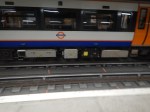
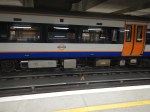
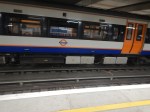
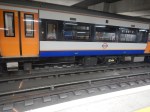
As a six-car train will have five motored cars, why not put one 50 kWh battery in each motored car, to give a capacity of 250 kWh.
In an article in the October 2017 Edition of Modern Railways, which is entitled Celling England By The Pound, Ian Walmsley says this in relation to trains running on the Uckfield Branch, which is not very challenging.
A modern EMU needs between 3 and 5 kWh per vehicle mile for this sort of service.
So how far would a six-car Class 378 train go with a fully-charged 250 kWh battery?
- 5 kWh per vehicle mile – 8 miles
- 4 kWh per vehicle mile – 10 miles
- 3 kWh per vehicle mile – 14 miles
- 2 kWh per vehicle mile – 20 miles
This is only a crude estimate, but it shows that fitting batteries to a Class 378 train with batteries could give a useful range.
Adding Batteries To A Three-Car Class 378 Trains
The same calculation can be performed for a three-car train created by removing the two MOS cars.
- The empty train will weigh around 96 tonnes
- The maximum speed of the train is 75 mph.
- The train will hold 525 passengers, who I will assume each weigh 90 Kg with baggage, bikes and buggies.
- This gives a fully loaded train weight of 143.3 tonnes.
Using the Omni Kinetic Energy calculator gives an kinetic energy of 22.4 kWh.
Unsurprisingly, the kinetic energy of the three-car train is around half that of a six-car train.
As a three-car train will have two motored cars, why not put one 50 kWh battery in each motored car, to give a capacity of 100 kWh.
Using the Ian Walmsley formula gives the following ranges.
- 5 kWh per vehicle mile – 7 miles
- 4 kWh per vehicle mile – 8 miles
- 3 kWh per vehicle mile – 11 miles
- 2 kWh per vehicle mile – 17 miles
When you consider that the length of the Greenford Branch Line is 2.5 miles, these ranges are very useful.
Routes For Three-Car Class 378 Trains With Batteries
I would suspect that these trains will have the following specification.
- Dual-voltage with ability to use either 25 KVAC overhead or 750 VDC third-rail electrification.
- A maximum speed of 75 mph
- Three cars
- Passenger capacity of 525 passengers.
- Range of between seven and fifteen miles
So for what routes would the train be suitable?
Brentford Branch Line
There have been various ideas for reopening the freight-only Brentford Branch Line to passenger traffic.
The simplest proposal would be to run a two tph shurttle train Southwards from Southall station.
As the branch is only four miles long, I believe that a three-car Class 378 train, which ran on battery-power and charged at Southall station could work the branch.
Greenford Branch Line
I’ve already mentioned the 2.5 mile long Greenford Branch Line.
The following work would need to be done before the trains could be used.
- Electrification of the bay platform at West Ealing with 25 KVAC overhead wires.
- Electrification of the bay platform at Greenford with 750 VDC third-rail.
- Minor lengthening of the bay platform at Greenford to allow sixty metre long trains.
- An extra crossover at the West Ealing end of the branch.
With these modifications it might be possible to run four tph on the branch.
Romford To Upminster Line
Currently, the Romford-Upminster Line uses a single train to shuttle the three miles at a frequency of two tph.
If the passing loop were to be reinstated, I believe that two trains could run a four tph service.
Using battery-power on the line and charging on the existing electrification at either end of the line might be a more affordable option.
It should be noted that increasing the current two x four-car tph to four x three-car tph, would be a doubling of frequency and a fifty percent increase in capacity.
West London Orbital Railway
The West London Orbital Railway is outlined like this in Wikipedia.
The West London Orbital is a proposed extension to the London Overground that makes use of a combination of existing freight and passenger lines including the Dudding Hill Line, North London Line, and the Hounslow Loop. The route runs for approximately 11 miles from West Hampstead and Hendon at the northern end to Hounslow at the Western end via Brent Cross West, Neasden, Harlesden, Old Oak Common, Acton and Brentford.
This is one of those plans, which ticks a lot of boxes.
- The tracks are already in existence.
- There is a proven need.
- Passenger numbers would support at least four tph.
- The route connects to Crossrail and HS2.
- Changing at Old Oak Common to and from Crossrail gives a quicker route to Heathrow for many in West London.
- There is electrification at both ends of the route, with only four miles without any electrification.
- At only eleven miles, it could be run by electric trains under battery power.
- The cost is quoted at around £250 million.
- Studies show it has a benefit cost ratio of 2.2:1.
As the route is now being promoted by the Mayor of London, I have a feeling this route will be created in time for the opening of HS2 in 2025.
If you want to know more about the proposals, this document on the Brent Council web site, which is entitled West London Orbital Rail, was written by consultants WSP to analyse the proposals and give a cost.
This is paragraph 5.4.38
At this stage we are assuming that the railway will be operated by diesel traction, or possibly battery or hybrid traction. While the Kew – Acton and Dudding Hill Line sections are not electrified, all the rest of the line is and battery technology may have developed sufficiently by the time of opening to be a viable option. Therefore, potential subsequent phases of the
enhancement plans could electrify the non-electrified sections.
The consultants go on to say, that stabling for diesel trains is more difficult to find in London than for electric..
The route would be suitable for Class 378 trains with batteries, but the consultants say that four-car trains will be needed.
So four-car Class 378 trains with a battery capability will be needed.
Alternatively, new four-car Class 710 trains, which I’m certain are built around a battery capability could be used instead.
A rough estimate says that for the full service of two four tph routes will need a total of eight four-car trains.
This is a much-needed route with definite possibilities.
Should A Battery MOS Car Be Designed?
If the Class 378 trains are lengthened to six cars, it looks like there will be a need for at least twelve new MOS cars.
I wonder, if it would be better to design a new BMOS car with batteries, that could either be created from an existing MOS car or newly-built.
The car would have the following specification
- It would be able to replace any current MOS car.
- It would contain the appropriate size of battery.
The advantages of a compatible new BMOS car are.
It would not require any modifications to the PTOS or DMOS cars, although the train software would need to be updated.
It would make it possible to easily create trains with a battery option with a length of four and five cars.
Could The PTOS Car Be Updated With Batteries?
This could be a logical way to go, if a battery of sufficient size can be fitted in the limited space available with all the other electrical gubbins under the floor of a PTOS car.
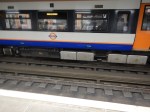
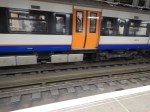
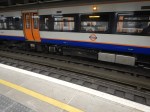
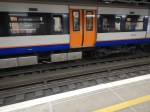
These pictures show a Class 378/2 PTOS car.
Modifying only the PTOS cars would give the following advantages.
- Only the PTOS car would need to be modified.
- PTOS cars for Class 378/1 trains would be 750 VDC only.
- PTOS cars for Class 378/2 trains, would be dual-voltage.
- Only PTOS cars for Class 378/2 trains would have a pantograph.
I will propose that the PTOS car is fiited a 100 kWh battery.
This would be sufficient for the six-car East London Line services, as all it would do was handle the regenerative braking energy, which has a maximum value of just 45 kWh. Battery range of the train would be between three and five miles, which would be enough to recover the train if power failed.
For three-car trains, the 100 kWh ranges would be as I calculated earlier.
- 5 kWh per vehicle mile – 7 miles
- 4 kWh per vehicle mile – 8 miles
- 3 kWh per vehicle mile – 11 miles
- 2 kWh per vehicle mile – 17 miles
Which is a very useful range.
If some four-car trains, were built by adding a new MOS car, the ranges on 100 kWh batteries would be.
- 5 kWh per vehicle mile – 5 miles
- 4 kWh per vehicle mile – 6 miles
- 3 kWh per vehicle mile – 8 miles
- 2 kWh per vehicle mile – 12.5 miles
As the Dudding Hill Line is only four miles long with electrification at both ends, these four-car Class 378 trains would be able to work the routes of the West London Orbital Railway.
Conclusion
Fitting batteries to Class 378 trains opens up a lot of possibilities.
One scenario could be.
- Forty-two six-car trains for the East and |South London Lines.
- One three-car train for the Brentford Branch Line
- Two three-car trains for the Greenford Branch Line.
- Two three-car trains for the Romford to Upminster Line.
- Eight four-car trains for the West London Orbital Railway.
There would be two spare three-car trains and another twenty MOS cars would be required.
.
Will The East London Line Ever Get Six-Car Trains?
On the East London Line yesterday, I was in the front car and it was noticeable how passengers moved backwards and forwards along the train so they could find a seat and also get in and out easily at the stations with short platforms.
It got me thinking, about whether six-car trains could be run on the East London Line.
Before I discuss this, I’ll give a few facts. Some are history and some are future plans.
The Original Line
I can remember taking the London Underground era line between New Cross Gate and Whitechapel stations, to get between Haywards Heath and Mile End stations. I had a client at the former and my youngest son, used to live by the latter.
The trains were four-car A60/62 Stock with a length of just 65 metres!
There were five intermediate stations, which coming North were as follows.
- Surray Quays
- Canada Water
- Rotherhithe
- Wapping
- Shadwell
The platforms and those at Whitechapel, were probably not much longer than the original trains.
The platforms have been improved in recent years.
- When the Jubilee Line was built, Canada Water station was rebuilt, but the platforms on the East London Line were not substantially lengthened.
- When the Overground was created in the early part of this century, the platforms ended up at their current length of around eighty metres.
- Recently, to create a better interchange for Crossrail, the platforms at Whitechapel station have been lengthened to around a hundred metres.
So there is now four short platforms on the East London Line.
The Class 378 Trains
The Class 378 trains were originally ordered as three-car trains, which were about sixty metres long.
Was this short length to fit the short platforms or was it because it was felt that these trains would be adequate for the route?
By the time, the trains entered service in 2010, the trains had all been extended to four-cars.
But this was still inadequate and in 2013 an order was placed to lengthen all trains to five cars, which was completed in January 2016.
Fitting Five-Car Trains Into Four-Car Platforms
Travel in the last coach of a train between Shadwell and Canada Water stations and when a station stop is made, you are left in the tunnel.
Some or all the doors don’t open and a announcement tells you, that if you want to get out, you should move forward in the train. This picture shows the last carriages of a train at Canada Water station.
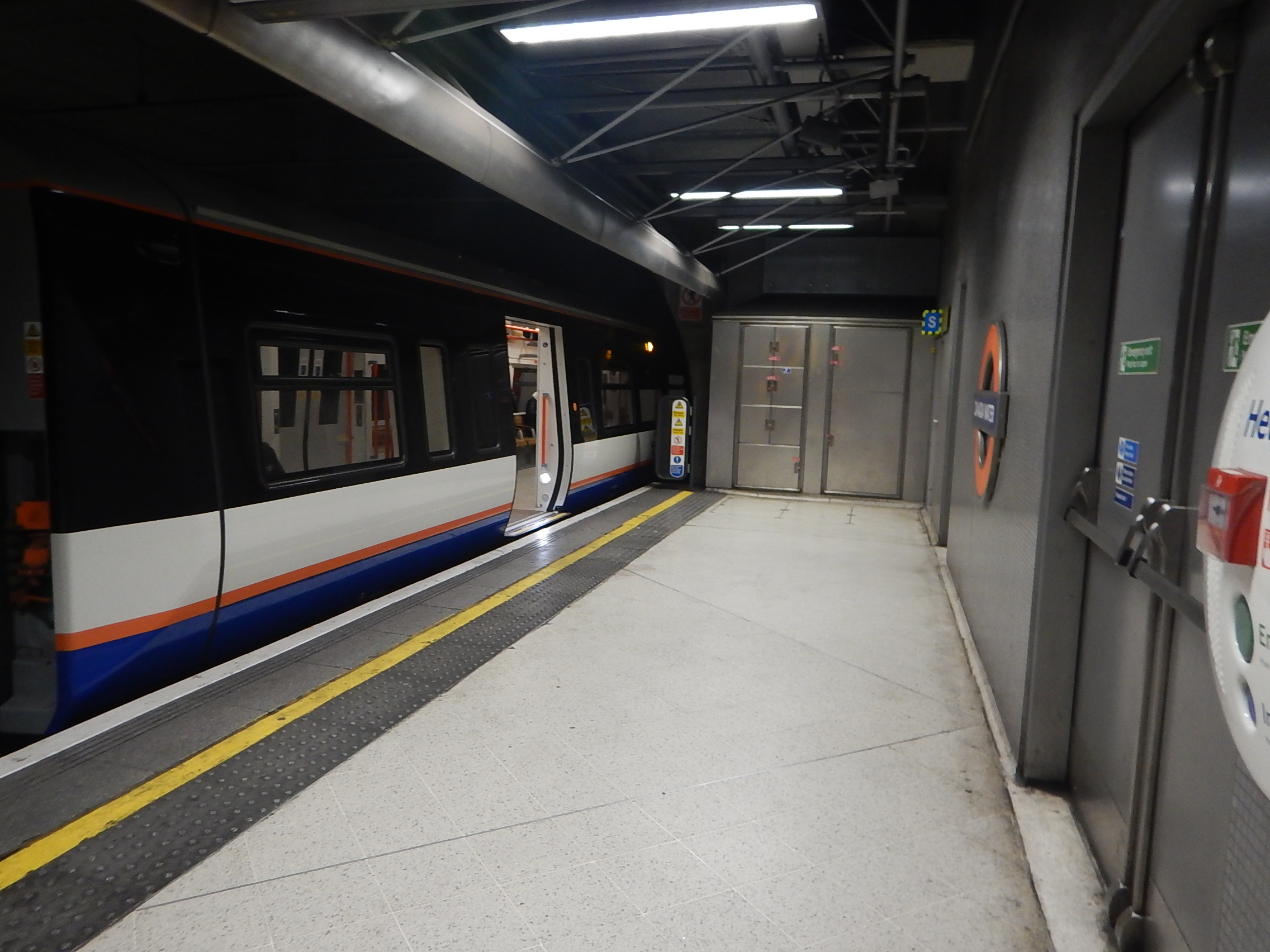
The less-than-perfect arrangement works very well.
- The walk-through nature of the trains means passengers can easily walk forward if required.
- The announcements are numerous and clear.
- Only Canada Water station, with its interchange to the Jubilee Line is a busy station.
But what probably makes the system work so well, is the fact that East Londoners are the World Champions at ducking and diving and they adjust their behaviour to the less-than-perfect arrangement.
The Length Of The Northern Platforms
Travelling home to Dalston Junction station in the last carriage, I got the impression, that all platforms are built to comfortably accept five-car trains.
It also appears that the two central bay platforms at Dalston Junction station were built for five-car trains.
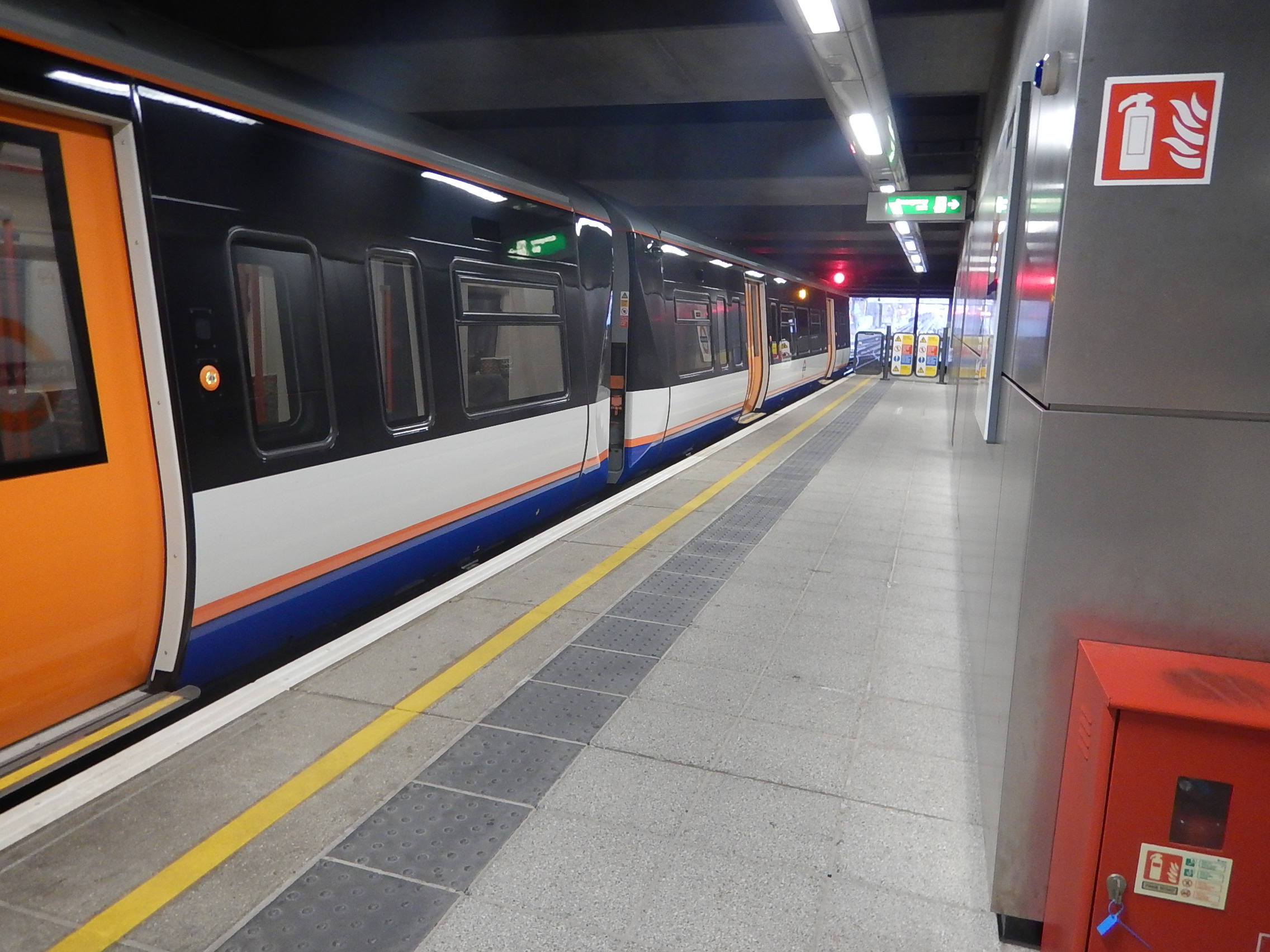
This picture shows Platform 2 at Dalston Junction station.
The Length Of The Southern Platforms
I have looked at nearly all the Southern platforms on all four Southern branches and there seems to be few if any platforms, that couldn’t take a six-car train. It should be noted that most platforms are shared with Southern services which are run by longer trains.
These pictures show Sydenham station.
Platform lengths like these are typical of many stations.
Work would be needed at Platform 2 at Clapham Junction station.
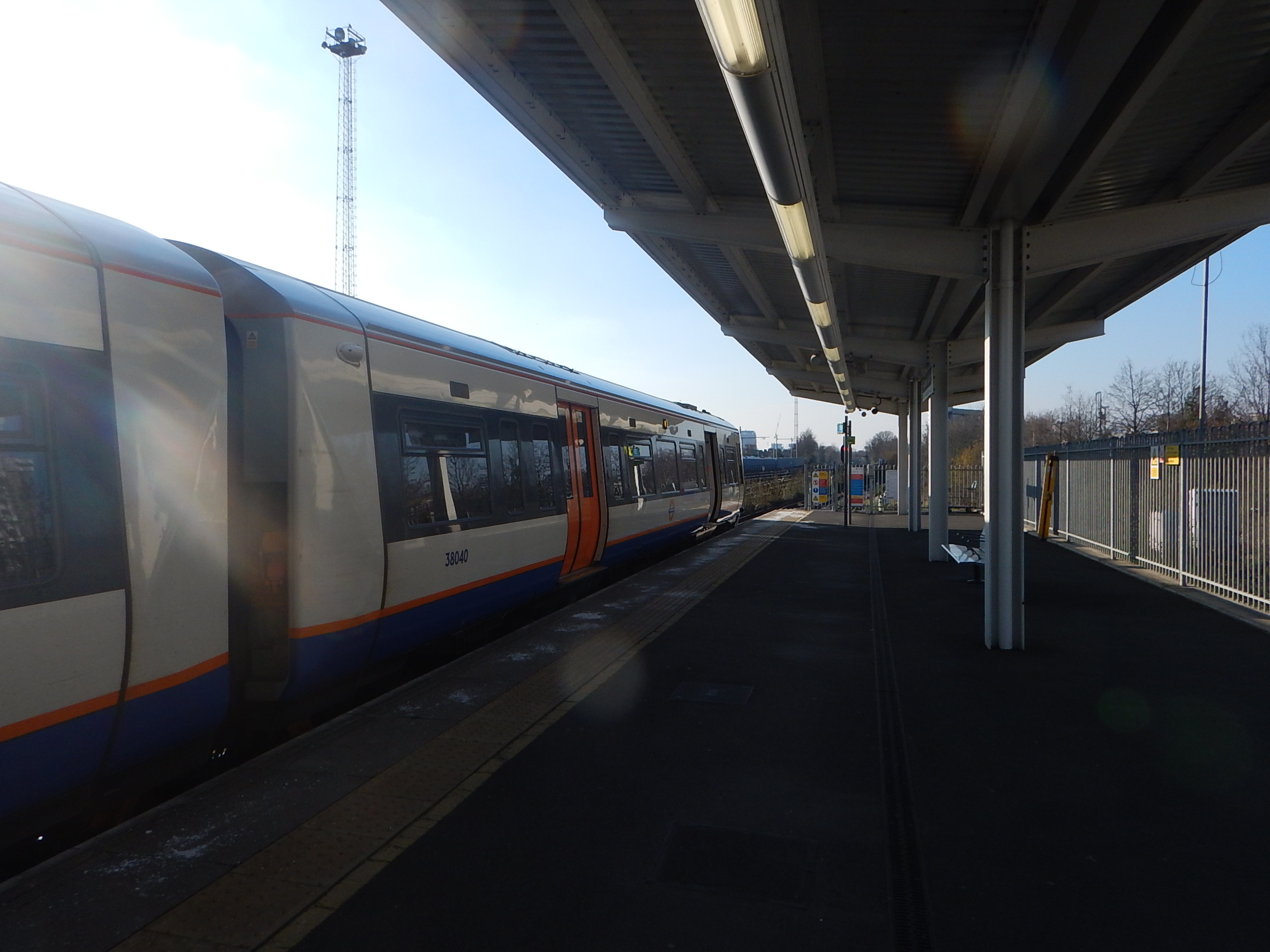
But there is space to extend the platform.
There are no problems at West Croydon station, where it seems all trains now use the bay Platform 1.

There appear to be no plans to increase services to West Croydon station from four tph, but turning the trains in the bay platform might make scheduling easier.
The Rebuilding Of Whitechapel Station
Whitechapel station is being rebuilt to provide an interchange between Crossrail, the District and Hammersmith & City Lines and the East London Line.
- The rebuilt East London Line platforms appear to be long enough for six-car trains.
- There will be two footbridges over the East London Line.
- There will be lifts and possibly escalators.
It will be a major high-capacity interchange.
The connection to Crossrail at Whitechapel station may actually take pressure from the Canada Water station.
Will passengers from the Northern section of the East London Line change at Whitechapel for Crossrail, if they are going to the West End or Canary Wharf, rather than using the Jubilee Line from Canada Water station.
As Crossrail will open up a large number of new routes, I believe, Whitechapel station will become one of the most important interchanges in East London.
East London Line Frequency Will Be Increased
This table shows Transport for London’s plas for the London Overground.
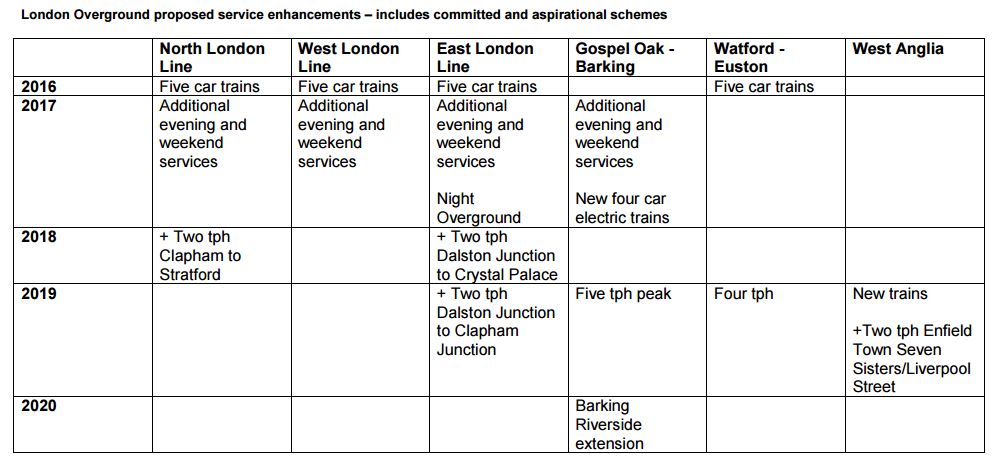
Note.
- In 2018, two extra trains per hour (tph) are planned to be run between Dalston Junction and Crystal Palace.
- In 2019, two extra tph are planned to be run between Dalston Junction and Clapham Junction.
This will mean that the frequency through the core of the East London Line will rise from 16 tph to 20 tph. This will be a train every three minutes.
It also means that the London Overground will be running ten tph between Whitechapel and Sydenham stations, with a call at New Cross Gate, which could become an important interchange.
Platforms Would Need To Be Lengthened
I think that, unless someone can come up with an innovative solution, that there will need to be some platform l;lengthening to accommodate six car trains on the East Londoin Line.
The tricky problem would be extending the platforms at Shadwell, Wapping, Rotherhithe and Canada Water stations.
Could Frequencies Be Increased?
After the increase of frequencies to Crystal Palace and Clapham Junction to four tph, there will be twenty tph, through the core of the East London Line.
With five-car trains, this would be a hundred cars per hour and with six-car trains, it would be 120 cars per hour.
Suppose another four tph, were to be squeezed through the core, then this would be 24 tph. With five-car trains, this would be 120 cars per hour.
There would be two main alternatives to increase the frequency.
- Run six tph on all the four routes.
- Add a new route, with a frequency of four tph.
Note.
- Twenty-four tph, is a frequency that is proposed for Crossrail and Thameslink using digital signalling.
- There will be one train every two and a half minutes.
- No major engineering work would be required at the stations with short platforms.
I very much feel, that increasing the frequency of trains, will be more affordable than using six-car trains.
The Problem Of Creating Six-Car Trains
Note these points about running trains through the core of the East London Line.
- Class 378 trains have an end door, so that passengers can be evacuated in the Thames Tunnel.
- Aventras don’t have end doors and would need to be updated.
- Five-car Class 378 trains can be replaced by Aventras on the North London Line and the Watford DC Line, to release more trains for the East London Line.
But the biggest problem, is probably that Bombardier don’t make Electrostars any more, and the factory ihas been turned over to Aventra production.
Conclusion
I will be very surprised if Network Rail’s original plan on six-car trains on the East London Line happens in the next few years.
£18.75m Halton Curve Project Delayed A Further Six Months
The title of this post is the same as that of this article on Rail Technology News.
I could just blame politicians for the latest project to be delayed, but it is not wholly their fault.
Train companies all over the UK, Europe and the Rest of the World have been ordering new trains at an unprecedented rate for the following reasons.
- The replacement of clapped-out trains like Pacers.
- Extra trains to provide extra services.
- Faster trains to provide faster services.
- Bigger or longer trains to provide more capacity.
- New electric trains for newly electrified routes.
- New trains often cost less to service and maintain.
- Affordable finance for quality new trains is available in billions of pounds, euros and dollars of all kinds.
In addition a lot of trains are being updated with new technology like signalling, automatic systems and high-technology interiors.
All of these factors mean that there is a high level of train testing that needs to be done.
These test tracks are in Europe and listed in Wikipedia.
- Czech Replublic – Velim railway test circuit – Two circuits of 4 and 13 km.
- France – Centre d’essais ferroviaires – Near Alstom Valenciennes factory site in Raismes, includes 2.75 km for testing at 100 km/h, a 1.85 km loop for endurance testing at 80 km/h, and a loop for testing driverless trains.
- Germany – Test and validation centre, Wegberg-Wildenrath – Near Wildenrath in North Rhine-Westphalia, Germany. Several loops of standard gauge and metre gauge track with various electrification systems.
- Poland – Test Track Centre near Żmigród – Operated by Warsaw Railway Institute. 7.7 km standard gauge loop, 160 km/h maximum allowed speed.
- Romania – Railway Testing Center Faurei – Total length of lines: 20,2 km, maximum speed 200 km/h.
- United Kingdom – Old Dalby Test Track
- United Kingdom – High Marnham Test Track
Note that Italy and Soain, who build substantial numbers of trains, don’t have a specialist testing centre.
I have read somewhere that each individual train has to be run for so many hours before it can be certified for service.
Consider
- Bombardier is building 412 Aventras with lengths between three and ten cars.
- CAF is building trains for Calodonian Sleeper, Keolis Amey Wales, Northern, TranPennine Express and West Midlands Trains.
- Hitachi is building 182 Class 800/801/802 trains with length of five or nine cars.
- Hitachi is building 80 Class 385 trains with lengths of 3/4 cars.
- Siemens are building trains for Govia Thameslink Railway.
- Stadler is building trains for Greater Anglia, Keolis Amay Wales and MerseyRail.
I haven’t done a detailed calculation must it must be at least 700 trains.
In addition there are various rebuilt and existing trains that will need to be tested.
- ScotRail’s shorterned InterCity 125s
- Porterbrook’s Class 769 trains.
- Vivarail’s Class 230 trains.
- Alstom’s Class 321 Hydrogen trains.
- Crossrail Class 345 trains need further testing.
And there will be new orders for the following franchises and lines.
- East Midlands.
- London Underground Piccadilly Line.
- South Eastern
- West Coast Alliance
I haven’t done a detailed calculation but we must be talking of nearly a thousand new trains of which probably six hundred will be delivered in the next five years.
I’m no expert, but I feel that two short test tracks and short lengths of improvised test tracks in factories, isn’t enough to test all these trains and certify them for service.
I should also blow my own trumpet and I know that when I wrote project management software, I was probably the best programmer in the World, at automatically scheduling resources.
So I tend to know, an impossible scheduling problem, when I see one!
Conclusion
We do send trains to Europe to specialist centres like the one at Velim in the Czech Republic. But these centres are also used by other European manufacturers.
I am led to the inevitable conclusion, that we need more train testing facilities, in both the UK and mainland Europe.
The Welsh Government has come to the same conclusion and are planning a test track at Neath, which I wrote about in £100m Rail Test Complex Plans For Neath Valley.
What would help, would be if Chris Grayling oiled a few wheels with some money. It might even result in some Continental trains coming to Wales for specialist testing like curing them of dracophobia.
I would also have felt that CAF would be happy with a test track fifty miles away from their new factory in Newport.
Come on, Wales! Fire up the dragons and get started!
Bombardier Introduces Talent 3 Battery-Operated Train
The title of this post is the same as that of this article on InsideEVs.
This picture of the train is from Bombardier’s web site.
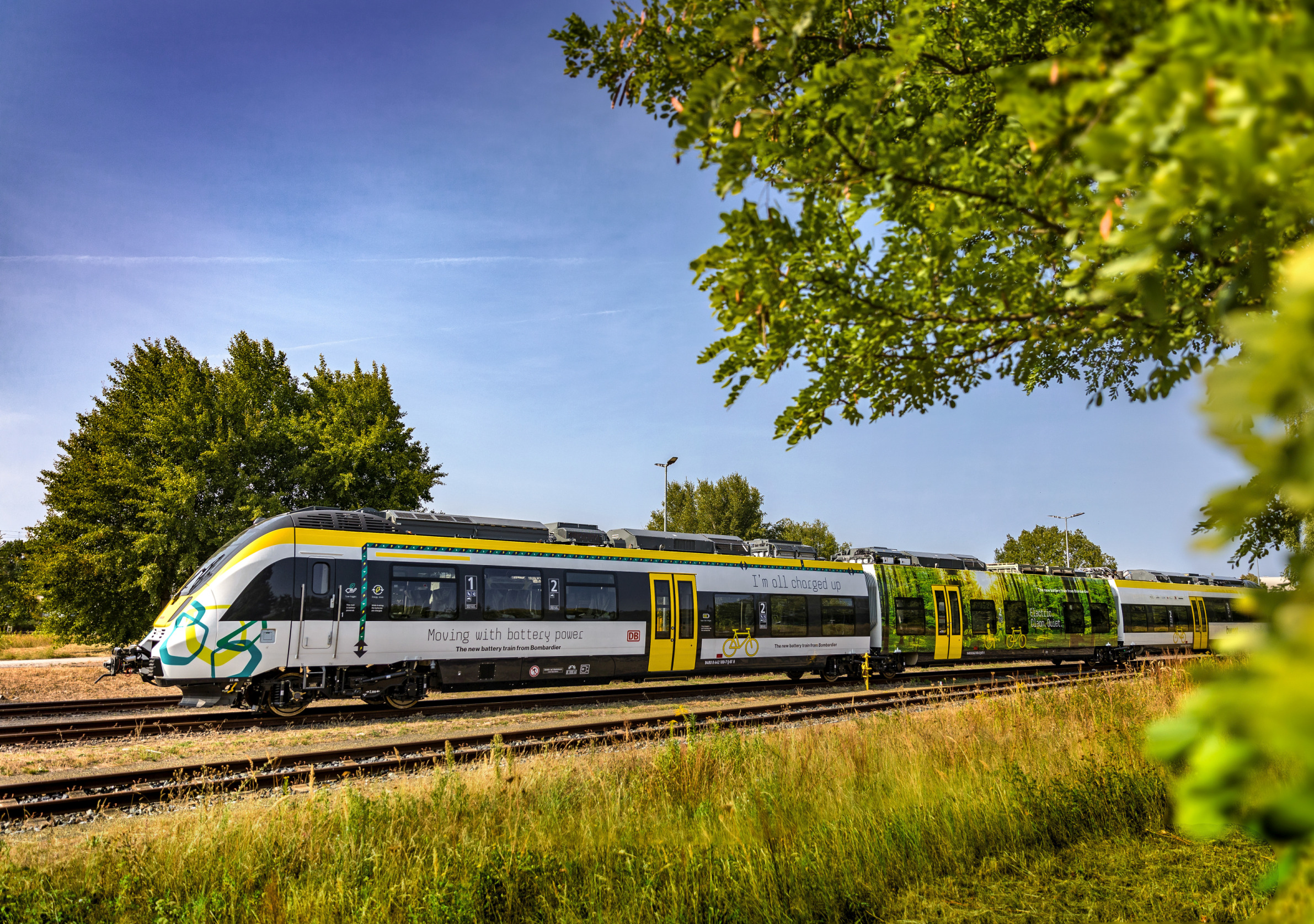
This is said.
Bombardier recently presented the Talent 3, which according to the press release, is the first of its kind to enter passenger operation in Europe in over 60 years.
The first prototype has a range of 40 km (25 miles), but the second one scheduled for 2019 will go 100 km (62 miles) on a single charge.
There’s even a nifty little video.
All the features and benefits of the train are detailed.
- Bridging gaps in electrification.
- Modular batteries, so more can be added to increase range.
- Regenerative braking to save energy.
- Lower infrastructure costs.
- Electric instead of diesel trains under city centres.
- Low noise.
- No CO2 emissions.
- Low cost of ownership.
But this is all about a Talent 3 train, that is designed to a Continental loading gauge. Wikipedia says this about the design.
The Talent 3 is based on the earlier Talent and Talent 2 designs, with a wider carbody, larger doors, and a lower floor to increase capacity and improve passenger flow at station stops. Depending on the intended service pattern, the Talent 3 can be specified with either a 160 kilometres per hour (99 mph) or 200 kilometres per hour (120 mph) top speed. Talent 3 trainsets can vary in length based on customer requirements—ÖBB ordered six-car sets with a passenger capacity of 300, while Vlexx ordered three-car sets that carry up to 160 passengers.
The picture and the video look like a three-car train.
How Large Are The Batteries On A Talent 3?
What do we know about the train?
- It appears to have three cars.
- According to this page on the Bombardier web site, the train has four batteries.
- I estimate that according to weights in Wikipedia, a three-car Talent weighs 86.5 tonnes
- A three-car Talent 3 can carry 160 passengers.
My calculation is as follows.
- 160 passengers at 90 Kg each with baggage, bikes and buggies weigh 14.4 tonnes.
- I’ll assume each battery weighs a tonne.
- This gives a total train weight of 104.9 tonnes.
At a speed of 160 kph, the Omni Kinetic Energy Calculator gives a kinetic energy of 28.8 kWh.
So four batteries of 25 kWh each would be sufficient to handle the regenerative braking energy.
What about the UK?
Bombardier’s equivalent product for the UK is the Aventra, which unlike the Talent 3 is a substantially all-new design, although it does use proven technology from previous trains.
It has also received six orders for a total of over 400 trains.
I have always thought, that after the successful BEMU trial with a Bombardier Class 379 train, that batteries will become an important part of rail technology and they will feature in the design of the Aventra.
You may think, that looking at the video, that we’ll have trouble with the UK’s small loading gauge putting the batteries on the roof of the train, but the actual size of batteries is not large and they can go underneath.
I sometimes wonder, If the reason for the delay of the Class 710 trains, is that when they are successfully running, Bombardier will finally come clean in the UK, about how batteries are used on the Aventra. You wouldn’t want the trains to be unreliable, so they are making sure that all systems, including the important batteries are 100 % reliable.
In Don’t Mention Electrification!, I state why I believe that the Barking Riverside Extension of the Gospel Oak to Barking Line could be built without electrification.
So I’m fairly certain that the Class 710 trains are designed to run this section of the route on battery power.
Cost Studies Could See Electrification Comeback
This post was updated on the 1st May 2021.
The title of this post is the same as that of an article by Roger Ford in the September 2018 Edition of Modern Railways
There are now two studies into the cost of railway electrification.
- The Department of Transport has commissioned Professor Andrew McNaughton.
- The Railway Industry Association have launched an Electrification Cost Challenge.
Both arudies expected to be completed in October.
The article gives some examples of electrification costs per single track kilometre (stkm).
- A sustained rolling program – £1million/stkm
- Great Western Main Line – £3million/stkm
- Northern England – Below £2million/stkm.
- Cumbernauld-Springburn – £1.2million/stkm
- East Coast Main Line – £500,000/stkm (At current prices)
The article finishes with these words.
£1million/stkm would be a feasible target.
That the Department for Transport has commissioned the independent review suggests electrification could still be on the agenda.
Roger is very much a respected commentator and his conclusions are more likely to be spot on, than wide of the mark.
Does Running Electric Trains On A Route Count As Electrification?
I ask this question deliberately, as over the last few years several schemes have been proposed to electrify perhaps two miles of line to a new development or city or town centre.
The Midland Metro is being extended to Wolverhampton station by building a tram line, that will be run using battery power on the existing trams.
Another example of this type of line is the extension of the Gospel Oak to Barking Line to Barking Riverside. After reading all the documentation, I have found that electric trains are mentioned several times, but electrification is not. As Bombardier Aventras probably can run on battery power, does this mean that the extension will be built without wires?
May 2021 Update – It now looks like the route is being fully electrified.
There are also some electrified branch lines, where the overhead electrification is unadulterated crap, that was erected over fifty years ago and has been got at by the steel moths.
Could we see the electrification on these branches removed to save on replacement and maintenance costs and the trains replaced by battery trains charged on the electrified main lines?
Recent Developments
I think various developments of recent years will help in the containing of electrification costs.
Batteries On Trains
It is my belief that batteries on trains could revolutionise the approach to electrification.
In my view, batteries are the only way to handle regenerative braking, which cuts energy costs.
This means, that if no trains using a route, return their braking energy through the electrification, then costs are saved by using simpler transformers.
Adequate battery capacity also gives other advantages.
- Bombardier are fitting remote wake-up to Aventras. I wrote about this in Do Bombardier Aventras Have Remote Wake-Up?
- Depots and sidings can be built with only limited electrification.
- Hitachi use batteries charged by regenerative braking to provide hotel power for Class 800 trains.
- Batteries are a simple way of moving trains in a Last Mile application on perhaps a short branch line.
- Battery power can be used to rescue a train, when the electrification fails.
Reports exist of Alstom, Bombardier, CAF, Hitachi, Siemens and Stadler using or researching the use of batteries in trains.
May 2021 Update – All Merseyrail’s Class 777 trains and East Coast Trains’ Class 803 trains will have small batteries for all purposes except traction.
Hydrogen Power
I am becoming more enthusiastic about hydrogen power, which is primarily being developed by Alstom.
- The UK could produce a lot of hydrogen easily from electrolysis of either brine to produce chlorine or water to produce hydrogen and oxygen.
- Wind power would be a convenient way to provide the electricity needed.
- Alstom are starting a project at Widnes to convert redundant Class 321 trains to hydrogen power.
A hydrogen powered Class 321 train would appear to be a powerful concept.
- The trains will still be able to run on electrification.
- The trains are pollution-free.
- The trains make extensive use of batteries.
- Alstom quote ranges of several hundred kilometres.
- It would appear that the trains will still be capable of 100 mph after conversion.
- Class 321 trains can be updated with quality interiors.
I believe these trains could find a solid market extending electrified routes.
Porterbrook’s Class 769 Trains
The Class 769 trains have been a long time coming, but companies have ordered 35 of these bi-mode upgrades of Class 319 trains.
- They will be capable of 100 mph on electricity
- They will be capable of 90 mph-plus on diesel
- They will be able to use 25 KVAC overhead or 750 VDC third rail electrification.
- They have been designed with a powerful hill-climbing capability.
Looking at the orders, some need the hill-climbing capability and GWR’s proposal to use the trains on the dual-voltage Reading-Gatwick route is a sensible one.
Bombardier’s 125 mph Bi-Mode Aventra With Batteries
I think that this train and others like it will be the future for many rail routes in the UK and around the world.
I will use the Midland Main Line as an example of the use of this type of train.
In a few years time, this important route will have the following characteristics.
- A high proportion of 125 mph running.
- Electrification between St. Pancras and Kettering/Corby
- Possibly, electrification between Sheffield and Clay Cross courtesy of High Speed Two.
Full electrification would be difficult as part of the route is through a World Heritage Site.
But Bombardier’s train would swap power source intelligently as it powered its way along at 125 mph.
May 2021 Update –Hitachi got the order and their Class 810 trains appear to be capable of being converted into Hitachi Intercity Tri-Mode Battery Trains, which are described in this Hitachi infographic.

Note the claim of fuel and carbon saving of at least twenty percent.
Stadler’s Electric/Diesel/Battery Hybrid Train
This version of Greater Anglia’s Class 755 train, has been ordered for the South Wales Metro.
It can run on the following power sources.
- 25 KVAC overhead electrification.
- Onboard diesel generators.
- Batteries
An intelligent control system will select the best power source.

With a central power pack between passenger cars, the design of this train is slightly quirky.
- It is a 100 mph train with lots of acceleration.
- I’m sure it could be equipped for 750 VDC electrification.
- The power pack can be configured for different operators and types of routes.
- Stadler are quite happy to sell small fleets of trains into niche markets.
- It is a member of the successful Flirt family of trains, which are selling all over the world.
I wouldn’t be surprised to see more of these trains sold to the UK.
Hitachi’s Class 800 Trains and Class 802 Trains
Hitachi’s Class 800 trains are already running on the Great Western Railway.
- They have an operating speed of 125 mph on both electricity and diesel.
- TransPennine Express have ordered nineteen Class 802 trains.
- Hull Trains have ordered five Class 802 trains.
I have gone from London to Swansea and back in a day in Class 800 trains and they the new trains seem to be performing well.
They will get even better, as electrification is extended to Cardiff.
May 2021 Update –Hitachi are developing battery-electric and tri-mode versions of these trains.
100/125 mph Bi-Mode Trains
In the previous sub-sections I have talked about four new bi-mode trains, that can run using electrification and under their own power.
- Class 321 Hydrogen
- Porterbrook’s Class 769 Train
- High Speed Bi-Mode Aventra
- Tri-Mode Stadler Flirt
- Hitachi’s Class 800 Trains and Class 802 Trains
The designs are different, but they have common features.
- An operating speed of at least 100 mph on electrified lines.
- 90 mph-plus operating speed, when independently powered.
- An out-and-back range of at least 200 miles away from electrification.
- Proven designs from large families of trains.
Only one new route for these trains has been fully disclosed and that is Greater Anglia’s new Liverpool Street-Lowestoft service.
- There will be three round trips a day between Lowestoft and London, using Class 755 trains.
- North of Ipswich, diesel power will be used.
- South of Ipswich, electric power will be used and trains will join the 100 mph queues to and from London.
- Extra trains North of Ipswich, will use additional Class 755 trains, shuttling up and down the East Suffolk Line.
As the Class 755 trains and the express Class 745 trains on London-Ipswich-Norwich services will share the same team of drivers, it is an efficient use of bi-mode trains to extend an electric network.
Several of the proposed electrification schemes in the UK in addition to allowing electric trains, will also open up new routes for bi-mode and tri-mode trains.
- Stirling to Perth electrification would allow bi-mode trains to run between Glasgow and Aberdeen via Dundee.
- Leeds to York electrification would improve TransPennine bi-mode performance and allow electric trains access to Neville Hill TMD from the East Coast Main Line.
- Sheffield to Clay Closs electrification for High Speed Two would also improve bi-mode performance on the Midland Main Line.
I think it should be born in mind, that the rolling out of the Class 800 trains all over the GWR, seems to have generated few bad reports, after a few initial problems.
In Thoughts On The Introduction Of Class 800 Trains On The Great Western Railway, I came to this conclusion.
There’s nothing much wrong operationally or passenger-wise with the Class 800 trains, that will not be put right by minor adjustments in the next couple of years.
So perhaps extending an electric network with quality bi-mode trains works well.
Used creatively bi-mode trains will increase the return on the money invested in electrification.
Tram-Trains
I first saw tram-trains in Kassel in 2015 and I wrote about them in The Trams And Tram-Trains Of Kassel.
We are now embracing this technology in a trial in Sheffield using new Class 399 tram-trains.
I believe that, the UK is fertile territory for this technology.
- KeolisAmey Wales haven’t waited for the results of the Sheffield trial and have already ordered thirty-six tram-trains with batteries for the South Wales Metro.
- It also looks as if the West Midlands are planning to use the technology on an extension of the Midland Metro to Brierley Hill.
- Glasgow are investigating a tram-train route to Glasgow Airport.
Although Network Rail and the Department for Transport seem to be only lukewarm on the technology, it does appear that local interests are much more enthusiastic.
In my view, the South Wales Metro is going to be a game changer, as it uses existing tracks, virtually standard tram-trains, electric/diesel/battery trains and a modicum of street running to transform a city’s transport system.
Intelligent Pantographs
I have read that the electro-diesel Class 88 locomotive can change between electric and diesel modes at line speed.
As a Control Engineer, I don’t believe it would be an impossible problem for a train powered by a mixture of 25 KVAC overhead electrification and diesel, battery, hydrogen or some other fuel to raise and lower a pantograph efficiently, to take advantage of any overhead wires that exist.
The raising and lowering could even be GPS controlled and totally automatic, with the driver just monitoring.
Ingenious Electrification Techniques
In Novel Solution Cuts Cardiff Bridge Wiring Cost, I wrote about how two simple techniques; an insulating coating and surge arresters, saved about ten million pounds, by avoiding a bridge reconstruction.
How much can be saved on electrification schemes by using simple and proven techniques like these?
Better Surveying And Site Information
A lot of the UK’s railways are like long Victorian buildings.
If you’ve ever tried to renovate a cottage that was built around the middle of the nineteenth century, you will understand the following.
- It is unlikely you will have any accurate plans.
- Some of the construction will be very good, but other parts will be downright shoddy.
- You have no idea of the quality of the foundations.
- If the building is Listed you’ll have a whole new level of bureaucracy to deal with.
Now scale your problems up to say a ten mile stretch of rail line, that needs to be electrified.
Instead of dealing with a cottage-sized plot, you may now be dealing with the following.
- A double track railway with four train per hour (tph) in both directions.
- A site that is several miles long.
- Access to the work-site could be difficult.
So just surveying what has to be done and making sure you have details on any unforeseen underground structures like sewers, gas and water mains and old mine workings, can be a major undertaking.
Reading local newspaper reports on the Gospel Oak to Barking electrification, you get the impression the following happened.
- Various overhead gantries were built to the wrong size.
- A sewer was found, that had been missed by surveyors.
- It was wrongly thought that the bridge at Crouch Hill station had sufficient clearance for the electrification. So much more work had to be done.
At least there weren’t any mine workings in East London, but as you can imagine these are a major problem in areas in the North.
Surely, nearly twenty years into the 21st century, we can avoid problems like these.
Discontinuous Electrification
Low bridges and and other structures crossing the tracks, can be a big and expensive problem, when it comes to electrifying railway lines.
In the proposed electrification of the lines for the South Wales Metro, look at these statistics.
- A total of 172 km. of track will be electrified.
- Fifty-six structures were identified as needing to be raised.
The cost savings of eliminating some of this bridge raising would not be small.
In the July 2018 Edition of Modern Railways, there is an article entitled KeolisAmey Wins Welsh Franchise.
This is said about the electrification on the South Wales Metro.
KeolisAmey has opted to use continuous overhead line equipment but discontinuous power on the Core Valley Lnes (CVL), meaning isolated OLE will be installed under bridges. On reaching a permanently earthed section, trains will automatically switch from 25 KVAC overhead to on-board battery supply, but the pantograph will remain in contact with the overhead cable, ready to collect power after the section. The company believes this method of reducing costly and disruptive engineering works could revive the business cases of cancelled electrification schemes. Hopes of having money left over for other schemes rest partly on this choice of technology.
In the final design, KeolisAmey have been able to use this discontinuous power solution at all but one of the fifty-six structures.
These structures will be checked and refurbished as required, but they would be unlikely to need lengthy closures, which would disrupt traffic, cyclists and walkers.
Each structure would need a bespoke structure to create a rail or wire on which the pantograph, would ride from one side of the structure to the other. But installing these would be a task of a much smaller magnitude.
There must be a lot of scope for both cost and time savings.
I think in the future, when it comes to electrifying existing lines, I think we’ll increasing see, this type of discontinuous electrification used to avoid rebuilding a structurally-sound bridge or structure.
I also think, that experience will give engineers a more extensive library of solutions.
Hopefully, costs could be driven downwards, instead of spiralling upwards!
Complimentary Design Of Trains And New Electrified Routes
In recent years two major electric rail projects have been planned, which have gone much further than the old philosophy of just putting up wires and a adding fleet of new trains.
I believe that the Crossrail Class 345 trains and the tunnel under London were designed to be complimentary to each other to improve operation and safety and cut operating costs.
But the interesting project is the South Wales Metro, where discontinuous electrification and battery power have been used to design, what should be a world-class metro at an affordable cost.
Too many electrification schemes have been designed by dull people, who don’t appreciate the developments that are happening.
Conclusion On Recent Developments
UK railways are doing better on electrification than many think.
Possible Developments
These are ideas I’ve seen talked about or are my own speculation.
Intelligent Discontinuous Third Rail Electrification
New third rail electrification is not installed much these days, due to perceived safety problems.
I have seen it proposed by respected commentators, that third rail electrification could play a part in the charging of train batteries.
Discontinuous third-rail electrification is already used extensively, at places like level crossings and where a safe route is needed for staff to cross the line.
But it is done in a crude manner, where the contact shoes on the train run up and down the sloping ends of the third rail.
As a time-expired Control Engineer, I’m fairly sure that a much better, safer system can be designed.
On the South Wales Metro, where discontinuous overhead electrification is to be used, battery power will be used to bridge the gaps.
Supposing trains on a third-rail electrified route, were fitted with batteries that gave the train a range of say two kilometres. This would give sufficient range to recover a train, where the power failed to a safe evacuation point.
The range on battery power would mean that there could be substantial gaps between sections of electrification, which would be sized to maximise safety, operational efficiency and minimise energy use.
Each section of electrification would only be switched on, when a train was present.
Train drivers could also have an emergency system to cut the power in a particular section, if they saw anything untoward, such as graffiti artists on the line.
Third Rail Electrification In Stations
I have seen it proposed by respected commentators, that third rail electrification could play a part in the charging of train batteries.
When you consider that trains often spend fifteen or twenty minutes at a terminal station, it could make it easier to run electric or bi-mode trains with batteries on branch lines.
The rail would normally be switched off and would only be switched on, when a train was above and connected to the rail.
As a time-expired Control Engineer, I’m fairly sure that a safe system can be designed.
Third Rail Electrification On Viaducts
To some overhead electrification gantries on top of a high viaduct are an unnecessary eyesore.

So why not use third-rail electrification, on top of viaducts like these?
Trains would need to be able to swap efficiently and reliably between modes.
Gravity-Assisted Electrification
For a country with no really high mountains, we have quite a few railways, that have the following characteristics.
- Heavily-used commuter routes.
- Double-track
- A height difference of perhaps two hundred metres.
These are a few examples.
- Cardiff Queen Street to Aberdare, Merthyr Tydfil, Rhymney and Treherbert
- Exeter to Barnstaple
- Glasgow Central to East Kilbride
- Manchester to Buxton
All are in areas, where putting up overhead gantries may be challenging and opposed by some campaigners.
As an example consider the Manchester to Buxton route.
- The height difference is 220 metres.
- One of Northern’s Class 319 trains weighs 140.3 tonnes.
- These trains have a capacity of around 320 passengers.
- If each passenger weighs 90 Kg with baggage, bikes and buggies, this gives a train weight of 167.3 tonnes.
These figures mean that just over 100 kWh of electricity would be needed to raise the train to Buxton.
Coming down the hill, a full train would convert the height and weight into kinetic energy, which would need to be absorbed by the brakes. Only small amounts of new energy would need to be applied to nudge the train onto the hill towards Manchester.
The brakes on trains working these routes must take a severe hammering.
Supposing, we take a modern train with these characteristics.
- Four cars.
- Electric traction.
- 200 kWh of battery capacity to handle regenerative braking.
Such a train would not be a difficult design and I suspect that Bombardier may already have designed an Aventra with these characteristics.
Only the uphill line would be electrified and operation would be as follows.
- Climbing to Buxton, the train would use power from the electrification.
- On the climb, the train could also use some battery power for efficiency reasons.
- The train would arrive at Buxton with enough power left in the batteries to provide hotel power in the stop at Buxton and nudge the train down the hill.
- On the descent, regenerative braking would be used to slow the train, with the energy created being stored in the batteries.
- On the level run to Manchester, battery power could be used, rather than electrification power to increase efficiency.
How efficient would that be, with respect to the use of electricity?
I would also investigate the use of intelligent third-rail electrification, to minimise visual impact and the need to raise any bridges or structures over the line.
Gravity is free and reliable, so why not use it?
We don’t know the full
Conclusion On Possible Developments
Without taking great risks, there are lots of ideas out there that will help to electrify routes in an affordable manner.
Conclusion
I very much feel we’ll be seeing more electrification in the next few years.
Battery Trains On The Uckfield Branch
The Uckfield Branch is not electrified and it only gets an hourly service to London Bridge.
However a few years ago, all platforms on the line were extended, so that twelve-car trains could run services.
I have always felt that this service was ideal for running using battery trains.
- Trains would run between London Bridge and Hurst Green using the third rail electrification.
- The batteries would be charged between London Bridge and Hurst Green stations.
- South of Hurst Green, the train would run on battery power.
- Top-up charging could be provided during the eleven minute turnround at Uckfield station.
These are distances and times between stations South of Hurst Green.
- Hurst Green – Edenbridge Town – 4.33 miles – 6.98 km. – 6 mins – 7 mins
- Edenbridge Town – Hever – 1.75 miles – 2.81 km – 4 mins – 4 mins
- Hever – Cowden – 2 miles – 3.21 km. – 4 mins – 5 mins
- Cowden – Ashurst – 2.77 miles – 4.47 km. – 4 mins – 4 mins
- Ashurst – Eridge – 2.31 miles – 3.72 km. – 6 mins – 6 mins
- Eridge – Crowborough – 3.74 miles – 6.01 km. – 6 mins – 6 mins
- Crowborough – Buxted – 4.71 miles – 7.58 km – 7 mins – 7 mins
- Buxted – Uckfield – 2.25 miles – 3.62 km – 6 mins – 4 mins
Note.
- The first time is Southbound and the second is Northbound.
- I only calculated distances to two decimal places.
It appears the route has a generally 70 mph operating speed.
What Is The Performance Of The Current Class 171 Trains?
Class 171 trains have the following characteristics.
- 100 mph operating speed
- Acceleration of 0.5 m per second²
- A weight of 90.41 tonnes.
- Seating for 109 passengers.
- On my trip today, the train rarely exceeded 50 mph.
What Would Be The Performance Of A Battery Train?
I will assume that the battery train is something like a Class 701 train fitted with batteries.
- Ten cars
- 100 mph operating speed
- Acceleration of 1.0 m per second² (taken from Class 345 train)
- A weight of 364.9 tonnes. (An estimate based on data from Weight And Dimensions Of A Class 345 Train.
- Based on the Class 345 train, I would reckon the train would have at least eight motored cars.
- I would put a battery in each motored car.
- Capacity of 546 seated and 673 standing passengers.
I will use this information to calculate the energy of the train.
Assuming each passenger with all their baggage is 90 kg., this gives a passenger weight of 109.71 tonnes
This gives a total train weight of 474.61 tonnes.
Calculating the kinetic energy for various speeds gives.
- 30 mph – 11.8 kWh
- 40 mph – 21 kWh
- 50 mph -30.9 kWh
- 70 mph – 64.5 kWh
- 80 mph – 84.3 kWh
- 90 mph – 106.7 kWh
- 100 mph – 131.7 kWh
Even the highest energy figure, which is way above the operating speed of the line could be handled under regenerative braking by a convenient size of battery.
How Would A Battery Train Operate?
This Google Map shows Hurst Green station and Hurst Green Junction, where the Uckfield and East Grinstead branches split.
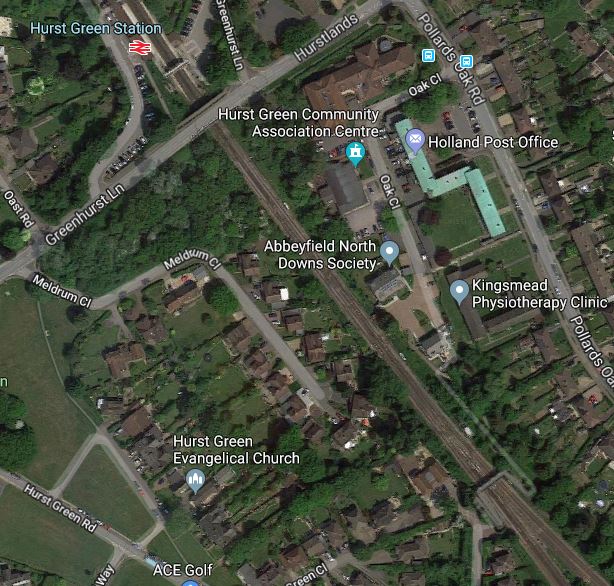
As the East Grinstead branch is electrified, after stopping at Hurst Green station, a train for Uckfield station will have something like two to three hundred metres of electrified track to accelerate it to the operating speed.
At present the operating speed appears to be 70 mph, but if it were higher, the train would enter the section of track without electrification, with more energy.
As it is, the train would probably be entering the branch with batteries, that had been fully-charged on the way from London.
The electrification would have been used like a catapult to impart maximum energy to the train.
At each stop, the following would happen.
- Regenerative braking will convert the train’s kinetic energy into electricity, which will be stored in the batteries.
- Battery power would then accelerate the train after each stop.
As regenerative braking is not 100% efficient, there would be a loss of perhaps fifteen percent of kinetic energy at each stop.
So gradually as the train progresses to Uckfield and back, the battery charge will be depleted.
There are seven stations between Hurst Green and Uckfield,so that means that fifteen stops will have to be made before the train returns to the electrification at Hurst Green.
If the train was operating at 70 mph, the kinetic energy would be 64.5 kWh and the losses in the regenerative braking at fifteen stations would be 64.5 *0.15 *15 or 145.57 kWh.
I will assume each battery train has eight 50 kWh batteries, as Bombardier have a 50 kWh PRIMOVE battery that would be suitable.
So if the train entered the Uckfield branch with 400 kWh in the batteries and 64.5 kWh in the train, it would be carrying 464.5 kWh, that could be used to power the train.
As I said, 145.57 kWh would be lost in braking, so that would leave 318.93 kWh to take a ten car train, a distance of 46 miles.
This works out at a figure of 0.7 kWh per car per mile for the journey.
In an article in the October 2017 Edition of Modern Railways, which is entitled Celling England By The Pound, Ian Walmsley says this in relation to trains running on the Uckfield Branch, which is not very challenging.
A modern EMU needs between 3 and 5 kWh per vehicle mile for this sort of service.
So it looks like running a battery train on the route could be impossible, as there is a large difference between 0.7 and 3.
Let’s see what the mathematics say for various ideas.
Put A 50 kWh battery In Each Car
The larger battery capacity would mean the train will enter the branch carrying 564.5 kWh, that could be used to power the train.
Thus after deducting the regeneration losses of 145.57 kWh, this would leave 418.93 kWh to run the 460 vehicle miles.
This works out at a figure of 0.9 kWh per car per mile for the journey.
Improve The Efficiency Of The Regenerative Braking
Suppose that the energy lost at each stop can be reduced from fifteen to ten percent, how much difference would that make?
If the train was operating at 70 mph, the kinetic energy would be 64.5 kWh and the losses in the regenerative braking would now be 64.5 *0.10 *15 or 96.75 kWh.
Using the 500 kWh battery would mean the train will enter the branch carrying 564.5 kWh, that could be used to power the train.
Thus after deducting the regeneration losses of 96.75 kWh would leave 467.75 kWh to run the 460 vehicle miles.
This works out at a figure of 1 kWh per car per mile for the journey.
Charge the Train At Uckfield
Trains take eleven minutes to turn round at Uckfield station.
So how much power could be put into the batteries in that time?
But the Aventra isn’t a normal train.
Crossrail’s Class 345 trains have the following formation.
DMS+PMS+MS1+MS3+TS(W)+MS3+MS2+PMS+DMS
Note that it is symmetrical with two PMS cars, which have pantographs and the heavy electrical gear.
I suspect that the trains are two half trains with a degree of independent systems, so that if there are problems in the Crossrail tunnel, the train doesn’t get trapped.
I wonder if Thameslink’s Class 700 trains are the same?
So will South Western Railway’s third rail Class 701 trains be similarly designed, so that they can bridge gaps in the third rail electrification. If the third-rail shoes were in the second and ninth cars, they would be around 160 metres apart.
So perhaps a charging point based on third rail technology could be a double one, with a connection to each half-train.
This picture shows the exceedingly long platform at Uckfield station.
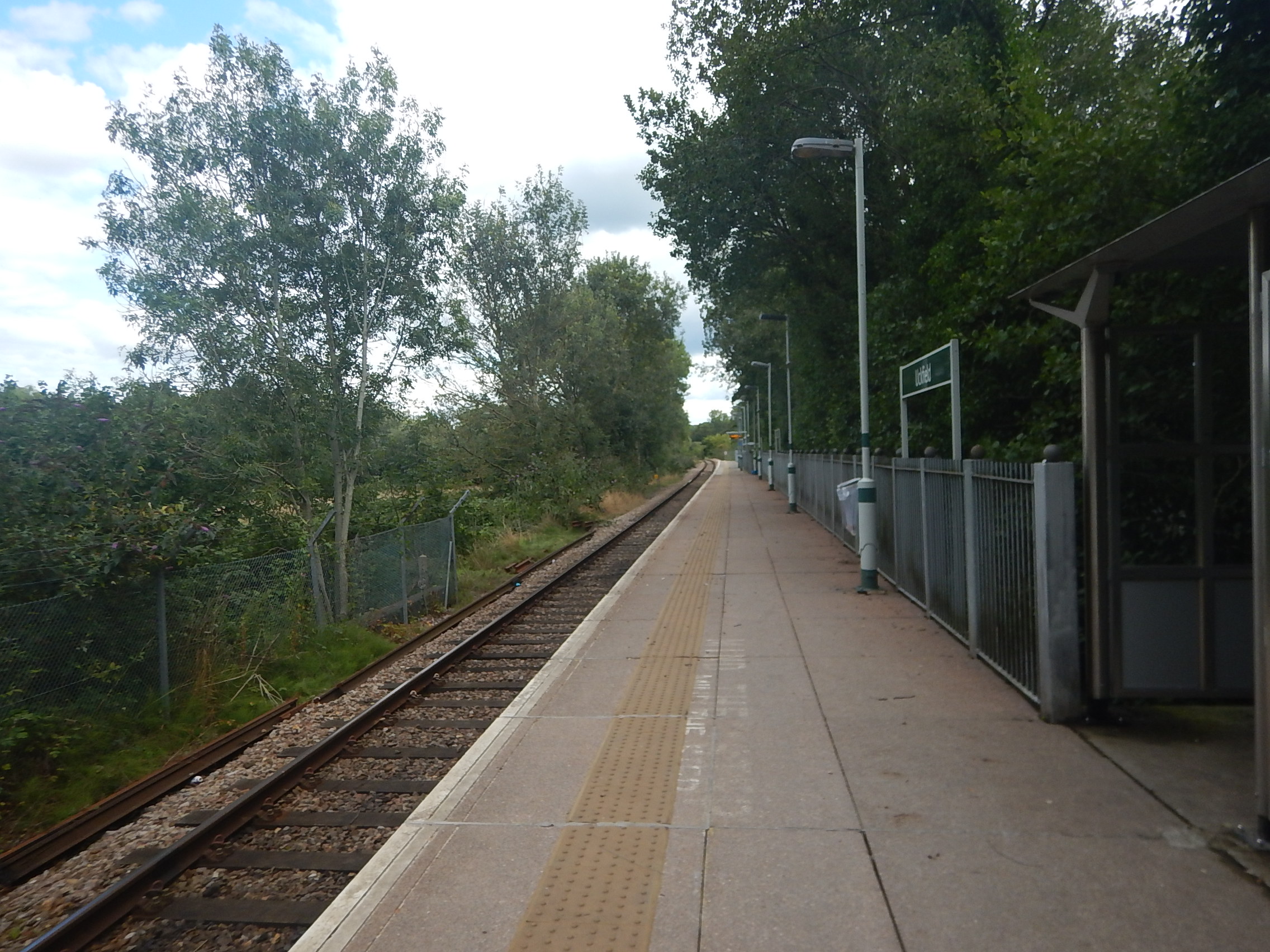
It could certainly accommodate a double third rail-based charging system.
- It would be on the far-side from the platform.
- It would only be activated with a train the platform and connected.
- It could be designed to have no serious safety problems.
The eleven minute charge would be equivalent to one of twenty-two minutes.
There must surely be the option to adjust the timetable, so that trains spend a few minutes longer at Uckfield and a few less at London Bridge, where charging isn’t necessary, as they charge the batteries all the way to and from Hurst Green.
Aventra Trains Have A Low Energy Mode
A few months ago, I was on a Crossrail train and I got talking to one of the driver/trainers.
I asked him what happens, if the power fails in the Crossrail tunnel.
He told me, that the driver switches systems off to reduce power requirements and switches to emergency power to move the train to a safe place to evacuate passengers.
Suppose though, when the train is running on batteries, power-hungry systems like air-conditioning were turned to a low energy mode. With judicious switching and innovation in design, I suspect that energy use can be lowered when running on batteries and raised when running on electrification to compensate.
Suppose, it was a very hot summer’s day.
The air-conditioning would be cooling the train from London Bridge to Hurst Green, getting more than adequate power from the electrification.
At Hurst Green, the train would be just the right temperature and the air-conditioning would be switched to eco-mode.
The train would be well-insulated and this would help maintain the cool environment, until the electrification was regained.
What about a cold day in the winter?
This post is entitled Aventras Have Underfloor Heating. On a cold day will this act a bit like a storage heating and keep the train warm if the power fails?
As I said I don’t think an Aventra is a normal train and although some of this is my deductions, we should be prepared for surprises as more of these trains start running on the UK’s railways.
Will Battery Trains Be Slower?
Much of the battery running on this route will be short hops of a few miles and minutes between stations.
The longest section will be between Crowborough and Buxted stations, which is 4.71 miles and currently takes seven minutes in both directions.
Both the Class 171 trains and the battery trains, will operate each section in the same way.
- Accelerate to the line speed, as fast as possible.
- Run at line speed for a measured distance.
- Slow down and apply braking to stop precisely in the next station.
As the battery train has 1 metre per sec² acceleration, as opposed to 0.5 metre per sec² of the diesel train, the battery train will get to line speed faster
Regenerative braking will also be smoother and possibly greater, than the brakes on the diesel train.
I am fairly sure, that a well-designed battery train will save a few minutes on each leg from Hurst Green to Uckfield.
These time savings could be used to extend the charging time at Uckfield
Conclusion
Running services on the Uckfield branch using battery-powered trains is a feasible proposition.
But these trains must have the following features.
- Regenerative braking to the trains batteries.
- A design where batteries are central to the traction system, not an afterthought.
- The ability to minimise power use for onboard systems.
But above all, the trains must have energy efficient systems.
Bombardier obviously have better figures and information than I do, so I think we should be prepared for surprises.
How Long Will A Class 345 Train Take To Go Between Two Stations Ten Kilometres Apart?
A Class 345 train has the following characteristics.
- Maximum speed of 145 kph.
- Acceleration of 1 m per second²
Using Omni’s Acceleration Calculator, I can calculate that, the train can accelerate up to full speed in 40 seconds.
Using the formula v²=u²+2as, this means that the train takes around 811 metres to get to 145 kph.
With regenerative braking, I suspect that a deceleration of the same order can be assumed.
So will it take 811 metres to stop from speed? I’ll use this figure until someone corrects me.
If the train is doing a start-stop over ten kilometres, then it will travel 8.4 kilometres at maximum speed, which will take about 3.5 minutes.
This means that the start-stop time will be 4.7 minutes.
Now I’ll look at a real example using a similar Greater Anglia Class 720 train.
These are 160 kph trains and typically work on the Great Eastern and West Anglia Main Lines with a similar operating speed.
The train will take 44.4 seconds to accelerate to operating speed and this will take 985.7 metres.
The distance between Tottenham Hale and Cheshunt stations is 12894.8 metres.
So the full speed distance could be 10923.4 metres. This will take 4.09 minutes at 160 kph.
So the start-stop time will be 5.5 minutes.
Currently, the fastest train on this route I can find takes 10 minutes.
I suspect that somewhere in this, the time at the station will complicate matters, but I do think that the fast acceleration and deceleration of the new trains will contribute to faster schedules.
And it’s not just Aventras that have this fast acceleration!
This is an extract for the Wikipedia entry for a Stadler Flirt.
Acceleration also varies between 0.8 and 1.2 m/s2 (2.6 and 3.9 ft/s2)
If you’re worried about the G forces, this is taken from the Wikipedia entry for London Underground’s 2009 Stock for the Victoria Line.
They have a higher top speed of 80 km/h (50 mph), a faster maximum acceleration of 1.3 m/s2(4.3 ft/s2), a normal service deceleration of 1.14 m/s2 (3.7 ft/s2), and an emergency brake deceleration of 1.4 m/s2 (4.6 ft/s2).
These accelerate even faster and are used for over 200.000 million journeys a year.
To put in an example from motoring, a Mini Cooper S has a 0-60 mph time of 7.4 seconds, which is an acceleration of 3.62 m/s2
Conclusions
Possibly the most important thing to reduce journey times on a rail journey, is to make sure that the operating speed is as high as possible and trains running on the route must be capable of running at that speed.
Obviously, trains do the short journey in three sections.
- They accelerate as fast as they can to the operating speed.
- They cruise at the line speed.
- They decelerate and brake, so they stop in the right place in the next station.
Dear Old Vicky has been doing this under computer control since, the line opened in the 1960s.
I gave an example from Merseyrail in Slow Trains Outside The South-East.
I said this.
The new Stadler Flirt trains are promised to save nine minutes between Southport and Hunts Cross stations, because they are better designed for passenger entrance and exit with faster speed and better braking and acceleration.
There is a corollary to all this.
So long as you have the energy on a train for fast acceleration, whether it is battery, diesel, electrification or hydrogen, it doesn’t matter for a faster service.
So alternatives to electrification are just as good!
The Battery Trains Are Coming
Every month seems to bring more information about trains where batteries are an important part of the propulsion system of the train.
So what are the various manufacturers offering?
Alstom
Alstom’s Coradia iLint train is hydrogen powered and as this video shows, batteries are an important part of the design of the train, which can probably be considered a hydrogen/battery hybrid train.
As I wrote in Germany Approves Alstom’s Hydrogen Train For Passenger Service, these trains will be entering service in late summer in Germany.
In the UK, Alstom are to convert some of the hundred-plus fleet of Class 321 trains, to running on hydrogen power.
I set out my thoughts on this in Thoughts On A Hydrogen-Powered Class 321 Train.
These were my conclusions.
- The Class 321 train will make a good hydrogen-powered train.
- Alstom would not have looked at converting a thirty-year-old train to hydrogen power, if they thought it would be less than good.
- British Rail’s design of a 750 VDC bus makes a lot of the engineering easier and enables the train to be tailored for world-wide markets, with different electrification systems and voltages.
- Having two different hydrogen-powered trains will give Alstom a better place in an emerging market.
I suspect in a few years time, if these two hydrogen projects are successful, Alstom will design and manufacture, a whole family of hydrogen-powered trains, with different gauges, capacities and operating speeds.
Bombardier
Unlike Alstom, who seem to be telling the world what they are doing with hybrid hydrogen/battery trains, Bombardier are playing their cards close to their chest.
In early 2015, I rode on Bombardier’s Class 379 Battery-Electric Multiple Unit demonstrator between Manningtree and Harwich.
It destroyed my scepticism about battery-electric trains.
Since then, the following has happened.
Class 345 Trains Have Entered Service
Class 345 trains have entered service on Crossrail routes to the East and West of London.
Until denied by Bombardier, I believe that these trains from Bombardier’s new Aventra family use batteries for the following purposes.
- Storing and reuseing the energy generated by regenerative braking.
- Providing an emergency power source, should the main electricity supply fail.
- Allowing depots and stabling sidings without electrification.
The trains should also make Crossrail and the other routes on which they run, more electrically efficient.
Five More Fleets Of Aventras
Bombardier have sold five more fleets of Aventras.
Could electrical efficiency because of clever use of batteries be a reason?
A 125 Mph Bi-Mode Aventra With Batteries Has Been Launched
This article in Rail Magazine is entitled Bombardier Bi-Mode Aventra Could Feature Battery Power.
A few points from the article.
- Development has already started.
- Battery power could be used for Last-Mile applications.
- The bi-mode would have a maximum speed of 125 mph under both electric and diesel power.
- The trains will be built at Derby.
- Bombardier’s spokesman said that the ambience will be better, than other bi-modes.
- Export of trains is a possibility.
In Mathematics Of A Bi-Mode Aventra With Batteries, I analyse the train in detail.
This was my conclusion.
I am rapidly coming to the conclusion, that a 125 mph bi-mode train is a practical proposition.
- It would need a controllable hydrogen or diesel power-pack, that could deliver up to 200 kW
- Only one power-pack would be needed for a five-car train.
- For a five-car train, a battery capacity of 300 kWh would probably be sufficient.
From my past professional experience, I know that a computer model can be built, that would show the best onboard generator and battery sizes, and possibly a better operating strategy, for both individual routes and train operating companies.
Obviously, Bombardier have better data and more sophisticated calculations than I do.
My calculation might be wrong, but it’s in the right area.
Voyager Battery Upgrade
This use of batteries by Bombardier was a total surprise.
In the July 2018 Edition of Modern Railways, there is an article entitled Bi-Mode Aventra Details Revealed.
A lot of the article takes the form of reporting an interview with Des McKeon, who is Bombardier’s Commercial |Director and Global Head of Regional and Intercity.
This is a paragraph.
He also confirmed Bombardier is examining the option of fitting batteries to Voyager DEMUs for use in stations.
I discuss what Bombardier might be doing in Have Bombardier Got A Cunning Plan For Voyagers?.
I feel the simplest use for batteries on these trains would be to store the energy generated by regenerative braking in batteries, from where it would be used for the train’s hotel power!
This would reduce the need for the engines to be running in stations.
Conclusion
I think Bombardier have been thinking very hard about how you design a train with batteries.
CAF
CAF have fitted several of their trams with batteries and this system will be used on the Midland Metro, to create new routes without catenary.
But they only seem to have an on-off order for trains fitted with batteries for Auckland.in New Zealand.
The order seems to be on hold.
Given that CAF, have a reputation for research and development and they have used batteries in trams, I can’t believe that they are not looking seriously at how to use batteries in their train designs.
Hitachi
On page 79 of the January 2018 Edition of Modern Railways, Nick Hughes, who is the Sales Director of Hitachi Rail Europe outlines how the manufacturer is embracing the development of battery technology.
He is remarkably open.
I wrote Hitachi’s Thoughts On Battery Trains, after reading what he said.
Hitachi certainly have working battery trains in Japan and use batteries on Class 800 trains to capture the energy generated by regenerative braking. On these trains, it appears to be used for hotel power.
Siemens
Siemens have now merged with Alstom and they are also developing a hydrogen-powered train.
I wrote about this train in Siemens Joins The Hydrogen-Powered Train Club.
As with Alstom, I suspect this train will be using batteries.
Siemens have also won the order for the New Tube For London.
I wrote about this in Thoughts On The New Tube For London.
In the Future Upgrades section of the Wikipedia entry for the Piccadilly Line, this is said.
Siemens publicised an outline design featuring air-conditioning and battery power to enable the train to run on to the next station if third and fourth rail power were lost. It would have a lower floor and 11% higher passenger capacity than the present tube stock. There would be a weight saving of 30 tonnes, and the trains would be 17% more energy-efficient with air-conditioning included, or 30% more energy-efficient without it
I would suspect, the batteries are also used to handle the energy from regenerative braking
Stadler
Stadler have developed a bi-mode Flirt, which has been ordered by Greater Anglia as the Class 755 train.
They have now sold a diesel/electric/battery tri-mode to KeolisAmey Wales, which from the visualisations look like the trains are closely related to the Class 755 trains.
Stadler are also delivering Class 777 trains to Merseyrail. Wikipedia says this.
In May 2018, it was announced the sixth Class 777 unit to be delivered will be fitted with batteries for a trial.
So it looks like two major fleets of trains for the UK from Stadler will have batteries.
There is also the Stadler Wink, which has been sold to Arriva Nederland.
Wikipedia says this about the design.
It has an aluminium carbody that can be customized in length by the customer, and can be powered by either diesel or electric powertrains with supplemental on board batteries. Arriva units will be delivered with Deutz diesel engines and batteries charged by regenerative braking; the engines are planned to be replaced by additional batteries once electrification is installed over part of their route.
Stadler seem to be putting a lot of effort into batteries.
Vivarail
Vivarail’s Class 230 train started as a diesel-electric and they have now sold a battery version to KeolisAmey Wales, which should be in service in May 2019.
Conclusion
All train manufacturers seem to be applying battery technology to their trains.
The main purpose seems to be to recycle the energy generated by regenerative braking.
Some trains like Alstom’s hydrogen trains, Bombardier’s Aventras and Stadler’s tri-mode Flirt, use the energy for traction, whilst others like Hitachi’s Class 800 trins, use the energy for hotel power.
If a researcher or company comes up with a better battery, they will certainly get a return for their efforts in the rail industry.

