Chiltern Railways Seeks Fleet Proposals
The title of this post, is the same as that of this article on Rail Business UK.
These are the first two paragraphs.
Chiltern Railways has invited proposals from established rolling stock owners for the lease and maintenance of between 25 and 70 existing vehicles to operate inter-city and regional services on the Chiltern Main Line between London Marylebone and Birmingham.
The operator is seeking either ‘self-powered’ multiple units or locomotive-hauled coaches, which can operate at 160 km/h in fixed formations of five or six passenger vehicles.
It does appear that only existing vehicles will be allowed.
These are my thoughts.
A Very Tight Timescale
The Rail Business UK article, says this about entry into service.
Requests to participate are required by February 2. Driver training is planned for 2024, and entry to passenger service for early 2025.
This requirement probably means that new trains are not allowed, as I doubt any manufacturer could deliver them by early 2025.
Although, I could envisage a proposal, where a couple of trains are delivered early for driver training and the other trains are delivered, as soon as they are refurbished or perhaps even built.
100 mph Trains With At Least Five Cars
The second paragraph from the Rail Business UK article is very definite about speed and the length of trains.
The operator is seeking either ‘self-powered’ multiple units or locomotive-hauled coaches, which can operate at 160 km/h in fixed formations of five or six passenger vehicles.
It does appear, that this paragraph, rules out multiple units, with less than five coaches. Unless it counts a two-car Class 175 train and a three-car Class 175 train working together as a five-car fixed formation. They would though be 100 mph trains.
Noise Restrictions
This noise restriction must be met according to the Rail Business UK article.
The trains must also offer a reduction in ambient noise compared to Chiltern’s existing MkIII coaches hauled by a Class 68 diesel locomotive.
This could be a difficult condition to meet for some trains and probably rules out diesel locomotives.
What Fuels Can Be Used?
This is the only restriction in the Rail Business UK article.
Any diesel-powered trains should be compatible with use of alternative fuels, such as HVO, from the service introduction date.
Chiltern have experience of this fuel.
‘Self-Powered’ Multiple Units Or Locomotive-Hauled Coaches
i am tending towards the former for the following reasons.
- I was told by someone, that between London and Norwich, ‘self-powered’ multiple units are faster than locomotive-hauled coaches.
- Without the locomotive and the driving van trailer, you may get more passengers in a shorter train. This might avoid some platform lengthening.
- The Chiltern route to Birmingham has around a dozen stops and the lighter ‘self-powered’ multiple units may save time.
- Battery-electric ‘self-powered’ multiple units can be very quiet.
- Chiltern have had complaints about noise from diesel locomotives.
The last two points probably clinch it.
The Operating Speed Of The Chiltern Main Line
I have followed the Chiltern Main Line on OpenRailwayMap and virtually all of it is faster than 75 mph, with several sections of 90-100 mph running.
Hence the need for 100 mph trains!
What Distances Are Involved
The route can be split into sections.
- London Marylebone and High Wycombe – 28.1 miles
- High Wycombe and Banbury – 41 miles
- Banbury and Warwick – 21.8 miles
- Warwick and Birmingham Moor Street – 20.8 miles
Note.
- The total distance is 111.7 miles.
- High Wycombe and Warwick are 62.8 miles apart.
No sections are too challenging.
Could A Battery-Electric Train Handle The Route?
In The Data Sheet For Hitachi Battery Electric Trains, these were my conclusions for the performance.
- The battery pack has a capacity of 750 kWh.
- A five-car train needs three battery-packs to travel 100 miles.
- A nine-car train needs five battery-packs to travel 100 miles.
- The maximum range of a five-car train with three batteries is 117 miles.
- The maximum range of a nine-car train with five batteries is 121 miles.
It would appear that a five-car train with three batteries could handle the route, but there would need to be some form of charging at both ends of the route. This might not be too easy to arrange, as all three terminal stations are not the most spacious.
Could A Tri-Mode Train Handle The Route?
LNER have taken the tri-mode route with their new trains, which I wrote about in First Tri-Mode Long Distance Trains For The East Coast Main Line.
These trains could be a possibility, especially if they used battery power in stations where there have been complaints of noise.
I suspect CAF’s tri-mode trains could also be run on HVO, as it is likely they’ll have Rolls-Royce mtu engines, which can use the fuel.
As Hitachi’s Class 802 trains also use Rolls-Royce mtu engines and Hitachi are developing a tri-mode version, these trains are also a possibility.
Although tri-mode trains are a possibility, I doubt that delivery would be easy by the beginning of 2025.
Unless, the Government has tipped off CAF and/or Hitachi and they are already building some trains that can be completed as tri-modes.
After all, CrossCountry, Grand Central, South Western Railway and TransPennine may need tri-mode trains for their routes.
What About Hydrogen?
I don’t think, there is a hydrogen train, that would be suitable and could start driver training this year.
So, unless someone like Stadler says they have a train, hydrogen looks to be a non-starter.
An Unusual Solution
As I said on the previous section about hydrogen, the time-scale is tight and this probably cuts out totally new trains.
But we may have an unusual solution, that surprised everyone.
Consider.
- I have stated that I believe that a five-car Class 802 train with three battery packs has a range of 117 miles.
- The range would be enough to go between London Marylebone and Birmingham.
- So why not put in short lengths of overhead electrification at High Wycombe, Banbury and Warwick, where the train can have a quick splash and dash?
I am certain, that a unusual strategy like this can be made to work.
Conclusion
I suspect we’ll see an innovative solution, that gives ISquared what they want.
CrossCountry’s Bournemouth And Manchester Piccadilly Service
Whilst I was at Basingstoke station yesterday one of CrossCountry‘s services between Bournemouth and Manchester Piccadilly came through, so I took these pictures.
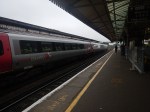
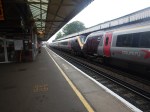
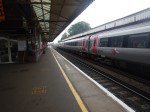


It was a long formation of Class 220 trains.
Could This Service Be Replaced By Hitachi Regional Battery Trains?
This Hitachi infographic gives the specification of the Hitachi Regional Battery Train.

I feel that in most condition, the range on battery power can be up to 56 miles.
I can break the Bournemouth and Manchester Piccadilly route into a series of legs.
- Bournemouth and Basingstoke – 60 miles – 750 VDC third-rail electrification
- Basingstoke and Reading – 15.5 miles – No electrification
- Reading and Didcot North Junction – 18 miles – 25 KVAC overhead electrification
- Didcot North Junction and Oxford – 10 miles – No electrification
- Oxford and Banbury – 22 miles – No electrification
- Banbury and Leamington Spa – 20 miles – No electrification
- Leamington Spa and Coventry – 10 miles – No electrification
- Coventry and Manchester Piccadilly – 101 miles – 25 KVAC overhead electrification
Note.
- 63 % of the route is electrified.
- The short 15.5 mile gap in the electrification between Basingstoke and Reading should be an easy route for running on battery power.
- But the 62 mile gap between Didcot North Junction and Coventry might well be too far.
The train would also need to be able to work with both types of UK electrification.
If some way could be found to bridge the 62 mile gap reliably, Hitachi’s Regional Battery Trains could work CrossCountry’s service between Bournemouth and Manchester Piccadilly.
Bridging The Gap
These methods could possibly be used to bridge the gap.
A Larger Battery On The Train
If you look at images of MTU’s Hybrid PowerPack, they appear to show a basic engine module with extra battery modules connected to it.
Will Hitachi and their battery-partner; Hyperdrive Innovation use a similar approach, where extra batteries can be plugged in as required?
This modular approach must offer advantages.
- Battery size can be tailored to routes.
- Batteries can be changed quickly.
The train’s software would know what batteries were fitted and could manage them efficiently.
I wouldn’t be surprised to see Hitachi’s Regional Battery Train able to handle a gap only six miles longer than the specification.
Battery And Train Development
As Hitachi’s Regional Battery Train develops, the following should happen.
- Useable battery capacity will increase.
- The train will use less electricity.
- Actions like regenerative braking will improve and recover more electricity.
- Driving and train operating strategies will improve.
These and other factors will improve the range of the train on batteries.
A Charging Station At Banbury Station
If some form of Fast Charge system were to be installed at Banbury station, this would enable a train stopping at Banbury to take on enough power to reliably reach Oxford or Coventry depending, on their final destination.
This method may add a few minutes to the trip, but it should work well.
Electrification Of A Section Of The Chiltern Main Line
This could be an elegant solution.
I have just flown my helicopter between Bicester North and Warwick Parkway stations and these are my observations.
- The Chiltern Main Line appears to be fairly straight and has received a top class Network Rail makeover in the last couple of decades.
- There are a couple of tunnels, but most of the bridges are new.
- Network Rail have done a lot of work on this route to create a hundred mph main line.
- It might be possible to increase the operating speed, by a few mph.
- The signalling also appears modern.
My untrained eye, says that it won’t be too challenging to electrify between say Bicester North station or Aynho Junction in the South and Leamington Spa or Warwick Parkway stations in the North. I would think, that the degree of difficulty would be about the same, as the recently electrified section of the Midland Main Line between Bedford and Corby stations.
The thirty-eight miles of electrification between Bicester North and Warwick Parkway stations would mean.
- The electrification is only eight-and-a-half miles longer than Bedford and Corby.
- There could be journey time savings.
- As all trains stop at two stations out of Banbury, Leamington Spa, Warwick and Warwick Parkway, all pantograph actions could be performed in stations, if that was thought to be preferable.
- Trains would be able to leave the electrification with full batteries.
- The electrification may enable some freight trains to be hauled between Didcot and Coventry or Birmingham using battery electric locomotives.
Distances of relevance from the ends of the electrification include.
- London Marylebone and Bicester North stations – 55 miles
- London Marylebone and Aynho junction – 64 miles
- Didcot North and Aynho junctions – 28 miles
- Leamington Spa and Coventry stations – 10 miles
- Leamington Spa and Birmingham Snow Hill stations – 23 miles
- Leamington Spa and Stratford-upon-Avon stations – 15 miles
- Warwick Parkway and Birmingham New Street stations – 20 miles
- Warwick Parkway and Birmingham Snow Hill stations – 20 miles
- Warwick Parkway and Kidderminster – 40 miles
- Warwick Parkway and Stratford-upon-Avon stations – 12 miles
These figures mean that the following services would be possible using Hitachi’s Regional Battery Train.
- Chiltern Railways – London Marylebone and Birmingham Moor Street
- Chiltern Railways – London Marylebone and Birmingham Snow Hill
- Chiltern Railways – London Marylebone and Kidderminster
- Chiltern Railways – London Marylebone and Stratford-upon-Avon
- CrossCountry – Bournemouth and Manchester Piccadilly
- CrossCountry – Southampton Central and Newcastle
- Midlands Connect – Oxford and Birmingham More Street – See Birmingham Airport Connectivity.
Other services like Leicester and Oxford via Coventry may also be possible.
As I see it, the great advantage of this electrification on the Chiltern Main Line is that is decarbonises two routes with the same thirty-eight miles of electrification.
Conclusion
CrossCountry’s Bournemouth And Manchester Piccadilly service could be run very efficiently with Hitachi’s proposed Regional Battery Train.
My preferred method to cross the electrification gap between Didcot North junction and Coventry station would be to electrify a section of the Chiltern Main Line.
- The electrification would be less than forty miles.
- I doubt it would be a challenging project.
- It would also allow Hitachi’s proposed trains to work Chiltern Main Line routes between London Marylebone and Birmingham.
I am fairly certain, that all passenger services through Banbury would be fully electric.
Birmingham Airport Connectivity
On the Midlands Connect web site, they have a page, which is entitled Birmingham Airport Connectivity.
This is the introductory paragraph.
By using capacity released by HS2 and investing in new track south of Birmingham Airport, we can improve connections from the south of England, East Midlands, Yorkshire and the North East.
The page contains this helpful map.
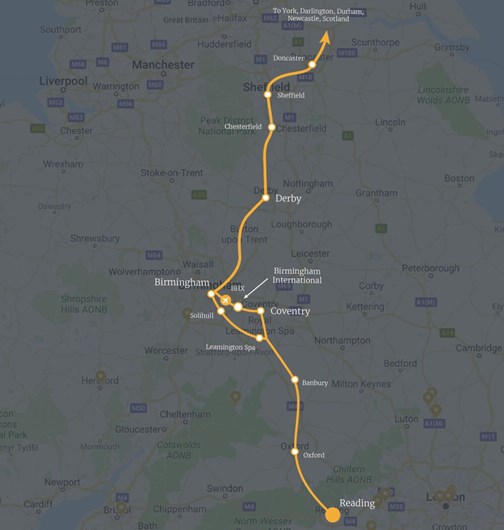
It looks like Midlands Connect are thinking about improving the Reading and Newcastle service.
Points made on the page and related articles, like this one on Rail News include.
- Birmingham Airport has plans to increase passenger numbers to 18 million by 2033.
- Coventry and Leamington Spa via Kenilworth will be double-tracked.
- High Speed Two will release capacity in the area.
- It will open up rail capacity between Birmingham and Solihull.
- There will be a new service between Birmingham Moor Street and Oxford via Solihull and Warwick Parkway.
- It will improve local connections to Birmingham Airport.
- Birmingham and Reading services will be increased to two trains per hour (tph)
- The Government is being asked to chip in £20 million.
These are my thoughts.
Birmingham Airport
Birmingham Airport can become a true Heart of England Airport.
I feel that the future of aviation will be very different to the past.
- COVID-19 and the future pandemics, that we will endure from the East and the Americas, will mean that flying will be a very different experience with hygiene and social distancing to the fore.
- Smaller aircraft, for flights up to 500 miles, will be odd-looking zero-carbon machines with exotic power systems.
- Larger aircraft will be energy efficient planes powered by aviation biofuels produced from household and industrial waste, and biomass.
- Boeing 747s and Airbus A380s will only be talked about in tales from older people to the young.
- Airports will be important rail hubs to more than just the local area.
Wikipedia also says this about expansion of Birmingham Airport.
Plans for a second runway (a third when demand requires) on the other side of the M42 and a new terminal complex and business park have been published, and they could help to create around 250,000 jobs. It has been estimated that if these plans went ahead, the airport could handle around 70,000,000 passengers annually, and around 500,000 aircraft movements.
This Google Map shows the Airport.
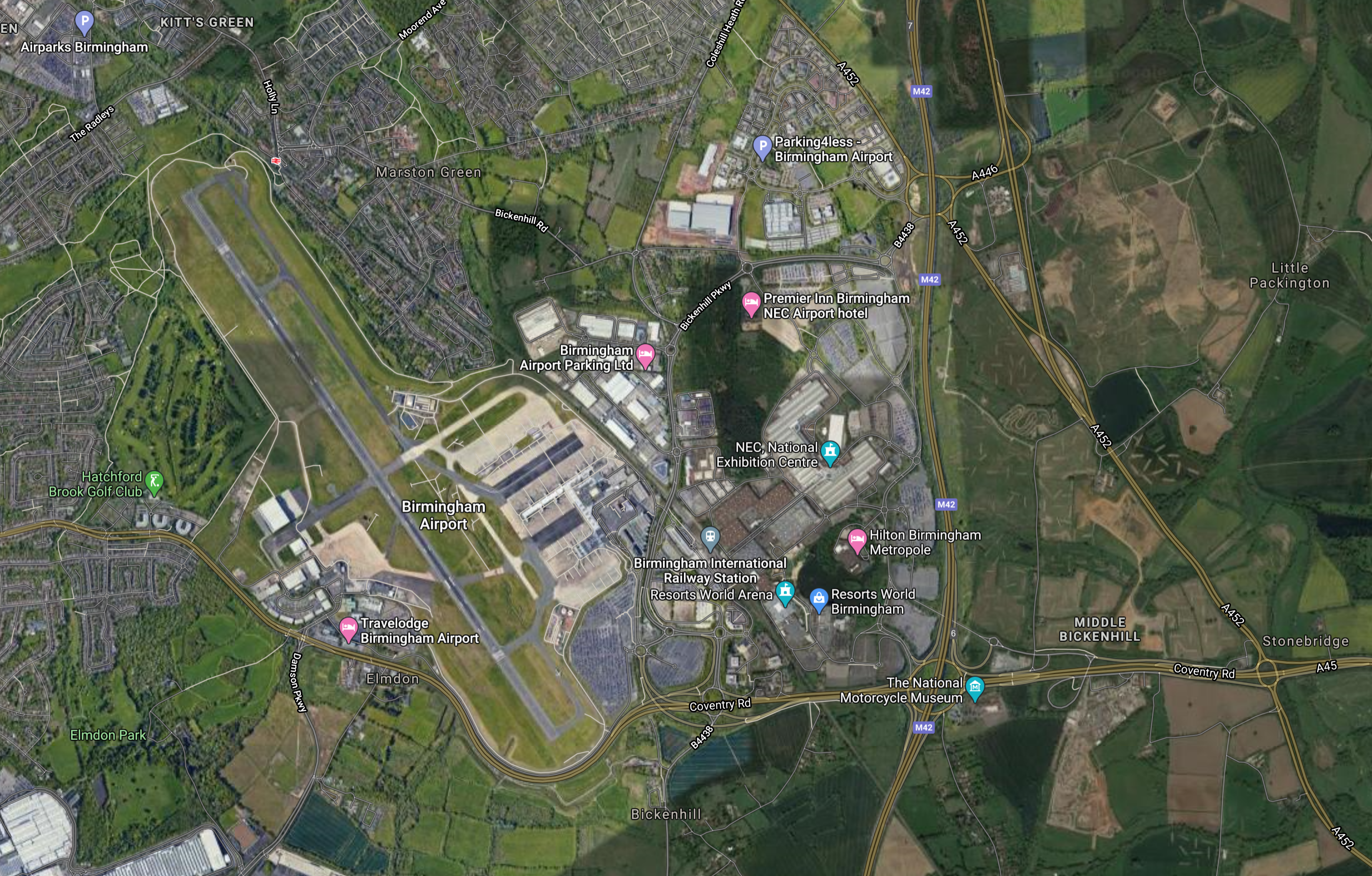
Note the M42 motorway passing North-South to the East of the Airport.
Could Birmingham Airport develop towards Birmingham Interchange and High Speed Two?
It is worth looking at the distance to other airports.
- Aberdeen – 328 miles
- Amsterdam – 280 miles
- Dublin – 199 miles
- Frankfurt – 478 miles
- Geneva – 558 miles
- Paris – 304 miles
All could be within range of an electric aircraft like the under-development Eviation Alice.
I believe that large airports will develop low-noise zero-carbon secondary runways.
Birmingham Airport is well-situated to take advantage.
Adding A Second Track Between Leamington Spa And Coventry
This section of track is about ten miles long, with probably under half only single-track.
This Google Map shows the single-track through the new Kenilworth station.

And these are pictures I took soon after the station opened.



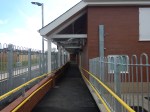
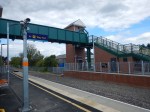
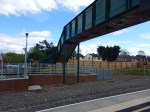
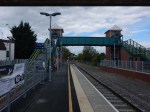
It is certainly one of the best of the current crop of new small stations.
I don’t think that adding a second track will be the most challenging of projects.
It should be noted that the Leamington Spa and Nuneaton service could be a candidate for a battery electric train.
- The route is twenty miles long
- Nuneaton and Coventry stations are fully electrified.
- There might be possibilities to extend this service at either or both ends.
- Nuneaton and Leicester are nineteen miles apart and a new Nuneaton Parkway station is proposed for the route. I wrote about this station in New Railway Station Between Hinckley And Nuneaton Receives Backing.
- Leamington Spa and Stratford-upon-Avon are fifteen miles apart and would need a reverse at Leamington Spa.
A battery electric train might give a faster and more passenger-friendly service, if the passenger numbers and forecasts would support an extended service.
A Birmingham Moor Street And Oxford Service
This Google Map shows Birmingham Moor Street station.
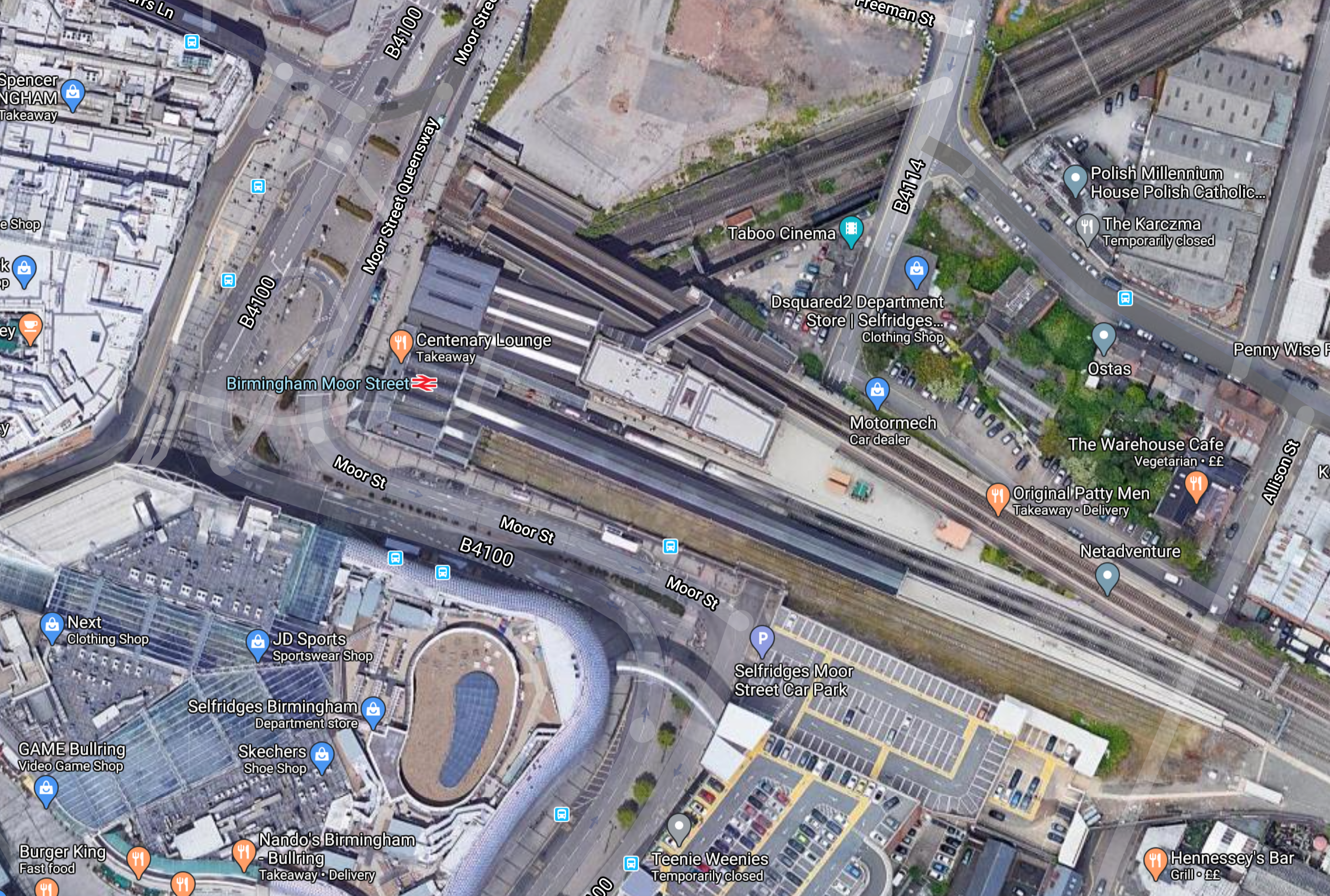
Note.
- The two Northern through platforms on the Snow Hill Lines, that continue under Birmingham to Birmingham Snow Hill station.
- At least two, but possibly three bay platforms, that can take Chiltern Railway’s longest trains.
- There is more space for possibly another two bay platforms to be reinstated or built.
Birmingham Moor Street station will also be a short walk from High Speed Two’s Birmingham Curzon Street station.
This Google Map shows Oxford station.
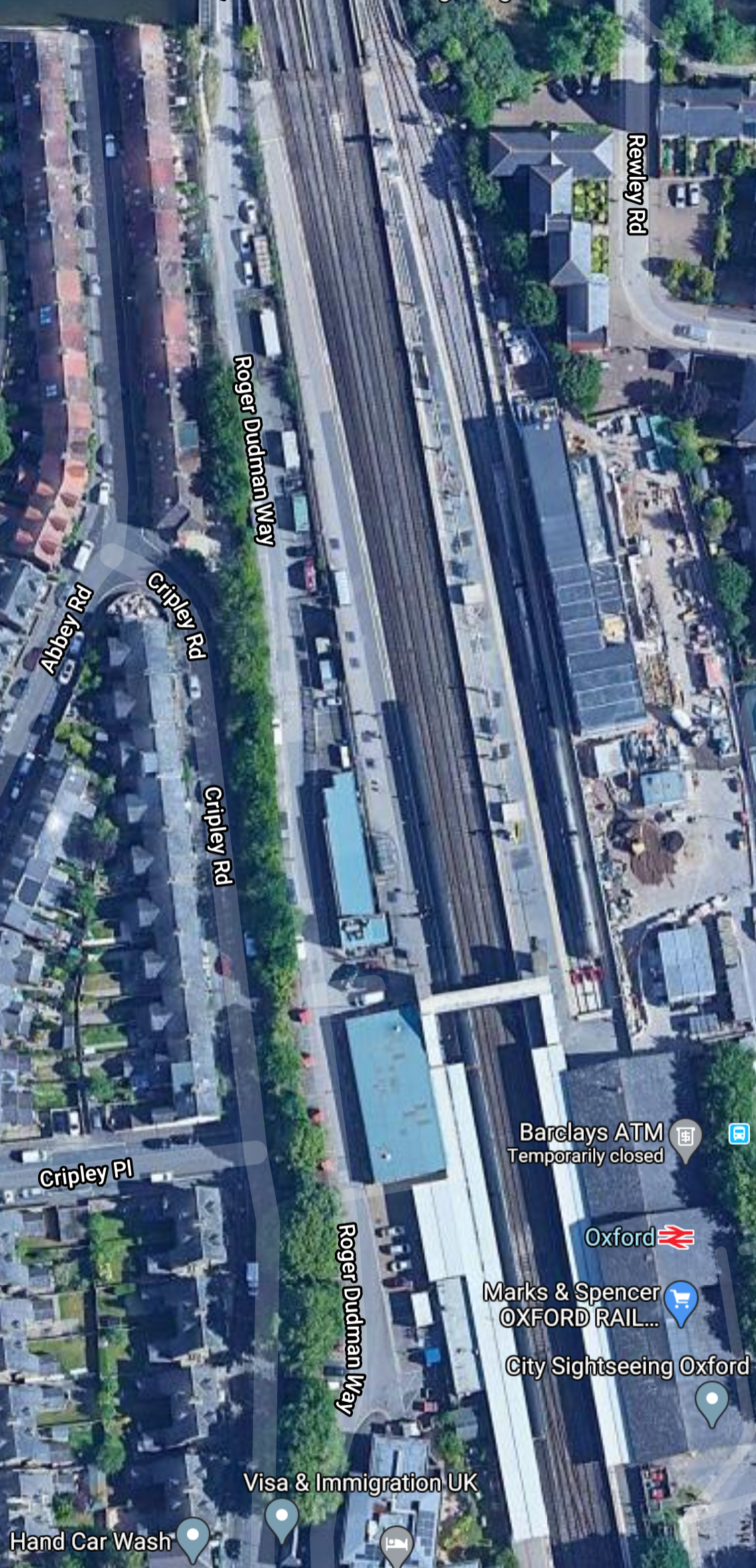
Note.
- Birmingham Moor Street station is to the North via Banbury and Warwick Parkway stations.
- The two long through platforms capable of taking a nine-car train.
- There are two bay platforms to the East of the two through platforms, at the Northern end of the station.
- The bay platforms handle Chiltern’s services from London Marylebone and could also handle the proposed service to Birmingham Moor Street.
Consider this about the proposed Birmingham Moor Street and Oxford service.
- The service could stop at Solihull, Warwick Parkway, Warwick, Leamington Spar and Banbury, as was thought necessary.
- I estimate that Birmingham Moor Street and Oxford are 66 miles apart and that a 100 mph train would take around 66 minutes.
- Birmingham Moor Street and Banbury are 43 miles apart.
- Oxford and Banbury are 23 miles apart.
With these timings and a few minutes to reverse at each end of the route, I would estimate that a 2.5 hour round trip would be possible.
But, I also think, that with charging facilities or short lengths of electrification at Birmingham Moor Street, Banbury and Oxford stations, this service could be run by battery electric trains.
- A three hour round trip should be possible.
- Three trains would be needed to provide an hourly service.
- Oxford, Banbury, Leamington Spa and Warwick would have a direct connection to High Speed Two.
It should also be noted
- Birmingham Moor Street and Stratford-upon-Avon stations are only 25 miles apart and the journey rakes 46 minutes
- Banbury and Stratford-upon-Avon are 35 miles apart. and the journey takes 57 minutes.
- Leamington Spa and Nuneaton are 20 miles apart and the journey takes 36 minutes.
There would appear to be tremendous potential for battery electric services between Birmingham and Oxford.
How many tourists would a Birmingham and Oxford service via Stratford-upon-Avon attract?
Improving The Reading And Newcastle Service
Currently, this is a one tph service between Reading and Newcastle stations.
- It is run by CrossCountry.
- Intermediate stops include Oxford, Banbury, Leamington Spa, Birmingham New Street, Derby, Sheffield, Doncaster, York, Darlington and Durham.
- It appears that the full journey takes four-and-a-half hours.
It looks like to run a two tph service would need as many as twenty trains.
There is an alternative route after High Speed Two opens.
- High Speed Two – Newcastle and Birmingham Curzon Street – 118 minutes
- Walk – Curzon Street and New Street – 10 minutes
- CrossCountry – Birmingham New Street and Reading – 90 minutes
This saves about forty-five minutes.
You could even do a double change.
- High Speed Two – Newcastle and East Midlands Hub – 96 minutes
- High Speed Two – East Midlands Hub and Birmingham Interchange – 17 minutes
- Walk – Birmingham Interchange and Birmingham International – 10 minutes
- CrossCountry – Birmingham International and Reading – 78 minutes
This gives a time of around three hours and twenty minutes.
High Speed Two certainly saves time.
But look at this map clipped from the High Speed Two web site.
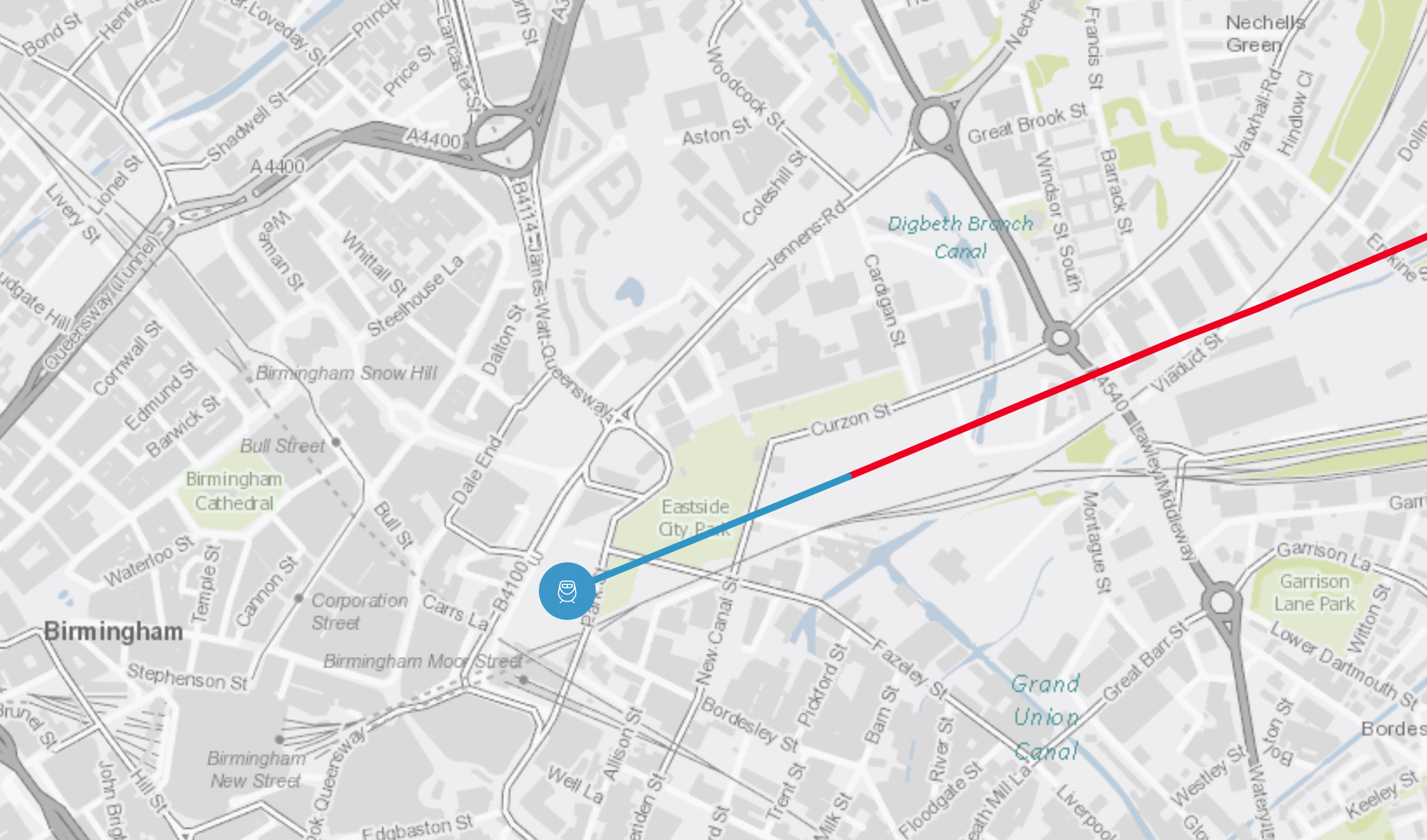
Note.
- The blue dot shows the location of Curzon Street station.
The West Coast Main Line running into New Street station, is just to the South of Curzon Street station.
New Street station can be picked out to the West of Curzon Street station.
This Google Map shows a close-up of the current Curzon Street station site.
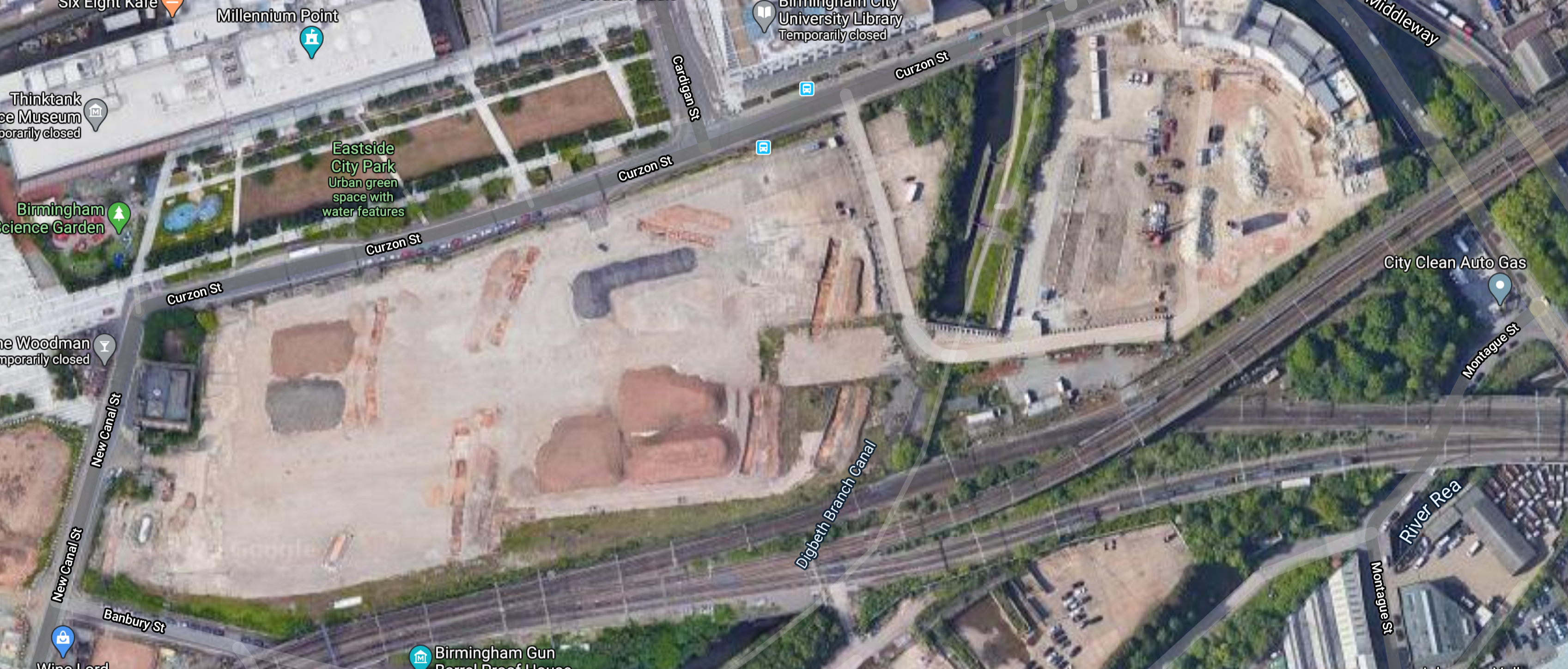
The same pattern of rail lines going past the Curzon Street site into New Street station can be picked out.
Surely, a connection could be made to allow trains from a couple of platforms in Curzon Street station to terminate trains from the West Coast Main Line.
To improve services between Newcastle and Reading, trains would do the following.
- Run on the current East Coast Main Line infrastructure between Newcastle and York. Station stops could be Durham, Darlington and York.
- Switch to new High Speed Two infrastructure South of York.
- Run on High Speed Two infrastructure to Birmingham Curzon Street station. Station stops could be Sheffield, Chesterfield and East Midlands Hub.
- The train would reverse at Birmingham Curzon Street station.
- Switch to the West Coast Main Line outside Birmingham Curzon Street station.
- Run on the West Coast Main Line to Birmingham International station.
- Take the route currently used by CrossCountry between Birmingham International and Reading. Station stops could be Leamington Spa, Warwick Parkway, Banbury and Oxford stations.
Timings would be as follows.
- Newcastle and Birmingham Curzon Street – 118 minutes – From High Speed Two web site.
- Birmingham Curzon Street and Reading – 90 minutes – Current CrossCountry timing.
Note.
- This saves about an hour over the current CrossCountry timings.
- It could use classic-compatible High Speed Two trains.
- Between Birmingham Curzon Street and Newcastle, it follows the same route as one of the current proposed High Speed Two services.
- The service could be extended to Edinburgh from Newcastle.
- The service could be extended to Southampton from Reading
- As there are only twelve tph planned to be running on the Eastern leg of High Speed Two, against a total capacity of eighteen tph, it should be possible to accommodate the extra service or services.
This would surely be a very useful High Speed Two service.
Conclusion
It is a comprehensive package of measures, some of which could have a high cost benefit ratio.
 The Anonymous Widower