Support For Edinburgh Tram-Train Scheme
The title of this post, is the title of a third-of-a-page article in the June 2025 Edition of Modern Railways.
This is the first paragraph.
Final-Year civil engineering undergraduates at Heriot-Watt University’s Edinburgh campus have received warm support for a study in which they recommend reopening the city’s 7.5 mile South Suburban Railway, used for freight and diversions since 1962, using tram-trains.
It looks like they would start in the West at say Edinburgh Gateway or the Airport and would then turn South at Murrayfield to join the South Suburban Railway at Gorgie.
This OpenRailwayMap shows the tracks to the South of Murrayfield stadium.
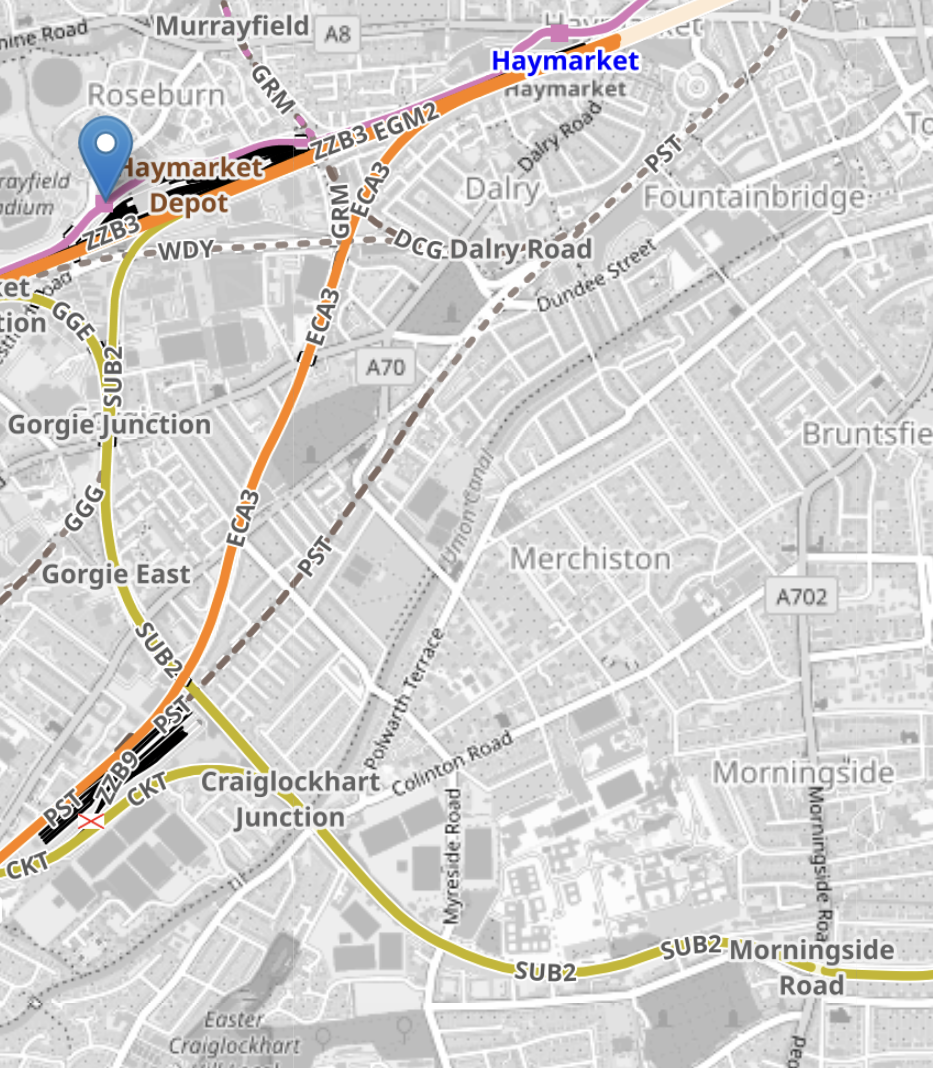
Note.
- The more Westerly-oriented orange tracks lead to Glasgow.
- The orange tracks running South-Westerly are the tracks to Carstairs.
- The yellow tracks are the South Suburban Railway.
- Tram-trains could then go all the way to Brunstane on the Borders Railway.
- The blue arrow indicates the tram-stop for Murrayfield.
- I would assume that the connection to the South Suburban Railway, is to the East of this stop.
- Gorgie East, Craiglockhart and Morningside Road were stations on the South Suburban Railway.
This map shows where the South Suburban and Borders Railways meet in a large triangular junction.
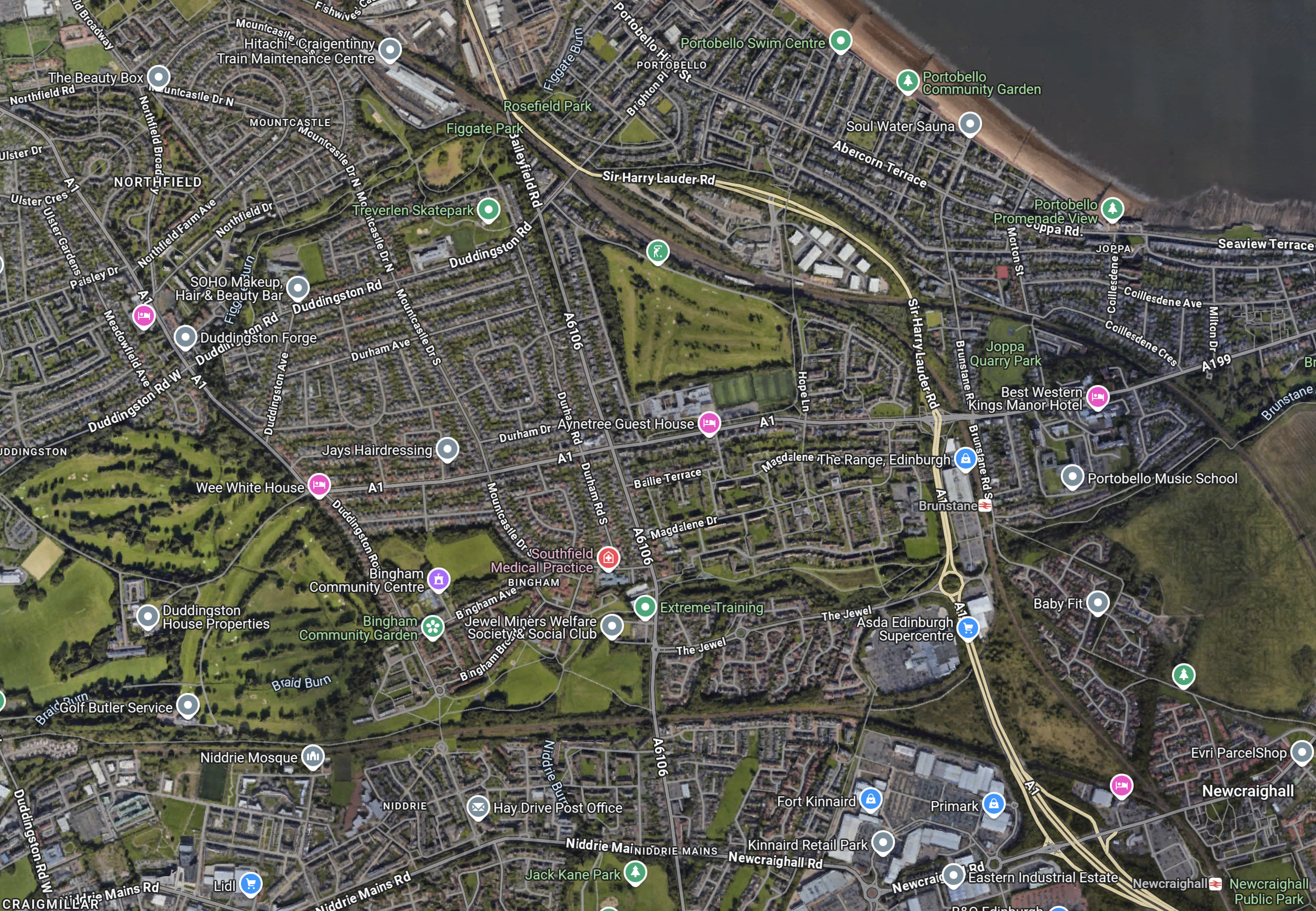
Note.
- Newcraighall station on the Borders Railway is in the South-East corner of the map.
- Brunstane station is to its North-West almost halfway up the map.
- The two stations are the North and South points of the triangular junction, where the South Suburban and Borders Railways meet.
- The South Suburban can be seen going West towards Gorgie and Murrayfield.
- Edinburgh’s beach at Portobello is in the North-East corner of the map.
- Between Murrayfield and Brunstane, there would be an appropriate number of tram stops and a tram-train every fifteen minutes.
Optionally, the route can be extended to Leith on a mothballed freight line.
This OpenRailwayMap shows the railways and tramways of Edinburgh between Brunstane, Edinburgh Waverley and Leith.
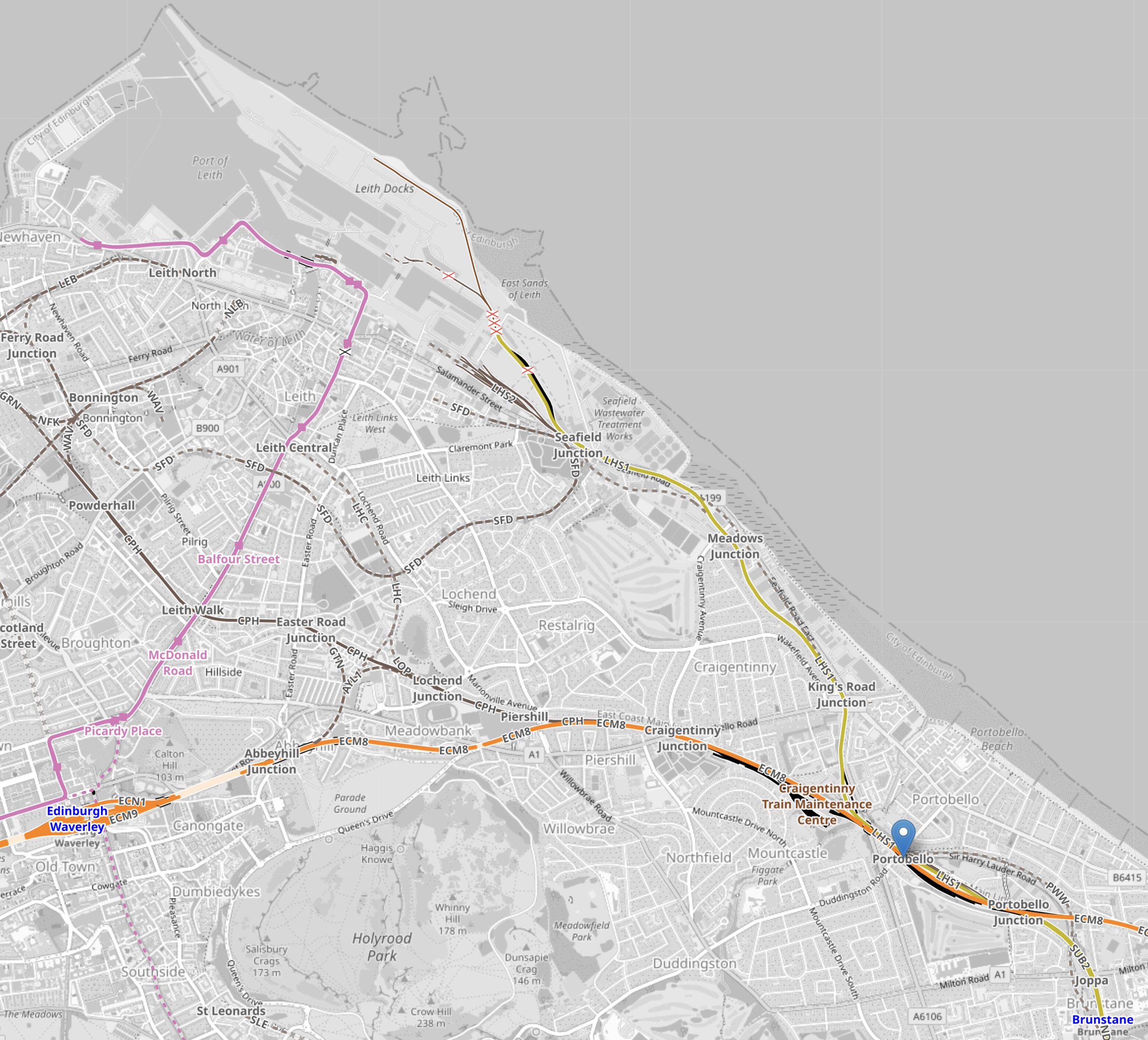
Note.
- The orange track running across the bottom of the map is the East Coast Main Line into Edinburgh Waverley station, which is clearly marked.
- The pink track is the Edinburgh tram to Newhaven.
- Brunstane station is in the South-East corner of the map.
- The site of the former Portobello station is marked by the blue arrow.
- The yellow track from Portolbello up the coast is a mothballed freight line to Leith Docks.
The proposal suggests that the tram-train route finishes at Leith Docks. One of the reasons, is that this part of Edinburgh, is not well served by public transport.
I have some extra thoughts.
Changing Between Borders Railway and the Tram-Train At Brunstane Station
Brunstane station, is a two-track station, with only one platform, so there may need to be track modifications.
Do Edinburgh’s Urbos Trams Have A Tram-Train Variant?
They do!
Do Edinburgh’s Urbos Trams Have A Battery Variant?
Battery tram-trains charged at either end of the route will be needed.
A battery-electric Urbos 3 tram, can be seen running through the City of Birmingham in England.
Conclusion
The proposal looks feasible to me. But the devil will be in the detail.
More Trains For Fife As ScotRail Enhance Leven Services In May 2025 Timetable
The title of this post, is the same as that of this press release from ScotRail.
This is the sub-heading.
ScotRail is set to introduce significant timetable improvements from Sunday, 18 May 2025, with a major focus on enhancing rail connections for Fife.
This first paragraph gives more details of the improvements to services.
The new timetable will include more frequent services to and from Leven, improving access to and from Edinburgh, and better connecting communities throughout Fife. Additional carriages are also being added to some trains at the busiest times to provide more seats for customers.
It sounds to me, that services to Leven have got a bad case of London Overground Syndrome, which I define in this post, which unsurprisingly is called London Overground Syndrome. I define it like this.
This benign disease, which is probably a modern version of the Victorian railway mania, was first identified in East London in 2011, when it was found that the newly-refurbished East London Line and North London Line were inadequate due to high passenger satisfaction and much increased usage. It has now spread across other parts of the capital, despite various eradication programs.
It keeps appearing across the UK and I suspect it happens in other countries too!
As ScotRail had a severe dose of London Overground Syndrome, when they reopened the Borders Railway, you’d have think that they’d have been prepared this time.
Cross Border Railway £10million Feasibility Study Due To Get ‘Underway Imminently’
Thw title of this post, is the same as that of this article on ITV.
These three paragraphs introduce the article.
A £10million feasibility study into expanding the Borders Railway to Carlisle is due to get “underway imminently”.
Penrith and the Border MP Dr Neil Hudson discussed the plans at Parliament with Scotland Minister, John Lamont.
There have been calls for the service to be extended past Tweedbank to Carlisle taking in towns and villages including Longtown, Hawick and St Boswells.
This finally looks like a serious move by the Government.
But then there’s an election coming!
Elizabeth Line: Commuters Say Service ‘Not What Was Promised’
The title of this post, is the same as that of this article on the BBC.
This is the sub-heading to the article by Tom Edwards.
All of the huge modernist stations are now open and it is architecturally impressive, but what has service on the Elizabeth line been like since it opened in the summer?
These three paragraphs talk about how passengers have reported problems to Tom.
Many say it has been hit and miss, and commuters in West Ealing have been in touch with me to highlight some of the problems.
They recorded some of their journeys for BBC London, and it doesn’t look pleasant.
Many are really fed up with the delays and cancellations and above all the overcrowding.
As with many new railways, like the London Overground, the Borders Railway and the Dartmoor Line, the passenger numbers on the Elizabeth Line have exceeded projections.
The main reasons are probably.
- Convenience of the new route and its stations.
- Curiosity about the new infrastructure.
- The improved access to the trains with heavy cases.
But in the case of the Elizabeth Line two other factors also apply.
Are Passengers Changing From the Piccadilly to the Elizabeth Line?
Consider.
- The Piccadilly Line trains are smaller than the Elizabeth Line trains.
- The Piccadilly Line trains are not air-conditioned.
- Heathrow Central to Holborn is 62 minutes on the Piccadilly Line and several minutes quicker using the Elizabeth and Central Lines with a change at Bond Street or Tottenham Court Road.
Many passengers, who previously used the Piccadilly Line may swap to the Elizabeth Line for a quicker journey on a more comfortable and spacious train.
The new Piccadilly Line trains will have more space, walk-through carriages and air conditioning, so may well tempt passengers back.
Bond Street And All Stations To the East On the Elizabeth Line Are Only Five Minutes Slower By Elizabeth Line Direct
Consider.
- Heathrow Central and Bond Street is 38 minutes using Heathrow Express and the Elizabeth Line with a change at Paddington.
- Using the Elizabeth Line all the way takes 43 minutes.
- The figures for Liverpool Street are 46 and 51 minutes respectively.
- The figures for Canary Wharf are 53 and 58 minutes respectively.
Note.
- The direct route avoids the change at Paddington.
- The change at Paddington between Heathrow Express and the Elizabeth Line is not onerous.
- Routes using Heathrow Express are fifteen pounds more expensive.
- If you’re desperate for a coffee, you can pick one up, when you change at Paddington using Heathrow express.
I believe a regular traveller to Heathrow, who has easy access to an Elizabeth Line station and in the past has used Heathrow Express will give the Elizabeth Line a chance.
The Jewel In The East Is On The Elizabeth Line
In 2014, I wrote Is Whitechapel Station Going To Be A Jewel In The East?.
Consider.
- The Elizabeth Line will go through the station with a frequency of up to 24 trains per hour (tph).
- The two Eastern branches of the Elizabeth Line split to the East of Whitechapel station.
- There will be four tph between Heathrow and Whitechapel.
- The East London Line of the London Overground goes through the station with a frequency of 16 tph, that will be raised to at least 20 tph in a few years.
- The District Line goes through the station with a frequency of upwards of 12 tph.
- The Hammersmith and City Line goes through the station with a frequency of 6 tph.
- The station has large numbers of lifts and escalators.
Passengers from all over the Eastern half of London will change at Whitechapel on their journey to and from Heathrow.
Farrington station Connects Thameslink And The Elizabeth Line
Consider.
- The Elizabeth Line will go through Farringdon station with a frequency of up to 24 tph.
- The Circle, Hammersmith and City and the Metropolitan Lines will go through the station with a combined frequency of up to 24 tph.
- Thameslink will go through the station with a frequency of up to 14 tph.
Passengers from Thameslink’s catchment area will change at Farringdon on their journey to and from Heathrow.
Overcrowding On The Elizabeth Line
It is not a surprise to me, that the Western end of the Elizabeth Line is overcrowded.
I noticed it in November 3022, when I wrote So Many Cases On A Train!.
What Can Be Done To Ease The Overcrowding?
These are possible ways to ease the overcrowding.
Increase The Number Of Trains To Heathrow
I would feel the obvious way to increase the number of trains to Heathrow, would be to run direct trains between Shenfield and Heathrow.
Currently, there are these trains.
- 4 tph – Heathrow Express – Paddington and Terminal 5
- 2 tph – Elizabeth Line – Abbey Wood and Terminal 4
- 2 tph – Elizabeth Line – Abbey Wood and Terminal 5
But is there the capacity to add extra trains between Hayes & Harlington and Heathrow through the tunnel?
Run A Service Between Shenfield And Hayes & Harlington
This would add capacity in West London, where it is needed, but wouldn’t add any extra trains through the tunnel to Heathrow.
By timing this service in combination with the Elizabeth Line services to Heathrow, I suspect a very efficient service between Heathrow and both Eastern terminals could be devised.
- As four tph run between Abbey Wood and Heathrow, four tph would be run between Shenfield and Hayes & Harlington.
- Going towards Heathrow, the train from Shenfield to Hayes & Harlington would be a few minutes in front of the train from Abbey Wood to Heathrow. Passengers going from Shenfield to Heathrow would be instructed to change at any station between Whitechapel and Southall, by waiting a few minutes for the following train.
- Coming from Heathrow, passengers wanting to go to Shenfield would walk across the platform at Hayes & Harlington to catch the waiting train to Shenfield. The Shenfield train would follow a few minutes behind the Abbey Wood train.
Note.
- The two train services would run as a pair, a few minutes apart.
- No new infrastructure would be required.
Currently, there are eight tph between Whitechapel and Hayes & Harlington.
Four tph between Shenfield and Hayes & Harlington would increase the following.
- The capacity between Whitechapel and Hayes & Harlington by fifty percent.
- The train frequency in the central tunnel to twenty tph or a train every three minutes.
- The frequency between Paddington and Shenfield to twelve tph.
There would still be four tph available for more services.
Piling Work To Get Underway To Electrify Line To Fife
The title of this post, is the same as that of this press release from Network Rail.
These four paragraphs outline the project.
Work to lay foundations that will pave the way for the electrification of the Fife Circle is about to get underway.
The £55million Scottish Government investment in the line between Haymarket and Dalmeny will see the railway transformed to accommodate quieter, more environmentally friendly electric trains.
The first phase of work between Haymarket and Dalmeny will see Network Rail pile the foundations for masts that will carry overhead wires up to the Forth Bridge. In total it will see 25 single track kilometres (STKs) of railway electrified by December 2024.
Subsequent phases of work will see ‘partial’ electrification of lines in Fife – totalling a further 104 STKs, to enable the introduction of Battery Electric Multiple Units (BEMUs) to replace life-expired diesel units which will be phased out.
This map from Wikipedia shows the stations on the Fife Circle Line.
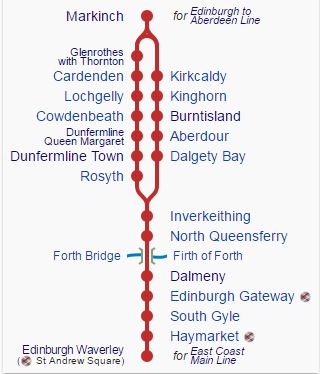
Note.
- The route is double-track.
- The route is not electrified.
- The train service is generally two trains per hour (tph) in both directions.
- The distance from Dalmeny to Glenrothes with Thornton via Cowdenbeath is 22.3 miles
- The distance from Dalmeny to Glenrothes with Thornton via Kirkcaldy is 21.4 miles
- Trains appear to wait between three and seven minutes at Glenrothes with Thornton before returning to Edinburgh by the alternate route.
I have a few thoughts.
Partial Electrification And Battery-Electric Trains
In the Notes To Editors, this is said about what Network Rail means by partial electrification.
The ‘partial’ electrification approach to the decarbonisation of the railway – beyond delivering a reduction in carbon emissions, will also reduce the ongoing net cost to the taxpayer of operating the railway at an earlier point.
Reduced upfront infrastructure and associated capital expenditure makes projects more affordable and enables electrification of key trunk routes to start as a priority so the benefits of electrified railways will be realised earlier. Additionally, it does not preclude full electrification occurring at a future date.
The Fife electrification scheme has been approved for partial electrification, using battery electric multiple units, and further development work is to be undertaken to support this. The project is part of the plan to decarbonise the passenger railway network by 2035.
This map has been downloaded from the Network Rail web site.
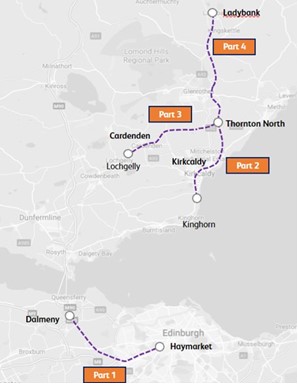
The electrification is split into four phases.
- Haymarket and Dalmeny – 25 km
- Kirkcaldy and Thornton North – 25 km.
- Lochgelly and Thornton North – 20 km.
- Thornton North and Ladybank – 34 km.
Note that the last three phases of electrification connect to Thornton North.
Thornton North is Thornton North Junction, which is shown in this map from OpenRailwayMap.
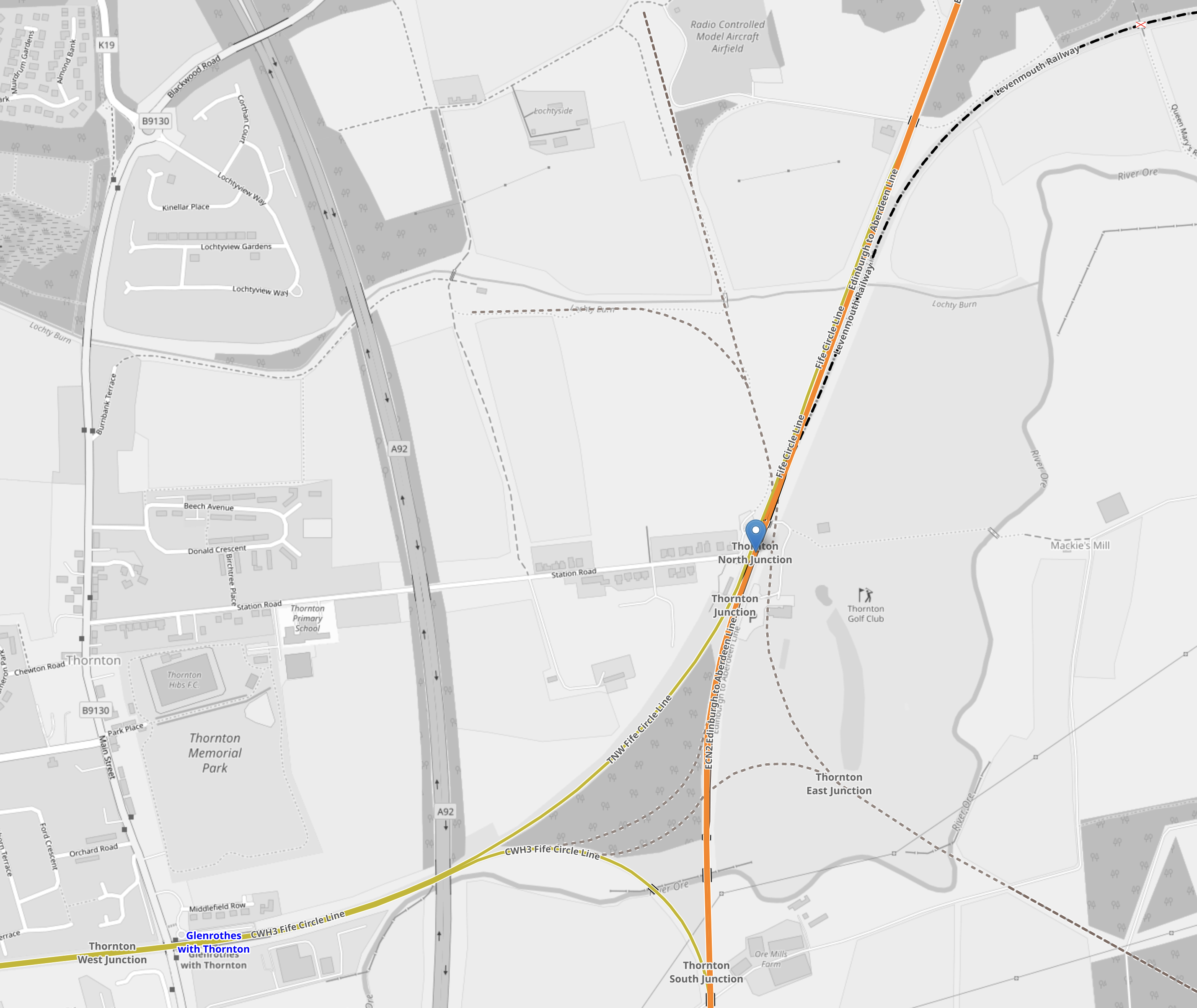
Note.
- The orange line is the main Edinburgh and Aberdeen Line. South from here, it forms part of the Fife Circle Line and goes over the Forth Bridge.
- The yellow lines going West via Glenrothes with Thornton station are the Fife Circle Line via Dunfermline.
- The lines form a triangle which is Thornton Junction.
- North Thornton Junction is the Northern point of the triangle marked by a blue arrow.
- The black hashed line going to the North-East is the Levenmouth Rail Link, which is under construction.
As the Levenmouth Rail Link will be electrified, there will be four electrified lines fanning out from Thornton North Junction.
This must make construction easier.
- Power supply can be established at Thornton North Junction.
- The Levenmouth Rail Link can be built and electrified.
- Phase 1 of the Fife Electrification between Haymarket and Dalmeny can be installed, as an extension of the electrification at Haymarket station.
- These two sections of electrification could also allow battery-electric trains to run between Edinburgh and Leven stations, as the gap is less than thirty miles.
- Phase 2, 3 and 4 of the Fife Electrification can then be installed in the preferred order.
It would appear, that someone has designed the electrification to a high standard.
The Forth Bridge
The Forth Bridge will be a nightmare to electrify.
I suspect the engineering problems can be solved, but the Heritage Taliban would probably protest about the desecration of a World Heritage Site.
Electrification Gaps And The Hitachi Regional Battery Train
The gaps in the electrification after all phases of the electrification have been completed, will be as follows.
- Dalmeny and Lochgelly – 15.2 miles
- Dalmeny and Kirkaldy – 16.4 miles
- Ladybank and Perth – 17.8 miles
- Ladybank and Dundee – 20.1 miles
The performance of the Hitachi Regional Battery Train is shown in this Hitachi infographic.

Note that a battery range of 90 km. is 56 miles.
A battery train of this performance, should be able to handle these routes.
- Edinburgh and Dundee
- Edinburgh and Glenrothes with Thornton via Kirkcaldy
- Edinburgh and Glenrothes with Thornton via Lochgelly
- Edinburgh and Leven
- Edinburgh and Perth
With one of more further stretches of electrification North of Dundee, a train with this performance should be able to reach Aberdeen.
But to handle the Fife Circle and Levenmouth Rail Link, would probably need a train with a battery range of about forty miles, to allow for a round trip, if say there were problems like lifestock on the line.
Rolling Stock Procurement
The Network Rail press release also says this about Rolling Stock Procurement.
Approval has also been given hold a procurement competition to identify a preferred manufacturer and financier for new suburban trains to operate decarbonised rail passenger services on the routes covered by East Kilbride, Fife and Borders routes, replacing 42 Class 156 trains and to replace the 55 Class 318 and 320 trains operating in the Strathclyde area.
Note.
- It would appear that the East Kilbride, Fife and Borders routes would be worked by battery-electric trains, as they are all routes without electrification.
- I wrote about the East Kilbride and Kilmarnock services in East Kilbride Electrification Underway. The largest gap is about 16.8 miles.
- I wrote about electrification of the Borders Railway in Scottish Government Is Considering Plans To Electrify The Borders Railway. The largest gap is just under 31 miles.
It looks to me that a Hitachi Regional Battery Train with a battery range of over 40 miles would be suitable for the East Kilbride, Fife and Borders routes’
Battery And Hydrogen Trains For ScotRail ‘Could Make Scotland A Global Leader’ In Zero-Emission Transport
The title of this post is the same as that of this article in the Scotsman.
This is the first paragraph.
New fleets of cutting-edge trains expected to include battery and hydrogen power are to be ordered for ScotRail which the rail industry believes will put Scotland at the forefront of zero-emission transport.
Other points from the article.
- Talgo appear to have passed the story to Scotland on Sunday.
- Three routes are mentioned; Borders Railway, Fife Circle and Glasgow-East Kilbride.
- The new trains could help phase out diesel trains by 2035, which is Scottish Government policy.
- The Inter7City trains might be replaced by 2030.
- Talgo hopes to win an order for its factory in Fife.
Talgo’s Managing Director is quoted as saying, they are starting testing of a hydrogen and electric train with a range of 311 miles.
Consider.
- I wrote about this train in Talgo To Begin Fuel Cell Loco Trials.
- Talgo’s hydrogen and electric train would be ideal for Scotland’s railways of which only forty percent are electrified.
- A four or five-car high specification hydrogen and electric train would be ideal for the Inter7City routes, if it were built specifically for the routes.
- The range would cover all of Scotland.
- Hydrogen hubs are being planned all over Scotland.
- Scotland have 26 Inter7City trainsets.
This could be a rather nice order to fund the factory and test all the trains close to the factory.
Is there a better place to show off your new train to a prospective buyer than the Highlands of Scotland?
In A Class 319 Train, But Not As We Know It!, I told this tale.
I am reminded of a tale, that I heard from a former GEC manager.
He was involved in selling one of GEC’s Air Traffic Control radars to a Middle Eastern country.
The only working installation of the radar was at Prestwick in Scotland, so he arranged that the dignitaries and the sales team would be flown to Prestwick in GEC’s HS 125 business jet.
As they disembarked at Prestwick and walked to the terminal, the pilot called the GEC Manager over.
The pilot told him “The Scottish Highlands at this time of the year, are one of the most beautiful places in the world! Would you and your guests like a low-level tour on the way back? I can arrange it, if you say so!”
Despite knowing GEC’s draconian attitude to cost control he said yes.
The sale was clinched!
I’m sure that Talgo will exploit the scenery and the local produce.
Talgo’s Hydrogen Trains
This page on the Talgo web site, is entitled Talgo’s Hydrogen Train Will Be Ready In 2023.
This paragraph gives an overview of Talgo’s hydrogen power system.
This system is configured as a modular solution that can be installed on all types of trains, as well as in upgrades from diesel to hydrogen. However, it has been specifically designed for the Vittal platform for Commuter and Regional trains, which Talgo has presented in the bidding process for various tenders in Spain and other countries.
And these two paragraphs describe Talgo’s hydrogen trains in more detail.
This innovative system uses hydrogen batteries that provide the energy for the train’s electric motors. It is powered by renewable energy sources, such as solar photovoltaic or wind, which produce hydrogen that is stored and then used to power fuel cell-based propulsion systems, such as the one designed by Talgo. The system is complemented by batteries that increase the speed of the train when it starts, taking advantage of the braking system to recharge it.
Unlike the extended battery systems in the automotive industry, hydrogen (H2) technology is the logical answer to the needs of heavy transport and, in particular, of those railway lines that do not have catenary electrification systems, and which today depend on trains powered by diesel engines. The hydrogen system designed by Talgo enables conventional network lines to be “electrified” without the need for costly and lengthy adaptation operations, and without the use of fossil fuels.
What do they mean by hydrogen batteries? Looking at the German and the Spanish on the page, I think Talgo means hydrogen fuel cells.
The Rebuilding Of Ukraine
It should be noted that Talgo have sold trains in the past to Russia, which has a gauge of 1.520 metres, which lies between Iberian gauge of 1.668 metres and our standard gauge of 1.435 metres.
- Talgo have also sold trains to Germany, who use standard gauge.
- Talgo have built Strizh trains for Russia, that are both standard gauge and Russian gauge for running between Berlin and Moscow.
- According to the BBC and The Times, Ukraine’s railways have been an important lifeline during the Russian invasion, but pictures show they are in need of modernisation and more electrification.
- The Strizh trains or a development would surely be ideal for running between Kviv and Berlin, Budapest, Prague and Warsaw.
- There would also appear to be a need for a hydrogen and electric regional train to reconnect the country back together.
- Other countries using Russian gauge include Mongolia, Kazakhstan, Kyrgyzstan, Tajikistan, Turkmenistan, Uzbekistan, Armenia, Azerbaijan, Georgia, Belarus, Moldova, Estonia, Latvia, Lithuania, and Finland.
So are Talgo positioning themselves to take part in the modernisation of Ukraine’s railways, once the war is over?
- Development and testing is done in Spain and Scotland.
- Manufacturing could be done in Spain and Scotland.
- Delivery from Scotland could either be by ship or if they were dual-gauge trains, they could be hauled through the Channel Tunnel and then through Germany and Poland.
As Talgo has the technology, I can certainly see them exploiting the Russian gauge market once Vlad the Mad has gone.
Storm Arwen: Image Shows Severe Damage To Train Following Red Weather Warning
The title of this post, is the same as that of this article on the Scotsman.
It shows a dramatic picture of a Class 170 train, that was hit by a tree, that was blown onto the line.
The incident happened on the Borders Railway and luckily no-one was hurt.
Nuggets From The Union Connectivity Review
The Union Connectivity Review has now been published and it can be read online.
This paragraph outlines the objective of the Review.
The UK Government asked Sir Peter Hendy CBE to undertake a detailed review into how transport connectivity across the UK can support economic growth and quality of life in England, Scotland, Wales and Northern Ireland.
Sir Peter was also asked to make recommendations as to whether and how best to improve transport connectivity between the nations of the UK.
Sir Peter Hendy is the Chairman of Network Rail.
In no particular order, these are some nuggets from the review.
The Case For UKNET – A Strategic Transport Network For The Whole United Kingdom
This paragraph introduces the case for UKNET.
Having identified the importance of good connections across internal borders and the challenges that currently prevent a pan-UK strategic vision or investment strategy, the Review recommends that the UK Government develop UKNET – a strategic transport network for the whole United Kingdom which would connect all the nations of the
UK, with appropriate funding and coordination with the devolved administrations to deliver it.
The creation only follows best practice from the European Union and large countries like the United States.
These three paragraphs sum up how UKNET would work and how it would bring benefits to the whole of the UK.
UKNET would provide a network into which transport investment would be made on a pan-UK basis to support economic growth, jobs, housing and social cohesion, across the nations of the UK, for the benefit of the whole country.
It would allow transport appraisals for schemes on the network to be undertaken on a UK-wide basis with all costs and benefits being fully accounted for. This would limit the risk of cross-border schemes being deprioritised.
The development of such a network would provide additional certainty for businesses and the private sector, allowing them to plan complementary investments in specific regions and to invest in the supply chain across the country.
I think overall that UKNET is sound thinking, but my only feeling is that it should also look at transport links to and from the whole island of Ireland.
The Case for Faster Rail Journey Times Between England And Scotland
These three paragraphs probably apply to most rail journeys in the world, that compete against air and road travel.
Both the UK and Scottish Governments have previously agreed to develop options which could support a rail journey time between London and Scotland of three hours. A journey time improvement of this size, even when compared to expected journey times once HS2 opens, would dramatically increase the number of people travelling by rail.
There is a correlation between journey times and how many people choose to travel by rail over air. If it takes the same amount of time to travel by rail or by air, the evidence shows that people choose to travel by rail. Rail is typically favoured when the journey time is around three hours between city centres.
Work undertaken by Network Rail and HS2 Ltd on behalf of the Review has demonstrated the potential for increased trips by rail if journey times are reduced. For assurance purposes, two forecasting models were used to assess savings of 20, 35 and 50 mins on the journey times forecast for HS2 Phase 2b. The outcomes for both models were broadly similar and the approach built upon the changes in mode share observed between rail and aviation following previous UK and European rail investments.
Three hours between London and Scotland could be a tough ask.
Note these points about the East Coast Main Line.
- An InterCity 225 ran between London and Edinburgh on the 26th September 1191 in three hours and 29 minutes.
- Full digital in-cab signalling will allow running at 140 mph.
- There are improvements to come on the East Coast Main Line.
- As now, the review says two tph will run between London and Edinburgh.
- London Kings Cross and Edinburgh is 393 miles
- On the East Coast Main Line a non-stop train between would need to average 131 mph.
Three hours is tough but not impossible.
And these points about the West Coast Main Line.
- Trains will run on High Speed Two between London Euston and Crewe.
- High Speed Two are claiming fifty-six minutes between London Euston and Crewe.
- Full digital in-cab signalling will allow running at 140 mph.
- Crewe and Glasgow Central is 243.4 miles.
- Current fastest time between Crewe and Glasgow Central is three hours and five minutes.
- Between Crewe and Glasgow Central, a non-stop train would need to average 118 mph.
A well-driven InterCity 125, with a clear track, could average that speed between Crewe and Glasgow Central.
Three hours is tough but very possible.
This paragraph sums up the mode shift expected between air and road to rail.
These initial estimates indicated that a three-hour journey time was forecast to increase the number of passengers by around four million a year and increase rail mode share from the 2019 level of 29% to around 75%. It was also forecasted that journey times in the region of three hours would generate considerable transport user benefits and revenues over the lifetime of the scheme.
People travelling from the Midlands and North West England to and from Scotland would also get substantial reductions in journey times.
Linking High Speed Two With The WCML
The review says this about linking High Speed Two with the West Coast Main Line.
The UK Government has already acknowledged some of the issues identified by the Review. The ‘Golborne Link’—the current proposed connection between HS2 and the WCML—is expected to deliver quicker journey times and more capacity between England and Scotland and resolve some of the constraints between Crewe and Preston.
However, the ‘Golborne Link’ does not resolve all of the identified issues. The suitability of alternative connections between HS2 and the WCML have been considered by the Review. The emerging evidence suggests that an alternative connection to the WCML, for example at some point south of Preston, could offer more benefits and an opportunity to reduce journey times by two to three minutes more than the ‘Golborne Link’. However, more work is required to better understand the case for and against such options.
These benefits could also include additional operational flexibility when timing freight services and less disruption to the WCML than major upgrades as most construction could take place away from the railway.
An infrastructure philosophy is also detailed.
- Replacing and enhancing track, signalling and power supply.
- Possible new sections of line north of Preston.
- Maximising of line speed.
My feeling is that for good project management reasons and to give faster journey times with the existing trains, that a lot of these improvements should be started as soon as possible.
Borders Railway
The Review says this about the Borders Railway.
Communities in the Scottish Borders region are enthusiastic about the economic and social benefits they see resulting from an extension of the Borders Railway south, across the border, to Carlisle.
The Review also welcomes the £5 million in funding that the UK Government has made available for the development of a possible extension to the Borders Railway which would support improved connections to and from Scotland and with the WCML at Carlisle.
I would build this early, as when the West Coast Main Line is being upgraded between Carlisle and Glasgow, this would be available as a diversion route.
Perhaps too, the Glasgow South Western Line should be improved and electrified as well.
Air Passenger Duty
The Review has a sizeable session on Air Passenger Duty, where it concentrates on the problems of its application to domestic flights.
The Review makes this recommendation.
Where journeys are too long to be reasonably taken by road or rail, the UK Government should reduce the rate of domestic aviation tax.
I believe that before the end of this decade, there will be smaller zero-carbon airliners, that will be ideal for domestic routes, which could totally change the regime of domestic Air Passenger Duty.
Decarbonisation And The Future Of Flight
This is a section in the Review, where this is the first paragraph.
In July 2021, the Department for Transport published the Jet Zero Consultation: a consultation on our strategy for net zero aviation127, alongside the Transport Decarbonisation Plan. This includes the ambition to have zero-emission routes connecting different parts of the UK by 2030 and a commitment to assess the feasibility of serving PSO routes with low carbon aviation. The Review welcomes the commitments made in both publications to accelerate the uptake of sustainable aviation fuels (SAFs) and develop low and zero-emission aircraft.
The Review goes on to make two recommendations.
- Drive the uptake of sustainable fuels and zero emission technologies on domestic aviation through a combination of incentives, tax benefits and subsidies to make the UK a world leader in developing these fuels and technologies.
- Support the development of sustainable aviation fuel plants in parts of the United Kingdom that are particularly reliant on aviation for domestic connectivity.
Note.
- PSO means Public Service Obligation.
- One of the world leaders in the field of sustainable aviation fuels is Velocys, which is a spin out from Oxford University.
- The Review also suggests building a sustainable aviation fuel plant in Northern Ireland.
The Review gives the impression it is keen on the use of sustainable aviation fuel
Conclusion
There are some good nuggets in the sections I have read in detail.
This post is not finished and there will be additions to the list.
Report Reveals The Environmental Benefits HS2 Will Deliver
The title of this post, is the same as that of this article on Rail Technology Magazine.
This is the introductory paragraph.
A significant report from the High-Speed Rail Group has been published today and details how the environmental team working on HS2 are delivering connected, climate-resilient habitats at a new scale, raising ambition for future infrastructure projects.
The report also suggests that High Speed Two will bring forward other projects.
The Borders Railway
The article says this about the Borders Railway.
Besides providing capacity, an extended high-speed rail network could catalyse wider public transport upgrades, such as improving the case for reopening the Borders Railway to Carlisle.
It appears to me, that to go South, from towns like Galashiels, Hawick, Peebles and Selkirk will be quicker if you change at Carlisle to High Speed Two.
Battery Electric Trains On The Borders Railway
The Borders Railway could also be one, that is ideal for battery electric operation.
- It is already electrified at the Edinburgh end of the route.
- Newcraighall station, where the current wires end, is only thirty miles or so from the current end of the line at Tweedbank.
- Tweedbank and Hawick are about 15 miles.
- At the Southern end of the route it joins the West Coast Main Line to the North of Carlisle.
- Hawick and the West Coast Main are about 35 miles.
- The West Coast Main Line is fully electrified.
This Hitachi infographic gives the specification of their Regional Battery Train
As Hitachi and others are talking of trains with a range of over fifty miles on batteries, I can see a sensible plan evolving to run battery electric trains between Edinburgh and Carlisle.
- At both ends trains would join the Borders Railway with full batteries.
- It might be sensible to extend the electrification at both ends for perhaps five to ten miles.
- From the South trains could certainly reach Hawick and might possibly be able to reach Tweedbank.
- From the North trains could certainly reach Tweedbank and might possibly be able to reach Hawick.
I feel that by using the best of modern battery technology and with charging during extended stops at Hawick and Tweedbank, battery electric trains could work between Carlisle and Edinburgh.
 The Anonymous Widower