Exercise ‘Better Than Drugs’ To Stop Colon Cancer Returning
The title of this post, is the same as that of this article in The Times.
This is the sub-heading.
First study of its kind finds that an ‘exercise prescription’ can reduce the chances of colon cancer patients dying from a relapse by a third
These first two paragraphs add more detail.
Exercise can be “better than a drug” for reducing the risk of cancer returning, a study has found.
Patients with advanced colon cancer who received an “exercise prescription” after finishing their cancer treatment were found to be a third less likely to die from the disease.
I find these findings from the The CO21 Challenge trial, partially funded by Cancer Research UK’s Stand Up To Cancer fund, rather remarkable.
The research was led by Christian Booth, of Queen’s University in Canada, which illustrates the international nature of medical research.
On a third reading of the article, I noticed the full implications of this paragraph.
Alongside benefits for colon cancer, Booth said that fewer patients in the active group went on to develop breast cancer, suggesting that there may be an effect on other cancer types too. Of those who received an exercise prescription, only two went on to develop breast cancer, compared with 12 in the control group.
This could be a very significant study, that changes the treatment of cancer.
Coeliac Journey Through Covid-19 – A Few Bad Years
A Few Bad Years
In 2007, my wife died of what her consultant at Papworth said was one of the worst cancers he’d ever seen. It was a squamous cell carcinoma of the heart.
Her’s was the only occurrence in the UK that year and someone told me, there were four in the United States.
Our youngest son; George, then died of pancreatic cancer in 2009.
When I had been diagnosed as a coeliac in 1997, my wife and I had told our sons to get themselves tested, as is now advised on the NHS web site.
But George was a sound engineer in the music business, who lived the unhealthy rock-and-roll lifestyle.
A year later, I had a serious stroke in Hong Kong.
I had had a warning a year or so before and Addenbrooke’s recommended I go on Warfarin, but my GP in Suffolk, talked me out of it.
Now twelve years later, my GP and myself manage my Warfarin, where I do the testing of my INR on my own meter from Roche.
But then I am a Graduate Control Engineer!
A couple of doctors have said I have made a remarkable recovery, and I’ll go along with that as the only thing I can’t do, that I could before the stroke is drive, as the stroke damaged my eyesight.
On the other hand, the latest therapy for stroke in the United States is B12 injections and I haven’t missed one of my three-monthly injections since 1997.
If anybody is doing serious research into B12 and stroke recovery, then I would be happy to be a lab-rat.
UK’s Rude Place Names To Be Toured By Man On Moped
The title of this post, is the same as that of this article on the BBC.
This paragraph gives a flavour of the route.
His journey will begin in Shitterton, Dorset, on Wednesday and will take in locations such as Twatt in Orkney and Booze in the Yorkshire Dales.
Mary Whitehouse would not have been amused, but I suspect many will find some of the names raise more than a titter.
This is the JustGiving page of the guy doing what he calls the Moronic Moped Marathon. The money raised will go towards Cancer Research.
AI ‘Outperforms’ Doctors Diagnosing Breast Cancer
The title of this post is the same as that of this article on the BBC.
This is the first two paragraphs.
Artificial intelligence is more accurate than doctors in diagnosing breast cancer from mammograms, a study in the journal Nature suggests.
An international team, including researchers from Google Health and Imperial College London, designed and trained a computer model on X-ray images from nearly 29,000 women.
I have rarely worked with healthcare data, so I can’t comment on the accuracy of this trial.
However, over fifty years ago, I was able to make a lot of progress in the analysis of mass spectrometry data, by observing operators and asking how they identified various chemicals in the scan from the mass spectrometer.
I wouldn’t be surprised to find some detailed observation of the working methods of radiologists, formed the foundation data for this research.
The research seems to have done it well, judging by the published results.
Should we trust ourselves to methods like this in healthcare?
Undoubtedly! Yes!
Many systems like this are starting to be used in the maintenance of complex entities, as diverse as trains, planes, chemical works and advanced automated distribution depots.
But every fault, is always tested by a trained person.
This is a paragraph from the BBC article.
Prof Ara Darzi, report co-author and director of the Cancer Research UK (CRUK) Imperial Centre, told the BBC: “This went far beyond my expectations. It will have a significant impact on improving the quality of reporting, and also free up radiologists to do even more important things.”
I very much feel we will see very much more of this automated testing of the human body! And not just for cancer!
I already know of groups working on automatic diagnosis of arthritis!
Cancer Is No Laughing Matter, But!
I took this picture on an Overground train, with permission of the young ladies.
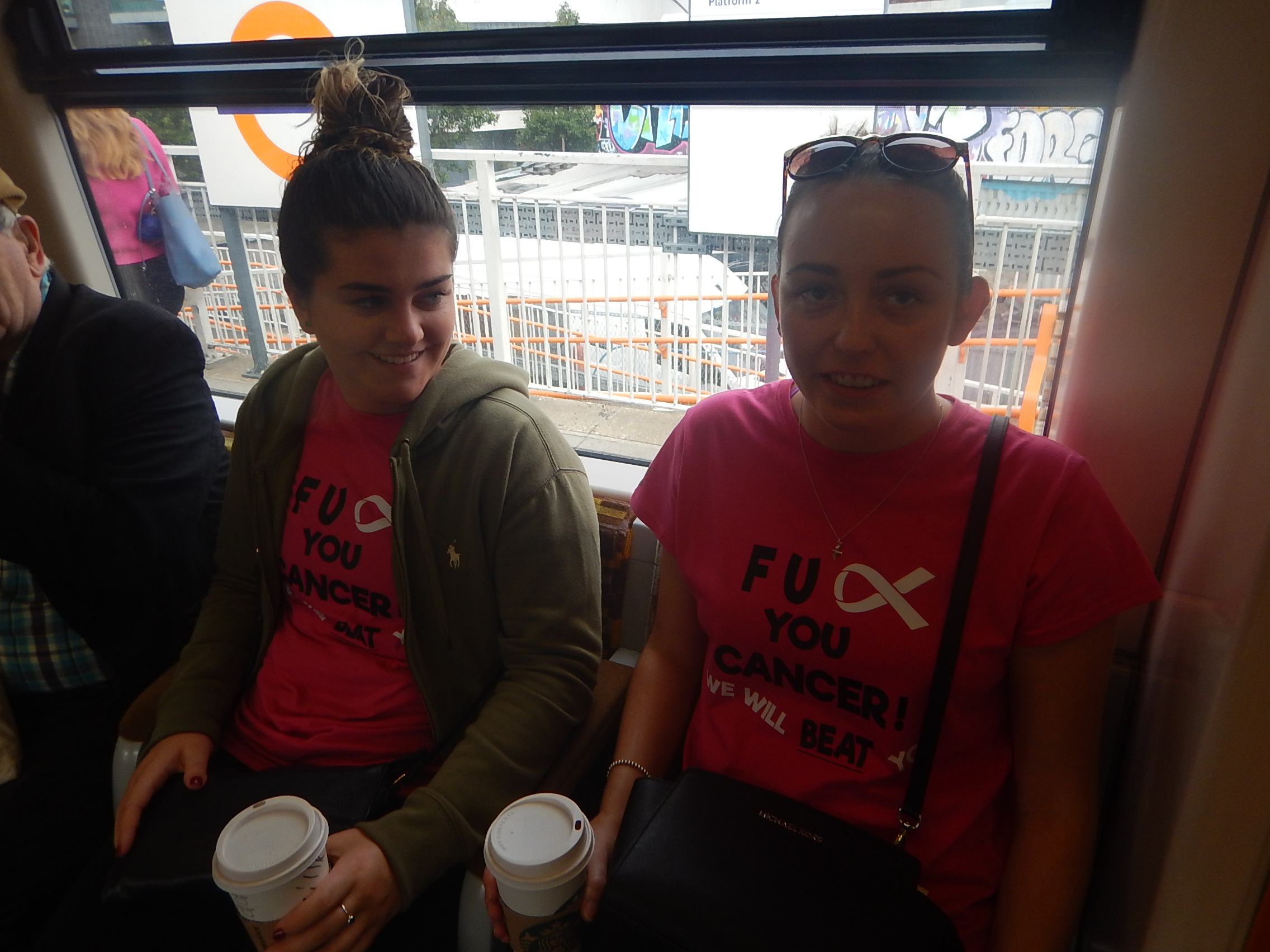
I have this feeling that we’re winning the fight against cancer, through top-quality research.
It’s Cancer Good News Time Again!
These articles have appeared on the BBC in recent days.
Last June this story on the BBC web site entitled ‘Major Win’ In Pancreatic Cancer Fight was published.
It is not unexpected at this time of year, as a big cancer conference takes place around now every year.
There is also another pattern that seems to be happening in all the good news.
Research is key and often the research has been funded by Cancer Research UK and performed in our Universities.
Some techniques like innovative routes of attacking the cancer cells and understanding the action of existing drugs better seem to be more common.
We’ll never win totally against cancer, but we’ll certainly win a few skirmishes.
We should all do our bit for not ourselves, by not smoking!
There’s More To Liverpool Than Football And The Beatles!
This morning, this story on the BBC web site entitled ‘Major Win’ In Pancreatic Cancer Fight is one of the top stories. This is said.
A new combination of chemotherapy drugs should become the main therapy for pancreatic cancer, say UK researchers.
The disease is so hard to treat that survival rates have barely changed for decades.
But data, presented at the world’s biggest cancer conference, showed long-term survival could be increased from 16% to 29%.
The findings have been described as a “major win”, “incredibly exciting” and as offering new hope to patients.
I must admit that I feel a touch of pride, as the study was led by Professor John Neoptolemos at Liverpool University, which was where my late wife and I met when we were both students at the University.
But I also feel a touch of relief for others, who might get this awful cancer in the future, as now they may stand a better chance of survival, than did our youngest son; George, who survived just a few months after diagnosis.
I also raised a small sum of money for the research by visiting all 92 English and Welsh football clubs in alphabetical order by public transport. The main funding for the research included Cancer Research UK and I think some EU money!
The BBC story also says this.
The trial on 732 patients – in hospitals in the UK, Sweden, France and Germany – compared the standard chemotherapy drug gemcitabine against a combination of gemcitabine and capecitabine.
I’ve looked up the two drugs mentioned and both are on the WHO Model List of Essential Medicines, which are the most important drugs needed in a basic health system.
An article in The Guardian is also illuminating. This is said.
The ESPAC trials, which began publishing findings in 2004, showed that chemotherapy with gemcitabine brings five-year survival up to 15-17%, doubling the rate of survival with surgery alone. The latest research, presented at the American Society of Clinical Oncology meeting in Chicago, showed the two-drug combination nearly doubles the survival rate again to 29%.
It showed, said Neoptolemos, that chemotherapy does work in pancreatic cancer, even though most attention in cancer research is now focused on immunotherapy, and precision or targeted medicine.
But the trial would not have happened without funding from the charity CancerResearch UK (CRUK), because both drugs are old and off-patent, meaning they can be made by any generic drug manufacturer and are consequently cheap. Drug companies would not foot the bill for such a trial because the profits to be made are small.
“This is an academic-led presentation,” said Neoptolemos. “This shows the enormous value of CRUK. Without them, none of this would have happened. There is a lot of pressure [on doctors] to do drug company trials because you get £2,000 to £3,000 a patient. For something like this, you don’t get anything. It has been quite tough to do.”
So this is not some elite drug for the rich, famous and powerful, but one that might even be applied everywhere.
I must admit, that I’ve shed the odd tear this morning!
 The Anonymous Widower