When Will The United States Realise That Guns Kill People?
On the wall of my office, there used to be a picture of my wife presenting a racing trophy to a racehorse trainer.
Both are now dead.
- My wife died from a squamous cell carcinoma of the heart.
- The trainer died because of an argument and a gun was available and used to settle it.
We fight cancer with common sense and all the tools that science has given us.
Isn’t it about time, that common sense is applied to the problem of guns in the United States and other countries where they are responsible for a high murder rate?
Why I Support Cancer Research UK
In yesterday’s post; There’s More To Liverpool Than Football And The Beatles, I talked about how researchers at Liverpool University had developed a better prostate cancer treatment. I posted this from an An article in The Guardian.
The ESPAC trials, which began publishing findings in 2004, showed that chemotherapy with gemcitabine brings five-year survival up to 15-17%, doubling the rate of survival with surgery alone. The latest research, presented at theAmerican Society of Clinical Oncology meeting in Chicago, showed the two-drug combination nearly doubles the survival rate again to 29%.
It showed, said Neoptolemos, that chemotherapy does work in pancreatic cancer, even though most attention in cancer research is now focused onimmunotherapy, and precision or targeted medicine.
But the trial would not have happened without funding from the charity CancerResearch UK (CRUK), because both drugs are old and off-patent, meaning they can be made by any generic drug manufacturer and are consequently cheap. Drug companies would not foot the bill for such a trial because the profits to be made are small.
“This is an academic-led presentation,” said Neoptolemos. “This shows the enormous value of CRUK. Without them, none of this would have happened. There is a lot of pressure [on doctors] to do drug company trials because you get £2,000 to £3,000 a patient. For something like this, you don’t get anything. It has been quite tough to do.”
That is a very strong endorsement of Cancer Research UK.
Today, there is this story on the BBC web site, which is entitled Bowel cancer: Stents ‘may prevent need for colostomy bags’. This is said.
Bowel cancer patients may avoid the need for colostomy bags if they are first treated by having an expandable tube inserted at the site of their blockage, cancer doctors have said.
The new approach, presented at the world’s biggest cancer conference, showed that the tube, or stent, cut the risk of complications from surgery.
The trial took place at Central Manchester University Hospitals! And who funded the trial? Cancer Research UK!
So I shall keep supporting the work of Cancer Research UK!
Why The London Tramlink Should Be Extended To The Royal Marsden Hospital
One of my Google Alerts picked up this article in the Sutton Guardian entitled Bunker for breakthrough cancer therapy machine could fit 24 Routemaster buses.
It is about the creation of a concrete bunker at the Royal Marsden Hospital to house a cross between an MR Linac machin which is decribed like this here on the Institute for Cancer Research web site.
The MR Linac combines two technologies – an MRI scanner and a linear accelerator – to precisely locate tumours, tailor the shape of X-ray beams in real time, and accurately deliver doses of radiation even to moving tumours.
All this leads to more and more patients going to the Royal Marsden Hospital in Sutton to get treatment.
As many will not be in the best of health and would not relish a stressful journey, surely now is the time to build extension A of the London Tramlink to Sutton and the Hospital. This map shows the current proposal.

St. Helier Tramlink
The Royal Marsden Hospital is South of Sutton.
As Sutton is a Thameslink station, this Tramlink extension will give access to the Royal Marsden from a large area of London and the South East.
Do We Have Too Many Breast Cancer Charities?
That may be a controversial thing to say, but these posters for a new breast cancer charity have been appearing everywhere in London.
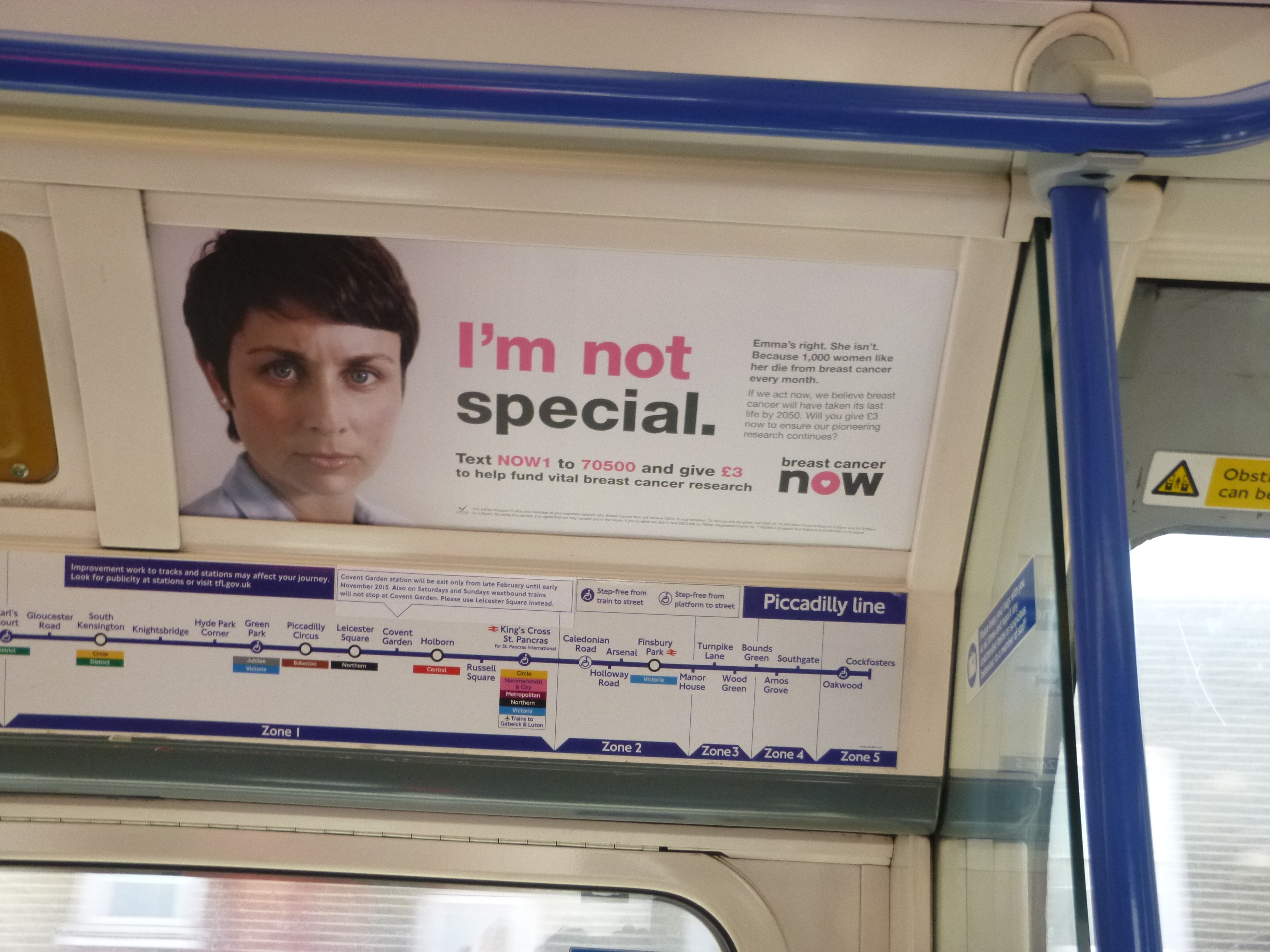
Do We Have Too Many Breast Cancer Charities?
Now C successfully survived breast cancer, so it is not a subject I know nothing about.
But I think now, that some of the most promising cancer research, like looking at the genetics, is very expensive and covers the whole spectrum of cancers.
So surely, this is where we should give our money. I incidentally subscribe to three different cancer charities, none of which are directly linked to breast cancer.
Although, Cancer Research UK, which I support, does support research into breast cancer.
An Unusual Cancer Story From Germany
I have just read this story on the BBC web site entitled The Blind Breast Cancer Detectors. Here’s the first paragraph.
Women being screened for breast cancer in Germany may find themselves in the hands of a blind examiner. The idea has been around for a few years, and unpublished research suggests that it really works – that blind people can in fact detect tumours earlier than their sighted counterparts.
Now I’ve never had cancer, but C had breast cancer and she found the lump herself, which the GP discounted. It was later confirmed by a specialist.
But in Penang in Malaysia, we were staying at the Mutiara hotel. My back was giving me trouble, so C suggested I had a massage.It was probably the most successful massage I’ve ever had.
And the masseur was blind! They explained that the Malaysian government was training them to work in the luxury hotels of the country.
I thought at the time, it was a good idea. I still think it is and after reading the BBC article, I think that the sensitive fingers of the blind may go a lot further than relieving tension in my spine.
Skin Cancer Trial Results Exciting
That is the headline on this story on the BBC web site. Here’s the first few paragraphs.
The results of two international trials against advanced skin cancer have been hailed as “exciting and striking”.
Both treatments, for advanced melanoma, are designed to enable the immune system to recognise and target tumours.
The last statement is key. After all one of ourposes of your immune system is to fight infections and any other dangerous things it finds in your body.
Research has shown that coeliacs on a gluten free diet, have a reduced cancer rate compared to the general population.
So should everybody avoid obesity, too much drink, smoking and gluten, if they want to reduce their cancer risk?
I don’t have the data, so I won’t make a prediction. But the man, who helped to identify the link between smoking and lung cancer, Richard Doll, was a coeliac and was obviously on a gluten-free diet.
He lived until he was 92.
He obviously looked at the data and probably massaged his immune system.
It’s Just Not Good Enough!
On Sunday morning, I heard a guy called the Casual Hopper on BBC Radio 5. As he was raising money for a reputable cancer-related charity, I thought I might send him a donation.
So I logged in to his Just Giving page and donated, using my John Lewis Partnership card. I got an acknowledgement from Just Giving, as expected. However, a few minutes later, I got a message from them saying that the payment had been rejected. Now as I’d just paid my credit card bill, I knew that I was some thousands of pounds below my credit card limit.
I then attempted to login to my Partnership card account and found the problem. Their system was down and I couldn’t log in.
I have managed to login this morning, but there is no trace of the payment to the Casual Hopper. In fact, there is no trace of any payments made by the account and I used the card twice yesterday in Sainsburys and Waitrose.
If we can use our cards on a 24-hour basis, surely we ought to be able to see the information in a likewise manner.
After all, if I missed a payment, they’d be on me like a ton of bricks.
It’s just not good enough!
Especially, as it’s caused grief and extra work to a whole series of people like the Casual Hopper, Just Giving and of course myself.
Barbican Station
I have some happy memories of Barbican Station and on Saturday, I passed through on the way to the Anniversary Games.
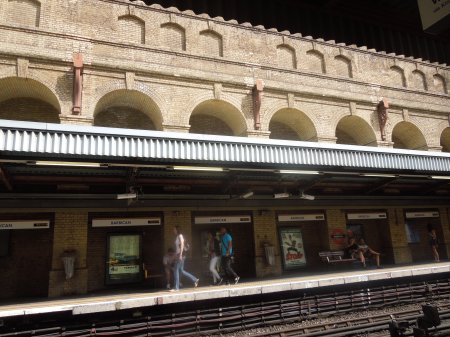
Barbican Station
I can particular remember pushing our youngest son in his buggy along the central platform, from where the picture was taken, sometimes with C and our two sons and sometimes without.
Sad to think, that C and the baby in the buggy have both died from cancer.
More On Immunocore
I found this excellent article on Immunocore, which is the company behind the possible cancer cure, I mentioned yesterday. \Here’s a flavour of the article.
In all probability, Immunocore is the only company worldwide that has been able to develop a way to harness the power of the immune system’s natural-born killer cells: the T-cells of the blood that kill invading pathogens, like viruses and bacteria, the Independent reported.
Obviously, it’s too late for my wife and son, but hopefully it will bring a pathway to help others in the future.
Is This Bad News For Cancer?
This report from the Independent headlined, Exclusive: Cancer – A cure just got closer thanks to a tiny British company – and the result could change lives of millions, was flagged up on BBC Radio 5 this morning and is a fascinating read.
It seems that researchers may have found a way to get the body’s T-cells to attack the cancer cells.
I think everything in the report sounds feasible and the company in Oxford; Immunocore, have now got masses of backing from two of the largest pharmaceutical companies. So money for the research won’t be a problem.
In some ways, this research all fits with my belief that if you have a healthy immune system, you are less likely to get cancer. Hence my gluten-free diet and abhorrence of smoking.
 The Anonymous Widower