Britain’s Biggest Clean Power Projects Among 2.4GW Of Transmission Connections National Grid Delivers In 2025
The title of this post, is the same as that of this press release from National Grid.
This is the sub-heading.
Record-breaking renewable power projects are among the 2.4GW of new generation connections we plugged into our transmission network during 2025, in another key step in the UK’s clean energy transition.
This first paragraph adds some detail to the headlines.
This year’s works build on the 3GW of connections we delivered in 2024 – which included a new interconnector between Wales and Ireland – and is part of 12.6GW of generation capacity we’ve connected in England and Wales over the past five years.
The rate of connections appear to have been fairly steady over the last five years, at about 2.5 GW/year.
Three projects are highlighted.
- In April the 373MW Cleve Hill Solar Park, Britain’s largest solar array, began exporting power across the network following work to connect it at our Cleve Hill substation in Kent.
- Over summer Statera Energy’s Thurrock Storage project, the country’s biggest battery energy storage system (BESS), connected at our Tilbury substation in Essex to add 300MW of flexible capacity across London and the south east.
- And in September we completed upgrades and commissioning activity at our Lackenby substation in North Yorkshire in readiness for RWE’s Sofia offshore wind farm – one of the world’s biggest – to complete construction.
They also completed works for more than 400MW of additional BESS connections during the year, including a 150MW scheme connecting at Ferrybridge substation in West Yorkshire, a 100MW facility plugging in at Thornton substation in North Yorkshire, and further projects at our substations in Enderby (Leicestershire), Rainhill (Merseyside) and Bredbury (Greater Manchester).
I think that adds up to ten projects in total.
It looks like National Grid had a good year.
UK’s Largest Solar Plant Cleve Hill Supplying Full Power To The Grid
The title of this post, is the same as that of this article on the Solar Power Portal.
This is the sub-heading.
Quinbrook Infrastructure Partners has completed construction and started commercial operations of the 373MW Cleve Hill Solar Park, now the largest operational in the UK.
Note.
- According to Quinbrook, during the commissioning phase in May, electricity exports from Cleve Hill peaked at a level equivalent to 0.7% of the UK’s national power demand.
- Construction of the 373 MW solar project began in 2023, and Quinbrook said construction is now underway on a 150 MW co-located battery energy storage system (BESS).
- The gas-fired power stations at Coolkeeragh, Corby, Enfield, Great Yarmouth and Shoreham are all around 410-420 MW for comparison.
- On completion of the BESS, Cleve Hill will go from the largest solar plant in the UK to the largest co-located solar plus storage project constructed in the UK.
- The solar and storage plant was the first solar power project to be consented as a nationally significant infrastructure project (NSIP) and is supported by the largest solar + BESS project financing undertaken in the UK.
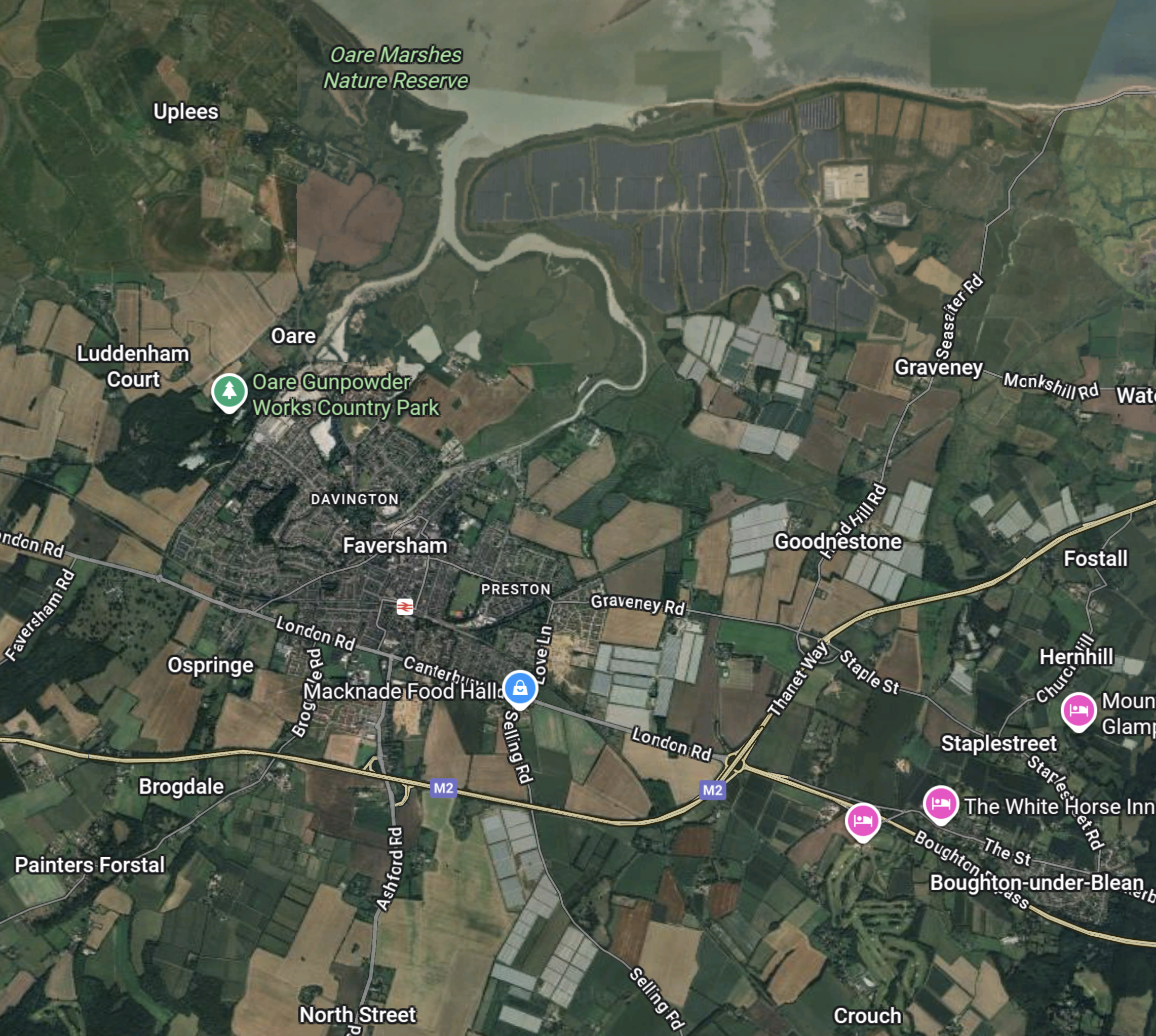
This Google Map shows the location of the solar farm with respect to Faversham.
Note.
The town of Faversham to the left of the middle of the map.
Faversham station has the usual railway station logo.
The North Kent coast is at the top of the map.
Cleve Hill Solar Park is on the coast to the East of the River Swale.
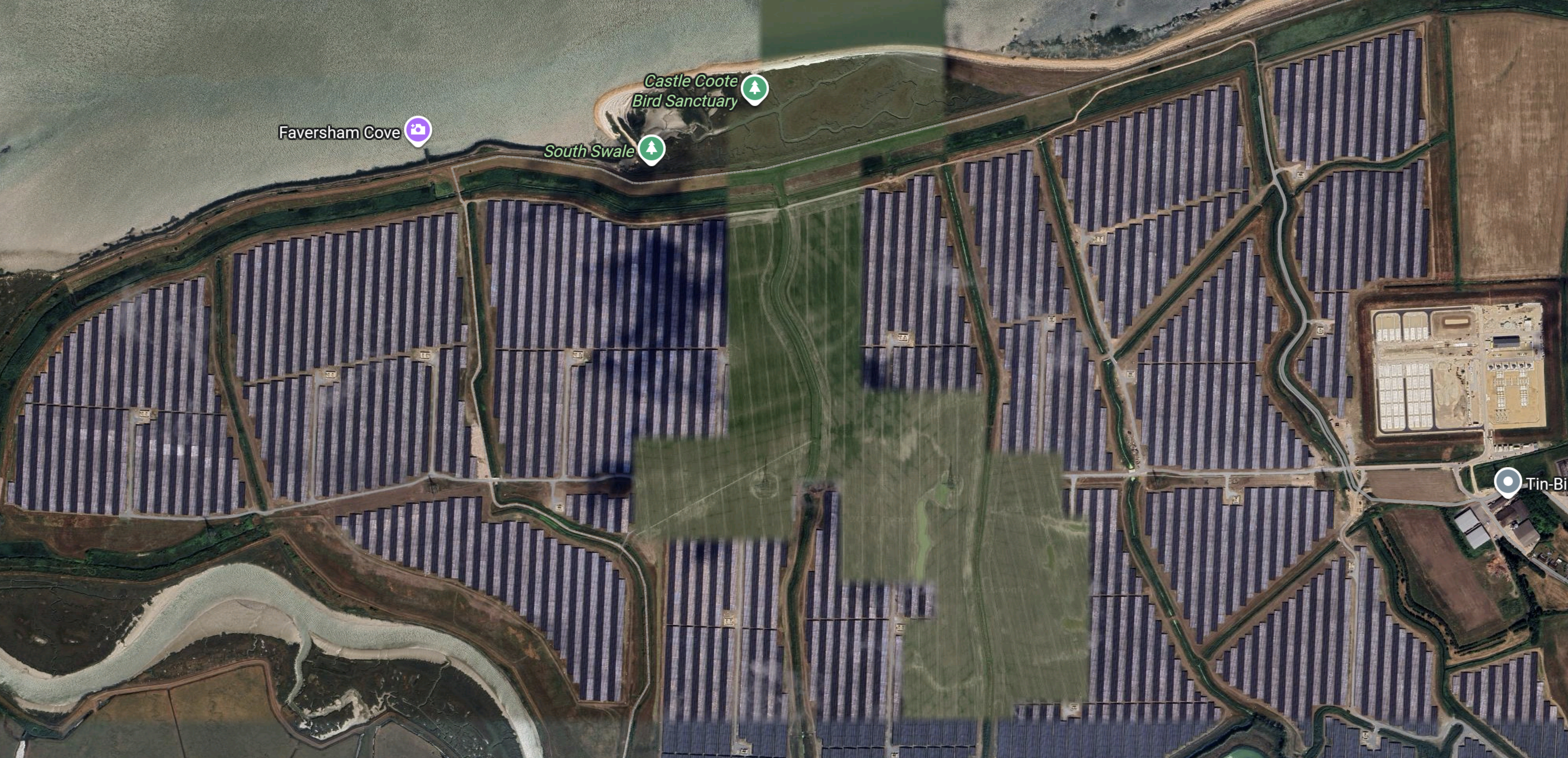
This second Google Map shows a close up of the solar farm.
Note.
- The large number of solar panels.
- The North Kent coast is at the top of the map.
- The River Swale in the South-West corner of the map.
- It appears that Cleve Hill substation is at the right edge of the map.
- The boxes at the left of the substation appear to be the batteries.
- The 630 MW London Array wind farm, which has been operational since 2013, also connects to the grid at Cleeve Hill substation.
- When completed, the London Array was the largest offshore wind farm in the world.
As a Control Engineer, I do like these Battery+Solar+Wind power stations, as they probably provide at least a reliable 500 MW electricity supply.
Could A System Like Cleeve Hill Solar Park Replace A 410 MW Gas-Fired Power Station?
The three elements of Cleeve Hill are as follows.
- Solar Farm – 373 MW
- BESS – 150 MW
- Wind Farm – 630 MW
That is a total of only 1,153 MW, which means a capacity factor of only 35.6 % would be needed.
How Much Power Does A Large Solar Roof Generate?
Some people don’t like solar panels on farmland, so how much energy do solar panels on a warehouse roof generate?
This Google Map shows Amazon’s warehouse at Tilbury.
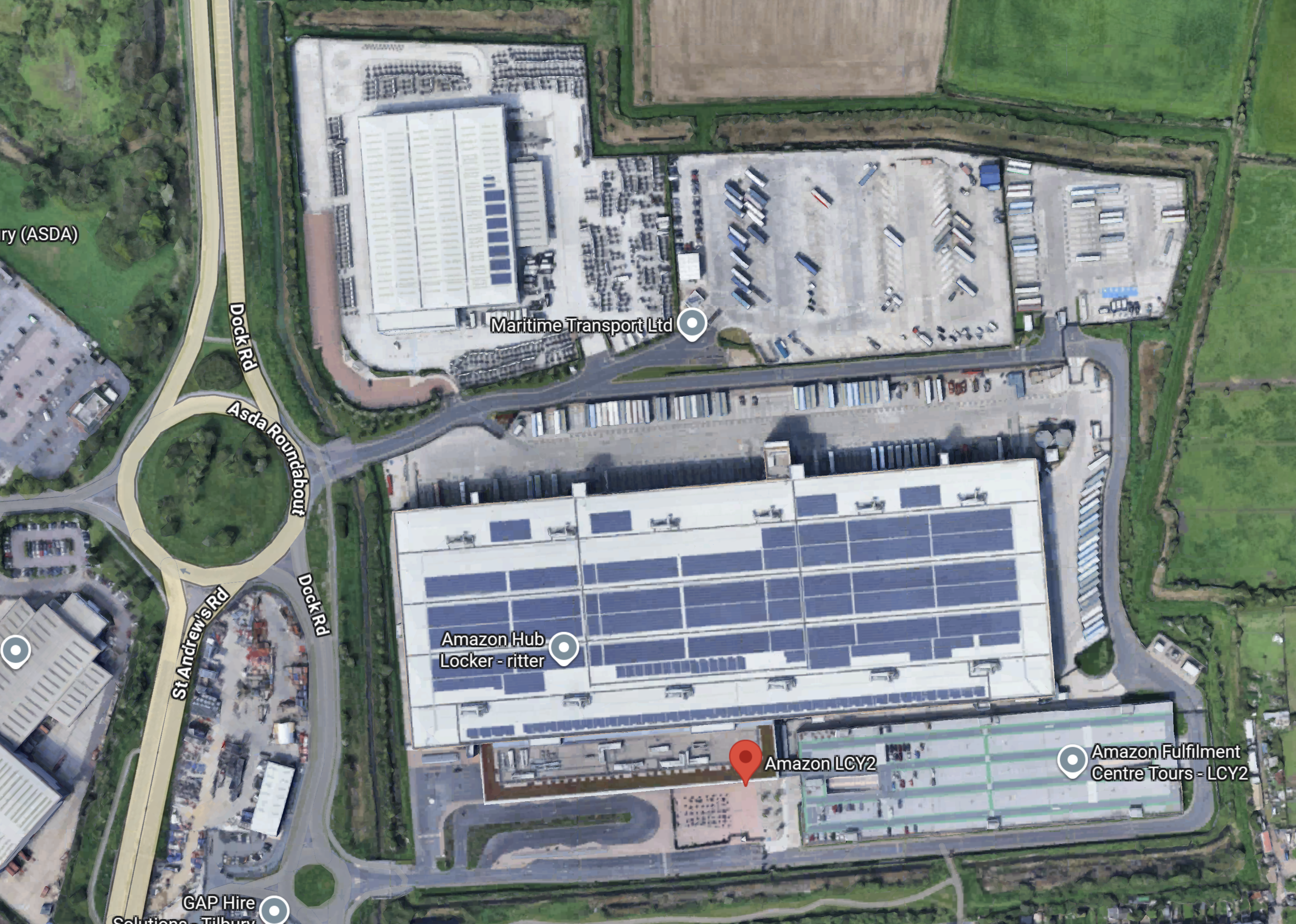
I asked Google AI to tell me about Amazon’s solar roof at Tilbury and it said this.
Amazon’s solar roof at the Tilbury fulfillment center is the largest rooftop solar installation at any Amazon site in Europe, featuring 11,500 panels across the two-million-square-foot roof. Unveiled in 2020, it is part of Amazon’s larger goal to power its operations with 100% renewable energy by 2025 and reduce its emissions, contributing to its Climate Pledge to be net-zero carbon by 2040.
It generates 3.4 MW, which is less that one percent of Cleeve Hill Solar Park.
UK Solar Deployment Poised To Increase 50% YoY, Following Rapid Growth In The Second Half Of 2024
The title of this post, is the same as that of this article from Solar Power Portal.
This is the sub-heading.
Josh Cornes, analyst at Solar Media Market Research, looks at what 2025 might hold for the solar industry.
The first four paragraphs give some interesting statistics.
The UK is forecast to add between 3-3.5GWp-dc of capacity in 2025, just shy of the huge numbers seen in 2015 and huge growth on 2024.
The UK added around 2.3GWp-dc in 2024, exceeding original expectations with the help of a push in ground mounted projects toward the back end of the year. This equates to around 20% growth on the 1.9GW that was added in 2023.
Approximately 20% of the 2.3GW deployed in 2024 came from residential rooftop installations, continuing the boost in this sector, first highlighted by the near 200% year-on-year (YoY) increase from 2022 to 2023. Commercial rooftops also contributed 20% of installations in 2024 with a slight increase of 10% YoY.
Large-scale ground-mount installations in 2024 saw the largest growth, making up 60% of the annual capacity. This uptick has continued to be driven by projects with Contracts for Difference (CfD), with rounds AR4 and AR5, and even AR6, accounting for nearly 850MW of the 1.3GW added.
It is a well-written article, that should be read in full.
Summarising 2024
In 2024 solar installations broke down as follows.
- Ground-mounted -1.38 GW
- Residential rooftops – 0.46 GW
- Commercial rooftops – 0.46 GW
Which adds up to the total installed solar capacity of 2.3 GW.
3.5 GW of total solar is scheduled to be installed in 2025, which at that rate until the end of 2030 would add 21 GW of total solar power.
But the UK will get help from what I think is one of the best solar ideas, which surprisingly comes from The University of Swansea in Wales.
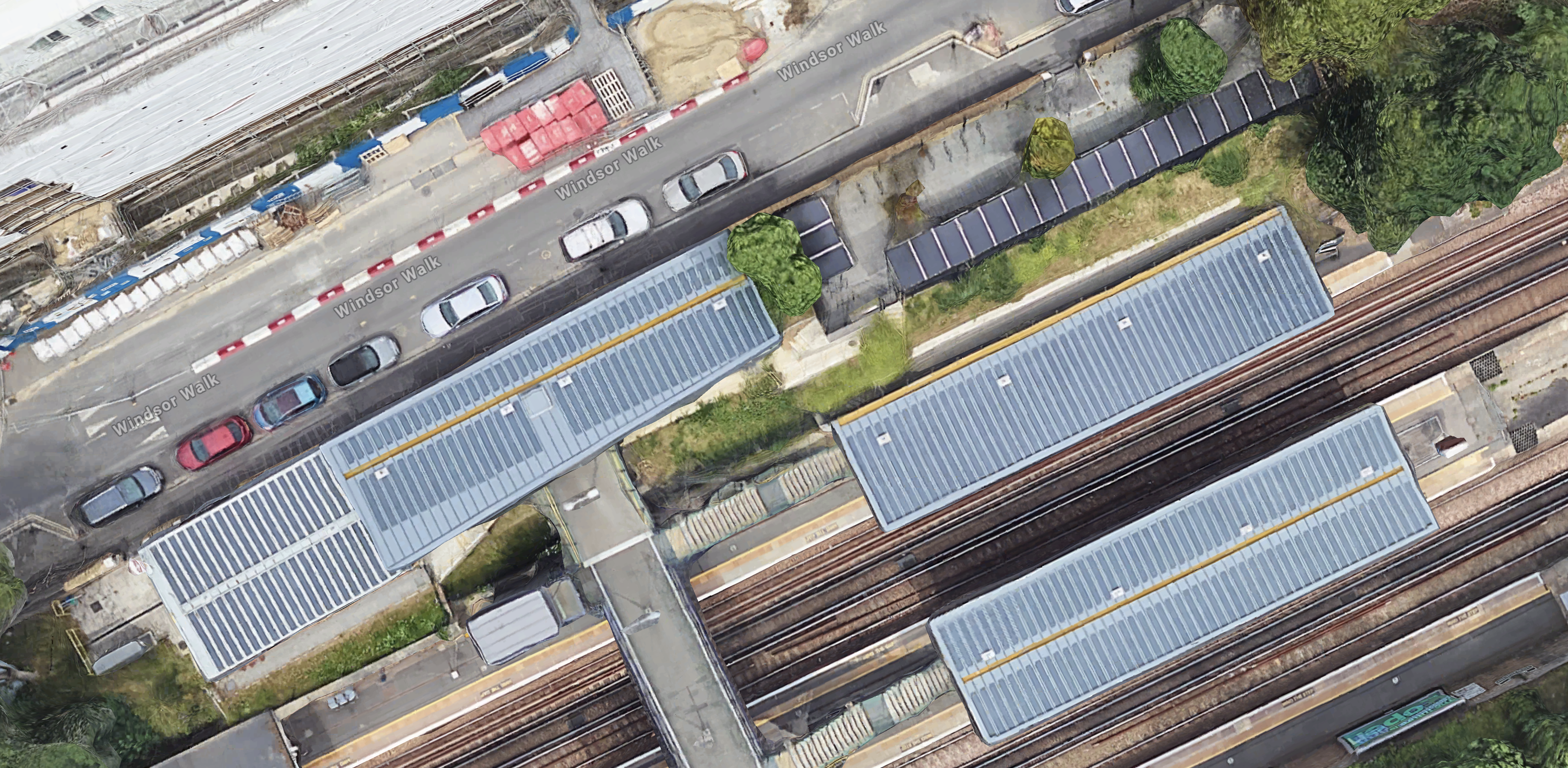
This Google Map shows the three large solar roof panels on Denmark Hill station in London.
Note.
- The three large panels are flat.
- The panels are built on a steel substrate.
- Two provide shelter for three platforms.
- The third panel provides shelter for entering passengers.
These pictures show the panels from various angles.

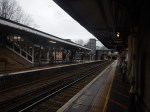






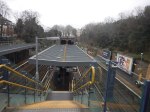






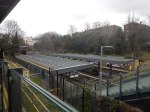



So often, a small improvement opens up a large opportunity.
This page on the Kalzip web site which is entitled Modernisation of Denmark Hill Station, gives more details of the station project.
Over the years, I put up a few steel-roofed buildings in my time and I helped design a few with a client in the 1970s, that could have benefited from solar panels like these.
Project Fortress
Project Fortress is described like this in its Wikipedia entry.
Project Fortress (formerly Cleve Hill Solar Farm) is a photovoltaic power station under construction on the Graveney marshes between Faversham and Whitstable, Kent in the UK.
Once operational, it will be the largest solar farm in the UK, generating 373 MW of electricity from 900 acres (360 ha) of vertical solar panels and will also include 700 MWh of battery storage. Because of its size, it is a nationally significant infrastructure project so outside the standard local planning procedure.
Electricity will be exported from the project via the 400 kV National Grid substation at Cleve Hill, constructed to serve the London Array offshore wind farm that lies to the north. Here, a battery array will be placed, that will charge from the sunlight during the day and release the energy at night when it is needed.
It is one of the very few co-located solar farms and lithium ion batteries that are co-located with a wind farm in the UK.
We need more of these to balance our power supplies and improve their quality.
Gresham House Energy Storage Sets GBP80 Million Fundraise
Gresham House Energy Storage Fund must be doing something right, as similar headlines are used in half-a-dozen places on the Internet and they regularly seem to be raising more money.
But then, as a Graduate Control Engineer and a previous owner of half a finance company, I’ve always thought raising money to build batteries was a good idea.
My only niggle with Gresham House, is that I would have thought by now, they would have put some money into building one of the excellent new technology batteries that are coming through.
The storage fund or some of its employees, may of course have contributed to some of the crowdfunding for these new technologies, all of which I feel have a good chance of being a success.
Note.
- Energy Dome is Italian and all the others are at least fifty percent British.
- Most of the British batteries have had backing from the UK government.
- All these batteries are environmentally-friendly.
- None of these batteries use large quantities of rare and expensive materials.
- Energy Dome even uses carbon dioxide as the energy storage medium.
In addition, in Scotland, there is traditional pumped storage hydro-electricity.
Project Iliad
This article on renews.biz has a slightly different headline of Gresham House To Raise £80m For US Battery Buildout.
This is the first two paragraphs.
Gresham House Energy Storage Fund is seeking to raise £80m through a share placing.
The new equity raised will primarily be used to finance 160MW of solar with co-located four-hour battery projects in California, US, known as Project Iliad.
The article then gives a lot of financial details of Project Iliad and Gresham House.
Will Gresham House be backing co-located solar/battery projects in the UK?
- In Cleve Hill Solar Park, I write about a co-located solar/battery project in Kent.
- This press release from National Grid is entitled UK’s First Transmission-Connected Solar Farm Goes Live, which also describes a co-located solar/battery project, being built near Bristol.
These two projects are certainly serious and could be pathfinders for a whole host of co-located solar/battery projects.
WillGresham House back some of this new generation?
Quinbrook Breaks Ground On ‘Largest’ Solar And Storage Project In The UK
The title of this post, is the same as that of this article on Energy Storage News.
These three paragraphs outline the project.
Quinbrook Infrastructure Partners has started construction on Cleve Hill Solar Park, the largest solar and energy storage project in the UK, it claimed.
The specialist global investment manager revealed the Kent-based project, which consists of 373MW of solar and “more than” 150MW of battery energy storage, is expected to be fully completed by the end of 2024.
Once complete, Cleve Hill Solar Park will consist of 880,000 solar panels and battery storage. It was granted development consent by the energy secretary in May 2020.
It is my view, as a Control Engineer, that all solar farms and wind farms should be paired with an appropriately-sized energy storage device.
If this project works out well, we should repeat it on other solar farms of a similar size.
Are These Turbines An Alternative To Solar Panels?
I took this picture yesterday of the Ventum Dynamics turbine on Skegness Pier.
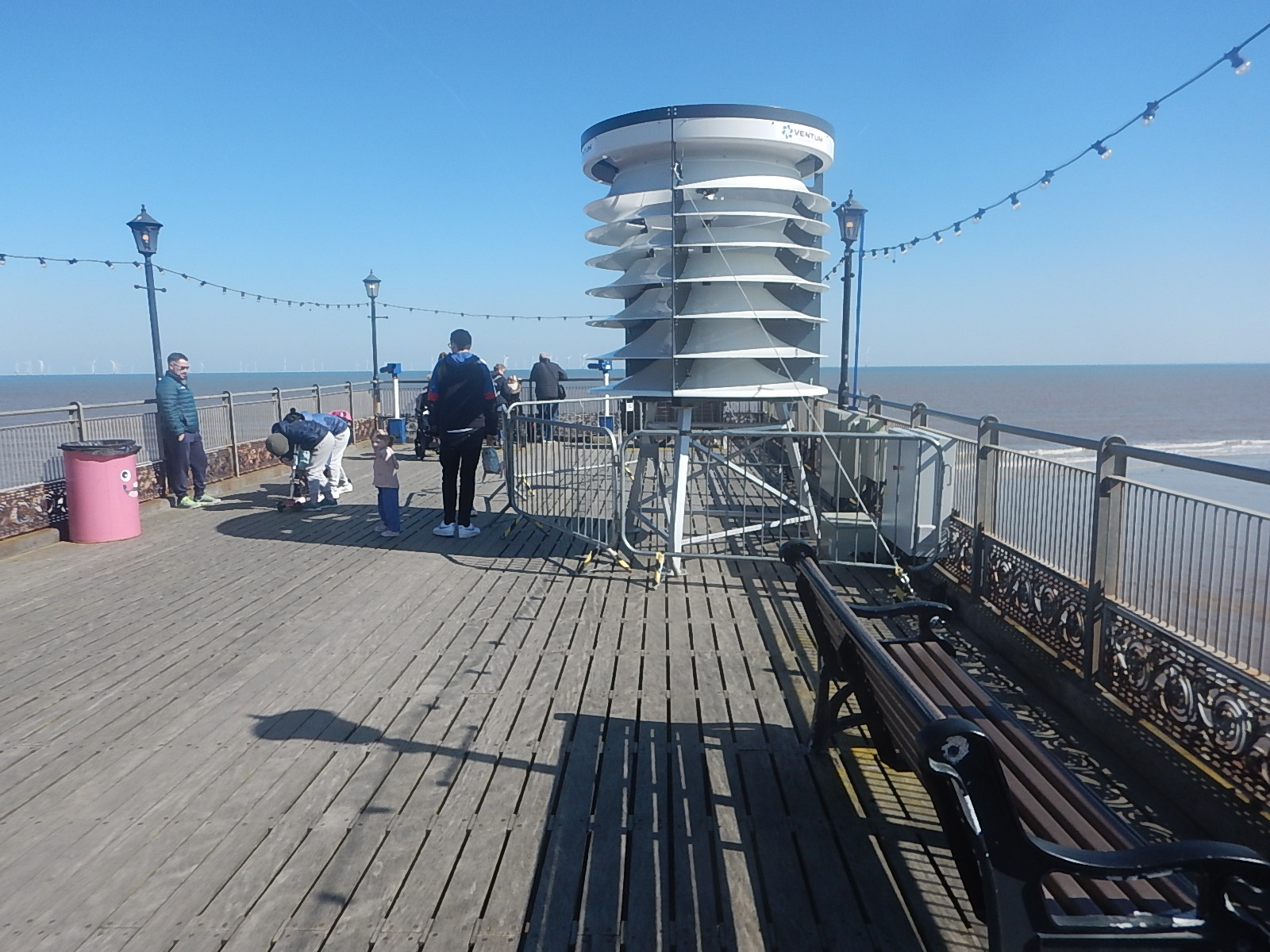
On the Ventum Dynamics web site, there are several pictures of buildings with flat roofs, that have several turbines on each.
I have some thoughts.
Connecting The Turbines
The Skegness turbine has been installed to light up the pier, but it doesn’t seem to have masses of cabling!
So can one of these turbines or a whole fleet of them be connected up by a qualified electrician, who is familiar with connecting up solar panels?
It would certainly, be a positive feature if they could, as these turbines could be another string to the bow of a solar power company.
I would design them to be electrically interchangeable with solar panels, so that roofs could be covered by a mixture of both solar and wind power.
Will We See more Hybrid Systems?
Cleve Hill Solar Park in Kent is being built as a solar park with a battery close to the London Array offshore wind farm.
I can see batteries and Ventum’s turbines being added to solar farms.
Conclusion
Ventum’s turbines are both an alternative and a partner to solar panels.
Do All Wind Turbines Have To Be Similar?
I feel this is a reasonable question to ask.
But do all wind turbines have to look like those in this picture?

Wikipedia lists three main types.
- Horizontal Axis – Those in the picture are of this type, as are all the large wind turbines I’ve seen in operation.
- Vertical Axis – Wikipedia shows several examples.
- Unconventional Types
Recently, I have come across some which would be placed in the last group.
Hybrid Offshore Wind And Wave Energy Systems
This article on the Journal of Physics is entitled Review of Hybrid Offshore Wind and Wave Energy Systems, is a study from serious academics.
This is the abstract.
Hybrid wind wave systems combine offshore wind turbines with wave energy on a shared platform. These systems optimize power production at a single location by harnessing both the wind and the waves. Wave energy is currently at an earlier development stage than offshore wind. Research in this area is focused in wave energy converters being used for platform motion suppression of floating offshore wind turbines. Wave energy converters can passively shelter offshore wind turbines from waves and can also be actively controlled to reduce the system loads. Additionally, a small amount of supplemental power may be generated, which can be used for offshore wind turbine local power needs. There may be future benefits to these hybrid systems, but at this stage wave energy may increase the project cost and risk of offshore wind turbines. Hybrid wind wave system research and development is discussed, with a focus on floating offshore wind turbines. Additionally, two ocean demonstration scale hybrid wind and wave systems are discussed as case studies: the Poseidon Wave and Wind system and the W2Power system. Hybrid wind wave systems show potential to be part of the future of offshore wind energy.
Note.
- Wave energy development is at an earlier stage than offshore wind.
- Wave energy converters can passively shelter offshore wind turbines from waves and can also be actively controlled to reduce the system loads.
- There is more about Poseidon on this page on the Tethys web site.
- There is more about W2Power on the Pelagic Power web site.
The last sentence of the abstract is significant and I believe that hybrid offshore wind and wave energy will play a significant part in the future of offshore energy.
Wind Turbines With Added Storage
Critics and cynics of wind power always ask, what happens, when the wind doesn’t blow.
It is generally accepted, that the best thing to do is to pair a wind farm with some form of energy storage.
Technologies and solar and/or wind farms with energy storage are starting to be proposed and/or installed.
- In Cleve Hill Solar Park, I wrote about a solar farm, a wind farm and a battery sharing a grid connection.
- In First Ever Gravity Green Energy Storage System Set For North Yorkshire Town, I wrote about a battery being installed where two massive wind farms connect to the grid.
- In How To Store Excess Wind Power Underwater, I describe a Dutch system called an Ocean Battery.
- In UK Cleantech Consortium Awarded Funding For Energy Storage Technology Integrated With Floating Wind, I wrote about adding Marine Pumped Hydro to offshore wind farms.
More energy storage will be added in the future in or near to wind and solar farms.
Twin Turbines
This document from the Department of Business, Industry and Industrial Strategy lists all the Contracts for Difference Allocation Round 4 results for the supply of zero-carbon electricity.
One of the projects allocated a Contract for Difference, was the 32 MW TwinHub wind turbine, which I wrote about in Hexicon Wins UK’s First Ever CfD Auction For Floating Offshore Wind.
A full scale twin turbine hasn’t been built yet, but it does seem promising and the visualisations are impressive.
Scroll down on the TwinHub home page to see a video.
World Wide Wind
I’ll let the images on the World Wide Wind web site do the talking.
But who would have thought, that contrarotating wind turbines, set at an angle in the sea would work?
This is so unusual, it might just work very well.
Conclusion
There will be other unusual concepts in the future.
2.2 GW Of Solar Farms To Be Installed In The UK
This document from the Department of Business, Industry and Industrial Strategy lists all the Contracts for Difference Allocation Round 4 results for the supply of zero-carbon electricity that were announced yesterday.
There were sixty-six solar power projects, that totalled up to 2.2 GW, which gives an average size of 33.3 MW.
- Many complain that we don’t have enough sun in this country, so surely solar farms totalling up to 2.2 GW is an astonishing figure.
- For a comparison, Hinckley Point C will supply 3.26 GW.
- In Cleve Hill Solar Park, I wrote about the largest, which will be a 350 MW solar farm with a 700 MWh battery.
- Sixty-one are in England, two are in Wales and surprisingly three are in Scotland, So being that far North isn’t as bad for solar power, as you might think.
- It looks like 251.38 MW are proposed to be installed in 2023/24 and 1958.03 MW in 2024/25.
The Wikipedia entry for Solar Power In The United Kingdom, gives these numbers.
UK solar PV installed capacity at the end of 2017 was 12.8 GW, representing a 3.4% share of total electricity generation. Provisionally, as of the end of January 2019 there was 13,123 MW installed UK solar capacity across 979,983 installations. This is an increase of 323 MW in slightly more than a year. A new record peak generation from photovoltaics was set at 9.68 GW on 20 April 2020.
How many people correctly predicted that the UK would be be generating so much energy from the sun?
How Many Of These Solar Farms Will Be Co-located With Batteries Or Wind Farms?
Consider.
- Cleve Hill Solar Park will be a 350 MW solar farm, that is co-located with a 700 MWh battery.
- Is it significant that the battery could supply 350 MW for two hours?
- It also connects to the grid at the same substation, that connect the London Array offshore wind farm.
- As substations are complicated and probably expensive bits of electrical gubbins, sharing a substation is probably a good idea to save costs.
I hope that companies like wind and solar farm developers, the National Grid and Network Rail talk a lot to each other, so that efficient infrastructure is developed.
Conclusion
Over the years 2023 to 2025, we should develop these solar farms at a rate of around 0.7 GW per year.
Can we sustain that rate in the future or will we run out of land?
Cleve Hill Solar Park
This document from the Department of Business, Industry and Industrial Strategy lists all the Contracts for Difference Allocation Round 4 results for the supply of zero-carbon electricity that were announced yesterday.
There were sixty-six solar power projects, that totalled up to 2.2 GW, which gives an average size of 33.3 MW.
I looked at the list and found the following.
- All contracts had the same strike price of £45.99 per MWh.
The largest solar farm with a contract is Cleve Hill Solar Park.
- ,Cleve Hill Solar Park received a contract for 112 MW.
- According to Wikipedia, the solar park will have a battery of 700 MWh.
- Will the battery enable the solar park to supply 112 MW on a twenty-four seven basis?
- According to Wikipedia, solar farms have a capacity factor of about 10 % in the UK.
- The Cleve Hill Solar Park will have a capacity of 350 MW.
- On a typical day, it will generate 350 * 24 *0.1 = 840 MWh
- The Contract for Difference mechanism means they get the strike price for each MWh of electricity up to the level in the contract, which is 112 MW.
- I suspect that for several months of the year, the solar park will be able to supply 112 MW to the grid.
- I do feel that overnight and on sunless winter days, the system will provide a lot less electricity.
- This page on the EMR web site explains Contract for Difference mechanism.
This extract from Wikipedia, describes, the solar park’s connection to the National Grid.
Across the marsh run the 400kV powerlines of the national grid. They are supported by eight 40m pylons. There is a large 150/400kV electricity substation at Cleve Hill, serving the London Array offshore wind farm that lies to the north beyond the mouth of the Thames Estuary. The output from the Solar Farm will use this substation to connect to the grid. Here, a battery array will placed, that will charge from the sunlight during the day and release the energy at night when it is needed.
I can build a table showing the earnings on a per day and per year basis, against average output.
- 20 MW – £22,076.20 per day – £8,057,448 per year
- 50 MW – £55,188 per day – £20,143,620 per year
- 70 MW – £77,263.20 per day – £28,201,068 per year
- 100 MW – £110,376 per day – £40,287,240 per year
- 112 MW – £123,621.12 per day – £45,121,708.80 per year
Note.
- I have assumed the year is 365 days.
- As a time-expired Control Engineer, I know that the battery can be optimised to supply the electricity, when it is needed and the price is highest.
- I wouldn’t be surprised to see co-operation between the London Array and Cleve Hill Solar Farm, as on a sunless but windy day, there may be scope to store excess wind energy in the battery for later release.
On this brief look, it appears that owning a solar farm, can be a nice little-earner.
Thoughts On The Battery
Consider.
- According to Wikipedia, the solar park will have a battery of 700 MWh.
- One of the largest lithium batteries in the UK is the one at Clay Tye in Essex, which is just under 200 MWh.
I suspect that lithium ion batteries will not be used.
Highview Power are building a 250 MWh battery in Manchester.
- This battery will be able to supply 50 MW.
- The batteries use liquid air as an energy storage medium.
- The company says the design can be extended up to a GWh by adding more tanks for the liquid air.
- The only fossil fuels used in Highview’s batteries is probably some lubricating oil.
I feel that a Highview battery or something similar would be an ideal solution at Cleve Hill Solar Farm.
I should be noted that the London Array is a 630 MW wind farm, so the London Array and Cleve Hill Solar Farm have a combined nameplate capacity of 980 MW.
I feel there is a case for a larger battery at the substation, to give the grid an almost-guaranteed GW all day.
It would be large than most if not all gas-fired power stations.
It could be used to balance the grid.
The controlling software would optimise the finances by buying and selling electricity at the right time.
 The Anonymous Widower