Wrightbus Back To Coach With Contour Diesel And Hydrogen Future
The title of this post, is the same as that of this article on Route One.
These are two introductory paragraphs.
Wrightbus has announced details of its return to the coach sector with the launch of the Contour, a new diesel-powered two-axle model built in partnership with Chinese OEM King Long.
Alongside the Contour, the company has spoken in more detail of its plans to introduce a tri-axle integral hydrogen fuel cell-electric coach, due for debut in 2026.
Specific and new product points include.
- The diesel-powered coach will be built in partnership with a Chinese OEM.
- It will be a 12.2m coach with 55 seats plus toilet.
- Left- and right-hand drive variants will be available.
- Luggage space is nine cubic metres, reducing to seven cubic metres with a passenger lift fitted.
This paragraph describes the hydrogen coach.
That vehicle will be its first fully integral coach model, developed entirely in-house. The initial variant will be a 15m overdecker capable of accommodating 69 passengers on the upper deck and up to 15 passengers and two wheelchair users on the lower deck, with 10 cubic metres of luggage space. Wrightbus has not confirmed yet whether it will carry the Contour name, nor where the body will be built.
They also say that a single-deck version is being considered for later, while the coach’s modular construction will make it suited to a number of different drivetrain options, depending on demand.
It would appear that Wrightbus have all options covered.
Wrightbus Goes Back To The Future As It Relaunches The Contour Coach
The title of this post, is the same as that of this press release from Wrightbus.
This is the detail of the press release.
Wrightbus is entering the coach market for the first time in more than 30 years with the launch of two new vehicles in the next 18 months.
The first vehicle to hit the market is the Contour, a low-emission 55-seater coach that was launched at a customer showcase event today (March 5).
It’s a case of back to the future for Wrightbus, which last produced a Contour coach in 1987 before retiring the vehicle.
The second vehicle, a zero-emission hydrogen coach – which is under development in Ballymena, Northern Ireland – will be added to the Wrightbus coach range within the next 18 months to help drive decarbonisation of the sector.
The low emission Contour has a lead time of just six months from order, which is considerably faster than the current one-to-two-year average wait customers have come to expect from the sector. Featuring a Cummins Euro 6 400BHP X11 engine and a ZF automatic gearbox, the modern-day Contour has been built with comfort in mind, with up to 55 reclining seats – each with its own USB port – alongside other modern safety features. Competitively priced and available with or without PSVAR compliance, there is also the option of the vehicle being ‘pre-prepared’, protecting the vehicle’s ‘second life’ and flexibility.
The coach has a range of bespoke options for customers to choose from and is designed to maximise luggage space and functionality.
It will be supported by a full Wrightbus warranty, alongside an unparalleled service and maintenance package from AllServiceOne, the Wrightbus repair and maintenance arm.
With the largest fleet of mobile technicians throughout the UK and Northern Ireland, AllServiceOne is the ultimate one-stop-shop for fleet support and service.
Wrightbus CEO, Jean-Marc Gales, said bringing the Contour to market was a pivotal move.
“The coach market has changed over the last few years and it’s the right time for a new player to come to the market.
We have long spoken about broadening our portfolio to offer customers an even greater range of Wrightbus vehicles.
Our first entry into the coach sector after an absence of more than three decades is another significant step in our expansion plans,” said Mr Gales.
“We know there are gaps in the market and the demand for coaches is growing.
This partnership allows us to bring high-quality low-emission vehicles to market almost immediately.
Throughout the process of readying the vehicle for our UK market, we have worked alongside our partner closely to ensure the Contour meets the exacting Wrightbus high quality standards that customers have come to expect.
Our AllServiceOne technicians have embarked on an extensive training programme and have a full working knowledge of the coach to ensure excellent fleet support. “At the same time as the launch of the Contour, our world-leading engineers are continuing to develop our own zero-emission hydrogen coach from our factory in Northern Ireland. We expect the hydrogen coach to be ready for launch in the next 18 months, which is a hugely exciting prospect.” The hydrogen coach concept was first revealed in 2024 as a prototype vehicle.
When launched, it will be a tri-axle hydrogen fuel cell electric coach capable of a 1,000km range, putting it on a par with traditional diesel-fuelled coaches.
These are my thoughts.
The Coach Has A Cummins Engine
Cummins will probably build the engines in their UK factory in Darlington.
Thirty years ago, I did a small data analysis consultancy for Cummins in Darlington and I was impressed by the operation and the company’s attitude.
One of their policies was that if the customer wants a special engine, then the company, is prepared to give the customer what they need.
So you can be sure, that the Cummins X11 engine to be supplied for the Contour coach, will be exactly what Wrightbus want.
The Cummins X15 Engine Is Convertible To A X15 Hydrogen Engine
Some of Cummins diesel engines are convertible to hydrogenfuel, by changing the cylinder head and the fuel system.
This can be done with a Cummins X15 engine and I wouldn’t be surprised if the X11 engine fitted to the Contour coach can be converted to hydrogen.
So an operator can buy a diesel coach and if they need, they could convert it to hydrogen.
USB Ports
This is stated in the press release.
Contour has been built with comfort in mind, with up to 55 reclining seats – each with its own USB port.
When I rode recently in a Irizar coach, there were no USB ports.
There Is A Promised Delivery Time Of Six Months
In the 1990s, I used to part-own a finance company, that leased vehicles.
One of the vehicles we used to loan money for was upmarket coaches like the Wrightbus Contour.
- They were a relatively large loan of about £50,000.
- The borrower was often very reputable with a good credit history.
- The repossession rate was very low.
The press release says, that a two-year delivery time is normal for coaches and, I can remember that we could have financed more coaches, if they had been available.
So it would appear to me, that if Wrightbus can deliver a new coach in six months, they will sell a lot of coaches and I believe from past experience, that finance will be available from trusted sources.
The Hydrogen Coach Will Be A Hydrogen Fuel Cell Electric Tri-Axle Coach
This is stated in the press release.
When launched, it will be a tri-axle hydrogen fuel cell electric coach capable of a 1,000km range, putting it on a par with traditional diesel-fuelled coaches.
I suspect to get the 1,000 km range of the diesel coach and to protect the hydrogen tank, means some extra weight and an extra axle.
But I wouldn’t be surprised to see a reduced range hydrogen coach without the third axle.
Wrightbus Are The Company Who Launched Ballard Hydrogen Fuel Cells In London
I wrote London’s Hydrogen Buses in July 2013 and all Wrightbus buses hydrogen buses have used hydrogen full cells from Ballard Power Systems in Canada.
But there could be a complication in that Cummins make fuel cells in Germany and we are approaching Trumpian Tariff War Territory.
On the other hand in Australian Volgren Rolls Out First Hydrogen Bus Based On Wrightbus Chassis Technology, it shows how Wrightbus are prepared to licence their technology to reputable companies.
So any country, like Australia, Brazil, Canada, India, Mexico, Singapore or the United States, who can build coaches, can licence Wrightbus’s designs and fit the appropriate components to make a complete coach.
Note.
- Wrightbus is owned by the Bamford family, who own JCB.
- Wrightbus have licenced designs to Australia, Hong Kong and Singapore in the past.
- JCB have large manufacturing facilities in India.
I’m certain that the Bamfords and their advisors can work it out!
Heathrow Rail Link Project Could Be ‘Reopened’
The title of this post, is the same as that of this article on the BBC.
This is the sub-heading.
Network Rail has said plans for a rail link between the Great Western mainline and Heathrow Airport could still move forward if funding is found in the future.
These three paragraphs give the current status of the scheme.
The Local Democracy Reporting Service recently reported that the project had been put on hold.
It began in 2012 and involved proposals for a 4 mile (6.5km) rail link to allow train services from Reading and Slough in Berkshire to reach Heathrow using a tunnel.
The £900m scheme would allow people living to the west of Heathrow to travel direct to the airport, instead of having to go into London.
These are some other facts and my thoughts.
The All-Party Parliamentary Group (APPG) For The Western Rail Link To Heathrow
According to the BBC article, this has now been established and this is said.
Labour MP for Slough, Tanmanjeet Singh Dhesi, held a debate in parliament on the western rail link in April and established the All-Party Parliamentary Group (APPG) for the Western Rail Link to Heathrow, to make sure it “remains on the government’s agenda”.
He said the project had been “beset by delays and funding challenges” but still had “wide cross-party and local support”.
Parliamentary backing is surely a good thing.
The Current Scheme
The BBC article shows this map with a rail link connecting the Great Western Main Line to Terminal 5 railway station.
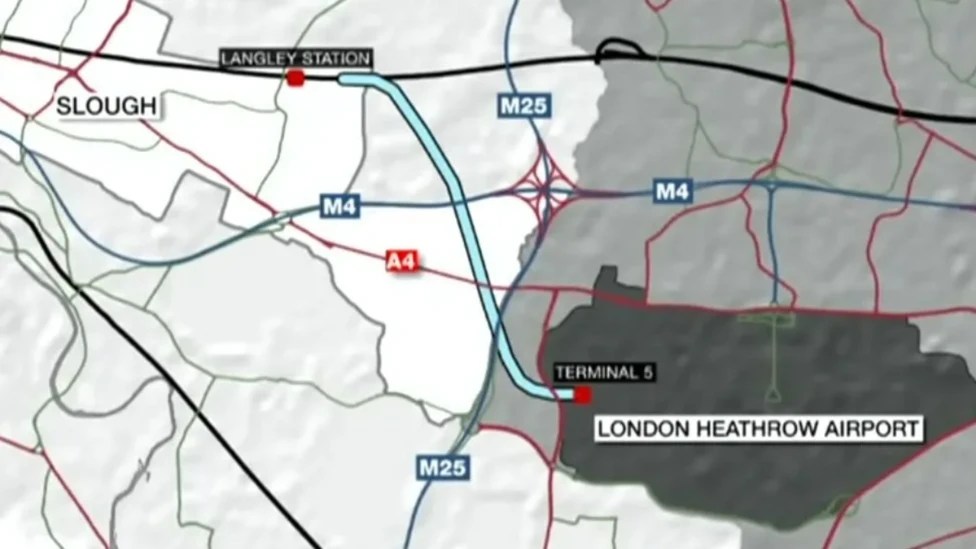
Note.
- The rail link starts from East of Langley station.
- Terminal 5 station can take full-length Elizabeth Line trains.
- Main line trains from Bristol, Cardiff and Wales and the West should be able to access Heathrow.
But I suspect, that there would be extensive changes to Heathrow’s railways to access the other terminals. This would explain the near billion pound cost of the link.
I also suspect that it would take about eight to ten years to build and from what I havc heard, the rail link is urgently needed.
RailAir
RailAir is the current way of travelling between Reading station and Heathrow Airport.
This is the first paragraph of RailAir’s Wikipedia entry.
RailAir describes a number of airport bus and coach services designed to connect the National Rail network to airports in the United Kingdom. Services are currently concentrated on Heathrow Airport, with one other from Luton Airport. RailAir services are operated as public transport services by or on behalf of train operators, where the whole journey is paid for as a through-ticket which combines the railway and bus journey, although journeys can be made using the bus only. As such, many are operated where the train and bus operator are owned by the same company.
Could RailAir be updated to be a more frequent and integrated service?
CoacH2
This page on the Advanced Propulsion Centre UK web site is entitled CoacH2 – Next Generation Hydrogen Fuel-Cell Coach Powertrain Demonstrator.
This is the sub-heading.
Accelerating the development of zero-emission hydrogen fuel-cell electric coaches, with a full on-vehicle technology demonstrator.
These are the first two paragraphs.
Coaches are an integral part of the public transport network, with over 30,000 diesel coaches operating across the UK and Ireland. Due to the specific demands of coach operation (motorway driving, long-range, high passenger and luggage loading capacity) decarbonisation options for this sector are extremely limited with hydrogen fuel-cell technology considered the most viable choice. This project will tackle this difficult to decarbonise sector by developing, testing and validating an innovative hydrogen fuel-cell powertrain suitable for coach applications.
Delivered by a Northern Irish consortium spanning OEM, coach operator and academia, CoacH2 will accelerate the development of zero-emission, fuel-cell electric coaches, with a full on-vehicle technology demonstrator to be manufactured and showcased at Cenex Expo 2024.
As I indicated in British Buses For British Bottoms, Wrightbus build a good well-built, smooth-riding and comfortable bus, so now they can add hydrogen-powered coaches to the product range.
This press release on the Wrightbus web site is entitled Wrightbus Coach Demonstrator Unveiled At Cenex Expo, gives more information on CoacH2.
- The demonstrator has a power of 300 Kw.
- It has a range of 1,000 km. on one refueling.
- An internet search reveals a launch date of 2026 for the hydrogen-powered coach.
I wonder, if RailAir changed their coaches to these new Wrightbus hydrogen-powered coaches, they would transform travel to airports all over the UK.
If the hydrogen-powered coaches are of the same quality of their hydrogen-powered siblings, they will be a quality product with good road-holding, sufficient performance and superb passenger comfort.
RailAir could be the ideal, initial application.
Conclusion
A proper rail link to Heathrow from Reading is needed, but it will take at least ten years to build and cost a billion pounds.
However the RailAir links to Heathrow from Reading and Woking can be improved by using high-performance Wrightbus hydrogen-powered coaches.
Never Mind Heathrow: Gatwick Airport Is Close To Getting A New Runway
The title of this post, is the same as that of this article on The Times.
A friend passed through at Gatwick Airport yesterday, so I went to wish him well. For a change , I took a Metrobus from Sutton station to the South terminal – This route is free and doesn’t need a ticket with a Freedom Pass!
The bus was no ordinary bus, but a brand new Wrightbus hydrogen double decker from Ballymena.
It took a round-about route, as its main function is to bring local workers and passengers into the airport and handle traffic to Redhilll, Reigate and East Surrey Hospital.
But if this is the shape of buses to come, then I’m for it. Quality was more coach than bus and performance was sparkling with little or no noise and vibration.
Gatwick and Metrobus are building a network of local hydrogen buses to bring workers and passengers into the airport and I suspect, if the Airport has the fuel, they’ll use it for other purposes, like air-side vehicles, aircraft tow-trucks and car park buses.
Gatwick unlike Heathrow has a close-by source of electricity to produce hydrogen in the soon-to-be-extended 1.6 GW Ramplion offshore wind farm, just off Brighton.
Airbus are talking about bringing hydrogen aircraft into service by 2035 and I believe that by this date we’ll be regularly seeing hydrogen-turboprops on short routes.
As someone, whose software planned the Channel Tunnel, I think it reasonable by 2035, the following projects will be completed.
- Zeroavia are talking of converting aircraft to hydrogen in the next few years.
- A number of short-haul hydrogen aircraft are in service.
- Gatwick’s new runway and terminals are built.
- Ramplion is pumping hydrogen to the airport.
- The station has been updated.
- The Thameslink frequency of trains will have been increased.
Gatwick could be the first major airport to use large amounts of hydrogen, to cut emissions.
Vallourec’s Delphy Hydrogen Storage Solution
Hydrogen can be a nuisance to store.
I have just found a YouTube video of a system called Delphy from French company Vallourec.
Delphy seems a neat solution, where hydrogen is stored vertically in a 100 metre hole, that can hold a 100 tonnes of hydrogen.
You can watch this video.
I think this would be an ideal hydrogen storage solution for a bus or coach company or a truck operator.
Wrightbus Hydrogen Coach Planned For 2026
The title of this post, is the same as that of this article in Bus&Coach Buyer.
This is the sub-heading.
Wrightbus‘ planned hydrogen coach is expected to be in production by 2026.
These are the first three paragraphs.
Jean-Marc Gales, Wrightbus CEO, told B&CB that a prototype model intended to demonstrate the powertrain is expected towards the end of the year.
Jean-Marc said: “The concept is ready, the predevelopment work has been done, so we are confident we can launch it in 2026.”
He says the vehicle is aimed at operators that do long distance coach journeys. “Hydrogen coaches can do up to 1,000km range and in five to ten years we will see a much higher proportion of hydrogen coaches than electrical,” he said.
Jean-Marc Gales also said this about the design challenge.
Jean-Marc said: “If you build a hydrogen coach, it’s a technical tour de force. Coach operators require six to ten cubic metres of luggage space. You need at least 50 to 60 seats and disability access and enough packaging space to put the tanks and the hydrogen cooling system and the fuel cells in. But we can do it, we have the technical expertise with fuel cells; we have the best engineers on the market for fuel cell buses. We have millions of miles with electrical and fuel cell vehicles in service since we launched them.
I haven’t ever used coaches much, but in the UK, there are some well-established long-distance markets.
These are some typical driving distances.
- Plymouth and Sunderland – 334 miles – 537 km.
- Brighton and Liverpool – 216 miles – 347 km.
- London and Edinburgh – 332 miles – 534 km.
- London and Paris – 213 miles – 343 km.
- London and Gdansk – 804 miles – 1294 km.
Note.
- Away football and fans of other sports use coaches and a 1,000 km range would certainly be needed to get Plymouth supporters to all away matches and back.
- The London and Scottish Market has been strong all my life.
- London and Gdansk would be an interesting trip in a coach. If you need one, look for Sinbad Coaches.
I certainly believe that Jean-Marc Gales and Wrightbus, are developing the technology for a worthwhile market.
Hydrogen Fuel Cell-Electric Coach Driveline Coming From Wrightbus
The title of this post, is the same as that of this article on RouteOne.
These are the first two paragraphs.
Wrightbus has been awarded up to £534,000 of government funding via the Advanced Propulsion Centre (APC) for the development, testing and validation of a hydrogen fuel cell-electric coach driveline.
The Ballymena manufacturer will receive the money from an £11 million pot administered by APC as a second round of the Advanced Route to Market Demonstrator scheme (ARMD2), which itself is part of over £50 million of public funding towards 30 “cutting edge manufacturing projects” in the UK.
I have never driven a coach, but I do feel that this project could be a winner.
- From riding in hundreds of their products over the years, I’m sure Wrightbus could produce a coach that satisfies the demands of coach companies and their passengers.
- Long routes like London and Scotland are popular coach routes and are of the order of 400 miles. Would passengers tolerate a thirty minute stop halfway to charge the batteries on an electric coach?
- Through, the experiences of the vehicle leasing company, I owned, I know that finance for quality coaches is not hard to come by and they are a good investment.
I also believe that a hydrogen-powered coach could be a flagship product for the hydrogen-powered transport sector.
We’ve all been on a motorway and seen coaches in the fast lane at 70 mph.
What effect will that have if the coach was emblazoned with “Green Hydrogen Coach – London-Glasgow Non-Stop In 7 Hrs”?
Turn Off Engine Or Face Parking Ban, Coach Drivers Told
The title of this post is the same as that of an article on page 12 of today’s copy of The Times.
This is the first paragraph.
Tourist coaches face being banned from parking in central London because of concerns that they pumping out toxic fumes as drivers leave engines idling.
Apparently, Westminster Council are thinking of reducing parking for coaches, if the practice continues.
Interestingly, this evening, I walked past two coaches parked close to Kings Cross station with their engines running.
Leaving On A Coach For Irun
The only way to get sensibly towards France, was to take a coach to Irun. But even the coaches were rather infrequent, with about one every two or three hours or so.
So it was just after two that I caught one from the logically-named Termibus.







It wasn’t a bad journey and by luck I had chosen one of the better seats. But it would have been so much better on a train.
Fyra Replaced By Slow Train To The Hague
This article from the Europe by Rail web site is a lesson to all those politicians and civil servants, who think they understand the transport needs of the general public. This is the first paragraph.
The Belgian Railway authorities this afternoon announced the return of old-style InterCity services from Brussels to stations in the Netherlands. This is to provide some kind of replacement for the short-lived FYRA service, introduced in December 2012 and then withdrawn last month.
The service has actually lasted less than two months.
There is also a sting in the tail of the article.
Meanwhile, coach operators have spotted a gap in this busy cross-border market. One company starts a new express link from Rotterdam to Brussels early next month.
After all, the UK has a large network of long distance coach services that compete with rail, so why not between Brussels and big centres of population in The Netherlands/
 The Anonymous Widower