The Eden Project, Geothermal Energy And Fracking
In Iceland last summer, I saw the benefits of geothermal energy, with one of the most spectacular being the amazing Blue Lagoon.
We don’t have any volcanoes in the UK, but in places like Cornwall and London Bridge station, projects are starting to test the feasibility of using heat from deep in the ground.
According to this article in the Glasgow Herald, the Eden Project is investigating geothewrmal energy. This is an extract.
Given the prominence of Friends of the Earth in the shale gas debate it often comes as a nasty surprise to local anti-fracking groups that most green groups do actually support drilling and fracking for deep geothermal projects. Only yesterday, the famous Eden Project in Cornwall announced such a project.
Today though, I read in The Times, that this £35million project is now under threat from an anti-fracking amendment in a bill in Parliament.
I suspect that the problem is if you wrote down all the science known by Members of Parliament, it would just about fit on a small postage stamp.
I wonder what will happen when politicians find out about the ground source heat pump at London Bridge could use fracking techniques, to enable it to be built properly and run efficiently.
Good News For Cornwall
Cornwall is not where you would go, if you want to drive there in an hour and it is unlikely you’ll ever be able to get an electric high speed train to the county. I drove back once at a very busy time in my Lotus and reported it here. It took six hours to Cambridge if I cut out the delay due to accidents. Why bother?
But today, it is reported on the BBC, that the government has announced a £146million package of measures to upgrade the rail system in Cornwall, by resignalling the Cornish Main Line from Totnes to Penzance and refurbishing the sleeper trains.
I’ve only taken the train as far as Plymouth a couple of times, but on one memorable trip, the train was several minutes late at Totnes and the driver had recovered most of the time by Plymouth, by showing how an Inter City 125 can perform, if it is needed.
The BBC article doesn’t say if Network Rail are going to raise the speed limits on the line, but surely when the signalling upgrade is complete, the current journey time of five and a half hours could be reduced and the frequency increased to half-hourly, even if they still run the same amazing trains designed in the 1960s. But I travel in these trains and Mark 3 coaches regularly and you rarely hear a complaint about the trains, as they ride so well on their air bag suspension. Read about the construction of the coaches here. It is true to say that they don’t build coaches like that any more.
As it currently takes two hours from Plymouth to Penzance and a couple of years ago, First Great Western did Plymouth to London in under three hours, it would seem to be a possibility, that when the updating is complete, we could see trains from Paddington to Penzance taking under five hours. The tourism business in Cornwall will be licking its lips in anticipation of a service like this.
So will we still be seeing these trains going at full speed to Cornwall in twenty or even thirty years time? With these trains you never say never, as clever engineers always find some way to prolong their lives for another few years.
More New Universities
We’ve just had a whole new set of universities created, as the BBC reports here.
I would have thought we had enough. On the other hand Cornwall gets its first university and other colleges like the Royal Agricultural College are upgraded.
Newquay Bans Mankinis
Newquay has banned mankinis and other inappropriate clothing, in a bid to improve its image according to this article in the Guardian.
Am I bothered? Not really, as I have no plans to visit Newquay and no plans to wear a mankini.
Cornwall Wins More Gold Medals Than Australia
The Aussie press is having a go at their athletes for failing to turn silver into gold, but what has happened to Australian sport? When I was growing up, Wimbledon was almost a suburb of Sydney or Brisbane, with win after win by a never-ending stream of players. Then more recently, the cricketers were invincible. So why has this happened?
I’ve just done a bit of research on London’s Olympic medallists and have found that one of the UK’s least populous counties, Cornwall, has won two gold medals; Helen Glover and Ben Ainslie, to Australia’s one.
Perhaps our athletes are doing better as they get a post box painted gold in their honour, in their home town. It costs us nothing, as we get bankers to do as a tax allowable expense.
And if that wasn’t enough shame, Wales, Scotland and Yorkshire have also got more gold medals than Australia. My adopted county, Suffolk may not get a gold medal. But here’s hoping!
BBC Ignores the Science and the History
Perhaps it’s symtomatic of our age, where people forget or ignore the science and history behind everything.
I watched the start of the torch relay at Land’s End on the BBC.
They didn’t mention that the miner’s lamp used to transport and safeguard the flame is a development of the Davy lamp. The original lamp was designed by Humpry Davy from Penzance. That was close to Land’s End, last time I looked.
The Future of Very Long Distance Trains in the UK
We may be a small island, but it is possible to do some of the longer train journeys in Europe in the UK, where you don’t have to change trains. The longest trip I did in Europe was Nice to Lille.
We have several major long distance routes starting or finishing in London. Some include.
- London (Kings Cross) to Inverness via Edinburgh
- London (Kings Cross) to Aberdeen via Edinburgh
- London (Euston) to Holyhead
- London (Paddington) to Fishguard
- London (Paddington) to Penzance
I should note that the longest route is actually Penzance to Aberdeen.
At present all of the routes use IC125s or other diesel trains, but for a lot of the journey some will be under wires used by high speed electric trains. It is probably for this reason that when civil servants specified the replacement for the incomparable IC125, they came up with the idea of a bi-mode train, that was electric, but hauled a diesel around for where there was no power supply. Just as with people obesity is not to be tolerated as it wastes fuel, causes more carbon dioxide to be emitted and probably causes all sorts of track problems because of the weight. As an engineer, I just don’t like it! But that’s my prejudice and what do I know about trains?
However, Ian Walmsley, a man who does know about trains, has proposed in the August edition of Modern Railways, that the ageing Class 90 electric locomotives and Mark 3 coaches on the London to Norwich line be replaced with Bombasrdier TRAXX electric locomotives, refurbished and modern styled Mark 3 coaches and perhaps a new set of driving van trailers. The article showed some impressive interiors proposed by a company called Dg8.
Would this concept work on say London to Inverness? I’ve travelled the northermost part of this line in the driver’s cab and it is a truly spectacular line, but it is unlikely that it will ever be able to be electrified further than Stirling. But there are diesel versions of TRAXX, so could an engine change be performed before the electricity runs out. If Bombardier has the engineering correct, which I suspect they do, I doubt that an engine change would take more than a few minutes. It would certainly be less hassle for the passengers than a train change.
As you are running engine facing London as trains do on the northern routes out of Kings Cross, there would be no need for any special operating procedures in London, but you would need to provide for perhaps a small amount of track work at the engine changeover. This point would have to be chosen with respect to driver availability, so perhaps on services via Edinburgh, this might be the point. But of course it would be a simple matter for the train company to work out the best place for the changeover.
In his article, Ian proposed new driving van trailers. When I went to Inverness on the IC125, the driver had no access to train services, so he had to disembark to use the toilet. So should the DVTs be provided with various facilities for the driver?
It should also be noted that the current trains on the route have no room for heavy luggage, so could they be used for such items as bicycles, surfboards for Cornwall and large cases.
If these long routes have more than just distance in common; many passengers will want an at-seat meal and many will be leisure passengers who would want to admire the view.
So should in some ways a retrograde step be taken and make sure everyone has a full table and that seats align with windows, just like they originally did when the Mark 3 coaches were built. In some ways all of the routes are premium routes, where many will book well in advance for a holiday or an event, so the extra cost of the trains would probably be affordable.
An idea I thought of was an observation car, but although it might be possible, it might make train operation difficult. But surely someone like Dg8 could come up with a Cafe Bar Car with large windows that sat in the middle of the train.
As the journey length could be up to about nine hours, it would probably need innovative entertainment systems. How about a front and back camera to show views.
I may be talking out of my backside. But as John Lennon said. Imagine!
Feeling Guilty
I hadn’t realised that the vicious floods at Boscastle had occurred on my birthday in 2004. I’ve been trying to think where I was, but can’t remember.
Perjhaps, I’m feeling guilty, whilst others were in so much peril.
Ice Cold in Cornwall
I went to Cornwall for the weekend with friends.
Cold wasn’t the word for the weather.
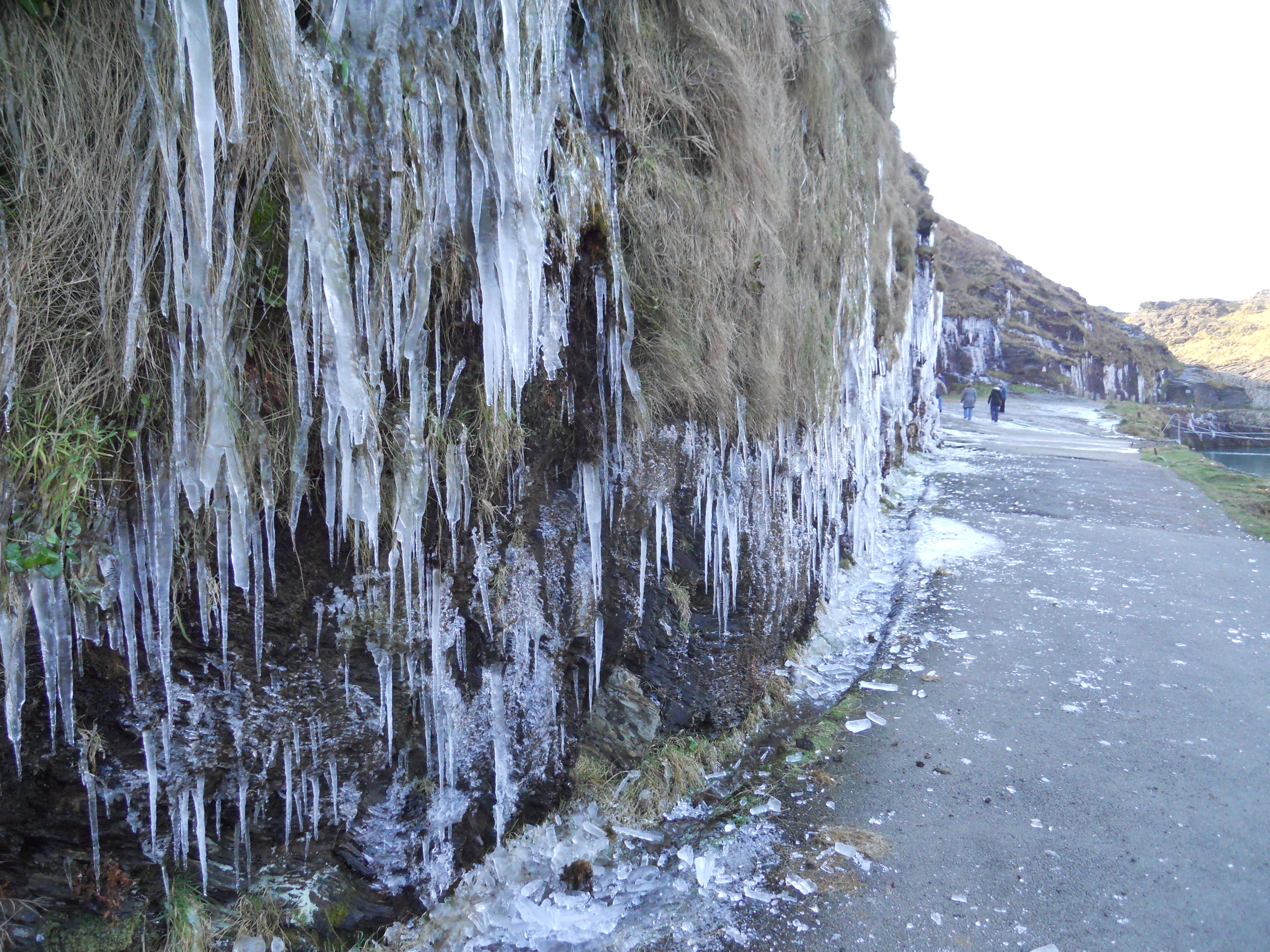
Icicles at Boscastle
This was the walk by the river in Boscastle. In the end we retreated to the Wellington Hotel for some delicious hot chocolate. We also had an early dinner there before returning to London. The menu was very coeliac and vegetarian friendly.
I had some delicious liver and bacon. All that B12 seems to have freshened up my skin quite a bit.

