How To Recycle A Station
Hanborough station on the Cotswold Line in Oxfordshire in being expanded.
Wikipedia says this, about theplans announced in 2016.
Plans were announced to increase services from Hanborough Station, by Great Western Railway. A launch event was held in Witney, at which GWR’s managing director Mark Hopwood said that the investment needed was £275 million. Double tracking would be reinstated between North Oxford and Long Hanborough and two disused platforms reopened. The local constituency MP and Prime Minister David Cameron told delegates at the meeting ” am utterly convinced of the necessity of investing in this line. I will do everything I can to give this vision a boost.”
This article on IanVisits, is entitled How Crossrail’s Legacy Could End Up In Rural Oxfordshire.
The article describes how the temporary station at Abbey Wood station, during Crossrail construction.
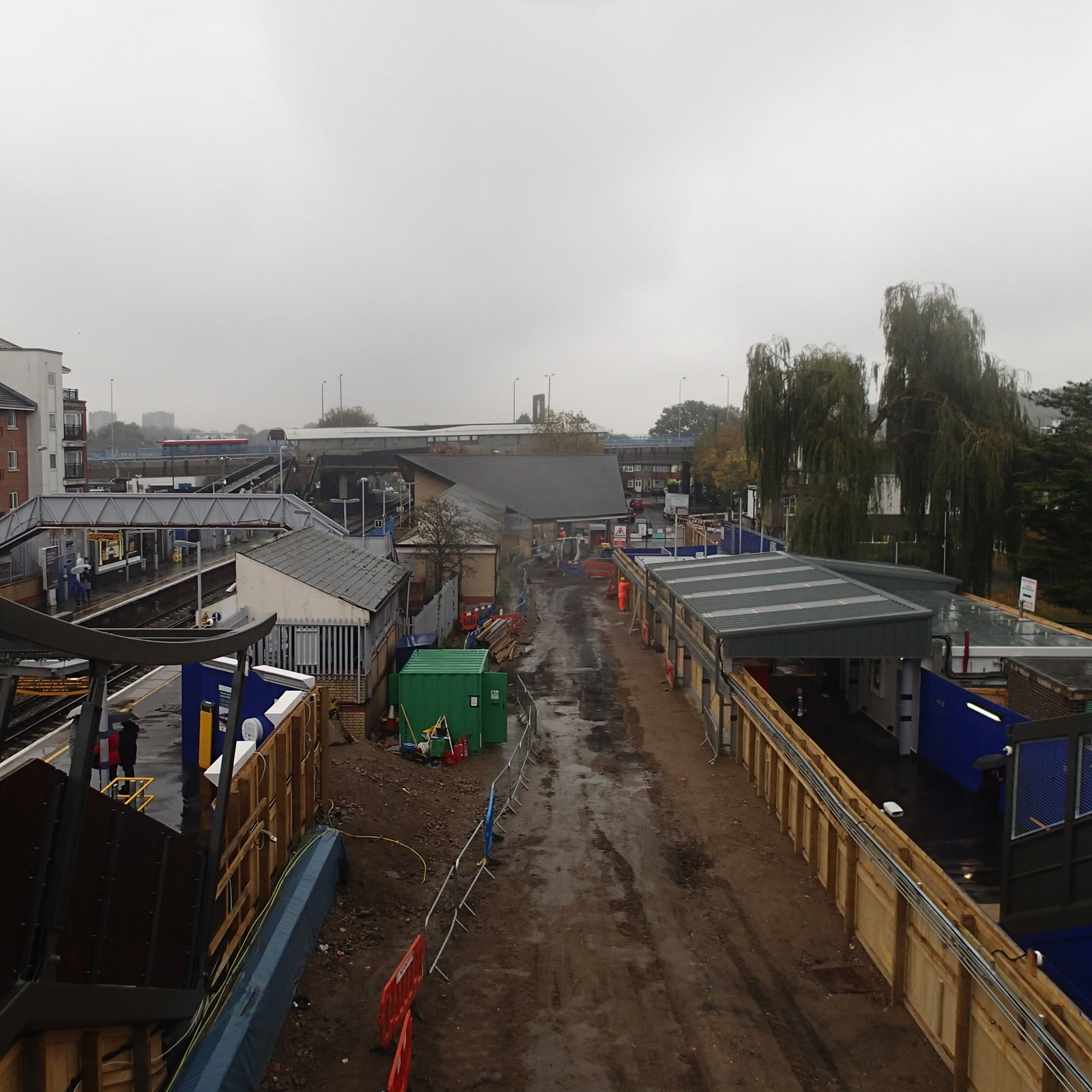
My picture comes from a post called Crossrail Build A Temporary Station.
The station buildings that could go to Hanborough are on the right behind the fence.
Custom House DLR Station Reopens – 10th January 2017
Custon House DLR station has now reopened and trains are now stopping again.





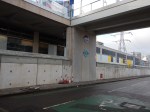
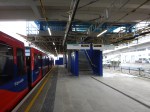
As the pictures show, there is still a fair bit of work to do.
I’m curious, as to what the structure on top of the station is for.
At the moment, it’s just a framework of steel beams, but is it for retail or a ticket office for either Crossrail or Excel.
Crossrail’s information on the design of the station is non-existent.,
New Tiling On The Northern Line Platforms At Moorgate Station
These pictures show the tiles and other fitments as the Northern Line platforms at Moorgate station are fitted out for Crossrail.
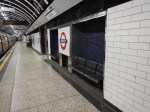


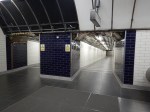
Lifts are being installed to complete the station.
When everything is finished on the Northern Line platforms and the parallel Northern City Line platforms that are above these platforms, there will be step-free access between these platforms and the Crossrail platforms at the massive double-ended Liverpool Street Crossrail station, that connects to Liverpool Street at one end and Moorgate station at the other.
C2E – Crossrail 1 1/2?
The title of this post is the same as that in this article in Rail Engineer.
It describes a proposal to extend the Abbey Wood Branch of Crossrail to Ebbsfleet International station along the North Kent Line.
The article starts with these two paragraphs.
With the main Crossrail project now mostly complete, and with tracks running right through the new tunnels, there has been much talk of Crossrail 2 as the next project, crossing under London from South West to North East and linking Wimbledon with the Leigh Valley.
Rather overlooked is a shorter-term proposal to extend the current Crossrail (or Elizabeth line as it will be called) from Abbey Wood to Ebbsfleet in Kent.
The article talks about the advantages of an extension to Ebbsfleet International station.
This proposal would connect several major brownfield development sites with central London, London City and Heathrow airports, and the West, while also connecting Crossrail passengers with Eurostar and the continent
Specific figures and points include
- Bexley has 1,100 acres of development space available.
- 55,000 homes could be built.
- Potential for high-value jobs.
- Dartford, where there is a lot of demand, has six trains per hour (tph) to London.
In addition the following additional services call or will call in the near future at Dartford.
- Southeastern – Two tph running between Gillingham and London Charing Cross.
- Southeastern – Two tph running between Gravesend and London Charing Cross.
- Thameslink – Two tph running between Rainham and Luton.
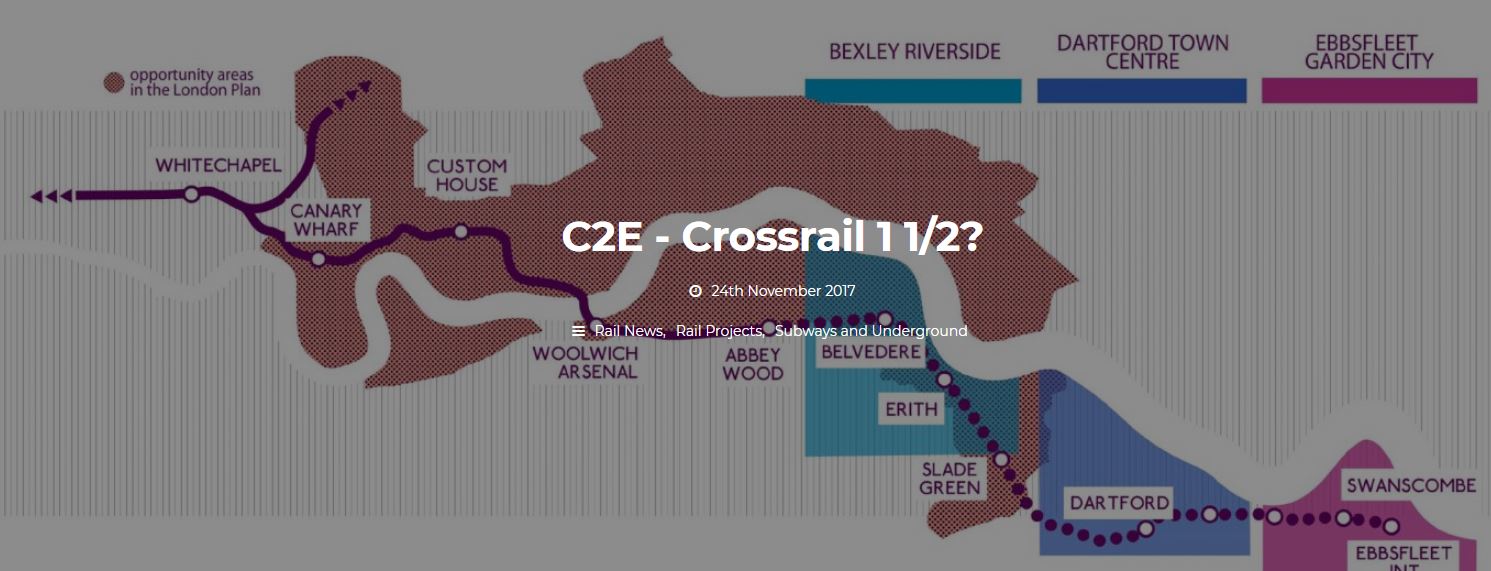
This map from the article shows the route.
I think it is a good plan and I’ll give my reasons in the following sections.
Abbey Wood Is Not A Terminal Station
Was the reason Abbey Wood station was chosen as a terminus more to do with giving a rail connection to the public transport desert of Thamesmead and all its supposed Labour voters?
- It’s not by any important tourist venue like the Thames.
- There’s not even a Shopping Centre.
- There’s little space for car parking.
- Abbey Wood station is a very cramped site.
When compared to the three other termini, it is the least significant.
- Shenfield is a small town with shops and a railway junction.
- Reading is a thriving city and a major transport interchange.
- Heathrow is Heathrow.
I also suspect that the track layout at Abbey Wood station has been designed to allow Crossrail trains to continue Eastwards on the North Kent Line.
Ebbsfleet International Would Be A Much Better Terminal Station
Ebbsfleet International station has a lot going for it, as a Crossrail terminal.
- It is a station for Eurostar and the Continent.
- Some continental services might terminate at Ebbsfleet in the future due to capacity limitations at St. Pancras.
- It would connect Crossrail to the Highspeed commuter services to and from East Kent and East Sussex.
- There’s plenty of space for platforms and depots.
- There’s already masses of car parking.
- The area may get a theme park.
There is also the interesting possibility, that it could be faster for many passengers from Central London to use Crossrail and Ebbsfleet, rather than a taxi and St. Pancras to get a train to Paris and Brussels.
I also believe that one of our World Class architects can come up with a proposal for a passenger-friendly station that combines the current Ebbfleet International station with Northfleet station on the North Kent Line.
The Route Would Require Little Major Engineering Works
The route to Ebbsfleet would be predominantly, if not completely, on the surface, along the double-track North Kent Line. Having just flown my helicopter along the route, there is a lot of apace on either side of the tracks for quite a proportion of the route.
A four-track route would probably be impossible, but I suspect that Network Rail could design an efficient route, that would handle the services on the route efficiently.
Trains Along The North Kent Line
Current frequencies of Off Peak through trains on the North Kent Line between Abbey Wood and Gravesend stations are as follows.
- Abbey Wood – 8 tph
- Belvedere – 8 tph
- Erith – 6 tph
- Slade Green – 6 tph
- Dartford – 4 tph
- Stone Crossing – 4 tph
- Greenhithe – 4 tph
- Gravesend – 2 tph
There will be additional services in the Peak and Thameslink will run an extra two tph from Rainham to Luton, within the next year or so.
The North Kent Line doesn’t seem to have the most extensive level of services.
The New Southeastern Franchise
The new South Eastern franchise will be awarded in August 2018 and is due to start by the end of the year.
The franchise will probably bring changes and add new trains to the fleet and lines like the North Kent Line.
I also suspect that all trains running on the North Kent Line will in a few years be modern trains capable of operating at 100 mph.
Modern Signalling Could Handle Twenty-Four Trains Per Hour On The North Kent Line
There is no doubt, that if Crossrail-style signalling were applied to the North Kent Line between Abbey Wood the Medway towns, capacity could be increased, if all trains on the line were modern 100 mph units.
I doubt that twenty-four tph would be needed, but I’m sure that enough capacity could be created on the route to handle all services; curent or proposed.
How Many Trains Would Crossrail Run Between Abbey Wood And Ebbsfleet International Stations?
Crossrail’s timetable plan shows these frequencies at the various termini in the Peak.
- Abbey Wood – 12 tph
- Gidea Park – 4 tph
- Heathrow Terminal 4 – 4 tph
- Heathrow Terminal 5 – 2 tph
- Liverpool Street – 4 tph
- Maidenhead – 2 tph
- Paddington – 12 tph
- Reading – 4 tph
- Shenfield – 12 tph
From these figures, it would appear that four tph to Ebbsfleet International would be reasonable starting point.
This would give the following frequencies along the line.
- Abbey Wood – 14 tph
- Belvedere – 14 tph
- Erith – 12 tph
- Slade Green – 12 tph
- Dartford – 10 tph
- Stone Crossing – 10 tph
- Greenhithe – 10 tph
- Gravesend – 4 tph
Note I have added in the 2 tph Thameslink trains from Rainham to Luton.
These frequencies are well within the limits of a double-track railway with a 100 mph operating speed and modern signalling.
The Original Plan Was To Extend To Gravesend
The route for Crossrail from Abbey Wood is safeguarded to Gravesend. Under Future Extensions in the Wikipedia entry for Crossrail, this is said.
The route to Gravesend has been safeguarded by the Department for Transport, although it was made clear that as at February 2008 there was no plan to extend Crossrail beyond the then-current scheme. The following stations are on the protected route extension to Gravesend: Belvedere, Erith, Slade Green, Dartford, Stone Crossing, Greenhithe for Bluewater, Swanscombe, Northfleet, and Gravesend.
A depot would be built at Hoo Junction to the East of Gravesend.
The extended service could always call at both stations.
- Ebbsfleet International station connects to Eurostar and has space for masses of parking.
- Gravesend connects to services to East Kent and is on the Thames.
Money and accountants would decide.
Conclusion
Extending four tph from Abbey Wood to a new terminus at Ebbsfleet International station, doesn’t appear to be the most difficult of undertakings.
Trains Are Timetabled Between Leeds And Manchester Oxford Road Station This Week
I have been looking at the National Rail timetables and it appears that certainly on Monday and possibly tomorrow, trains are timetabled to run between Leeds and Manchester Oxford Road stations, stopping at Manchester Victoria station.
This means that weather permitting, the Ordsall Chord is expected to be open. Weather permitting of course!
It’s now Sunday morning and according to the National Rail train departures system, the 08:57 train from Manchester Oxford Road to Leeds is ready to rumble.
The article in The Independent is entitled Six Minute Rail Link Promises To Transform North West Train Services.
It gives this precise explanation of what the Ordsall Chord is all about.
Network Rail, which has created the £85m link, says: “Congestion currently seen at Manchester Piccadilly will reduce by a quarter with some services being rerouted through Manchester Victoria.
“There will be more capacity on the railway, meaning more frequent trains to run.”
By connecting Victoria and Oxford Road stations for the first time, the Ordsall Chord will provide a link from Leeds to Manchester airport which does not require trains to reverse, and free up space by reducing the number of services terminating at Victoria.
I would assume that this short length of railway, has been built so that it can handle a high frequency of trains across the City. So if it has been traditionally signalled like the East London Line of the Overground train frequencies of upwards of twelve trains per hour (tph) will certainly be possible.
But modern signalling using ERTMS, will give this route a frequency up there with Crossrail and Thameslink of twenty-four tph.
Manchester’s Crossrail
Manchester has got its Crossrail, a year before London.
I don’t think Manchester knows what is going to hit the City!
A lot of local services at Manchester Victoria are arranged so that they run back-to-back connecting pl;aces like Blackburn, Kirkby, Southport, Stalybridge, Todmorden and Wigan.
Now services will run back-to-back through the core of Victoria, Salford Central, Deansgate, Oxford Road, Piccadilly and the Airport.
- Manchester has gained a Third City Crossing!
- It needs a frequency of at least twelve tph or one train every five minutes.
On the section between Deansgate and Piccadilly, there will be even more trains.
- Piccadilly to Liverpool Lime Street and Warrington services
- Piccadilly to Blackpool, Bolton, Preston and Southport services via Salford Central and the Windsor Link Line.
Summing this spaghetti up, you get destinations to the North of the Irwell.
- Barrow/Lancaster/Windermere
- Blackburn
- Blackpool *
- Bolton *
- Clitheroe
- Glasgow/Edinburgh *
- Halifax
- Kirkby
- Leeds
- Liverpool *
- Preston *
- Rochdale
- Southport
- Stalybridge *
- Warrington
And these to the South
- Buxton
- Crewe *
- Glossop/Hadfield *
- Hazel Grove *
- Manchester Airport *
- Stockport *
Note.
- The stations marked with asterisks (*) will be fully electrified by the end of 2018.
- Piccadilly is not included in the list of stations South of the Irwell, as it is not a station, where trains can be reversed to go North.
- Oxford Road can be used to reverse trains and it is significant the the first Ordsall Chord services are between Oxford Road and Leeds.
There is a lot of scope for back-to-back services across the Irwell using the current Class 319 trains, that work Liverpool to Manchester, Preston and Wigan services.
Thinking about what Manchester has now got, it’s more like Thameslink than Crossrail, as it has a lot of branches on both sides of the Irwell.
So perhaps it should be called IrwellLink?
The Arrival Of the Class 769 Trains
Northern have another train up their sleeve! Or should I say, under construction in Loughborough?
At least eleven of the Class 769 bi-mode train are coming!
On paper these trains seem a bizarre but simple idea! You take a nearly thirty-year-old British Rail Class 319 train and fit two diesel alternator sets underneath, so that it can generate its own electric power on lines without electrification.
But in practice, it appears Northern will be getting a train that can do the following.
- Bridge all the electrification gaps in the North-West of England.
- Work the very stiff Manchester to Buxton route.
- Do 100 mph under the wires and 90 mph on diesel.
- Meet all the regulations with respect to Persons of Reduced Mobility.
- Deputise for and augment Class 319 trains when required.
- Give a performance improvement over Pacers and Class 150 and Class 156 trains.
- Work into most stations, where Pacers and Class 150/156 trains currently work, without station upgrades.
All this comes in a strong Mark 3-based design, that drivers seem to like.
I think that Northern said a lot about their confidence in these trains, when they increased the order from eight to eleven, around the time serious testing started.
If more than eleven Class 769 trains are needed, there are a total of 86 Class 319 trains of which 32 are the Class 319/4 variant, which would be the preferred conversion, as they have a better interior.
Class 769 Train Routes
The Class 769 trains could work between Leeds and Oxford Road stations, as soon as they receive certification.
But surely, one of their main uses will be to link destinations on lines without electrification on either side of the electrified core lines in Manchester.
This map from Wikipedia shows the layout of the main lines and stations in Central Manchester.
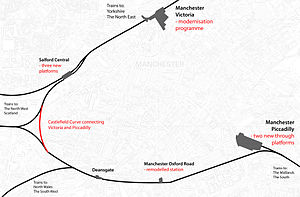
Starting at the top and going anti-clockwise the stations are as follows on the lin, which is fully electrified.
- Manchester Victoria
- Salford Central
- Deansgate
- Manchester Oxford Road
- Manchester Piccadilly
The Ordsall Chord is shown in red.
Note that most of the lines radiating from the cross-city line can be joined to the others.
This leads to services such as.
- Buxton to Clitheroe via Piccadilly, Salford Cresent, Bolton and Blackburn
- Crewe to Blackburn via The Styal Line, Piccadilly, Victoria, Todmorden and Burnley.
- Southport to Manchester Airport.
- Sheffield to Liverpool via the Hope Valley Line, Stockport, Piccadilly and Warrington.
- Kirkby to Stalybridge
Feel free to add any route you feel convenient.
Add in a few extra platforms at perhaps the two Salford and Oxford Road stations and Manchester could have a rail network, that would be second-to-very-few.
There are also a lot of opportunities around Leeds and along the East Coast Main Line.
Constipation At Liverpool Street Station
My bus got struck in traffic at Liverpool Street station yesterday. So I walked.
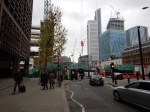
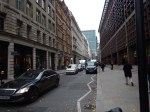
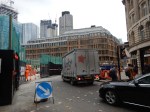

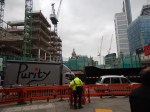
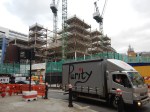
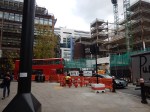
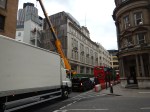
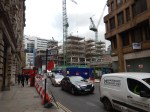
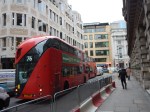


Crossrail construction is the problem, so hopefully time will cure it.
How Much Energy Does A Crossrail Class 345 Train Use?
I will start with the Crossrail Rolling Stock Technical Fact Sheet, which dates from 2012.
The Class 345 trains were built to this specification.
This is said about the power required.
Energy efficiency of 24 KWh per train kilometre (equivalent of 55g CO2 per passenger kilometre)
So what does this mean now that trains are running and trains will have been designed and probably accepted to this specification.
Assuming, that trains will be nine-car when completed, 24 KWh per train per kilometre translates into 2.67 KWh per car per kiometre or 3.29 KWh per car per mile.
Ian Walmsley’s Train Energy Usage Figure
In an article in the October 2017 Edition of Modern Railways, which is entitled Celling England By The Pound, Ian Walmsley says this in relation to trains running on the Uckfield Branch.
A modern EMU needs between 3 and 5 kWh per vehicle mile for this sort of service.
My calculated value is in line with this figure, as the Uckfield Branch is not that different to some of the Crossrail branches.
What Is The Kinetic Energy Of A Crossrail Train?
I ask this question to show the energy values involved.
If I take a nine-car Class 345 train, this has a mass of less than 350 tonnes and a maximum speed of 145 kph.
1500 passengers at 80 kg each works out at another 120 tonnes.
So for this crude estimate I’ll use 450 tonnes for the mass of a loaded train.
This gives the train an energy of 365 megajoules or 101 KWh.
This amount of energy is only a couple of KWh larger than the largest battery size of a Tessla Model S car.
It leads to the conclusion, that batteries could be large enough to store the regenerative energy generated by the train, when it stops.
How Far Could A Crossrail Train Run On Batteries?
If the batteries were sized for the regenerative braking, then a battery of 100 KWh would probably be sufficient in most circumstances.
Using Crossrail’s figure of 24 KWh per train per kiometre, gives a convenient range of four kilometres, which is probably in excess of the largest distance between stations.
But Crossrail trains are effectively two half-trains with two pantographs.
So perhaps they will be fitted with two batteries!
The battery capacity would be arranged to give the desired amount of emergency power.
Conclusion
There’s a lot more to learn about these Crossrail trains.
Location! Location! Location!
I’ve heard it several times, that the title of this post is the three most important things about property.
This article on Construction Enquirer is entitled Great Portland Estates Plans Work on £233m Trio Of Schemes.
The three schemes are.
Cityside House E1
This Google Map shows the location.
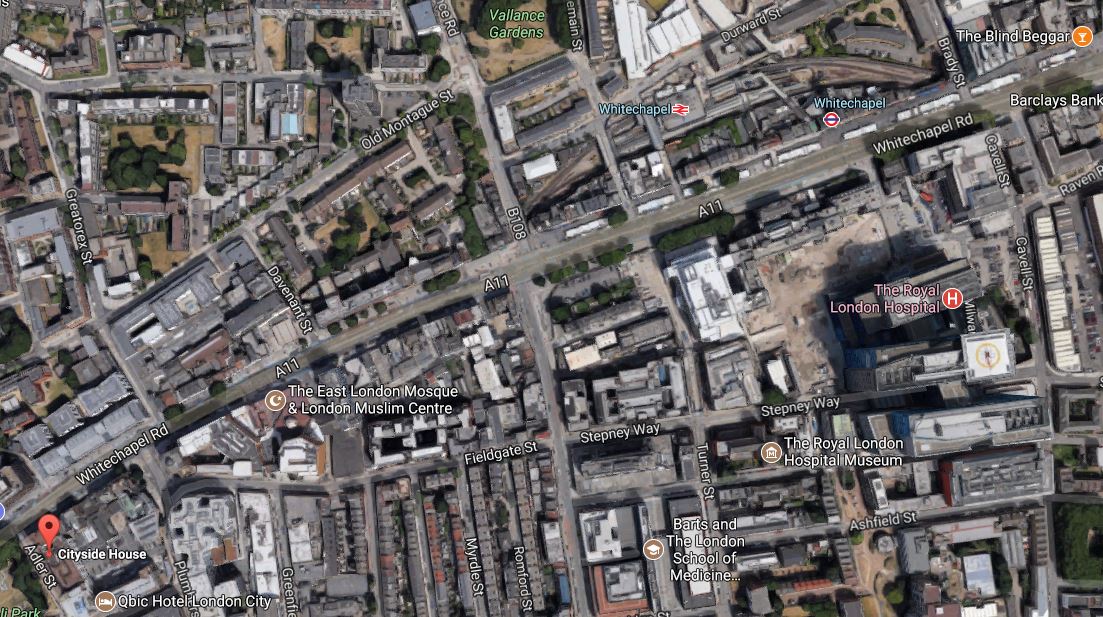
Note.
- The block is indicated by a red arrow.
- It is a short walk from Whitechapel station, which is served by Crossrail.
The office accommodate is being upgraded and residentialo and a hotel will be added.
Oxford House W1
This Google Map shows the location.
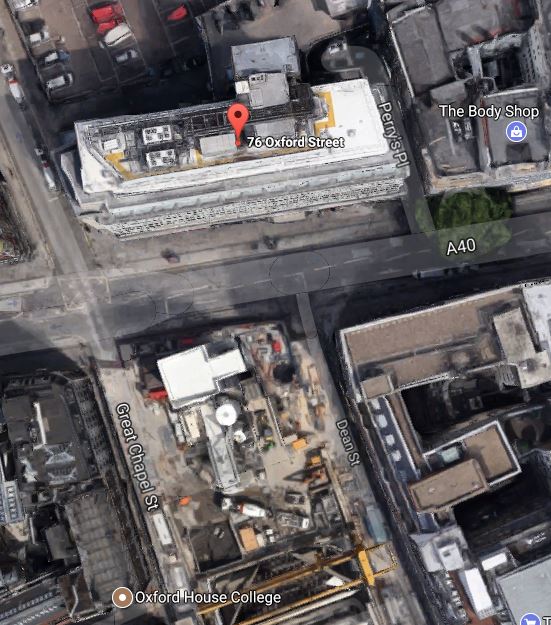
Note.
- The block is indicated by a red arrow.
- The building site opposite is the under-construction Western entrance to Tottenham Court Road station, which is served by Crossrail.
- Tottenham Court Road station is just thirty minutes to Heathrow on Crossrail, with a train every ten minutes.
The block is to be redeveloped.
Is there a better location for an office block?
Hanover Square W1
This Google Map shows the location.
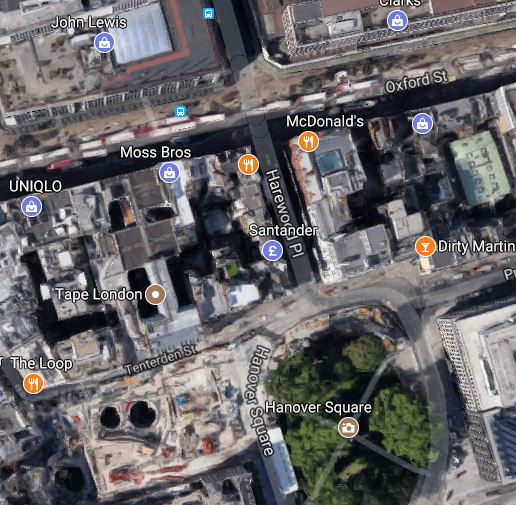
Note.
- The site is on the North-West corner of Hanover Square.
- The building will be on top of the Hanover Square entrance to Bond Street station, which is served by Crossrail.
- Bond Street station is just twenty-seven minutes to Heathrow on Crossrail, with a train every ten minutes.
I doubt Great Portland Estates will have problems filling this development.
Conclusion
These three property developments are all tightly tied to Crossrail.
There will be many more!
Updating The Central Line
The Central Line will breathe two huge sighs of relief in the next eighteen months.
- The Elizabeth Line will open between Abbey Wood and Paddington stations in December 2018.
- The Elizabeth Line will open between Shenfield and Paddington stations in May 2019.
Travellers, from London, other parts of the UK and abroad will then have the following.
- Five East-West interconnected routes across Central London; Metropolitan, Central, Elizabeth, District and Jubilee Lines.
- Massive transport interchanges at Canary Wharf, Stratford, Whitechapel, Liverpool Street, Farringdon, Tottenham Court Road, Bond Street and Paddington will tie it all together.
- Liverpool Street. Whitechapel and Stratford will allocate passengers in the East of Central London.
- Paddington will allocate passengers in the West of Central London.
And this is before the Elizabeth Line opens between Paddington and all stations to Heathrow and Reading in December 2019.
The Central Line After the Elizabeth Line Opens
So will the Central Line become a little-used backwater?
- Holborn is a major interchange with the Piccadilly Line, which is that line’s only access to the Central or Elizabeth Lines.
- Oxford Circus is a major interchange with the Victoria Line, which is that line’s only access to the Central or Elizabeth Lines.
- Holborn, Oxford Circus, Marble Arch and other stations are destinations in their own right.
- The overcrowding of the Central Line probably kept passengers away and after freeing up will they come back?
I suspect that in a few years time it will be as busy as it ever was!
Improving the Central Line
It is my view, and probably that of Transport for London, that improvements need to be made to the Central Line.
Three projects are underway.
The Central Line Train Upgrade
This article on Railway-news.com is untitled London Underground’s Central Line Trains Set For Upgrade.
Currently, the Central Line‘s 1992 Stock have DC motors, which will be replaced by more efficient AC motors and a sophisticated control system.
The cost of the upgrade will be £112.1 million or about £1.3 million per train.
Transport for London are only making a reliability claim for the upgrade. Hopefully, if the trains are more reliable, then more can be in service. so can a higher frequency be run?
I also think in addition, the trains could possibly accelerate faster from stops, thus reducing the dwell times at stations and ultimately the journey times.
- Epping to West Ruislip currently takes ninety minutes with 38 stops.
- Ealing Broadway to Newbury Park takes sixty minutes with 24 stops.
- Northolt to Loughton takes sixty-seven minutes with 28 stops.
Saving just ten seconds on each stop will reduce journey times by several minutes.
I suspect that Transport for London will rearrange the timetable to increase the service frequency from the current twenty-four trains per hour (tph).
It will be interesting to see what frequency of trains and journey times are achieved, when all the Central Line trains have been updated.
Bank Station Capacity Upgrade
This page on the Transport for London web site gives details of this important upgrade at Bank station, which is already underway. It starts with this paragraph.
Bank and Monument stations form the third busiest interchange on the London Underground network. Work we’re doing to substantially improve the capacity of Bank station should finish in 2022.
It lists these improvements.
- A new railway tunnel and platform for the Northern line that will reduce interchange times and create more space for passengers
- Step-free access to the Northern line and DLR platforms
- More direct routes within the station, with two new moving walkways
- Two new lifts and 12 new escalators
- A new station entrance in Cannon Street
There will also be a new entrance in Wallbrook Square under the Bloomberg Building, which is planned to open this year.
Comprehensive is a good word to describe the upgrade.
I avoid the Northern Line platforms at Bank because they are so narrow. After the upgrade, I will have no need.
Holborn Station Capacity Upgrade
This page on the Transport for London web site, gives details of this important upgrade at Holborn station. It starts with this paragraph.
We’re proposing changes at Holborn station that would make it substantially easier for customers to enter, exit and move around the station. Subject to funding and permissions, work on the station would start in the early 2020s.
I don’t think this upgrade can come too soon.
As with some parts of Bank station, I avoid Holborn station.
What Still Needs To Be Planned?
The major projects left must surely be upgrading the capacity and providing step-free access at the following Central London stations.
St. Paul’s And Chancery Lane
St. Paul’s and Chancery Lane stations both need step-free access, but the problems of installing lifts at the two stations would be surprisingly similar, as both stations have a similar layout.
- Both stations will need lift access to the ticket halls, which are below street level.
- At both stations, the two Central Line tracks are unusually arranged one on top of the other.
- Even more unusually, the Westbound tunnel is on top at St. Paul’s and the Eastbound tunnel at Chancery Lane.
- At both stations, escalators lead down to a spacious lobby, which has direct access to the top platform.
- St. Paul’s has two escalators and a staircase, whereas Chancery Lane has three escalators.
- From the low-level lobby, two short escalators and a staircase lead down to the bottom platform.
It may be possible to provide lifts that go from the ticket hall to both platforms as before rebuilding in the 1930s, this arrangement was used.
Both stations might also be suitable for the application of inclined lifts.
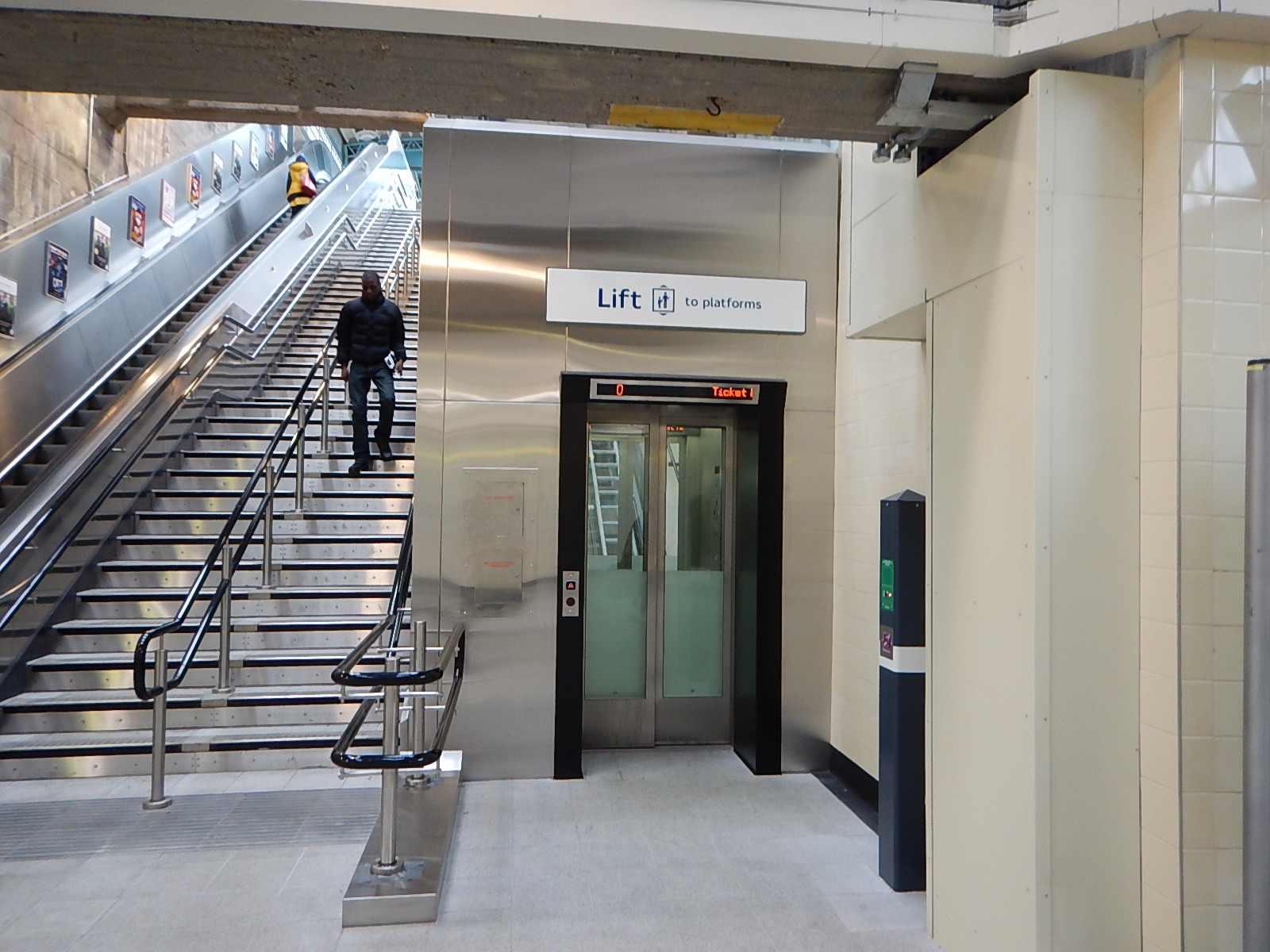
For instance, would two escalators and an inclined lift handle the lower transfer at both stations?
Oxford Circus
Oxford Circus is a busy interchange, where the Bakerloo, Central and Victoria Lines cross each other.
This map from carto.metro.free.fr shows the lines at Oxford Circus station.
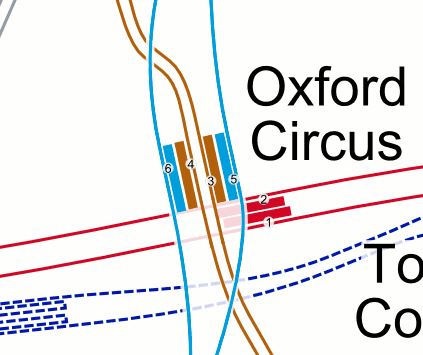
Note.
- The Cemtral Line, shown in red, was built under Oxford Street to avoid disturbing the buildings.
- The Bakerloo Line, shown in brown, was built under Regent Street.
- The Victoria Line, shown in light blue was cleverly threaded through in the 1960s to give cross-platform interchange with the Bakerloo Line.
- The dotted purple lines are the Elizabeth Line.
- Between the two dotted lines, the Eastern End of the platforms at Bond Street station can be seen.
These pictures show the buildings at the four corners of Oxford Circus.



Wikipedia says this about these buildings.
Oxford Circus was designed as part of the development of Regent Street by the architect John Nash in 1810. The four quadrants of the circus were designed by Sir Henry Tanner and constructed between 1913 and 1928.
Note.
- The building on the North-East corner used to be Peter Robinson and is Grade II Listed.
- The other three corner buildings are also Listed.
- The shops in the two Southern corners are being refurbished.
I believe that the following is needed at Oxford Circus station.
- Measures to alleviate the overcrowding.
- Full step-free access to all platforms.
- Improved access to the Central Line platforms.
- Better interchange between the Bakerloo/Victoria platforms and the Central Line.
In some ways, the biggest problem in the next few years will be passengers changing between the Victoria and Elizabeth Lines. Passengers between say Walthamstow and Heathrow will probably want to change between Oxford Circus station and the new Hanover Square entrance to Bond Street station.
- The planned pedestrianisation of Oxford Street will obviously help, especially if the roads around Hanover Square, like Harewood Place and Princes Street are similarly treated.
- Joining the Victoria Line at Oxford Circus is not a problem, as there are four entrances to the ticket hall under Oxford Circus, a large number of entrance gates and four escalators down to the trains.
- But on arrival at the station, you are forced to exit from the station about fifty metres East of the station, which means you’re going the wrong way for the Elizabeth Line.
It strikes me what is needed is a new entrance to the station on the South Western corner of Oxford Circus.
But would this alone satisfy the needs of this station?
More Station Entrances On Oxford Street
For Crossrail, Bond Street station is being given two new entrances in Davies Street and Hanover Square.
But it is also being given another entrance on the North side of Oxford Street, to give better access to the Central and Jubilee Lines.
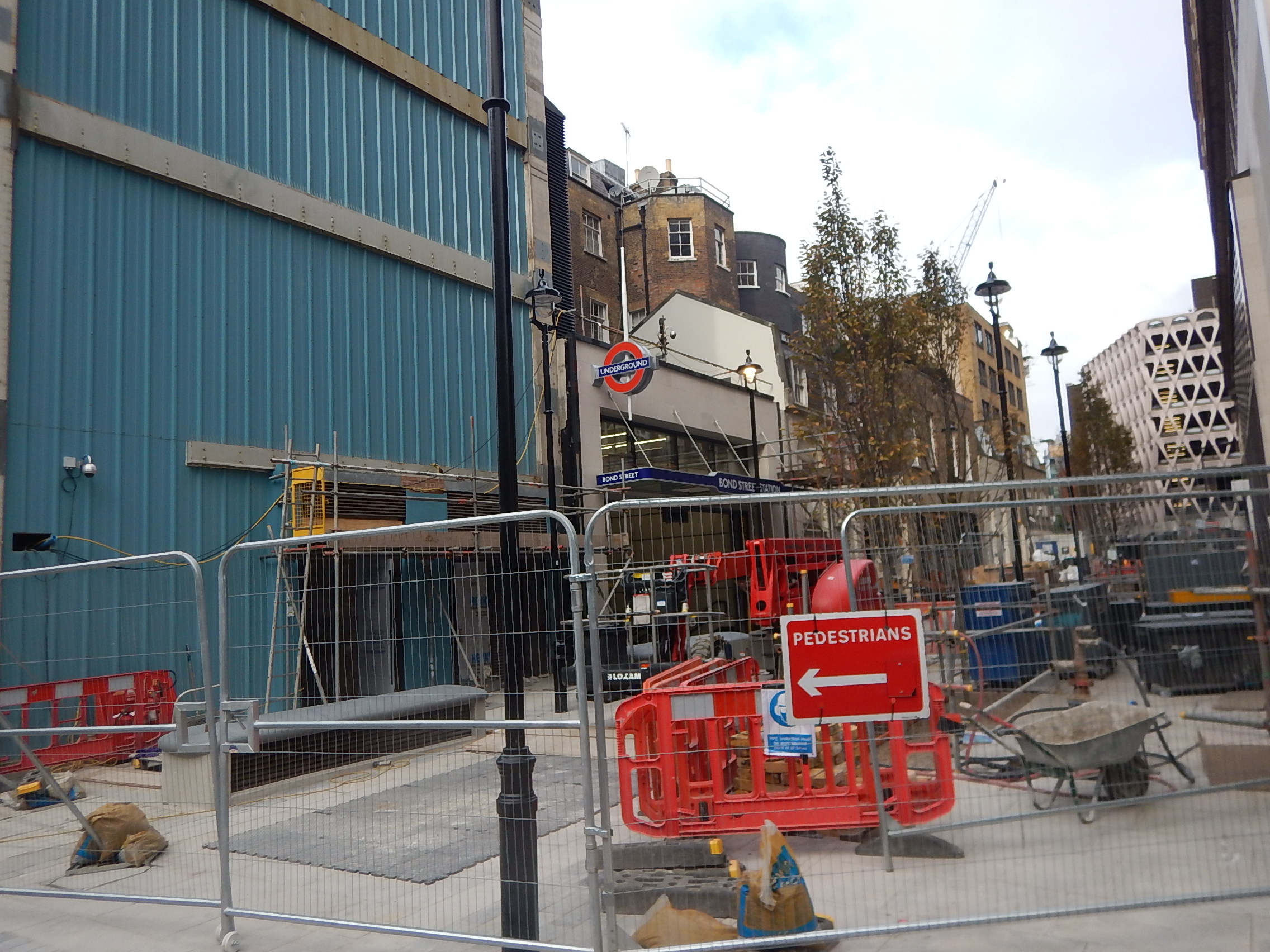
The picture shows the new entrance tucked away in what will probably become a new development.
So could this technique be used on Oxford Street to improve station access?
Look at the map of the lines at Oxford Circus station earlier in the post and you will notice that the Central Line platforms extend to the East. I took these pictures around where the platforms could end.

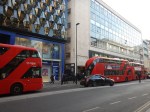


Could there be space to squeeze in another entrance to the Eastern end of the Central Line platforms?
It probably won’t be possible whilst traffic is running up and down Oxford Street. But after the road is pedestrianised, it would surely be much easier to dig down to the Central Line , which is not very deep below the surface of Oxford Street.
Marble Arch
Marble Arch station is at the Western end of Oxford Street. Wikipedia says this about the station.
The station was modernised (2010) resulting in new finishes in all areas of the station, apart from the retention of various of the decorative enamel panels at platform level.
But has it got the capacity needed?
It is also not step-free and needs lifts.
New Trains In The Mid 2020s
Under Future and Cancelled Plans in the Wikipedia entry for the Central Line, this is said.
The Central line was the first Underground line to receive a complete refurbishment in the early 1990s, including the introduction of new rolling stock. A new generation of deep-level tube trains, as well as signaling upgrades, is planned for the mid-2020s, starting with the Piccadilly line, followed by the Bakerloo Line and the Central Line.
The new trains would fit well to replace the current trains and give an increase of capacity to the line.
Possible Developments
These are possible developments.
Shoreditch High Street Station
There is a possibility of connecting Shoreditch High Street station to the Central Line.
This is said under Plans in the Wikipedia entry for the station.
There have also been discussions of creating an interchange with the Central line between Liverpool Street and Bethnal Green which runs almost underneath the station. However, this would not be able to happen until after the Crossrail 1 project is complete, due to extreme crowding on the Central line during peak hours.
Given that in a few years time, the following will have happened.
- There will have been a lot of development in Shoreditch.
- The East London Line will have a frequency of twenty-four trains per hour.
The connection may be worth creating.
On the other hand, the Elizabeth Line may make the connection unnecessary, as travellers can use the two connections at Stratford and Whitechapel stations.
Mile End Station
If ever there was a station, where step-free access would surely be worthwhile it must be Mile End station.

Consider.
- It is a busy station.
- It has cross-platform access between District/Metropolitan and the Central Lines.
- It has a cab rank.
Knowing the station fairly well, I suspect fitting the probably three lifts required would not be the most challenging of tasks.
Eastern Improvements
Crossrail has a step-free cross-platform interchange with the Central Line at Stratford, which will have the following effects.
Changing at Stratford will give better access to and from Oxford Street, Paddington and Heathrow.
Crossrail trains will be larger, more comfortable, better equipped and probably less crowded.
Journey time savings will be six minutes to Bond Street and nineteen minutes to Ealing Broadway stations.
Taken with the improved Central Line trains, it all must result in increased patronage in the East.
But there are twenty stations East of Stratford, of which only four are step-free.
So I suspect that Transport for London will make strenuous efforts to improve the Eastern end of the Central Line.
- More step-free access.
- Better bus services.
- More small retail outlets at stations.
I believe that in ten years time, the Eastern station will be very different.
Western Improvements
West of Marble Arch, there are seventeen stations, of which by 2020 only two will be step-free.; Ealing Broadway and Greenford.
Improvements will probably a similar pattern to the East, although there are rumours of rebuilding some stations.
Conclusion
There’s a lot of scope for improvement in the Central Line.
Oxford Street Could Be Pedestrianised By Next Christmas
The title of this post is the same as the sub-title of this article in the Independent.
The aim is to pedestrianise Oxford Street from Oxford Street to Orchard Street by December 2018, which is the date when the Elizabeth Line will open.
It is an ambitious plan and despite substantial backing from the Mayor, Westminster City Council, the West End Company and groups like the British Heart Foundation, I don’t think it will be plain sailing.
Walking Along Oxford Street
In Walking Along Oxford Street, I show various pictures I took this morning whilst walking between Marble Arch and Tottenham Court Road stations.
Oxford Street looked to have improved, since I last did this. But then it’s a long time since I’ve walked the streets without crowds.
My views are as follows.
Measuring Success Or Failure
The success or failure of the pedestrianisation of Oxford Street is very easy to gauge.
The rate of change of turnover is a direct measure.
The Buses
I regularly go shopping in Oxford Street and often used a bus to travel there and back.
I used to be able to get a 73 bus from either 200 metres from my house or by changing at the Angel. But since the 73 has been cut back to Oxford Circus, I’ve tended to use the Underground, often by taking a bus to Bank for the Central Line.
Under Sadiq Khan’s plan all buses will be removed from Oxford Street and only the 139 and the 390 will remain, being rerouted along Wigmore Street.
A lot of people who go to Oxford Street regularly by bus, will lose their direct bus route. How will they react?
Will they use the Underground or the Elizabeth Line or will they go shopping elsewhere?
Since the 73 has been cut back, I think I’ve also gone to Oxford Street a lot less.
Why? I’ve no idea.
But it could be, that regularly, I’d buy something in John Lewis,Selfridges or perhaps in Bond Street and get straight on a 73 bus to the Angel, where I just got off the bus and waited until a bus home arrived at the same stop. As the 73 buses are New Routemasters, they’re a real shoppers’ bus and a lot easier than the Underground.
The Underground And Crossrail
Oxford Street will have the following stations and entrances as you proceed from East to West.
- Holborn – Central and Piccadilly
- Tottenham Court Road (Current Entrance) – Central, Elizabeth and Northern
- Tottenham Court Road (Dean Street Entrance) – Central and Elizabeth
- Oxford Circus – Bakerloo, Central and Victoria
- Bond Street – Central, Elizabeth and Jubilee
- Marble Arch – Central
Between Oxford Circus and Orchard Street, which will be the first section to be pedestrianised, you’ll never be more than two hundred metres from a fully step-free Elizabeth Line station.
Will this be enough to do away with the buses on Oxford Street?
Holborn station is being expanded with a new entrance, so will Oxford Circus and Marble Arch be upgraded?
Cycling
This will be banned. Although the plan envisages alternative cycle routes to the North and South.
Taxis
These will be banned from Oxford Street. Taxi ranks will be provided.
Will this be acceptable to the taxi drivers?
Uber And Mini-Cabs
These will be banned from Oxford Street.
How will these effect the surrounding streets?
Deliveries
How will these be arranged? You can’t get behind all the shops!
The Stalls
There are lots of stalls selling various goods along Oxford Street.
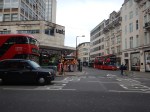



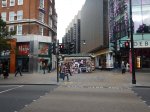


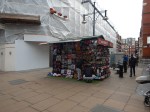
Will the stallholders give up their pitches quietly, if necessary?
Security
I’m no security expert, but after the latest attacks in the UK and Europe, surely keeping out vehicles must remove the weapon of choice from a large group of terrorists.
Local Residents
There are quite a few residents in the area perhaps two hundred metres on either side of Oxford Street.
They could be the biggest losers with traffic cramming the side streets.
Timing
Crossrail opens in December 2018. Does this mean the 1st, 31st or some day in between?
How do you time the pedestrianisation of Oxford Street to fit in with Crossrail?
Especially, as December 2018 will probably contain Christmas!
Conclusion
There is going to be a lot of discussion about this scheme.
As to my view, I like pedestrianised streets and Oxford Street should have gone this way years ago.
 The Anonymous Widower