The Crown Estate Refines Plans For Celtic Sea Floating Wind
The title of this post, is the same as that of this press release from Crown Estate.
This is the first part of the press release.
The Crown Estate has set out further details on its plans for Offshore Wind Leasing Round 5, which aims to establish new floating offshore wind technology off the coast of Wales and South West England. The update includes details on the final planned locations for the new windfarms, as well as further information on a multi-million-pound programme of marine surveys.
Round 5 is expected to be the first phase of development in the Celtic Sea, with The Crown Estate working to catalyse and accelerate the UK’s energy transition, and to de-risk developments to speed up their deployment. This includes investing in an upfront Habitats Regulation Assessment, an extensive programme of marine surveys and working with the Electricity System Operator on a coordinated approach to grid design.
This latest update follows a period of engagement with developers and wider stakeholders on proposals set out in July over how to make best use of available space in the Celtic Sea. As a result of the feedback received, The Crown Estate has confirmed that:
- Three Project Development Areas (PDAs) of roughly equal size are expected to be made available to bidders, as opposed to the previously proposed four PDAs of varying sizes
- No bidder will be able to secure an Agreement for Lease for more than one PDA
- As a result of bringing forward three equal-sized PDAs – each with a potential capacity of up to 1.5GW – the overall capacity available through Round 5 has increased from a possible 4GW to up to 4.5GW, enough to power more than 4 million homes
Note.
- Another 4.5 GW of offshore wind should hit the queue.
- It sounds like they have been listening to developers.
To find out more of the potential of the Celtic Sea, I recommend this article on the Engineer, which is entitled Unlocking The Renewables Potential Of The Celtic Sea.
I’ll go along with what this article says and accept that 50 GW of wind capacity could be installed in the Celtic Sea.
Crown Estate Supports Four Nature-Positive Offshore Wind Research Projects
The title of this post, is the same as that of this article on offshoreWIND.biz.
This is the sub-heading.
The Crown Estate has revealed that it is partnering with a range of UK-wide expert bodies to launch four research projects to support nature recovery and the coexistence of offshore wind farms with marine life.
The four projects are described in these paragraphs.
The first of four projects is called Prevalence of Seabird Species and Collision Events in OWF (PrediCtOr), led by the Carbon Trust under the Offshore Renewables Joint Industry Programme (ORJIP).
It aims to develop a coordinated approach for reducing uncertainty surrounding bird collision risk and influencing factors, and therefore reducing consenting risk, at offshore wind farms.
The second project is Procellariiform Behaviour & Demographics (ProcBe), led by JNCC, which seeks to fill evidence gaps around how seabird species, such as storm petrels and Manx shearwater might interact with offshore wind farms and improve the demographic rate and population modelling approaches.
Reducing Seabird Collisions Using Evidence (ReSCUE) project, led by Natural England, is a three-and-a-half project that could improve the industry’s knowledge of seabird flight heights and collision risk with offshore wind turbines in UK waters.
And the last project, named Strategic Compensations Pilots for Offshore Wind, is led by OWIC.
Research like this will surely increase the acceptance of offshore wind power amongst conservationists.
UK Round 4 Offshore Wind Winners To Start Paying Option Fees With Lease Agreements Now Signed
The title of this post, is the same as that of this article on offshoreWIND.biz.
This is the sub-heading.
The Crown Estate has signed Agreements for Lease for all six offshore wind projects selected in the UK’s Round 4 offshore wind seabed leasing. This enables the developers to now further progress their plans and also kicks off the period in which they will be paying annual option fees of almost GBP 900 million to The Crown Estate and HM Treasury.
The article then lists the wind farms.
- RWE’s Dogger Bank South East & West (3 GW).
- EnBW and BP’s Morgan and Mona (3 GW).
- TotalEnergies and Corio Generation’s Outer Dowsing (1.5 GW).
- Cobra and Flotation Energy’s Morecambe (480 MW).
This is just under 8 GW.
The article then goes on to show what developers will pay to the Crown Estate.
These two paragraphs explain the fees paid.
By signing the Agreements for Lease, which can be in effect for a maximum of ten years, the developers have committed to at least three years of option payments and will pay an annual option fee for each project until they are ready to enter into a lease for the seabed site.
The option payments, totalling some GBP 979 million per year, reduce as a project moves into a lease, or leases, and cease when a lease(s) for the maximum capacity/whole site is granted, at which point developers will move to paying rent.
It looks to me that developers will pay nearly a billion pounds per year for at least a minimum of three years and not more than ten years.
Once a project moves into a lease, rent will be paid.
It seems to be a very profitable occupation to own loads of empty sea!
Crown Estate Accelerates Celtic Sea Floating Offshore Wind Surveys
The title of this post, is the same as that of this article on offshoreWIND.biz.
This is the sub-heading.
The Crown Estate has announced the awarding of the first contracts for its first major investment in surveys to help with the construction of floating offshore wind farms in the Celtic Sea.
These two paragraphs describe the contracts.
Contracts have now been signed for the initial phase of metocean surveys, which look at wind, wave, and current patterns, to begin in Spring 2023. The Crown Estate is progressing the procurement of the remaining surveys over the coming weeks and months, subject to further commercial discussions.
By investing in these surveys at an early stage and making the data freely available to successful bidders, the Crown Estate is aiming to accelerate the delivery of the projects, making it easier for developers to take early decisions and manage risk while supporting future project-level Environmental Impact Assessments (EIAs) as part of the planning process.
It looks like a good idea to me, as it could make the bidding process much quicker and bidders with special expertise may be able to get contracts more suited to their expertise.
Equinor Sets Sights On Gigawatt-Scale Floating Offshore Wind Projects In Celtic Sea
The title of this post, is the same as that of this article on offshoreWIND.biz.
This is the opening paragraph of the article.
Equinor has disclosed its interest in developing gigawatt-scale floating offshore wind in the Celtic Sea, with the upcoming Celtic Sea floating wind seabed leasing round in view.
These are some other points from the article.
- The Crown Estate is planning a seabed leasing round in the Celtic Sea in 2023.
- As the developer and soon-to-be operator of two of the world’s first floating offshore wind farms, Equinor said it views new floating opportunities in the Celtic Sea with great interest.
- Project development areas are being prepared by The Crown Estate for the development of gigawatt-scale floating offshore wind projects.
Equinor could move into the Celtic Sea in a big way.
On the Projects page of the Blue Gem website, this is said about floating wind in the Celtic Sea.
Floating wind is set to become a key technology in the fight against climate change with over 80% of the worlds wind resource in water deeper than 60 metres. Independent studies have suggested there could be as much as 50GW of electricity capacity available in the Celtic Sea waters of the UK and Ireland. This renewable energy resource could play a key role in the UK meeting the 2050 Net-Zero target required to mitigate climate change. Floating wind will provide new low carbon supply chain opportunities, support coastal communities and create long-term benefits for the region.
How much of this possible 50 GW of offshore wind in the Celtic Sea will be leased by the Crown Estate in 2023?
Floating Wind Farms At Sea To Create 29,000 Jobs – Crown Estate
The title of this post, is the same as that of this article on the BBC.
These three paragraphs introduce the article.
Plans to generate electricity through floating wind farms off the south Wales coast could create thousands of new jobs, according to the Crown Estate.
The property business owned by the monarch but run independently said the new industry could create about 29,000 jobs, including 10,000 in Wales.
It is leasing the space to generate enough power for four million homes.
Will Wales be the world’s next offshore wind powerhouse?
Wind power experts have said there is a potential for 50 GW of offshore wind power in the Celtic Sea and the BBC article talks of an investment of £43.6 billion by 2050.
The process has started, but will the engineers be able to tame the dragons?
Accelerating The Delivery Of Offshore Wind Farms
It is one of Kwasi Kwarteng’s ambitions to accelerate the delivery of offshore wind farms.
In The Growth Plan 2022, these groups of wind farms are mentioned.
- Remaining Round 3 Projects
- Round 4 Projects
- Extension Projects
- Scotwind Projects
- INTOG Projects
- Floating Wind Commercialisation Projects
- Celtic Sea Projects
My thinking in this post, will probably apply to all of these groups.
These are my thoughts.
Accelerating Delivery Of A Wind Farm
This will have these positive effects.
- Electricity will be delivered earlier.
- Customers will have a more secure supply of electricity.
- The wind farm owner will start to be paid for their electricity.
- The Crown Estate will start to be paid for their leases. Although, these might start at signing.
- National Grid will be paid for the transmission of the electricity.
- An energy storage company could be paid for storing surplus electricity.
- Construction teams and engineers can move on to the next project.
- Expensive construction hardware like ship-mounted cranes will no longer be needed.
- I also suspect that the government will raise some taxes from the various companies involved.
It looks like it’ll be winners all round.
How Will Delivery Be Accelerated?
These are some thoughts.
Overall Project Time
In How Long Does It Take To Build An Offshore Wind Farm?, I came to these conclusions.
- It will take six years or less from planning consent to commissioning.
- It will take two years or less from the start of construction to commissioning.
I suspect that as we have been building offshore wind farms for some years, that it will be very difficult to reduce these times significantly.
But as some wind farms take quite a few years to progress from the initial proposal to planning consent, I suspect that improvements to the planning process may speed up the overall construction time of a wind farm.
Project And Resource Management
Good project and resource management will always help.
Better Design And Construction Methods
I always remember in the early days of North Sea Oil, being told by a very experienced project manager that construction of production platforms was accelerated by the availability of larger and more powerful cranes.
Are we approaching the design of the ultimate wind farm? I doubt it, as in the last few months, I’ve seen two very radical new designs.
In Hexicon Wins UK’s First Ever CfD Auction For Floating Offshore Wind, I show this image of one of their TwinHub turbine installations being towed into place.
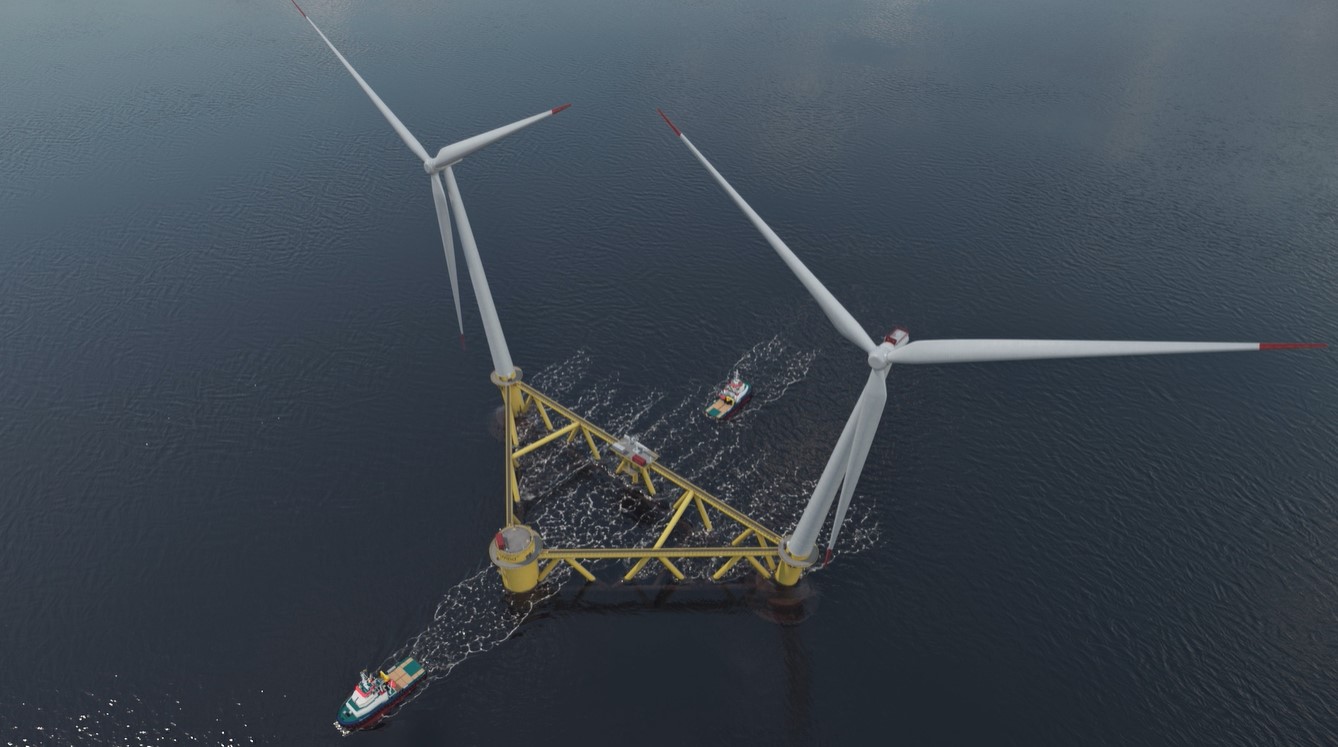
The TwinHub home page has a title of The First Floating Offshore Wind Project in The Celtic Sea.
This is the description on the page.
The TwinHub offshore wind demonstration project intends to prove how Hexicon’s innovative design with two turbines on one floating foundation can further reduce the Levelized Cost of Energy (also referred to as LCoE) before large scale commercialisation. The TwinHub project is a stepping stone to help kick-start floating wind in the Celtic Sea, an area identified as a hotspot for floating wind by the UK Government. It will pave the path for larger and larger projects to help support The Crown Estates’ ambitious target of 4GW of floating wind in the Celtic Sea.
Scroll the page down and there is a fascinating short video of a pair of wind turbines in operation.
- It appears that when there is no wind, it automatically goes into a safe parked mode.
- As the wind rises, one turbine starts up.
- The second turbine starts up and the float turns so they face the wind.
It appears to be a classic example of disruptive innovation.
I have a feeling that this type of installation might have generation, assembly and cost advantages over a single turbine mounted on a single float.
RCAM Technologies are also creating interesting designs for mounting turbines and energy storage using 3D-printed concrete.
What Ts The UK Government Doing To Accelerate Projects?
This article on offshoreWIND.biz, was published in late September 2022 and is entitled BREAKING: UK Puts Massive Amount Of New Offshore Wind Capacity On Fast Track and this is the first paragraph.
The UK will speed up planning and development consent processes for projects from the recently completed, currently ongoing, and upcoming (floating) offshore wind leasing rounds to bring new energy capacity online faster and facilitate economic growth and job creation.
The article is based on what Kwasi Kwateng said on the 23rd of September about speeding up projects in the 2022 Growth Plan.
A Quick Summary Of Our Wind Energy
The article has this paragraph, which summarises our wind energy.
For the UK, which currently has around 14 GW of offshore wind capacity in operation and 8 GW under construction, the projects from the listed auction rounds could bring well beyond the targeted capacity for 2030, which was recently raised to 50 GW.
I can see the target being raised again to at least 60 GW.
 The Anonymous Widower