The Great Car Con
Tomorrow night on Despatches on Channel Four are showing a program called The Great Car Con. They say this in summary about the program.
Motorists were promised diesel would be the cheap, green fuel of the future, but it turns out that’s not the case. Why did politicians encourage the ‘dash for diesel’?
All of today’s generation of politicians, won’t know much about air pollution, like my generation suffered from before the Clean Air Act of 1956, cleaned up our major cities. Unless of course they have been on a freebie to Beijing.
In my view we need to agree an objective function, where the amount of everything we emit into the air is balanced in a scientifically-correctly weighted way.
I would want a strict limit for CO2 and all the other pollutants. And there should be a firm cut-off date when after which vehicles that do not meet the limits are banned. I should also be Europe-wide.
In London we should start with buses, taxis and trucks, which would be controversial. But lots of legislation is opposed, but if it is sensible and well thought out, after a brief time, no-one would want to give up the improvements to their lives.
Does anybody want to allow smoking on buses, trains and in public houses?
I used to love my cars, but I haven’t driven for nearly five years now. Do I miss it?
Of course not!
I do wonder if people choose to give up driving voluntarily or not bother to learn, then they should be entitled to a discount on public transport.
London’s Proposed Ultra Low Emission Zone
London is proposing to have an Ultra Low Emission Zone. Here’s the summary of the proposal.
Air pollution affects the quality of life of a large number of Londoners, especially those with respiratory and cardiovascular conditions. It is estimated in 2008 more than 4,000 deaths in London were brought forward due to long term exposure to air pollution.
I’m all for this, as not only will improved air quality help my breathing, but also it will hopefully get some of the older and larger vehicles off the roads.
As a pedestrian, I’ve nearly been hit a couple of times, when something like an older 5-series BMW has been driven far too fast across lights turning red. Strangely, these near misses have never occurred with a vehicle less than a couple of years old. I think people tend to look after new vehicles better, or is it that as they are fully-taxed and insured, they are traceable. Usually, the drivers have the look of someone, I wouldn’t want as a friend.
But not everybody wants it, as this article on ITV shows.
Who’d Want To Live In Peterborough, Colchester, Milton Keynes Or Swindon?
This BBC article describes best and worst places to get around without a car. The four places in the heading are the four worst places.
I do know that as regards getting to the football ground, Colchester and Milton Keynes are pretty difficult, although Peterborough and Milton Keynes aren’t too bad.
This is the top ten worst and my thoughts.
Peterborough – I’ve been to the city several times by train and just walk into the town centre to see the magnificent cathedral or have a meal with a friend. I have never seen a bus there at all or any signs to a central bus station. But there are lots of taxis.
Colchester – It’s years since I’ve been there and it has a station, that is away from the town centre, the hospital and football ground, the only places I would ever be likely to go. As I don’t drive or take unnecessary taxis, I doubt, I’ll ever go to the town again.
Milton Keynes – I have no fond memories of the capital of roundabouts, but I was mugged there by the street furniture. I shall not be sad, if I never go to the town again.
Swindon – When I went to Swindon, the road in front of the station was being dig up, but I don’t have any fond memories of my walk to the football ground.
Wigan – I suppose it’s got a public transport system, that suits the character of the town. It hasn’t even signposted a decent walking route from the rail station to the football ground.
Bradford – I remember Bradford, as one of the worst places I went to, when I visited all 92 football grounds.
Derby – I go to Derby regularly to see Ipswich play at Pride Park, which is close to the station. There is nothing at the station, that might draw me into the city to perhaps have a meal. Is Derby’s passenger-unfriendly public transport system summed up, by the fact that there are no late trains back to London, after an evening football match? It treats those without cars and especially visitors as losers, who should be ignored.
Dudley – No comment. But I don’t think I’d ever want to go!
Northampton – A strong contender for the capital of roundabouts, where I would definitely think twice about going.
Gateshead – See Dudley
If I look at the best places, London is top, with Manchester second and Liverpool third. My big argument with most of them in the top ten except London, is that the information and maps aren’t good enough for someone, who doesn’t know the city well.
One big difference between the top and bottom tens, is that Derby is amongst the worst and Nottingham is in with the best. Surely, as the cities are so close together, the comparison between them should be examined in detail.
The full details of the Better Transport 2014 Car Dependency Scorecard, should be read by everyone.
Chaos At The Angel
I went to the Angel this morning to get some shopping and the jams were so bad, I actually got off the bus and walked.
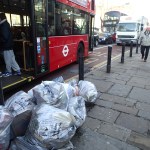
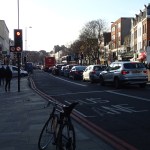
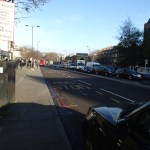
I sometimes think that not driving a car any more sometimes is an advantage.
The cause of all the problems was roadworks.
But luckily it didn’t affect my journey home as my 38 bus was able to sneak through.
Have The New Car Tax Rules Killed The Congestion Charge/Parking Fiddle?
Some years ago, I was selling an old Ford Escort Estate that was definitely a runner with virtually a year’s car tax and MOT, on eBay.
I only wanted a few hundred and I thought I had a deal.
When the lady who’d bought it and I talked over the phone, she said that she’d give me cash and deal with all the handover paperwork to save me the hassle. I said no to the latter and she then said, that I could forget the sale.
So I then looked at her purchase history on eBay and found that she’d bought about twenty or so clean cars like the Escort. All seemed to have a reasonably long tax and MOT and cost just a few hundred pounds.
I e-mailed the DVLA, as I thought the whole thing stank. They informed me, that the car would be sold to someone, who needed to get around London without paying the congestion charge. All of the fines and charges would obviously go to the previous owner.
They asked if I could forward all of the details to them.
I never heard any more from the lady, but the DVLA informed me a couple of years later, that they had mounted a successful prosecution.
Having looked at the new car tax rules, I think that the days of this type of scam are dead.
A Road Death Database
The BBC has put together a database of all road deaths in the UK from 1999 to 2010.
I have looked at some areas and you can draw some interesting conclusions.
If I look at a typical London Borough like Hackney, the number of deaths is generally between 70 and 90. But some rural areas, despite less population have figures well over a hundred.
And then there’s the Oxford and Cambridge effect. Oxford has 34 deaths and Cambridge has just 16. Both these cities have extensive Park and Ride networks, good bus services and bikes are used quite a bit. But then Ipswich and Norwich also have low figures, but Colchester, Milton Keynes and Peterborough are higher.
So does a decent public transport network cut road deaths, as the drunks and the bad drivers are on the buses rather than in their cars?
If you look at the big northern cities like Liverpool, Leeds, Manchester and Newcastle, the figures would appear to be similar, but Newcastle is a lot less. Why?
Only by a serious analysis can we tell what is the reason!
Do We Want Platoons of Trucks?
I first read about this idea in the Sunday Times, but I have found a detailed article on the bbc.com website. Here’s the lead paragraph.
Convoys of wireless-linked semi-autonomous vehicles could soon be hitting our roads, giving drivers a chance to put their feet up on the morning commute.
I don’t drive and I miss driving, like you miss the teenager next door, who thinks he’s the best drummer since Ringo, who has just left home.
The technology may well work, but it’s in the same category as driverless cars and unmanned level crossings. They’re all perfectly good and safe until something goes wrong. How many air accidents were never envisaged, when the aircraft was designed?
The thing though about this technology, is there is already a proven alternative in the UK. It’s called freight trains. The money would be better spent removing trucks from the roads, as far as possible. Obviously for long distances across countries like the US, Canada, Australia and Russia, it may well have a place.
The Things You Find When You Look Through Old Photos
I’ve just bought myself a cloud and I’m putting all the family pictures on DVD up there, so that my son and certain old friends can see them.
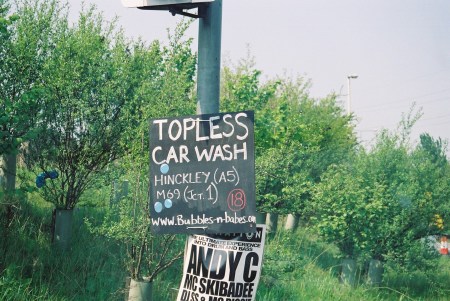
I found this photo of a sign on the outskirts of Leicester or Derby.
The Things You Find When You Look Through Old Photos
I wonder what happened to Bubbles and Babes?
Did the bottom fall out of the market?
The picture was taken around 2006 or so!
A Telling Statistic
Justin Webb in this article in The Times says the following.
This year under 70 per cent of American 19-year-olds have driving licences, down from 87 per cent two decades ago.
I have heard young people in London, say they are not going to learn to drive, as they have no need. So as [ublic transport and cycling gets better, are we all falling out of love with our cars.
In a thought provoking article he goes on to say this.
Does the hunger for live events in the internet age — concerts, exhibitions, demonstrations — encourage people to meet and talk again?
Certainly here in East London, there are two groups of four seats on the new Routemasters on route 38, where people do seem to congregate to have a chat. If they don’t chat, everybody also interreacts in a very polite way.
So has a good design, made life in the world’s greatest city better and less fraught?
The Other Side Of Healthcare
According to reports like this, the new boss of the NHS is going to create more smaller community hospitals. Here’s the first few paragraphs
Smaller community hospitals should play a bigger role especially in the care of older patients, the new head of the NHS in England has said.
In an interview in the Daily Telegraph, Simon Stevens signalled a marked change in policy by calling for a shift away from big centralised hospitals.
The health service chief executive said there needed to be new models of care built around smaller local hospitals.
I think there is something, which is just as important, that he doesn’t seem to mention.
That is that all hospitals should be easy to access from most of their catchment area.
When I lived in Suffolk, the only way to get to the excellent local hospital at Addenbrooke’s in Cambridge, was either by a private car or taxi. It certainly couldn’t be done by public transport.
Where I live now, I only have to walk round the corner about fifty metres and every ten or fifteen minutes, there is a 30 bus direct to University College Hospital. The other local hospitals; Royal London, Barts and Homerton are also easy by public transport. I could even get the 30 bus to Harley Street for a private consultation.
But not everybody is so lucky and many hospitals are downright difficult or even impossible to access by public transport. Two hospitals in Suffolk; Ipswich and Bury \St. Edmunds come to mind.
Fixing this problem, will not only help patients, but make it easier for visitors without their own private transport to get to the hospitals.
Hopefully good public transport to hospitals, may also ease parking problems for staff and visitors and hopefully cut down the number of patients who miss their appointments.
 The Anonymous Widower