Opinion: Why Aviation Needs to Go Green, and How
The title of this post is the same as that of this article on Aeronautics Online.
Read the article and especially what it says about the Wright Electric Jet.
This is a paragraph from Wikipedia, talking about co-operation between Wright Electric and easyJet.
In September 2017, UK budget carrier EasyJet announced it was developing an electric 180-seater for 2027 with Wright Electric. Wright Electric built a two-seat proof-of-concept with 272kg (600lb) of batteries, and believes that batteries can be scaled up with substantially lighter new battery chemistries: a 291 nautical mile (540km) range would suffice for 20% of Easyjet passengers. Wright Electric plans to develop a 10-seater and eventually an at least 120 passengers single-aisle, short-haul airliner and targets 50% lower noise and 10% lower costs.
I would assume, that the plane also emits a lot less CO2 and other pollutants.
I would assume that the plane will be built by using the best of these technologies.
- Aerodynamics
- Lightweight structures
- Electric Motors
- Batteries
- Electronics and avionics.
But I also believe that designing an electric aircraft could be a very different process to a conventional one.
There Is No Fuel
Consider.
- Fuel is a high proportion of the weight of an airliner on take-off.
- There are a lot of complicated systems to pump fuel to the engines and also from tank to tank to trim or balance the aircraft
- When a conventional airliner takes off, it is much heavier than when it lands, as fuel has been burned.
- Fuel is dangerous in a heavy landing or crash.
On the other hand, I’m fairly certain, that empty batteries and full ones weigh the same.
This would mean, that the plane aerodynamics and structure, would be designed to be optimal in the various phases of flight.
- Taxiing out to the runway.
- Taking off.
- The climb to the cruising altitude.
- The cruise
- The descent to the destination airport.
- The landing
- Taxiing in to the terminal or stand.
In the climb, cruise and descent phases power would be set and the trim adjusted, by the autopilot to attain the right speed and rate of climb or descent.
Aerodynamics
As the weight of the aircraft would be the same in all three phases and would need more or less the same lift, with clever aerodynamics, I think we will see a very simple wing. In fact, probably more like that of a sailplane than an airliner.
Wikipedia says this about the design.
The aircraft is to run on batteries and handle flights of under 300 miles. It will feature high aspect-ratio wings for energy efficient flight, distributed electric propulsion and swappable battery packs with advanced cell chemistry.
Note that sailplanes have high aspect ratio wings.
Compared to say a small jet airliner like an Airbus A318, I suspect that the wings will be longer, but possibly simpler.
The Wright Electric Jet will probably have various aerodynamic aids, like flaps and winglets. In fact the picture on Wikipedia shows the latter, which reduce drag.
A Simple Flight Profile
The fastest way to fly between A and B is probably to take off and climb as fast as possible to the optimum cruising altitude, where an optimum cruise is maintained, until the time comes to descend into the destination airport. Much of the descent would be straight in to the runway.
I have flown in an easyJet Airbus 320 from Schipol to Southend in much this manner and the plane arrived ahead of schedule.
I suspect that easyJet like to fly like this, as it saves fuel, but Air Traffic Control probably doesn’t allow it that often.
But simple efficient profiles like this would be ideal for electric aircraft.
If as I suspect their aerodynamics would allow a better glide ratio than a jet powered airliner. So to get a longer range, an electric aircraft might do a long approach.
A Low Noise Aircraft
As I said earlier, Wright are talking about fifty percent less noise.
This could be a game-changer for a smaller airport like Luton or Southend, where the approach can be over residential areas.
Especially for Southend, where planes from the East could do a long descent over the sea and come straight in on Runway 23.
Could Southend become London’s short-haul airport for electric aircraft?
- easyJet and Ryanair are already there.
- There’s plenty of wind power in the area
- It has a good rail connection to London and could be served by Crossrail.
Essex is a county that likes to be different.
Airbus
The original article also mentions Airbus.
Airbus has the skills to design the required light and strong airframe, the aerodynamic knowledge.and a large support network.
They also have a lot to lose, if someone else takes away, the smaller part of their masrket.
Ignore Airbus at your peril.
Conclusion
The more I think about it, the more that I think a 120 passenger electric airliner with a range of 540 km, could be a very handy plane.
Off To Krakow
I’m leaving for Krakow in a few minutes on easyJet from Gatwick
My overnight schedule is as follows ;-
Wednesday, June 10th – Krakow
Thursday, June 10th – Krakow
Friday, June 12th – Prague
Saturday, June 13th – Dresden
Sunday, June 14th – Dresden
Monday, June 15th – Osnabruck
I’ll be on the last Eurostar out of Brussels on the 16th
Obviously, all of the trips in the middle will be by train.
If you want to get in touch, text me on 07860-243707 starting the message with Krakow.
Edinburgh – Plane Or Train?
I have just been up to Edinburgh and the Borders to see friends. I went up by EasyJet from Stansted and came back in First Class by East Coast.
I took the 11:50 flight and that meant I left home about eight in the morning. That sounds early, but as I needed to get there as the gate closed at 11:20 and the train took an hour or so, I wasn’t taking any chances. I also wanted to have a good breakfast on the way to the airport, as I know that there isn’t a good gluten-free restaurant air-side at Stansted.
I also had to take my passport for security purposes.
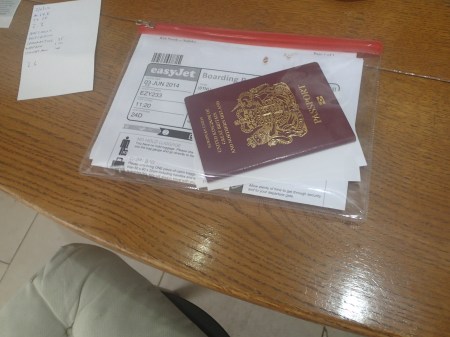
A Passport For Scotland
I suppose if Scotland votes for independence, this will become the norm for every journey across the border.
The plane was a few minutes early and after getting slightly lost in the Terminal, I was met by one of old friends and we were soon on one of the new trams to the city centre.
The flight up had cost me £47.93 for the actual flight, £13.85 to get to Stansted and £9 to get into Edinburgh. Which makes a total of £70.78.
Coming back yesterday, I bought my First Class ticket at nine o’clock in the evening on Wednesday for £64.35.
This cost surprised me and should I say my hosts in the Borders, thought it was good value.
It did of course include snacks on the way down, which I declined, as they we’re gluten-free, but I did keep myself plied with free drink all the way. It was mostly tea, but I did have a miniature of whisky (Scotch of course!) and was offered a second.
On the flight up, all I’d got on board, was an excellent lemonade in a box. Paid for at £2.50. If EasyJet keep selling these, it’ll certainly mean when I fly, I’ll know where to book.
If we look at the time taken. From my house to the centre of Edinburgh, it took me an elapsed time of about five and a half hours. I did give myself a lot of time to get to Stansted, but I needed it, as security took nearly an hour. Gone are the days of turn-up-and-go at London’s third airport.
Coming back, the train left at 14:30 and I just missed the end of the One Show, which means that the time was about seven-thirty. So it was just over five hours.
I don’t think I’ll be flying up to Edinburgh again from Stansted. Both journeys took about the same time, but the train was cheaper, more luxurious and included as much free food and drink as I wanted. Even if as a coeliac, I couldn’t eat the food. On the train, I also got a proper table on which to lay my paper flat out. And of course, security was more noted by its apparent absence.
Over the next few years the train will get faster as new trains, in-cab signalling and track improvement will mean that large portions of the line will be capable of 140 rather than the current 125 mph.
So city centre to city centre travellers like me will probably always take the train. For me, all that East Coast Trains need to do is get some decent gluten-free food. As Virgin do it, why can’t they?
Stansted Airport Isn’t What It Used To Be!
When I flew out of Stansted Airport on Sunday to Bilbao on easyJet, the place was full. And so were the bins!
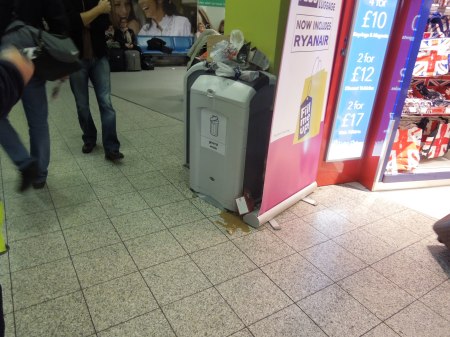
Stansted Airport Isn’t What It Used To Be!
It’s not to the same standard it was a few years ago!
Through London In The Dark On A Bus
To start the journey back from Palermo, I needed to get to Gatwick Airport for the 06:20 easyJet flight.
I did think about checking in to a hotel at the airport, but in the end I got up early aiming to catch the 04:00 Gatwick Express to the airport.
I looked for a taxi and in the end I took a night bus from close to my house to Victoria.


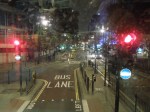







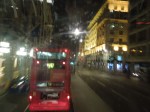
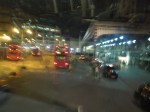
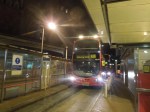

It was an unusual and almost magical experience, as I sat up front at the top, on a virtually empty bus, that sped through an empty city. It ran a bit faster than the schedule.
Some of my friends advised against this method of getting to the airport, as you don’t know who you’ll meet. But I didn’t meet or even see anybody, except for the bus driver and another passenger on the bus, who took the same route to Gatwick.
If I have to get an early flight from Gatwick, I will use the same method again.
Off To Palermo Tomorrow
I’m off to Palermo tomorrow on the 06:20 easyJet flight out of Gatwick, to do another home run by train.
My schedule is looking like this at the moment.
8th – Palermo
9th – Naples
10th – Genoa
11th – Turin
12th – Geneva
13th – Paris
14th – I’m booked on one of the last Eurostars back to London.
 The Anonymous Widower