‘I Get To Work On The Most Scenic Railway Line In The World’
The title of this post, is the same as that of this article on the BBC. It is a quote from someone in the BBC article.
This is the sub-heading.
Have you heard the one about the railway line that was threatened with closure, so lots of people started using it and it was saved?
These three opening paragraphs add some detail to the story.
Welcome to the Settle to Carlisle line, the quirky steel road through some of Britain’s most magnificent countryside.
The line starts in Leeds and passes through Shipley and Skipton, but it is the section between North Yorkshire and Cumbria that is world-famous for its views.
Heading north from Settle, the peak of Pen-y-Ghent soon looms large, with Whernside and Ingleborough following a few miles later.
The saving of the line in the 1980s, is one of those classic British tales of a fight against bureaucracy, which like all these tales involved a dog, who gets a heroic mention in the BBC article.
In the next few sections, I will detail how improvements to the rail infrastructure between Bradford, Carlisle, Lancaster, Leeds have gradually developed the rail infrastructure, so that the Settle and Carlisle Line can play an increasing part in improving the economic outlook for a large area of England.
Is The Settle And Carlisle Line In Good Condition?
Google AI gives this answer to the question in the title of this section.
Yes, the Settle-Carlisle line is in good, operational condition and is considered a vital, well-maintained part of the National Rail network.
Despite a history of threatened closures and past structural issues, major investments have secured its future, and it currently carries over 1.2 million passengers a year.
Here is the current status of the line as of early 2026:
Infrastructure Condition: Following significant repairs, including a major £2.1 million project on the Ribblehead Viaduct completed in 2021 and extensive work at Eden Brows (2017), the line’s 14 tunnels and 22 viaducts are in good condition.
Active Usage: It is regularly used by Northern passenger services and is a designated diversionary route for mainline express trains when the West Coast Main Line is closed.
Operational Status: The line is fully operational, featuring regular commuter services, tourist trains, and steam heritage charter trains.
Safety & Upgrades: While it is a historic line, the infrastructure is deemed safe.
Occasional, isolated issues (like the 2022 freight derailment near Carlisle) have been managed with swift repairs.As of early 2026, the line is heavily used, with special passenger services and 150th-anniversary celebrations planned.
It’s probably in better condition, than many houses in the UK.
What Is The Operating Speed Of The Settle And Carlisle Line?
Google AI gives this answer to the question in the title of this section.
The Settle and Carlisle Line generally operates at a maximum speed of 60 mph/97 km/h.
While historically faster, this 60 mph limit is standard for modern passenger and freight services on the route.
Usage Examples and ContextPassenger Services: Northern Rail and various chartered services, including the scenic “Staycation Express” HST 125, operate along the route.
Freight: The line is used for heavy freight, including oil, timber, and cement trains.
Diversions: The line is frequently used as a, albeit slower, alternative route (approx. 2.5 hours for Leeds-Carlisle) during major West Coast Main Line (WCML) closures.
Scenic Tourism: The line is renowned as one of England’s most scenic, carrying over a million travelers annually, with notable sights like the Ribblehead Viaduct.
The Settle And Carlisle Line Is Well Connected To The Rail Network At The Northern End
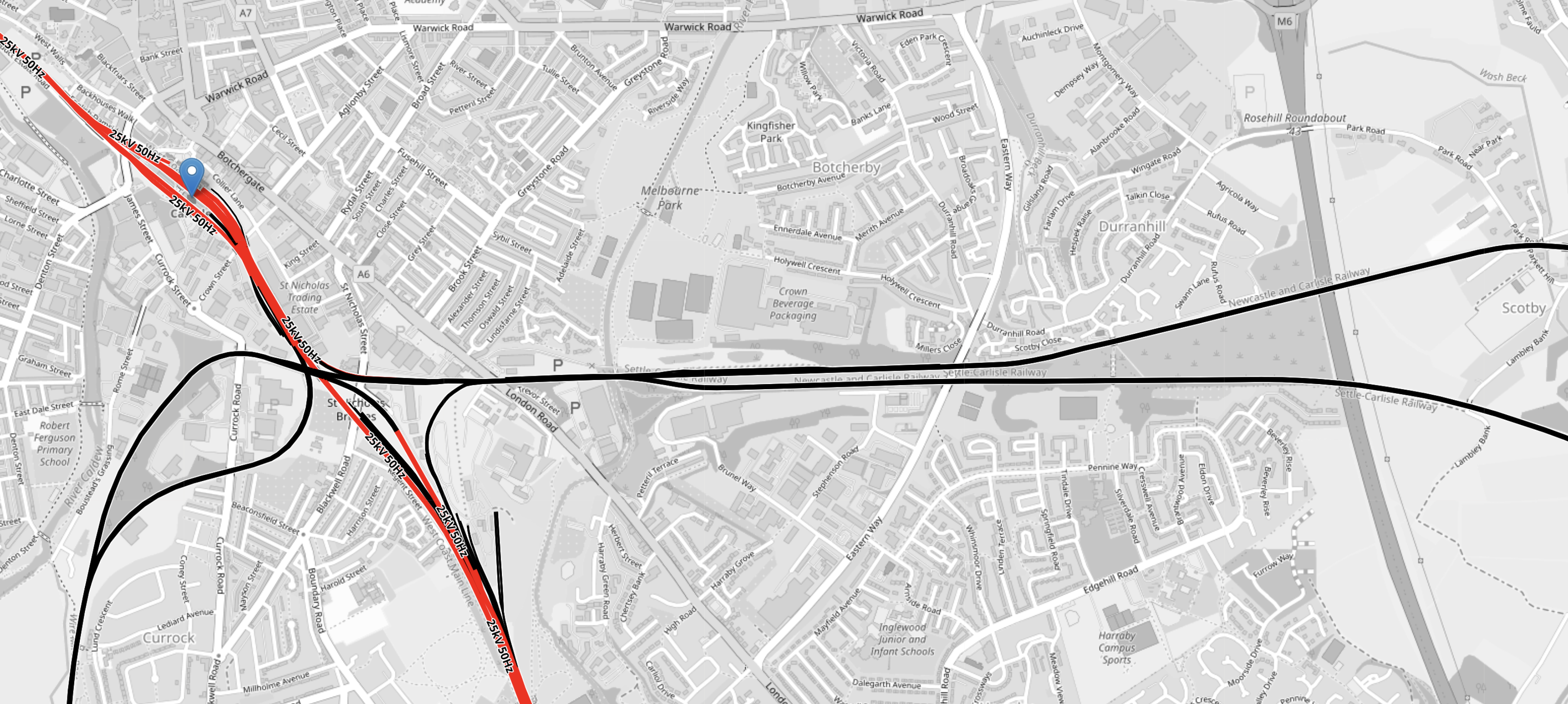
This OpenRailwayMap shows how the line connects to the West Coast Main Line and the Tyne Valley Line, to the South of Carlisle.
Note.
- Electrified lines are shown in red and lines shown in black are not electrified.
- The electrified West Coast Main Line runs diagonally across the South-West corner of the map.
- The blue arrow on this line, indicates Carlisle station.
- The Northernmost of the two black cross lines is the Tyne Valley Line between Carlisle and Newcastle.
- The Southernmost of the two black cross lines is the Settle And Carlisle Line, which goes South to Settle, Bradford Forster Square, Leeds and Settle stations.
- The line going South-West joins the Cumbrian Coast Line, which joins the West Coast Main Line at Carnforth.
It does appear that the junction South of Carlisle is very comprehensive and allows very flexible routing.
The Settle And Carlisle Line Is Well Connected To The Rail Network At The Southern End
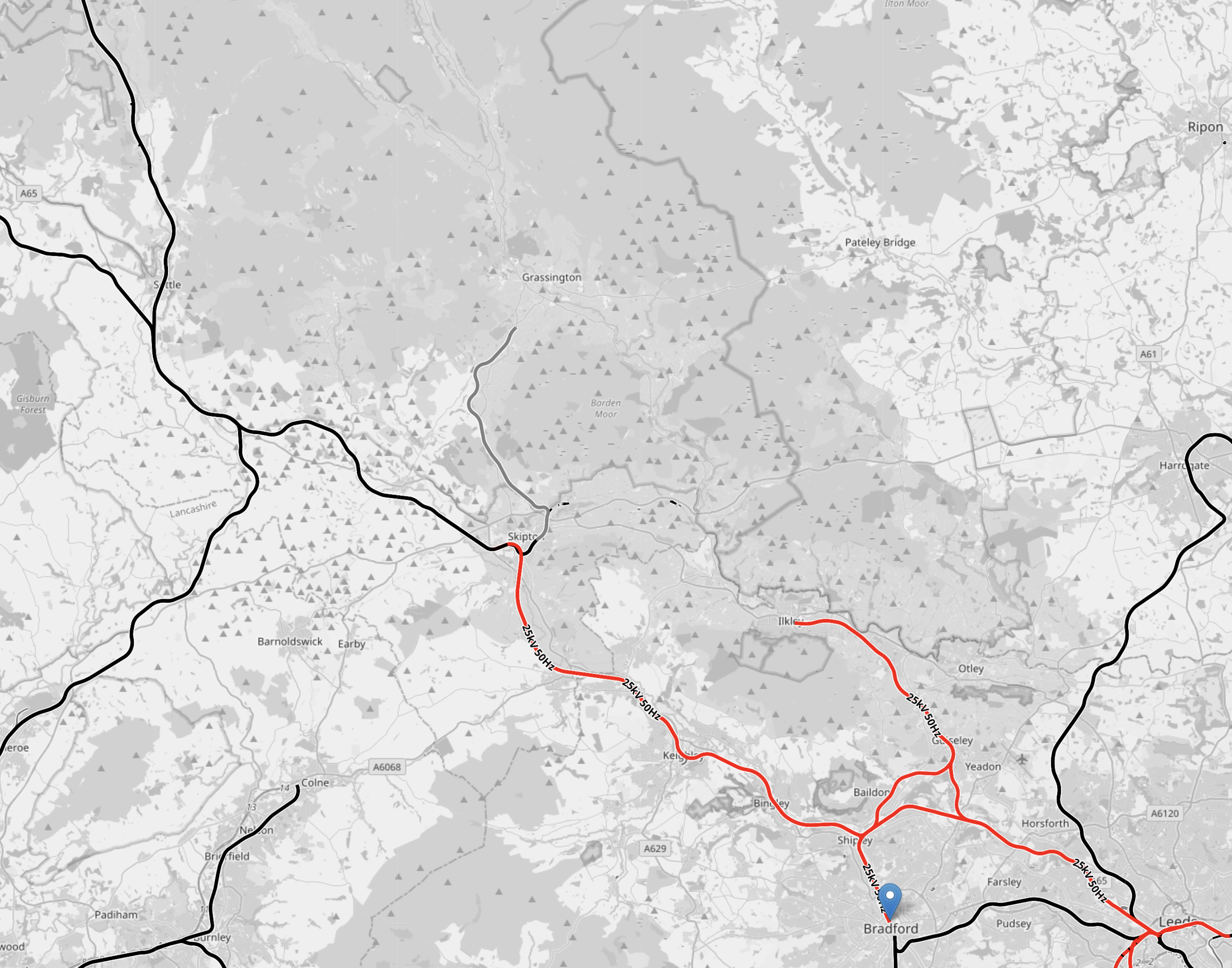
This OpenRailwayMap shows how the line connects to the West Coast Main Line and the Tyne Valley Line, to the North of Skipton.
Note.
- Electrified lines are shown in red and lines shown in black are not electrified.
- The blue arrow on this line, indicates Bradford Forster Square station.
- The fully-electrified Leeds station is in the South-East corner of the map. You can just pick out the ee of the name.
- The electrified Leeds-Bradford Line connects Bradford Forster Square and Leeds station via Shipley station and its triangular junction.
- The electrification continues in a North-Westerly direction as far as Skipton, where the red track stops.
- Electric intercity trains can run from London to Leeds, Bradford Forster Square and Skipton.
- Self-powered intercity trains can also run from London to Harrogate, which is on the line without electrification, that runs North from Leeds.
- Leeds receives a London service of two trains per hour (tph).
- Bradford Forster Square station receives a London service of one train per two hours (tp2h) via Leeds.
- Harrogate station receives a London service of 1 tp2h via Leeds.
- Skipton station receives a London service of one train per day (tpd) via Leeds.
The Leeds-Bradford area gets a frequent service to London and the South.
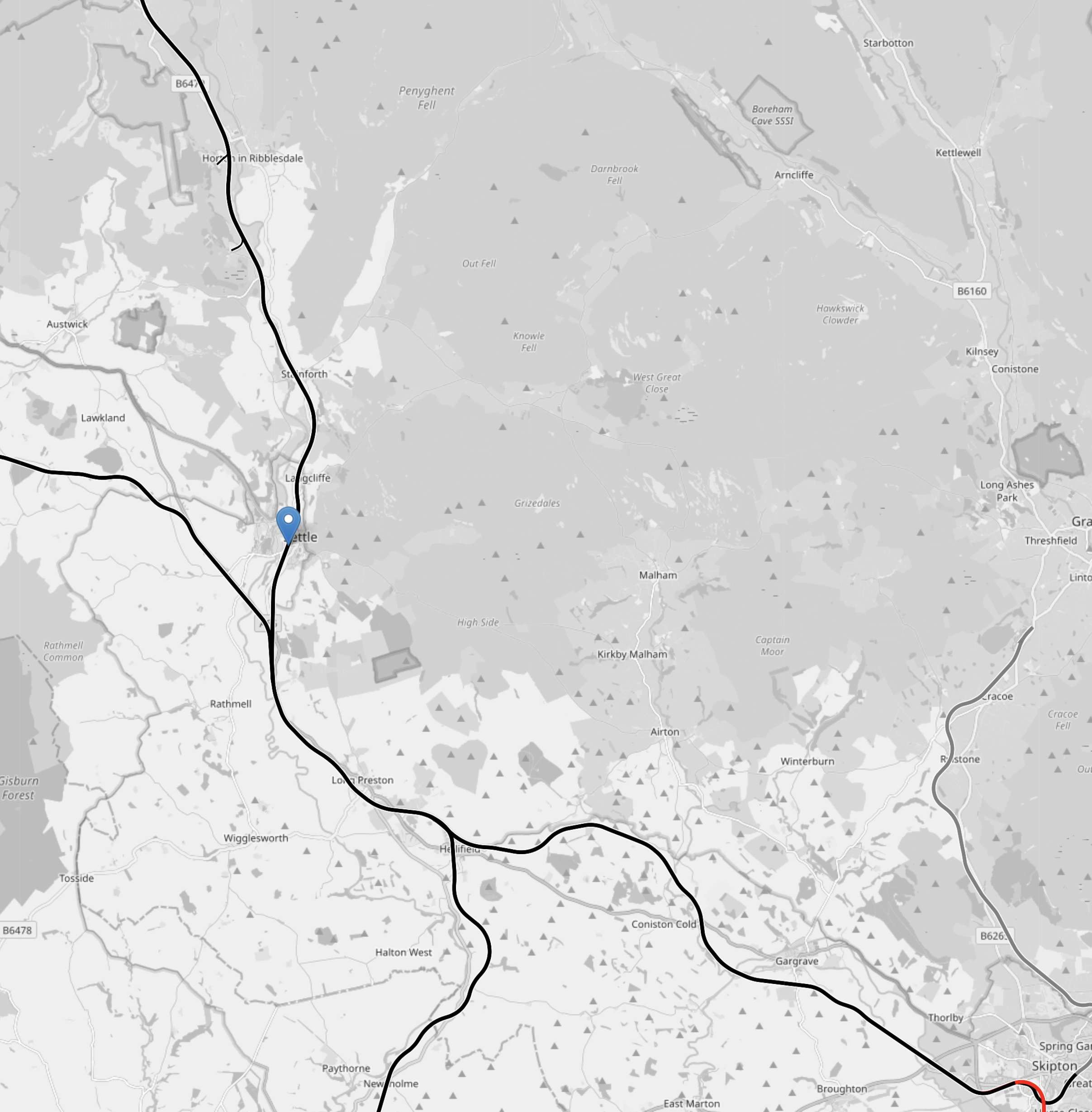
This OpenRailwayMap shows how the Settle and Carlisle Line connects to the electrification at Skipton.
Note.
- Electrified lines are shown in red and lines shown in black are not electrified.
- The only electrified lines on the map are at Skipton station in the South-East corner of the map.
- The blue arrow on this line, indicates Settle station.
- Skipton and Settle stations are 15.2 miles apart.
- Settle and Carlisle are 71.5 miles apart.
To bridge the gap in the electrification between Carlisle and Skipton, trains will need to be able to run 86.7 miles on their own power.
Bridging The Carlisle And Skipton Gap
But once the train gets to Carlisle or Skipton, the train will have the luxury of 25 KVAC overhead electrification to both power the train and charge any batteries.
In my opinion, there are three intercity trains coming into service, that could handle an 86.7 mile gap in electrification.
- East Midland Railways’s Class 810 train, which is a diesel bi-mode with lots of power, which is described in this Wikipedia entry.
- LNER’s Class 802 trains, which currently is a diesel bi-mode, that Hitachi could convert into a Hitachi Intercity Battery Train, which is described on this Hitachi web site.
- LNER’s Class 897 trains, which is a diesel tri-mode, that CAF are building in Spain and Wales, which is described in this Wikipedia entry.
In How Far Will A Hitachi Intercity Battery Train Travel Without Using The Electrification?, I answer the question for both Hitachi and CAF trains.
Surprisingly, I got the answer of a range of 120 miles for both the Hitachi and CAF trains. But could it be that Network Rail and the train companies wanted a range of 120 miles to electrify the UK rail network and so a 120 mile battery range was in the specification.
My estimate of 120 miles for Hitachi’s trains, was also confirmed by the company.
Bridging The Gaps
Some other distances, where gaps must be bridged include.
- Sheffield and South Wigston – 69.4 miles
- Holyhead and Chester – 84.4 miles
- Exeter and Basingstoke – 124,3 miles
- Fishguard Harbour and Cardiff Central – 119.1 miles
- Aberystwyth and Shrewsbury – 81.5 miles
- Bristol Temple Meads and Newbury – 70.8 miles
- Inverness and Aberdeen – 108.3 miles
- Carlisle and Glasgow Central via Dumfries – 115.9 miles
- Hereford to Didcot Junction – 96.9 miles
120 miles could be a good fit.
Could it be that that distance was the range of a steam locomotive on a full load of water?
The Updating Of Bradford Forster Square Station
This is now a four-platform station, with two platforms able to take a pair of 5-car Hitachi or the new CAF 10-car Class 397 trains.
In Bradford Forster Square Station – 20th May 2025, I describe and show pictures of the updated station.
Bradford Forster Square station now gets seven trains per day to and from London King’s Cross via Leeds.
This article on the BBC, which is entitled New Platform’s Opening Gives Bradford More Trains has this sub-heading.
A new £35m platform at Bradford’s Forster Square Station has opened – boosting rail services in the city
£35million seems a lot of money to spend to just increase the number of services between King’s Cross and Bradford, even though 2025 was the year that Bradford was UK City of Culture, but there may be valid reasons to create a new route between London and Scotland, using the Settle and Carlisle Line.
- The Settle and Carlisle Line is one of the UK’s most famous scenic routes with 20 viaducts, 14 tunnels and countless beautiful vistas along its 72 mile track.
- You put the Mona Lisa on display, not in a store.
- LNER now has battery-electric bi-mode trains, with CAF tri-mode trains due to enter service in 2028, that can both handle the 86.7 mile gap in the electrification in silence.
- The CAF trains have extra diesel power, about which CAF is not disclosing much. This to me, suggests some innovative use.
- There appear to be no flights between Leeds/Bradford Airport and Scotland.
- There appear to be no direct trains between Glasgow and West Yorkshire.
- A direct train between Glasgow and Leeds and Bradford Forster Square would add additional connectivity between Scotland and Yorkshire.
- With the cancellation of High Speed Two, we need more train paths between London and Scotland.
- Decarbonisation of aviation is difficult, but replacing fossil-fueled planes with zero-carbon trains is easier.
- A single Class 897 train can carry 569 seated passengers, which is about 3.5 times the capacity of a single Airbus A320.
- The proposed Leeds Metro would bring passengers to the new service.
- Leeds and Bradford could see an upturn in tourism.
I also think the line will not be lightly used due to its iconic status.
How Would A Leeds/Bradford And Scotland Service Call At Bradford Forster Square Station?
- Bradford Forster Square station now gets seven trains per day to and from London King’s Cross via Stevenage, Newark Northgate, Doncaster, Wakefield Westgate, Leeds and Shipley.
- There is one fewer train on Sunday.
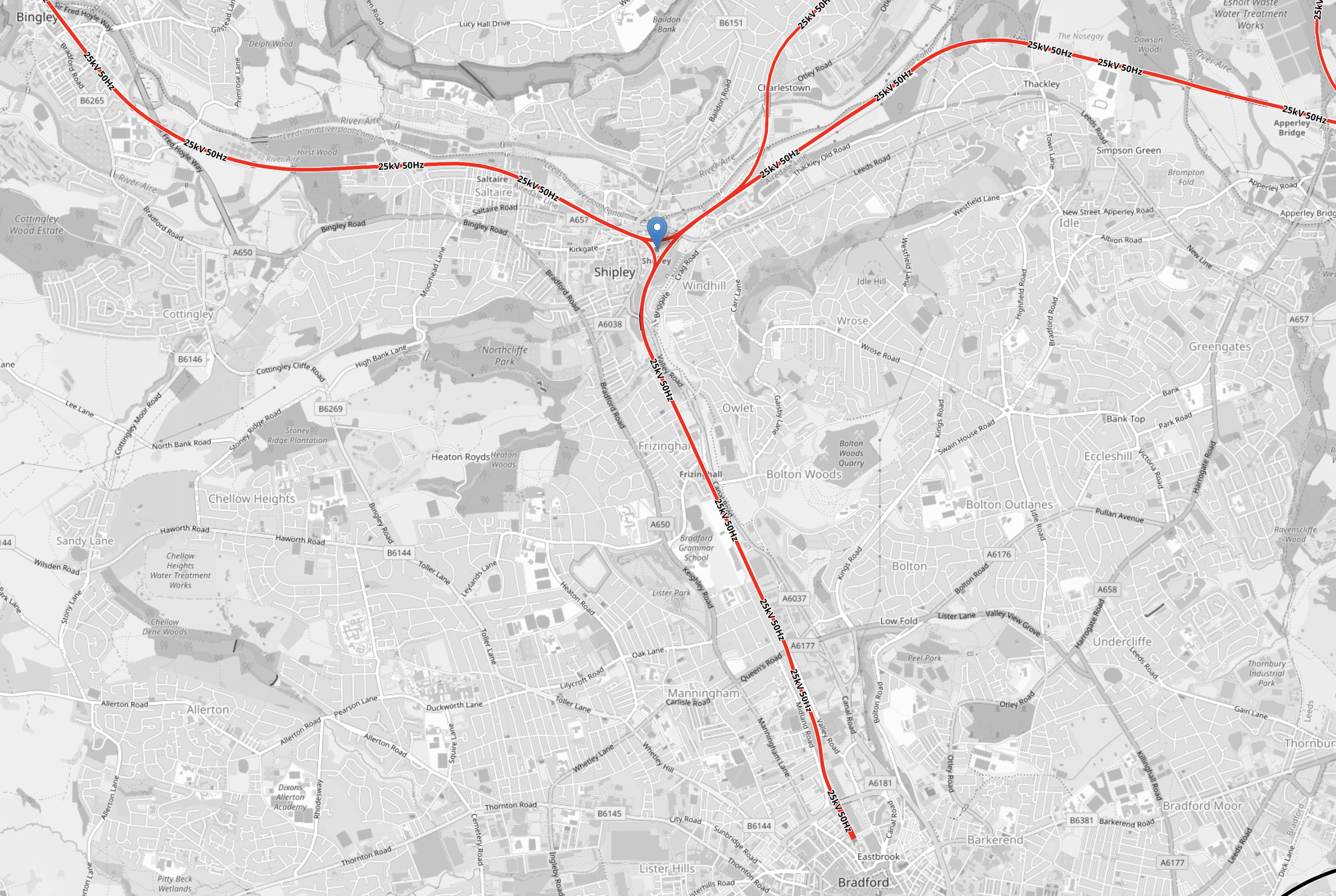
- There is a triangular junction at Shipley station, which connects the three electrified lines to Leeds, Bradford Forster Square and Skipton.
This OpenRailwayMap shows Shipley station and the triangular junction.
Note.
- All rail lines are electrified and shown in red.
- The blue arrow on this line, indicates Shipley station.
- Shipley station appears to be in the middle of the junction.
- The line going East connects to Leeds station.
- The line going South connects to Bradford Forster Square station, which is at the end of the line.
- The line going West connects to Skipton station and the Settle and Carlisle Line.
Trains returning to London would reverse out of Bradford Forster Square station and take the Eastern route through Shipley and Leeds back to London.
- An appropriate number of trains for Carlisle and Scotland, could surely just reverse out of the station and take the Western route through Skipton station and go on to the Settle and Carlisle Line.
- The trains would call at Wakefield Westgate, Leeds, Shipley, Bradford Forster Square and Skipton stations in the Leeds/Bradford conurbation.
- Other stations could be added to the route if required.
- The trains would effectively reverse direction in their call at Bradford Forster Square station.
- Going North the trains might check their battery levels in Bradford Forster Square station and use a fast-charger if necessary.
- Going South, there would be no need for charging, as the route South from Bradford Forster Square station, is already fully-electrified.
- Would the operator, use this longer stop to replace the crew with a fresh one?
It could be a simple and efficient way to run a London and Scotland service via the Settle and Carlisle Line.
What About Hull, Sheffield And York?
I’m asking this question, as Yorkshire is a large county and this article has only mentioned a few places, where people live and might need to go to London or Scotland.
In February, I wrote Northern Launches New Yorkshire Flyer Fast Service Between Leeds And Sheffield.
I’m fairly sure that Hull, York and other cities and large towns in Yorkshire already have a good regional service to Bradford Forster Square or Leeds station, which will give a good connection to the new service.
Could Dumfries Be Served By Using The Glasgow South Western Line?
This OpenRailwayMap shows the Southern part of the Glasgow South Western Line.
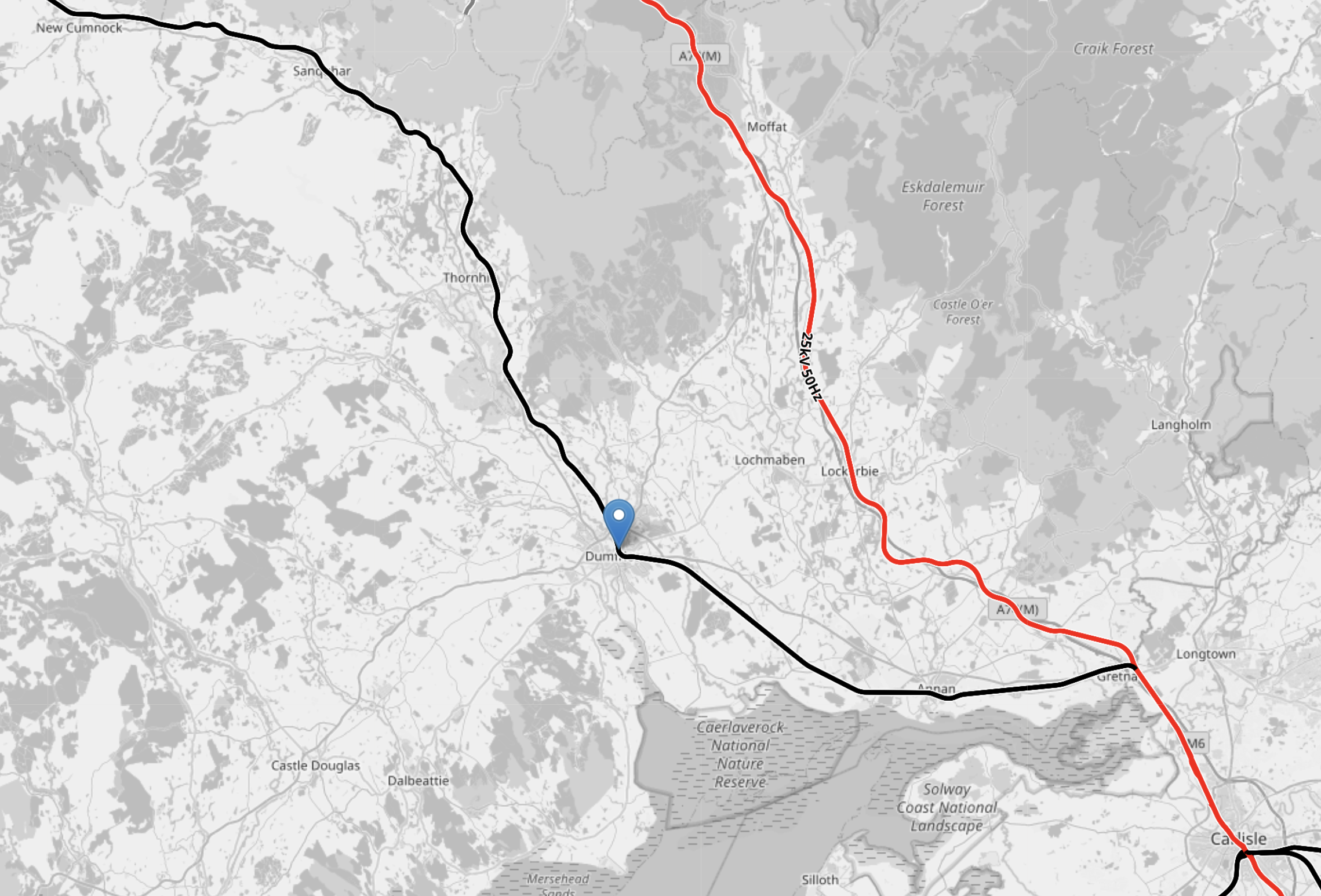
Note.
- Electrified lines are shown in red and lines shown in black are not electrified.
- The blue arrow on the black track, indicates Dumfries station on the Glasgow South Western Line.
- The red track is the West Coast Main Line.
- Carlisle is in the South-East corner of the map.
- Carlisle and Glasgow Central via Dumfries is 115.9 miles
- The Thames-Clyde Express, ran on this route until 1974.
- According to the Wikipedia entry for the Thames-Clyde Express, the train called at Dumfries and Kilmarnock stations.
From this brief look it appears that the new service could include Dumfries and should be able to serve the town on battery power.
Is More Capacity Needed On The West Coast Main Line Between Carlisle And Glasgow?
I asked Google AI, this question, to see if there is capacity.
This was the answer I received.
Yes, increased capacity and infrastructure enhancements are required on the West Coast Main Line (WCML) between Carlisle and Glasgow, as the line is currently full and unable to meet modern, growing passenger and freight demands.
Upgrades are necessary to tackle aging infrastructure, bottlenecks, and the need for more frequent services.
Key Aspects of the Need for Capacity:Full Capacity: The WCML is essentially full, with little space left for growth, despite 75 million passengers using it annually.
Freight and Passenger Growth: Passenger numbers are expected to double by 2050, and the line is a crucial artery for Anglo-Scottish freight.
Infrastructure Age: The northern section is undergoing its largest upgrade in half a century to address reliability issues.
Performance Bottlenecks: Specific locations, such as those north of Carlisle, require signaling and track improvements to prevent delays.
Proposed Upgrades: Current initiatives include a £400m investment until March 2029 for upgrades, including signalling and track renewals, though these are largely to boost reliability rather than provide a massive increase in capacity.
It looks to me, that a bit of a redesign and some use of battery trains on the Glasgow South Western Line, might squeeze a few more trains into the route.
Flybe Appears To Be On The Way Back
I was alerted to the relaunch of the Flybe airline being a serious proposition by this article on the Birmingham Mail, which is entitled Watch As First Of 32 New Flybe Planes Lands At Birmingham Airport.
These are the first two paragraphs.
The first of Flybe’s more eco-friendly planes has landed in Birmingham ready for the launch of the airline’s new city HQ.
Part of a planned 32-aircraft fleet, the De Havilland Canada Dash 8-400 turboprop touched down on the runway at Birmingham Airport on Friday.
The new Flybe will be based at Birmingham Airport and will have a fleet consisting of thirty-two De Havilland Canada Dash 8-400 aircraft.
The De Havilland Canada Dash 8-400
Note these facts about the aircraft.
- According to Wikipedia, 645 aircraft have been ordered, with 587 having been delivered.
- Different variants can handle between 40 and 80 passengers.
- All aircraft delivered since 1996 are dubbed Q-Series and have active noise and vibration suppression, which is designed to improve the cabin ambience.
- A Dash 8-400 is also called a Q400.
But the most interesting development of the Dash 8 aircraft, is that developments are underway, so that the aircraft will be able to be powered by hydrogen.
Universal Hydrogen And A Hydrogen-Powered Q400
This article on Future Flight is entitled Universal Assembles Hydrogen Aircraft Conversion Team In Washington State.
This is the first two paragraphs.
Universal Hydrogen and its hydrogen fuel cell partner Plug Power are joining forces with electric motor specialists MagniX and AeroTec to set up a Hydrogen Aviation Test and Service Center at Grant County International Airport in Moses Lake, Washington. The partners will use the new facility to convert a Dash 8 regional airliner to hydrogen propulsion in time to start commercial operations in 2025. Flight testing is due to begin in 2022.
The new hydrogen powertrain will consist of an electric propulsion unit (EPU) developed by MagniX and fuel cells provided by Plug Power, which has extensive experience converting trucks to hydrogen. Seattle-based AeroTec will take the lead on converting the Dash 8s to hydrogen propulsion, conducting flight tests, and arranging for certification under FAA supplemental type certificates. The system installation work will be conducted at the Moses Lake facility.
This paragraph gives details of the design.
The hydrogen-powered Dash 8 aircraft, which carry between 41 and 60 passengers, will be able to operate on routes of up to around 625 miles. Universal Hydrogen’s plan calls for the fuel to be delivered directly to aircraft in capsules that are installed in a compartment at the rear of the fuselage.
These are my thoughts on the design.
Power Required
Wikipedia says this about the engines of the Dash 8-400 (Q400).
The Series 400 uses Pratt & Whitney Canada PW150A engines rated at 4,850 shp (3,620 kW).
This means that the aircraft will need fuel cells capable of delivering over 7 MW.
This data sheet on the Plug Power web site, says that the company has fuel cells up to 125 KW, which weigh 350 Kg and need a cooling module, that weighs a further 103 Kg. Scaling up shows the power unit could weigh around 25.4 tonnes.
As the maximum take-off weight of a Q400 is around 30.5 tonnes, this wouldn’t leave much weight for the airframe, the two electric motors and propellers, the hydrogen and the passengers and their luggage.
It would appear that Plug Power must be using some form of lighter-weight fuel cell.
Or could they be using an appropriately-sized gas turbine generator from Pratt & Whitney Canada?
It should be noted that a Pratt & Whitney Canada PW150A engine, weighs under a tonne and generates over 3.5 MW.
Obviously, they wouldn’t be developing the plane, if they hadn’t figured out how to generate enough electricity to get it off the ground.
The Hydrogen Capsules
The Product page on the Universal Hydrogen web site is revealing.
This paragraph from the Product page describes how they would convert Regional Aircraft to Hydrogen.
Our first product is a conversion kit for existing regional aircraft, starting with the ATR72 and the De Havilland Canada Dash-8, to fly on hydrogen. This consists of a fuel cell electric powertrain that replaces the existing turboprop engines. It also accommodates, in the rear of the fuselage, our proprietary, lightweight, modular hydrogen capsules that are transported from green hydrogen production sites to the airport and loaded directly into the aircraft using the existing intermodal freight network and cargo handling equipment. By providing both an aircraft conversion solution for the existing fleet and a fuel services offering directly to regional airlines, we will be in passenger service with zero emissions by 2025 and in cargo service shortly thereafter.
Note.
- The cutaway on the Product page of a De Havilland Canada Dash-8, which has three capsules in the rear fuselage.
- The cutaway shows forty seats in the aircraft.
- If you scroll the pictures, you’ll see the design of the capsule.
- The product can be used to convert two regional airliners both of which are in production.
- Airports will need no new infrastructure to handle the hydrogen.
Universal Hydrogen has also signed a deal with Fortescue Future Industries to supply green hydrogen to fill the capsules.
Are A First Flight In 2022 And An in-Service Date Of 2025 Over Ambitious?
The article in Future Flight says this.
AeroTec will take the lead on converting the Dash 8s to hydrogen propulsion, conducting flight tests, and arranging for certification under FAA supplemental type certificates.
FAA Supplemental Type Certificates are outlined on this page on the FAA web site, where this introductory paragraph is given.
A supplemental type certificate (STC) is a type certificate (TC) issued when an applicant has received FAA approval to modify an aeronautical product from its original design. The STC, which incorporates by reference the related TC, approves not only the modification but also how that modification affects the original design.
They are a much-used and well-proven method to update aircraft for new purposes and new power units.
I suspect that going this route will enable Q400 and ATR 72 aircraft will be flying on hydrogen by 2025.
How Far Will A Range Of 625 Miles Take The Plane From Birmingham?
I have used the Air Miles Calculator to calculate distances in miles from Birmingham.
- Amsterdam Schiphol – 276
- Barcelona – 791
- Belfast City 225
- Berlin Schönefeld – 644
- Biarritz – 621
- Bilbao – 635
- Bordeaux – 529
- Cologne – 397
- Copenhagen – 624
- Cork – 290
- Dublin – 200
- Dusseldorf – 373
- Edinburgh – 251
- Frankfurt – 452
- Geneva – 556
- Glasgow – 260
- Hamburg – 495
- Inverness – 364
- Jersey – 225
- Kirkwall – 474
- Lerwick – 536
- Lyon – 558
- Munich – 660
- Newcastle – 179
- Newquay – 198
- Nice – 735
- Oslo – 726
- Paris-Charles de Gaulle – 303
- Paris-Orly – 315
- Rotterdam – 265
- Strasbourg – 494
Note.
- It might be possible to serve some routes without refuelling at the other end.
- Some routes could be paired for efficiency and still be well below 600 miles.
- The large intercontinental airports of Amsterdam Schiphol, Frankfurt and Paris-Charles de Gaulle should be reached easily.
- Amsterdam Schiphol Airport has a well-connected railway station.
- Paris-Charles de Gaulle Airport has a TGV station.
- Frankfurt Airport has a long distance railway station on the Cologne-Frankfurt high speed line.
- If you’re flying to the South of France or Switzerland, it looks like flying from London City Airport is about a hundred miles shorter.
It would appear that the range of 625 miles could be very useful, especially if you use a long distance train at both ends of the flight.
I can certainly understand why Flybe has chosen Birmingham as its main base.
Will Flybe Convert Their Aircraft To Hydrogen?
This is obviously up to the company, but if they don’t, someone else will and Flybe will lose their regional market in the UK.
Conclusion
I think those behind the new Flybe could be looking to create the UK’s first zero-carbon airline.
Monarch Goes Bust
It is not a good time for airlines with Ryanair in a mess and now Monarch has gone bust.
The CAA has announced a web site at www.monarch.caa.co.uk, where passengers should look for information.
I checked the site out of curiosity and it seems to do what the chair of the CAA said it does on the BBC!
The internet would seem to help in these situations.
A Previous White Christmas
All of this bad weather reminds me of a tale of getting home for Christmas in probably 1978. I say probably as the BBC have said that that was a very bad winter. Ian, one of our consultants, was working in Amsterdam and joined the exodus with many fellow Brits back to the UK on Christmas Eve at Schipol. But Heathrow was closed as many aircraft were frozen to the stands. More by luck than judgement BA were able to get a Tri-Star to Schipol after finding out that East Midlands airport was free of snow. The jet then did several shuttles between the two airports to bring everybody home, albeit not to where they wanted to go. BA also hired every coach they could find to complete the passengers’ journeys.
One version of the story says that the last flight came in at three in the morning of Christmas Day.
One gets the impression, that that sort of spirit no longer exists in our transport industry. Although as I said at the time, I’ll give credit to National Express East Anglia for getting me home on Saturday from Ipswich.
Evian on Cathay Pacific
I suppose they fly it halfway round the world, but surely there is something good and more local to Hong Kong.
Tête-Bêche or Herringbone
BA and Cathay Pacific have very different ideas about how Business Class should be laid out. In the former you sleep head to tail, whereas in Cathay, you’re arranged on either side of the aisle.
In my view BA’s layout is much better, as you can leave your seat so much easier, without taking the seat out of the sleeping position. Apparently, the herringbone gives a wider seat, but I don’t need that. I also found the Cathay seat a lot more uncomfortable, probably because I couldn’t lay on my stomach and because my spine sticks out at the bottom.
I should also say that the gluten-free food on BA was much better than that on Cathay, but this might be because it was out of Hong Kong. Strangely, the best I had, was on Astraeus on a charter to Gambia. It had been produced by a small Welsh company.
Travelling with Time to Spare
Since I’ve had the stroke, I try to make things easier for myself.
Take yesterday, as I had to get to Heathrow for BA 027 that left at 21:25, I decided that it would be a good idea to get my taxi to drop me at Whittlesford to catch the 16:30 train for Tottenham Hale. There it was to be the Victoria Line and Piccadilly Line to the airport for about an eighty-minute ride with just one walk across the platform at Finsbury Park.
But two things happened.
I forget to take my driving licence and we had to go back. It was only a delay of about five minutes, but it made things tight.
And then the automatic machine at the station wouldn’t serve me any suitable ticket. What I wanted was an open return with my Senior railcard. In the end I settled on a single to Tottenham Hale. I know in the cost of the this trip, it is a small thing, but if you do look after the pennies, you can afford to do the bits where the style is worth it!
I’d been on the train for a couple of minutes, when I noticed the train was going to Broxbourne. Weird! Then I found out the lines were down and it would be a bus from Broxbourne to Cheshunt.
Oh! Well!
I still had plenty of time. But then we waited and waited outside Harlow for well over half-an-hour after a bit of a crawl from just before Bishops Stortford. I was starting to get worried. I do seem to worry more, but perhaps it’s just worried about being worried and stressed. Perhaps, I should try Yoga!
We got to Harlow about six and I saw a taxi and asked the driver to take me to the Tube. I had thought about Redbridge or Walthamstow, but he suggested rightly that Epping would be better.
And so I had a marathon ride from one end of the Tube network to the other with just a change from the Central Line to the Piccadilly Line at Holborn. I was safely in Heathrow at eight-fifteen after an hour and three quarters and forty stations. Note that this isn’t far out from the formula of two minutes a station and fibve minutes for a change.
I wish though that I’d missed the first train. I would have found out what had happened and the taxi could have taken me to Cambridge, where I could have gone to Kings Cross at speed.
But I didn’t! In the end nothing really happened except more stress than I wanted, which could have been avoided by better thought on my part and better information on that of National Express.
FlyGlobeSpan and BA Cabin Crew
On the one hand the Scottish airline, FlyGlobeSpan, has gone bust and on the other we have BA’s cabin crew threatening a twelve day strike.
These are in effect two ends of the same problem. There are too many airlines chasing too little business and difficult choices have to be made. In BA’s case, they have to cut costs to survive and as I understand it, they are just reducing the conditions at the staff they employ at Heathrow to those at Gatwick and other bases.
Perhaps, the Scottish experience will knock some sense into the BA cabin crew. But it doesn’t look hopeful!
As Prudence bailed out the Scottish banks will he bail out this Scottish airline?
After all, there are a lot of Labour constituencies in Scotland!
Sheffield City Airport
Sheffield is one of the largest cities in Europe without a major airport.
It did have one, called Sheffield City Airport, and for a time just after it opened in 1996, it was reasonably successful. But it closed a couple of years ago and now it is being turned into a business park.
The reasons it closed was because it was designed to take limited short take-off and landing aircraft like London City. But unlike that airport, it couldn’t sustain the high value traffic that airports like that need for profit and growth.
On a more general point, Sheffield had too short a runway, to attract the low-cost airlines like Ryanair and EasyJet and in any case Manchester, Leeds and East Midlands were all within an hours drive. There is now even the new Robin Hood Airport on the former RAF Finningley.

