It’s Not A New Train
This may look like a new train, but it’s just a well refurbished one!
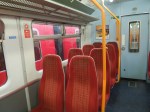






The story of the refurbishment of these Class 455 trains is detailed here in Wikipedia. It includes this comment.
This refurbishment was so comprehensive that many passengers thought the refurbished units were new trains.
But refurbishment of trains is something we do well in this country. And there are lots of similar trains built like these Class 455, running all over the UK. Some like the Class 317 are already being earmarked for full refurbishment and upgrading.
So don’t despair that the old rattletraps on your line are beyond improvement. Some designer or engineer has ideas for your trains. Whether they will get done is up to the Treasury, which is not a real bastion of hard core engineering and design.
The First Shoots Of Electrification
Huyton lies on the original route of the Liverpool and Manchester Railway and you pass through Rainhill, where the trials were synonymous with the Stephenson’s Rocket, on your way to Manchester. As you travel you notice the pylons for the electrification of the line by the trackside.




It reminds me of watching as a child, as the pylons started to be added to the Great Eastern Main Line electrification was extended to Chelmsford and Colchester in the 1950s and 1960s.
There is one big difference. The modern pylons are much stronger than those of the past. Hopefully, these will cure some of the overhead wiring problems encountered on some of the lines electrified in the last century.
Going Underground
I saw this poster on the Undergound.
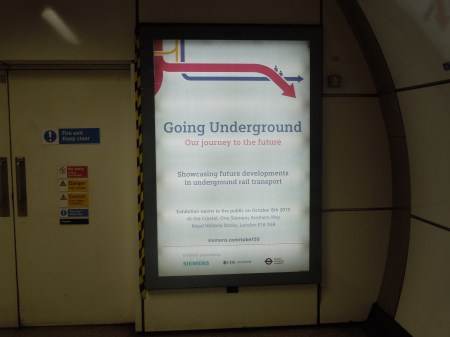
Going Underground
I think it will be worth seeing, as a glimpse into the future.
An Investigation Into The Stability Of Peer-To-Peer Lending Systems
For some time, I’ve thought that peer-to-peer lending systems, and Zopa which I know best, in particular, are a very interesting proposition mathematically. I did muse on this question some time ago in Stability in Financial Systems.
My education is at Liverpool University, where I got a B. Eng degree in Electronics in 1968. I had specialised in Control Engineering and my undergraduate thesis was all about mathematical modelling.
Most of my career since has been about large business, monetary and planning computing.
But one thing that must be born in mind, is that after I sold Metier in 1985, I formed a finance company in partnership with a friend. We still talk so it must be a good relationship.
In the years I had a stake in that company, I modelled the cash flows for obvious reasons of watching risk, just as I do with my funds invested in Zopa now.
The company taught me a lot about the finance industry and it was partly for that reason, that I invested my savings in Zopa nearly six years ago. And I’ve not regretted it one bit!
As I said in Stability in Financial Systems last year, I have a feeling that Zopa is a stable system. I also think they have used this stability to their own advantage, to create their Safeguard offers.
Obviously, a full investigation would be of value to see how, if Zopa my proposition concerning the system is correct.
You would just right down the various cash flows and see how the various scenarios will affect the company.
Can We Delay Fracking?
Or any other new means of energy creation for that matter?
There has just been a very heated debate about fracking on BBC Radio 5 Live and the amount of hot air produced could power the whole of Sussex without doubt.
Most of the arguments on both sides were fact-free and full of emotion, with accusations of lying and wrong facts from both sides.
The most significant energy news of the day is this story from the Guardian. It says that domestic energy use has dropped by a quarter since 2005.
More work in this field could actually delay the crunch, when we need to build lots of new power stations, be they powered by whatever.
That delay is the time to use to research every method of obtaining energy fully.
The trouble is this would probably give engineers and scientists enough time, to find a solution that ended all the arguments, so a lot of protesters and believers in uneconomic technologies would be kicked soundly into the long grass.
If I’d had a pound for every scientifically incorrect argument about energy I’d heard, I’d be a very rich man.
Who Needs Outside Investors?
The Sunday Times has two articles today about very successful companies that have become that way and financially secure, without any external finance.
I’ve known about the first, Martin Baker for many years and in some ways it’s surprising that they haven’t sold out, as anno domini catch up with us all.
The other is a Cambridge company called Real VNC, who provide software for virtual network connections. They have just won the MacRobert Award as is reported here.
I like the quote from Andy Harter, one of the founders of the company.
We need to persuade young people that engineering means the people who built the Olympic Park and the internet, and that it is a great choice of career.
I’ve spend a life in engineering and would thoroughly agree. I’ve even applied engineering principles to banking and finance. Bankers have needed me more, than I’ve needed them!
On the other hand when I needed a good banker, I found an excellent one in my friend David, who came to me because of the quality of my work on an internal project he started in the bank. How many bankers these days would recognise a good engineer or scientist? Only after he’s sold his or her company, I suspect!
Zopa Tweaks The Alogorithm
I am a Control Engineer by training, so I’m supposed to be able to make systems perform in a safe and stable manner. As an example, when your train comes into the station and stops precisely in the right place, or an airliner lands itself automatically, a Control Engineer will have been responsible for working out the principles of how that is done. I have said before that Zopa is in fact a stable system, but now they have tweaked the algorithm to speed up the lending process without losing any of the stability. It’s all described here in their blog.
The most important way to lend money faster is to create a bigger demand. Zopa asks lenders to spread the word to those with good credit ratings, who might want to borrow money for sensible purposes.
But of course, you won’t get a bigger demand unless you have more money in the pot to borrow! So the whole process should spiral and feed in on itself.
The one thing that needs to be maintained to the highest possible level, is the checking of borrowers to make sure, they’re credit worthy.
But even this process should get better, as Zopa learns more about good borrowers and this feeds back into the system.
The whole system is a classic feedback control system, that has the ability to mutate and change itself by learning from its history.
Does your very average bank, like the Royal Bank of UK Taxpayers behave like this? Of course it doesn’t, as those at the top cast a strategy in stone and it gets slavishly followed to the letter. Unfortunately, it has no capacity to learn and change in a Darwinian manner.
But more importantly, it can’t respond easily to increased demand and a changed marketplace. Royal Bank of UK Taxpayers also has constraints placed on it, as regards to parameters like working capital.
Zopa just needs to balance their lending to the amount that is deposited by lenders, or as I prefer savers. If I look at my figures for Zopa over the last year or so, these figures have been moving towards balance.
Now with their Safeguard system enabled, the loop has been closed!
The Death Of A Brave Man
This story from the BBC, tells the story of Masao Yoshida and his fight to get the nuclear reactors at Fukushima under control after the tsunami and his recent death from an unrelated cancer.
It is worth reading, as it shows how people will make a sacrifice for the greater good.
Engineering Pornography At York
I went to the National Railway Museum today to see the Mallard 75 event or the Great Gathering as it is named by some.
Here are some pictures.






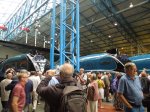




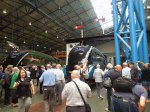




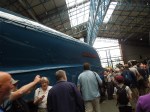


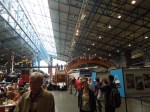
Sadly only three of the six iconic A4 Pacifics designed by Sir Nigel Gresley are still capable of steaming.
The Trains Are Learning From Formula One
This is message on a BBC report today, but it’s a rather shallow one, as it ignores the way engineers have designed systems for years. They are saying for instance, that trains now report their fault and they’ve learned this from Formula One. But trains have effectively had extensive computerised reporting systems for years. A classic example is the 1995 Stock trains on the Northern Line of the Underground, which were designed with such a system. How good it is, I don’t know!
A lot of improvements in any system, are down to attention to detail and that is probably what Formula One does in spades. But that is just good design! I was on a heavily loaded commuter train yesterday, and the station stops, were very quick, partly because, the train accelerated and stopped quickly, the passenger handholds were all in the right place, the doors were wide and the self-loading cargo, knew how to get on and off quickly.
I suspect this has little to do with Formula One, but some of the parts of the train, may well have been manufactured using advanced techniques developed for motor-racing.
 The Anonymous Widower