A Walk Between Walton-on-the-Naze And Finton-on-Sea Stations
One of the reason’s I went to Walton-on-the-Naze station today, was to see if I could have a nice walk in the sun along the sea to Frinton-on-Sea station and then take the train home.
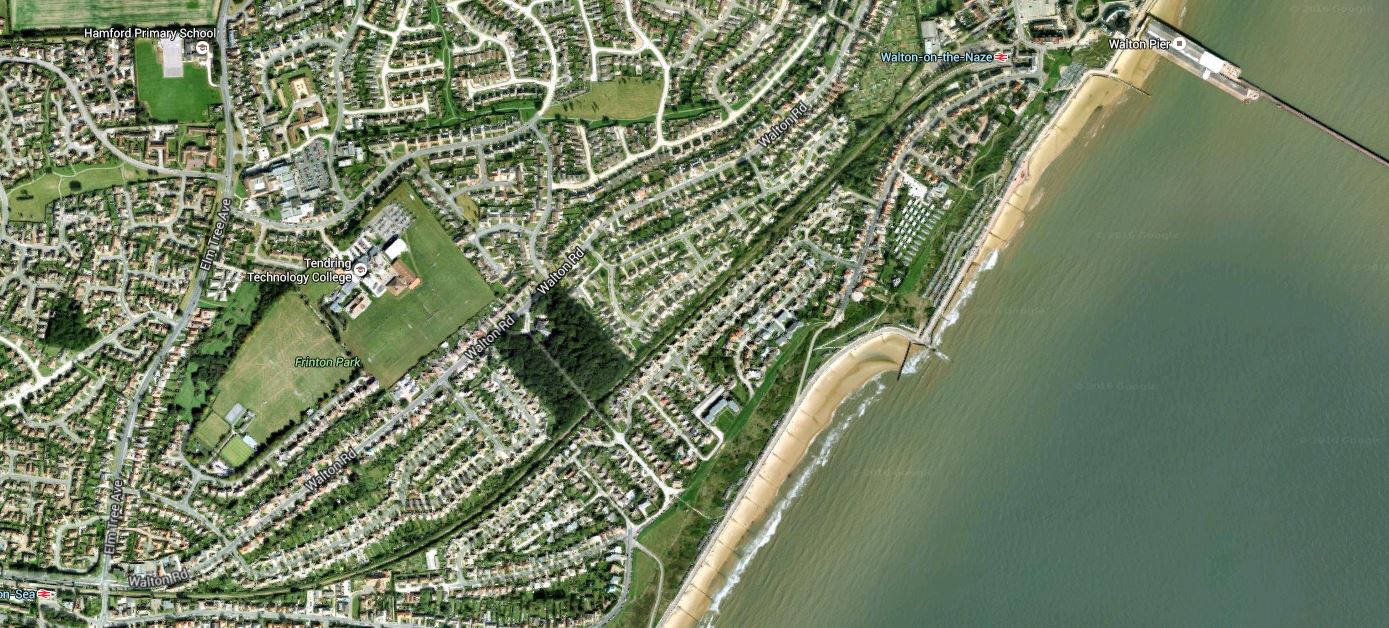
This Google Map shows the two stations and the sea.
A Walk Between Walton And Frinton Stations
Walton-on-the-Naze station is in the North-East corner of the map by Walton Pier and Frinton-on-Sea station is in the South-West corner.
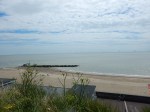
I walked along the promenade, which goes all the way to Clacton-on-Sea, between the beach-huts on the shore and the wide sandy beach and the sea.
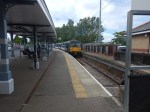
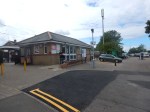
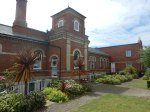
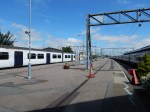
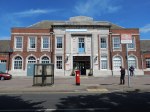
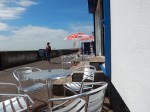
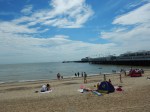
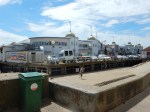
I took these pictures as I walked.



Note.
- The number of Thames Sailing Barges in the sea. I saw five, but others saw six.
- The beach welcomes dogs.
- The memorial to PC Brian Bishop.
- I got lost walking from the beach to Frinton-on-Sea station. There were no signs or maps.
The walk took me about ninety minutes. Unlike at Clacton, I didn’t pass a decent cafe. I should have had lunch before I left Walton.
A First Visit To Clacton
Despite living quite close to Clacton for perhaps about thirty years of my life, I’d never been to the town before today.
I needed some sun and felt that a visit and a walk along the front was in order.
Since the Shenfield Metro train service through East London to henfield has been run by TfL Rail, getting to places like Clacton and Sudbury, as I did, a couple of weeks ago, has become a lot cheaper.
Sudbury cost me £11.70 return, and Clacton today was £14.25! As Clacton is seventy miles from London, surely that is good value!
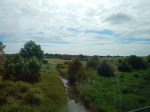
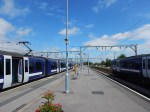
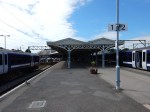
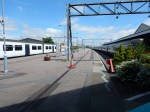
These are of some pictures I took of the trip from the time I joined the Sunshine Coast Line at Colchester.














Note.
- The stations on the branch look reasonable, although Thorpe-le-Soken station could do with improvements.
- According to a local, the front at Clacton has had a recent makeover.
- There is a maintenance depot for the trains at Clacton.
- The line is an electrified double-track, although the branch to Walton-on-the-Naze and Frinton-on-Sea is only a single-track.
- I must admit to being surprised at the size of Clacton station with four platforms capable of taking twelve-car trains.
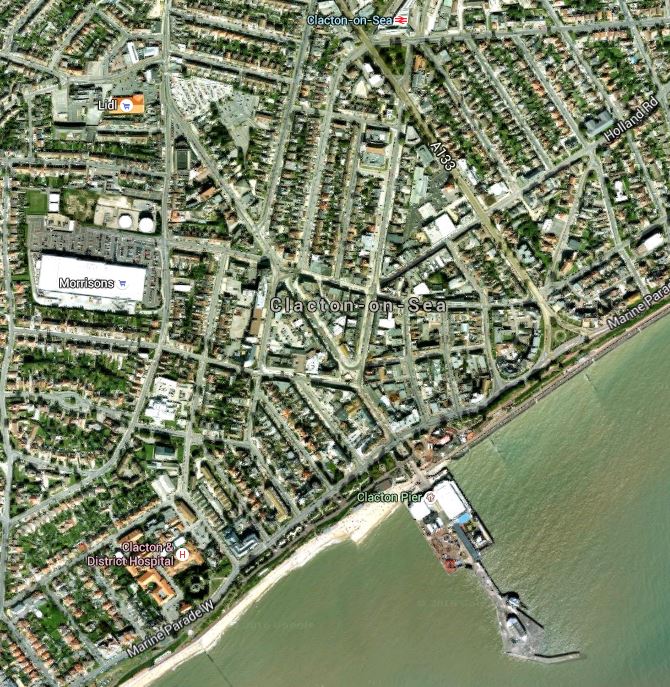
This Google Map shows the route where I walked.
Clacton
I walked down from the station to the sea front, along the promenade to the Pier and then back up to the station. It was virtually flat all the way.
One of the reasons, I went to Clacton was to look at the train service and see if it is likely, than the new franchise will improve it.
- As I said earlier, most of the stations I saw are in reasonable condition, although some may need step-free access.
- Thorpe-le-Soken station would appear to need improvement.
- According to Wikipedia Abellio has plans to improve stations at at Alresford, Kirby Cross and Weeley
- It is still possible to see the remains of the second track to Walton at Thorpe-le-Soken station.
- Generally, the Off Peak service to Clacton and Walton is one train per hour.
- Going to Clacton, I rode in an acceptable Class 360 train, but going back I was in a Class 321 train.
- Signalling on the Sunshine Coast Line was modernised a few years ago, but what is the state of the electrification?
- Colchester Town station is served by a spur from the Sunshine Coast Line, which has a low speed limit because of sharp curves.
There is certainly scope for improvement.
These are a few notes on what can be done.
Colchester Town Station
Wikipedia says this about the station.
As of 2013 there is only one platform, but there is space for a second which would make possible a more intensive service on the Sunshine Coast Line. To the east of the station, Colne Junction is the western extremity of a triangle which gives access towards Colchester station to the west and Hythe station to the east. The curve to the north from Colne Junction to East Gates Junction is sharp, with a continuous check rail which necessitates slow passage.
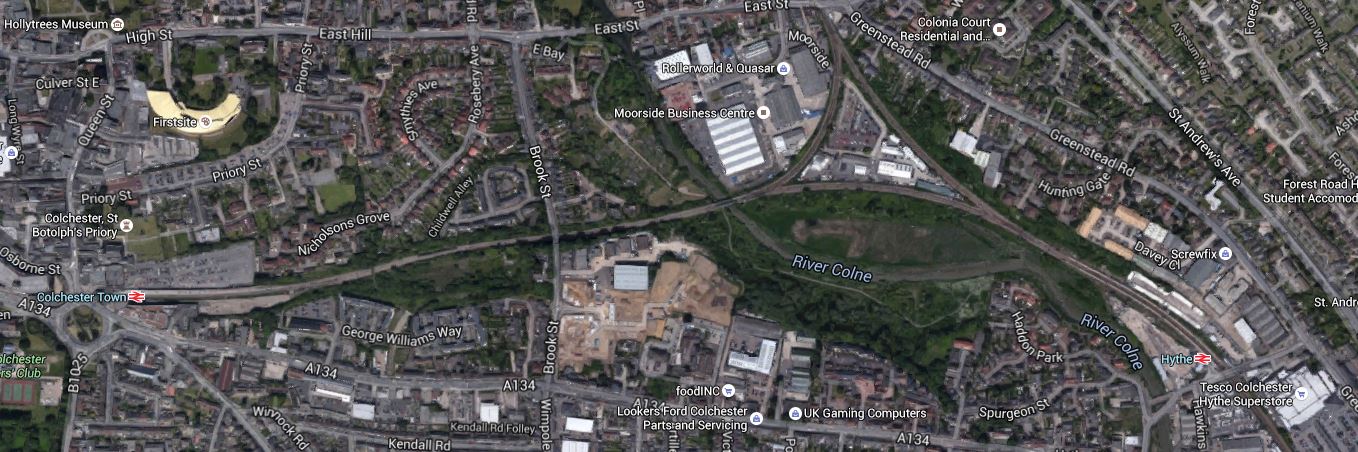
This Google Map shows Colchester Town station and Colne Junction.
Colchester Town Station And Colne Junction
Colchester Town station is at the Western side of the map and the lines lead out of the station to the triangular Colne Junction.
As the map shows, it is a much sharper curve to turn North than go to the Sunshine Coast.
The other station shown at the |Eastern side of the map is Hythe station, which is on the route to Clacton and Walton.
I suspect that there have been many sensible ideas to improve services through Colchester Town station, but that as train services in East Anglia have always had a low priority, nothing has been done.
These pictures show Colne Junction from a train between Clacton-on-Sea and Colchester.


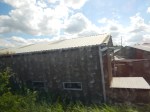

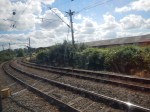
I was surprised to see that all sides of the junction are double-track.But not surprised to see a collection of second-rate industrial and Royal Mail development in the middle of the junction.
An absolute minimum of improvements would be.
- Improving the curve to the North at Colne Junction, so that there is a speed increase for trains going to and from Colchester and towards London, that serve Colchester Town and the Sunshine Coast Line.
- A second platform at Colchester Town station.
- Opening Colchester Town station on Sundays.
I will be interested to see if improvements are proposed in the new East Anglia Franchise.
New Trains
In Could Class 387 Trains Do Norwich In Ninety And Ipswich In Sixty?, I wrote that to obtain these timings, North of Chelmsford, all trains must be capable of holding a 100 mph line speed or perhaps even 110 mph.
The Class 360 trains might be fast enough, but there are rumours in the Derby Telegraph, that a new fleet of Bombardier trains will be ordered, to fulfil a requirement in the new franchise agreement.
If a version of something like a Class 710 train is ordered, it could have the following characteristics.
- Four-car trains, able to run in four, eight and twelve car formations.
- 100 mph or 110 mph line speed.
- Regenerative braking.
- Provision for on-board energy storage.
On the Sunshine Coast Line, the trains would not use the onboard energy storage for primary traction, but to save energy, as I don’t suspect the line has been updated for regenerative braking.
These trains will certainly provide a better passenger experience. They could also be faster between Liverpool Street and Colchester.
Electrification
The electrification looked to be in good condition, but judging by the design, some of it, is fairly elderly.
I also have my doubts as to whether the overhead wires can handle regenerative braking. Use of regenerative braking in the UK have shown energy saving around 15%, but it does need a more expensive infrastructure.
So will we see, a project to renew the wires, transformers and other electrical equipment, as has been seen on parts of the Great Eastern Main Line?
I think we will, but the operator could use on-board electrical storage in new trains to simplify the electrification.Instead of returning braking energy through the overhead wires, it would be stored on the train for using the train to get started again.
One idea that could happen, is that to appease the sensitive souls in Frinton, that the Walton-on-the-Naze branch could be run using onboard energy storage to eliminate any pantograph noise. After all the branch is only five miles long. But that would be five miles less of overheasd wire to maintain.
I do wonder whether some branch lines like the short one to Walton-on-the Naze could be run to tram rules using on-board energy storage. It might enable stations to be built step-free without electrification, lifts and bridges. I wrote about Thurston station, where they have a walk across with lights in Two Solutions To Make Crossing A Railway Safe.
Track Improvements
As with Colne Junction, I suspect that there are some long-standing ideas to increase the line speed from the current 40-90 mph on the Sunshine Coast Line.
Only In Frinton
A common target of East Anglian humour is Frinton, as over the years the town has acquired a dubious reputation about being anti-fun.
In The First Off Licence In Frinton, I told the story of how C got the town its first Off Licence. Her version of the tale, always ended with Frinton were not amused.
Rumour has it, for years, the sign on Manningtree station, which said something like Harwich For The Continent had been annotated with And Frinton For The Incontinent.
Tonight I found this under Recent Developments in the Wikipedia entry for The Sunshine Coast Line, which is the branch line that serves Clacton and Frinton.
A £104 million engineering project known as the Colchester to Clacton Resignalling Project took place on the line between December 2006 and July 2009. Life-expired signalling equipment was replaced and a new control system was installed; 170 modern LED signals were installed and eight manual level crossings were upgraded to full barrier crossings with security cameras. The line was closed every weekend and on public holidays, with bus replacement services provided.
There was opposition from the town of Frinton to keep the manual gates, which were reportedly removed “under cover of darkness”. Folklore has it that townspeople used to lock the gates to keep out coach-loads of tourists.
It is a typical Frinton story. I have no idea, if it’s true!
Only In Essex
This story is from the Brentwood Gazette and is entitled C2C train delays after car abandoned on track at Pitsea.
Enough said!
The Long Way Back From Rayleigh
For various reasons, I go to a dentist in Rayleigh near Southend.
Usually, it is a simple out and back from Stratford.
But today although it was easy getting there, coming back was a long journey, as a man was killed by a train at Harold Wood according to this report in the Romford Recorder.
I was informed that there would be a long wait at Rayleigh, so as a bus arrived, which was going to Southend, I took that as if the Liverpool Street was closed, I could at least get a c2c train to Barking or West Ham.
It is only when you are forced to take a bus in a strange town, that is information-free and nearly all your fellow travellers are wearing head-phones, you realise how most buses are terrible outside London.
I haven’t been to the centre of Southend since the 1960s, so it was only because my phone told me, that I was somewhere near the centre, that I got off at the right stop, near Southend Victoria station.
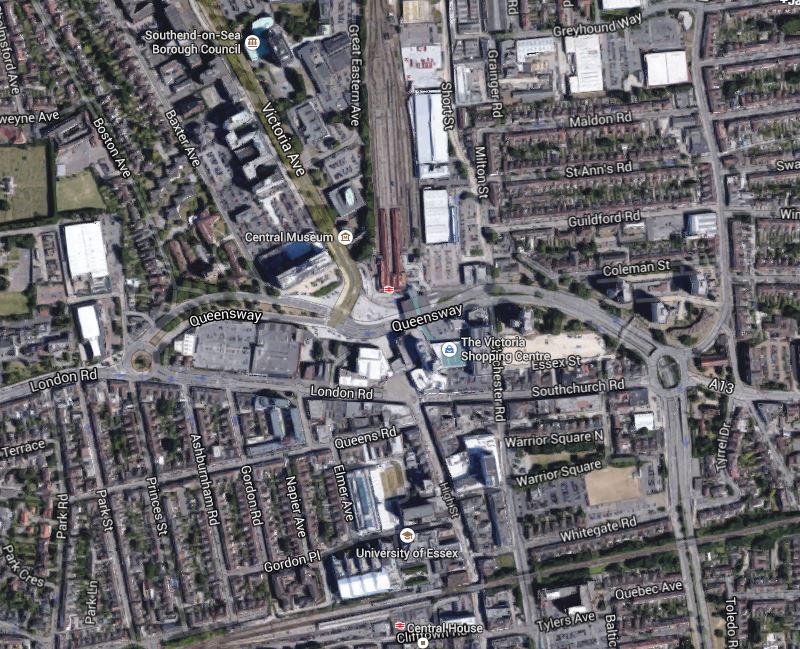
After buying my ticket and a drink, I was then informed that the trains were still not running. So I decided to walk to Southend Central station for the c2c train. This Google Earth image shows the two stations.
Central Southend
Victoria is at the top and Central is on the railway line that runs across the image.
The walk was easy, if rather windy and after ascertaining that c2c would happily accept my GreaterAnglia ticket, in a few minutes I was on a train to London. These pictures taken on the first part of the journey, illustrate the quality of the weather and how close the line is to the coast.

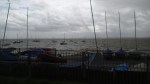


The weather was certainly worse than I encountered on the Cumbrian Coast.
In the end I changed onto the Metropolitan Line at Barking and then came home my usual way via Whitechapel and Dalston Junction.
Thinking Big In Essex
I found this report in the Southend Echo from 2008 interesting.
It is a plan to link Canvey Island with the Hoo Peninsular in Kent using an immersed tube road and rail tunnel. This is an extract from the report.
Metrotidal’s blueprint seeks to combine the tunnel with new flood defences protecting London and a tidal power plant in the middle of the Thames Estuary.
This could support a new eco-town or generate enough power to operate a rail service through the tunnel, the consortium said.
This is a Google Earth image of the Thames south of Canvey Island.
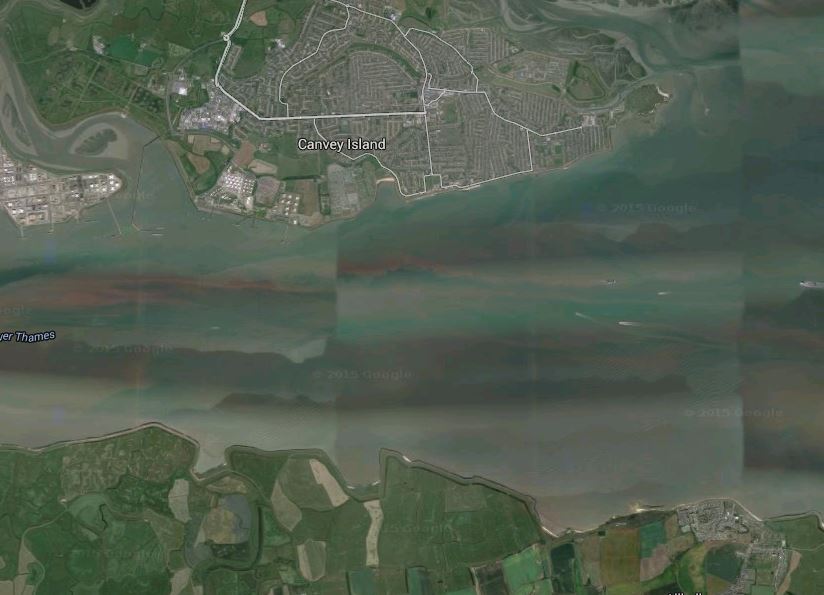
The Thames South Of Canvey Island
The surprising thing is that the river isn’t that wide and is probably about a couple of kilometres.
There hasn’t been anything on the news in recent years, so I suspect that the plan is very much on the back burner.
But one day, a project like this will be built!
An Essex Girl Shows New Yorkers How To Behave
We often forget that Dame Helen Mirren was brought up in Leigh-on-Sea, although she was born in Hammersmith.
There’s a story in the Daily Telegraph showing her riding in state on the New York subway and the praise she has received for her perfect posture and behaviour.
Essex Girls may be the butt of jokes, but like Dame Helen, they are often blessed with strong wills to do the right thing.
Boom Or Bust In Ilford?
I like this article about the effect of Crossrail on Ilford, when it opens in 2018, from the Ilford Recorder.
I think generally the article thinks the new line will have a positive effect on the area.
One thing the article ignores is the Essex Effect. Give the county an opportunity and it will take the fullest advantage of what has been given.
East Tilbury Level Crossing
After hearing about this level crossing a couple of weeks ago, I just had to visit.

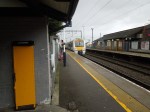
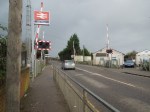
East Tilbury may be loved by some, but it was all I had expected. I didn’t get a demonstration about how it is a real problem for emergency vehicles, but that was probably just as well.
Is This The Most Dangerous Level Crossing In The Country?
Level crossings are generally a danger on railways. In East Anglia and Essex, there are a number that should have been removed years ago.
Buit surely the one described in this article from the Thurrock Gazette, must surely be the most dangerous of them all. What makes this one even more dangerous is that there is no alternative route, and sometimes emergency vehicles get stuck, waiting for a train.
When the London Gateway Port, is fully open, there will be regular mile-long freight trains passing this crossing.
I found out about this crossing on the BBC London News tonight. When I saw the report, I was surprised that no-one in authority had ordered Network Rail to do something about it.
I thought the level crossing in Lincoln was a disgrace, but this one is much more dangerous.
 The Anonymous Widower