The Three Baltic Countries Sign The Largest Railway Electrification Agreement In History
The title of this post, is the same as that as this news item on the LTG Group web site.
This is the sub-heading.
Today in Vilnius, the institutions of the three Baltic countries responsible for implementing the Rail Baltica project signed a historic agreement on railway electrification. The contract, valued at €1.77 billion (excluding VAT), has been awarded to COBELEC Rail Baltica – a consortium formed by the Spanish companies Cobra Instalaciones y Servicios S.A. and Elecnor Servicios y Proyectos S.A.U.
These three paragraphs add more detail.
The electrification of the Rail Baltica European railway is considered the largest cross-border railway electrification initiative in Europe, implemented as a single, joint project.
“Rail Baltica is more than just infrastructure – it is an economic and security link to the West. This contract is particularly important for our integration into the European railway network, enabling smooth passenger and freight transport while strengthening the resilience of the Baltic region. It is our strategic pathway to the future,” said Eugenijus Sabutis, Acting Minister of Transport and Communications of Lithuania.
One of the largest contracts in the history of the Baltic States was signed by the institutions responsible for implementing the project: LTG Infra, the infrastructure company of the LTG Group; Eiropas Dzelzceļa Līnijas in Latvia; and Rail Baltic Estonia in Estonia. Representatives from the ministries of transport and communications of all three countries also gathered in Vilnius for the occasion.
Note.
- The electrification will be to the European standard of 25 KVAC overhead.
- There will be a total of 2,400 km. of electrification.
- High-speed passenger and freight trains will operate on the full length of the route.
- It is planned that the electricity used will be generated from renewable energy sources.
- I feel everybody will be pleased except Putin.
The Russian dictator and war-monger won’t like it, as the railway will not be built to Russian standards.
British Five-Year-Olds Up To 7cm Shorter Than Western Peers
The title of this post, is the same as that of this article in The Times.
This is the sub-heading.
Poor diet and health service cuts blamed for ‘pretty startling’ trend
These are the first two paragraphs.
Five-year-olds in Britain are on average up to seven centimetres shorter than their peers in other wealthy nations, in a trend described as “pretty startling”.
A poor national diet has been highlighted as a major culprit in Britain’s fall down international rankings of child height.
I am coeliac and am only 170 cm.
During the pandemic, I did some statistical research on coeliac disease and the covids for my own interest.
I found a peer-reviewed Indian medical paper entitled Coeliac Disease: Can We Avert The Impending Epidemic In India? The author felt that modern high-gluten wheats, were increasing the rate of the disease.
The author also said this about introduction gluten to babies in Sweden.
The time of first exposure to wheat influences the development of celiac disease. In countries such as Finland, Estonia, and Denmark, characterized by low gluten consumption in infancy, celiac disease prevalence is much lower than in Sweden where gluten consumption is high in infancy. A natural experiment occurred in Sweden about two decades ago when national recommendations were made to introduce wheat into the diet after cessation of breast feeding at six months. This change was coupled with increased wheat gluten consumption through infant feeds. Together these measures resulted in a two-fold increase in incidence of celiac disease in Sweden, which was attributed to introduction of wheat into the diet after cessation of breast feeding. In 1996 this recommendation was changed to introduce gluten in gradually increasing amounts while the infant was still being breast fed. This led to a dramatic decrease in celiac disease incidence.
It is interesting to look at heights of five-year-olds given in the Times article for the four countries.
- Denmark – 117.4 – 118.1
- Estonia – 116.9 – 115.7
- Finland – 116.3 – 114.5
- Sweden – 115.1 – 115.1
Note that all heights are in centimetres, with boys first.
As according to the graphs in the article the UK and the US have shown the biggest declines in height, is gluten-rich junk food, the major cause of this decline?
More research needs to be done!
Amber Train Links The Baltic States To Western Europe
The title of this post, is the same as that of this article on Railway Gazette.
These paragraphs outline the freight link.
A trial Amber Train service between the Baltic States left the Estonian port of Muuga on September 13, arriving the following day at Kaunas in Lithuanian where its load of semi-trailers was transferred to 1 435 mm gauge wagons for onward transport to destinations including France and the Netherlands.
The 1 520 mm gauge wagons returned to Muuga with trailers for onward sea transport to Finland.
This Google Map shows the Estonian port of Muuga Harbour.
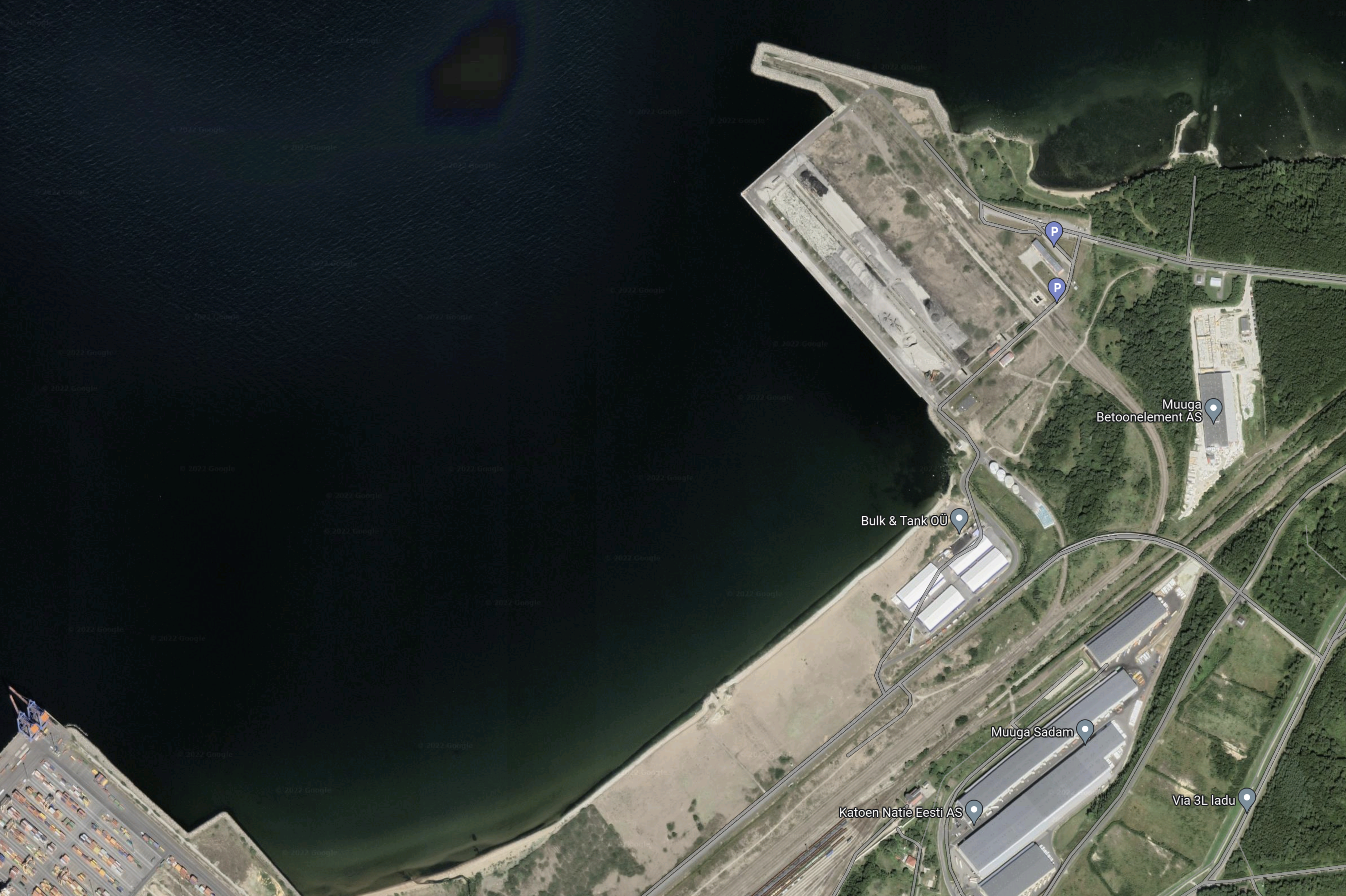
Note.
- Muuga Harbour is the largest cargo port in Estonia, located on the southern coast of the Gulf of Finland, 17 kilometres (11 mi) northeast of the capital Tallinn
- It is one of the few ice-free ports in northernmost Europe and one of the most modern ports in the Baltic Sea region.
- Enlarging the picture shows a lot of rail lines.
It looks like Muuga Harbour is an ideal Northern terminus for the Amber Train freight service.
This Google Map shows the area of the Kaunus Intermodal Terminal.
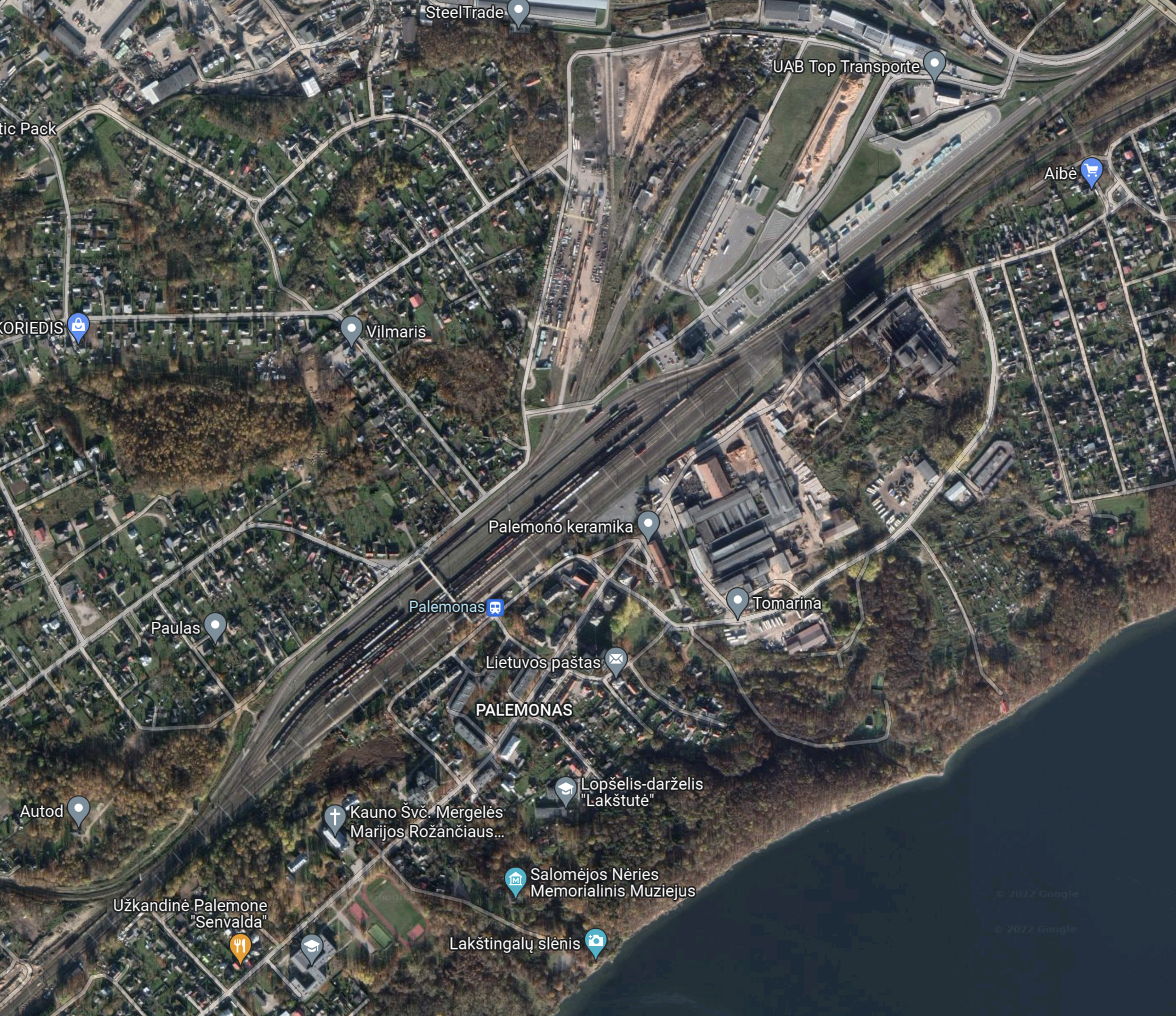
Note.
- The railway runs diagonally across the map.
- Estonia is to the North-East.
- Poland is to the South-West.
This map shows how the different gauges are used in the North-East of the previous map.
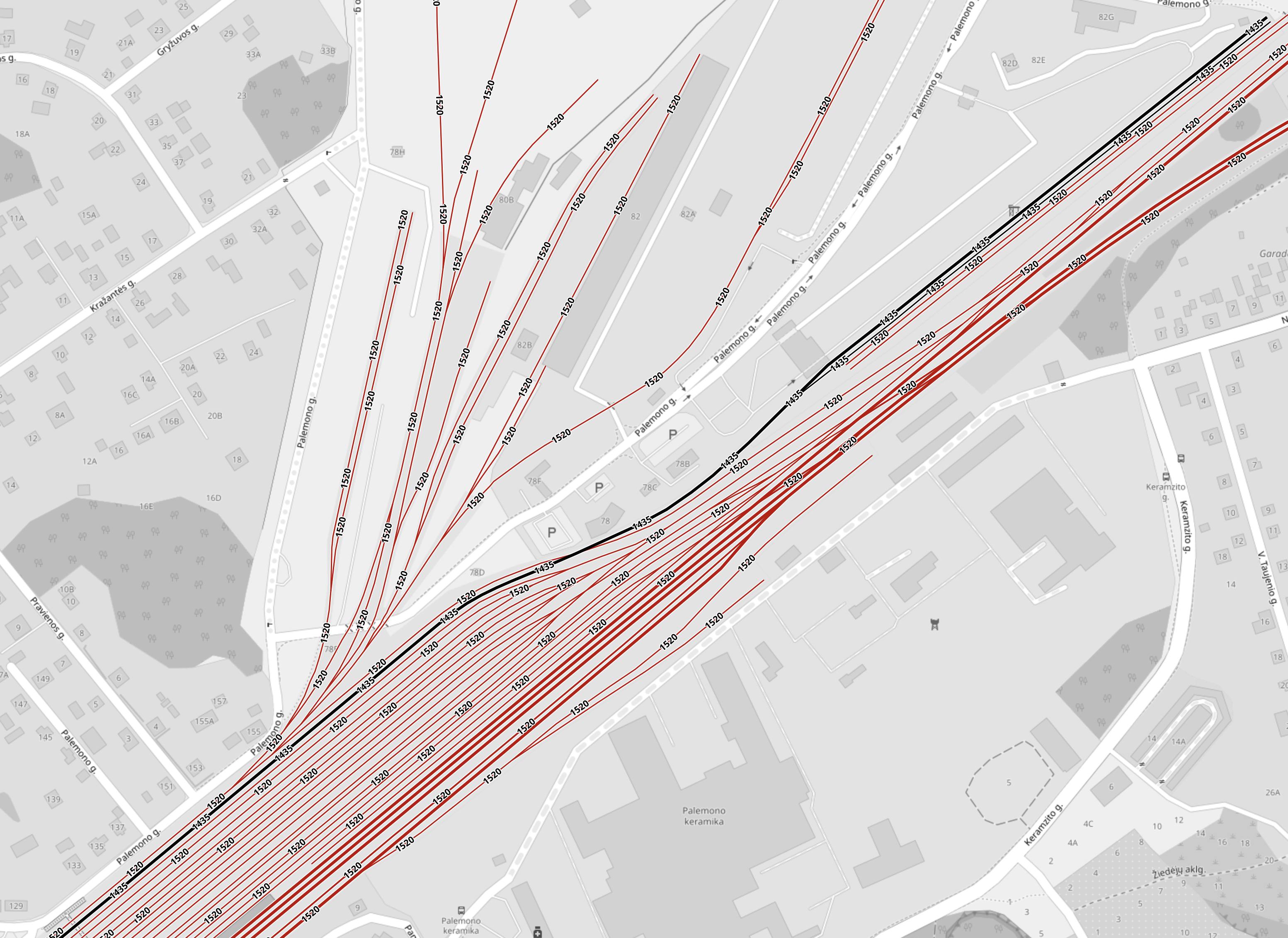
Note.
- Standard gauge tracks are shown in black.
- Russian gauge tracks are shown in red.
- The standard gauge track ends in the North-East corner of the map.
Trucks would probably moved between trains on parallel tracks in this freight terminal.
It appears to be a very simple way to run piggy-back trains of trucks between The Baltic States and Finland and Central and Western Europe.
Rail Baltica
According to Wikipedia, the location for the Kaunas Intermodal Terminal was chosen as it is compatible with the route of Rail Baltica, which will create a new standard gauge route between Kaunas and Tallinn in Estonia.
The Amber Train
The Amber Train has an impressive web site, where this is said on the home page.
Amber Train is a joint project of the national railways of Lithuania, Latvia and Estonia. It is an excellent example of cooperation, that offers road and railway clients convenient and efficient freight logistics.
Amber Train is an intermodal train, which runs on the route Šeštokai / Kaunas – Riga – Talinn, thus connecting the three Baltic States by railways and opening new business opportunities for freight shippers.
Exclusivity of the project is the connection of Western and North Europe, using the unique Šeštokai and Kaunas intermodal terminals, which enable the transshipment of freight from the European gauge to the 1520 mm gauge and vice versa.
The train is planned to run 2 times per week (with a future perspective to run up to 4 times per week), delivery time is 24 hours. Train length – up to 43 container wagons.
It is planned, that already in 2021 customers will be offered the opportunity to transport semi-trailers by railways via all three Baltic States. For this purpose, special “pocket” wagons are already in production.
Operations are managed by AB LTG Cargo (Part of Lithuanian Railways group), Latvia’s LDZ Loģistika and Estonia’s Operail.
It appears to be a well-thought out service.
A few years ago, I was on the roads of North-East Poland, about a hundred miles South of Kaunas.
These roads were crowded with large trucks going between The Baltic States and Finland and Central and Western Europe.
I suspect that once the Amber Train is fully established, a proportion of these trucks will go by rail.
Rail Baltica Electrification Procurement Begins
The title of this post, is the same as that of this article on Railway Gazette.
These two paragraphs define the project.
Rail Baltica project promoter RB Rail has begun procurement of the electrification systems for the future standard gauge line between Poland, Lithuania, Latvia and Estonia, saying it will be the largest railway electrification scheme in Europe to be implemented as a single project.
The energy subsystem contract covers 870 km of double track line from the Polish border to Tallinn including the line from Kaunas to Vilnius, and includes design and construction of substations, connections to the public high voltage grids, control systems and more than 2 000 track-km of overhead equipment.
It looks like the procurement process will be finished by 2023.
Hopefully, Vlad the Mad won’t object to this standard gauge line going too close to lines with his beloved Russian gauge.
Will Rail Baltica Annoy Putin?
Rail Baltica is described like this in Wikipedia.
Rail Baltica (also known as Rail Baltic in Estonia) is an ongoing greenfield railway infrastructure project to link Finland (via ferry or an undersea tunnel), Estonia, Latvia, Lithuania with Poland and through this with the European standard gauge rail line network. Its purpose is to provide passenger and freight service between participating countries and improve rail connections between Central and Northern Europe, specifically the area in the Southeast of the Baltic sea. Furthermore, it is intended to be a catalyst for building the economic corridor in Northeastern Europe. The project envisages a continuous rail link from Tallinn (Estonia) to Warsaw (Poland). It consists of links via Riga (Latvia), Kaunas and Vilnius (Lithuania). Rail Baltica is one of the priority projects of the European Union.
These are a few more details.
- It will be a double-track railway or four tracks if it handles freight.
- Passenger trains will run at up to 250 kph (155 mph)
- Electrification will be either 25 KVAC or 3 KVDC overhead.
- It will be a standard gauge line.
- There will be no level crossings.
- It is planned to open around 2026.
The biggest problem could be that some of the route is shared with the Russian gauge line, that connect Kaliningrad to Vilnius and then from there to the main part of Russia.
This map from OpenRailwayMap shows the railways between Kaliningrad and Vilnius.
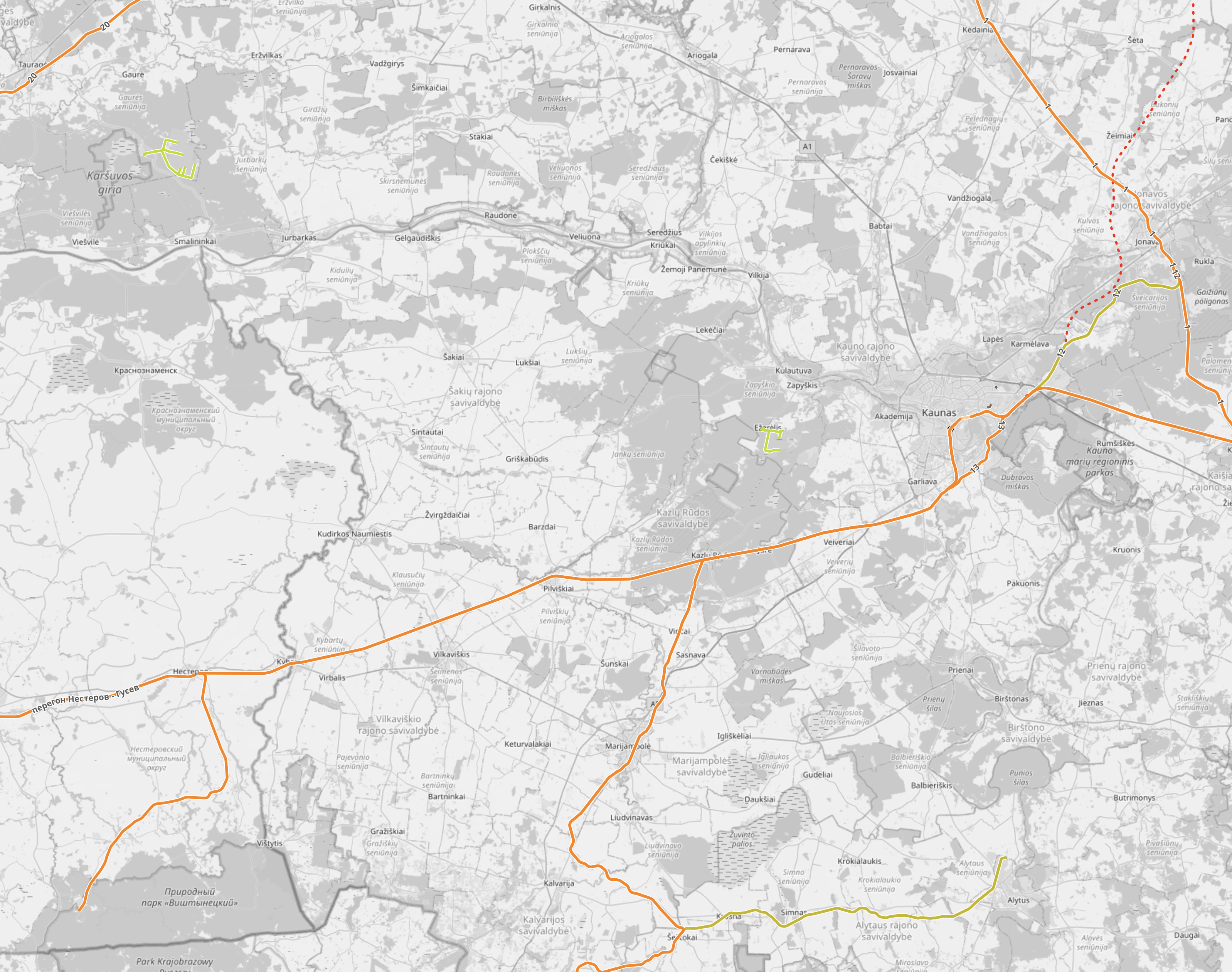
Note.
- The orange lines are main lines.
- The yellow lines are secondary lines.
- The orange line going West goes to Kaliningrad.
- The dark grey line crossing the railway is the border of the Kaliningrad enclave, which was annexed by the Soviet Union in 1945.
- The orange line going South goes to Bialystok, Warsaw and all places to the West.
- The loop in the line is at Kaunus, where there will be an interchange between the two lines.
- The orange lines going East go to Vilnius.
- The dotted red line in the North-East corner of the map, will be new track for Rail Baltica.
The new railway will effectively squeeze itself between Kaliningrad and Kaunus.
Railway Gauges In Poland and the Baltic States
Consider.
- Most, if not all of the railways in the Baltic States are Russian gauge.
- The line between Kaliningrad and Kaunus is Russian gauge.
- Most of the railway lines in Poland are standard gauge.
- The EU likes all new high speed lines like Rail Baltica to be built to standard gauge and have 25 KVAC overhead electrification.
- Kaunus is in Lithuania, so NATO control access to Kaliningrad in sensitive times.
I can’t believe that Vlad likes the current situation and would probably prefer Rail Baltica to be built to Russian gauge, as it would enable the Russian Army to easily move tanks into the Baltic States.
Conclusion
There’s a chance that Vlad will make trouble.
Rail Baltica Concept Trains Inspired By Sun, Sea And Sand
The title of this post, is the same as that of this article on Railway Gazette.
The article shows concept images and I suspect that any of Europe’s train makers could make trains like these.
Rail Baltica will have following route and specification.
- It will eventually run between Helsinki and Warsaw, via Estonia, Latvia and Lithuania.
- There will be a tunnel between Helsinki and Tallinn.
- It will carry both passengers and freight.
- Freight trains will have a maximum length of 1050 metres, as opposed to 775 metres in the UK.
- It will be mainly double-track.
- It will be a standard gauge track with right-hand running, as all countries in the area use right-hand running.
- There will be no level crossings.
- It will have 25 KVAC overhead electrification.
- There will be ERTMS signalling.
- Passenger trains will run at 249 kph (161 mph)
- It is intended to be completed in mid-2026
The specification is similar to High Speed Two, with these exceptions.
- High Speed Two is faster at 205 mph.
- High Speed Two runs on the left.
- High Speed Two will not carry freight.
Phases 1 and 2a of High Speed Two should complete in 2029-2033, with Phase 2b following in 2035.
The bidders to build High Speed Two’s rolling stock include.
- Alstom Transport
- Bombardier Transportation (acquired by Alstom Transport on 29 January 2021) and Hitachi Rail Europe consortium
- Construcciones y Auxiliar de Ferrocarriles
- Patentes Talgo
- Siemens Mobility
I wouldn’t be surprised to see a similar list of companies tendering to build the trains for Rail Baltica.
- Stadler, who have factories in Poland may be added to the list.
- As the trains are being designed at the same time as High Speed Two trains, I wouldn’t be surprised to be similarities.
- They would also have to be designed for both left and right hand running, if there was any chance of a service between Paris and Helsinki.
- Although, they will run under 25 KVAC electrification on Rail Baltica,they may need to be able to run on other voltages.
I very much feel that Rail Baltica will be offered a selection of excellent trains.
Where Will The Trains Be Built?
Consider
- This obviously depends, where winning bidder has factories.
- But there is also the problem of getting trains between the factory and the Baltic.
- This could be difficult for factories in Spain, as there would need to be a gauge change.
- It would be easier, if the route were standard gauge all the way, as it would be from France, Germany, Italy and the UK
- If a Spanish company got the contract, could it build the trains in the UK, as delivery could be easier.
- I puzzle, why Talgo are building a factory in Scotland without any UK orders. But it would be easier to deliver trains to Russia and Eastern Europe by sea from Longannet than Spain.
There are a lot of factors that will define where the trains will be built.
Pärnu – Latvian Border Rail Baltica Contract Awarded
The title of this post, is the same as that of this article on Railway Gazette.
This is the introductory paragraph.
Rail Baltica project promoter RB Rail has awarded a consortium of Indra subsidiary Protec and Obermeyer Planen + Beraten a €10·8m contract to provide design and construction supervision services for the 93·5 km section of the double-track route between Pärnu and the border with Latvia.
In my view, Rail Baltica is one of the most important rail projects in Europe, if not the World.
It will connect the Baltic States to Poland and Germany, and hopefully will play a large part in reducing road traffic in the area.
Should We Have An Electronic Vote On Brexit?
We need to do something quick and radical to sort out Brexit.
Surely, if electronic voting is good enough for Estonia, it’s good enough for us!
Also if we can work out a secure system for Strictly Come Dancing and Love Island, we must have the technology for a secure vote!
Try getting that proposal through the House of Commons
Finland – Estonia Tunnel Secures €15bn In Funding
The title of this post is the same as that of this article on the International Rail Journal.
This is the first paragraph.
FINEST Bay Area Development has signed a memorandum of understanding (MOU) with Touchstone Capital Partners, China, to secure €15bn in financing for construction of a 100km railway tunnel under the Gulf of Finland between Helsinki, Finland, and Tallinn, Estonia.
Linked to the planned Rail Baltica, it will mean that passengers and freight will be able to use railways between the UK and Finland.
Finland-Estonia Rail Tunnel Feasibility Study Completed
The title of this post is the same as that of this article in the International Railway Journal.
This is the first two paragraphs.
A feasibility study into the construction of a rail tunnel under the Baltic Sea between the Finnish capital Helsinki and the Estonian capital Tallinn estimates the cost of the project at €13-20bn.
The FinEst Link tunnel would be constructed as two 10m-diameter single bores connected at intervals with an 8m-diameter central service tunnel. The concept includes two artificial islands, and three stations in Helsinki – City Centre, Pasila and Vantaa Airport – and one station at Ülemiste in Tallinn. The tunnel would be standard gauge to connect with the new Rail Baltica high-speed line linking Estonia, Latvia, Lithuania and Poland.
The article also goes on to say this about the economics of the tunnel.
While the project has a low cost:benefit ratio of 0.45 due to the high capital cost, its wider economic impact on GDP ranges from €4bn for the low scenario to €6.9bn for the base scenario.
Would the projected cost and economics of the FinEst Tunnel be a rough guide to what would happen if a fixed link were to be built between Scotland and Ireland?
The FinEst Tunnel will be standard gauge to be compatible with Rail Baltica, despite both Finland and Estonia using different railway gauges.
Just like the difference between Great Britain and the island of Ireland.
 The Anonymous Widower