Thistle Wind Partners Rename 2 GW ScotWind Offshore Wind Projects
The title of this post, is the same as that of this article on offshoreWIND.biz.
This is the sub-heading.
Thistle Wind Partners (TWP), a consortium founded by DEME Concession, Qair, and Aspiravi, has announced the final names for its two ScotWind offshore wind projects
This is the first paragraph.
TWP won the seabed leasing rights for two offshore wind projects in the ScotWind auction last year, in which 25 GW of capacity was awarded.
These paragraphs give details of the new names and an update on the sizes of the turbines.
The consortium plans to build the 1 GW Bowdun offshore wind project, originally named Cluaran Deas Ear, located off the coast of Stonehaven and lying 44 kilometres out from the landmark of Bowdun Head.
The site covers an area of 187 square kilometres (in the E3 leasing zone). The project is planned to feature between 50 and 60 wind turbines with an individual capacity of 18-25 MW each, depending upon the final design choice.
The second wind farm, located 33 kilometres from the East Mainland of Orkney in the NE2 leasing zone, is named the Ayre Offshore Wind Farm, originally called Clearan Ear-Thuath. This will be a 1 GW floating wind project following a similar base case for turbine numbers and capacity as Bowdun.
Note.
- They appear to be using 18-25 MW turbines.
- These are the first wind farms, that have talked about using such large turbines.
- 18 MW turbines would need 55 turbines for a GW.
- 25 MW turbines would need 40 turbines for a GW.
- Ayre wind farm has a web page, which says that it will have 56 x 18 MW turbines.
- Bowden wind farm has a web page, which says that it will have 56 x 18 MW turbines.
- The web site does say that the size and number of turbines is provisional.
Construction of both farms should start in 2029, with commissioning in 2033.
A Worthwhile Tailpiece
The article has a good tailpiece in the last paragraph.
TWP is one of the founders of a new initiative from the University of Highlands & Islands to deliver a STEM (Science, Technology, Engineering, and Mathematics) outreach programme for primary schools in Scotland, providing materials and teacher training.
TWP obviously intend to catch the next generation of technologists young.
Conclusion
Thistle Wind Partners have gone for the bold option.
Vattenfall Selects Norfolk Offshore Wind Zone O&M Base
The title of this post, is the same as that of this article on offshoreWIND.biz.
This is the sub-heading.
Vattenfall has selected Peel Ports as the preferred bidder, and its port at Great Yarmouth as the location for the operations and maintenance base of the Norfolk Offshore Wind Zone in the UK.
This was said about the competition to host the facility.
Vattenfall said that the competition was fierce to secure the agreement with an excellent bid from Lowestoft and Associated British Ports. With both ports offering excellent services it is clear that East Anglia’s potential as a superpower of offshore wind is secure.
I have a few thoughts.
Lowestoft In Suffolk And Great Yarmouth In Norfolk Must Work Together
This Google Map shows the coast between the two ports.
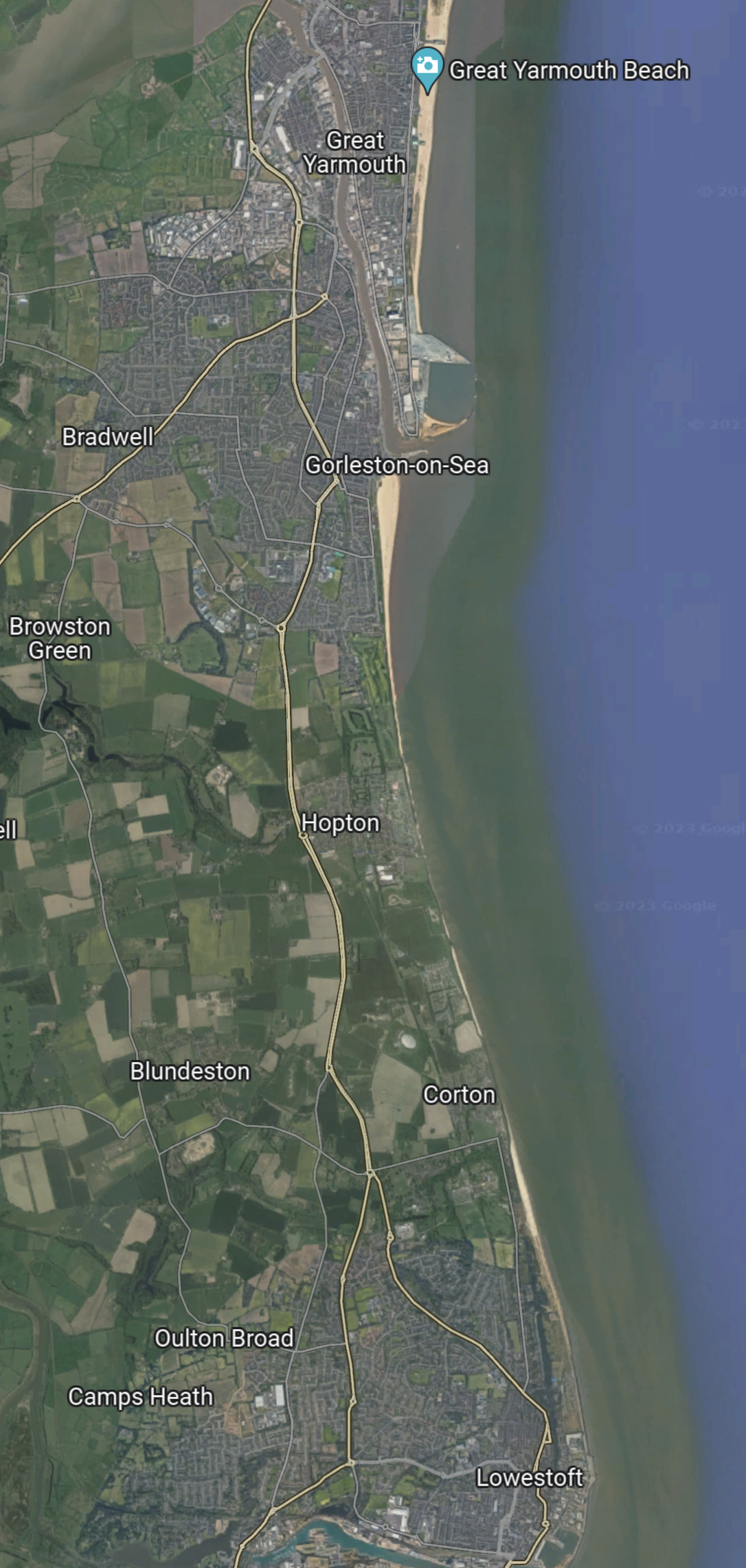
Note.
- Great Yarmouth is at the top of the map.
- Lowestoft is at the bottom of the map.
- The two towns are less than twelve miles apart.
- The Great Yarmouth Outer Harbour, is towards the top of the map.
The Google Map shows the port in more detail.
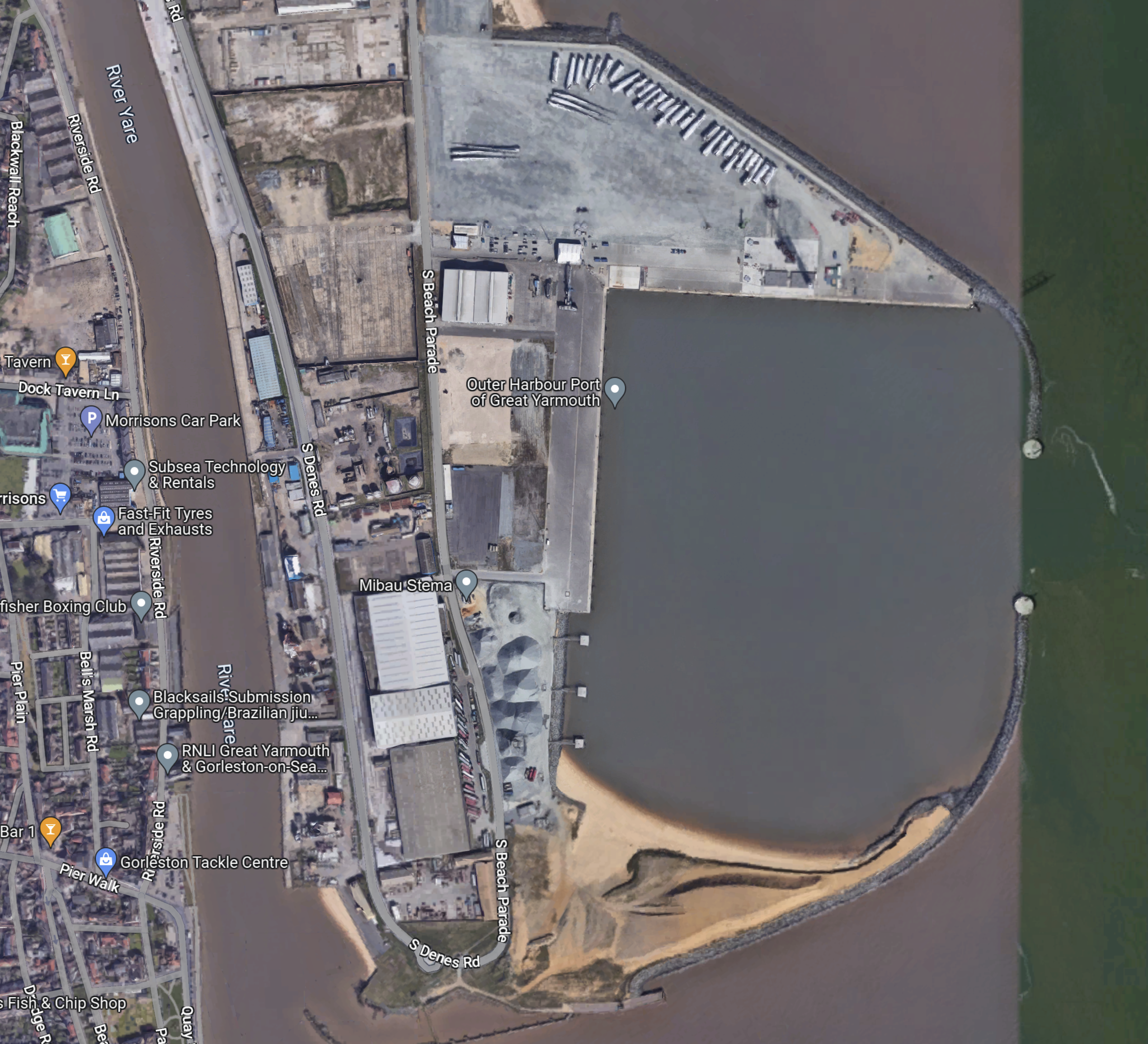
Note.
- Great Yarmouth Outer Harbour only opened in 2009.
- It has an average depth of 10 metres.
- It was planned as a container port, but the ships didn’t materialise.
- Some consider it to be a bit of a white elephant.
Could the Outer Harbour be used to assemble floating wind turbines?
I think it could but at present, there are no plans to use floating wind turbines off the coast of Norfolk.
I suspect though, if someone decided to build floating wind farms to the East of the Vattenfall’s Norfolk Zone fields, that Great Yarmouth Outer Harbour could be used to assemble the floating wind turbines.
This Google Map shows the Port of Lowestoft.
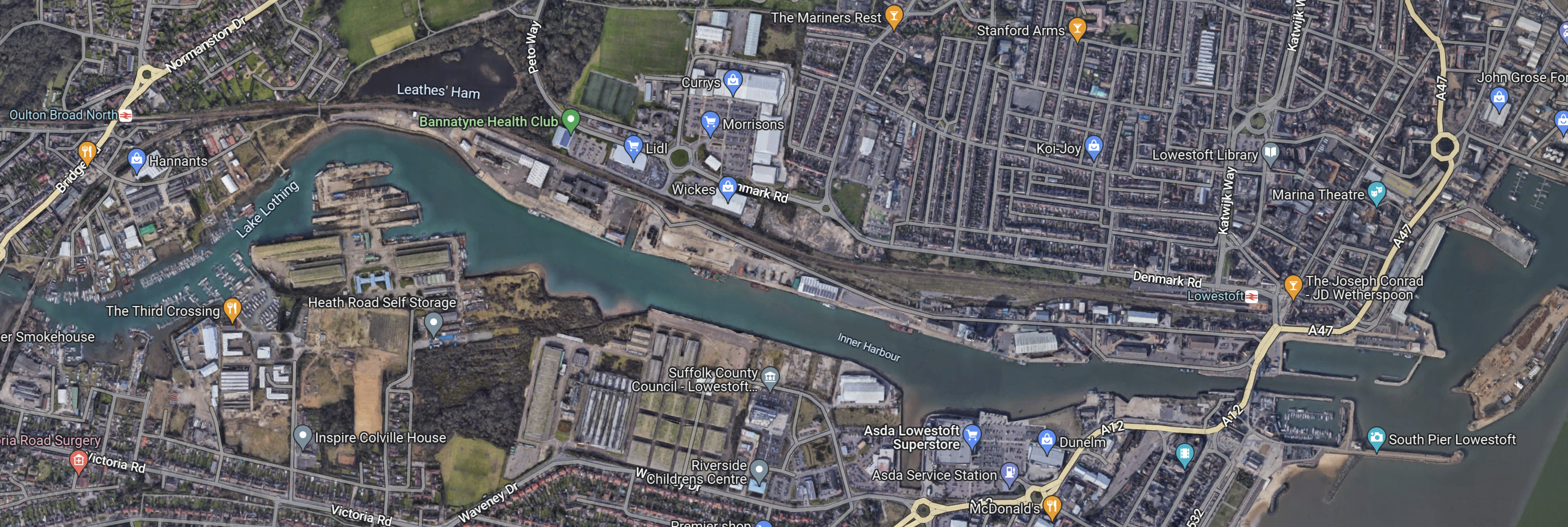
Note.
- There is over a kilometre of quays.
- It doesn’t have the water depth of Great Yarmouth.
- There is a lot of brownfield sites along the River Waveney.
- The East Anglia One wind farm is managed from Lowestoft.
Both harbours have their good and bad points.
- Both have good rail connections to Norwich.
- Lowestoft has a rail connection to Ipswich and has been promised a London service.
- Road connections to Ipswich and Norwich need improvement.
I suspect that it was a close contest, as to the port that got the Vattenfall contract.
A Lowestoft And Great Yarmouth Rail Connection
This map from Open RailwayMap between the two towns.
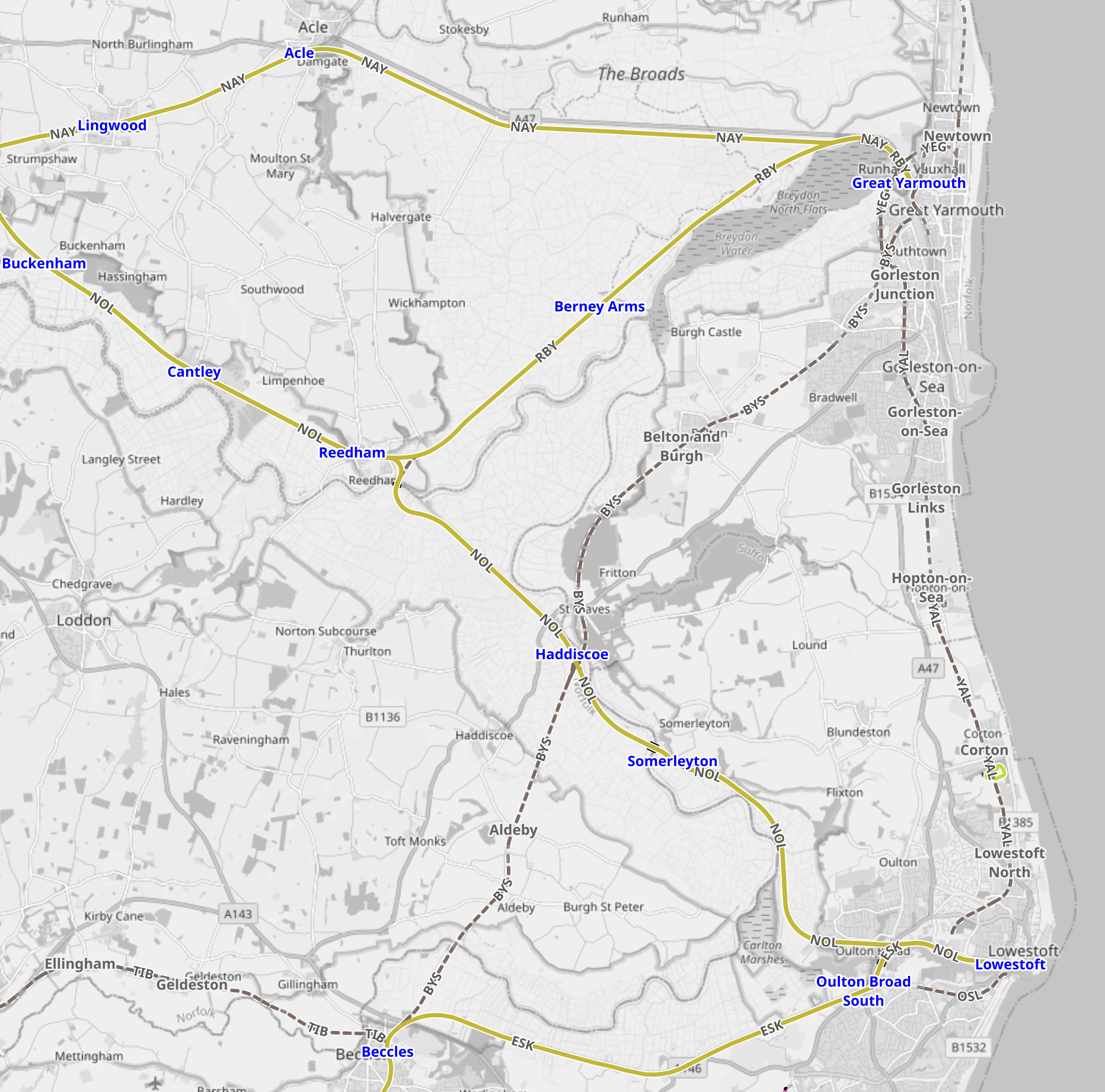
Note.
- The existing railways are shown in yellow.
- Former railways are shown in black dotted lines.
- There was even a railway along the coast.
The only rail connection between the ports is via Reedham, where the track layout is shown on this second OpenRailwayMap.
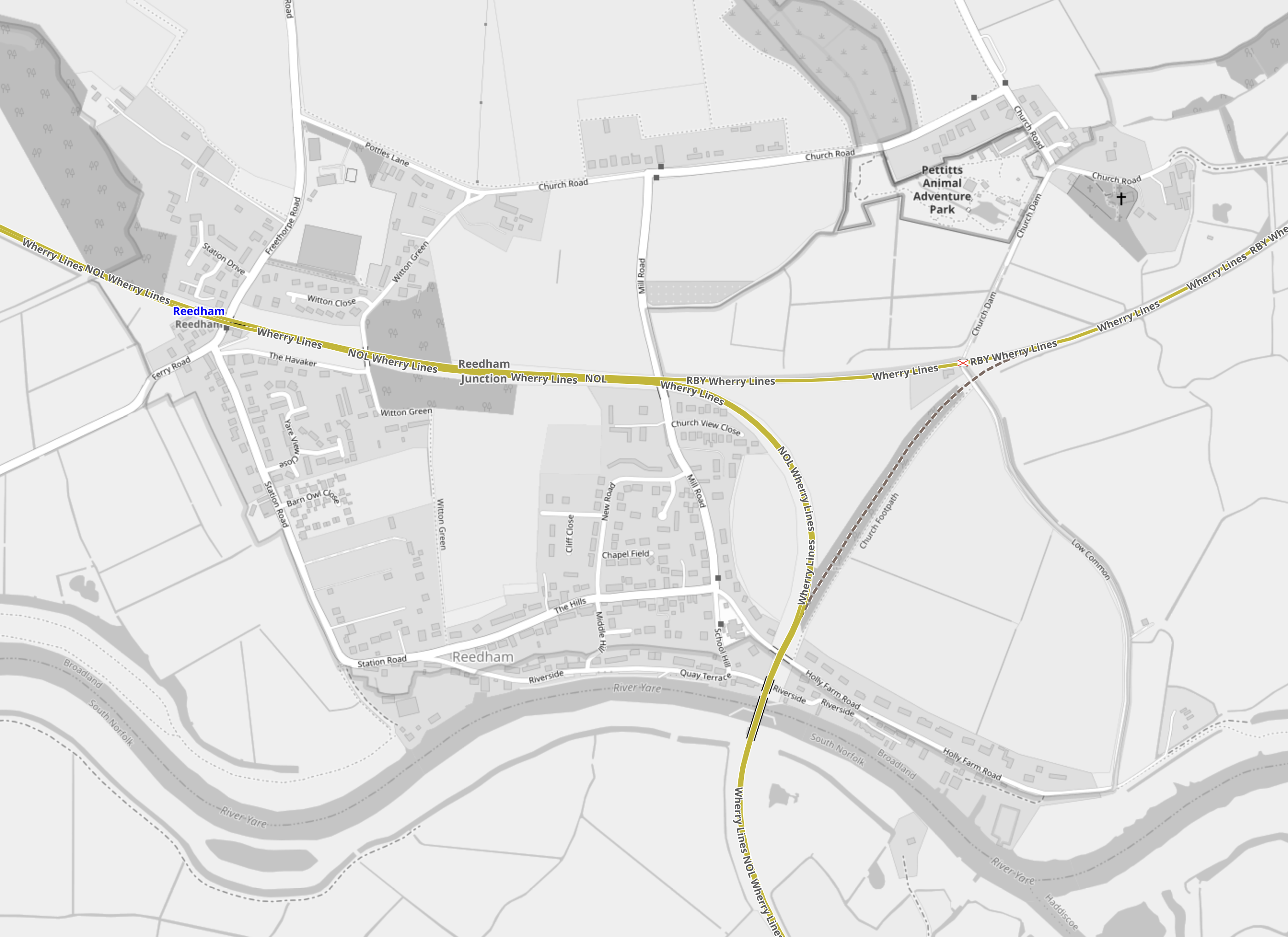
Note.
- Reedham station is in the North West corner on the line to Norwich.
- The line going North-East goes to Great Yarmouth.
- The line going South goes to Lowestoft.
There used to be a chord connecting Great Yarmouth and Lowestoft, but it was cancelled by Beeching’s grandfather.
There is certainly scope to improve the rail connection between the two ports.
- There could be a convenient change at Reedham, if the timetables were adjusted.
- Trains could reverse at Reedham.
- The chord could be reopened to allow direct trains.
It wouldn’t be the most challenging rail project to have an hourly rail service between the two ports.
A Lowestoft And London Rail Service
This was promised with a frequency of something like four trains per day (tpd)
I think it should run between London and Yarmouth with a reverse at Lowestoft.
SSE, Marubeni & CIP’s Floating Wind Farm In Scotland Could Have 270 Turbines And 6 Offshore Substations
The title of this post, is the same as that of this article on offshoreWIND.biz.
This is the sub-heading.
SSE Renewables, Marubeni and Copenhagen Infrastructure Partners (CIP) have submitted the Environmental Impact Assessment (EIA) Scoping Report for the array area of their Ossian floating wind farm to Marine Scotland. According to the report, the wind farm could have up to 270 wind turbines and six offshore substations.
Ossian floating wind farm will be one of the world’s largest floating wind farms.
- If it sticks to 3.6 GW, 270 turbines will mean 13 MW turbines.
- 14 MW would be 3.8 GW and 15 MW would be 4 GW, with the same number of turbines.
- If they stick to 3.6 GW, this could be 257 x 14 MW or 240 x 15 MW turbines.
- Knowing ambitious engineers as I do and given that 15 MW turbines are on the way, I wouldn’t be surprised to see 15 MW turbines, to get the full 4 GW.
- According to this press release from Siemens Gamesa, they can make the turbine blades for their 15 MW turbines in Hull.
These two paragraphs outline the design possibilities.
For the floating wind turbine foundations, the consortium is considering either semi-submersible or Tension Leg Platform (TLP) structures and three mooring configurations; catenary, semi taut and taut mooring lines. Anchoring options currently under consideration include driven piles, and a number of different embedded anchor types, including suction piles, Drag Embedment Anchors (DEA) and VLA, with up to nine anchors required per foundation.
Floating foundations might not only be used for the wind turbines, but also for Ossian’s offshore substations.
When I look at a project like this, I also think of the project management possibilities.
- Will the six offshore sub-stations be positioned, so that as turbines are installed, they can be commissioned and start generating electricity?
- Is there software to optimise the order of installation?
- Has a specialist project management system been written for wind farms?
If you need a program to do analyse anything like that, buy me a drink and we’ll talk about it.
It’s about time, some of the algorithms in my brain were put to use.
The article also says this.
The 3.6 GW Ossian floating wind farm is planned to be up and running before the end of the decade.
My experience tells me, that if the right philosophy is used, that estimated date could be beaten.
It’s just that it is a project with so many complexities, that a proper mathematical model of its construction would yield benefits.
UK Ports Need GBP 4 Billion Investment To Help Unleash Floating Offshore Wind Industry – Report
The title of this post, is the same as that of this article on offshoreWIND.biz.
This is the sub-heading.
A new report by the Floating Wind Offshore Wind Taskforce says up to eleven ports around the UK will need to be transformed as fast as possible into new industrial hubs to enable the roll-out of floating offshore wind at scale
This is the first paragraph.
The report contains a series of recommendations which could see 34 GW of floating wind installed in UK waters by 2040 if the country’s government takes swift and decisive action. At present Ministers have set a target of 5 GW by 2030.
What a lorra lorra lot of wind! (With apologies to Cilla!)
Welsh Government Greenlights Erebus Floating Offshore Wind Farm
The title of this post, is the same as that of this article on offshoreWIND.biz.
This is the sub-heading.
The Welsh Government has granted consent for the country’s first floating offshore wind farm located 40 kilometres off the coast of Pembrokeshire
This is the first paragraph.
Project Erebus will feature seven next-generation 14 MW turbines on floating platforms, providing enough renewable energy to power 93,000 homes.
This near 100 MW project is the first in the Celtic Sea, where there 4 GW are to be installed in the next decade.
This is another paragraph.
Future phases of the development could realise an additional 20 GW of renewable energy, according to the Government.
Wales is not going to be short of energy!
X1 Wind’s Floating Prototype Delivers First Power Offshore Canary Islands
The title of this post, is the same as that of this article on offshoreWIND.biz.
This is the sub-heading.
X1 Wind has announced that its floating offshore wind turbine prototype delivered first power to PLOCAN’s smart grid in the Canary Islands, Spain.
The article is based on this news item from X1 Wind, which is entitled X1 Wind’s X30 Floating Wind Prototype Delivers First kWh, which starts with these two paragraphs.
X1 Wind has announced today (MARCH 07) that its X30 floating wind prototype, installed in the Canary Islands, successfully produced its first kWh.
The milestone marks the world’s only floating wind platform currently installed with a TLP mooring system, which dramatically reduces the environmental footprint and improves compatibility with other sea uses. It further heralds Spain’s first floating wind prototype to export electricity via a subsea cable.
Note.
- TLP is short for tension leg platform, which is described in this Wikipedia entry.
- The TLP Wikipedia entry contains a section, which describes their use with wind turbines.
- TLPs have been in use for over forty years, with the first use in the Hutton field in the North Sea.
- TLPs work well for water depths of between 300 and 1,500 metres.
I also suspect there’s a lot of experience from the oil and gas industry around the world about how to deploy TLPs.
The X1 Wind news item also has this paragraph.
The novel X30 platform is equipped with a specially adapted V29 Vestas turbine and ABB power converter. Another key design feature, developed through the EU-backed PivotBuoy Project, combines advantages of SPM and TLP mooring systems. The proprietary SPM design enables the floater to ‘weathervane’ passively and maximise energy yields, with an electrical swivel ensuring electricity transfer without cable twisting. The TLP mooring system also dramatically reduces the seabed footprint, compared to traditional designs proposing catenary mooring lines, minimizing environmental impact while maximizing compatibility with other sea uses, in addition to its suitability to move into deeper waters.
SPM is short for single point mooring, which is described in this Wikipedia entry, where this is the first sentence.
A Single buoy mooring (SrM) (also known as single-point mooring or SPM) is a loading buoy anchored offshore, that serves as a mooring point and interconnect for tankers loading or offloading gas or liquid products. SPMs are the link between geostatic subsea manifold connections and weathervaning tankers. They are capable of handling any tonnage ship, even very large crude carriers (VLCC) where no alternative facility is available.
Note.
- The use of the weathervane in both paragraphs.
- If an SPM can handle a VLCC, it surely can handle a well-designed floating structure with a wind turbine mounted on top.
- I suspect that an SPM used for a wind turbine will be much simpler than one used to load or unload a gas or oil tanker.
As with TLPs, I also suspect there’s a lot of experience from the oil and gas industry, from around the world about how to deploy SPMs.
It looks to me, that X1 Wind have used the proven attributes of SPMs and TLPs to create a simple mooring for a wind turbine, that is designed to align itself with the wind.
X1 Wind Are Open With Their Technology
Today’s news item from X1 Wind also links to two other useful documents.
- X1 Wind Adaptation Of A Vestas V29 Turbine To Downwind Configuration
- X1 Wind Successfully Installs Floating Wind Platform In Spain
They are certainly open with their information.
The news item, also includes this video.
Thoughts
These are some thoughts.
Capacity Factor
The capacity factor of this wind turbine could be an interesting figure.
As the turbine constantly will turn to be downwind, this should maximise the amount of electricity produced over a period of time.
Tetrahedrons
The design is effectively a tetrahedron.
Alexander Graham Bell knew a lot about the properties of tetrahedrons and invented the tetrahedral kite.
This document details Bell’s involvement with tetrahedrons and says this.
Bell found the tetrahedron to have a very good strength to weight ratio.
Put more simply this means that an object is structurally very strong but at the same time very lightweight.
So X1 Wind’s design is probably extremely strong for its weight.
Large Turbines
X1 Wind’s prototype uses a wind turbine of only 225 KW.
Manufacturers are building 15 or 16 MW turbines now and talking of 20 MW in the next few years.
Given the strength of the tetrahedron, I wonder, if it will be possible to build a PivotBuoy, that is capable of hosting a 20 MW wind turbine?
Conclusion
Although it appears radical, it uses proven technology to generate power in an innovative way.
In some ways the thinking behind the design of this floating technology, is a bit like that of Issigonis in his design for the first Mini, where he took proven technology and arranged it differently to perform better.
Surveys Completed For Celtic Sea Floating Offshore Wind Projects
The title of this post, is the same as that of this article on offshoreWIND.biz.
This is the sub-heading.
N-Sea Group has finished a series of benthic and geophysical surveys for Llŷr 1 and Llŷr 2 floating offshore wind projects in the Celtic Sea.
I described the two projects in detail in Two More Floating Wind Projects In The Celtic Sea.
- At least the surveys are complete and it still appears that a commissioning date of 2026/27 is still feasible for these twin 100 MW projects.
- In the original documents, it was stated that there would be six next generation turbines in each wind farm, with a capacity of between 12 and 20 MW.
- There appears to be no decision on the floats or turbine size to be used.
I wouldn’t be surprised to see larger turbines used and the capacity of the farms increased.
Floating Foundation For 15+ MW Offshore Wind Turbines Launches
The title of this post, is the same as that of this article on offshoreWIND.biz.
This is the sub-heading.
Odfjell Oceanwind has launched the Deepsea Star™ harsh environment floating wind foundation designed to support wind turbines with a capacity of 15 MW and more.
Note.
- Odfjell Oceanwind is a Norwegian company and has this web site.
- This news item from Odfgell Oceanwind is entitled Odfjell Oceanwind Launches The Deepsea Star™ 15MW Floating Wind Foundation and was published on the 28th of February, 2023.
- The news item was the source of the iffshoreWIND.biz article.
- In the news item, one of the designers, explains some of the features.
I very much believe that ,my twenty-three-year-old self armed with ICI’s PACE 231-R would have had great fun examining the dynamic proiperties of a structure like this.
Activity Ramping Up On Irish Floating Wind Test Site
The title of this post, is the same as that of this article on offshoreWIND.biz.
This is the sub-heading.
The Sustainable Energy Authority of Ireland (SEAI) is busy with bringing forward its Atlantic Marine Energy Test Site (AMETS), a floating wind and wave energy technology test site which has been in development for several years now. Along with offshore surveys scheduled for next month, SEIA has also commenced work on procuring an onshore substation and a floating LiDAR for AMETS.
It all sounds very professional.
The Atlantic Marine Energy Test Site will be located off Annagh Head in the West of Ireland. This Google Map shows the location of Annagh Head on the island of Ireland.

I do have a imperfect memory of a weekend of good hospitality and gourmet food at a hotel called the Cashel House Hotel to the West of Galway, but I can’t remember how C and I flew there. Did we fly to Knock or Shannon either using a scheduled airline or my Cessna 340 A?
All I can remember of the holiday, was that it was very windy at times and driving through Westport. So did we explore towards Annagh Head?
This Google Map shows a close-up of Annagh Head.
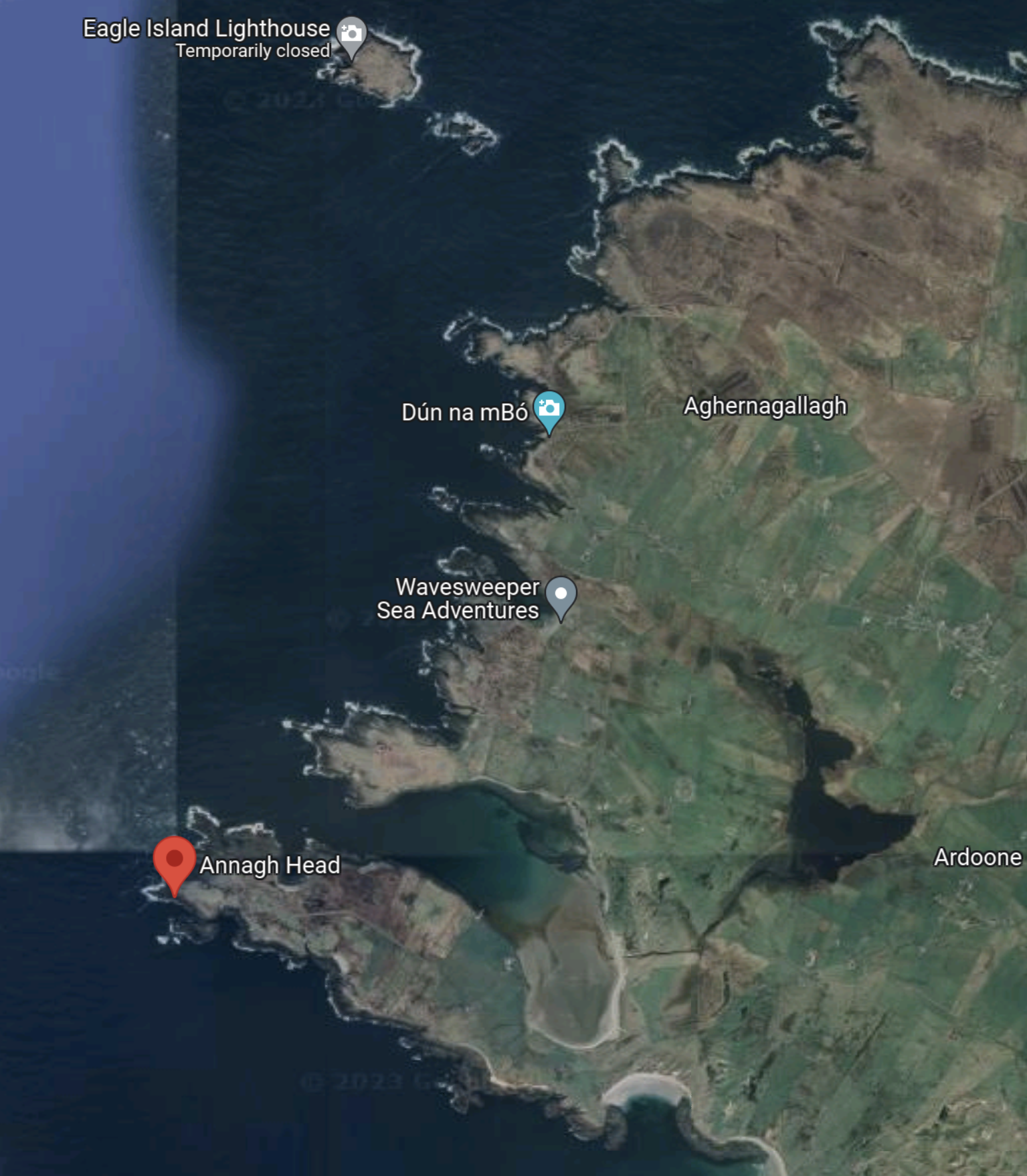
I suspect that Annagh Head is an ideal location to test floating wind and wave power.
There will also be good hospitality and airlinks to the UK and Europe.
In So Many Floating Wind Designs, So Few Test Sites – Norwegian METCentre Sold Out, I wrote about the shortage of test sites for wind power.
So perhaps, AMETS will help to fill the gap?
In
Wales’ First Floating Offshore Wind Farm Gets Marine License
The title of this post, is the same as that of this article on offshoreWIND.biz.
This is the sub-heading.
Blue Gem Wind, a joint venture between TotalEnergies and Simply Blue Group, has secured a marine license for the 100 MW Erebus floating offshore wind project in Wales.
These are some other points from the article.
- The project will use seven next-generation 14 MW turbines.
- They will be mounted on WindFloats, which are a proven technology.
- The wind farm will provide enough renewable energy to power 93,000 homes.
- It is aimed that the project will be commissioned in 2026.
The project has a web site, which is in English and Welsh. The home page has a good visualisation of three wind turbines on their WindFloats. Underneath is this mission statement.
Independent studies have suggested there could be as much as 50GW of electricity capacity available in the Celtic Sea waters of the UK and Ireland. This renewable energy resource could play a key role in the UK meeting the 2050 Net-Zero target required to mitigate climate change. Erebus, the first floating offshore wind project in the Celtic Sea will provide new low carbon supply chain opportunities, support coastal communities and create long-term benefits for the region.
Wales will be powered by sea dragons!
 The Anonymous Widower