Floating Foundation For 15+ MW Offshore Wind Turbines Launches
The title of this post, is the same as that of this article on offshoreWIND.biz.
This is the sub-heading.
Odfjell Oceanwind has launched the Deepsea Star™ harsh environment floating wind foundation designed to support wind turbines with a capacity of 15 MW and more.
Note.
- Odfjell Oceanwind is a Norwegian company and has this web site.
- This news item from Odfgell Oceanwind is entitled Odfjell Oceanwind Launches The Deepsea Star™ 15MW Floating Wind Foundation and was published on the 28th of February, 2023.
- The news item was the source of the iffshoreWIND.biz article.
- In the news item, one of the designers, explains some of the features.
I very much believe that ,my twenty-three-year-old self armed with ICI’s PACE 231-R would have had great fun examining the dynamic proiperties of a structure like this.
Activity Ramping Up On Irish Floating Wind Test Site
The title of this post, is the same as that of this article on offshoreWIND.biz.
This is the sub-heading.
The Sustainable Energy Authority of Ireland (SEAI) is busy with bringing forward its Atlantic Marine Energy Test Site (AMETS), a floating wind and wave energy technology test site which has been in development for several years now. Along with offshore surveys scheduled for next month, SEIA has also commenced work on procuring an onshore substation and a floating LiDAR for AMETS.
It all sounds very professional.
The Atlantic Marine Energy Test Site will be located off Annagh Head in the West of Ireland. This Google Map shows the location of Annagh Head on the island of Ireland.

I do have a imperfect memory of a weekend of good hospitality and gourmet food at a hotel called the Cashel House Hotel to the West of Galway, but I can’t remember how C and I flew there. Did we fly to Knock or Shannon either using a scheduled airline or my Cessna 340 A?
All I can remember of the holiday, was that it was very windy at times and driving through Westport. So did we explore towards Annagh Head?
This Google Map shows a close-up of Annagh Head.
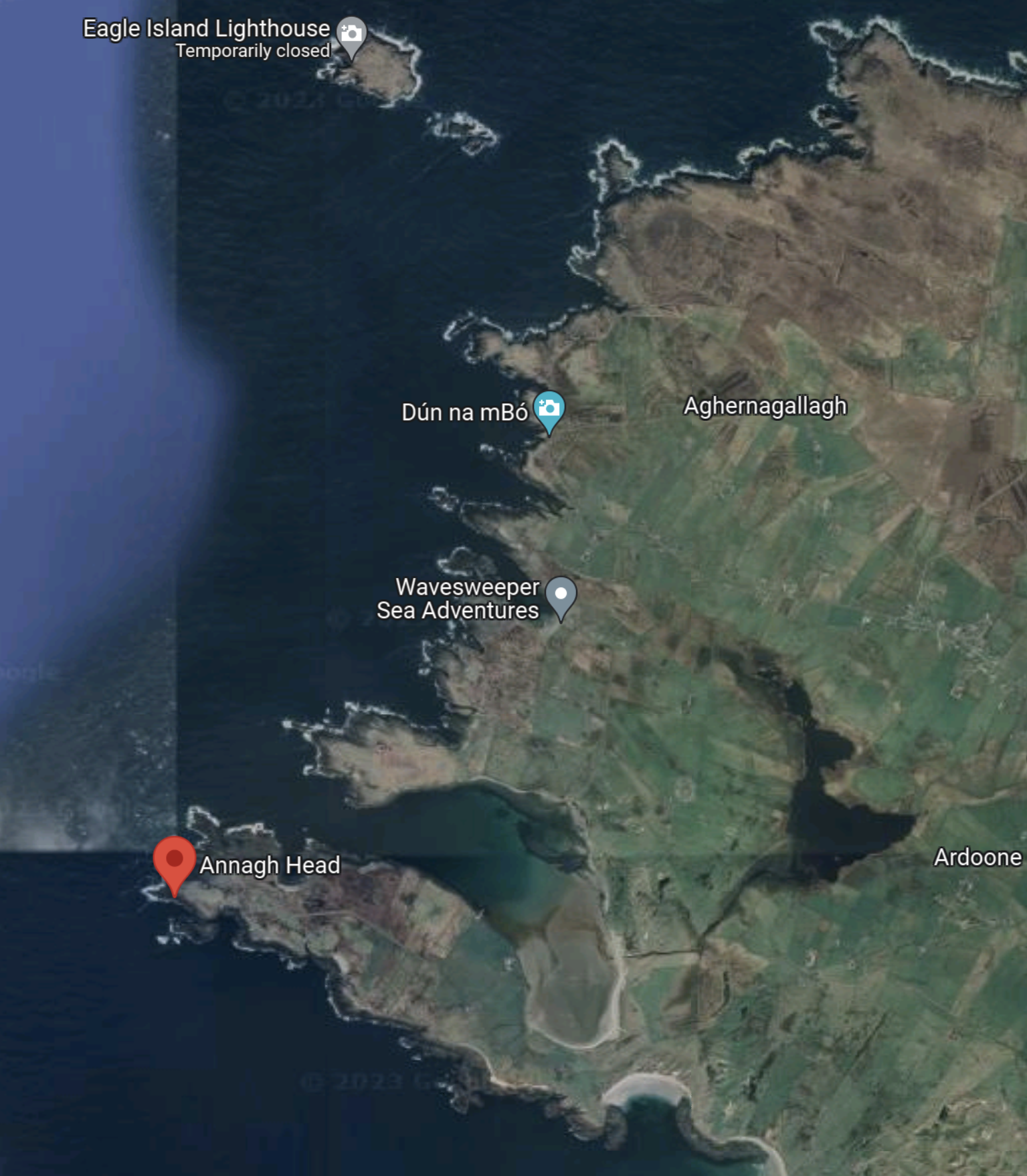
I suspect that Annagh Head is an ideal location to test floating wind and wave power.
There will also be good hospitality and airlinks to the UK and Europe.
In So Many Floating Wind Designs, So Few Test Sites – Norwegian METCentre Sold Out, I wrote about the shortage of test sites for wind power.
So perhaps, AMETS will help to fill the gap?
In
Wales’ First Floating Offshore Wind Farm Gets Marine License
The title of this post, is the same as that of this article on offshoreWIND.biz.
This is the sub-heading.
Blue Gem Wind, a joint venture between TotalEnergies and Simply Blue Group, has secured a marine license for the 100 MW Erebus floating offshore wind project in Wales.
These are some other points from the article.
- The project will use seven next-generation 14 MW turbines.
- They will be mounted on WindFloats, which are a proven technology.
- The wind farm will provide enough renewable energy to power 93,000 homes.
- It is aimed that the project will be commissioned in 2026.
The project has a web site, which is in English and Welsh. The home page has a good visualisation of three wind turbines on their WindFloats. Underneath is this mission statement.
Independent studies have suggested there could be as much as 50GW of electricity capacity available in the Celtic Sea waters of the UK and Ireland. This renewable energy resource could play a key role in the UK meeting the 2050 Net-Zero target required to mitigate climate change. Erebus, the first floating offshore wind project in the Celtic Sea will provide new low carbon supply chain opportunities, support coastal communities and create long-term benefits for the region.
Wales will be powered by sea dragons!
Floating Offshore Wind Could Reach Full Commercialisation By 2035, Research Says
The title of this post, is the same as that of this article on offshoreWIND.biz.
This is the sub-heading.
Floating offshore wind could reach full commercialisation by 2035, said 60 per cent of respondents in the latest research that was done by DNV, with 25 per cent believing it will be as early as 2030.
I’ll go along with that, but as a serial disruptive innovator, I believe full commercialisation could be earlier than 2027.
It will be for these reasons.
Capacity Factor
There is reason to believe from the figures from existing floating wind turbines, that the capacity factor is very good and could be higher than those of turbines with fixed foundations.
Wikipedia says this about the world’s first commercial floating offshore windfarm; Hywind Scotland.
In its first 5 years of operation it averaged a capacity factor of 54%, sometimes in 10 meter waves.
If other floating technologies show as good capacities as this, then the technology may well find it easier to attract finance.
Design
We have only seen a couple of designs deployed; Hywind and WindFloat.
There will be plenty more to come.
This visualisation shows five D-Floaters being transported on a ship.
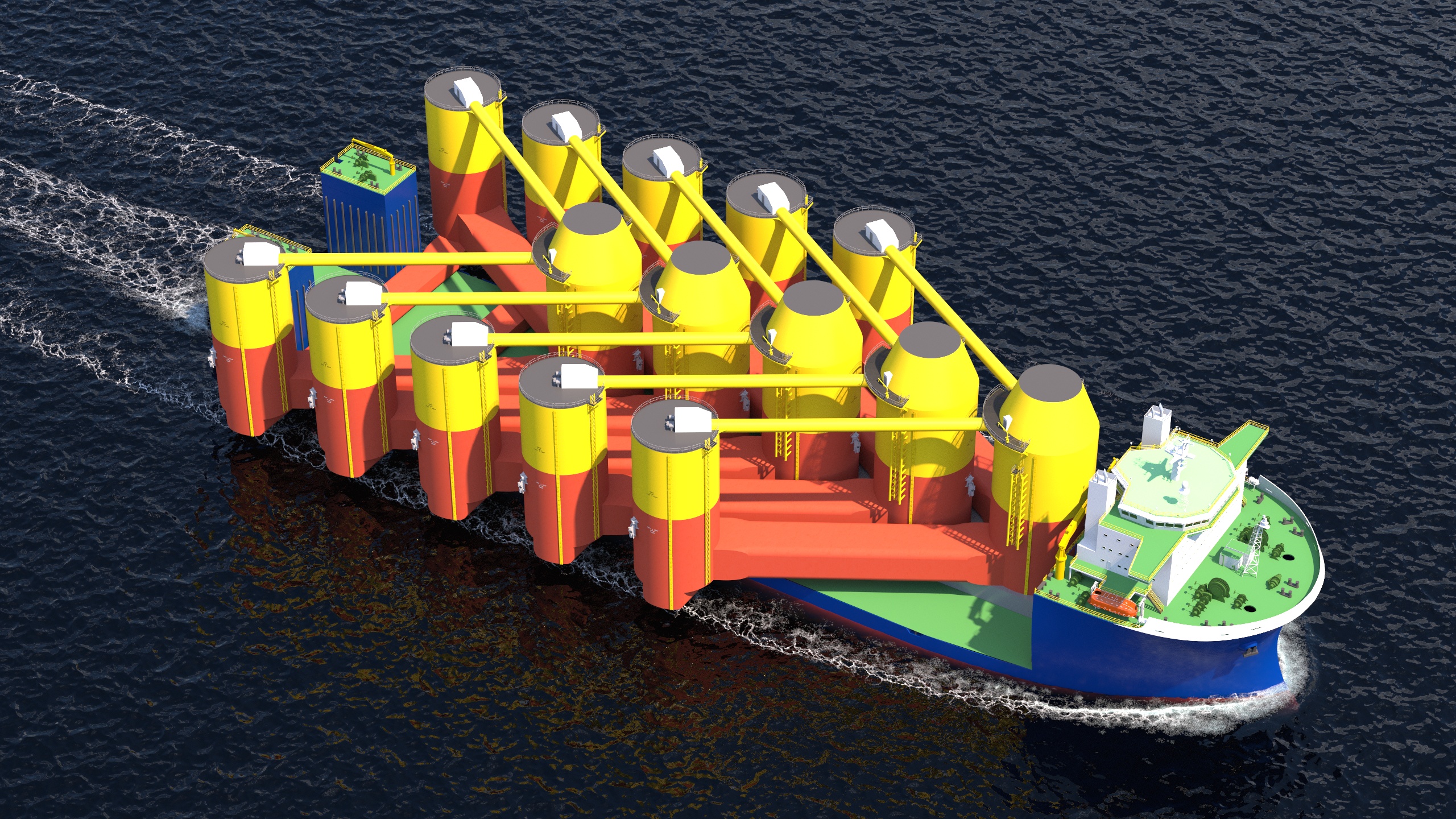
Note.
- D-Floaters are being developed by Bassoe Technology.
- As many floats will be manufactured, a long way from their final mooring, why not make them easy to transport.
- Other companies are developing floats that can be bolted or welded together from standard components.
I wouldn’t be surprised if one design came to dominate the market.
This might be a good thing, as it would surely speed up deployment of floating wind farms.
Construction And Installation
This video shows the construction and installation if Principle Power‘s, Windfloat prototype.
Note.
- All the construction and assembly is done in a dock with a suitable crane.
- This is much easier than doing it the assembly out at sea, as has to be done with turbines with fixed foundations.
- I suspect that with the best design of float and turbine, high rates of turbine assembly can be achieved.
- Health and Safety will prefer this type of assembly.
I suspect other floating wind turbines will be similarly assembled.
Suppose you were assembling 15 MW floating turbines at a rate of one per day, that would be a production rate of over 5 GW of turbines per year from just one dock.
Early Delivery Of Power
I suspect that to build a floating wind farm, one of the first things to be towed out would be the substation to which all the turbines will be connected.
- This could even be floating.
- I’ve seen floating sub station designs, that incorporate energy storage and hydrogen production.
Once the substation is fully-installed and tested, floating turbines could be towed out, anchored, connected to the substation and immediately start to produce electricity.
I have built a lot of cash-flow models in my time and I believe that one for say a 2 GW floating wind farm would be very friendly to proposers, investors and operators.
There’s A Lot Of Sea Out There!
And after nearly sixty years of offshore semi-submersible platforms in UK water, we now how to work in the conditions.
In ScotWind Offshore Wind Leasing Delivers Major Boost To Scotland’s Net Zero Aspirations, I said this, about the total capacity, that will be developed under the ScotWind leasing round.
- Adding up these fixed foundation wind farms gives a capacity of 9.7 GW in 3042 km² or about 3.2 MW per km².
- Adding up the floating wind farms gives a capacity of 14.6 GW in 4193 km² or about 3.5 MW per km².
Note.
- You appear to get ten percent more capacity in a given area of sea with floating wind farms.
- The energy density of floating wind farms is 3.5 MW per km².
I suspect investors will prefer the floating wind farms.
Lower Visibility
Floating wind farms will generally be further out to sea and less likely to be objected to, than installations nearer to land.
Maintenance And Updating
Floating wind farms can be towed into port for servicing and updating, which must ease the process.
Project Management
I believe that floating wind farms, are projects, that would benefit highly from good project management.
Sometimes, I wish I was still writing project management software and I am always open to offers to give my opinion and test anybody’s software in that area!
Finance
I can see that floating wind farms could offer better cash flows to investors and this will make them invest in floating wind farms at the expense of those with fixed foundations.
Conclusion
For all these reasons, but with my instinct telling me that floating wind farms could offer a better return to investors, I wouldn’t be surprised if floating wind farms came to dominate the market.
Green Volt On Track To Power UK Oil & Gas Platforms By Mid-2020s
The title of this post, is the same as that of this article on offshoreWIND.biz.
This is the sub-heading.
Flotation Energy and Vårgrønn have submitted a Marine Licence application for the Green Volt floating offshore wind farm.
These two paragraphs outline the project.
This consent application could allow the project to start generating power in the mid-2020s, making it the most advanced oil and gas decarbonisation project in the UK, the developers said.
Flotation Energy and Vårgrønn are applying for a lease for Green Volt under the Crown Estate Scotland’s Innovation and Targeted Oil and Gas (INTOG) round.
Green Volt wind farm already has a web site, which gives these details of the wind farm.
- It will be 50 miles off Peterhead.
- 300-500 MW
- Operational in 2027.
The offshoreWIND.biz article also says that the project has the potential to generate enough green power to electrify all major oil and gas platforms in the Outer Moray Firth area.
I can’t wait for the successful INTOG bids to be announced in April.
Engineers are creating exciting times.
Scotland And Brittany Discuss Partnership On Floating Wind Turbines
The title of this post, is the same as that of this article on offshoreWIND.biz.
This is the sub-heading.
A delegation of fifteen Scottish companies met in Rennes, France, with companies from the Brittany offshore wind and marine energy sector to discuss the development of partnerships around floating wind turbines.
I can see more partnerships like this.
Multi-Turbine Windcatcher Secures More Funding
The title of this post, is the same as that of this article on offshoreWIND.biz.
This is the sub-heading.
Norway’s Wind Catching Systems AS, the developer of the Windcatcher floating offshore wind technology, has secured a pre-project grant of NOK 9.3 million (USD 0.9 Million) from ENOVA.
The Windcatcher certainly looks impressive on the home page of the Wind Catching Systems AS web site.
This image is of the over-station development at Moorgate station.
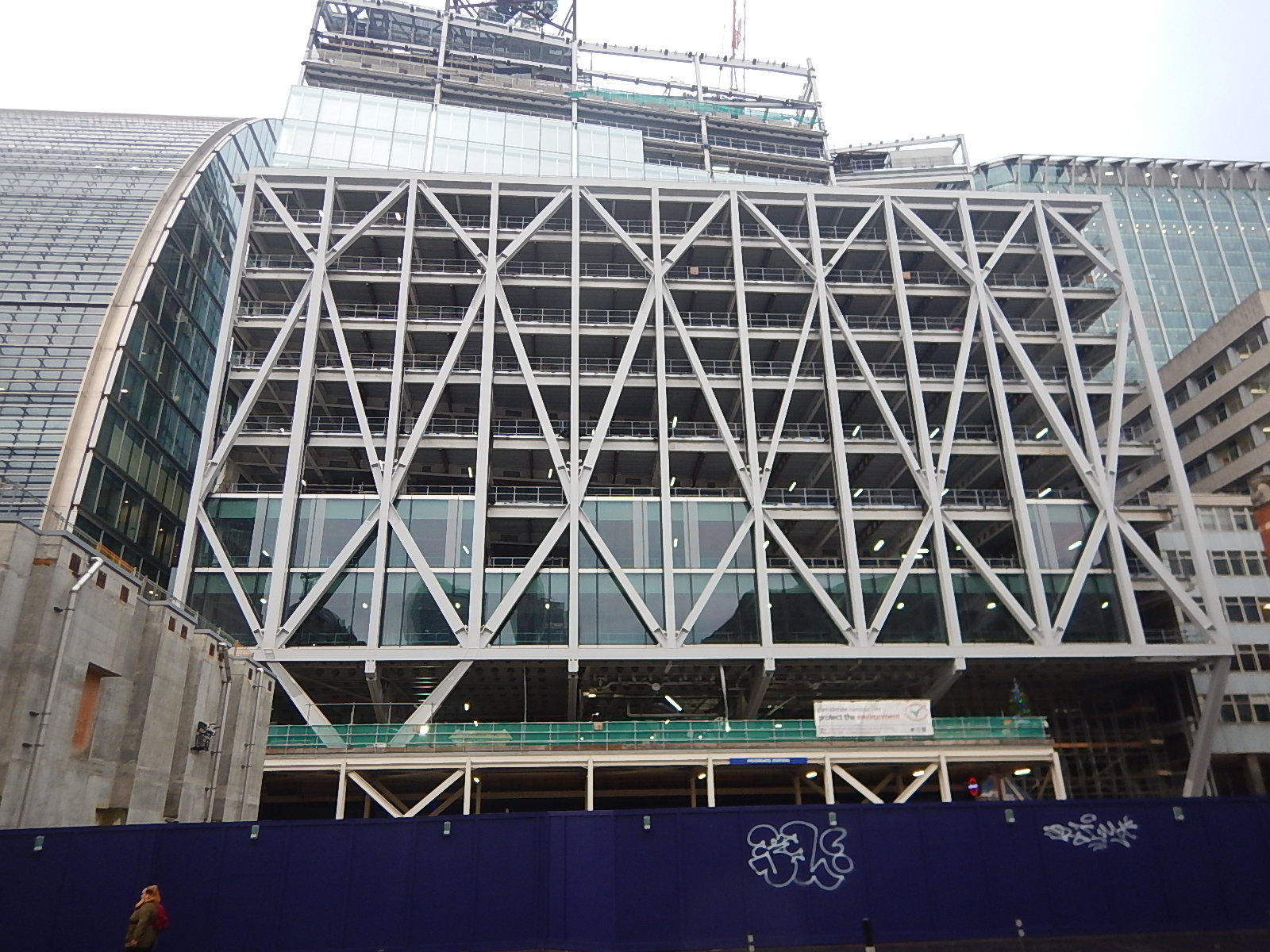
If this structure is strong enough to hold up an eight floor building, surely a system can be designed to hold up a number of small wind turbines.
But will it work well in practice or is it just something that looks good in a visualisation?
Note that aerodynamics and fluid flow are difficult subjects to model on a computer, as I say from experience of getting nowhere, when I tried to mathematically model a plastic extruder at ICI in the early 1970s.
But I did successfully invest in two guys, who went on to develop the Respimat inhaler for Boehringer Ingelheim.
So I have had mixed success in dealing with these tricky subjects.
When I look at the Windcatcher, I think there’s a fifty-percent chance, that it will be a success and a lot depends on the investors.
I do wish the company well and I feel it in my bones, that a couple of weird turbine designs will be runaway successes.
So Many Floating Wind Designs, So Few Test Sites – Norwegian METCentre Sold Out
The title of this post, is the same as that of this article on offshoreWIND.biz.
This is the sub-heading.
There are currently more than 80 floating wind technology concepts and designs worldwide, and testing even a certain number of these could prove to be an endeavour since there are not many test sites dedicated to floating wind technology in Europe.
It strikes me that we need more test centres.
As UK waters will in the next couple of decades be home to a lot more GW of wind farms, perhaps we should develop a test centre.
I wonder, if South Wales would be the place for a test centre.
- There is a lot of sea, which isn’t cluttered with oil and gas rigs, and wind farms.
- There are a lot of wind farms planned in the area.
- There are at least two good technology universities.
- There are some deep water ports.
- Electricity connections and power generation are good.
- There is good train connections to the rest of England and Wales.
- A train testing centre is being built at Nant Helen. Some tests needed to be done could be the same.
Some innovative designs for wind turbines are also being developed in South Wales.
An Elegant Solution
There’s an old English expression about couples lying in bed like spoons.
I wonder, if this analogy is used in other languages like Swedish.
Swedish company; Bassoe Technology have certainly used the stacking technique of spoons or bodies in the design of their innovative wind-turbine floats, which they call D-Floaters.
This visualisation shows five D-floaters being transported on a ship.
Note.
- The D-Floaters do look strong and sturdy.
- There are several competing floats for wind turbines based on triangles.
- There is probably an optimal cost between transporter ships and D-Floaters.
Given that these structures may be moved thousands of miles before installation, this method of transportation must be economic.
The loaded ship does remind me of one of the bath toys my kids had in the 1970s.
MPS Floating Platform To Feature FibreMax Tendons
The title of this post, is the same as that of this article on offshoreWIND.biz.
This is the sub-heading.
Welsh company Marine Power Systems (MPS) has joined forces with FibreMax to provide integrated floating foundation and tendon solutions to the growing floating offshore wind sector.
And these three paragraphs outline the design.
The tendon solution will be used in the anchoring and moorings of MPS’ tension leg platform (TLP), called PelaFlex, to deliver the highest system stability and zero tilt, the partners said.
It will be the “world’s first” TLP with FibreMax tendons, made with Twaron fiber from Japan-headquartered Teijin.
Compared to traditional steel moorings synthetic cable offers a much better strength-to-weight ratio, longer operational life, and lower levels of maintenance, according to the partners.
Note.
- PelaFlex tension leg platforms are used in the project I wrote about in Simply Blue Group And Marine Power Systems To Pursue INTOG Innovation Project Opportunity.
- Wikipedia is a good source of information on tension leg platforms, where there is a large section on how they could be used for wind turbines.
- Twaron has an informative product page.
- There is more about PelaFlex on the PelaFlex web page including a video.
- The press release for the joint Simply Blue/MPS project talks of six turbines totalling up to 100 MW, which is probably around 17 MW per wind turbine.
It looks to me, that the PelaFlex design is getting better by the simple process of adding lightness and therefore being able to have a higher energy density in a deep area of the sea.
The amount of innovation involved probably makes PelaFlex an ideal component for the upcoming INTOG leasing round.
 The Anonymous Widower