China To The UK By Freight Train
This article in the Railway Gazette is entitled First China to UK rail freight service arrives in London.
The article describes in detail how 34 containers came all the way to Barking by train.
It is very much a route-proving exercise at the moment and the UK shipment was effectively part of a larger shipment that was split at Duisburg
in Germany.
The trip can be summarised as follows.
- The trip took seventeen days, which was faster than container ship.
- The trip is slower, but a lot cheaper than air-freight.
- The trip is 12,000 kilometres.
- There were two changes to gauge and transshipment of the containers on the route.
It is intended to run the trains for three or four months to assess demand.
The article finishes like this.
The project supports the Chinese government’s One Belt, One Road trade connectivity initiative to create a modern-day Silk Road. According to DB around 40 000 containers were transported by rail along the routes between China and Europe in 2016, with journey times of between 12 and 16 days. Annual traffic is expected to increase to 100 000 containers by 2020.
If these figures are achieved, it certainly looks like the route could be approaching viability.
In How To Move 100,000 Containers A Year Between Germany And China, I wrote about German plans to create a standard gauge railway from Germany to China via Georgia, that would avoid Russia and all the gauge-changing.
Without the gauge-change, this would surely be a faster route, thus increasingly viability.
There’s going to be an interestimg commercial battle in the next bfew years between the various metods of getting freight between Europe and China.
|Aberthaw Resumes Cement Dispatch
This is the title of another article in the January 2017 Edition of Modern Railways.
I wasn’t sure where Aberthaw was, so I looked it up on the Internet and this Google Map shows Aberthaw Cement Works, Cardiff International Airport and the Vale of Glamorgan Railway, that links Cardiff Central station in the East to Bridgend in the West.
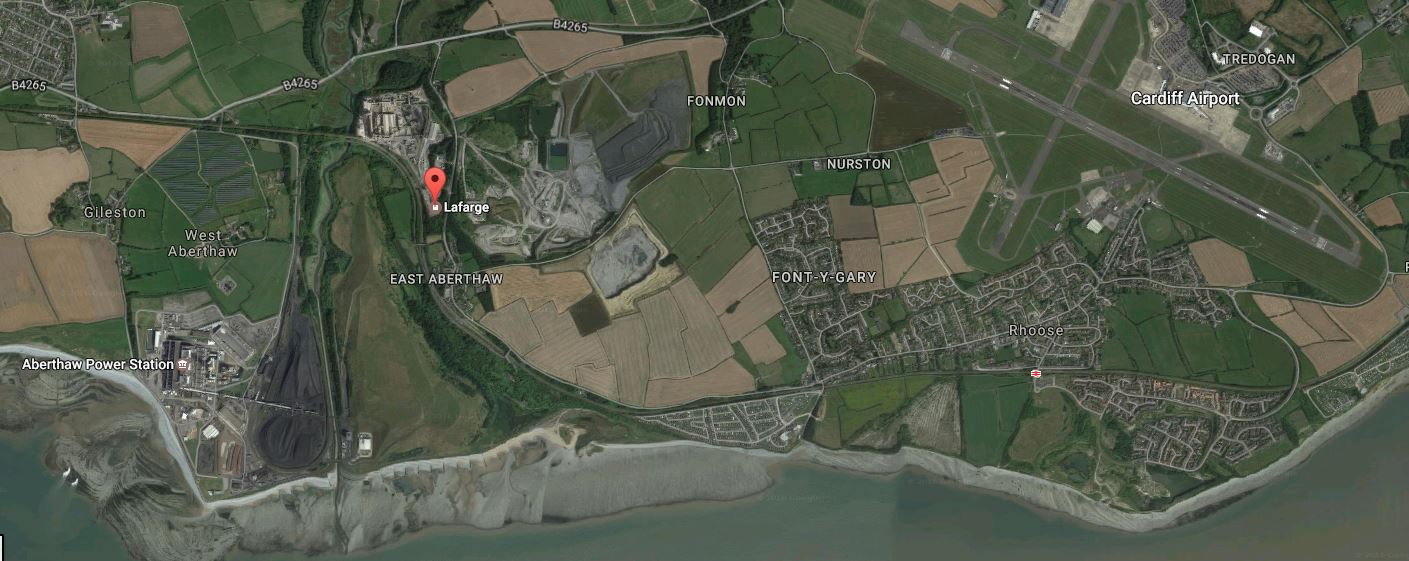
Note.
- The red arrow indicates the cement works.
- The Airport terminal is on the North side of the long runway,.
- Rhoose Cardiff International Airport railway station is on the other side of the runway and connected to the Airport by a sguttle bus.
- The line was closed by Beeching to passenger traffic in 1964, but was reopened in 2005.
Could Cardiff Airport benefit from the same sort of train-train link, that has been proposed for Glasgow that I wrote about in The Glasgow Airport Rail Link Will Be A Tram-Train?
But the map does illustrate the benefit of rail access to the cement works.
- The works is close the Vale of Glamorgan Line.
- Trains from the cement works can go East to places that need the product, including surprisingly, the South West of England.
- The rail link could cut the number of truck movements by 25%.
This would seem to be an ideal use for rail freight.
Are we doing enough to develop similar links, from other large factories all over the UK?
As the line is supposed to be electrified in a few years, could it be that a proper review of the line should be done first, to see whether any other projects should be done at the same time.
The reason I say this, is that the history of the line is much the same as that of the Grand Old Duke of York and his soldiers.
Curious Rail Construction At Ipswich Station
I came into Ipswich station today on a train from Lowestoft and took these pictures before I got on a train to London.






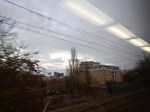

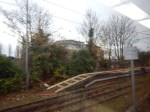

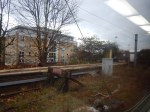
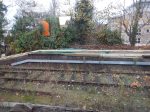
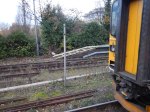
They would appear to show the following.
- An electrified line has been created to the North of Ipswich Yard between the Felixstowe Branch Line and Ipswich station.
- Some construction on the far side of the siding that lies next to the platform used for Lowestoft and Felixstowe trains.
Could the construction, be tye start of work for a dedicated platform for the Felixstowe Branch?
Consider the following about traffic on the Felixstowe Branch Line.
- According to this article in Rail Magazine, there are now twenty-three daily freight trains out of Felixstowe.
- The freight trains are getting longer and I have seen trains hauled by a pair of Class 66 locomotives.
- Passenger trains are a single-car Class 153 train every hour.
- The Class 153 train takes twenty-six minutes.
- The line is around fifteen miles of unelectrified line.
- The Freightliner motive power depot is going to be moved from Ipswich to Felkixstowe.
- The December 2016 Edition of Modern Railways is saying that a 1.4 km loop will be built on the branch and six level crossings will be closed.
Despite the last two points, the single track branch line must be very much full.
There are also issues with the Class 153 trains at Ipswich.
- Do they sometimes find it difficult to get through all the freight trains to the bay platform at Ipswich?
- Sometimes, they use the end of the main platform 2, but as the Flirts will be longer, this won’t be possible when the new trains arrive.
- Various reports have said that two bay platforms are needed; one for Felixstowe services and one for Lowestoft services.
We don’t know their actual plans, but Greater Anglia would probably love to put a modern electric train on the Ipswich-Felixstowe route.
Electrification of the Felixstowe Branch is not even likely.
- Electrification of the Felixstowe Branch without wiring all the way to Nuneaton would probably not be good value for money.
- Where would Freightliner get all the electric locomotives?
- The Port of Felixstowe isn’t wired and might not want wires all over the place with cranes everywhere!
- The Gospel Oak to Barking Line will be electrified and what effects will this have?
The only bright spot on the horizon is Greater Anglia’s new Flirts, which could release fifteen well-maintained and reliable Class 90 locomotives.
A modern two-coach train, even if it was a diesel, would have benefits.
- It would be faster and thus scheduling the crowded route could be easier.
- It might attract more passengers to the line, especially, if there was space for bicycles and buggies.
- It should be more reliable.
But I suspect Greater Anglia would want an electric train with all the trimmings.
So am I right, that a new electrified line has been created into the station in a place where a new platform can be created?
- I might be wrong and it could have been there for years to enable the movements of electric locomotives, without blocking the main line.
- But there are certainly modern style gantries and supports for the overhead wires.
- The existing bay platform 1 is wired. Why? No current or possible electric services could use the platform.
But something is certainly happening.
- Is it a new platform or just tidying up?
- Is it a walkway to enable train drivers to get to locomotives in Ipswich Yard?
- Is it a short platform to take up to a two-car train?
There is one other possibility, that fits with my observations at Maidenhead and the Marlow Branch, that I wrote about in Bourne End Station And Improving The Marlow Branch Line.
At Maidenhead, I came to the conclusion, that electric trains (Class 387s?) with on-board energy storage were going to be used on the Marlow Branch to Bourne End, with a diesel shuttle between Bourne End and Marlow.
Is the current Platform 1 at Ipswich, which could probably accommodate a five-car Aventra going to be used in the same way?
Consider how an electric train with on-board energy storage, would work the Ipswich-Felixstowe service.
- I’ll assume that a fully-charged train starts from the new depot at Manningtree or some othe suitable overnight stabling.
- The train positions early in the morning for the first service from Felixstowe, using overhead power to Ipswich and on-board power on the branch.
- Passengers load at Felixstowe and the train proceeds to Ipswich under on-board power to the current Platform 1 at Ipswich.
- The train would sneak into the platform on the North side of Ipswich Yard, well out of the way of the Great Eastern Main Line and any freight movements.
- If the platform was busy and the train had to wait at a signal, it could even up pantograph to start the recharging of the on-board storage.
- Once in Platform 1, the train would either start or continue the charging process.
- The pantograph would be lowered, when the charging was complete or the train was approaching the limit of the overhead wiring on its way out to Felixstowe.
The process would continue all day.
But Aventras will be a clever train. This is a snippet from an article in the Derby Telegraph.
Unlike today’s commuter trains, Aventra can shut down fully at night and can be “woken up” by remote control before the driver arrives for the first shift.
So could we see a train parked at Felixstowe overnight, ready for the driver to get into a nice warm train?
I used to live round the corner from Felixstowe station and as the train would be in full view of the Police Station opposite and electrifically dead, I doubt there would be any security problem.
A five-car Aventra parked overnight with an appropriate all-over paint scheme might even encourage new passengers to give it a try.
Obviously, the suitable Aventra doesn’t exist yet, but putting in a new short platform 0 at Ipswich station, that can accept a three-car train, would mean.
- Platform 2 would no longer be needed for terminating trains at Ipswich.
- Twelve-car Flirts could work the London-Norwich services, without terminating services interfering.
- Felixstowe and Lowestoft services would have a short platform 0 and a longer platform 1, to use appropriately.
- The infrastructure would be ready for the Aventra with on-board storage.
But surely the biggest advantage is that a second bay platform would probably be to make it possible to schedule all trains such that if passengers were changing between the various lines to Bury St. Edmunds, Cambridge, Felixstowe, London, Lowestoft and Norwich, it was a convenient process of less than ten minutes.
Whether an Aventra with on-board storage will ever appear on this route is unknown at present, but there could be other advantages to running such a train on the Felixstowe Branch.
- Electrification of the branch can be kicked into some very long grass or buried at sea.
- The branch gets a massive increase in passenger capacity, without losing any paths for freight trains.
- The extra capacity with plenty of space for bicycles and buggies.
- Greater Anglia get a line for training drivers to use on-board storage.
- Bombardier get a demonstration of a train with on-board energy storage.
It could be a win for all parties.
Liverpool2 On The One Show
Liverpool2 is the Port of Liverpool’s new extension to handle the largest container ships.
They were reporting from it today on BBC’s One Show, as it will official open tomorrow.
- It can handle two of the largest container ships at the same time.
- It can handle 95% of the global container fleet.
- The Canada Dock branch is being upgraded, so it can handle 48 trains per day.
Depending what you read, Peel Ports are investing up to £750million in upgrading their port of Liverpool and the Manchester Ship Canal.
This article in the Liverpool Echo is entitled Liverpool port’s Panama deal could boost transatlantic trade from city.
This is said.
Bosses at the Port of Liverpool have signed a deal with the Panama Canal’s owners they say could create jobs and help boost trade across the Atlantic.
Peel Ports has signed an agreement with the Panama Canal Authority, which runs the vital waterway that connects the Atlantic and Pacific oceans.
The Memorandum of Understanding aims to grow trade links between Liverpool and the west coast of America via the Panama Canal.
So will that bottle of Chilean wine have arrived in the UK, via the Panama Canal and Liverpool?
I remember reading somewhere or I might have been told by someone in the University, that if you send goods by container ship from the Americas to Europe, that going via Liverpool and then using a train, takes a day off the journey, than going via Rotterdam.
So Liverpool can exploit its position at one end of the Blue Banana. I wrote more about this in Have You Heard about…the New European Transport Strategy?, which I wrote when the Gotthard Base Tunnel was completed.
It’ll be interesting to see how much of the container traffic through Liverpool in a few years time is coming from or going to mainland Europe.
With many goods, speed is paramount and Liverpool’s position may give it an advantage.
Incidentally, one of the main reasons for HS2, is to create freight paths between the Liverpool, Birmingham, London and the Channel Tunnel, on the West Coast Main Line, by reducing the passenger trains on the line,
Where the trouble is going to come is in London, as freight trains between Liverpool and Europe will have to come through Camden, Islington and Hackney. At least, they’re electrifying the missing link between Gospel Oak and Barking.
Can All Bi-Mode Trains And Locomotives Do This?
The November 2016 Edition of Modern Railways has an article about the new Class 88 locomotive.
It is an electro-diesel locomotive, than can run on both overhead electric power or its own onboard diesel engine.
This is said.
The loco can transition from electric to diesel power on the move, dropping the pantograph without losing speed.
That must make operation very flexible.
I wonder if all bi-mode trains and locomotives can do this!
Coal’s Economic Victims
Coal still claims victims, but these days, the biggest ones are economic and corporate.
In the United States, this article has been published on Bloomberg, with a title of Coal Slump Sends Mining Giant Peabody Energy Into Bankruptcy.
The article makes these points.
-
Biggest U.S. producer felled by cheap gas, China slowdown
-
Environmental costs could complicate miner’s reorganisation
How many US pensions have lost value because Peabody was considered a safe investment?
As fracked cheap gas is given as the reason for Peabody’s fall, don’t think that the US is swapping one dirty fuel for another!
- When you burn coal, which is virtually pure carbon with impurities, you create a lot of carbon dioxide and spread the impurities, which are sometimes quite noxious over a wide area.
- But natural gas is mainly methane, which is one carbon atom and four of hydrogen. So burning gas creates a lot of water, as well as less carbon.
I seem to remember that to get the same amount of heat energy from natural gas, as from a given quantity of coal, you only create about forty percent of the carbon dioxide.
This page on the US Energy Information Administration probably can lead you to the answer.
In the UK, there are two recent stories on Global Rail News.
Rail freight is going through a bit of a crisis in the UK, because we are burning much less coal in power stations.
As coal is moved to power stations by diesel-hauled trains in the UK, from open-cast sites and the ports, the burning of less coal in power stations is having a serious effect on rail freight companies.
At least, if any train drivers are made redundant, there are plenty of vacancies for drivers of passenger trains and I’ve yet to meet a freight train driver, you likes the dreaded Class 66 locomotives, with all their noise, vibration and smell, that generally pull coal trains.
But it’s not all bad news, as this article from the Railway Gazette, which is entitled Freightliner wagons use recycled coal hopper components, shows. This is said.
Freightliner has taken delivery of the first of 64 open wagons which are being built by Greenbrier Europe using bogies and brake components recovered from coal hoppers made redundant as a result of the decline in coal traffic.
Freightliner Heavy Haul needed a fleet of high capacity box wagons for a new contract to haul construction materials for Tarmac, and decided to investigate the possibility of using recycled parts from redundant Type HHA 102 tonne coal hoppers. With assistance from engineering consultancy SNC Lavalin, Freightliner and Greenbrier Europe identified that with some modifications the bogies and some of the braking equipment would be compatible with an existing design of Greenbrier box wagon.
To a small extent, the movement of aggregates around the country by rail instead of truck, is replacing the coal trains on the the railways.
Improving Services To Lincoln
Lincoln is one of those places, where, companies have promised better train services for years and they’ve never appeared.
The Wikipedia entry for Lincoln station under Future Services reads like a catalogue of broken promises and very little progress.
I think that it is time to think out of the box to provide a better service for the City.
Sorting Out Newark
Newark is an important interchange to get good services to and from Lincoln.
Because of the notorious Newark Flat Crossing, the railways around the town need improving.
Currently there are two fast trains to and between Lincoln and London a day in both directions, an hourly service to Newark and various other random services.
To make matters worse, the change at Newark Northgate station is often fifteen minutes or so.
These pictures were taken as I changed trains at the station for Lincoln on a fine day.
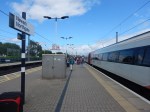
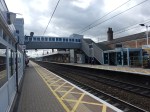
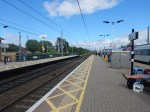
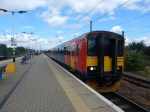
Is an hourly single coach Class 153 train between Lincoln and Newark Northgate an adequate service?
There are other services to Newark Castle station, but the two stations are separated by the notorious flat junction at Newark, which slows services on the East Coast Main Line.
I think in a well-thought out solution, the following will be achieved.
- Trains on the Nottingham to Lincoln Line will pass Newark without inconveniencing trains on the East Coast Main Line, possibly by means of a flyover or a dive-under.
- These trains would ideally call at both Newark stations.
- Hopefully lifts and stairs will make the changebetween the two lines step-free.
I wouldn’t be surprised to see a very unconventional solution to the problem.
Newark Northgate station could be closed and a flyover could take the Nottingham to Lincoln Line over the East Coast Main Line to the North of the town, where a new out-of-town station could be built, which had platforms on all lines and they were connected by lifts. I have called this arrangement A Four-Poster Station in the past.
The new station could also be a transport hub, with lots of car parking.
I changed twice at Newark Northgate today and in both instances I waited nearly fifteen minutes.
So why not just build a simple single-track flyover or dive-under and provide a comfortable electric shuttle bus between Northgate and Castle stations, that meets all trains and does the journey in less time, than the current wait?
Remember that Castle station is closer to the town centre.
It would be a cheaper flyover and the money saved might purchase some bigger new trains.
The service from Nottingham could even be run by tram-trains or like in Zwickau by diesel multiple units, which left the Nottingham to Lincoln Line at Castle station and then went walkabout in Newark.
The only certainty about the sorting of Newark, is that there are innumerable ways to do it and some could be unusual.
I doubt though, that we’ll see much improvement at Newark until after 2020.
The Great Northern And Great Eastern Joint Line
In Project Managers Having Fun In The East, I talked about hoe the Great Northern And Great Eastern Joint Line (GNGE) has been upgraded to be a valuable diversion route for freight trains travelling up and down the East Coast Main Line.
£230million has been spent to create a high-quality railway from Werrington Junction just North of Peterborough to Doncaster via Spalding, Sleaford and Lincoln.
Given the increasing traffic on the East Coast Main Line and the long wait for any relief in the shape of HS2 to Leeds, the North East and Scotland, I think we will see further development of the GNGE.
- I reported in To Dive Or Fly At Werrington, how plans are ongoing to improve the Southern connection of the line to the East Coast Main Line.
- The latest details on Werrington Junction are here on the Network Rail web site and talk about a 2020 completion.
- Could a new Lincoln Avoiding Line be built, so that freight trains avoid going through Lincoln Central station and the level crossings?
- The GNGE has lots of closed stations and some have been reopened in the last few years. Could more be reopened?
All these developments lead me to the conclusion, that there will be improved passenger services on the Peterborough to Doncaster route via Lincoln.
As the GNGE is now a high-class modern route, the single coach Class 153 train will be replaced by something like a two-car Class 158 train or Class 170 train.
The speeds of the three trains are.
- Class 153 – 120 kph
- Class 158 – 140 kph
- Class 170 – 160 mph
As Inter-City 125s are released by the arrival of new Class 800 trains, could we even see shortened versions running between Kings Cross and Yorkshire via Peterborough, Lincoln and Doncaster? These magnificent trains certainly perform well on secondary routes, as anybody, who has ridden in the cab between Edinburgh and Inversion can testify.
I wonder what times a well-driven Class 170 train could achieve. Currently Peterborough to Lincoln takes eighty minutes and Lincoln to Doncaster takes two hours.
I estimate that a Class 170 train could do the journey between Lincoln and Peterborough in about an hour, which is about the fastest time that can be achieved changing at Newark.
An estimate for the time between Lincoln and Doncaster could be about ninety minutes.
All of this speed improvement could probably be obtained without any major infrastructure improvements, but updating Werrington Junction and creating a new Lincoln Avoiding Line would improve things further.
Faster connections to Doncaster and Peterborough would bring various benefits.
- At Doncaster, it would give access to the East Coast Main Line services to the North East and Scotland.
- From 2018, at Doncaster, it would give access to the the improved TransPennine services to Leeds, Liverpool, Manchester and Manchester Airport.
- At Peterborough, it would give access to services to London, East Anglia and the South Midlands.
- From 2018, at Peterborough, there will be a connection to Thameslink, to take passengers all over London and the South East.
Surely these connections will benefit Lincoln most, but a fast service to Peterborough would also do something to improve connectivity at places like Sleaford and Spalding.
I suspect that when the new East Midlands Franchise is announced next year or when suitable trains are procured, we will see significant speed, frequency and comfort improvements on this route.
Reinstating The Complete Great Northern And Great Eastern Joint Line
With the next East Anglian Franchise, it is rumoured that there will be a marked improvement in train services in the region with new and refurbished trains everywhere, running many more services.
One possibility, is that the Bramley Line to Wisbech will be served by passenger trains, as a network of local services are improved and created around Cambridge with expansion and development needs and its soon-to-be-two stations.
I think that the possibility exists that the line between March and Sleaford might be reinstated to give freight trains to and from Felixstowe, direct access to the GNGE to get to Doncaster, avoiding Peterborough and the East Coast Main Line South of Yorkshire.
If you look at Google Maps, then the old rail line is clearly visible for most of the way between March and Sleaford. However, Whitemoor Prison has been build over the route.
If this Southern part of the GNGE were to be reinstated, could we see passenger services between Cambridge and Lincoln?
I think we would, as the engine of growth that is Cambridge, would then be directly connected by train to all the cities and larger towns of East Anglia and Lincolnshire.
I should say, that just as London dominates the South East, I believe that Cambridge with all its skills, ambition and success will dominate the East of England.
Lincoln to Cambridge could be about ninety minutes using a fully developed GNGE, as opposed to two hours now.
Conclusions
I have come to the following occlusions.
- The record of train companies in getting more direct services to Lincoln says a lot and I’d be very surprised if Lincoln sees more direct services to London.
- Newark is a basket case and sorting it will be difficult and probably expensive
- The best bet for improved services is to put faster trains on the upgraded Great Northern And Great Eastern Joint Line between Peterborough and Doncaster, which could mean Peterborough in an hour and Doncaster in ninety minutes from Lincoln.
- The trains for this should be available in 2018.
In the long term, I can see benefits in connecting March and Sleaford.
Ironically, the GNGE was built to bring coal to East Anglia from Yorkshire and it could be used to bring freight between Felixstowe and the North, in an efficient ,manner.
The Victorians seem to have got the route of the GNGE correct.
Just as they did the Varsity Line and the Borders Railway.
An Unusual Double-Headed Freight Train
I travel up and down the Great Eastern Main Line regularly and recently, there seems to have been a greater incidence of freight trains with two locomotives on the front.
I am pretty certain, I’ve seen several trains with two Class 66 diesel locomotives or two Class 90 electric locomotives on the front.
But today from a train at Shenfield I took this rather poor picture.
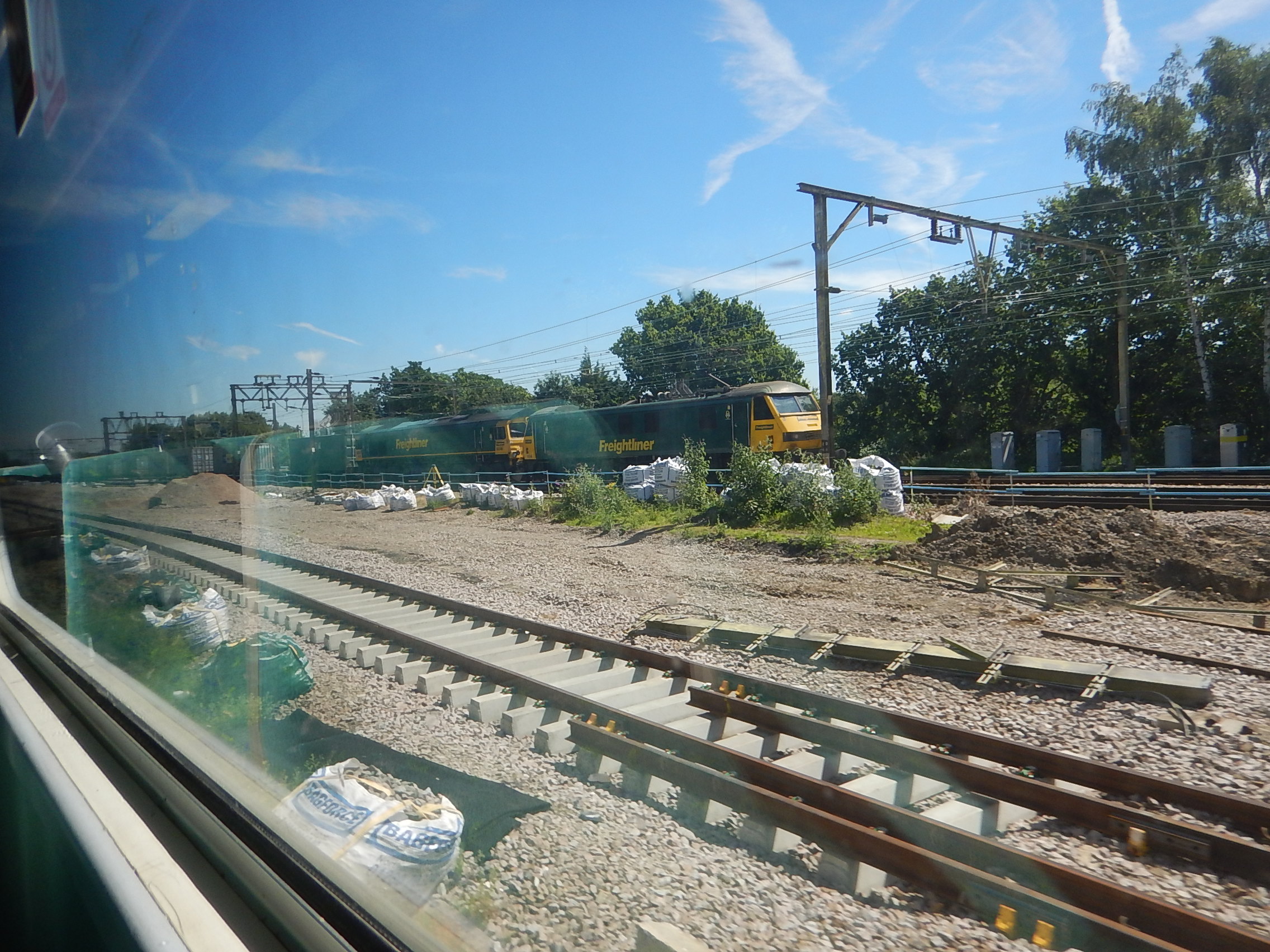
Is This A Class 90 And A Class 66 Working Together?
It would appear to show a Class 90 and a Class 66 working a freight train together.
Does this happen regularly? I can’t find any other pictures on the web.
I should get my camera out faster in future!
When Is A Train Not A Train?
Take a modern train, say something like a Class 172 DMU or a two-car version of say a Class 710 EMU.
The size and weight of these are very similar to that of one of Sheffield’s trams.
Many, if not all, trams in the UK run to a set of rules, which allow the following.
- Running at up to 50 mph on a dedicated track, which can be either single or double track.
- Running at slower speeds through City Centres and amongst pedestrians, as they do through Birmingham, Blackpool, Croydon, Edinburgh, Manchester, Nottingham and Sheffield
- Trams are driven, by a trained driver, who takes notice of everything and everybody around the tram.
- Passengers can cross the track in designated places provided they keep a good look-out.
- Passengers can only board a tram at a designated stop.
- All rail vehicles run to the same rules.
The rules must work, as you don’t often hear of trams having accidents with pedestrians. In fact fourteen people have died in accidents with modern trams in the UK since 2000. The rate seems to have dropped in recent years, so are drivers getting better and pedestrians learning how to live with the trams?
I believe that in Zwickau in Germany, local trains, run on the tram tracks in the City Centre. There’s more on it under Vogtlandbahn in Wikipedia.
So could some branch lines be run according to tram rules, but using standard modern trains, like Class 172 or Class 710 trains?
In A First Visit To Clacton, I said this about the Walton-on-the-Naze branch of the Sunshine Coast Line.
I do wonder whether some branches like the short one to Walton-on-the Naze could be run to tram rules using on-board energy storage. It might enable stations to be built step-free without electrification, lifts and bridges, provided trains kept to a safe slow speed.
In an ideal system, the rules could be.
- No electrification. Zwickau uses diesel vehicles, but ones using on-board energy storage would be ideal.
- Trains do not exceed an appropriate slow speed. Zwickau uses 80 kph.
- Step free access from platform to train.
- All trains on the line run to the same rules.
- No freight trains.
The advantages would be.
- There is no electrification.
- Signalling is standard railway signals and rules. Often routes would run under One Train Working, which is very safe and well proven.
- Many routes could be built as single-track without points and like the Sudbury branch trains would go out and back.
- DMUs would be exactly, the same as others of their type.
- EMUs would be too, but would have on-board energy storage.
- Extra stations could be added to the line, by just building platforms.
- The line could perhaps be extended past its current terminus.
I must get to Zwickau and see how the Germans do it.
A few examples of lines that could run to these rules include.
- Sudbury Branch
- St. Ives Branch
- Walton-on-the-Naze Branch of the Sunshine Coast Line
- Windermere Branch
Whether some of these would need it, is doubtful. Some though, like Sudbury and St.Ives, terminate as a single platform in a car park.
The Felixstowe Branch certainly couldn’t as it has lots of freight trains, although the final section, from where it branches off the line to Felixstowe Port could.
I said that no freight trains could run on the routes, but those devilish Germans have designed a freight tram that runs in Dresden to supply the Volswagen factory in the city. It’s called a Cargo Tram.
Could this be a way of bringing freight into a City Centre? as I said in The LaMiLo Project, this type of thinking is in the minds of planners.
 The Anonymous Widower