Freightliner’s New Livery
.As I passed through Ipswich yesterday, I took these images of Freightliner’s locomotives in their new livery.
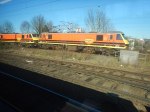


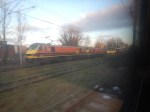

Note.
- Freightliner’s new depot on the town side of the Great Eastern Main Line appears to be fully open.
- Freightliner’s Class 90 locomotives, which they received from Greater Anglia now seem to be in the new livery.
- Freightliner’s Class 08 shunter is also shown in the new livery.
It also looked like up to four Class 90 locomotives were parked by Ipswich station.
This Google Map shows the tracks at the Western end of Ipswich station.
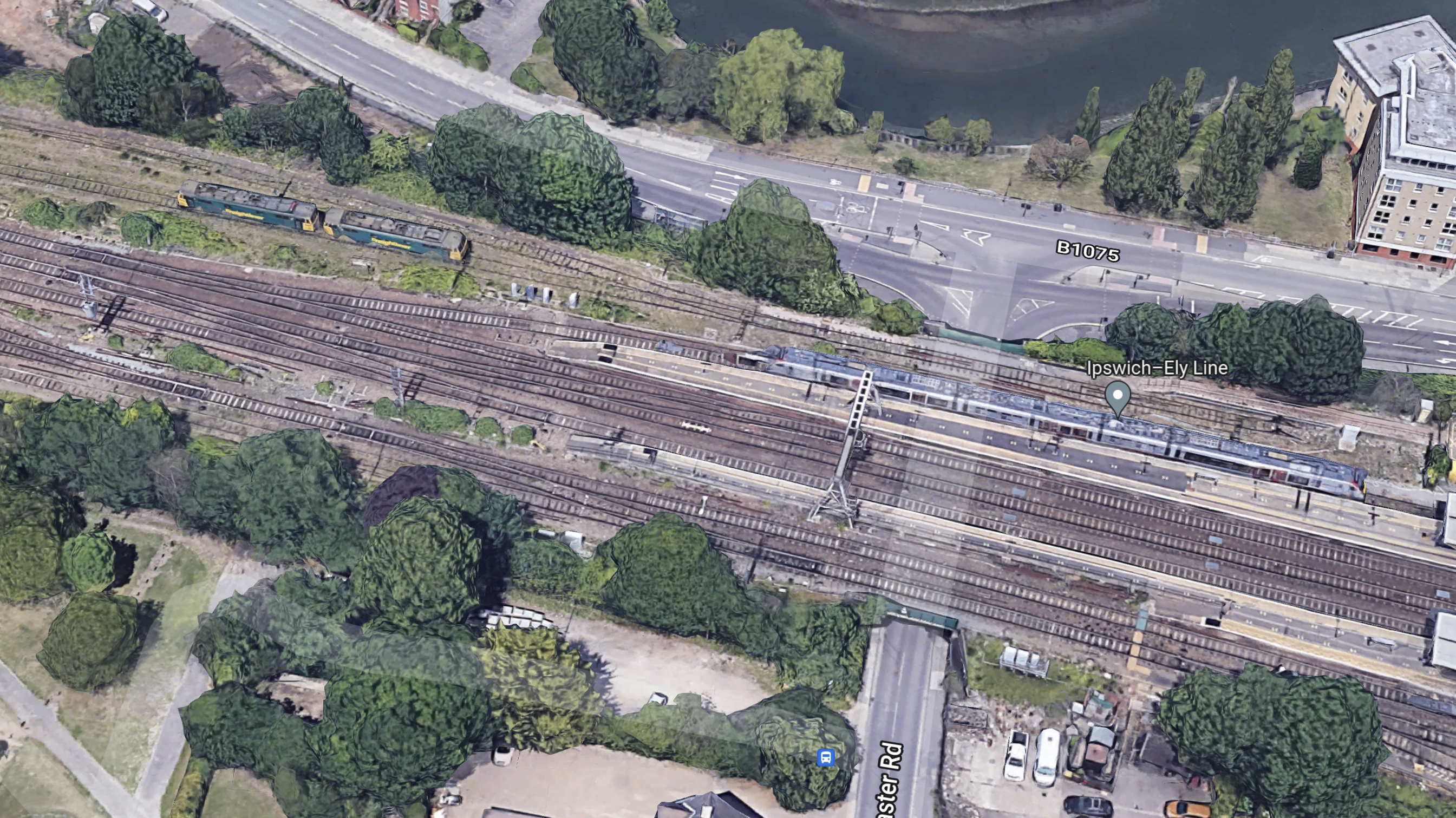
Note.
- The Greater Anglia Class 755 train in Platform 1 of Ipswich station.
- The two Freightliner Class 90 locomotives in the old green livery in the locomotive parking.
- I wonder, if freight trains are now changing to electric haulage after being hauled out of Felixstowe into Ipswich Yard, before continuing their onward journey.
Yesterday, by the use of Real Time Trains, I found these trains changed to electric haulage at Ipswich.
- 0250 – 436K – Felixstowe North to Garston – Changed back to diesel at Crewe.
- 0912 – 496K – Felixstowe North to Trafford Park – Changed back to diesel at Crewe.
- 0932 – 497K – Felixstowe North to Ditton
- 1113 – 412L – Felixstowe North to Trafford Park
- 2046 – 410M – Felixstowe North to Trafford Park
- 2152 – 412M – Felixstowe North to Garston – Changed back to diesel at Crewe.
These are my thoughts.
Changing Locomotives At Ipswich
It seems to take about 25 minutes to change a locomotive from diesel to electric.
At Ipswich, this seems to fairly easy.
- The freight train from Felixstowe stops in Ipswich Yard to the West of the station.
- The diesel locomotive is detached and probably moved to the yard to the South of the station.
- The electric locomotive is moved from by the station and attached to the train.
- The train goes on its way using electric traction.
All locomotive movements don’t seem to be too challenging.
Could More Electric Services Be Run?
I found these paths yesterday, where services left Felixstowe and went South to London.
- Coatbridge – 1
- Ditton – 2
- East Midlands Gateway – 1
- Garston – 2
- Hams Hall – 2
- Lawley Street – 3
- Trafford Park – 5
- Wentloog – 3
This is a total of nineteen trains and currently only six are electrified between Ipswich and London.
Would Bi-Mode Locomotives Be More Efficient?
In GB Railfreight Plans Order For Future-Proofed Bi-Mode Locomotives, I wrote about how GB Railfreight were planning to acquire a fleet of bi-mode locomotives.
In the related post, I said this.
I feel that, as the locomotive must fit current routes and schedules, so I wouldn’t be surprised to see the following specification.
- UK loading gauge.
- Co-Co
- Class 90 locomotive power and operating speed on electricity of 3.7 MW and 110 mph.
- Class 66 locomotive power and operating speed on diesel of 2.5 MW and 75 mph.
- Ability to change between electric and diesel power at speed.
- Ability to haul a heavy freight train out of Felixstowe.
- Ability to haul passenger trains.
Stadler will have one eye on the fact, that if they get this design right, this order for up to fifty locomotives could be just the start.
These locomotives would be ideal for Felixstowe to Ditton, Garston and Trafford Park.
- They would eliminate changing locomotives on these routes.
- They would reduce carbon emissions and fuel usage.
- They would be able to run at at least 100 mph on the Great Eastern and West Coast Main Lines.
They might also open up other partially electrified routes from Felixstowe via London.
Felixstowe And Wentloog
Wentloog freight terminal in South Wales.
In Movable Overhead Electrification To Decarbonise Freight, I used the Ipswich and Wentloog route to show how a long route could be decarbonised by the use of moveable electrification.
Conclusion
It looks like a philosophy is emerging to decarbonise a large proportion of freight services out of the Port of Felixstowe.
DB Cargo UK Successfully Trials The Use Of ‘Combi-Consists’
The title of this post, is the same as that of this press release on DB Cargo UK.
This is the first paragraph.
DB Cargo UK is trialling the use of ‘combi-consists’ to increase capacity, improve customer service and improve its efficiency.
The next four paragraphs describe the trial.
This month the UK’s largest rail freight operator ran a unique jumbo train from Belmont Yard in Doncaster to Barking, East London, carrying a mix of wagons for two altogether different types of customers.
The train consisted of two sets of empty wagons – 21 x MBA wagons for Ward Recycling and 18 x JNA wagons for FCC Environment – with an isolated DIT (dead-in-train) locomotive – in the middle.
The MBA wagons had previously been discharged at Immingham in North Lincolnshire and the JNA wagons discharged at FCC Environment’s new waste transfer facility at Tinsley in South Yorkshire.
Both sets of wagons were then taken to DB Cargo UK’s Belmont Yard depot in Doncaster where the jumbo train was assembled. The train travelled from Belmont Yard to Barking via Lincoln Central, Spalding, The East Coast Mainline, Hertford North and Canonbury Tunnel.
There is also a video embedded in the press release, which shows the formation of the train in detail.
This train is certainly efficient, as it uses less train paths, crew and fuel.
DB Cargo UK now intend to trial the concept on a greater portion of the East Coast Main Line and the Midland Main Line.
I have a few thoughts.
Could The Concept Work With Loaded Trains?
This trial was with empty trains, but would it be possible to use the concept with two shorter loaded trains?
Would there be advantages in terms of efficiency, if the following were done?
- Two container trains leave Felixstowe as a pair, with one going to Plymouth and the other going to Cardiff.
- They split at say Swindon and then proceed independently.
Obviously, all the weights would have to be in order and the locomotive would need to be able to pull the combined train.
Other possibilities might be.
- Stone trains running from the Mendips and the Peak District to London.
- Biomass trains running from import terminals to power stations in the Midlands.
- Trains delivering new cars.
- Trains delivering goods for supermarkets. Tesco are certainly increasing their use of trains.
I would suspect that DB Cargo UK have several ideas.
Could An Electric Locomotive Go In The Middle?
A Class 90 locomotive weighs 84.5 tonnes, as against the 129.6 tonnes of the Class 66 locomotive used in the trial.
So if the electric locomotive can be run dead-in-train, the weight would be slightly less.
But this might give a big advantage, if they ever wanted to run a pair of trains from Felixstowe to Plymouth and Cardiff, as per my earlier example.
- The trains would split anywhere on the electrified section of the Great Western Main Line.
- The lead train would go to Plymouth.
- The second train would go to Cardiff, which is now fully electrified.
There would appear to be possibilities to save carbon emissions.
Could An Electric Locomotive Go On The Front?
Some routes out of Felixstowe are fully-electrified from the Great Eastern Main Line.
It could be possible for the following.
- Two diesel-hauled trains to leave Felixstowe with ubiquitous Class 66 locomotives and form up as a combi-consist train in Ipswich yard.
- The Class 66 locomotive on the front is replaced by an electric locomotive.
- Both Class 90 and Class 92 electric locomotives have twice the power of a Class 66 locomotive, so both should be able to haul the combi-consist train.
The trains would split en-route with the electric locomotive hauling a train to an electrified destination.
This picture shows, what could be an experiment by Freightliner at Shenfield.
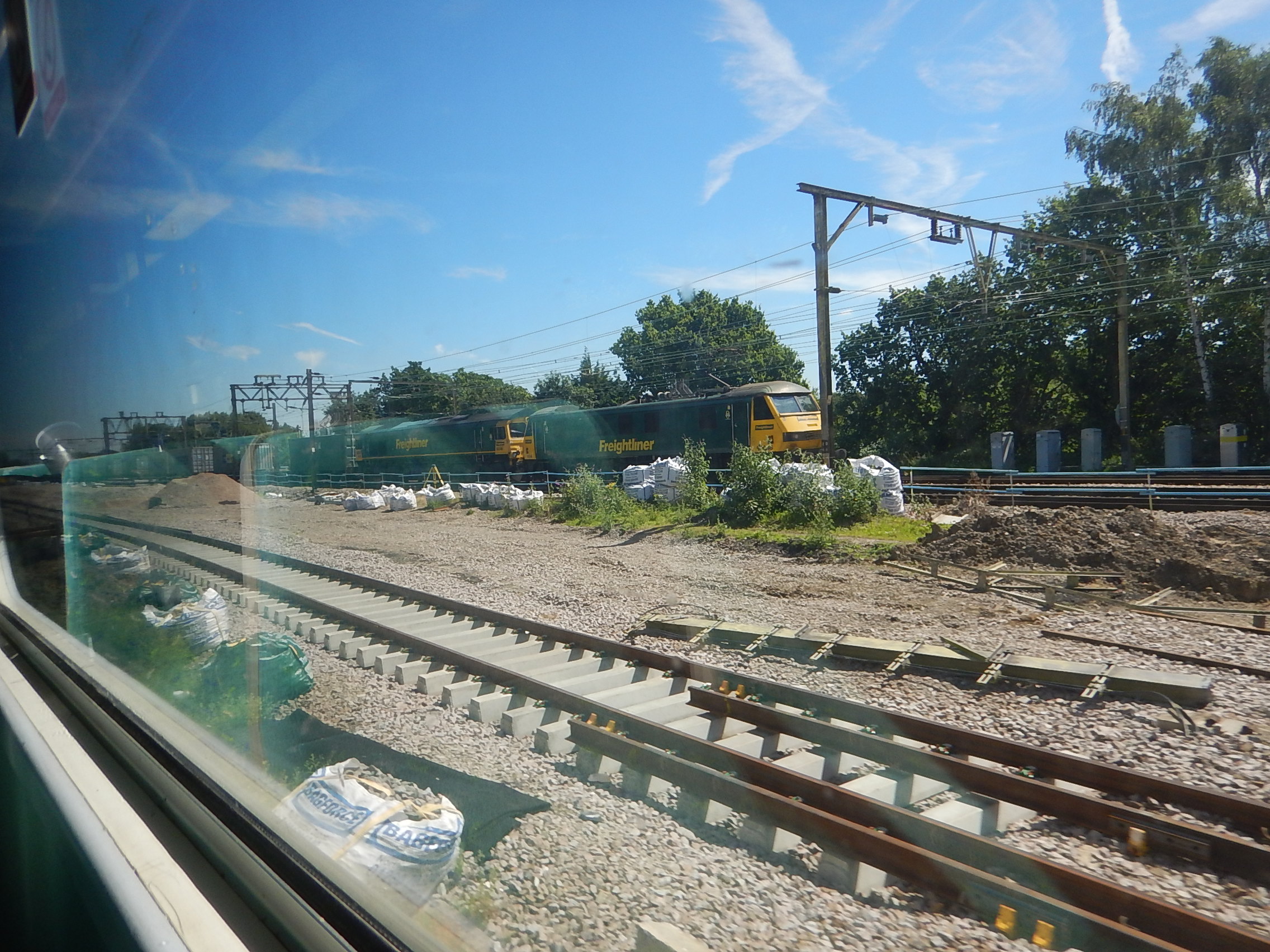
Unfortunately, I didn’t have a chance to ask the driver, if the Class 66 locomotive was running dead-in-train or helping the Class 90 locomotive with a very heavy load.
The picture shows, that the electric and diesel locomotives can work together, at the front of a train.
Since I took this picture, I’ve never seen a similar consist again.
Could A Bi-Mode Locomotive Go On The Front?
In GB Railfreight Plans Order For Future-Proofed Bi-Mode Locomotives, I talked about how GB Railfreight had started negotiations to purchase a fleet of powerful bi-mode locomotives from Stadler.
- Provisionally, they have been called Class 99 locomotives.
- The locomotives will be Co-Co bi-modes.
- The diesel engine will be for heavy main line freight and not just last-mile operations.
- I suspect that on diesel the power will be at least 2.5 MW to match a Class 66 locomotive.
These locomotives could be ideal for hauling combi-consist trains.
Would Combi-Consist Trains Save Energy?
This could be a big driver of the use of combi-consist trains and may push DB Cargo UK to acquire some powerful bi-mode locomotives.
Conclusion
Combi-consist trains seem to be an excellent idea.
GB Railfreight Plans Order For Future-Proofed Bi-Mode Locomotives
The title of this post, is the same as that of this article on Railway Gazette.
This is the introductory paragraph.
GB Railfreight is planning to order a fleet of main line electro-diesel locomotives with a modular design which would facilitate future replacement of the diesel engine with a battery or hydrogen fuel cell module.
The rest of the article gives clues to the deal and the specification of the locomotives.
- Negotiations appear to have started with Stadler for locomotives to be built at their Valencia plant.
- Twenty locomotives could be ordered initially, with options for thirty.
- The locomotive will be Co-Co bi-modes.
- The diesel engine will be for heavy main line freight and not just last-mile operations.
- They would be capable of hauling freight trains between Ipswich and Felixstowe, within two minutes of the times of a Class 66 locomotive.
- They will be of a modular design, so that in the future, the diesel engine might be replaced by a battery or fuel cells as required and possible.
They have provisionally been called Class 99 locomotives.
These are my thoughts.
EuroDual or UKLight?
Stadler make two types of bi-mode locomotives.
But the two types are closely related and open up other possibilities.
This paragraph from the Eurolight wikipedia entry, explains the various versions.
The type has been intentionally developed to support use on secondary lines without limiting power or speed performances, making it suitable for mixed traffic operations. Specific versions of the Eurolight have been developed for the United Kingdom market, and a 6-axle Co’Co’ machine for narrow gauge Asian markets, named UKLight and AsiaLight respectively. Furthermore, an electro-diesel locomotive derivative of the UKLight that shares much of its design, referred to as the Stadler Euro Dual, has also been developed and introduced during the late 2010s.
It looks like the customer can get the locomotive they want.
GB Railfreight would probably need locomotives to this specification.
- Slightly narrower than a EuroDual, to fit the UK loading gauge.
- Three-axle bogies to handle the weight of the larger locomotive.
- A body bigger than the UK Light to be large enough for the diesel engine.
- It would probably help if the locomotive could go anywhere that a Class 92 locomotive could go, so it could handle their duties if required.
This leads me to the conclusion that GB Railfreight will get a slightly narrower EuroDual.
Weight Issues
The weights of various locomotives are as follows.
- Class 66 Locomotive – 129.6 tonnes
- Euro Dual – 126 tonnes
- Class 90 Locomotive – 84.5 tonnes
- Class 92 Locomotive – 126 tonnes
All locomotives have six axles, except for the Class 90 Locomotive which has four.
I don’t think there will be any weight issues.
Power On Electricity
These are the power of the locomotives on electricity.
- Class 66 Locomotive – Not Applicable
- Euro Dual – Up to 7 MW
- Class 90 Locomotive – 3.7 MW
- Class 92 Locomotive – 5 MW
GB Railfreight can probably have what power is best for their routes.
Operating Speed On Electricity
These are the power of the locomotives on electricity.
- Class 66 Locomotive – Not Applicable
- Euro Dual – 100 mph
- Class 90 Locomotive – 110 mph
- Class 92 Locomotive – 87 mph
GB Railfreight can probably have what power is best for their routes, but I suspect they’d want it to be as fast as a Class 90 locomotive.
Power On Diesel
These are the power of the locomotives on diesel.
- Class 66 Locomotive – 2.5 MW
- Euro Dual – Up to 2.8 MW
- Class 90 Locomotive – Not Applicable
- Class 92 Locomotive – Not Applicable
To be able to handle trains, that a Class 66 locomotive is able to, 2.5 MW would probably suffice.
Could The Locomotives Use The Channel Tunnel?
I suspect that diesel locomotives are not liked in the Channel Tunnel because of all that flammable diesel.
But in the future, when there is a battery-electric variant, I would suspect that would be allowed.
In UK To France Automotive Train Service Launched, I talked about Toyota’s new service between Toton in England and Valenciennes in France via the Channel Tunnel. A locomotive with sufficient battery range might be ideal for this service, if it could handle the Market Harborough and Toton section, which is likely to be without electrification for some years.
Will The Locomotives Have Third Rail Shoes?
If their power on electricity is such that they can stand in for Class 92 locomotives, then there may be a need to fit all or some of the locomotives with third rail shoes.
As an example, they might be useful in taking freight trains to and from Southampton or the Channel Tunnel.
Conclusion
I feel that, as the locomotive must fit current routes and schedules, so I wouldn’t be surprised to see the following specification.
- UK loading gauge.
- Co-Co
- Class 90 locomotive power and operating speed on electricity of 3.7 MW and 110 mph.
- Class 66 locomotive power and operating speed on diesel of 2.5 MW and 75 mph.
- Ability to change between electric and diesel power at speed.
- Ability to haul a heavy freight train out of Felixstowe.
- Ability to haul passenger trains.
Stadler will have one eye on the fact, that if they get this design right, this order for up to fifty locomotives could be just the start.
It certainly seems a locomotive designed for the UK’s railway system.
Rail Freight ‘Booming’ Because Of HGV Driver Shortage
The title of this post, is the same as that of this article on Rail News.
These are a few points from the article.
- Tesco currently send 65,000 containers per year by train and are increasing this figure to 90,000.
- Tesco are also planning to run special wine trains.
- Dunelm is reported to have agreed a lease for a new warehouse at the Daventry rail terminal, creating another 70 jobs.
- CB Railfreight is running 400 trains per day.
- GB Railfreight trained seventy drivers in the last year.
- The number of people employed at the Daventry International Rail Freight Terminal, will rise by another 4,000 in January when a new section opens.
One Freight Operations Manager is quoted as saying business is booming. He believes that the truck driver shortage and thought for the environment are driving the growth in rail freight.
Class 319 Train Used In GB Railfreight Parcel Test At London Euston
The title of this post is the same as that of this article on Rail Advent.
This is the introductory paragraph.
GB Railfreight has used a Class 319 train during a successful trial of former commuter trains for express parcel delivery services.
Other points from the article.
- Standard roll-cages can be loaded and offloaded at most major stations.
- A substantial amount of cargo can be carried.
- GBRf is talking to the Government about deliveries to hospitals.
It should be noted that the Class 325 trains that are used to move goods for Royal Mail are based on Class 319 trains.
- Both trains are based on the legendary Mark 3 coach.
- There are sixteen of these Royal Mail trains.
- Each train is four cars.
- Each car can hold up to twelve tonnes.
- They are capable of 100 mph like the Class 319 trains.
- Class 319 trains are being converted into bi-mode Class 769 trains for use by Rail Operations Group as parcel trains.
As there are still at least fifty Class 319 trains still available for modification, will it mean a more will be converted into parcels trains?
Two Unrelated (?) Stories About Rail Freight
Today there are two news stories about rail freight on the Internet.
- There Has ‘Never Been A Better Time’ To Invest In Rail Freight–Report on Railnews
- New Owner For GB Railfreight on Rail Magazine.
I’ll sketch out a few details from both stories.
Invest In Rail Freight
This is the first paragraph of the news story.
A new report published by the Rail Freight Group today is outlining how an ‘ambitious growth strategy’ for rail freight over the next ten years could be worth between £75 billion and £90 billion in environmental and economic benefits.
The report was written by well-respected rail commentator; Stephen Joseph
Recommendations include.
- A new approach from national and local government.
- New investment
- More investment in the Strategic Freight Network.
- Increased electrification
- New rail linked terminals
- Reforms to planning laws
- High speed freight services to city centres.
- Road pricing could also be used to encourage a shift to rail.
The Rail Freight group’s director general Maggie Simpson is quoted as saying. With renewed focus on the environment, and with new trade opportunities on the horizon, there has never been a better time to invest in rail freight.
Note that invest or investment is mentioned five times in the short news story.
New Owner For GB Railfreight
This is the first paragraph of the news story.
Hector Rail Group has sold GB Railfreight to Infracapital – the unlisted infrastructure equity arm of M&GPrudential.
This article in Rail Magazine was published in July 2017 and is entitled GB Railfreight In ‘Locomotive Acquisition’ Talks.
GB Railfreight has a fleet of seventy-eight Class 66 locomotives with other locomotives in the ageing category. Some of their work like hauling the Caledonian Sleeper needs well-presented reliable locomotives, so perhaps they need to update their image.
Would being owned by Infracapital give the company better access to finance for a renewed fleet?
The previous article indicated, that new investment in infrastructure, like selective electrification, railfreight terminals and perhaps freight loops is needed in the UK Strategic Freight Network.
Would Infracapital be prepared to fund this infrastructure, where it made their locomotives more profitable?
Consider.
- Partial electrification of the Felixstowe Branch Line might enable a hybrid Class 93 locomotive to haul the heaviest intermodal freight trains between Felixstowe and Ipswich. This improvement would also allow Greater Anglia’s Class 755 trains to run partially on electricity on the route.
- Doubling of the single-track between Soham and Ely would increase the number of freight paths across Suffolk.
- Reworking of junctions at Haughley and Ely would also speed up freight trains across Suffolk.
These are just three examples from an area I know well, but in how many places in the UK would smaller projects improve the profitability of new locomotives.
Infracapital would also be paid track access charges for their small sections of infrastructure. So well-planned improvements would have two revenue streams. And both would have a lifetime of thirty to forty years.
Case Study – Partial Electrification Of Felixstowe Branch Line
The Felixstowe Branch Line has now been double-tracked to create a passing loop to the West of Trimley, which allows more freight trains per day into and out of the Port of Felixstowe.
I believe that if sections of the branch line were to be electrified, that a diesel/electric/battery Class 93 locomotive would be able to haul a maximum weight intermodal freight train from Felixstowe to Ipswich.
The freight train would continue South and would use electric power to go to Bristol, Cardiff, Glasgow, Liverpool and Manchester using existing electrified routes through London.
In Issue 888 of Rail Magazine, there is a short article, which is entitled Battery Power Lined Up For ‘755s.‘
This is said.
Class 755s could be fitted with battery power when they undergo their first overhaul.
Stadler built the trains with diesel and electric power.
The Swiss manufacturer believes batteries to be the alternative power source for rail of the future, and is to build tri-mode trains for Transport for Wales, with these entering traffic in 2023.
Rock Rail owns the Greater Anglia fleet. Chief Operating Office Mike Kean told RAIL on September 4 it was possible that when a four-car ‘755/4’ requires an overhaul, one of its four diesel engines will be removed and replaced by a battery.
I suspect the battery size and electrification can be designed, so that the trains can work the twelve mile branch without using diesel power.
I can envisage a time, when the following trains on the Felixstowe Branch are zero-carbon.
- Freight trains between Felixstowe and London via Ipswich.
- Passenger services.
That will be a substantial improvement in environmental credentials.
Conclusion
There is more to this than an insurance and fund management company, funding locomotives.
Suppose GB Railfreight see an opportunity to deploy a new fleet of locomotives on a valuable contract, but perhaps a missing piece of infrastructure, stops them from running the service. Will they then approach their parent company; Infracapital, to see if they can help?
Are we seeing the first green shoots of realism in the financing of much-needed improvements to the UK rail network.
If it works out well, I don’t think that Infracapital will mind the good publicity.
,
Charting An Electric Freight Future
The title of this post, is the same as the title of an informative article in the April 2018 Edition of Modern Railways, which was written by Julian Worth, who has many years experience of the rail freight industry.
This is a very comprehensive article looking at the future of motive power for freight trains.
These are points from the article, with some added comments of my own.
2040 And A Diesel-Free Rail System
Government ministers have said that by 2040, the UK will have a diesel-free railway, which will reduce emissions and especially particulates.
This page on the Government web site is entitled Let’s Raise Our Ambitions For A Cleaner, Greener Railway, which gives the text of a speech by the Rail Minister; Jo Johnson.
This is part of what he said.
And that’s why I am today announcing a new ambition.
I would like to see us take all diesel-only trains off the track by 2040.
If that seems like an ambitious goal – it should be and I make no apology for that.
After all, we’re committed to ending sales of petrol and diesel cars by 2040.
If we can achieve that, then why can’t the railway aspire to a similar objective?
Rail may be less carbon intensive than road transport.
That’s why modal shift’s so important.
As an engineer. I feel it is a challenge that is acceptable.
The Diesel Locomotives Are Getting Old!
The ubiquitous Class 66 locomotives, don’t meet the latest emission standards, but in addition, by the late 2020s, they will be getting to thirty years old.
Other locomotives like Class 59 locomotives will be even older.
Replacement locomotives will be needed, as maintenance costs will be getting too high.
The Last-Mile Electric Locomotive
Electric locomotives with a last-mile capability away from electrification like the Class 88 locomotive could be favoured.
- They could be used for terminal work and short-distance movements.
- They would have a 25 KVAC capability.
- They could possibly have a 750 VDC capability, to work on the third-rail network.
- They would meet all the emission standards, when running on diesel.
Julian Worth suggests that the last-mile capability could be provided by a battery.
Although, this would be environmentally-friendly and better in urban areas, I think that any onboard power, should be able to take a train into and out of the Port of Felixstowe, London Gateway and the other major ports.
I met a manager of the Port of Felixstowe a few years ago and they don’t like 25 KVAC wires in a dock, as containers do occasionally get dropped.
Most lines into ports and inland terminals, don’t appear to be too challenging and I’m sure that an uprated Class 88 locomotive could be built, that would handle entry and exit to all the ports and terminals in the UK.
Do We Need A Freight Electrification Strategy?
Julian Worth suggests we need one for the next couple of decades.
He makes some good points.
- Electric traction current is cheaper than diesel fuel.
- Availability of modern electric locomotives should be better than a diesel.
- Diesels may be restricted in urban areas. It could be a vote winner in Mayoral elections in the large Metropolitan areas.
He finishes this with this statement.
Crucially, switching to electric locos from around 2030 would not entail premature replacement of the current fleet and would represent necessary asset renewal in modern equivalent form.
Just imagine the outcry from the Green Movement, if these ageing diesels were to be replaced with modern diesel locomotives..
Undoubtedly, we need a well-thought out freight strategy.
GB Railfreight
This article in Rail Magazine is entitled GB Railfreight In ‘Locomotive Acquisition’ Talks.
So at least one freight company is looking for new motive power. GB Railfreight has a fleet of seventy-eight Class 66 locomotives with other locomotives in the ageing category. Some of their work like hauling the Caledonian Sleeper needs well-presented reliable locomotives, so perhaps they need to update their image.
It will be interesting to see what type and class of locomotive they buy.
Rail Freight Has Changed
Coal to power stations used to be the dominant freight on UK railways.
But n0t any more! Thank goodness!
The major freight on UK railways is intermodal or trains of containers from port to inland terminal and vice versa.
There is also a large growth in construction materials, miuch of it going from quarries in the West Country and the Peak District to the South East of England. To send this any other way than by train, would surely be madness.
There also seems to be an increasing number of trains carrying new vehicles to and from the Continent. More will surely start to use the Channel Tunnel.
Julian Worth says this, after summarising the freight flows.
This suggests modest extensions of electrification might permit much of the construction and intermodal businesses, together with most automotive traffic, to be electrically hauled throughout.
He then goes on to say that the big gap is Felixstowe to Peterborough, Nuneaton and Birmingham.
The Port of Felixstowe
I partly grew up in the town and never thought the port would grow to the size, it is today.
I also remember in the 1980s, when only the odd intermodal train was to be seen on the Felixstowe Branch Line.
- Now, a dozen trains in each direction on every day take the route between Felixstowe and the Midlands.
- The Felixstowe Branch Line is being upgraded to raise the number of trains from the port from 33 to 48.
- The Great Eastern Main Line and the routes through North London are close to capacity.
- The direct route via Peterborough is a lot shorter than the London route.
Julian Worth states, that the number of trains between Felixstowe and the Midlands could rise to as high as fifty every day.
Routes That Should Be Electrified For Freight
Julian Worth suggests that the following routes should be electrified.
Route 1 – London Gateway to Thames Haven Junction
If you electrify Felixstowe to the Midlands, this will remove some diesel freight trains from London.
It would be stupid to replace them with diesel freight trains from London Gateway. So it would be fairly logical to electrify the connecting route to London Gateway.
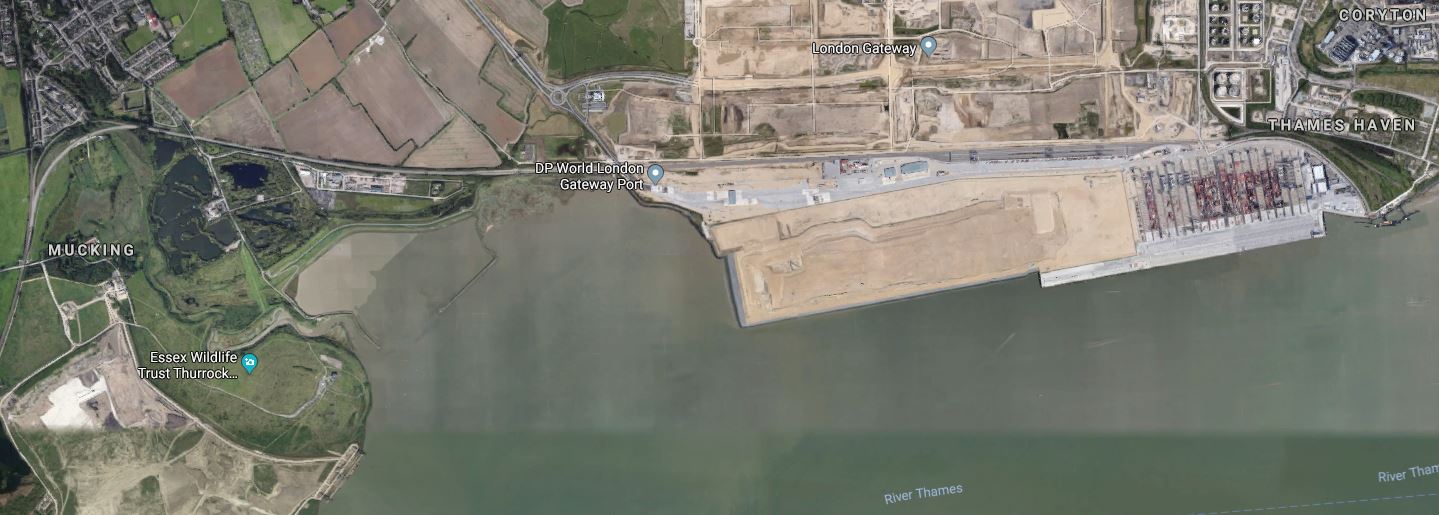
This Google Map shows London Gateway and the rail connection to the electrified London, Tilbury and Southend Railway.
Note.
- The electrified London, Tilbury and Southend Railway, runs North-South at the extreme left of the map.
- The connecting spur curves East on what appears to be a new chord before accessing sidings on the North side of London Gateway.
- There would appear to be a lot of space to expand the port.
- The rail spur to the port is double track.
- It looks like their are sat least five sidings for handling freight trains.
- The sidings are double-ended, so last-mile capable electric locomotives could run round trains, without the need for electrification.
It would have appeared to have been designed for electrification.
Full details on London Gateway’s plans for rail access are given here in the Wikipedia entry for London Gateway, under Rail Terminal.
This is a quick summary.
- Freight trains will use the newly-electrified Gospel Oak to Barking Line to access the West Coast Main Line.
- Freight trains have a route to the Channel Tunnel.
- London Gateway has planning permission for a second rail terminal.
In other places Wikipedia says the port is highly-automated.
I am led to the conclusion, that the Gospel Oak to Barking Line will see a high number of electric freight trains in the future.
I’m not surprised that Julian Worth says the spur currently handles sixteen trains per day and is set to grow significantly.
I certainly wouldn’t buy a house on the Gospel Oak to Barking Line.
Route 2 – Nuneaton To Birmingham Lawley Street
If Felixstowe to Nuneaton is electrified, then this extends the electrification to the massive Lawley Street Freightliner Terminal, which is in central Birmingham.
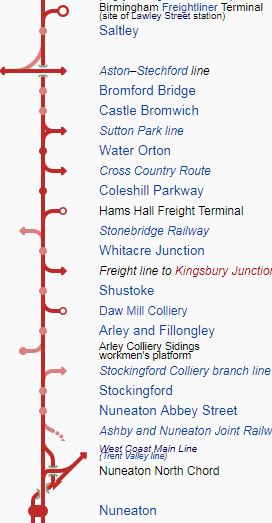
This diagram from Wikipedia shows the route.
Note.
- Lawley Street Freightliner Terminal, is on the short spur at the top of the diagram.
- iThis electrification would also complete a fully-electrified route between Birmingham New Street station and Sansted Airport, so CrossCountry could use electric trains on that route, instead of the current Class 170 train, which is often overcrowded.
- Would the electrification open up opportunities for more electrified local services in Birmingham?
Julian Worth says that this twenty miles carries thirty-two trains per day.
Would electrifying this route also have environmental benefits in terms of pollution?
Route 3 – Basingstoke To Southcote Junction and Oxford to Denbigh Hall Junction
This route, which connects the Port of Southampton with the West Coast Main Line, would require forty-two miles of electrification.
Consider.
- It would create a fully-electrified route from Southampton to the West Coast Main Line.
- Julian Worth says it carries forty-eight trains per day.
- I also think, he is assuming that the Great Western Electrification extends to Oxford, which surely it will do in the next few years.
- Dual voltage locomotives would be needed.
- It would require electrification of part of the East West Railway.
The East West Railway is to be built as a privatised railway and I’m sure if the sums were right, they would electrify the route from Oxford to Denbigh Hall Junction.
If the Western end of the East West Railway were to be electrified, this must increase the options and operating speed for passenger trains on the route.
Route 4 – Merehead/Whatley to Newbury
Consider.
- Merehead and Whatley are both Quarries of the Mendip Hills.
- The line is double-track and seventy-two miles long.
- Julian Worth says that this route carries twenty-eight stone trains per day.
- Many trains are double-size.
- In a four hour period, using Real Time Trains I found,three stone trains that weighed 4,800 tonnes and had a maximum speed of 45 mph and four stone trains that weighed 2,000 tonnes and had a maximum speed of 60 mph, using the route from the Mendips to London.
With all that heavy traffic, it strikes me that their are only two ways to power these trains on the route.
- Very powerful diesel locomotives, possibly working in pairs.
- Very powerful 25 KVAC electric locomotives, which would need electrification, able to supply lots of amps.
Mendip Rail currently run these services using Class 59 locomotives, which have the following characteristics.
- Built in North America between 1985 and 1995.
- They were the first privately-owned locomotives on the UK main line.
- They have the ability to creep to shift heavy loads on gradients.
- They have a maximim speed of 60-75 mph.
- They are towered by a 2.5 MW diesel engine.
This extract from Wikipedia illustrates their power.
On 26 May 1991 Kenneth J Painter (59005) (with assistance from Yeoman Endeavour) set the European haulage record, with a stone train weighing 11,982 tonnes and 5,415 feet (1,650 m) long. However the so-called ‘mega train’ experiment was not very successful, as a coupling in the centre of the train broke.
It would appear, there was nothing wrong with the locomotives.
By the late 2020s, these locomotives will be over forty years old and although they could probably soldier on for another ten or even twenty years, the cost of maintenance will increase and reliability could decrease. You don’t want a 4,800 tonne stone train blocking the Reading to Taumton Line.
I suspect too, that it is unlikely that this important stone traffic will decrease. This is said in the Wikipedia entry for Mendip Rail.
Mendip Rail’s class 59s work services between various destinations which have changed over time according to demand and specific contracts. They have worked regularly over southern railway tracks, for example to the former Foster Yeoman terminals at Eastleigh and Botley, as well as delivery aggregates for construction work on the Thames Barrier, Second Severn Crossing, Channel Tunnel and most recently Heathrow Terminal 5, which required 3 million tonnes of stone.
Mendip Rail hauls about 4.5 million tonnes of stone from Torr Works each year, and about 2.5 million tonnes from Whatley Quarry.
I suspect that these stone flows will continue and there will come a time in the not-to-distant future, where new locomotives will be required.
- The Class 59 locomotives were built for these stone trains and have a maximum tractive effort of 507 kN at just 7 mph.
- A large electric Class 92 locomotive has a maximum tractive effort of only 400 kN.
But I suspect that engineers can design an electric locomotive, that can handle these trains either by themselves or working in a pair.
So there will be a choice between a very powerful diesel locomotive or a very powerful electric one.
- Will those that live by the railway and environmentalists accept new diesel locomotives?
- Electric locomotives would require the line to be electrified.
- Electrification would allow Great Western Railway to run their Class 800 trains more efficiently using the wires.
- Would those who live by the railway, accept the electrification of the line?
It’s a difficult choice.
Route 5 – Felixstowe to Ipswich. Haughley Junction to Peterborough and Helpston to Nuneaton
Consider
- This would be a big project, as it would require 146 miles of new electrification.
- But the return could be worthwhile, as currently the route handles twenty trains per day and once the Felixstowe Branch Line has more double track, this figure could rise to fifty-six trains per day.
- At Ipswich, Peterborough and Nuneaton, the route connects to fully-electrified lines.
My project management knowledge tends to electrifying this line from East to West as almost three separate projects.
- Felixstowe to Ipswich
- Haughley Junction to Peterborough
- Helpston to Nuneaton
It could even be five, if Helpston to Nuneaton was split into two at either Leicester or the Midland Main Line.
I have three general questions.
- When the gauge clearance was undertaken a few years ago, were bridges raised to accommodate wires as well?
- Will the natives object to fifty trains per day?
- Will the line be resignalled to handle the greater number of trains?
Once the full route is electrified, the number of trains to and from Felixstowe , that used the Great Eastern Main Line and the routes through London would drop. Obviously, some trains like those between Felixstowe and Wales and the West Country would still need to use the London routes.
But overall, this would allow a mixture of the following.
- Higher passenger train frequencies on the North London Line
- Higher passenger train frequencies on the Gospel Oak To Barking Line
- More freight trains to and from London Gateway could use the cross-London routes.
The last point would mean, that electric locomotives would need to have access to London Gateway.
I will detail my thoughts on Felixstowe to the Midlands electrification in the next three sub-sections.
Route 5A – Felixstowe to Ipswich
Electrifying between Felixstowe and Ipswich shouldn’t be the most challenging of projects.
- The route is fairly flat.
- The route is double track, except for part of the Felixstowe Branch Line.
- The line was cleared for the largest containers a few years ago.
- Doubling of the Felixstowe Branch Line around Trimley and the removal of some level crossings should start this year.
- There should be an adequate 25 KVAC power supply at Ipswich.
I have two extra questions.
- Will the partial doubling of the Felixstowe Branch, prepare the line for electrification?
- Has a scheme been designed to take electrification to the port?
But there will be benefits.
- Some freight trains that use the Great Eastern Main Line and the electrified routes through London, could be hauled all the way. by electric locomotives.
- If Felixstowe station was to be electrified, Greater Anglia could run five-car Class 720 electric trains instead of Class 755 bi-mode trains on the branch, if required.
- Class 755 bi-mode trains on the Ipswich to Lowestoft service, would be able to use the electrification between Westerfield and Ipswich stations.
- Noise and vibration could be reduced.
It is just over a dozen miles of elwctrification, so isn’t the largest of projects.
Route 5B – Haughley Junction to Peterborough
Like the first section between Felixstowe and Ipswich, this section is also not very challenging.
- The route is fairly flat.
- The route is double track.
- The line was cleared for the largest containers a few years ago.
- Ely is being remodelled to remove a bottleneck.
- Ely to Soham improvements seem to have been dropped, but will surely happen.
- Haughley Junction needs to be remodelled.
- Network Rail are already removing level crossings.
- There should be an adequate 25 KVAC power supply at Haughley and Peterborough.
I have an extra question.
- Will the route between Cambridge and Chippenham Junction be electrified?
But there will be benefits.
- Electric freight between Felixstowe And The East Coast Main Line as far as Scotland.
- Greater Anglia could run their service between Colchester and Peterborough with a Class 720 electric train.
- Greater Anglia’s service between Ipswich and Cambridge would do more running under wires.
The electrification might even enable some useful electrified diversion routes.
Route 5C -Helpston to Nuneaton
I don’t know this section of the route, as well as I know the two other sections.
- The route is double track.
- There is a busy level crossing in the middle of Oakham.
- There should be an adequate 25 KVAC power supply at both ends of the route.
It would appear that the route goes through Leicester station on the Midland Main Line.
As the electrification of the Midland Main Line has been postponed, how will this section of the route be handled?
But there will be benefits.
- Electric freight between Felixstowe And The Midlands
- Fewer freight trains would need to go via London
- Some passenger services, like Birmingham-Stansted Airport, could be run using electric trains.
Completing all three sections will open up new possibilities for both freight and passenger services.
Route 6 – Hare Park Junction to Leeds Stourton
This is a freight route , which can be followed this way.
- It leaves the electrified Wakefield Line at Hare Park Junction, which is South of Sandal and Agbrigg station.
- It passes Wakefield Kirkgate and Normanton stations and there appears to be a connection to Wakefield Europort.
- It then joins the Hallam Line and goes to the Stourton Freightliner Terminal.
Electrification of this eighteen mile route, would allow freight trains with electric traction to reach the Stourton terminal.
The electrification could also be extended to Leeds station, so that passenger services on the Hallam Line, run by bi-mode trains would have an electrified route into Leeds.
Route 7 – Mountsorrel to Syston Junction and Manton Junction to Corby
Mountsorrel Quarry is one of the biggest granite quarries in Europe. It is not on the railway anymore, but is connected to the Midland Main Line at
Barton upon Soar, by a mineral conveyor.
These two short lengths of electrification connect Mountsorrel to the electrified portion of the Midland Main Line to London and by using the Felixstowe to Nuneaton route, there is access to the East and West Coast Main Lines.
Julian Worth says that thirty trains per day use the route.
Looking on Real Time Trains, they are not the mega-trains of the Mendips, but they seem to go all over England.
Route 8 – Whitacre Junction to Birch Coppice
Birch Coppice is a freight terminal and it is connected to the Birmingham Lawley Street to Nuneaton Line at Whitacre Junction, by a six mile rail link.
As in Julian Worth’s plan, the Birmingham Lawley Street to Nuneaton Line will have been electrified, it will be an logical section of wires to install.
Summarising The Routes
Summarising the routes, you get the following, once all the proposals are added to the UK’s electrified network.
- There is a major East-West route from Felixstowe to Birmingham, that connects to the two major North-South routes; East and West Coast Main Lines and East Anglia’s Great Eastern Main Line.
- The Reading to Taunton Line now provides an route to the South-West for electric trains.
- The massive quarries in the Mendips and at Mountsorrel are connected to the main electrified network.
- The ports of Felixstowe, London Gateway and Southampton are connected to the main electrified network.
- The inland depots of Birch Coppice, Birmingham Lawley Street and Leeds Stourton are connected to the main electrified network.
Others may well be added.
For instance, an electrified connection to Liverpool2 along the Canada Dock Branch, which runs in places through densely-packing housing and has been looked at for a passenger service by Merseyrail.
Installing The Electrification
Traditionally, electrification schemes have been done using money directly from the Treasury.
To say, performance in recent years has been mixed would be an understatement!
With my experience of project management, I have my theories about the poor performance, but as I have no serious data to back them up, I will not put most of them in this post.
I will say however, that my observations of the electrification of the Gospel Oak to Barking Line have led me to the conclusion, that there are not enough competent engineers, surveyors and technicians to install the current low-level of new electrification.
However, recent statements and documents from Chris Grayling about how the Southern rail access to Heathrow is to be financed, might suggest a model for electrification.
This Press Release on the Department of Transport web site, starts with these two paragraphs.
Private companies have been asked to come forward with ideas to deliver a new southern rail link to Heathrow Airport.
The link will be one of the first projects under government plans to invite third parties – such as local authorities and private sector companies – to invest in the rail network, over and above the £47 billion the government is already planning for the next 5 years.
The idea is that a private consortium would do the following.
- Design, build and finance a new line, station or other piece of railway infrastructure.
- Maintain it for a number of years.
- Charge train operators a charge for using the infrastructure, in much the same way as Network Rail charge every train for track access.
If the sums add up, I suspect it is model that will work for electrification.
I will take the Felixstowe Branch Line, that I know well as an example.
The benefits of electrification on this line could be as follows.
- Freight trains from the Port of Felixstowe using electrified lines from Ipswich, could be able to use electric haulage, which might be more affordable.
- Greater Anglia could run Ipswich to Felixstowe services using trains running solely on electricity.
- There would be less pollution and possibly less noise and vibration.
- Electrification might allow faster operating speeds on the branch, which in turn would allow more freight and passenger trains.
- The hourly passenger service between Ipswich and Felixstowe might be able to be doubled in frequency.
Currently, after the dualling at Trimley has been finished, the branch is planned to handle an hourly passenger train and around fifty freight trains per day.
It strikes me that if the contracts and charges have the right balance, that a deal could be struck with a competent consortium.
It would have the following parts.
- The consortium would design, finance and install the electrification.
- Installing the electrification would be done, without disturbing the passenger and freight traffic.
- The consortium would maintain the electrification for an agreed number of years.
- Electrification access charges would be modelled on track access charges and agreed with a regulator, such as the Office of Road and Rail.
- Failure to provide a working electrified railway, would incur penalty charges to operators.
I feel the model could work.
- The consortium would use best practice from around the world.
- The consortium might encourage innovative design and working.
- The consortium would make sure it had the best engineers, technicians and equipment to keep the electrification in tip-top condition, as that is the best way to maximise return on capital, against a fixed income.
- The Office of Road and Rail would ensure safety, quality and reliability.
I also feel, that one of the ways to get the electrification installed in a professional manner and then operational at an agreed date, is to get the project management right.
Too much of what I’ve seen on electrification in the UK, reminds me of the phrase – It’ll be alright on the night!
A consortium, which has to raise and justify the money it needs, can’t rely on this mantra and must be sure that if a scheme is going to cost £100 million, then.
- The initial budget must be correct.
- The electrification can be installed for that sum.
- Sufficient contingency is included.
Get the first project, seriously wrong and they won’t get another of the many electrification projects in the pipeline.
Grayling Gives Green Light To Double Track On Part Of Felixstowe Line
The title of this post is the same as that of this article in the East Anglian Daily Times.
This page on the Network Rail web site gives more details.
This is said.
Building the additional track will help increase the capacity of the Felixstowe branch line and take lorries off the road. It will also mean more reliable journeys for passengers traveling between Ipswich and Felixstowe.
There is also this map, which shows where a second track is being added to the Felixstowe Branch Line between Trimley station and Grimston Lane level crossing.
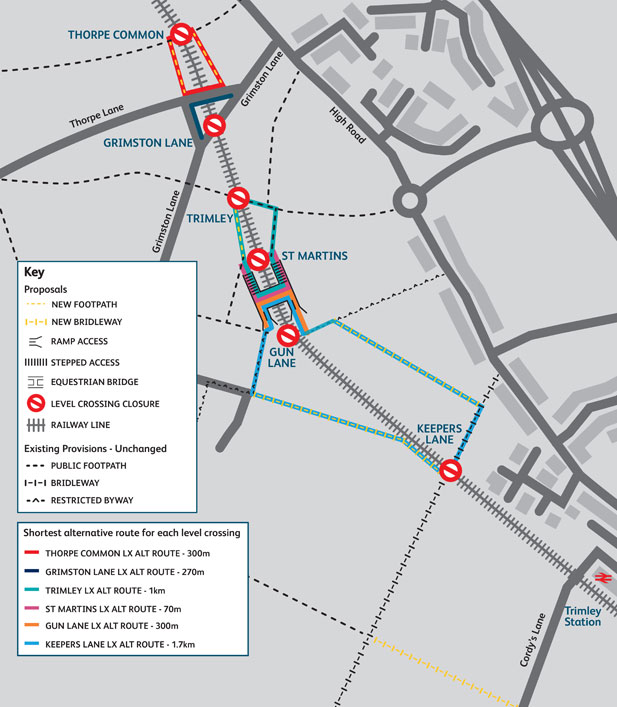
Note that six level crossings are also being removed, with the one at Gun Lane being replaced with a bridge, which seems to be a bit controversial.
Freight Traffic On The Line
The East Anglian Article says this.
This will allow up to 47 freight trains to run per day, 14 more trains than can currently run on the single line. Each train can carry the equivalent of 60 lorry loads, meaning fewer lorries on busy roads such as the A14.
That is quite a lot of freight and a forty-two percent increase in the number of trains.
Trimley Station
Trimley station will be the Southern end of the new track.
This Google Map shows Trimley station.

Note.
- Cordy’s Lane crossing the line at Trimley station.
- The line to Flelixstowe Port (North) going South.
- The line to Felixstowe station going straight on.
Judging by the number of houses on the South side of the track, I would assume that an automatic level crossing is being installed there.
Noise, Smell And Vibration
The Felixstowe Branch Line illustrates one of the problems of the various freight locomotives and especially the ubiquitous Class 66 locomotive. The locomotives are not particularly environmentally-friendly, especially when they are hauling up to forty truck with containers.
I think that some parts of the branch need to have noise mitigation measures installed, otherwise there will be serious levels of complaint.
New Locomotives Are Needed
This article in Rail Magazine is entitled GB Railfreight In ‘Locomotive Acquisition’ Talks, so at least one company thinks so!
In Jumbo Trains Are Arriving, I mused about the type of train required.
I came to this conclusion.
Some more powerful freight locomotives are needed, but the designs should be available.
I would add to that now. The locomotives would need to be dual-mode and a lot more environmentally-friendly/
From Hastings To The Czech Republic Via The Highlands Of Scotland
When British Rail drew up the specification for the Class 73 electro-diesel locomotive, in the early 1960s, they decided the locomotives would have the following characteristics.
- The ability to go anywhere on the then Southern Region’s third rail electrified network.
- The ability to travel on Southern Region’s non-electrified lines using the onboard diesel engine.
- The ability to haul a heavy train at over 80 mph.
- The ability for multiple working, with virtually all other trains in Southern Region.
One of the side-effects of this specification was a narrow profile, so that the locomotives could use the narrow tunnels of the Hastings Line.

This Class 73 locomotive at Tonbridge station certainly doesn’t look fat.
In recent years, the remaining Class 73 locomotives have found themselves various niche uses.
- At one time, Class 73 locomotives pulled a rake of Mark 2 coaches to form the Gatwick Express.
- Gatwick Express/Southern still retains one locomotive for Thunderbird duties.
- Eurostar used two locomotives to rescue failed Class 373 trains.
- GB Railfreight use several examples to pull engineering trains.
- Merseyrail used four for shunting and departmental duties.
- South West Trains use an example for Thunderbird duties.
For a locomotive designed over fifty years ago, they turn up in a wide range of places.
As many are in effect last-resort traction, when you do see one on the main line, it is usually looks to be clean and in top class condition.
But in the last couple of years, Class 73 locomotives have started working on perhaps the most high-profile niche market of all. This article in Rail Magazine, which is entitled Rebuilt ‘73/9s’ take over all Caledonian Sleeper work, describes the locomotives use in hauling the Highland portions of the Caledonian Sleeper to and from Edinburgh.
Perhaps the last laugh for the Class 73 locomotive is detailed in this article in Rail Magazine, which is entitled Czech trip for Caledonian Sleeper Class 73. One of the class will be sent to the Velim test track in the Czech Republic to assist in the testing of the new Mark 5 coaches for the Caledonian Sleeper.
Coal’s Economic Victims
Coal still claims victims, but these days, the biggest ones are economic and corporate.
In the United States, this article has been published on Bloomberg, with a title of Coal Slump Sends Mining Giant Peabody Energy Into Bankruptcy.
The article makes these points.
-
Biggest U.S. producer felled by cheap gas, China slowdown
-
Environmental costs could complicate miner’s reorganisation
How many US pensions have lost value because Peabody was considered a safe investment?
As fracked cheap gas is given as the reason for Peabody’s fall, don’t think that the US is swapping one dirty fuel for another!
- When you burn coal, which is virtually pure carbon with impurities, you create a lot of carbon dioxide and spread the impurities, which are sometimes quite noxious over a wide area.
- But natural gas is mainly methane, which is one carbon atom and four of hydrogen. So burning gas creates a lot of water, as well as less carbon.
I seem to remember that to get the same amount of heat energy from natural gas, as from a given quantity of coal, you only create about forty percent of the carbon dioxide.
This page on the US Energy Information Administration probably can lead you to the answer.
In the UK, there are two recent stories on Global Rail News.
Rail freight is going through a bit of a crisis in the UK, because we are burning much less coal in power stations.
As coal is moved to power stations by diesel-hauled trains in the UK, from open-cast sites and the ports, the burning of less coal in power stations is having a serious effect on rail freight companies.
At least, if any train drivers are made redundant, there are plenty of vacancies for drivers of passenger trains and I’ve yet to meet a freight train driver, you likes the dreaded Class 66 locomotives, with all their noise, vibration and smell, that generally pull coal trains.
But it’s not all bad news, as this article from the Railway Gazette, which is entitled Freightliner wagons use recycled coal hopper components, shows. This is said.
Freightliner has taken delivery of the first of 64 open wagons which are being built by Greenbrier Europe using bogies and brake components recovered from coal hoppers made redundant as a result of the decline in coal traffic.
Freightliner Heavy Haul needed a fleet of high capacity box wagons for a new contract to haul construction materials for Tarmac, and decided to investigate the possibility of using recycled parts from redundant Type HHA 102 tonne coal hoppers. With assistance from engineering consultancy SNC Lavalin, Freightliner and Greenbrier Europe identified that with some modifications the bogies and some of the braking equipment would be compatible with an existing design of Greenbrier box wagon.
To a small extent, the movement of aggregates around the country by rail instead of truck, is replacing the coal trains on the the railways.
 The Anonymous Widower