UK Energy Grid Needs £60bn Upgrade To Hit Green Target, Plan Says
The title of this post, is the same as that of this article on the BBC.
This is the sub-heading.
The UK’s electricity network needs almost a further £60bn of upgrades to hit government decarbonisation targets by 2035, according to a new plan.
These five paragraphs explain the plan.
About 4,000 miles of undersea cables and 1,000 miles of onshore power lines are needed, said the National Grid’s Electricity Systems Operator (ESO).
The investment would add between £20 to £30 a year to customer bills, it said.
The government said the ESO’s plans were preliminary and yet to pass a “robust planning process”.
The plans were written up by the ESO, the organisation which runs the electricity network and would run the updated system it is calling for too. It is currently owned by National Grid but will transfer into government ownership later this year.
Its latest £58bn estimate is for work needed between 2030 and 2035 and comes on top of a previous £54bn estimate for work taking place between now and 2030.
These are my thoughts.
The Amount Of Undersea Cable
Edinburgh and London are roughly 400 miles apart as the train runs, so it looks like there could be the equivalent of ten underwater cables between the North of Scotland and England.
In Contracts Signed For Eastern Green Link 2 Cable And Converter Stations, I talked about the proposed 2 GW link between Peterhead in Scotland and Drax in England, which will be a double cable. So there’s the first two of these long cables.
It looks to me, that National Grid are proposing to use underwater cables wherever they can, so they avoid large expensive planning rows stirred up by Nimbies.
Monitoring The Undersea Cables
Last week Ofgem gave National Grid a £400,000 grant to develop new innovative technologies, which I wrote about in £400k For National Grid Innovation Projects As Part Of Ofgem Fund To Help Shape Britain’s Net Zero Transition.
One of the project is called HIRE – Hybrid-Network Improvement & Reliability Enhancement and will be used to check all these cables are performing as they should.
My electrical engineering experience tells me, that there must be some cunning way, that will detect that something is happening to the cable. The involvement of a technology company called Monitra in the project is a bit of a giveaway.
How Much Will It Cost Me?
Currently, UK consumers pay about £30 per year to have electricity delivered, so this will rise to between £50 and £60 per year.
That is just over a pound a week. I would pay about the same for a resident’s parking permit outside my house for an electric car and probably three times more for a petrol or diesel car.
Do We Have Enough Cable?
Two undersea cable factories are under development in Scotland and I suspect the 4,000 miles of undersea cables will be delivered on schedule and covered in saltires.
What About T-Pylons?
The latest onshore electricity transmission line between Hinckley Point C and Bristol, doesn’t use traditional pylons.
It uses T-pylons like these to connect the 3.26 GW nuclear power station.

Note that they are shorter, designed to be less intrusive, have a smaller footprint and are made from only ten parts.
I suspect they will cost less to install and maintain.
There is more on T-pylons in National Grid Energise World’s First T-Pylons.
I wouldn’t be surprised that some of the oldest traditional pylons will be replaced by T-pylons.
I am surprised that T-pylons are not mentioned in the BBC article.
I like T-pylons. How do you feel about them?
Eastern Green Link 2
This press release from National Grid, describes Eastern Green Link 2 like this.
Eastern Green Link 2 (EGL2) is a 525kV, 2GW high voltage direct current (HVDC) subsea transmission cable from Peterhead in Scotland to Drax in England delivered as a joint venture by National Grid and SSEN Transmission.
This map from National Grid, shows the route of the Eastern Green Link 2.
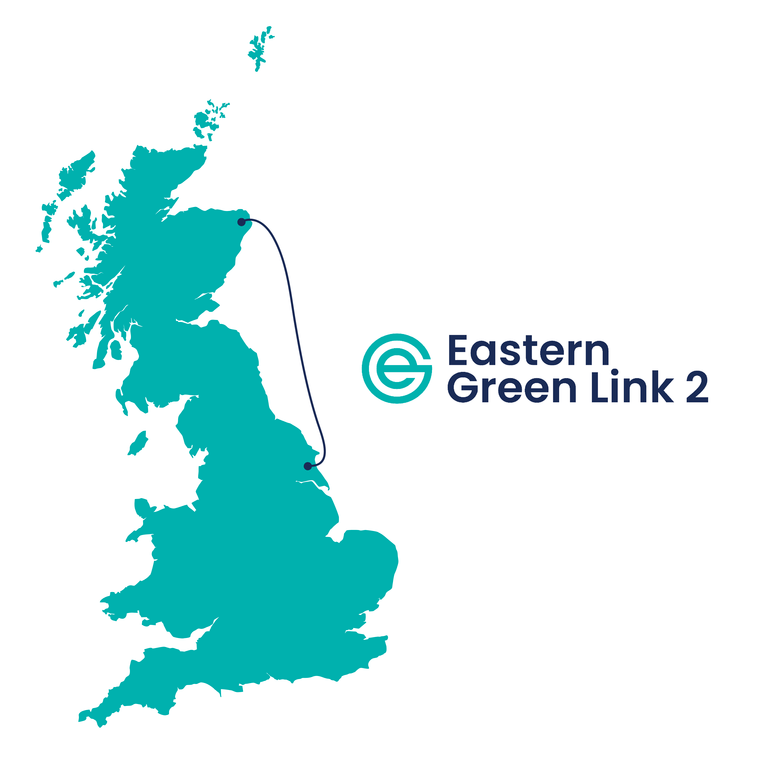
The Northern landfall is at Sandford Bay and the Southern landfall is at Wilsthorpe Beach.
This Google Map shows Sandford Bay and Peterhead power station.
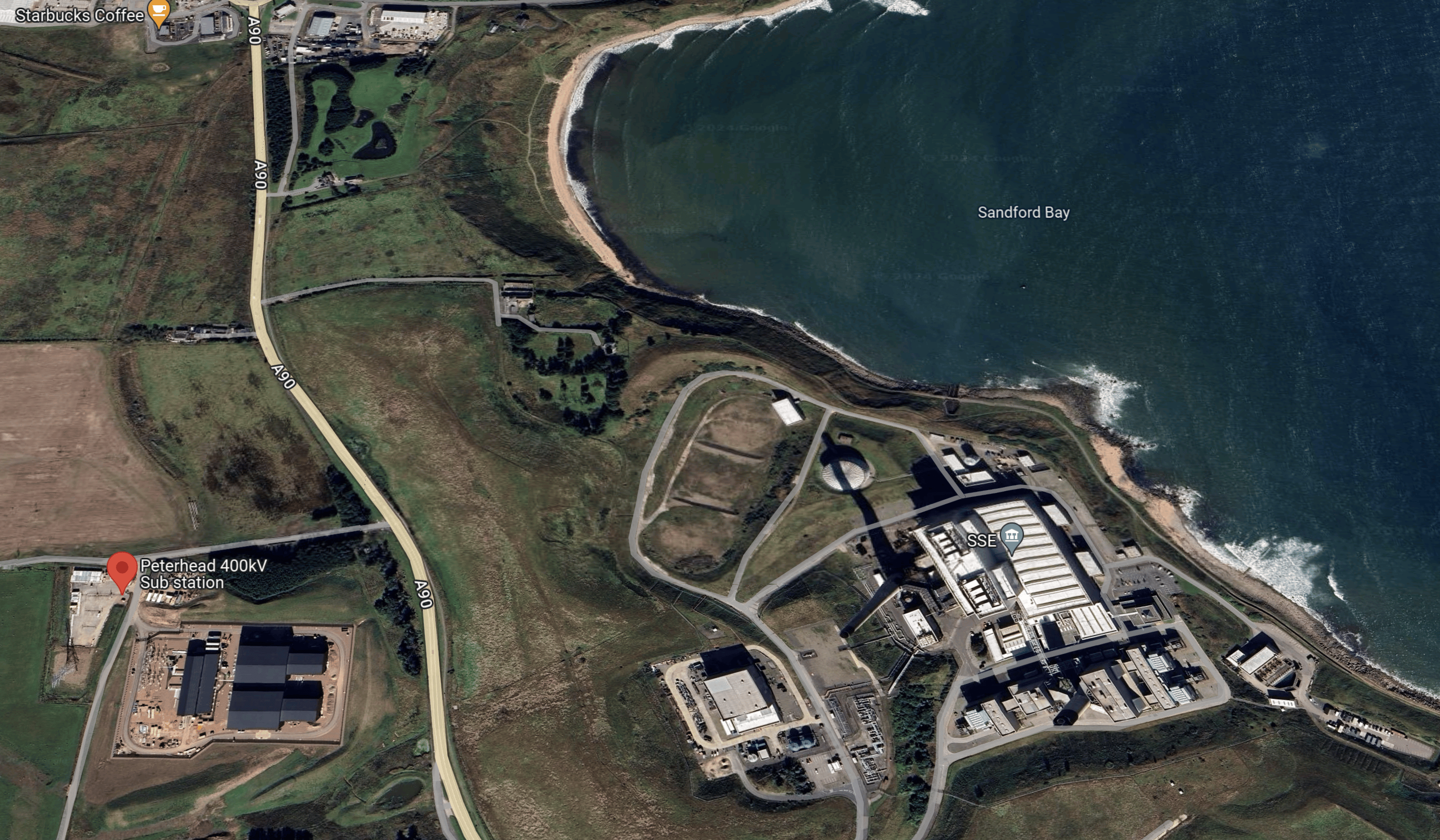
Note.
- Sandford Bay occupies the North-East corner of the map.
- The red arrow indicates the main 400kV sub-station at Peterhead.
- The 2177 MW gas-fired Peterhead power station is to the East of the sub-station marked as SSE.
This second Google Map shows the onshore route of the cable from Wilsthorpe to Drax.

Note.
- Flamborough Head is in the North-East corner of the map.
- Wilsthorpe Beach is at Bridlington a couple of miles South of Flamborough Head.
- The red arrow indicates Drax Power station.
- An onshore underground cable will be installed from landfall in Wilsthorpe to a new onshore converter station built in Drax.
The EGL2 HVDC cable connection from Scotland to England consists of 436km of submarine cable and 69km of onshore cable.
Both converter stations will be on existing power station sites and the major onshore works will be the underground cable between Wilsthorpe and Drax.
Where Does Drax Go From Here?
Currently, Drax power station is a 2595 MW biomass-fired power station.
There are now other large power sources that could replace some or all of the output of Drax power station.
- 2GW of Scottish wind power coming to Drax on Eastern Green Link 2.
- 6 GW of offshore wind is being developed at the Hornsea wind farms.
- 8 GW of offshore wind is being developed at the Dogger Bank wind farms.
- 2.5 GW from the three gas-fired power stations at Keadby, two of which are likely to be fitted with carbon capture.
- 1.8 GW from the proposed hydrogen-fired Keadby Hydrogen power station.
Given the bad feelings many have about Drax burning biomass, with 20.3 GW of electricity, you might think that shutting down Drax would be a simple solution.
But, according to Drax’s Wikipedia entry, it has a unique property.
Despite this intent for baseload operation, it was designed with a reasonable ability for load-following, being able to ramp up or down by 5% of full power per minute within the range of 50–100% of full power.
So Drax could be very useful in balancing the grid, by ramping up and down to fill the gap between production and need.
In addition, there is good biomass. This is from the Wikipedia entry.
A 100,000 tonne pa capacity straw pelletization facility was constructed at Capitol Park, Goole in 2008.
Drax are also promoting BECCS or Bioenergy carbon-capture and storage.
There is a Wikipedia entry for Bioenergy With Carbon Capture And Storage, of which this is the first couple of sentences.
Bioenergy with carbon capture and storage (BECCS) is the process of extracting bioenergy from biomass and capturing and storing the carbon, thereby removing it from the atmosphere. BECCS can theoretically be a “negative emissions technology” (NET).
I do feel that carbon capture and storage is a bit like sweeping the dust under the carpet, when you sweep the floor around it.
But carbon capture and use could be another matter.
This Google Map shows the Drax site.

Note how it is surrounded by agricultural land.
Could the power station be the source of pure carbon dioxide to be fed in greenhouses to flowers, herbs, salad vegetables, tomatoes and other plants?
I suspect there’s productive life left in Drax power station yet!
LionLink
LionLink, that is being developed by National Grid is a new type of interconnector, called a multi-purpose interconnector, that will connect Suffolk and The Netherlands via any convenient wind farms on the way. This means that the electricity generated can go where it is needed most.
I wrote about LionLink in World’s Largest-Of-Its-Kind Power Line To Deliver Clean Power To 1.8m UK Homes And Boost Energy Security.
Other Multi-Purpose Interconnectors
I can see other multi-purpose interconnectors like LionLink being built around the UK.
- There could be one across the Dogger Bank to link out 8 GW of Dogger Bank wind farms with those of the Dutch, Danes and Germans on their section of the bank.
- NorthConnect could be built between Scotland and Norway via some of the wind farms being developed to the North-East of Scotland.
- Could wind farms to the North of Ireland use a multi-purpose interconnector between Scotland and Northern Ireland.
- I can also see one or possibly two, being built across the Celtic Sea to link Devon, South Wales and Southern Ireland via the wind farms being developed in the area.
- Will we also see a Channel multi-purpose interconnector to transfer electricity along the South Coast of England?
Some of these multi-purpose interconnectors could be key to creating a revenue stream, by exporting electricity, to countries in Europe, that have a pressing need for it.
Conclusion
National Grid’s excellent plan will lead to the end of the practice of shutting down wind turbines. The spare electricity will be exported to Europe, which will surely create a good cash-flow for the UK. This in turn will encourage developers to create more wind farms in the seas around the UK’s coasts.
France’s First And Only Operational Floating Wind Turbine Gets Lifetime Extension
The title of this post, is the same as that of this article on offshoreWIND.biz.
This is the sub-heading.
Floatgen, the demonstration floating wind turbine installed at the SEM-REV offshore test site in France, has completed its planned five-year run but will operate for another five years as the demo project was decided to get a lifetime extension.
These are the first three paragraphs.
The floater, which consists of a 2 MW Vestas V80 wind turbine mounted on BW Ideol’s Damping Pool foundation, reached electricity production milestones several times since going into full operation in September 2018.
According to BW Ideol, Floatgen’s cumulated production has now surpassed 30 GWh, which the company ascribes to “the hydrodynamic properties and excellent sea-keeping capabilities” of its floating foundation.
Floatgen’s availability averaged 92.18 per cent between January 2021 and January 2024, with December 2023 standing out with a monthly production record of 922.026 MWh and a 61.96 per cent capacity factor, BW Ideol says.
Note.
- A three-year availability average of 92.18 % is surely very good.
- A 61.96 % capacity factor is better than most other floating wind farms, which are generally in the fifties.
With those figures, I suspect BW Ideol will be expecting, some orders soon.
This video shows a Floatgen being constructed.
An Excursion To Retford And Worksop
Today’s excursion was designed to be simple.
- Take an LNER train or a Hull Train to Retford station.
- Travel to Worksop station, have a look and take a few pictures.
- Travel back to Retford and take the first train back to London.
- In one if my two visits to Retford, have a look and take a few pictures.
- Talk to passengers and railway staff about what they felt about FirstGroup’s Proposed Sheffield Service, that I wrote about in FirstGroup Applies To Run New London To Sheffield Rail Service.
These were my thoughts and observations.
LNER’s Improved Ticketing
These pictures show the tickets that I bought.


Note.
- I bought my ticket to Retford from the Ticket Office at King’s Cross station.
- The ticket seller gave me a well-designed folder for the tickets.
- I was also able to buy my return ticket between Retford and Worksop on the LNER train to Retford. I’ve tried doing that before and it wasn’t allowed.
Making ticketing easier must be a good thing for passengers, staff and LNER.
£24.75 With A Railcard From King’s Cross to Retford
- The second picture shows my ticket to Retford.
- It cost me just £24,75 with my Senior Railcard.
- I also bought it about half-an-hour before the train left.
- I bought the ticket in the Ticket Office.
- I got a forward-facing window seat with an unrestricted view.
How much would the 145 mile and nearly three-hour journey have cost in a car?
I Missed My Connection At Retford Station
These pictures show my train to Worksop station in Platform 3 at Retford station, as I approached from the South.


Note.
The Northern Trains’s Class 195 train arriving on Platform 3 on the Sheffield and Lincoln Line.
- I arrived in Platform 2 at Retford station at 12:50
- There were three lifts or sets of stairs to negotiate between Platform 2 and Platform 3.
- It must take at least five minutes between the two platforms.
- One of the lifts was out of order and was being serviced by an engineer.
- There was no way, I could have caught the connection, which left at 12:51.
- At least one other passenger, had to wait the one hour and fifteen minutes I waited for the next train, which arrived at 14:03.
I feel that there needs to be a timetable adjustment here, so that as many passengers as possible avoid the long wait.
Retford Station
At least the long wait allowed me to take a lot of pictures and have a cup of coffee in the Costa Coffee on Platform 1.


Note.
- The toilets were immaculate.
- The Costa Coffee had friendly and professional staff, but only rudimentary gluten-free options.
- The station is fully step-free with four lifts.
- Platforms 1 and 2 on the East Coast Main Line can take a pair of five-car Class 802 trains, as Hull Train demonstrated.
- The Hull Train in Platform 2 was using the electrification.
- The station is in very good condition.
- The station is Grade II Listed.
This Google Map shows the station.

Note.
- The red arrow in the South-East corner are the low-level Platforms 3 and 4.
- The red arrow in the middle marks the low-level Platforms 1 and 2.
- Network Rail’s yellow Mobile Maintenance Train is visible in the siding opposite Platform 2.
- There is space around the platforms.
The station may have development possibilities. Especially, as there are signs of To Let over some of the buildings.
Ambitious Renewable Energy
Retford and Worksop are only eleven minutes away but there were a large wind farm and solar farms between the two stations.


Note.
- I was a bit slow on the uptake and missed the large wind farm.
- The strong sun was reflecting on the windows.
- They weren’t the best of photographs.
I had intended to take more and better pictures on the way back, but circumstances intervened.
This Google Map shows the wind and solar farms.

Note.
- The Sheffield and Lincoln Line going across the map.
- There are solar panels North and South of the railway.
- This is the Walkers Wood Solar Farm, which has a nameplate capacity of 27 MW.
- H M Prison Ranby is at the top of the map.
- The scars of the wind turbines are to the West of Babworth and the crematorium.
- At the moment, I can’t find any reference to the wind farm.
These wind and solar farms are probably a classic place to position a battery.
Prisons And Recycling
Worksop Station
I took these pictures during the time I spent at Worksop station.


Note.
- The station is not step-free, although you can cross the tracks using the level-crossing.
- The station has a pub and a cafe.
- There are train services to Leeds, Lincoln, Nottingham and Sheffield.
- The station is in very good condition.
- The station is Grade II Listed.
- The platforms are long enough to handle a Class 802 train without any modification.
- Hull Trains could run their Sheffield service to Worksop station without any new infrastructure.
- Lidl are developing a site on the other side of the level crossing.
- There are 100 car parking spaces.
The station may have development possibilities.
Worksop Station Cafe
These pictures show the Worksop station cafe.


Note.
- It is run by two ladies; Jo and Lyndsey.
- As one is coeliac, there were lots of gluten-free cakes.
- It was cosy and warm on a cold day.
This is definitely one of the better station cafes.
A Double Incident
My journey back to the capital was I suspect untypical.
- I’d arrived at Worksop at 14:14 and finally left at 16:38 on a train for Retford and Lincoln.
- The delay was because someone had been hit by a train between Barnsley and Sheffield, which resulted in cancelled trains.
- When I arrived at Retford at 16:49, there was an LNER train in the platform.
- It was the 15:15 from Leeds and I was told by LNER staff to catch it and get my ticket on the train.
- The train finally left Retford for London 69 minutes late at 17:07.
- We arrived in Peterborough at 19:27, where the train was now 170 minutes late.
- The delay was because someone had been hit by a train at Newark, which results in delays everywhere.
- LNER decided to give up on the train and all passengers were put on other trains.
- I got on the 14:30 from Edinburgh, which arrived in King’s Cross at 20:22, which was 96 minutes late.
Worse things happen at sea.
I am adding this a day after my trip to the North.
This article on the BBC is entitled ‘Major Disruption’ After Person Hit By A Train.
These are the first three paragraphs.
Train services on the East Coast Main Line have been seriously disrupted after a person was hit by a train in North Yorkshire.
Network Rail said the incident happened just before 07:00 GMT between York and Thirsk, with emergency services attending the scene shortly afterwards.
The line was blocked, resulting in delays and cancellations.
Three in two days us three too many.
Merthyr Tydfil Station – 28th November 2023
Yesterday, I went to South Wales to look at the progress of the South Wales Metro.
I took these pictures at the station and in the town.


Note.
- It is only a single-platform station.
- The platform and track appear to be reasonably flat.
- Several bay terminal platforms in the UK like four of those at Dalston Junction and Highbury & Islington stations near me are able to handle four trains per hour (tph).
- The Class 150/2 trains in the are 19.74 metres long and have a maximum capacity of 149.
- The new electric Class 398 tram-trains are 40.07 metres long and have a capacity of 252.
The platform appears to be long enough for the new trains.
These are my thoughts.
Capacity To And From Merthyr Tydfil
Consider.
- Currently, there are two Class 150/2 tph.
- This means current capacity is 298 passengers per hour.
- After electrification, there will be four Class 398 tph.
- This means future capacity is 1008 passengers per hour.
That is an increase of 238 % in the capacity.
Where Is The Electrification?
This OpenRailwayMap shows the proposed electrification at Merthyr Tydfil station.

Note.
- Electrified lines are shown in red.
- Unelectrified lines are shown in black.
- The railway is single-track until past Troed-y-Rhiw, after which it is double track to Merthyr Vale station.
- Between Merthyr Vale and Abercynon is single-track, with a short length of unelectrified double-track at Quaker’s Yard station.
It appears that the section of the Merthyr Line at Merthyr Tydfil station will not be electrified.
- The tram-trains’ batteries must be large enough to climb the unelectrified section .
- There must also be enough power to nudge the tram-train back down the hill, after the climb has been completed.
- At least the pictures show, that the track in Merthyr Tydfil station, is reasonably flat.
It looks to be a neat piece of cost-saving design.
Why Did I Feel Better In Merthyr Tydfil?
I have been feeling under the weather lately, but I felt a lot better in Merthyr!
Was it the altitude of 180 metres?
My cardiologist friend, says most people feel worse at altitude. But I seem to be the other way round.
My wife was certainly feeling rough, when I drove a car up to 13,000 feet in the Andes of Ecuador, whereas I was fine.
Incidentally, the car was coughing and wheezing like a good ‘un.
Portway Park & Ride Station – 10th August 2023
Portway Park & Ride station, opened on the first of this month, so I went to visit today.


Note.
- The Portway Park & Ride is served by both buses and trains.
- Buses serve the City Centre and rugby and football at Ashton Gate stadium.
- Trains serve Avonmouth, Bristol Temple Meads, Severn Beach, Weston-super-Mare and a large number of other Bristol stations.
The M5 crosses over the railway to the West of the station.
This Google Map shows the M5 and the Portway Park & Ride.

Note.
- The M5 goes diagonally SW-NE across the map.
- The wide river is the Avon.
- Portway Park & Ride with its station is in the middle of the bottom of the map.
- Avonmouth station is in the North-West corner of the map.
The Portway Park & Ride seems to be an extremely well-connected Park & Ride.
These are my thoughts.
Are There Any Other Park & Ride Sites, Where A Station Could Be Added?
Consider.
- I wrote about a possible new station at Leicester Forest East in A Station At Leicester Forest East.
- In A Look At New Station Projects, several possible Park & Ride stations are mentioned.
Has Portway Park & Ride been developed to see if sites served by buses and trains are a good idea?
Is Portway Park & Ride The Solution To Big Matches At Ashton Gate?
Consider.
- Ashton Gate Stadium has a capacity of 27,000.
- Wikipedia says that buses from Portway Park & Ride are used to bring supporters to games.
- The platform at Portway Park & Ride might be able to take a five-car Class 802 train for a big match.
I wouldn’t be surprised that Portway Park & Ride has been designed for large crowds at big matches at Ashton Gate.
A Pair Of Toilets At Peterborough Station
Coming back from Lincolnshire yesterday, I had a few minutes to wait for my train to London on Platform 3. As there was a sign to toilets, I thought I’d sort myself out before the train arrived.
I found two spacious identical unisex toilets.

If you were of any sexual orientation, in a wheelchair, needed a place to change a baby or just wanted a quick splash and dash, I don’t think, anybody would find a problem with this pair.
They were also scrupulously clean. But then most station toilets generally are these days. Earlier in the day, I’d used the toilets at Lincoln station and they were very clean too!
I do think that the quality and cleanliness of toilets has been one of the biggest improvements of train travel in the UK, in the last fifty years in the UK.
LED Lights Illuminate London’s Elizabeth Line
The title of this post is the same as that of this article on E & T Magazine.
This is the introductory paragraph.
Using LEDs to light up the stations, escalator shafts and concourses of the Elizabeth line was a bold move from Transport for London; especially as when they decided on its use back in the late 2000s, LED technology was yet to break into the lighting world.
These points are also made in the article.
- The Elizabeth line is one of the first sub-surface infrastructure projects to be lit entirely by LEDs.
- The decision to use the technology was based on industry evidence that its use will help reduce energy consumption and maintenance requirements.
- The Crossrail team used the light-grey, matt-textured, glass-reinforced concrete lining of the station and escalator tunnels to reflect light onto the passenger areas.
- The main lighting and the emergency lighting are incorporated in the wayfinding totems.
The article certainly explains how the excellent lighting was designed.
These pictures show some of the LED lighting on the Elizabeth Line.


Note that uplighters on the Underground are not new, as these pictures from Turnpike Lane station show.


They were installed in the 1930s and were also used on the Moscow Metro, where London Transport installed the escalators.
Lighting Can Calm Passengers
This is a paragraph from the article.
Both Kerrigan and Clements agree that the lighting infrastructure makes the Elizabeth line unique to all its predecessors seen across the London Underground and that they have met their goal to create a soothing environment to enhance the passenger experience. “We wanted to create a relaxed commuting environment that is the opposite to the poorly lit and cramped environment of the Central line, for example,” Clements admits. “And we believe that the lighting has a massive amount to do with this.”
Does this explain why passengers seem generally calm?
Passenger Behaviour On The Lizzie Line
The Elizabeth Line has been open for some weeks now and I am fairly certain it is true to say that I have yet to see any passenger behaviour, that even the most picky passenger would complain about.
I wonder, if this is partly down to the design of the stations, with wide platforms and passages and often two escalators in the direction passengers are travelling.


If you are not being jostled, as you are sometimes on the Underground, you’re surely less likely to react.
These pictures also show the wide entrances on the Central section.


Passengers do seem to get in and out without bumping into other.
The Quality Of The Ride On The Lizzie Line
This morning I went from Moorgate station to Paddington station on the Lizzie Line.
I was in a virtually empty car and I could gauge a good estimate of ride quality.
In my opinion, the gold standard in the UK for some time has been the British Rail Mark 3 coach.
- But Mark 3 coaches don’t always run on modern slab track, which must give a smoother ride.
- Each track under London also has its own tunnel, so there is no buffeting, when you pass a train going in the opposite direction.
- Acceleration is also very smooth, due to the high proportion of powered axles.
I am getting very close to naming the Class 345 train, as the new gold standard.
The New Entrance At Hackney Central Station – 2nd July 2022
The new entrance at Hackney Central station opened yesterday.


Note.
- The cafe must be fairly good, as it has two flavours of gluten-free brownies.
- I may have a touch of arthritis these days, but stairs like these are fine for me, as there are two right-handed paths.
- There is a second set of stairs down from the footbridge to speed passengers on their way to Hackney Downs station.
- There is a light-controlled crossing over Graham Road.
- Bus stops in both directions are only about twenty metres from the crossing.
- The station buildings appear to have green roofs.
- The is plenty of bike storage, but no car parking.
- There is no lift, although the design should allow one to be added later, if it is thought one is needed.
I’ve seen bigger budgets produce worse designed station entrances than this one.
My Use Of The Graham Road Entrance At Hackney Central Station
I suspect, I will use the new entrance mainly in one of two ways.
Going West On The North London Line
If I want to go west on the North London Line, the obvious one is to get a bus to Highbury & Islington station from the closest stop to my house and get the train from there.
But that route has got more difficult in recent years.
- Our South London Mayor in his wisdom cut the 277 bus back to Dalston Junction station.
- So there is only the 30 bus left and the route uses badly-designed Egyptian-built buses. I’ve nothing against Egyptians, but these buses don’t have the flat floor, that people expect from a bus these days.
- Since the roundabout was rebuilt, it seems to be a longer and more difficult walk for pedestrians.
So I’d prefer to take another route.
- Canonbury station is probably the closest station, but it is an uphill walk from my house.
- Dalston Kingsland station is a possibility, but the steps to the platform aren’t the safest.
- Dalston Junction station is another possibility, as it is step-free, but it means more changes of mode and train.
Going via the new Graham Road entrance has advantages.
- From my house, there are frequent 38 buses to the new entrance.
- The 38 bus stop at Hackney Central is only a few metres from the station entrance.
- There is a coffee stall in the station entrance.
- The steps in the entrance are easy for me.
I will try out this route the next time, that I go to the West on the North London Line.
Coming Home From Stratford With Shopping
If I need a big Marks & Spencer or a John Lewis, it is convenient to go to Eastfield at Stratford and come home on the North London Line.
I will usually use the The Canonbury Cross-Over to double-back and get a bus home from Dalston Junction station.
It is an easy route, but sometimes the trains mean a wait of nearly ten minutes at Canonbury station.
The new entrance at Hackney Central gives an alternative route.
- You would get in the back of the train at Stratford.
- Alight at Hackney Central.
- Exit the station through the new entrance.
- Cross Graham Road on the light-controlled crossing.
- Walk about twenty metres to the 38 bus stop.
- Wait for a frequent 38 bus.
Today, I waited just a minute.
Conclusion
The entrance was first mentioned in an article on Ian Visits in October 2019 and I wrote about it in Will Hackney Central Station Get A Second Entrance?.
In May 2021, I wrote £3m Hackney Overground Station Upgrade To Begin In June.
The entrance seems to have gone from a concept to reality in under three years and once the starting pistol was fired, it was built in under a year.
How many parts of the UK rail network could be improved, by small projects like this?