Gibb Report – Ashford – Hastings Route Should Be Transferred To The New Southeastern Franchise
The Gibb Report, says that the Ashford – Hastings route should be transferred to the new Southeastern franchise.
The Gibb Report says this about the operation of the route.
The Ashford – Hastings route is currently a service operated by 12 Class 171 diesel units, running as through services from Ashford / Hastings to Eastbourne and Brighton. The trains run empty to and from GTR’s Selhurst depot for maintenance. GTR’s 2018 Timetable consultation has proposed reducing the service back to Ashford / Hastings, and concentrating the fleet there to provide more capacity to relieve current overcrowding.
In my opinion this service in its new form, in December, 2018, should transfer to the new South Eastern franchise.Bidders for that franchise should be asked to include it, and identify the most efficient way to run the revised service, and maintain the trains in Kent or East Sussex rather than Selhurst. Other possibilities exist that bidders should explore, such as bi-mode trains and electrification.
Bidders will already be obliged to review arrangements for train maintenance and stabling as part of providing additional train capacity on South Eastern for the future. There are potential under utilised and rail connected depot facilities at Ashford and St Leonards, Hastings, that bidders will no doubt consider as part of their wider depot strategy.
It looks to me that this is not an efficient way to provide a service.
In Highspeed To Hastings, I outlined how Southeastern Highspeed services from St. Pancras would reach Hastings and Eastbourne. The most likely method seems to be by using a train with onboard energy storage, as bi-mode trains would have problems running with diesel in the tanks under London.
It should also be born in mind, that with the completion of the Ashford Spurs, that Ashford would become a more important stop for services going to and from the Continent.
So I suspect, there could be a strong case for a South Coast Express between Ashford and Bournemouth via Hastings, Eastbourne, Brighton, Portsmouth and Southampton.
This service could be a nightmare to organise, as it involves three franchise areas.
- Southeastern.
- Southern
- South Western Railway.
Bur several of my friends on the South Coast would benefit from such a service.
- The guy in Southampton, who regularly goes to Paris and Brussels.
- The guy near Chichester, who likes to visit his old school-friends in Brighton.
- People in Brighton, who would move to Hastings to take advantage of lower house prices and continue to work in Brighton.
Often people have to drive and they spend a long time on the South Coast’s incomplete road network.
Conclusion
Chris Gibb may be right, as regards Govia Thameslink Railway, but he is ignoring the wider picture.
Gibb Report – More Station Shelters Should Be Installed
The Gibb Report, says that more station shelters should be installed.
The Gibb Report says this about shelters.
When the decisions were taken to lengthen most services to 12 cars, and the trains were ordered, one element of the overall system was missed: the provision of shelters at stations. It is noticeable how, on wet days, peak passengers board together from places of shelter, causing overcrowding at that point and sub threshold delays at numerous stations. Most stations, whether large or small, do not have shelter along the full length of the platform, or a canopy. Even Gatwick Airport, is an example of this: fine on the sunny daypicture, but inadequate in the rain.
So it looks like the lack of shelters is a cause of train delays.
Conclusion
I have just watched the updating of the Gospel Oak to Barking Line, where several new shelters have been added.
I am very surprised GTR didn’t realise the importance of shelter for passengers.
Gibb Report – Gatwick Airport Station Should Be Transferred To Gatwick Airport
The Gibb Report, says that the Gatwick Airport station should be transferred to Gatwick Airport.
The Gibbs Report says this about the development of the station.
The scheme to provide additional concourse and platform capacity at Gatwick Airport has £120.5m assigned to it in CP5, with a £30m contribution from Gatwick Airport Limited (“GAL”).
Since the original concept was developed, the specification and costs have risen significantly, but not been matched by the budget, which has remained fixed. The outputs now fall far short of GAL’s expectations and ambitions, and do not meet Network Rail’s own Station Capacity Planning Guidance (2015).
The report then recommends that Gatwick Airport station, be sold to the Airport, with the Airport assuming responsibility for the development.
Conclusion
Chris Gibb makes a compelling case for the proposal.
How many other stations could be developed in this way?
There must be quite a few sporting, leisure and shopping venues, where a rail station lies inside or very close to the venue, where combining the station with a new development will be to everybody’s advantage.
In the GTR area, perhaps Falmer station should become part of the Amex Stadium.
Gibb Report – East Croydon – Milton Keynes Route Should Be Transferred To London Overground
The Gibb Report, says that the East Croydon – Milton Keynes route should be transferred to the London Overground.
By 2020 London will have two high-capacity and two medium-capacity cross-London heavy rail routes, backed up by several cross-London Underground Lines.
- Central Line – 30+ trains per hour (tph)
- District Line – 20+ tph
- Crossrail – 24 tph
- East London Line – 20 tph
- Jubilee Line – 30+ tph
- Metropolitan Line – 20+ tph
- Northern Line – 30+ tph
- North London Line – 16+ tph
- Piccadilly Line – 30+ tph
- Thameslink – 24 tph
- Victoria Line – 30+ tph
One line is missing from this list; the West London Line, which has a rather pathetic four tph between Clapham Junction and Willesden Junction stations.
Until Southern got embroiled in their Driver Only Operation dispute, there used to be a very useful one tph service between East Croydon and Milton Keynes Central stations.
The Gibb Report says this about the service.
I believe there is an option to transfer the East Croydon – Milton Keynes operation to TfL and it’s London Overground concession in 2018.
TfL may decide to change the service, for example by not running it north of Watford Junction, or running it to an alternative southern destination other than East Croydon. They could also develop the combined West London line service to better match available capacity to demand.
They would have a number of crewing and rolling stock options, but should be able to operate the service more efficiently than GTR in the longer term, without the involvement of Selhurst.
Selhurst TMD is the depot in South London, where the current Class 377 trains are based.
I think that this is a good proposal for the following reasons.
- As was seen on the Chingford Branch Line, London Overground have a reputation for making a good fist of taking over services that need improvement.
- As the Gibbs Report says, the combined West London Line service could be developed.
- I have net quite a few people, who use this West London Line route to get to and from events at Wembley stadium.
- The service could call at Old Oak Common station to connect to Crossrail and HS2.
- A variant of London Overground’s new Class 710 trains, could probably work the shortened route, as either four or eight-car trains.
- The Class 710 trains could be based at the convenient Willesden TMD, along with the rest of the fleet.
Being practical, a service of just two tph would give a train every ten minutes on the West London Line.
The Current Service
The current service is supposed to stop at the following stations.
- Bletchley
- Leighton Buzzard
- Tring, Berkhamsted
- Hemel Hempstead
- Watford Junction
- Harrow & Wealdstone
- Wembley Central
- Shepherd’s Bush
- Kensington (Olympia)
- West Brompton
- Imperial Wharf
- Clapham Junction
- Wandsworth Common
- Balham
- Streatham Common
- Norbury
- Thornton Heath
- Selhurst
Note.
- Stations between Watford Junction and Clapham Junction, already have a substantial Overground presence.
- London Overground already run three tph on the Watford DC Line between Euston and Watford Junction stations.
But would this be the ideal route?
The Northern Terminal
The West Coast Main Line is very busy and stations between Watford Junction and Milton Keynes are well-served by London Midland and Virgin Trains.
So would it be sensible to continue a slower local service North of Watford Junction?
It should also be remembered, that Southern introduced the original service to give better access to Gatwick Airport. Surely, this need is now satisfied by services from Clapham Junction and East Croydon.
As Watford Junction station probably has platform capacity, surely Watford Junction should be the Northern terminal
Could The Service Use The Watford DC Line?
If this were possible, this must surely give advantages, especially if Watford Junctio is the Northern terminal.
- Dual-voltage Class 710 trains could work the route.
- The service level on the Watford DC Line would be increased.
- There would be no problem accessing the bay platforms at Watford Junction station.
- There would be no requirement for any paths on the West Coast Main Line.
I think the answer to whether the Watford DC Line could be used at the present time is that trains going from the West London Line to Watford Junction must use the West Coast Main Line.
This map from carto.metro.free.fr shows the lines around Willesden Junction..
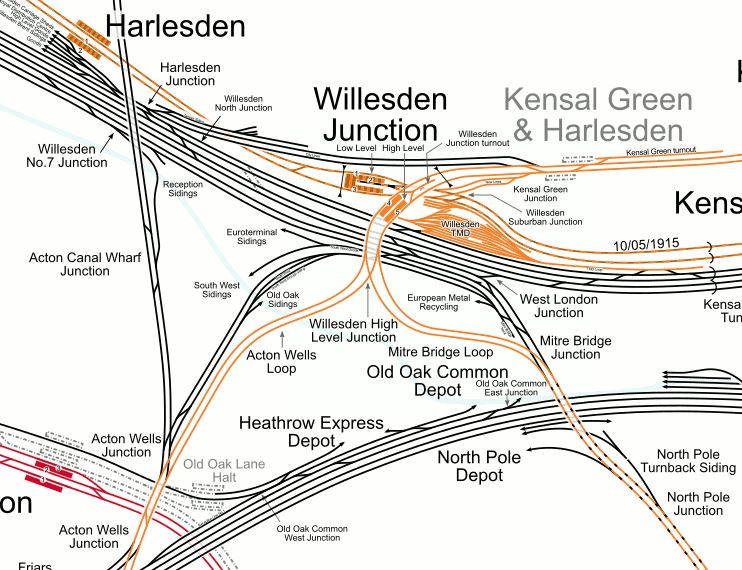
As it is all railway land, I suspect that the connection can be created.
The one problem, is that some of the Watford DC Line is shared with the Bakerloo Line.
But as the Bakerloo Line is being extended to the South and the Northern end will probably be improved, then surely creating an optimal solution to the Watford DC line, the Bakerloo Line and Overground services to Watford, makes a lot of sense.
The Southern Terminal
Various stations have merits and problems to be used as the Southern terminal for the service.
Clapham Junction
Clapham Junction would appear to have a strong case, but London Overground had enough problems squeezing in their current services.
As the station is now substantially step-free and has typically three tph to Gatwick Airport, Clapham Junction offers a good route to the airport.
Balham
Balham has been used as a terminal in the past and connects to the Northern Line. If redeveloped for Crossrail 2, it could be a possibility.
Steatham Common
Streatham Common could be developed as a major interchange and if this happens, then surely is is a possibility.
East Croydon
East Croydon would have a strong case, as it is a busy and well connected station, but there probably isn’t a suitable platform.
I think that any station South of East Croydon is probably too far.
My money would be on the new interchange station at Streatham Common, with Balham as an alternative.
Schedules And Trains
I estimate that a train doing a return journey between Watford Junction and Streatham Common would take under three hours, using the Watford DC Line. This would mean that three trains would be needed for an hourly service and six trains for a half-hourly service.
Conclusion
Transferring the East Croydon – Milton Keynes route to the London Overground looks feasible.
Reading The Gibb Report
The Gibb Report on the problems affecting GTR is entitled Changes To Improve The Performance Of The Southern Network And Train Services, And rRstore Passenger Confidence.
It is a weighty document that is well worth reading.
The document can be downloaded from here.
I shall write each of my comments as single posts, so that those looking for how their station or route will be effected, will only have to read what is relevant.
These are my various posts.
Ashford – Hastings Route Should Be Transferred To The New Southeastern Franchise
East Croydon – Milton Keynes Route Should Be Transferred To London Overground
Gatwick Airport Station Should Be Transferred To Gatwick Airport
Moorgate Services Could Be Transferred To The London Overground
More Station Shelters Should Be Installed
Last ‘319s’ On Thameslink This Summer
The title of this post is the title of an article in the May 2017 Edition of Modern Railways.
This is the first paragraph of the article.
Govia Thameslink Railway plans to withdraw its last Class 319s by the end of June, allowing it to operate a full Class 700 service on Thameslink this summer.
According to Wikipedia on the 28th April 2017, Thameslink still have thirty-five examples (319/0 – 13 and 319/4 – 22) and there are twelve examples Off Lease (319/2 – 1,319/3- 6 and 319/4 – 5)
So it looks like there could be a maximum of forty-seven trains released, of the following types.
In Riding In A Clean Class 319/4 Train, I wrote about riding in a particularly nice Class 319/4 train. If any of the other twenty-six are in as good a condition, operators will want to take them over.
There’s certainly enough trains to keep the refurbishment line busy for four or five years.
There is also plenty of scope for speculation about the specification of the refurbished trains and where the trains will see service.
- How many will end up as bi-mode Class 319 Flex trains?
- How many will retain their third rail capability?
- How many will retain their First Class seats?
- How many will get wi-fi?
- How many will end up in a reserve fleet to cover for train shortages? Think level crossing accidents!
- Will any have a luxury interior, so they can be used as special event trains and shuttles? Think Edinburgh to St. Andrews for the Open or Manchester to Aintree for the Grand National!
- Will any be bought for use in non-passenger roles? Think 100 mph parcel carriers bringing goods into and out of big city stations at three in the morning!
- Will any be bought by Network Rail for engineering purposes? Think testing and checking overhead and third-rail electrification!
Uses will be demand-led and I suspect some will be very surprising.
Operators have never had a train that is both a 100 mph electric train and a 90 mph diesel train, which is available, affordable and proven.
I shall discuss a few of the ideas in detail.
Parcels Trains
Currently, Royal Mail uses the closely-related Class 325 trains to move parcels traffic around the country. These trains have the following specification.
- They are four-car electric units.
- They can run as four, eight and twelve car units.
- They are 100 mph dual-voltage trains.
- Each car can carry twelve tonnes.
- They use the same running gear as the Class 319 trains.
If they have a problem it is that they can only run on electrified lines, so they seem to be confined to the West and East Coast Main Lines.
Royal Mail and their train operator DB Cargo UK, might be interested in some more trains. They might even have use for some Class 319 Flex trains for routes with no or partial electrification.
In A Station At Doncaster Sheffield Airport, I talked of Peel Group’s plans to develop the Airport.
I said this.
It should also be stated that Doncaster Sheffield Airport has air cargo ambitions.
Consider.
- It has a massive runway, that was able to accept the Space Shuttle in an emergency.
- The airport has lots of space for cargo terminals.
- The largest cargo planes, that exist only in the minds of Airbus and Boeing engineers would be welcome.
- The Great Northern and Great Eastern Joint Railway, which is a major freight route between the South East and the North passes the airport.
- Plans exist to create a network of high speed package carrying trains. I’d use Doncaster Shjeffield Airport as a hub.
- Amazon already fly freight to and from the Airport. Deliveries could leave the United States in the evening and be in Edinburgh, Glasgow, Liverpool, London and Manchester for a morning delivery.
It looks like the Peel Group have a plan to create a transport interchange for both passengers and freight for a cost of millions, not billions. But it were to be worth spending billions, I’m certain that they can obtain it.
Could Class 319 trains be the trains delivering the parcels to main-line stations all over the country for onward distribution?
There must also be specialist and possibly perishable cargoes like fish and flowers, perhaps between Cornwall and London. Some of the cargoes now go in the large space in the locomotives of the InterCity 125s , but these trains are being phased out.
Could a Class 319 Flex train substitue with honour?
The Luxury Go-Anywhere Shuttle Train
Look at the venues for the Open Championship and they seem to be tucked away. But supposing there was an all Class 319 Flex train fitted with all First Class seating and a bar, it would make a very good alternative to get spectators to the venue in style.
Other venues within the trains range would include.
- Aintree, Ascvot, Chelternham, Doncaster, Epsom, Goodwood, Haydock Park, Newbury, Newmarket, Sandown Park and York racecourses.
- Glastonbury for the Festival
- Henley for the Regatta.
- Important football and rugby matches.
Travel First Class in any InterCity 125 and you realise the standard that can be applied to a Mark 3 coach.
Reserve Trains
Greater Anglia are often short of a train or two, with the cause often being a level crossing accident.
Their way round the problem is to hire in two Class 68 locomotives and some elderly coaches.
But surely, a better way, would be to have an appropriate number of Class 319 Flex trains available for hire with a driver!
They could deputise for a 100 mph electric train and an up to 90 mph diesel train.
Network Rail Use
Network Rail have a highly-instrumented InterCity 125 called the New Measurement Train, which is used to test the condition of the tracks all over the UK.
But it can only test those tracks where an InterCity 125 train is allowed.
If Network Rail ever need to create a smaller version of the train and especially one to test both overhead and third-rail electrification systems, a Class 319 train would be a candidate.
Conclusion
Porterbrook’s Sales and Marketing Department are going to have fun!
Laura Kuenssberg On The Southern Rail Dispute
This article on the BBC by Laura Kuenssberg is entitled The politics behind the Southern rail dispute.
It is a must-read for everyone who uses trains to get to and from work or for important journeys.
This is said.
One former senior minister tells me that “successive secretaries of state” in charge at Transport have wanted to “get rid of guards on trains”. The ambition is to bring down the cost of rail travel for the tax payer and the train passenger.
With that considered to be a long term ambition, it’s no surprise that the RMT, the only union that represents guards, wants to fight this every step of the way. Union sources deny it, but it’s suggested that they have dug in in this dispute, because if they lose it, they also lose a big chunk of their industrial muscle.
If there have to be guards on trains, a strike works if they walk out. If services can run with drivers on their own, their power to disrupt would be reduced. It’s worth noting that the RMT has more than 80,000 members, nearly ten times as many as the drivers’ union, ASLEF. It’s ASLEF that has agreed to meet Southern for talks tomorrow.
So like it or not the traditional guard is going the way of the dinosaurs.
Can rail passengers and hard-pressed tax-payers afford to pay for a vanity job, which if abolished would result in no loss of employment, but as Laura points out, a considerable loss of industrial muscle.
It is interesting to look at the future in the shape of Merseyrail’s new trains, that I wrote about in Thoughts On Merseyrail’s New Trains.
- The trains will be designed to fit the platforms for step-free entry and exit for all passengers.
- The trains will be designed for as high a level of passenger safety as possible.
- The trains will have a high degree of automation.
- Automatic Train Operation may be implemented in the Loop Line under Liverpool.
The trains will be designed for Driver Only Operation. This article on the BBC, which is entitled Merseyrail driver-only trains: RMT sets guards decision deadline.
This is said.
A train operator has two weeks to give “cast-iron” assurances that guards will be retained or risk dispute, rail union RMT has said.
I have a feeling that Merseyrail have been cunning here and that as it is three years before the trains run, natural wastage and other factors, will mean that the second men and women on the trains by 2020, will be running under new contracts.
Liverpudlians like a good fight and I have a feeling that in this dispute the RMT and its guards will be severely outnumbered.
Strikes, Carnage and Threats
The title of this post is the same as that of an article in Rail Magazine, about the strikes on Southern.
I won’t pass any opinion and urge you to read the article.
Driver Only Operation Problems On The London Overground
This article in the Hackney Gazette is entitled Highbury-bound trains disrupted every day for Overground commuters.
As the East London Line trains share tracks with Southern trains, to the South of the Thames, the delays are caused by the Driver Only Operation dispute on that network.
Perhaps we need a referendum!
Has Sadiq Khan Got His Sums Right?
This article on the Rail Technology web site, which is entitled Underground set to undergo biggest capacity expansion ever, is a good summary of Sadiq Khan’s plans for Transport for London.
It’s All About Cash Flow
I am unsure about the plans, as it seems to me that a there is a lot of money to find in two years less to fund the building of the Bakerloo Line Extension.
So there is the double whammy of the fare freeze and accelerated construction!
Crossrail And Thameslink
I also think that Crossrail will contribute some of this money and because it is properly designed, it will stimulate growth in areas like Canary Wharf, Farringdon, Old Oak Common, Paddington, Romford and West Drayton, to name a few places.
The same however, can’t be said for Thameslink.
- It doesn’t serve many areas ripe for development.
- As it is not a TfL route like Crossrail, it won’t generate anything like the same fare revenue.
- Thameslink could turn out to be too much of a long-distance commuter line.
- Govia Thameslink Railway’s first loyalty is not to London.
On the whole, I don’t think it will benefit London as much as Crossrail will.
The Underground
Until I learn otherwise, I do think that the engineers of the Underground, may have thrown the Mayor a few lifelines.
- It would appear that the Victoria and Jubilee Lines can go to 36 trains per hour (tph).
- By raising the voltage and installing automatic train control on the sub-surface lines, there can be a 33 % increase in capacity.
- New Piccadilly Line trains will be ordered in 2017.
One and two, should happen easily and if the design is right, three could be a big game-changer.
But the problem, is that although these will generate cash flow in the long term, only 36 tph on the Victoria Line will happen in the near future.
I also feel, that although the capacity of the Victoria Line can easily be increased, will the stations be able to cope. Highbury and Islington, Oxford Circus and Victoria are not mentioned in the article.
All of these trains and passengers will also generate lots of heat and although Crossrail is designed to handle the watts, the deep-level Underground trains and stations were not.
This might mean a route change by passengers from older lines to Crossrail, which could have various effects.
The Non-Devolution Of Rail Lines To TfL
I have a feeling that the figures show that this is very much neutral to TfL’s finances, as some of the routes need a lot of money spent on stations and new trains. But under the new arrangement, TfL will probably have more say in service quality on the lines, than they do now.
Good Design Of The Bakerloo Line Extension
There must surely be scope to save more money in the design of the Bakerloo Line Extension. But I suspect that most of the easy savings have already been found.
However, I wouldn’t be surprised to see a radical design for the extension come out at a late stage. But this is less likely, as because the line is an extension, it must be compatible with the existing line.
The Petty Cash
I think that where the Mayor might make up the shortfall is in the smaller things, that people forget.
For example.
- Expansion of the Night Tube to all lines, the Drain and the Overground.
- Tactical and expanded contactless ticketing.
- Better train scheduling.
- Expansion of the Gospel Oak to Barking Line and the Barking Riverside Extension.
- Expansion of the East London and Lea Valley Lines.
- Extra stations and station entrances.
- Development of Old Oak Common.
But some things already proposed will be tricky.
- I don’t think that he’ll save the money he wants on staff.
- Politicians always overestimate what they’ll earn from property development.
- You can only build so much affordable housing.
- Developers might find building housing just outside London is more profitable.
- The Mayor could have Union trouble.
There are probably a lot more where these came from.
Conclusion
With Brexit and Trump, there is a possibility of a drop in passenger numbers and income, which could derail everything.
It will be a close run thing.
 The Anonymous Widower