Great British Railways And Private Sector To Compete For Ticket Sales
The title of this post, is the same as that of this article on Railway Gazette.
This is the introductory paragraph.
The Department for Transport has announced that the future Great British Railways will sell tickets online, while retaining a ‘thriving’ private sector market where third party ticket retailers can compete in an ‘open and fair’ manner.
I would certainly like to see more innovation in the selling of rail tickets.
A few things I would like to see in ticketing include.
Ticketing Machines At Busy Interchanges
When, I wrote My First Trip On The Northumberland Line – 18th December 2024, I bought my Lumo ticket between Kings Cross and Newcastle at King’s Cross and needed to buy my ticket for Ashington at Newcastle station.
There is no ticket machine on the long walk between where Lumo trains arrive and leave and the Northumberland Line.
This is a common problem and someone needs to design a ticketing machine for interchanges to simplify the changing of trains for passengers.
Stations that need such a machine include.
- Clapham Junction on the bridge.
- Ipswich on the central platform.
- Leeds on the bridge.
- Reading on the bridge.
It should be noted, that in some cases train staff will sell you a ticket, which gets round the problem. But other train companies are getting tough on revenue enforcement.
These ticket machines could be provided by Great British Railways or a private company.
Automatic Freedom Pass Extension
If I don’t want to buy a physical ticket for Gatwick Airport, I can use my Freedom Pass to East Croydon. Then I exit the station and come back in using a credit card or my phone. I then exit at Gatwick, using the method I used to reenter at East Croydon.
But wouldn’t it be so much easier, if I could link a credit card to my Freedom Pass, so that the charge for East Croydon and Gatwick Airport was automatically charged to my credit card.
Collection Of Tickets
In Collecting National Rail Tickets, I had a moan at Transport for London about their unwillingness to provide facilities for passengers to pick up National Rail tickets.
This was their unfriendly notice at Tottenham Court Road station.
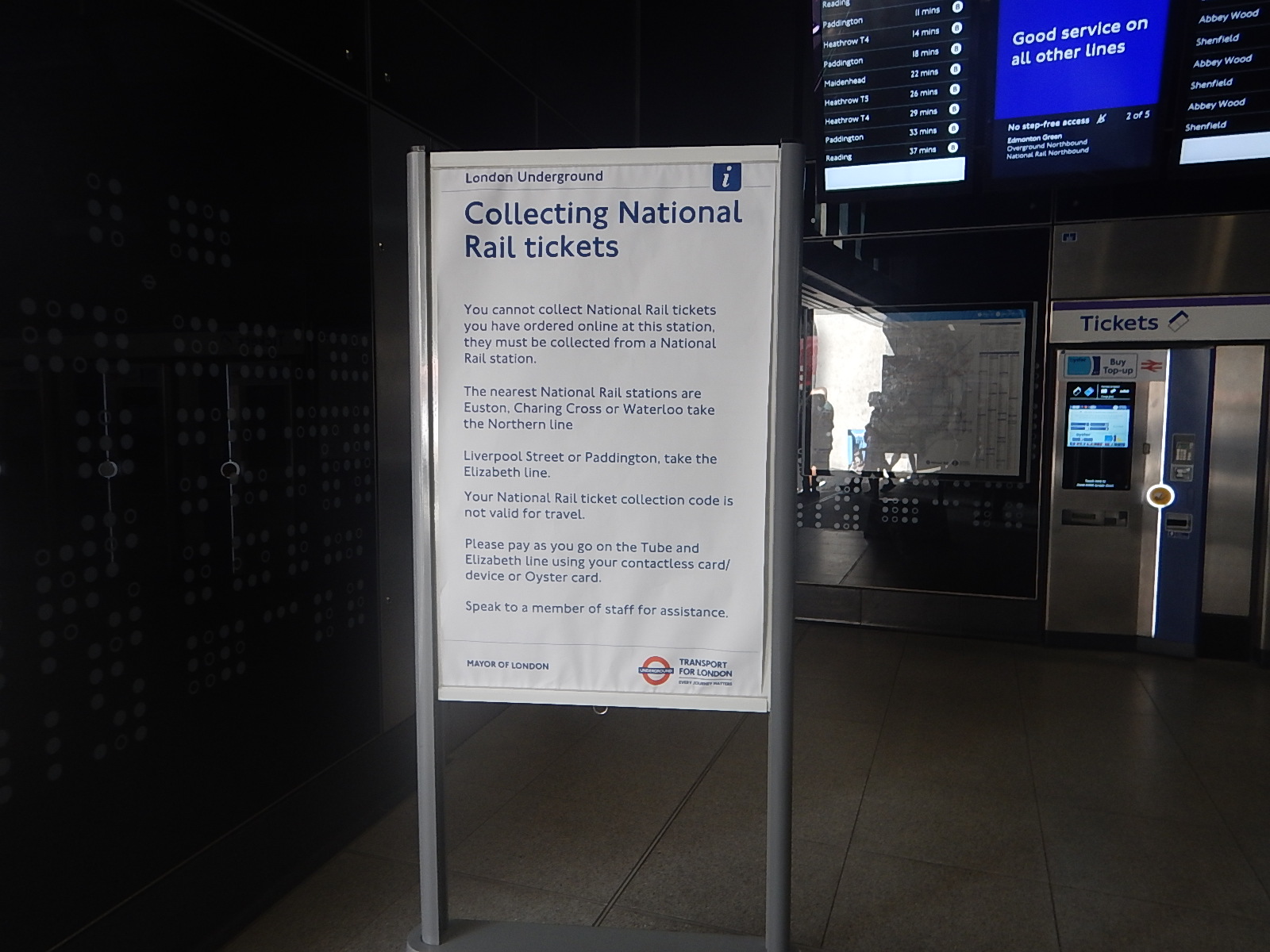
Facilities should be provided in many more places, where passengers can pick up rail tickets bought on-line.
These ticket collection machines could be provided by Great British Railways or a private company.
Scotland To Get New Intercity Fleet
The title of this post is the same as that of this press release from Transport Scotland.
These eight paragraphs make up the body of the press release.
The Scottish Government announced today that procurement will begin to replace the trains in its Intercity fleet.
The procurement will seek a replacement for the High Speed Train (HST) fleet of 25 trains which operates on its InterCity routes between Glasgow, Edinburgh, Aberdeen, and Inverness.
Cabinet Secretary for Transport, Fiona Hyslop said:
“Resilient, reliable ScotRail services are key to encouraging more people to choose to travel by train for work, leisure and learning.
“Over 4 million passengers travelled on InterCity trains between our key cities in the last year – we want to encourage even more people to do so. This procurement will enable us to replace the current Intercity fleet with trains which provide improved facilities and accessibility.
“Any replacement fleet is expected to be more energy efficient and therefore will significantly reduce emissions, reduce operating costs and be more in line with current passenger expectations, including for accessibility. The procurement process ensures Scottish suppliers will be able to offer to provide their services to potential bidders.
“This latest milestone in our rolling programme of decarbonisation will ensure the reliability of our Intercity routes for the long-term, making Scotland’s railway a more attractive and greener travel choice.”
Further details on this announcement will be shared when the contract is awarded in 2025. It is also expected that the refreshed Decarbonisation Action Plan will be published in Spring 2025, and this will detail updated targets for replacing ScotRail’s existing diesel fleets.
It is a press release full of good intentions, but very few facts.
Is this what Scots get from their political party?
I have a few questions.
Will The Trains Be Built In The UK?
This must surely give some advantages, but will it get the best trains at the best price?
What Will Be The Number And Capacity Of The Trains?
Transport Scotland could go for a like for like number and capacity replacement.
- But there have been capacity problems in Scotland, which have meant using diesel Class 153 trains as baggage cars.
- They might also want to add extra services.
- Will they replace the train lost at Stonehaven?
They could add a few options.
Other Companies May Need Similar Trains
Consider.
- GWR will need to replace their similar Castles.
- CrossCountry will need new trains.
- Grand Central will need new trains.
- South Western Railway may need new trains for services between Cardiff and Devon.
- Transport for Wales may need new trains.
Hull Trains and Lumo have recently ordered a selection of new Hitachi Class 802 and 803 trains, which I wrote about in Fourteen New Trains To Drive First Rail Open Access Growth.
I can see an argument for buying more Hitachi Class 80x trains, as it will surely save Great British Railways costs in the long time.
Should The New Trains Be A Forever Solution?
When British Rail electrified to Brighton, Crewe, Edinburgh, Glasgow, Leeds, Liverpool, Manchester, Newcastle, Norwich, Portsmouth, Southampton, Weymouth and many other places from London, they saw it as a mode of traction, that would be used forever.
As the trains wore out or got outdated, they would be replaced with trains, which at least could run using the same mode of traction.
Generally, on electrified routes, when British Rail’s electric trains have been replaced, they have been replaced by more modern new electric trains.
The one major exception was on the East Coast Main Line where some InterCity 225 trains were replaced with Hitachi Class 800 and Class 802 diesel bi-mode trains.
But as the Class 800 and Class 802 diesel bi-mode trains were also replacing InterCity125 trains, they were a pragmatic replacement.
The Hitachi trains can be considered a Forever Solution, as bi-mode trains will always be able to work some routes that will never get electrified.
But Hitachi are developing the successor to their diesel bi-mode train, which is the tri-mode train, capable of running on electrification, diesel or battery power.
- Diesel power-packs can be swapped for battery packs.
- The battery packs have the same weight and power as a diesel power-pack.
- Existing diesel bi-mode trains can be converted to tri-mode or battery-electric bi-mode trains.
- A range of over forty miles on a single battery pack has been demonstrated.
Could Hitachi tri-mode trains be The replacements for the Inter7City trains?
Will Some Trains Have A Battery Electric Capability?
I very much believe so, as some routes in Scotland could be decarbonised by battery-electric trains.
What Top Speed Would The Trains Have?
Most of the routes in Scotland, where new modern quality rolling stock is needed, has a top speed of less than 100 mph, but in places the top speed is 125 mph.
I suspect, if trains can run at 125 mph in the places, where it is allowed, could probably save a few minutes on journey times.
Take the Borders Railway.
- The electrification runs out at Brunstane. Batteries would be charged between Edinburgh and Brunstane using the existing electrification.
- To go from Brunstane to Tweedbank and return to Brunstane is 63 miles.
- To work the Borders Railway would need a battery range of 63 miles.
I suspect every route in Scotland could have an electrification strategy for use with battery-electric trains. Some of which would have short lengths of extra electrification.
What Lengths Would The Trains Be?
In my example I used the Borders Railway.
A typical service is run by a three-car Class 170 train or two such trains running as a pair.
Perhaps, a single four- or five-car train could work the service all day and still provide enough capacity?
Conclusion
I believe, that Scotrail services could be electrified line-by-line.
Some lines would need more or longer trains and an update to the electrification.
Battery Train Fast Charging Station Tested
The title of this post, is the same as that of this article on Railway Gazette.
This is the first paragraph.
A prototype Voltap rapid charging station for battery trains has been tested under real-world conditions for the first time.
The Voltap system is from Furrer + Frey and this is the data sheet on their web site, which is entitled Voltap Charging Station For Battery Trains.
Looking at the pictures in the article, the system seems to consist of two components.
- An overhead conductor rail suspended from pantries on the platform.
- A container that contains all the power supplies and control systems.
It certainly looks to be a simple system to install and operate.
- Charging would appear to take place through the pantograph, with no cables to handle.
- It is claimed to be able to charge a train in an extremely short time.
- The system is designed for areas, where the electricity network is perhaps a bit weaker.
- It is available in 15 KVAC and 25 KVAC.
- The system is future-proofed.
I can see these being suitable for several stations in the UK.
Norfolk And Suffolk
As an example, it looks like all the branch lines in Norfolk and Suffolk could be made suitable for battery-electric trains with Voltap systems at Cromer, Felixstowe, Lowestoft, Sheringham, Sudbury and Yarmouth.
Note.
- The Class 755 trains would be converted to battery-electric trains.
- Some stations would need more than one platform to have a charger.
- There may be other chargers to ensure that services like Norwich and Stansted Airport could be run electrically.
These pictures show Class 755 trains in various East Anglian stations.

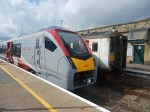
Felixstowe and some other stations may need a slightly different installation due to the narrow platforms, but I’m sure Furrer + Frey have installations for all platforms.
I think Great British Railways are going to need a lot of these chargers and the battery-electric trains to go with them.
The Uckfield Branch
The Uckfield Branch probably needs to have some form of charging at Uckfield station.

The picture shows the single long platform at Uckfield station.
Consider.
- Trains to work the branch will need to be able to use third-rail electrification between London Bridge station and Hurst Green junction.
- Hurst Green junction to Uckfield station and back is probably too far for a battery-electric train, so charging will be needed at Uckfield station.
- Third-rail charging could be used, but I suspect that Health and Safety will say no!
But using a dual-voltage train and a Voltap system at Uckfield station would probably be ideal.
Middlesbrough
From December the 13th, LNER will be running a new daily service between Middlesbrough and London, which I described in LNER’s Middlesbrough And London Service Starts On December 13th.
The route is fully electrified except for between Middlesbrough and Longlands Junction, where it joins the electrification of the East Coast Main Line, which is a distance of twenty-two miles.
Hitachi are developing a battery-train, which they call the Hitachi Intercity Tri-Mode Battery Train, which is described in this Hitachi infographic.

Note.
- LNER’s current Class 800 trains will probably be able to be converted to this train.
- Normally, these trains have three diesel generators.
- A range on battery power of upwards of forty miles would be expected.
If the range on battery-power can be stretched to perhaps sixty miles, this train should be capable of serving Middlesbrough without the need for any extra charging at the terminus.
I have just looked at the planned path of the first train on December 13th.
- The train comes from Heaton depot in Newcastle via Sunderland and Hartlepool.
- It passes through Middlesbrough station.
- It then reverses amongst the chemical and steel works to the East, before returning to Middlesbrough station.
Once back at Middlesbrough station, it waits for eight minutes before leaving for London.
It looks to me to be a safe route, to make sure that the train leaves on time. It also only occupies the platform at Middlesbrough station for less than ten minutes.
But it would also be possible to find space amongst the chemical and steel works to find space for a well-designed reversing siding with refuelling for the diesel-electric trains or a Voltap charging system for a battery-electric train.
Lincoln
I have been looking at the pattern of LNER’s London and Lincoln service today.
- There have been six trains per day (tpd) in both directions.
- Trains going North take up to seven minutes to unload passengers at Lincoln station before moving on to Lincoln Terrace C. H. S., which I would assume is a convenient reversing siding.
- Trains going South wait up to thirty-forty minutes at Lincoln station after arriving from Lincoln Terrace C. H. S., before leaving for Kings Cross.
It looks to me, that if London and Lincoln were to be run by a Hitachi Intercity Tri-Mode Battery Train, that the timings would be ideal for charging the batteries on the train in either the reversing siding or the station.
But surely, the charging system in the station would allow extension of the service to Grimsby and Cleethorpes, which has been stated as being part of LNER’s plans.
This picture shows Lincoln station.

I suspect that Swiss ingenuity could fit a Voltap charging system in the station.
These are a few distances from Lincoln station.
- Cleethorpes – 47.2 miles
- Doncaster – 35.4 miles
- Newark North Gate – 16.6 miles
- Peterborough – 56.9 miles
How many of these destinations could be reached by a battery-electric train, that had been fully-charged at Lincoln station.
The London And Edinburgh Travel Market
This paragraph comes from of this article on Railway Gazette.
Lumo is aiming to carry more than 1 million passengers per year. It is particularly targeting people who currently fly between Edinburgh and London; in June it says there were 74 764 air journeys on the route, compared to 82 002 by rail.
Lumo’s million passengers per year, will equate to around 83,300 passengers per month.
What these figures don’t show is the number of rail journeys made to intermediate stations like Newcastle, York, Doncaster and Peterborough.
These are a few thoughts.
Rail Capacity Between London And Edinburgh
Consider.
- LNER is currently the only rail carrier offering a daytime service between London and Edinburgh.
- LNER run approximately 26 trains per day (tpd) in both directions between London and Edinburgh.
- A nine-car Class 801 train can carry 510 Standard Class passengers and 101 First Class passengers.
That means that LNER had a capacity of just over 950,000 seats in June.
It might seem poor to have only sold 82,002 seats in June between London and Edinburgh, which is just 8.6 % of the available seats.
On the other hand, LNER’s two trains per hour (tph) are a lot more than London and Edinburgh trains, as they connect towns and cities all the way up the East Coast Main Line between London and Aberdeen.
Lumo’s capacity of a million seats per year, works out at 83,300 seats per month, which is another 8.7 % of capacity.
- Lumo will sell seats on price initially and I suspect they’ll end up running about 85-95 % full.
- It has been stated that they need to run 80% full to break even.
- I also think, that they would like to have a few seats for late bookers.
But even so, they will surely affect LNER’s bookings.
What Will LNER Do?
Several of the things, that Lumo are doing can be easily copied by LNER.
- Early booking.
- Improve onboard service.
- Better seating.
They could even reduce prices.
I think it is very likely we could end up with a price and service war between LNER and Lumo.
Would The Airlines Be The Losers?
This could be an outcome of competition between LNER and Lumo.
We are now talking about times of around four hours and twenty-five minutes between London and Edinburgh, but there are improvements underway on the East Coast Main Line.
- The remodelling of the approach to Kings Cross station has not been reflected in the timetables.
- The Werrington Dive Under has not been completed yet.
- Digital signalling is being installed South of Doncaster.
- The power supply is being upgraded North of Newcastle.
When these and other improvements are complete, I can see journey times reduced below four hours.
But would that only be for starters?great b
If a 1970s-technology Intercity 225 train, admittedly running as a shortened train formation, could achieve a time of just under three-and-a-half hours for the 393.2 miles between Kings Cross and Edinburgh stations in September 1991, what could a modern Hitachi train do, if all of the improvements had been completed and perhaps half of the route could be run at 140 mph under the watchful eyes of full digital signalling and an experienced driver.
Consider.
- London and York is nearly two hundred miles of fairly straight railway, that is ideal for high speed.
- Current trains run the 393.2 miles in four hours 25 minutes, which is an average speed of 89 mph.
- A train running at 89 mph would take two hours and fifteen minutes to cover 200 miles.
- A train running at 125 mph would take one hour and thirty-six minutes to cover 200 miles.
- A train running at 140 mph would take one hour and twenty-six minutes to cover 200 miles.
When Network Rail, Great British Railways or the Prime Minister renames the East Coast Main Line as High Speed East Coast, I think we can be sure that trains between London and Edinburgh will be able to achieve three-and-a-half hours between the two capitals.
High Speed Two is only promising three hours and forty-eight minutes.
What About LNER’s New Trains?
LNER Seeks 10 More Bi-Modes, was written to explore the possibilities suggested by a short article in the December 2020 Edition of Modern Railways.
There has been no sign of any order being placed, but Hitachi have moved on.
- They are building the prototype of the Hitachi Intercity Tri-Mode Battery for testing on the Great Western Railway.
- They have completed some of the Class 803 trains for East Coast Trains, which has now been renamed Lumo. These trains have a battery for hotel power in case of catenary failure, but no diesel engines.
- They are building the Class 807 trains for Avanti West Coast, which appear to be designed for high speed and have no batteries or diesel engines.
- The latest versions of the trains will have a reshaped nose. Is it more aerodynamic at high speeds?
It does seem that there is an emphasis on speed, better acceleration and efficiency.
- Could the lessons learned be used to improve the performance of the existing trains?
- Could a small high performance sub-fleet be created to run LNER’s Scottish services?
There are certainly possibilities, that would cut journey times between London and Edinburgh.
Conclusion
I can see the airlines flying between London and Edinburgh suffering a lot of collateral damage, as the two train companies slug it out.
 The Anonymous Widower