Will The Liverpool Street Rebuild Have More Platforms?
I asked Google AI, the question in the title of this post and received this reply.
The approved £1bn+ redevelopment of London Liverpool Street Station, greenlit in February 2026, focuses on increasing capacity and accessibility rather than adding new platforms. The plans, to be completed by mid-2036, involve enlarging the concourse by 76%, increasing lifts/escalators, and providing step-free access to all existing platforms.
Platform Changes: While there is no mention of increasing the total number of train platforms, the project will significantly improve access and reduce congestion.
Capacity Enhancements: The project includes a 76% increase in concourse capacity.
Infrastructure Upgrades: Escalators will increase from four to ten, and eight new lifts will be installed.
Accessibility: The project aims to provide full step-free access across all rail and underground platforms.
New Construction: A large, multi-story office building is planned above the station, and the concourse area will be redesigned for better flow.
The project aims to handle over 200 million passengers annually by the time it is finished.
This OpenRailwayMap shows the layout of tracks in the station.
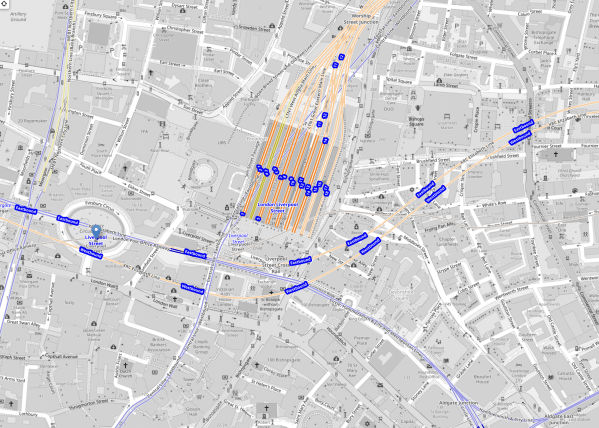
Note.
- The square block in the middle of the map are Platforms 1-18 of the main station.
- Eighteen is in the East and 1 is in the West.
- The Central Line of the London Underground runs diagonally in blue under the main station.
- Running in orange from the West to the North-East in front of the station is the Elizabeth Line.
- Running South of Lizzie in blue are the sub-surface lines of the London Underground.
I wonder, if at some point in the distant future, a terminal platform or two could be added to the very deep Elizabeth Line, that connected to tunnels underneath Liverpool Street station.
This second OpenRailwayMap shows the sub-surface lines and the Elizabeth Line, as they pass across in front of Liverpool Street station.
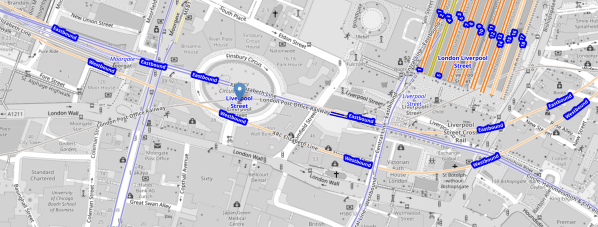
Note.
- Moorgate Station is in the North-West corner of the map
- Moorgate Statation has two virtually unused west facing bay platforms.
- The sub-surface lines are shown in blue.
- The Elizabeth Line is shown in orange.
- Finsbury Circus is in the middle of the map, with the sub-surface lines underneath.
- The Central Line is shown in blue and crosses between Finsbury Square and Liverpool Street station on its way to Bank.
- In front of Liverpool Street station, there is a disused bay platform on the sub-surface lines.
- The Bank branch of the Northern Line and the Great Northern run North from Moorgate station.
- Access to the Great Northern could be improved.
I feel there is scope for more trains to be run on the sub-surface lines through Moorgate and Liverpool Street.
- Accessibility to the sub-surface lines at Moorgate and Liverpool Street station could be improved.
- There has been talk of extending some services to Barking.
There is certainly scope to improve the sub-surface lines.
Did Plans For Crossrail Ever Include A Station At Holborn?
I have only one North-South bus route, where I live.
The 141 bus connects Palmers Green and London Bridge station.
- The 141 bus was the replacement for the 641 trolley bus, which was the main link between Wood Green, Turnpike Lane and Harringay, and the City of London, when I was a child.
- The vehicles are up to ten years old Wrightbus diesel hybrids.
- The route suffers badly from overcrowding as it connects, Bank and Moorgate stations in the City of London, with the outer reaches of the Piccadilly Line.
The overcrowding on the 141 bus route has got worse in the last couple of years because of the following.
- The rebuilding of London Bridge station brought more passengers to the 141 bus route.
- The opening of the new London Bridge bus station at London Bridge station has improved access to the buses at London Bridge station.
- The improvement of the connection of the buses to the Docklands Light Railway, Central Line and Northern Line at Bank station.
- The opening of the Battersea branch of the Northern Line, which brings more passengers to Bank station.
- The opening of the new Cannon Street entrance to Bank Underground station.
- The opening of the Elizabeth Line through Moorgate station.
- Recently, a new walking route between Moorgate and Liverpool Street was opened, which will bring more passengers to the buses on Moorgate.
- The rebuilding of Old Street station brought more passengers to the 141 bus route.
So what was the response of the Mayor and Transport for London, to all this increase of passenger numbers?
The 21 bus, which shadowed the 141 route, and doubled the number of buses through where I live, was moved to serve Holloway.
It was a big crime against mathematics and the wishes of our long-serving Labour MP; Meg Hillier.
So to handle many more passengers between London Bridge station and Newington Green through the City of London, the number of buses was halved.
I believe that the overcrowding will get worse because of the improvements, that Transport for London have planned.
- The Piccadilly Line will be getting new air-conditioned trains within a couple of years and these will inevitably attract more passengers to the line.
- On the other hand the air-conditioning may persuade passengers to use the Piccadilly Line more than they do now. Instead of changing to the 141 bus at Manor House station, passengers could change at Finsbury Park, King’s Cross St. Pancras or Holborn stations for other routes to the City of London.
- The third line to receive the new air-conditioned trains will probably be the Central Line, which would create another East-West air-conditioned line and bring more passengers to Bank station.
- The Central Line could give some relief for the buses through Bank, if an extra station was built on the Central Line to interchange with Shoreditch High Street station on the East London Line of the London Overground.
- The fourth line to receive the new air-conditioned trains will probably be the Waterloo and City Line, which would create another air-conditioned line and bring more passengers to Bank station.
- It is likely, that more services will be added to the Elizabeth Line, which will bring more passengers to Moorgate station.
- It is likely, that more services will be added to the Northern City Line, which will bring more passengers to Moorgate station.
- The Mayor is also planning to pedestrianise Oxford Street, which may fill up the Central Line with extra passengers.
It looks to me, that there will be a need for a large increase of bus capacity through the City of London on a North-South axis.
On the other hand, the City of London have stated that they will pedestrianise many of their streets.
So what can be done to avoid gridlock in the City of London?
Develop The Northern City Line At Moorgate
I use this route regularly to and from Moorgate station.
- It already has new Class 717 air-conditioned trains.
- The route is already digitally signalled in conjunction with the East Coast Digital Programme.
- It has two platforms at Moorgate station.
- Highbury & Islington station has interchanges with the Victoria Line and the North and East London Lines of the London Overground.
- Finsbury Park station has interchanges with the Victoria Line and National Rail services.
- Bowes Park station has an out of station interchange with Bounds Green station on the Piccadilly Line.
- Step-free access needs improving.
- The Victorians had plans to extend the line to Lothbury near Bank station.
If the Northern City Line could handle more passengers, would passengers get to all parts of the City of London by changing at Finsbury Park and walking from Moorgate or Old Street stations?
I regularly go between my house and Moorgate, by taking a bus to Essex Road station and using the Northern City Line.
I believe that with improvements on the Northern City Line, the line could be turned into a very valuable part of London’s rail infrastructure.
Connect The Central Line And The East London Line At Shoreditch High Street Station
I wrote about this proposal in Will Shoreditch High Street Be Connected To The Central Line?
The Elizabeth Line needed to be completed before this could be started.
Build The Western Extension Of The Docklands Light Railway
I wrote about this proposal in The Bank Station Upgrade And The Western Extension Of The DLR.
Rebuild Holborn Station
The interchange between Piccadilly and Central Line at Holborn station is difficult to say the least.
Holborn station is being extended with a new entrance. As with Euston, I suspect it has been designed with a feasible place for DLR platforms to be added.
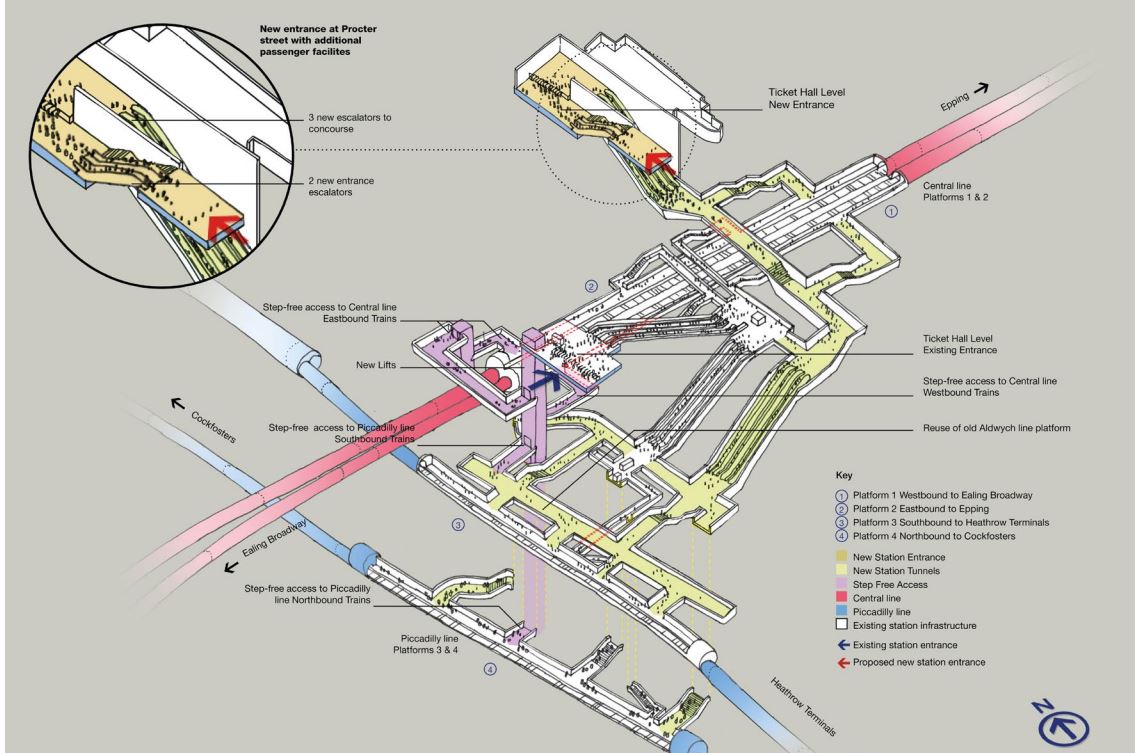
This document on the TfL web site, gives more details of what is proposed at Holborn station.
I extracted this visualisation of the proposed station.
This map from carto.metro.free.fr shows the lines in the through and around the station.
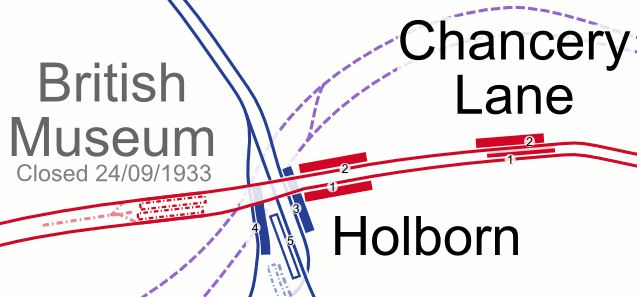
.Note, the Elizabeth Line, which is shown by dotted lines passes to the North of the station.
Conclusion
Not all these improvements need to be done, but each would improve transport in the City of London.
Porterbrook Acquires ‘379s’ For Lease To GTR
The title of this post, is the same as that of a small article in the April 2024 Edition of Modern Railways.
This is the first paragraph.
Porterbrook has successfully bid to acquire the fleet of 30 Class 379 Electrostar EMUs from Akiem and will lease them to Govia Thameslink railway, which will use them on Great Northern services.
Note.
- Will the Class 379 trains replace all or some of the 39 Class 387 trains currently used by Great Northern?
- The Class 379 trains are 25 KVAC overhead only trains, whereas the Class 387 trains are dual-voltage.
- If the Class 379 trains are not modified to run on 750 VDC third rail, they will be restricted to Great Northern routes.
- It may be a problem, that the Class 379 trains are only 100 mph trains, whereas the Class 387 trains are capable of 110 mph, but I suspect that the Class 379 trains can be upgraded to 110 mph.
It looks to me that it is likely that Govia Thameslink Railway will end up with thirty spare Class 387 trains.
The Wikipedia entry for the Class 387 train, says this about the differences between the two classes of Electrostar.
The Class 387 is a variation of the Class 379 with dual-voltage capability which allows units to run on 750 V DC third rail, as well as use 25 kV AC OLE.
This surely has three main ramifications for Govia Thameslink Railway.
- Third rail equipment can probably be fitted to the Class 379 train, if required.
- The Class 379 train can probably be uprated to the 110 mph of the Class 387 train.
- Retraining the drivers to use the new Class 379 trains, will not be a major exercise.
Govia Thameslink Railway will have the luxury of configuring the trains to run, the services their passengers need and want.
But Govia Thameslink Railway may have a collateral benefit.
In 2015, a Class 379 train was modified to do a trial as a battery-electric multiple unit.
This section in the Wikipedia entry for the Class 379 train, describes the trial.
During 2013, the national infrastructure owning company Network Rail announced that unit 379013 would be used as a testbed for a future Battery-Electric Multiple Unit. Following several months of conversion work and non-service testing, the unit was used to carry passengers for the first time on a Manningtree–Harwich Town service on 12 January 2015. Throughout its five-week trial period, data was gathered to assess its performance; it could reportedly operate for up to an hour on battery power alone, while charging via the pantograph took two hours.
Note.
- I feel it would be reasonable to assume, that a Class 387 train could be easily converted to battery electric operation.
- I’ve met commuters, who used the prototype every day between Harwich and Manningtree and it gave a good service.
- In an hour with stops, a typical Southern commuter service does just 35 miles.
Southern have two routes, where Class 171 diesel trains are still used.
- Ashford International and Ore – 25.4 miles
- Hurst Green Junction and Uckfield – 24.7 miles.
A battery-electric train with a range of 30 miles would surely decarbonise these routes.
- Batteries would be charged, where 750 VDC third-rail electrification is installed.
- As the Class 387 trains are dual-voltage, a short length of 25 KVAC overhead electrification, could be used to charge the train at Uckfield, if that was to be needed.
- Alternatively, the Vivarail Fast Charge system could be fitted.
A rough estimate is that ten battery-electric Class 387 trains would be needed to make Govia Thameslink Railway an all-electric railway.
- The now redundant Class 171 trains could be cascaded to someone, who needs them.
- The remaining twenty Class 387 trains could be used to replace twenty Class 377 trains, or converted to battery-electric operation and be cascaded to another operator.
Hopefully though, after all of the musical trains, there will be a reliable procedure to convert late model Electrostars into battery-electric trains.
The Definitive Battery-Electric Electrostar
It could have this specification.
- Based on a Class 377, Class 379 or Class 387 train.
- Three, four or five cars.
- I suspect the batteries would be spread around the cars.
- Dual-voltage or 25 KVAC overhead electrification only.
- Charging by 25 KVAC overhead electrification or Vivarail/GWR Fast Charge system.
Note.
- Battery range appropriate for the route.
- In GTR And Porterbrook Unveil £55 million Fleet Modernisation, I talk about an internal refurbishment of GTR’s trains.
It looks to me, that, whatever route Govia Thameslink Railway takes, there could be another twenty refurbished Class 377 or Class 387 trains, that could be available for conversion to four-car battery-electric trains.
Great Western Routes That Could Be Run By Battery-Electric Electrostars
Great Western Railway have 30 Class 387 trains, which are used on Thames Valley services around the London end of the Great Western Main Line.
Routes that could be suitable for Battery-Electric Electrostars include.
- London Paddington and Didcot Parkway – two trains per hour (tph) – 10 trains
- London Paddington and Oxford – one tph – 5 trains – 10.5 miles x 2
- London Paddington and Newbury – one tph – 5 trains
- Reading and Newbury – one tph – 2 trains
- Newbury and Bedwyn – one tph – 1 train – 13.3 miles x 2
- Reading and Basingstoke – two tph – 2 trains – 13.6 miles x 2
- Reading and Gatwick – two tph – 7 trains – 18.6 miles
Note.
- The number of trains is my rough estimate of the number, that would be needed to run each route.
- The miles is how much running would be needed on batteries.
My estimated total is 32, but there might be savings from more efficient routes. It looks like a range of around thirty miles would be sufficient.
Conclusion
It looks like after decarbonising Govia Thameslink Railway and the Thames Valley Services of Great Western Railway, there will be twenty high quality Electrostars available to decarbonise other routes.
First Digitally Signalled Passenger Train Comes To Northern City Line
The title of this post, is the same as that of this article on Rail Advent.
These two paragraphs introduce the article.
The Northern City Line experienced its first taste of digital signalling, as a passenger train controlled by the in-cab technology ran between Finsbury Park and Moorgate on Monday the 27th of November.
The introduction of this type of signalling – known as the European Train Control System, or ETCS – is a first step towards wider adoption across the rail network and represents an important milestone in the government-backed £1.4bn East Coast Digital Programme (ECDP). The programme is designed to improve journeys between London and north of Peterborough, with reliability and environmental outcomes at the forefront of the project’s deliverables.
I hope that one of the benefits will be more trains between Moorgate and Hertford North, Stevenage and Welwyn Garden City.
Govia Thameslink Railway Issues a Prior Information Notice For New Trains
This article on Railway Gazette is entitled UK Railway News Round-Up and contains this section.
Govia Thameslink Railway has issued a prior information notice seeking the provision of between 21 and 30 four-car 25 kV 50 Hz 160 km/h through-gangwayed EMUs with air-conditioning and toilets for use on existing and/or additional Great Northern services from May 2024. Maintenance would be undertaken in-house at Hornsey depot, supported by a Technical Support & Spares Supply Agreement.
I find this all a bit puzzling.
- The trains that need replacing are surely the eighteen Class 313 trains, that run on the West Coastway Line, as they are some of the oldest trains on the UK network.
- If Govia Thameslink Railway were serious about decarbonisation, they would also replace the Class 171 diesel trains, that work the Marshlink Line and the Uckfield branch, with electric trains with a range of thirty miles on batteries.
How many trains would be needed to replace the Class 313 and Class 171 trains?
- The eighteen three-car Class 313 trains could be replaced with an equal number of new four-car trains and this might result in a rise in passenger numbers.
- I would assume the eighteen trains includes allowances for trains in maintenance and spare trains for when a train fails.
- It may be possible to replace the six four-car Class 171 trains used on the Marshfield Line with three new four-car trains, which have a range of thirty miles on batteries.
- The eleven two-car Class 171 trains used on the Uckfield branch could be replaced with three new four-car trains, which have a range of thirty miles on batteries and would run as four-car trains.
- If eight-car trains were needed on the Uckfield branch, there would be a need for six new four-car trains.
- If twelve-car trains were needed on the Uckfield branch, there would be a need for nine new four-car trains.
Note.
- If four-car trains are needed on the Uckfield branch, this means a total of 18+3+3 or 24 trains.
- If eight-car trains are needed on the Uckfield branch, this means a total of 18+3+6 or 27 trains.
- If twelve-car trains are needed on the Uckfield branch, this means a total of 18+3+9 or 30 trains.
Trains on these Southern routes wouldn’t be stabled at Hornsey depot, but could be moved to Hornsey for maintenance using Thameslink.
But the puzzling bit is that the prior information notice says that the trains will be.
Four-car 25 kV 50 Hz 160 km/h through-gangwayed EMUs with air-conditioning and toilets for use on existing and/or additional Great Northern services from May 2024.
Note.
- There is no mention of the trains being able to run on 750 VDC third-rail infrastructure.
- The trains will run on Great Northern services and the Class 313 and Class 171 trains run on Southern routes.
- The only Great Northern services, that have not been moved to Thameslink are Kings Cross and Cambridge, Ely and King’s Lynn and services to Moorgate.
- The Moorgate services have their own dual-voltage Class 717 trains.
- Govia Thameslink Railway have ambitions to double the frequency of trains to King’s Lynn.
- Two eight-car trains per hour (tph) between King’s Cross and King’s Lynn would need sixteen operational four-car trains.
- Two twelve-car trains per hour (tph) between King’s Cross and King’s Lynn would need twenty-four operational four-car trains.
If Govia Thameslink Railway are thinking of thirty new trains, they must have other destinations in mind.
Could we be seeing a double swap?
- An appropriate number of new trains are procured to run Great Northern services between Kings Cross and Cambridge, Ely and King’s Lynn.
- The Class 387 trains released will be moved to the South to replace the Class 313 and Class 171 trains.
- Some or all of the transferred Class 387 trains will be fitted with batteries to give a range of thirty miles without electrification.
Note.
- Could the new trains be Siemens Desiro City trains like the Class 700 and Class 717 trains, which are already maintained at Hornsey depot? It would surely be more efficient and save money.
- Class 387 trains are dual voltage and would need little or no modification to replace the Class 313 trains.
- Uckfield and Hurst Green junction is 24.7 miles.
- Ashford International and Ore is 25.4 miles
- Adding a battery to a Class 387 train has not been done, but Bombardier converted a near-identical Class 379 train to battery-electric operation over eight years ago.
- Converting a Class 387 train gives a dual-voltage battery-electric train.
- I suspect a charger would be needed at Uckfield. Could it be a short length of 25 KVAC overhead electrification?
Could all the Class 387 trains, that will replace the Class 313 and Class 171 trains be identical to ease the problems, when a train develops a fault?
Conclusion
It looks a good plan.
It also opens up the following possibilities.
- Deployment of 750 VDC battery-electric trains on other routes.
- Deployment of 25 KVAC overhead battery-electric trains on other routes.
- Deployment of tri-mode battery-electric trains on other routes.
- Charging of battery-electric trains using a short length of 25 KVAC overhead electrification.
- Fitting of batteries to Class 379 trains to create a 25 KVAC overhead battery-electric train.
It might be possible to convert other Electrostars to battery-electric operation.
Ignoring Class 387 trains on dedicated services like Heathrow and Gatwick Express, these trains are available for conversion.
- Class 379 trains – Stored – 30 trains
- Class 387 trains – Govia Thameslink Railway – 40 trains
- Class 387 trains – Great Western Railway – 33 trains
Note.
- This gives 103 trains.
- They all have good interiors.
- They are all 100/110 mph trains.
- All trains could be updated to 110 mph.
- All trains can use 25 KVAC overhead electrification.
- The Class 387 trains can also use 750 VDC third-rail electrification.
- The Class 379 trains were built in 2010-2011.
- The Class 387 trains were built from 2014.
I believe both classes will make excellent battery-electric trains.
Where will they be deployed?
These are a selection of routes starting in the South-East of England.
- Ashford International and Eastbourne.
- Gravesend and Hoo.
- London Bridge and Uckfield.
- London Paddington and Bedwyn.
- London Paddington and Oxford.
- Reading and Basingstoke.
- Reading and Gatwick.
- Reading and Redhill.
- Slough and Windsor & Eton Central.
- Twyford and Henley-on-Thames
I’ve only added routes which are less than thirty miles.
 The Anonymous Widower