Thoughts On The Introduction Of Class 800 Trains On The Great Western Railway
I have travelled about six times on Class 800 trains on the Great Western Railway.
I have not had any train-related problems and on every journey, the trains have arrived close to schedule.
That even included an out-and-back trip to Swansea from Paddington on a Saturday.
There doesn’t seem to be too many complaints or news stories on the Internet. Although, I do feel some passengers are missing the InterCity 125s and others talk of hard seats.
I would also not complain about the view from a window seat and I have found the trains to be a good camera platform.
Rail Magazine’s Verdict
This article in Rail Magazine is entitled Does Great Western Railway’s Class 800 IET pass the test?.
This is their main conclusion.
The Great Western Railway Class 800 is a good train. It is quiet and comfortable, with better legroom for those travelling in Standard Class. Its acceleration on electric is borderline spectacular, while its diesel performance appears better than predicted.
They also say, that First Class is not worth the extra, whereas they felt it was was in the InterCity 125s.
Conclusion
There’s nothing much wrong operationally or passenger-wise with the Class 800 trains, that will not be put right by minor adjustments in the next couple of years.
The Stone Arch Railway Bridges Of Scotland
There are a lot of stone arch railway bridges in the UK, but they do seem to more numerous in Scotland, than in England.
These pictures show a selection of bridges on the Borders Railway.


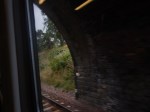





I counted to about fifteen between Edinburgh Waverley and Galashiels stations.
There were probably about an equal number of bridges where a stone arch bridge had been replaced by a modern concrete structure, like this one.
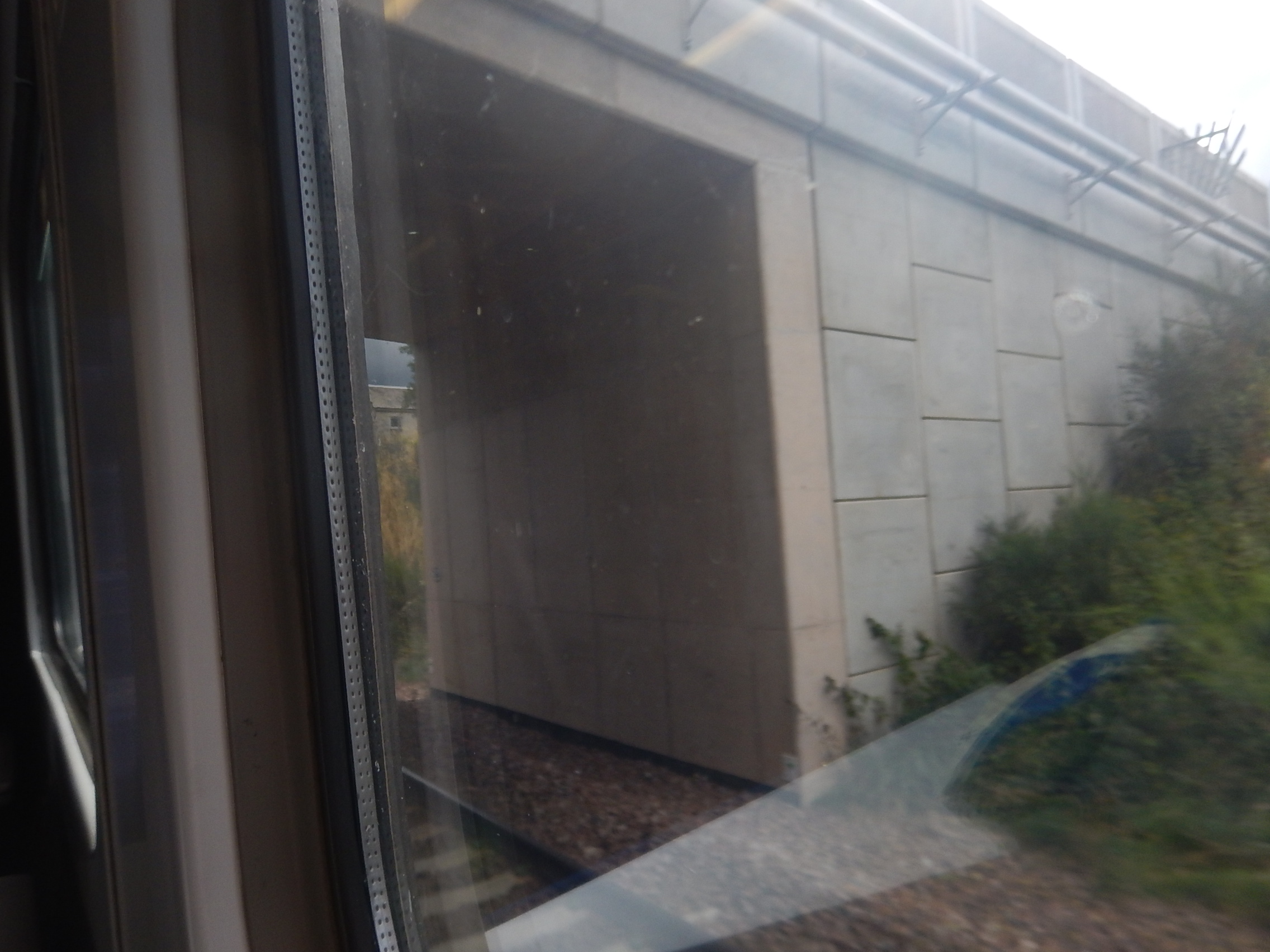
They’ll probably last a thousand years, but they lack the charm of the stone arch bridges.
These pictures show a selection of bridges on the Busby Railway between Glasgow Central and East Kilbride stations.




These pictures show a selection of the many bridges between Aberdeen and Montrose stations on the Edinburgh – Aberdeen Line.


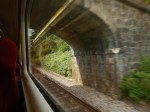





I took pictures of at least twenty.
Freight Trains
Freight trains, especially those with the larger containers need a loading gauge, that is big enough to accept them.
The loading gauge in the UK, is summed up by these two sentences from Wikipedia.
Great Britain has (in general) the most restrictive loading gauge (relative to track gauge) in the world. This is a legacy of the British railway network being the world’s oldest, and having been built by a plethora of different private companies, each with different standards for the width and height of trains.
These are the commonest gauges.
- W6a: Available over the majority of the British rail network.
W8: Allows standard 2.6 m (8 ft 6 in) high shipping containers to be carried on standard wagons.
W10: Allows 2.9 m (9 ft 6 in) high Hi-Cube shipping containers to be carried on standard wagons and also allows 2.5 m (8 ft 2 in) wide Euro shipping containers.
W12: Slightly wider than W10 at 2.6 m (8 ft 6 in) to accommodate refrigerated containers.
W12 is recommended clearance for new structures, such as bridges and tunnels
The Borders Railway appears to have been built to at least W8, so it could handle standard freight containers.
But the line doesn’t carry freight!
On the other hand, I suspect the following were considered, when designing the Borders Railway.
- Network Rail and rail maintenance companies, may need to bring some large rail-mounted equipment along the line for regular or emergency maintenance.
- If the line is extended to Carlisle, the route could be used as a diversion for freight trains, if the West Coast Main Line is closed, due to weather or engineering works.
- There may be a need to use the Borders Railway to extract timber from the forests of the Borders.
The need for freight on the Borders Railway, explains why there are so many new overbridges.
Electrification
Electrification with overhead wires needs extra clearance.
It looks to me, that the Borders Railway has been given enough clearance for future electrification.
Problems With EGIP
Electrification under the Edinburgh to Glasgow Improvement Program (EGIP), proved to be difficult.
It wasn’t helped by the standards changing half-way through the project and the numerous bridges and tunnels that had to be rebuilt.
An important route like Edinburgh to Glasgow probably needs to be fully-electrified, but the difficulties encountered and those in Lancashire have encouraged Network Rail and the engineering consultants to look at other methods of electrifying lines in the UK.
Electrification Between Edinburgh And Aberdeen
I doubt this will ever happen in a conventional manner.
- Would electrification of the Forth Bridge and Tay Rail Bridge be allowed?
- The disruption of rebuilding the stone bridges would be enormous.
- The line only has a maximum speed of 100 mph.
Diesel and alternative power sources like hydrogen will be able to maintain the fastest speeds, that are possible on the line.
Money would probably give better value, if it were to be used to increase line speed.
Opposition To Rebuilding Bridges
This article on Rail Technology Magazine is entitled Network Rail Electrification Plans Stalled After Council Rejects Bridge Removal Bid.
This is first paragraph.
Campaigners are celebrating after plans from Network Rail to demolish a bridge as part of its electrification scheme were rejected by a local council.
The bridge in question is a Grade II listed overbridge at Steventon in Oxfordshire.
It is not unlike those in Scotland, that are shown in my pictures.
In the 1960s, British Rail would have just blown it up and replaced it with a concrete monstrosity.
I am not advocating a return to this policy, but Network Rail has a problem at Steventon, that they need to fully electrify the line, if electric trains are to use the route on electric power, rather than using environmentally-unfriendly diesel power.
Since the new Class 800 trains for the route were designed and ordered, the technology has moved on.
In South Wales, discontinuous electrification and trains with a battery capability will be used.
Conclusion
Scotland and other parts of the UK, like the Pennines and in the valleys of South Wales, have a serious problem with the way the Victorians built our railways.
\development of the UK rail network with electrification and an enhanced freight capability needs to be thought out carefully and with great ingenuity.
HS4Air’s Connections To HS2, The Great Western Main Line And Heathrow
This map clipped from the Expedition Engineering web site, shows the route of HS4Air to the West of London.
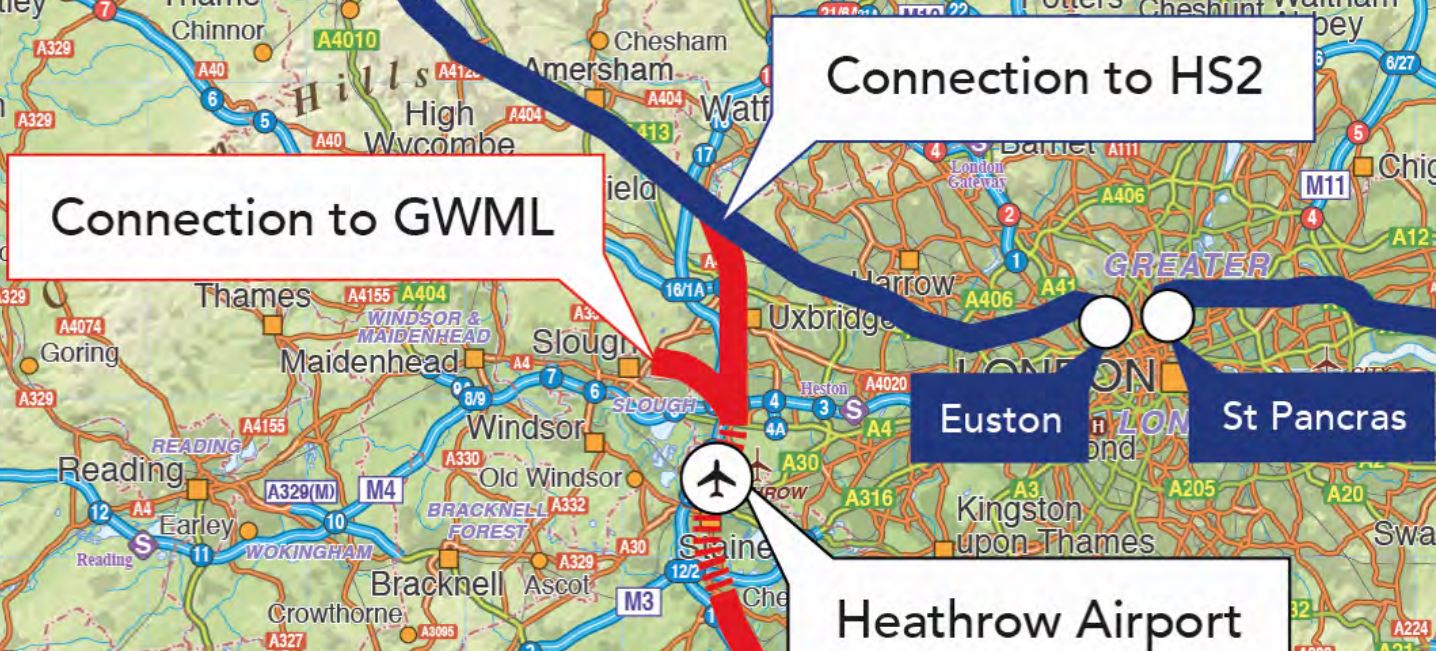
Note the M25 running North-South through the area.
The HS4Air And HS2 Junction
This Google Map shows the area, where HS4Air will join HS2.

Note.
- The M25 running North-South.
- The Chiltern Main Line running East-West.
- The two stations shown are Denham Golf Club and Denham.
- At the top of the map, just to the East of the M25 is a large quarry, which shows up in a beige colour.
The route of HS2 as it passes through the area from North-West to South-East is as follows.
- HS2 crosses the M25 in a tunnel, at the point where the lane crosses just below the M25 label, at the top of the map.
- HS2 then goes South East towards Denham on a mixture of cuttings, embankments and viaducts.
- HS2 then follows the Chiltern Main Line in a cutting towards London.
- HS2 goes into a tunnel just to the West of West Ruislip station.
It looks to me, that HS4Air will branch off HS2, just to the East of the M25, in the area of the quarry, which is shown in this Google Map.
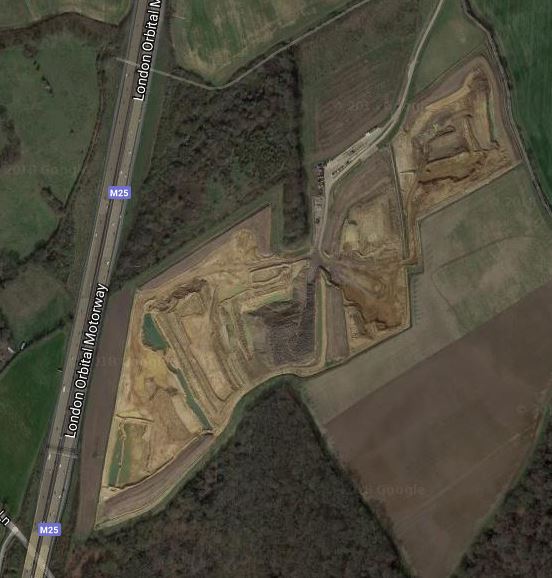
HS4Air would continue along the M25 motorway towards the South, whilst HS2 will continue in to the South East.
The HS4Air And Great Western Main Line Junction
This Google Map shows the area, where HS4Air crosses the Great Western Main Line.

Note.
- The M25 running North-South
- The M4 running East-West
- The Great Western Main Line running East-West.
- The two stations are Langley and Iver.
- Iver North Water Treatment Works sitting to the North East of where the M25 and the Great Western Railway cross.
This Google Map shows the area, where the M25 and the Great Western Main Line cross in more detail.

Consider.
- HS4Air would be following the M25 North-South.
- Two links to allow trains to go both ways from the Great Western to the Southbound HS4Air, would be needed.
- These links could loop over the Water Treatment Works.
- As the M25 will probably need widening, combining both projects would probably benefit both.
I think we could see a spectacular junction.
HS4Air North Of Heathrow
|As the first map shows HS4Air goes underneath Heathrow Airport in a tunnel, where there will be a station in the tunnel.
This map shows the M25 to the North of the Airport.
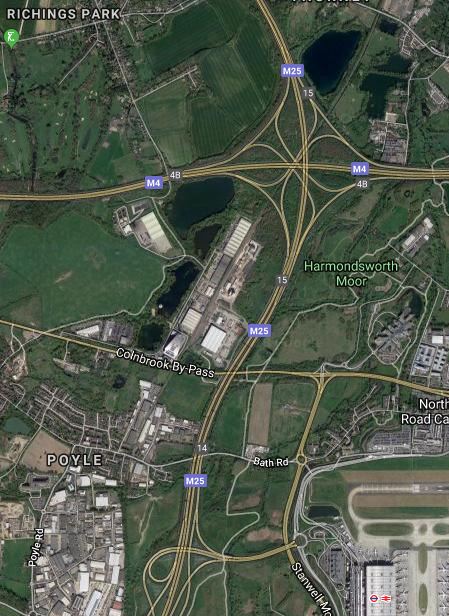
Terminal 5 at Heathrow is picked out with a station symbol.
I suspect that HS4Air will cross the massive M25/M4 junction on a viaduct and then descend into a tunnel for the Airport.
Or if the third runway at Heathrow is built, the railway could go into tunnel to the North of the motorway junction.
I suspect, the rail tunnels will be very deep under the airport, which will mean the following.
- They won’t disturb the existing airport.
- All the existing Crossrail design and construction expertise will be useful.
- The station could be as large as needed, with through and terminal platforms.
With its connections to Crossrail, it would also be West London’s high speed railway station.
HS4Air South Of Heathrow
South of Heathrow, the first map, shows that the Heathrow tunnel will emerge close to the M25, South of the major junction between the M25 and the M3.
This Google Map shows the area.
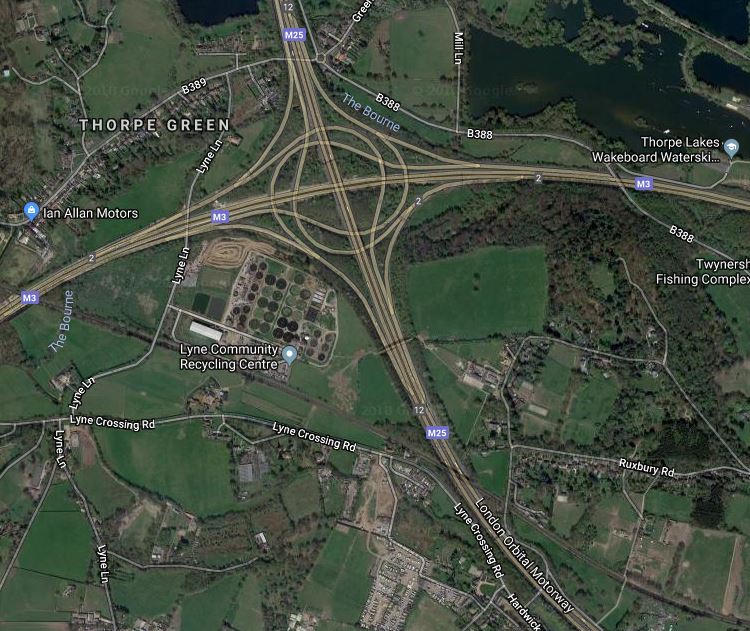
I will investigate where the Heathrow Tunnel emerges in HS4Air Between Heathrow And Gatwick Airports.
Conclusion
This section of HS4Air looks to be a railway that can be slotted through alongside the M25 with very little disturbance to existing traffic routes.
I doubt that few houses or other buildings will need to be demolished.
The two major junctions with HS2 and the Great Western Railway will cause little disruption during construction, as the former will be over a quarry and the second is by a sewage works, which could be moved if necessary.
This first section is so obvious, I am surprised it hasn’t been included with the building of HS2.
An Unusual Service Pattern Between Paddington And Hayes & Harlington Stations
I’ve just been looking at the service pattern from Monday between Paddington and Hayes & Harlington stations.
There appears to be four (tph) provided by both TfL Rail and Great Western Railway (GWR) at most times, which means an eight tph service between the two stations.
So it would appear logical that intermediate stations get the same service.
- Acton Main Line gets two tph
- Ealing Brodway gets eight tph.
- West Ealing gets four tph
- Hanwell gets two tph
- Southall gets five tph.
I wouldn’t be surprised to see complaints.
A Cheering Community Rail Story From Wiltshire
This article from the Wiltshire Times is entitled Station Scheme Gets Under Way.
The article talks about Melksham station and how the Transwilts Partnership and Great Western Railway are improving the station.
- A new community cafe, 53 car parking spaces and a bus interchange will be provided.
- GWR will lease land from Wiltshire Council and lay out and manage 75 parking spaces.
- Transwilts appear to be funding the community cafe.
- Car park improvements will be paid for by new parking charges.
- Passenger numbers have grown from 10,000 in 2013 to more than 75,000 last year.
- GWR have doubled the number of carriages on the route.
The last two points, must mean that everybody involved must be doing something right.
I’ll finish with this quote from Dan Okey of GWR.
We believe very strongly in community rail and in this route and we want to see it continue to grow.
This partnership between GWR and the local comminity rail partnership, could and should be copied elsewhere.
Nineteen Tri-Mode Flex Class 769s For GWR
The title of this post is the same as that of this article on Rail Magazine.
This brings the number of Class 319 trains to be converted to Class 769 trains, to thirty five.
- These trains for Great Western Railway (GWR) will be tri-mode trains and able to operate on 25 KVAC overhead and 750 VDC third rail electrification and diesel power.
- The Rail Magazine article, says they will support the introduction of refurbished Class 387 trains on Heathrow Express and on services from Reading to Gatwick and Oxford.
- The trains would release diesel Class 165 trains and Class 166 trains to be refurbished and improve services in the Bristol area.
Although, there appears to have been so sighting of a Class 769 train on the UK network, the trains must have shown up well in testing, as no-one would order nineteen trains, that didn’t meet the specification.
According to the Future section in the Wikipedia entry for the Class 319 trains, there are forty-five of the trains sitting in sidings off lease.
So there won’t be a shortage of trains to modify.
Good Design Always Wins!
I do find this story rather heartwarming.
When the Advanced Passenger Train project fell well behind schedule, Terry Miller and his team at Derby, came up with a short-term proposal for a High Speed Diesel Train, which when launched in 1975 was known as the InterCity 125.
Forty years later most of these iconic trains are still in service
But that wasn’t the end of the story.
The design of the Mark 3 carriages of the InterCity 125, was used by British Rail to build large numbers of less iconic electric and diesel multiple units, of which the Class 319 train was just one of seventeen classes of train based on the Mark 3.
The legacy of Terry Miller and his team is echoing down the years.
The Class 769 train is one of the ultimate echos.
How Will GWR Deploy The Class 769 Trains?
Nineteen trains is a substantial order and train companies don’t buy trains to stick them in sidings, so how will they be used?
Before answering the question, I’ll put in a few facts.
- According to Porterbrook’s brochure, Class 387 trains are four twenty metre coaches.
- According to Wikipedia, Class 319 trains are four twenty metre coaches.
- Both trains can be configured to work on 25 KVAC overhead of 750 VDC third-rail electrification.
- Porterbrook’s brochure says that Class 387 trains have a lot of modern features like, information systems for driver and passengers, air conditioning and passenger counting. The brochure also says that Class 387 trains will be ERTMS-ready.
I wouldn’t be surprised to see the Class 769 trains given a quality refurbishment, very much in excess of that Northern have given to their Class 319 trains.
Remember, that GWR must have massive experience about improving Mark 3 carriages from forty years of work with InterCity 125 trains.
GWR were also behind the superb refurbishment of a Class 150 train, that I wrote about in What Train Is This?. So they have form!
The quality must be in excess of that of the Class 165 and Class 166 trains, that they will often replace. And those two classes are not crap, just diesel, too slow for some routes and often lacking in capacity.
In Could A Three-Car Class 769 Train Be Created?, I showed that if a three-car Class 769 train is needed, that this is possible. But it would lose about sixty seats and the universal access toilet, if it follows a similar route as converting a four-car Class 321 train to a three-car Class 320 train.
Covering For Class 387 Trains Going To Heathrow Express
This page on the First Group web site, is the original press release about the procurement.
This is said.
Initially, the fleet will support the introduction of refreshed trains on Heathrow Express services, but will be predominantly be used on routes between Reading and Gatwick, and Reading and Oxford, where the train’s tri-mode can be used to its fullest. However, the tri-mode nature of the train will give GWR maximum flexibility to use them in other areas of the network should they be required.
The purchase of nineteen trains will surely be enough to cater for the loss of Class 387 units to Heathrow Express duties to replace the Class 332 trains.
I wrote about this in GWR Announces Plans To Replace Class 332s As It Takes Over Heathrow Express Service.
I estimated that if each Heathrow Express train eventually becomes two Class 387 trains working together as opposed to the current pair of Class 332 trains, that fourteen Class 387 trains will be needed for Heathrow Express.
Consider.
- GWR have forty-five Class 387 trains in their fleet.
- If Heathrow Express needed to be be worked by twelve-car trains, this would increase the number needed to twenty-one. That would still leave GWR with twenty-four trains for other services.
- There are plans for Southern and Western access to Heathrow, which could mean a need for more Class 387 trains for Heathrow Express .
- c2c could release their six Class 387 trains in the early 2020s, when their new Aventras arrive.
- Great Northern might be persuaded to release some of their twenty-five Class 387 trains.
It certainly looks, that all possibilities are covered for Heathrow, who are probably paying a substantial fee to GWR to run the service.
Reading And Oxford
The First Group press release mentions that Class 769 trains could be running between Reading and Oxford stations.
So does this mean that the current two trains per hour (tph) service between Paddington and Didcot Parkway station will be extended to Oxford and run by Class 769 trains?
Consider.
- A new South-facing bay platform is planned at Oxford station, that could be sized for a trio of Class 769 trains.
- All services between Paddington and Oxford will become electric or bi-mode.
- Class 387 and Class 769 trains are based on twenty metres carriages, so there should be no platform issues.
- A number of Class 387 trains would be released for modification.
- Several Class 165 and Class 166 trains will be released on other parts of the GWR network.
The only problem I see is that some passengers may complain about losing the Class 387 trains, with their comfortable seats and tables..
GWR must get the interior of the Class 769 trains spot-on!
Reading And Bedwyn
This is another route, where Class 769 trains could be used to advantage.
The turnback siding at Bedwyn station would need modification to incoporate a bi-mode Class 800 train, but a Class 769 train would fit the existing infrastructure.
Reading And Gatwick
If ever the Victorians designed a route that would be ideal for a tri-mode train it is GWR’s service between Reading and Gatwick Airport.
- It has sections with 750 VDC third-rail electrification.
- At Reading, it could be extended using the 25 KVAC electrification along the Great Western Main Line to perhaps Oxford.
- Currently, the service is run by Class 165 trains.
Could a way be found to take the trains into Heathrow as an alternative Western terminal, when the Southern and Western rail routes to the Airport are built?
This route has needed a bi-mode train for decades.
Cardiff to The South Coast via Bristol, Bath, Salisburu and Southampton
This over three hour route is currently run by Class 156 trains.
Consider.
- This route has significant overcrowding according to Wikipedia and my personal experience
- Cardiff to Bath should eventually be electrified with 25 KVAC overhead wires.
- Brighton to Southampton is electrified with 750 VDC third rail.
- GWR run this route and have Class 800 trains.
- Running at over 100 mph is only possible in a few places.
- Dual voltage Class 800 trains must be possible, but at five-cars, they may be too long for some stations.
To run this route efficiently, GWR would need an appropriate number of dual voltage bi-mode trains.
GWR will soon have two trains that could handle the route; Class 800 trains or Class 769 trains.
I suspect that the Class 769 train would be most suitable, especially as at busy times like the summer, they could run eight-car trains.
Transwilts
Transwilts is a Community-run rail service in Wiltshire. This page on the Transwilts web site, shows the rail routes in their area.
Currently, most local services seem to be run by two-car Class 150 and one-car Class 153 trains, so when passenger numbers increase, larger trains including Class 679 trains may be used.
I was in this area once a few days before the Glastonbury Festival. You couldn’t have squeezed ia chihuahua onto the train!
Slough And Windsor And Eton Central
Class 769 trains could work this short branch line. But they might be need to use a three-car version.
Henlry Branch Line
The Henley Branch Line has the following characteristics.
- The branch is not electrified.
- The branch is only single track.
- There is a single-track bridge over the Thames.
- Most services are shuttles between Henley-on-Thames and Twyford stations.
- In the Peak and during the Henley Regatta direct trains operate to and from Paddington.
- Crossrail will call at Twyford with a frequency of four tph between London and Reading.
I have just flown my virtual helicopter along the line and it looks like there is insufficient space to create a complete double track railway, that could work at a very high frequency.
But there is space to add a passing loop or loops, that would allow a four tph frequency on the branch to match Crossrail.
Class 769 trains would be able to work the updated branch using their onboard diesel generators.
- Modern signalling would probably be needed to be installed on the branch, as it will certainly be on the trains, as they work between Paddington and Reading.
- Selective door opening or platform extensions will be needed at intermediate stations, so that two Class 769 trains working as an eight-car train could use the branch.
- Trains could either run as shuttles or direct to Paddington.
In my view, there is a simple solution in there, which is much better than mine.
But the residents of and visitors to Henley will get the quality service they desire.
- Comfortable, air-cooled trains with wi-fi.
- Four tph with a change at Twyford to Crossrail.
- Direct electric trains in the Peak and during the Henley Regatta.
Maidenhead And Marlow
The Marlow Branch Line must be a particular problem for GWR.
- The line is single track.
- There is no electrification.
- The one tph shuttle trains between Marlow and Maidenhead take around 20-25 minutes, with a reverse at Bourne End station.
This extract from the Wikipedia entry for Bourne End station described the Services.
Bourne End is a terminus but effectively acts as a through station, with the driver having to change ends to continue to the next station. During peak hours service frequency is increased by having two trains work the line, each using Bourne End as the terminus: one runs Marlow – Bourne End and one Maidenhead – Bourne End, with passengers changing trains at Bourne End. Four trains per weekday operate between Bourne End and Paddington in the morning peak and coming back in the evening peak.
This Google Map illustrates the problem at Bourne End station.
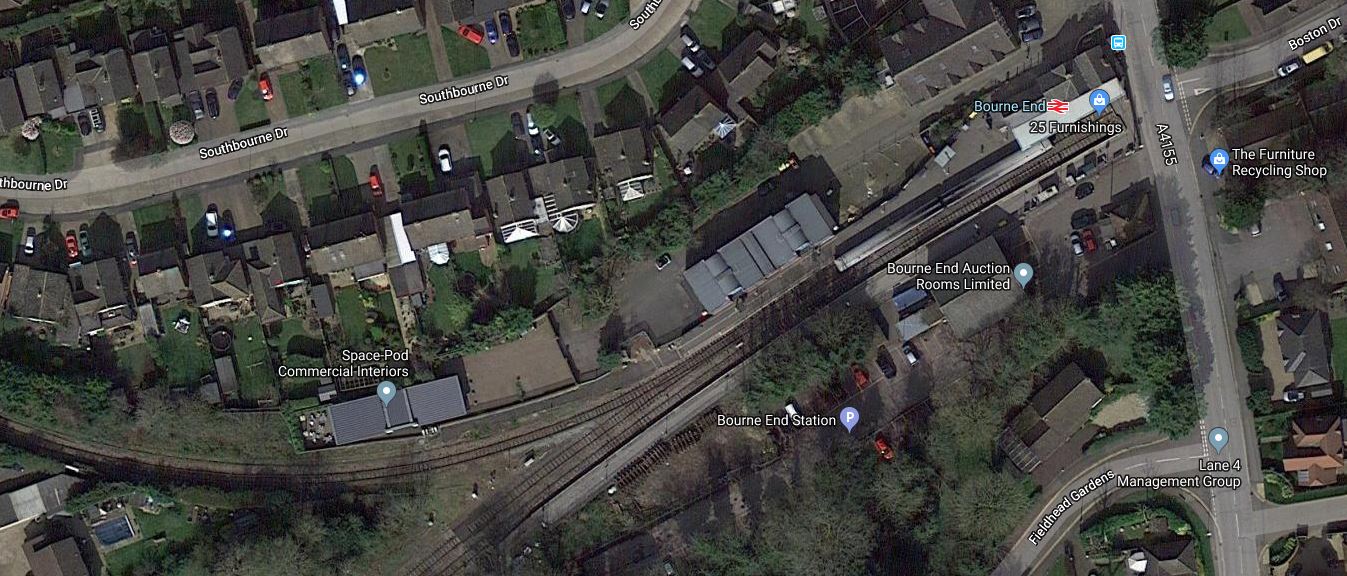
Note.
- The line to Marlow curves out of the Western side of the map.
- The double-track to Maidenhead goes in a South-Westerly direction out of the Southern side of the map.
- The Class 165 or Class 166 train in Platform 1 of the station is formed of two twenty-three metre carriages, so it’s forty-six metres long.
- Platform 1, is connected to both Marlow and Maidenhead, whereas Platform 2, is only connected to Maidenhead.
- A four-car Class 769 train is eighty metres long, with a three-car Class 769 at just sixty metres.
Just looking at the geography, I have my doubts that the existing track and platform layout at Bourne End could handle the reversing of a four-car Class 769 train. It’s might be too long to clear the junction, so would be unable to reverse and take the other route.
But I suspect with a bit of innovation, this might be possible.
Track realignment is the obvious possibility.
The other possibility would be to use a three-car Class 769 train, which is just fourteen metres longer than the current trains.
Four-car Class 769 trains could also be used for a direct service between Bourne End and Paddington in the Peak.
Greenford Branch Line
In Could Three-Car Aventras Run Services On The Greenford Branch?, I tried to answer the question in the title.
This was my conclusion.
Three-car Aventras could provide a good service on the Greenford Branch Line, but there are issues and it may be more complicated than anyone thinks to run a service, that is acceptable to passengers.
I was assuming three-car Aventras with batteries, but three-car Class 769 trains, which carry much more energy in their diesel tanks, might do it.
Conclusion
Nineteen Class 769 trains will find a lot of work to do.
I also feel that three-car trains will also be needed for routes like the Green and Marlow branches.
GWR Announces Plans To Replace Class 332s As It Takes Over Heathrow Express Service
The title of this post, is the same as that of this article on Global Rail News.
In some ways, I was surprised that Heathrow Airport are handing over the running of Heathrow Express to Great Western Railway (GWR).
But.
- It seems, that the main problem, in that HS2 want their depot for construction of their new line.
- GWR will use twelve Class 387 trains to run the service as opposed to the the current fourteen Class 332 trains.
- The new trains will be updated with First Class, high speed wi-fi and more luggage space.
- The deal seems to run to 2028.
I do think, that the main reason could be, that this gives FirstGroup or MTR Corporation a say in all the railways, serving or going near Heathrow Airport.
- GWR is owned by FirstGroup.
- Crossrail is operated by MTR on begalf of Transport for London.
- South Western Railway is a joint venture between FirstGroup and MTR.
The operation of Heathrow Express by GWR completes the set.
My post; MTR Vying To Join Heathrow Southern Rail Bid, could link MTR to the proposed Heathrow Southern Railway, who are hoping to create a link into Heathrow Airport from the South.
One of the plans of Heathrow Southern Railway is to create a new Basingstoke/Guildford – Woking – Heathrow – Paddington service.
- This would have a frequency of two trains per hour (tph) between Paddington and both Basingstoke and Guildford.
- This would mean there would be a four tph Frequency between Paddington and Woking via Heathrow Terminal 5, Heathrow Terminal 2/3 and Old Oak Common.
- Creating the new service by extending Heathrow Express, means that the new service can take-over the paths used by Heathrow Express, to and from Paddington.
- It is also worth noting that the Class 387 trains, that GWR are proposing to use on Heathrow Express are dual-voltage and can run on tracks with third-rail electrification.
Heathrow Express will become a double-ended service, in much the same way that Gatwick Express takes passengers from both London and Brighton to the airport.
GWR taking over Heathrow Express must make the operation of trains to and from Heathrow Airport easier.
Why Change The Trains?
I think there are various reasons.
Operation And Maintenance
Obviously, if GWR uses only Class 387 trains on their shorter electrified routes from Paddington, this gives advantages in terms of operation, maintenance and staff utilisation and training.
I suspect too, that GWR have the depot space and sidings, to accommodate all the Class 387 trains they need.
Increasing Fleet Size
There are two published plans y to increase rail services to Heathrow.
- Heathrow Southern Railway would like to extend Heathrow Express to Woking and ultimately to Basingstoke and Guildford.
- Western access to Heathrow could also be a route for Heathrow Express to perhaps Reading and Oxford.
In the future there could be other services.
- Developments could mean that a Heathrow-Gatwick service could be possible and worthwhile.
- There is speculation in the media, about a direct service between Heathrow and Southampton.
Any expansion of services would probably need more trains.
If they need more Class 387 trains in the future, there are two operators, who have small fleets of Class 387 trains.
- Great Northern have twenty-nine trains.
- c2c have six trains.
Some of these might become available, as the operators consolidate and update their fleets.
Acquiring more Class 332 trains could be problematical.
The Class 387 trains route, means that Heathrow Express will remain a fleet of identical trains.
Operation On Routes With Third Rail Electrification
Any expansion of Heathrow Express to the Western side of Terminal 5 could connect to the extensive network of third-rail electrification.
For this reason, a Heathrow Express fleet without the capability to use third-rail electrification, would be limited in its market.
The Class 387 trains have been designed as dual voltage units and could work on third-rail networks by adding third-rail shoes.
Can Class 332 trains work on third-rail routes?
Operating Speed
The Class 387 trains are also 110 mph trains, whereas the operating speed of the Class 332 trains is 100 mph.
The faster operating speed must help operation on the busy fast lines to and from Paddington, where the Class 800 trains are 125 mph capable.
Train Length Issues
Consider.
- The current Class 332 trains, run as nine-car trains, consisting of one four-car and one five-car trainset.
- Class 387 trains are basically a four-car trainset, which can run as four, eight or twelve-car trains.
- To complicate matters, Crossrail, which will use the same platforms at Heathrow are planning to nine-car Class 345 trains, but these could be lengthened to ten or even eleven cars.
These probably cause no problems with the current service, as running eight-car Class 387 trains would probably provide enough capacity.
Would a twelve-car Class 387 train need some platforms to be lengthened?
A four-car Class 387 unit is 80.77 metres long, so a twelve-car train would be 243 metres long.
This compares with the following.
- Heathrow Express Class 332 – Nine cars – 206 metres.
- Crossrail Class 345 – Nine cars – 205 metres
- High Speed Train running with eight carriages – 220 metres
- Inter-City 225 running with nine carriages – 246 metres
- Two five-car Class 444 trains running togeyther – 230 metres
- Two five-car Class 800 trains running together – 260 metres
A twelve-car Class 387 train is long, but not wildly out of line.
As the pairs of Class 800 trains work into Paddington,, I suspect twelve-car Class 387 trains can do the same.
If there is a problem, it will be in the Hathrow stations.
Alternatively, could some extra cars be built by Bombardier to create five-car trains, that would work as ten-car units, which would be around two hundred metres long?
Joining And Splitting Of Trains
Could Heathrow Express benefit from trains with the ability to split and join?
When there are more than one route to the West from Terminal 5, there may be advantages for trains to split and join in Terminal 5 station, to serve more than one destination to the West of the airport.
This picture was taken, as I watched two Class 387 trains joining together.
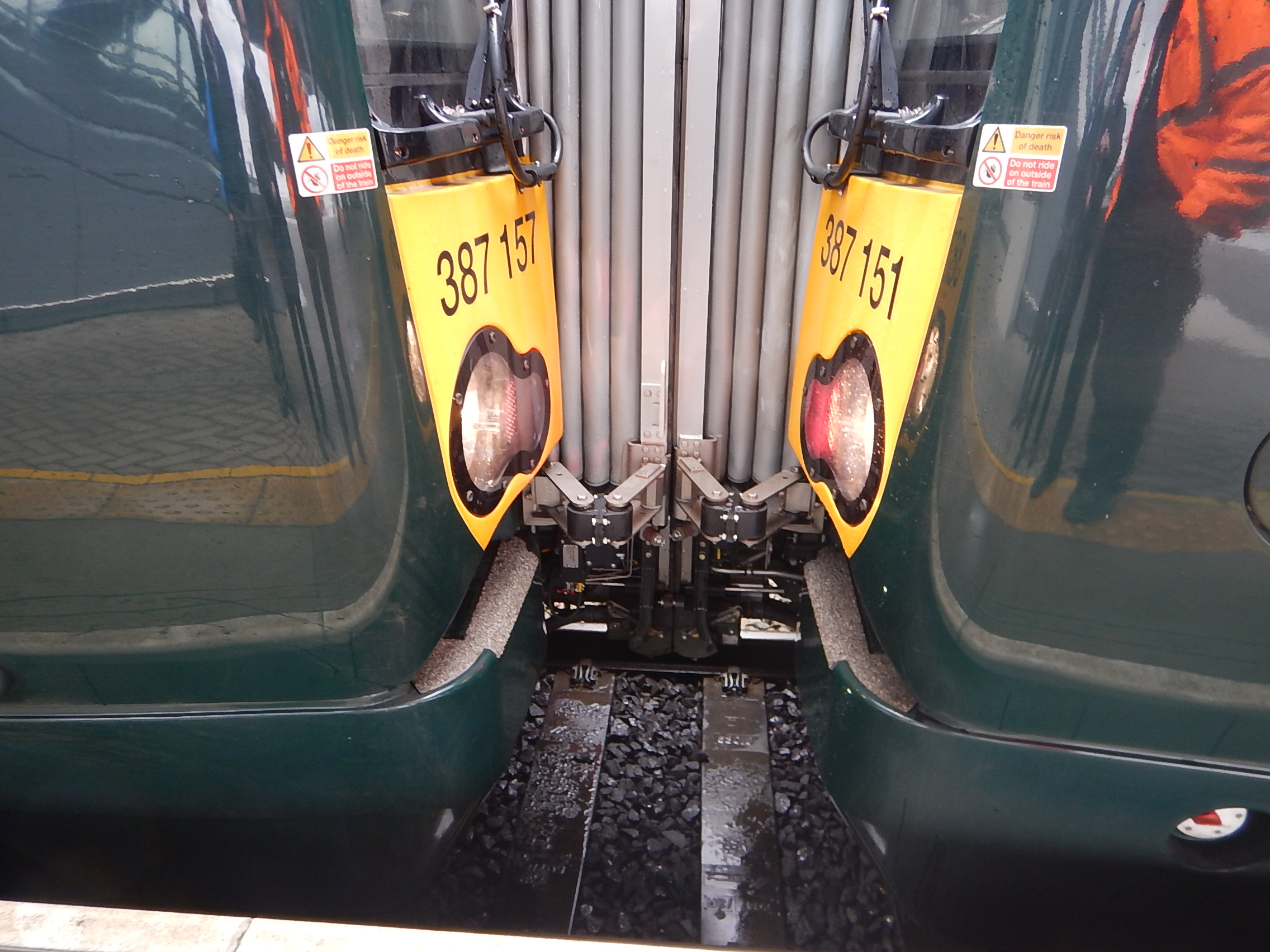
Note the driver in the cab on the right, controlling the process.
There is also a gangway between the two Class 387 trains, which the Class 332 trains don’t have.
Updating The Trains
The production of Class 387 trains has only just finished at Derby, but the Class 332 trains were built twenty years ago.
So could it be, that creating a modern fleet with all the features needed is easier with the later trains?
Suitability For Use With Heathrow Southern Railway Proposal
There are various issues here.
These concern fleet size and capacity
- Any extensions to the South and West will need more trains.
- If express services between Basingstoke, Guildford and Woking, and Paddington via Heathrow are successful, this could lead to calls for more services and other destinations, which could need more trains.
- If five-car units were needed, then Bombardier could probably oblige.
- There may be a need to lengthen platforms at the Heathrow stations.
Expanding a Class 387 train fleet would be easier.
There are also line speed issues.
- What would be the design operating speed of Heathrow Southern Railway’s tracks alongside the M25? – 90, 100 or even 125 mph!
- Could the operating speed of the Chertsey Branch Line be increased to the same speed, as there are only two stations; Chertsey and Addlestone?
The 110 mph maximum speed of a Class 387 could be a serious advantage, as speed sells!
How Many Trains Would Need To Be Converted?
Currently, there are fourteen Class 332 trains working Heathrow Express services.
They usually work in pairs, so there are seven trains.
If these are replaced by twelve-car Class 387 formations, that means up to twenty-one trains will be needed for the airport services from their current fleet of forty-five trains.
Eight-car formations would need fourteen trains.
Conclusion
It appears to me, that it is good decision to change the fleet for Class 387 trains.
Overall Conclusion
It’s all coming together for Heathrow Southern Railway.
MTR Vying To Join Heathrow Southern Rail Bid
The title of this post, is the same as that of this article in New Civil Engineer.
The title gives you all you need, but consider these facts about MTR.
- MTR is a Hong Kong company with a revene of about £4 billion per year, which is about the same size as the Stagecoach Group.
- MTR will be running Crossrail for Transport for London.
- MTR in partnership with First Group, are running South Western Railway.
In addition, FirstGroup are running Great Western Railway.
So it could seem logical for MTR to be included in the consortium behind Heathrow Southern Railway, as they could have a lot of influence on the consortium’s policies.
In an argument about train paths or stations, MTR or their partner; First Group, will be involved on both sides.
The problem is Heathrow Airport and their ownership of Heathrow Express, especially if it is extended deep into South Western Railway territory at Basingstoke, Guildford or Working.
This is said on the Heathrow Southern Railway web site.
Whether or not a third runway is built, many more passengers and airport workers need to be accessing Heathrow by train. The Government’s recent M25 South West Quadrant Study ruled out widening the motorway. HSR provides the alternative, switching traffic from the roads and contributing to improving local air quality. We estimate that HSR will reduce use of this section of the M25 by over three million car trips a year.
Heathrow might be a greedy bully, but they probably need a superb rail service more, than they need to own Heathrow Express.
MTR and AECOM, who is a large partner in Heathrow Southern Railway partner, are big enough to stand up to anybody.
The Railway At Dawlish Is In Trouble Again
This report on the Guardian is entitled Waves Batter Railway Line At Dawlish Station As Storm Emma Hits UK. It has a video, which shows the ferocity of the storm.
But at least things seem to be happening to create an alternative route, when Emma and her friends are causing trouble!
This article in the Tavistock Times Gazette is entitled Okehampton Rail News Welcomed Across The Region.
This is the first paragraph.
The news that the Government is creating a plan to bring an all-week, all year train service to Okehampton has been welcomed by MPs — including those for Okehampton and Tavistock — and county councillors from across the area.
The article goes on to say that the Transport Secretary; Chris Grayling, has instructed Great Western Railway to produce a creditable plan for an all-week, all-year train service between Exeter and Okehampton.
It is not a complete railway line to Plymouth and Cornwall avoiding Dawlish, but surely, it will help get rail passengers round a blockage, perhaps by using coaches along the A38 between Bodmin Parkway and Okehampton stations.
I suspect that part of the GWR plan will be to be able to get a trusty short-formation InterCity 125 between Exeter and Okehampton in all but the worst weather.
I suspect too, that GWR and their drivers and other staff, know the limitations of InterCity 125s by now, when it comes to getting services through Dawlish in atrocious weather.
The BBC has this video of the last train going through before the line through Dawlish was closed in 2014.
Hitachi Battery Trains On The Great Western Railway
The slow pace of the electrification on the Great Western Main Line has become a big stick with which to beat Network Rail.
But are rolling stock engineers going to pull Network Rail out of their hole?
On page 79 of the January 2018 Edition of Modern Railways, Nick Hughes, who is the Sales Director of Hitachi Rail Europe outlines how the manufacturer is embracing the development of battery technology.
He is remarkably open.
I discuss what he says in detail in Hitachi’s Thoughts On Battery Trains.
But here’s an extract.
Nick Hughes follows his description of the DENCHA; a Japanese battery train, with this prediction.
I can picture a future when these sorts of trains are carrying out similar types of journeys in the UK, perhaps by installing battery technology in our Class 395s to connect to Hastings via the non-electrified Marshlink Line from Ashford for example.
This would massively slice the journey time and heklp overcome the issue of electrification and infrastructure cases not stacking up. There are a large number of similar routes like this all across the country.
It is a prediction, with which I could agree.
I conclude the post with this conclusion.
It is the most positive article about battery trains, that I have read so far!
As it comes direct from one of the train manufacturers in a respected journal, I would rate it high on quality reporting.
Hitachi Battery Train Technology And Their UK-Built Trains
The section without electrification on the Marshlink Line between Ashford International and Ore stations has the following characteristics.
- It is under twenty-five miles long.
- It is a mixture of double and single-track railway.
- It has nine stations.
- It has a sixty mph operating speed.
As the line is across the flat terrain of Romney Marsh, I don’t think that the power requirements would be excessive.
In the Modern Railway article, Nick Hughes suggests that battery technology could be installed in Class 395 trains.
The Class 395 train is part of a family of trains, Hitachi calls A-trains. The family includes.
- Class 800 trains as ordered by GWR and Virgin Trains East Coast.
- Class 801 trains as ordered by GWR and Virgin Trains East Coast
- Class 802 trains as ordered by GWR, Hull Trains and TransPennine Express
- Class 385 trains as ordered by ScotRail.
In Japan, another member of the family is the BEC819, which is the DENCHA, that is mentioned in the Modern Railways article.
As a time-expired electrical engineer, I would think, that if Hitachi’s engineers have done their jobs to a reasonable standard, that it would not be impossible to fit batteries to all of the A-train family of trains, which would include all train types, built at Newton Aycliffe for the UK.
In Japan the DENCHAs run on the Chikuhō Main Line, which has three sections.
- Wakamatsu Line – Wakamatsu–Orio, 10.8 km
- Fukuhoku Yutaka Line – Orio–Keisen, 34.5 km
- Haruda Line – Keisen–Haruda, 20.8 km
Only the middle section is electrified.
It looks to me, that the Japanese have chosen a very simple route, where they can run on electrification for a lot of the way and just use batteries at each end.
Bombardier used a similar low-risk test in their BEMU Trial with a Class 379 train in 2015.
So How Will Battery Trains Be used On the Great Western?
On the Great Western Main Line, all long distance trains and some shorter-distance ones will be Class 80x trains.
The size of battery in the DENCHA can be estimated using a rule, given by Ian Walmsley.
In an article in the October 2017 Edition of Modern Railways, which is entitled Celling England By The Pound, Ian Walmsley says this in relation to trains running on the Uckfield Branch.
A modern EMU needs between 3 and 5 kWh per vehicle mile for this sort of service.
So the energy needed to power the DENCHA, which is a two-car battery train on the just under twenty miles without electrification of the Chikuhō Main Line in a one way trip would be between 112 and 187 kWh.
A Battery-Powered Class 801 Train
The Class 801 train is Hitachi’s all-electric train, of which Great Western Railway have ordered thirty-six of the closely-related five-car Class 800 train and twenty-one of the nine-car units.
The difference between the two classes of train, is only the number of generator units fitted.
- Trains can be converted from Class 800 to Class 801 by removing generator units.
- Bi-mode Class 800 trains have a generator unit for each powered car.
- The all-electric Class 801 train has a single generator unit, in case of electrical power failure.
- When trains couple and uncouple, the train’s computer system determines the formation of the new train and drives and manages the train accordingly.
If I was designing the train, I would design a battery module, that replaced a generator unit
This leads me to think, that a five-car Class 801 train, could have one generator unit and up to four battery modules.
- The computer would decide what it’s got and control the train accordingly.
- The generator unit and battery power could be used together to accelerate the train or at other times where high power is needed.
- If the batteries failed, the generator unit would limp the train to a safe place.
- The number of battery units would depend on the needs of the route.
It would be a true tri-mode train; electric, diesel and battery.
I will now look at some routes, that could see possible applications of a battery version of Class 80x trains.
Cardiff To Swansea
I’ll start with the most controversial and political of the cutbacks in electrification.
At present plans exist to take the electrification on the Great Western as far as Cardiff Central station, by the end of 2018.
The distance between Cardiff Central and Swansea stations is forty-six miles, so applying the Ian Walmsley formula and assuming the train is five-cars, we have an energy usage for a one-way trip between the two cities of between 690 and 1150 kWh.
As the Class 80x trains are a modern efficient design, I suspect that a figure towards the lower end of the range will apply.
But various techniques can be used to stretch the range of the train on battery power.
- From London to Cardiff, the line will be fully-electrified, so on arrival in the Welsh capital, the batteries could be fully charged.
- The electrification can be continued for a few miles past Cardiff Central station, so that acceleration to line speed can be achieved using overhead wires.
- Electrification could also be installed on the short stretch of track between Swansea station and the South Wales Main Line.
- There are three stops between Cardiff and Swansea and regenerative braking can be used to charge the batteries.
- The single generator unit could be used to help accelerate the train if necessary.
- There are only two tph on the route, so efficient driving and signalling could probably smooth the path and save energy.
- Less necessary equipment can be switched off, when running on batteries.
Note. that the power/weight and power/size ratios of batteries will also increase, as engineers find better ways to build batteries.
The trains would need to be charged at Swansea, but Hitachi are building a depot in the city, which is shown in these pictures.


It looks like they are electrifying the depot.
Surely, enough electrification can be put up at Swansea to charge the trains and help them back to the South Wales Main Line..
The mathematics show what is possible.
Suppose the following.
- Hitachi can reduce the train’s average energy consumption to 2 kWh per carriage-mile, when running on battery power.
- Electrification at Cardiff and Swansea reduces the length of battery use to forty miles.
This would reduce the battery size needed to 400 kWh, which could mean that on a five-car train with four battery modules, each battery module would be just 100 kWh. This compares well with the 75 kWh battery in a New Routemaster bus.
Will it happen?
We are probably not talking about any serious risk to passengers, as the worst that can happen to any train, is that it breaks down or runs out of power in the middle of nowhere. But then using the single generator unit, the train will limp to the nearest station.
But think of all the wonderful publicity for Hitachi and everybody involved, if the world’s first battery high speed train, runs twice an hour between Paddington and Swansea.
Surely, that is an example of the Can-Do attitude of Isambard Kingdom Brunel?
Paddington To Oxford
The route between Paddington and Oxford stations is electrified as far as Didcot Parkway station.
The distance between Didcot Parkway and Oxford stations is about ten miles, so applying the Ian Walmsley formula and assuming the train is five-cars, we have an energy usage for the return trip to Oxford from Didcot of between 300 and 500 kWh.
If the five-car train has one generator unit,four battery modules and has an energy usage to the low end, then each battery module would need to handle under 100 kWh.
There are plans to develop a South-facing bay platform at Oxford station and to save wasting energy reversing the train by running up and down to sidings North of the station, I suspect that this platform must be built before battery trains can be introduced to Oxford.
If it’s not, the train could use the diesel generator to change platforms.
The platform could also be fitted with a system to charge the battery during turnround.
Paddington To Bedwyn
The route between Paddington and Bedwyn is electrified as far as Reading station, but there are plans to electrify as far as Newbury station.
The distance between Newbury and Bedwyn stations is about thirteen miles, so applying the Ian Walmsley formula and assuming the train is five-cars, we have an energy usage for the return trip to Bedwyn from Newbury of between 390 and 520 kWh.
As with Paddington to Oxford, the required battery size wouldn’t be excessive.
Paddington To Henley-on-Thames
The route between Paddington and Henley-on-Thames station is probably one of those routes, where electric trains must be run for political reasons.
The Henley Branch Line is only four miles long.
It would probably only require one battery module and would be a superb test route for the new train.
Paddington To Weston-super-Mare
Some Paddington to Bristol trains extend to Weston-super-Mare station.
Weston-super-Mare to the soon-to-be-electrified Bristol Temple Meads station is less than twenty miles, so if Swansea can be reached on battery power, then I’m certain that Weston can be reached in a similar way.
Other Routes
Most of the other routes don’t have enough electrification to benefit from trains with a battery capability.
One possibility though is Paddington to Cheltenham and Gloucester along the Golden Valley Line. The length of the section without electrification is forty-two miles, but unless a means to charge the train quickly at Cheltenham station is found, it is probably not feasible.
It could be possible though to create a real tri-mode train with a mix of diesel generator units and battery modules.
This train might have the following characteristics.
- Five cars.
- A mix of generator units and battery modules.
- Enough generator units to power the train on the stiffest lines without electrification.
- Ability to collect power from 25 KVAC overhead electrification
- Ability to collect power from 750 VDC third-rail electrification.
Note.
- The battery modules would be used for regenerative braking in all power modes.
- The ability to use third rail electrification would be useful when running to Brighton, Exeter, Portsmouth and Weymouth.
The train could also have a sophisticated computer system, that would choose power source according to route,timetable, train loading, traffic conditions and battery energy level.
The objective would be to run routes like Paddington to Cheltenham, Gloucester to Weymouth and Cardiff to Portsmouth Harbour, as efficiently as possible.
Collateral Advantages
Several of the routes out of Paddington could easily be worked using bi-mode Class 800 trains.
- But using battery trains to places like Bedwyn, Henley, Oxford and Weston-super-Mare is obviously better for the environment and probably for ticket sales too!
- If places like Bedwyn, Henley and Oxford are served by Class 801 trains with a battery option, it could mean that they could just join the throng of 125 mph trains going in and out of London.
- Battery trains would save money on electrification.
I also suspect, that the running costs of a battery train are less than those of using a bi-mode or diesel trains.
Conclusion
Hitachi seem to have the technology, whereby their A-train family can be fitted with batteries, as they have done it in Japan and their Sales Director in the UK, has said it can be done on a Class 395 train to use the Marshlink Line.
We may not see Hitachi trains using batteries for a couple of years, but it certainly isn’t fantasy.
Great Western Railway certainly need them!

