Heathrow Southern Railway And Woking Station
This news item on the Heathrow Southern Railway web site is entitled Plans Announced For £1 billion Rail Link Between Southampton And Heathrow.
This is an extract.
We hope three trains an hour (tph) could be running to Southampton by 2026.”
That is the message from Graham Cross, chief executive of Heathrow Southern Railway (HSR), which is preparing plans for a £1 billion rail link between the city and the UK’s biggest airport.
This map shows a schematic of the Heathrow Southern Railway.
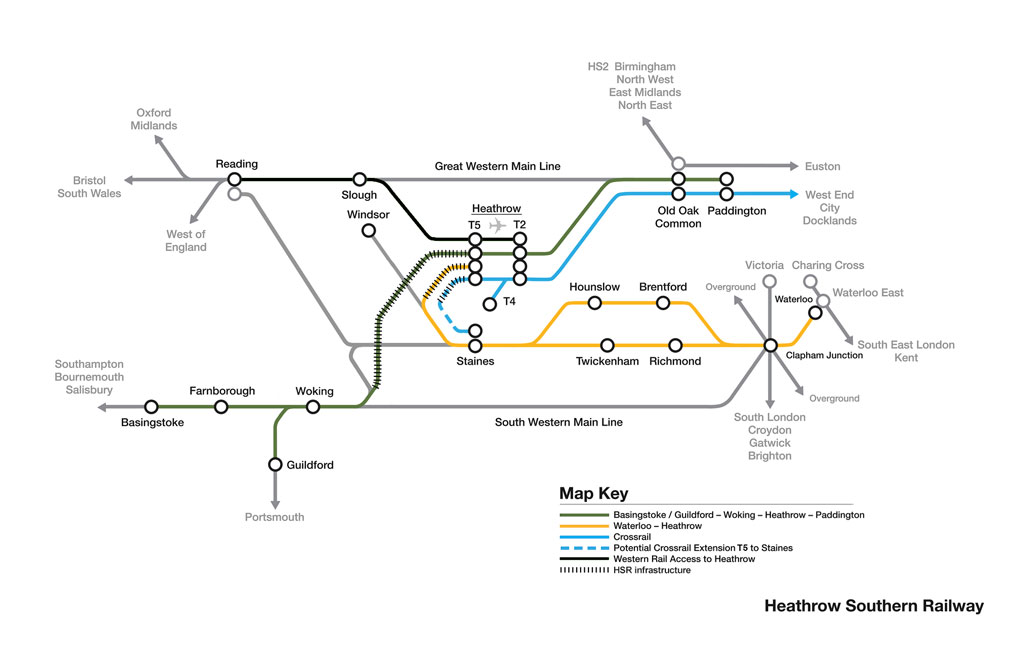
Hethrow Southern Railway’s plans are as follows.
- A new section of railway will connect the Chertsey Branch Line to Heathrow Terminal 5 station.
- This new section of railway will be built alongside the M25 to minimise environmental disruption.
- From there trains will call at Heathrow Central and Old Oak Common stations before terminating at Paddington station.
- Trains will connect Heathrow to Woking station and on to Basingstoke and Guildford.
Currently, the service between Southampton Central and London is as follows.
- South Western Railway – One tph – Poole and Waterloo
- South Western Railway – One tph – Weymouth and Waterloo – Stops at Woking
- South Western Railway – One tph – Weymouth and Waterloo
- Southern – One tph – Southampton Central and Victoria – Stops at Gatwick
If we take Graham Cross at his word, that the following frequencies to various stations.
- Gatwick Airport – 1 tph
- Heathrow Airport – 3 tph
- Old Oak Common – 3 tph
- Victoria – 1 tph
- Warerloo – 3 tph
- Woking – 4 tph
Passengers from Southampton.Bournemouth, Poole and Weymouth would have a much larger choice of London stations.
As Heathrow Southern Railway also plan to run two tph between Paddington and Guildford via Heathrow, Woking could become a busier place.
These pictures show Woking station.
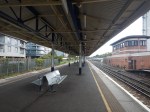
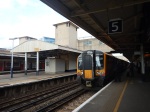


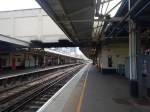


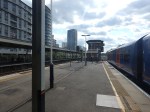
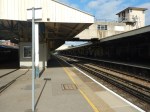



This Google Map shows the station.
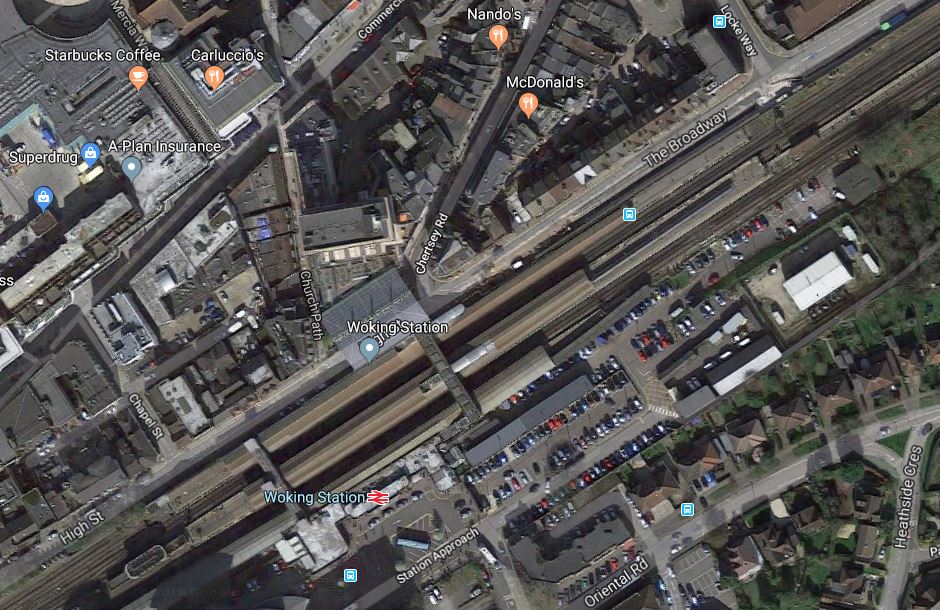
Note some of the characteristics.
Four Long Through Platforms
The station has four long through platforms, which can accommodate the longest ten-car trains used by South Western Railway.
Twelve-Car Class 387 Trains
Two five-car Class 444 trains are 230 metres long, when running as a ten-car train.
If Heathrow Southern Railway want to run Class 387 trains, train lengths will be as follows.
- Eight cars – 163 metres
- Twelve cars – 280 metres
Twelve-cars trains may be too long for the platforms at Woking and other stations. but as Heathrow Southern Railway won’t open for a few years, I wouldn’t be surprised to see new trains used by Heathrow Express and Heathrow Southern Railway.
Splitting And Joining Trains At Woking
I also think, that these platforms are ideal for pairs to join and split here, so that trains are say tencars between Woking and Paddington via Heathrow and Old Oak Common and five cars to the South West of Woking.
Conclusion
Woking’s long platforms will be used to great advantage by Heathrow Southern Railway to match their services to the capacity needed.
- For passengers and workers to and from Heathrow Airport.
- For commuters and passengers to and from Paddington, Central London, the City of London and Canary Wharf
- For passengers to and from HS2 at Old Oak Common.
Heathrow Southern Railway will do a lot more, than just provide Southern access to Heathrow.
A Shorter Bay Platform At The London End
There is a shorter bay platform at the London end of the station, which is currently used for stopping trains to London.
It can’t handle long trains like the through platforms and for this reason along, I doubt it will be used by services to Heathrow.
But I wouldn’t be surprised to see a second bay platform added to improve capacity.
A Shorter Bay Platform At The Country End
Wikipedia says this about Plstform 6, which is a short by platform facing West.
The first train of the day to Portsmouth Harbour via Eastleigh starts from this platform, and it is often used to stable diesel locomotives in the event of a train failure.
It is probably best filed under operationally useful and I doubt it will be used by Heathrow Southern Railway, as it faces away from Heathrow.
Woking Station Is Surrounded By Tower Blocks
In the pictures, you can see tower blocks rising all round the station.
There will obviously be more, even if as I suspect the local residents object.
But we do need more housing in this crowded country of ours and Woking is a convenient distance from London for commuters.
Should Tracks At Woking Station Be Remodelled?
After Heathrow Southern Railway opens, trains calling at Woking station will use the following routes towards London.
- Via Clapham Junction to Waterloo.
- Via Heathrow to Old Oak Common and Paddington
And the following routes away from London.
- Via Basingstoke to Bournemouth, Exeter, Poole, Salisbury, Southampton and Weymouth.
- Via Guildford to Portsmouth
An ideal layout might be two wide island platforms, as they have at Reading stations.
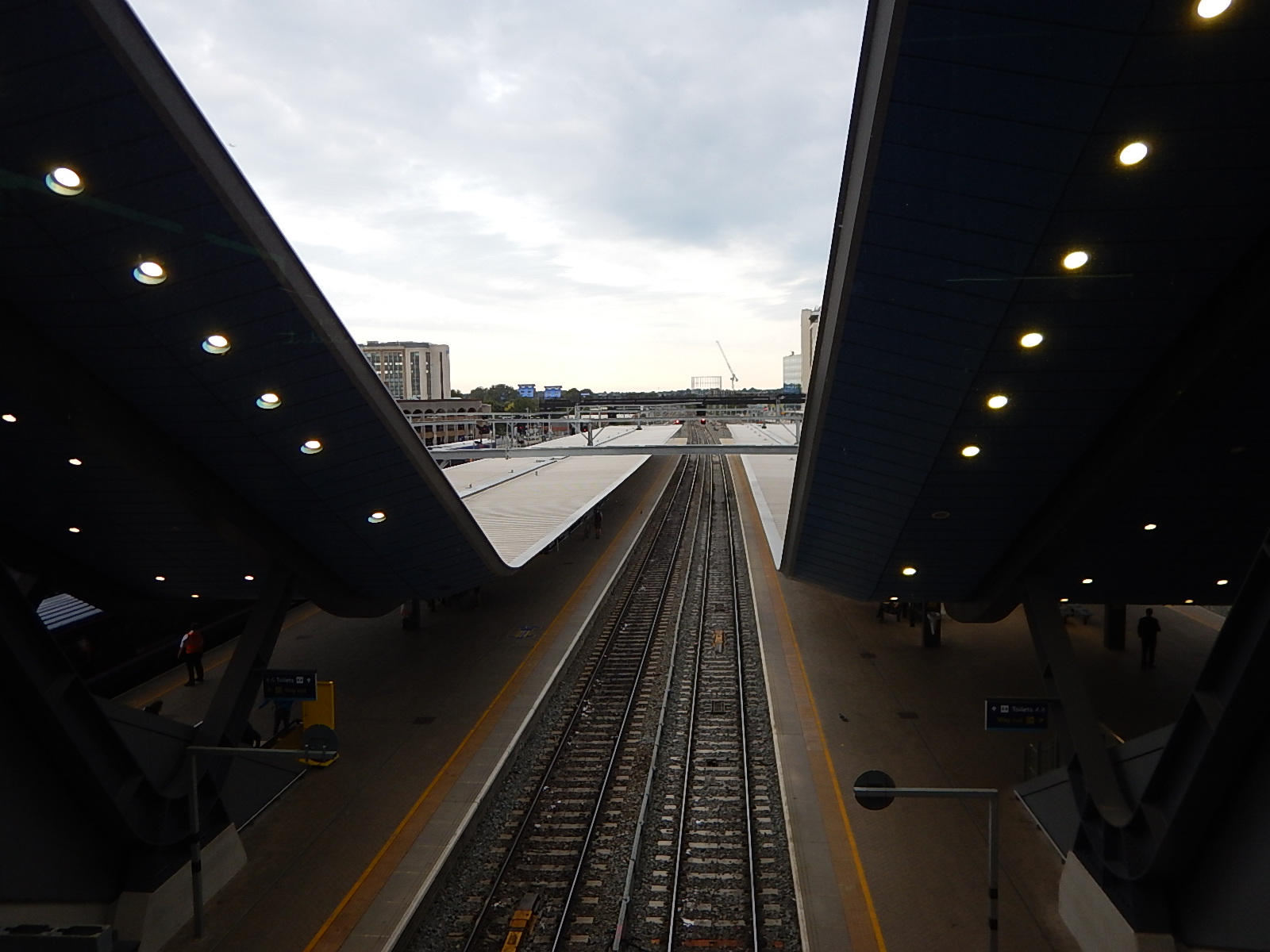
The platforms are connected to a wide overbridge with coffee kiosks and useful shops, by escalators and lifts.
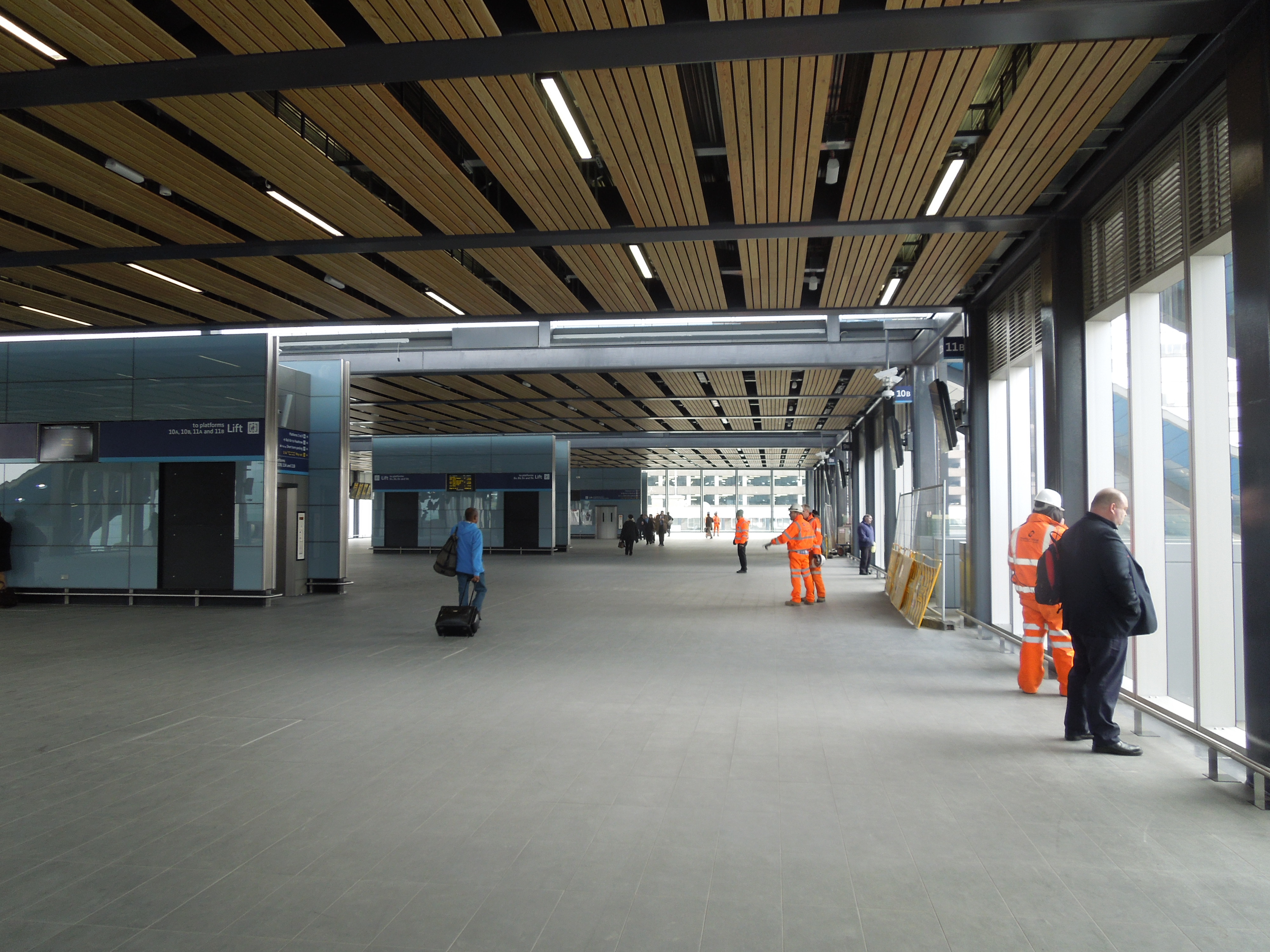
The picture shows the wide open spaces of the overbridge at Reading on the day it opened.
At Reading passengers can change trains, by waiting on the platform or sitting on the overbridge.
Would a similar design work at Woking?
Certainly something designed on similar principles to fit the circumstances of Woking station would!
Reading incidentally manages at least six tph on each face of the wide island platforms.
They are able to do this because.
- The platforms are very wide.
- Trains are increasingly Class 800 trains with modern doors.
- There are both up and down escalators.
- There are lifts.
I suspect, that when InterCity 125 trains no longer call at Reading and all trains are using modern in-cab signalling, that the frequencies of train through Reading will rise significantly.
Space To The West
To the West of Woking station, where the routes to Guildford and Basingstoke divide, there is a lot of space and if required a flyover or dive-under could be built to minimise the need for flat junctions.
West Byfleet and Byfleet & New Haw Stations
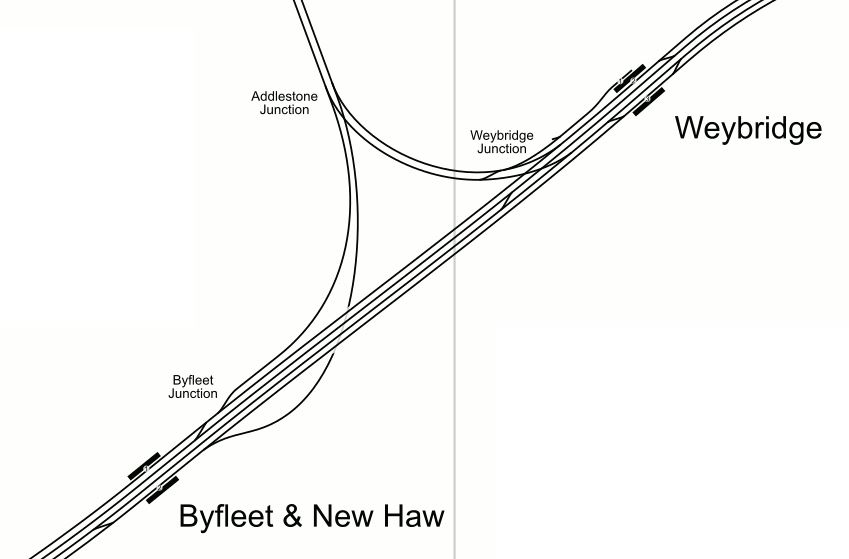
West Byfleet and Byfleet & New Haw stations are between Woking station and Byfleet Junction, where Heathrow and Waterloo services will divide.
This map from carto.metro.free.fr shows Byfleet & New Haw station and Byfleet Junction.
Note.
- There is only four tracks between Byfleet junction.
- Byfleet junction connects to the slow lines.
- Crossovers connect the slow and fast lines.
This layout means that fast trains coming from Heathrow will have to go through the slow platform at Byfleet & New Haw station.
There are two ways to increase safety.
- Increase the number of tracks between Woking station and Byfleet Junction to six, with dedicated tracks for Heathrow services.
- Rebuild the platforms on the two intermediate stations to the design rules in Two Platform Stations With 125 mph Trains.
It all depends, whether Heathrow Southern Railway want to use 125 mph trains on their services to Heathrow!
I discussed this in Will Heathrow Southern Railway Use Trains Capable Of 125 mph?, where I came the conclusion that the railway will be built to that standard.
Will Woking Station Be Rebuilt?
To work efficiently, as a railway station, I very much feel that Woking station will be rebuilt.
As at Reading, this will probably be done without too much disruption to passengers and trains.
It is quite a large station site and I wonder, if the ideal solution would be to build a concrete deck over the station and railway and put developments like housing, offices, shops, cafes and green spaces over the top.
Why shouldn’t we create more land for useful purposes?
The Station Concourse
The station could have a massive concourse.
- Wide lines of gates on either side would give quick access to the Town Centre and the Car Parking.
- Escalators and lifts would lead down to the platforms
- Useful shops and cafes would be on the concourse.
Think Edinburgh Haymarket station, only bigger, more spacious and with escalators
A Capacity Of 24 Trains Per Hour
The new station should be designed to allow up to 24 tph, through the station.
Currently, services include
- 14 tph to Waterloo
- 4 tph to Portsmouth
- 2 tph to Salisbury and/or Exeter
- 6 tph to Southampton, Bournemouth and/or Poole
Perhaps it would be sensible to design fora capacity of 12 tph on all branches.
With modern signalling and perhaps a degree of automatic train control, these frequencies shouldn’t be a problem.
Wide Platforms
Wide platforms, that allow passengers to change trains, by just getting off one train and onto another a few minutes later are an essential.
A double-faced island platform could be used or a single wide platform in each direction as on Thameslink at St. Pancras station.
The platforms at St. Pancras work reasonably well and have been designed to handle 24 tph.
- They have three escalators.
- They have a lift.
- The platforms are fully-manned.
- Passenger information displays are magnitudes better than most stations.
- There are Harrington Humps for step-free access to the Class 700 trains.
- Only one class of train uses the platforms.
- Modern digtal signalling is used.
- Passengers use the station to change trains, when perhaps they are on a train going to one direction and need another.
To complicate matters at St.Pancras, there is a flat junction to the North of the station, where services go to and from the Midland Main and East Coast Main Lines. It appears the junction causes no delays to services.
So perhaps at Woking we could see one very wide platform in each direction.
Building On Experiences At London Bridge, Reading And St. Pancras
I’m sure that Network Rail and their architects can use the experience gained at other stations in the UK to create an interchange station at Woking, that is fit for the 21st Century.
Conclusion
I feel there is a lot to be gained by creating a bold interchange at Woking station to integrate the Heathrow Southern Railway and the existing services into Waterloo
Will Heathrow Southern Railway Use Trains Capable Of 125 mph?
If the Heathrow Southern Railway is built, by the time it opens, there will have been significant developments.
- Digital signalling based on ERTMS, with the possibilities of a degree of automatic control will be commonplace.
- Train manufacturers will offer 125 mph trains, that with the right interiors will be able to perform well on 100 mph routes with frequent stops.
- 125 mph bi-mode trains will have arrived.
- Great Western Railway services into Paddington, with the exception of local services will be run by 125 mph Class 800 trains.
- The opening of Old Oak Common station with its connections to High Speed Two, may mean that some Great Western Railway services stop at that station.
These developments may mean that on the Western end of the Great Western Main Line, there will be a need for a train with a lot of acceleration, to avoid inducing delays in the complex schedule of trains serving Paddington and Old Oak Common stations.
The easy way to achieve the required acceleration, may be to use more powerful trains, which will probably be capable of 125 mph.
But would they offer advantages over other parts of the routes Heathrow Southern Railway will serve?
The following must be considered.
The Top Speed Of Third-Rail Trains
Currently, the Class 395 train, is the fastest train fitted with third rail shoes.
But the train only has a top speed of 100 mph, when on lines electrified using third-rail electrification.
The world record for a train powered by third-rail electrification was set by a Class 442 train at 108 mph.
As several trains in the UK can cruise at 125 mph, could it be that the dynamics of third-rail electrification impose a limit to top speed?
This article in Rail Magazine, is entitled Bombardier Bi-Mode Aventra To Feature Battery Power.
A few points from the article.
- Development has already started.
- The bi-mode would have a maximum speed of 125 mph under both electric and diesel power.
- The trains will be built at Derby.
In Mathematics Of A Bi-Mode Aventra With Batteries, I analyse the train in detail.
This was my conclusion.
I am rapidly coming to the conclusion, that a 125 mph bi-mode train is a practical proposition.
- It would need a controllable hydrogen or diesel power-pack, that could deliver up to 200 kW
- Only one power-pack would be needed for a five-car train.
- For a five-car train, a battery capacity of 300 kWh would probably be sufficient.
From my past professional experience, I know that a computer model can be built, that would show the best onboard generator and battery sizes, and possibly a better operating strategy, for both individual routes and train operating companies.
Obviously, Bombardier have better data and more sophisticated calculations than I do.
My calculation might be wrong, but it’s in the right area.
Using batteries with third-rail electric trains, may be an alternative way to overcome any problems with the dynamics of that method of electrification.
But I do suspect that if train manufacturers were asked to produce an electric train capable of running at 125 mph using third-rail electrification, they would take the money and build the trains.
Upgrading Track To 125 mph
Virtually all of Heathrow Southern Railway’s proposed or possible routes to the South and West of Heathrow are third-rail electrified
- The South Western Main Line to Southampton, Bournemouth, Poole and Weymouth has a 100 mph operating speed.
- The Portsmouth Diect Line to Guildford and Portsmouth has a 90 mph maximum speed.
South Western Railway know that speed on these routes sells tickets, so much so that they are refurbishing the Class 442 trains for the Portsmouth route because of their higher performance.
Network Rail may get a lot of criticism for their performance with electrification, which work on new track layouts and improvements,seems not to attract.
They have also been very successful in designing and executing 125 mph track upgrades to the Midland Main Line.
So would it be possible to upgrade some of the routes to allow faster running?
Consider.
- Fifty miles of line upgraded from 100 mph to 125 mph running saves six minutes.
- Waterloo to Weymouth is 143 miles.
- More powerful trains might save time on station stops.
- The routes are four tracks to Basingstoke.
- As modern digital signalling is applied to this route there will be further time savings.
At the moment there is no point, as South Western Railway only has trains with an operating speed of 100 mph.
But these trains will probably be replaced in the next few years or so and I wouldn’t be surprised to see them replaced with trains that are capable of 125 mph, which would make updating sections to the West of Woking possible.
South Western Railway
Surely faster services to Bournemouth, Poole, Portsmouth, Southampton and Weymouth will be of interest to South Western Railway, even if it means new trains.
The New Route Between Heathrow And Woking
Heathrow Southern Railway intends to build a new route between Heathrow Terminal 5 and Working stations.
- A tunnel will connect the Western end of Heathrow Terminal 5 station to new tracks running alongside the M25 to connect to the Chertsey Branch Line to the West of Chertsey station.
- Trains would pass through Chertsey and Addlestone stations, before joining the South Western Main Line at Byfleet Junction.
- Trains would pass through West Byfleet and Byfleet & New Haw stations to reach Woking station.
It is a well-designed route, that uses the M25 to minimise environmental damage.
From what I have said earlier about 125 mph third-rail trains, upgrading of routes to 125 mph and South Western Railways desire for faster services, I can see no reason, why this route shouldn’t be built for 125 mph operation.
125 mph trains would mean.
- Removing level crossings at Chertsey and Addlestone stations.
- Upgrading West Byfleet and Byfleet & New Haw stations.
- Probably upgrading between Byfleet Junction and Woking station for 125 mph running.
But there would be about fifteen miles of high speed rail line, which for ease of operation would probably be electrified with third-rail.
Trains would switch electrification systems in Heathrow Terminal 5 station.
Conclusions
I am led to the following conclusions.
- 125 mph third-rail trains will become a reality.
- South Western Railway and Heathrow Southern Railway will look at them seriously.
I also feel that Heathrow Southern Railway will be a 125 mph railway.
Could Rail Access To Heathrow Be Formed Of The Best Bits Of Various Schemes?
Various schemes have been proposed to improve rail access to Heathrow.
There are also two schemes in progress, that will improve rail access to Heathrow.
- Crossrail, which will open in 2019.
- Piccadilly Line Upgrade, which will be complete in 2025.
I also believe that if the West London Orbital Railway is created, then this could have a positive affect on travelling to and from Heathrow.
Heathrow In The Future
Heathrow are disclosing a master plan, for rebuilding a lot of the airport to make it more efficient and up with the best.
- There will be two main terminals; Heathrow West and Heathrow East with satellites in between handling the actual planes.
- These two terminals and the satellites will be between the two existing runways, with a passenger and baggage transport system beneath.
- Terminal Five will become Heathrow West.
- An extended Terminal Two will become Heathrow East.
- Crossrail, Heathrow Express and the Underground will serve both main terminals.
I believe that this rebuilding will happen, whether or not a third runway is built and it could start in the next few years.
Heathrow’s Pollution Footprint
Heathrow is a big polluter, but it is not so much the planes, as the diesel cars, buses and trucks serving the airport.
Uses For Improved Rail Access
There are several uses for improved rail access to Heathrow.
Passengers
Many passengers feel they must drive to and from Heathrow.
Next year, Crossrail will connect Heathrow directly to the City of London, Canary Wharf, the West End and to the heart of London’s Underground, Overground and National Rail system.
An example journey will be Bond Street to Heathrow Central in twenty-six minutes.
New trains on the Piccadilly Line are planned to enter service in 2023 and will offer more capacity and more pleasant journeys.
Currently, Piccadlly Circus to Heathrow Central takes fifty-two minutes and I would hope that this time is reduced to perhaps 40-45 minutes.
I think, these two upgrades will change the way many in Central, North East, East and South East London access the airport.
- Trains will be more comfortable.
- Trains will be frequent.
- Crossrail will be completely step-free.
- The Piccadilly Line will have more step-free stations.
- The Crossrail trains will have masses of space.
- Trains will take passengers to all the terminals
But Crossrail and the Piccxadilly Line upgrade, will do little for those in North West and South West London and those living to the West of the airport.
Workers
Workers at Heathrow, range from highly-paid pilots down to lowly-paid cleaners, with a full spectrum in between.
Many though have a problem, in that they need to get to and from the airport at times, that are inconvenient for public transport.
A station guy at Staines said that getting between there and Heathrow for an early start or after a late finish is difficult.
The lower-paid workers also need good links to areas of lower-cost housing.
In an ideal world, Crossrail and Piccadilly Line services, should run on a twenty-four hour basis, with appropriate frequencies.
Supplies For The Airport And The Aircraft
I wonder what percentage of the supplies for Heathrow is brought in by diesel truck.
In the Heathrow of the Future, surely many supplies could be loaded onto smart trolleys and taken on electric freight trains to delivery points under the airport.
Air Cargo
Heathrow is an important air cargo terminal, but as with supplies, surely the cargo can be collected outside of the airport and delivered by electric shuttle trains.
The Best Bits Of The Various Actual And Proposed Rail Routes Into Heathrow
Crossrail
- Connectivity to large parts of London and the East.
- Connectivity to lower-cost housing areas in East and West London.
- High capacity.
- Frequent trains
- Modern trains
- All terminals served
- Extra trains could be added.
The capability for 24 hour operation has hopefully been built in.
Heathrow Southern Railway
- Connectivity to Waterloo, Clapham Junction, South and South West London
- Extends Heathrow Express to Woking and Basingstoke
- Adds a new route for commuters into Paddington.
- Extends Crossrail from Heathrow to Staines.
- It will be built alongside the M25 with a tunnel to Terminal Five.
- All terminals served
- Provides a freight route into the airport from the South West.
- Privately funded.
HS4Air
- Connectivity to HS2, the Midlands, North and West of England and Wales
- Possible connection to Gatwick and Ashford for the Continent.
- North-South station in a tunnel deep under Heathrow.
- The Heathrow station will be able to handle full-length high speed trains from Birmingham, Cardiff and Manchester.
- Heathrow could become a High Speed Rail hub serving Greater Western London.
- Sneaks along the M25.
- All terminals could probably be served, by escalators and lifts from the deep station.
- Provides a freight route into the airport from the North and West.
- Privately funded
I’m keener on the section North of Heathrow, than that to the South.
Piccadilly Line Upgrade
- Connectivity to West and North London
- Connectivity to lower-cost housing areas in West London
- Frequent trains
- All terminals served.
- No new infrastructure
Probably needs 24 hour operation.
Western Rail Approach To Heathrow
- Connectivity to Slough and Reading and further West with a change.
- All terminals served.
- Provides a freight route into the airport from the West.
- Network Rail’s proposed scheme.
- Government funded (?)
West London Orbital Railway
- Connectivity to North West London with a change at Old Oak Common.
- Connectivity to low-cost hosting areas in West London.
- Created as part of the Overground.
- Eight trains per hour (tph) through Old Oak Common.
- Connectivity for high-value passengers in affluent parts of North London.
- Connectivity for important workers in less-affluent parts of North West London.
- Probably, Transport for London funded.
- No difficult construction.
The West London Orbital Railway should go ahead, because it connects so much of West London to Crossrail, Old Oak Common and High Speed Two.
Windsor Link Railway
- Connectivity to Slough and Reading and further West with a change.
- All terminals served.
- Provides a freight route into the airport from the West.
- Privately funded
This scheme also unlocks development of upmarket housing in Windsor.
Conclusions
I have seen railway stations and airports all over Europe.
Many airport stations are cramped, as they have been built as an afterthought.
But some like Schipol and Frankfurt have a comprehensive station, where you can get trains to a very long list of places without a change.
Heathrow Connectivity
Heathrow needs a very high level of connectivity, for passengers, workers and freight.
Two schemes provide that.
- Heathrow Southern Railway, which extends Heathrow Express to the South West and provides links to Waterloo and Greater South London.
- HS4Air, which has an elegant expandable station deep under the airport and connects to High Speed Two and the Great Western Railway in the North. Extending to Gatwick and Ashford for the Continent could also be possible, if required.
Western Rail Approach To Heathrow only does what it says in the name and HS4Air does that without bagging valuable platforms at Terminal Five.
What About The Workers!
Heathrow’s other big need is rail access for the increasing numbers of people, who work at the airport and live locally.
- Heathrow Southern Railway links the airport to South West London and also allows an extension of Crossrail to Staines.
- Windsor Link Railway links the airport to Windsor, Slough and Reading.
- Crossrail links the airport to Old Oak Common with its housing developments and rail connections with High Speed 2 and the London Overground.
- West London Orbital Railway will bring more workers and passengers to Old Oak Common from all over North West and South West London.
Old Oak Common will be important for many working at the airport.
Old Oak Common station
Old Oak Common station will become an important interchange for workers and passengers travelling to and from Heathrow.
- It must be totally step-free.
- Some of the long interchange walks on current plans should be augmented by travelators.
- Crossrail is planning six tph between Old Oak Common and Heathrow. Is that enough?
Get Old Oak Common right and all those needing to go to and from Heathrow will benefit.
Heathrow And Gatwick
The connection between Heathrow and Gatwick airports is tortuous at present, but will get better as the years progress, as Crossrail and Thameslink improve.
As the airports grow, with a third runway at Heathrow and a second one at Gatwick, how many people will want to travel quickly between the two airports, as increasingly, both airports will offer services to more destinations?
As a Londoner, I also believe that we will see more split flights, where passengers stopover in London for a night or two, when they are going halfway around the world. Terminal London will be the best airport transfer terminal in the world.
Predicting the number of travellers between the two airports will be extremely difficult and only a direct measurement will be a worthwhile figure.
If a direct rail link is needed, HS4Air should be extended to Gatwick to provide a frequent fifteen minute connection.
Heathrow And High Speed One
I will be very surprised if many travellers need to go quickly between Heathrow and High Speed One.
Why would anybody between say St. louis and Paris not fly direct? Perhaps only, if you were spending time in London between the two legs of your journey.
For those that need to do it, using an extended Crossrail between Heathrow and Ebbsfleet will probably be good enough.
But when passenger numbers say it would be viable, extending HS4Air to Ashford would be a distinct possibility.
Heathrow And High Speed Two
For all sorts of reasons Heathrow needs good connectivity to High Speed Two.
If I was the CEO of Heathrow, I would want to have a station at my airport, where passengers could travel to and from the major cities of Birmingham, Leeds, Liverpool, Manchester, Newcastle and Nottingham in as direct a manner as possible.
Using Crossrail to Old Oak Common will give access to all High Speed Two trains, but the ability to get a train to the North within thirty minutes of clearing immigration and customs, would be a major selling point for my airport.
Suppose HS4Air was providing four tph to Birmingham of which two tph, went to each of Crewe/Manchester and Nottingham/Leeds.
Or the four tph could be double trains, with one half serving each Northern route.
This would make Heathrow a viable alternative to regional airports.
Heathrow will strongly support HS4Air, as it would be like having a whole series of regional flights, with a thirty minute transfer to and from long-haul routes.
Western Rail Approach To Heathrow
The Western Rail Approach To Heathrow is far inferior to the HS4Air proposal.
Consider.
- The Western Rail Approach To Heathrow only connects the Great Western Railway to Heathrow.
- HS4Air connects High Speed Two as well.
- HS4Air creates a new expandable station under the airport, which would be capable of handling the longest trains.
- HS4Air can be expanded to Gatwick and Ashford.
- HS4Air is privately funded.
Direct access between Slough and Heathrow can be provided by the Windsor Link Railway.
A Final Conclusion
All these schemes have their good points and I think that the best way to get the rail access that Heathrow and Gatwick need, is to let the private sector build what the airports need, subject to the correct planning permissions.
HS4Air’s Heathrow and Gatwick Tunnels And Stations
One of the details I like about the HS4Air proposal is that the HS4Air tracks cross both Heathrow and Gatwick Airports at right-angles to the existing rail routes through the airports.
In my experience, stations with this layout, make for an easy interchange.
I suspect, the Heathrow and Gatwick Tunnels will be very deep under the airports, which will mean the following.
- They won’t disturb the existing airport.
- All the existing Crossrail design and construction expertise will be useful.
- The station could be as large as needed, with through and terminal platforms.
The stations will have lifts, escalators and travelators all over the place to connect to the existing airport terminals.
Heathrow
The Heathrow HS4Air station could have direct services all over the place.
For many getting to Euston or Paddington to perhaps take a train to Swansea can be a pain, but if Heathrow develops a proper local transport network based on Crossrail and proposals like Heathrow Southern Railway, this will be much easier.
Heathrow Airport could become a massive High Speed Rail Hub buried under the existing Airport.
Gatwick
Gatwick Airport is already an excellent Rail-Hub between London and the South Coast.
HS4Air would mainly add fast connections to Heathrow and HS1.
I suspect that Gatwick would have a smaller number of terminal platforms than Heathrow.
Conclusion
These two stations will be massive building projects, which using the expertise gained from other similar projects, will not disrupt anything on the surface.
HS4Air Between Heathrow And Gatwick Airports
In terms of the number of trains, the route between Heathrow and Gatwick Airports could be one of the businest section of HS4Air.
This map clipped from the Expedition Engineering web site, shows the route of HS4Air between the two airports.
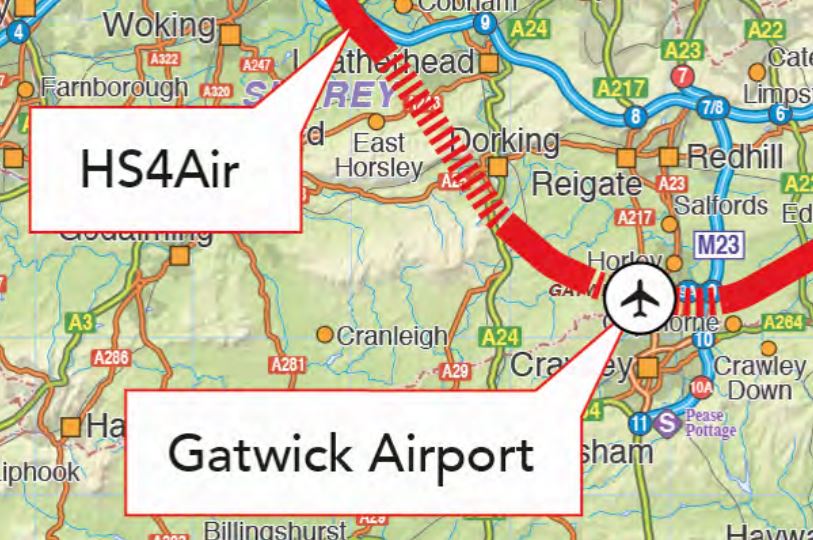
Note that in addition to the tunnels under the two airports, there is another tunnel through sensitive parts of Surrey.
Heathrow Southern Railway And The Southern Portal Of HS4Air’s Heathrow Tunnel
This Google Map shows the first section of the route South from Heathrow.

The two motorways are.
- The M25 goes roughly North-South.
- The M3 goes roughly East-West
I said in HS4Air’s Connections To HS2, The Great Western Main Line And Heathrow, that it appears that HS4Air’s Heathrow Tunnel will emerge somewhere just South of where the motorways meet.
The station in the South-East corner is Addlestone on the Chertsey Branch Line.
Follow the line Northward and Chertsey station is visible.
Heathrow Southern Railway intend to use this branch as part of their proposal to create access from the South into Heathrow.
From Chertsey, their route would follow to the East of the M25 and then use a short East-West tunnel to connect into Heathrow Terminal 5.
This Google Map shows the Chertsey Branch Line, where it crosses the M25.
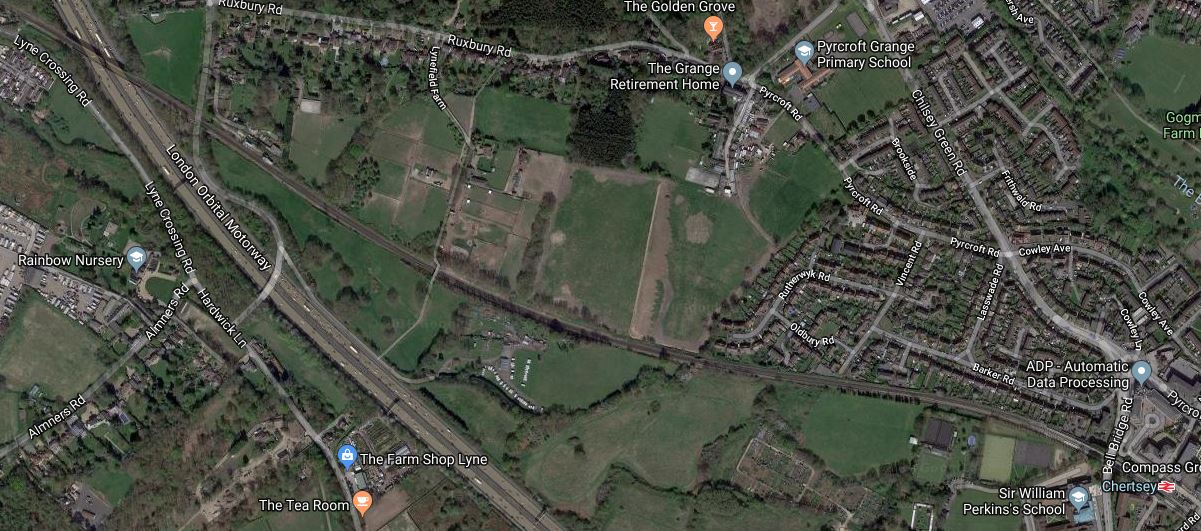
The Chertsey Branch Line goes diagonally across the map from Chertsey station in the South-East corner to the North-West corner.
A Junction just before the Chertsey Branch crosses the M25 would connect to the new railway running on the East side of the M25, towards Heathrow.
So that HS4Air and the Heathrow Southern Railway avoid each other, it would appear that the Southern portal of HS4Air’s Heathrow Tunnel must be to the South of the Chertsey Branch.
Onward To Junction 11 Of The M25
If HS4Air, then followed the M25, it could probably be squeezed in as far as a short distance past Junction 11.
This Google Map shows the section of the M25 around junction 11.
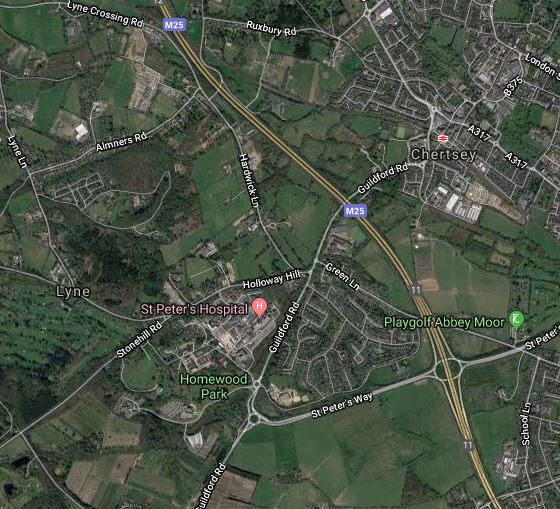
Junction 11 to 12 Of The M25
The first map, shows HS4Air following the M25 and passing over the M25/A3 junction.
This Google Map shows the area around the M25/A3 junction.
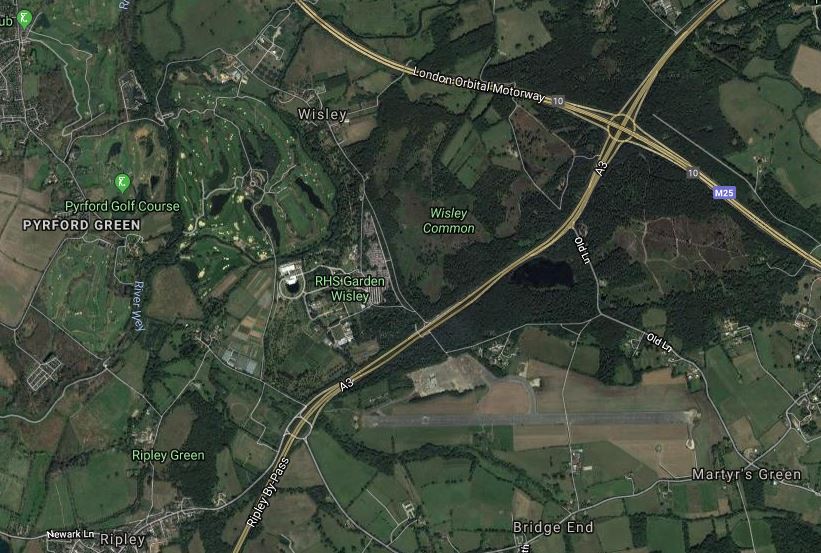
The junction between the M25 and the A3 is clearly visible.
On either side of the A3, as it goes South of the junction are the RHS Garden Wisley and Wisley Airfield.
I doubt that HS4Air will go anywhere near the Garden, but the airfield might well be the place, where the tunnel under the North Downs has its Northern portal.
The problem is how does HS4Air get between Junctions 11 for the A320 and Junction 10 for the A3 along the M25.
This Google Map shows the section of the M25.

Junction 11 is in the top-left of the map and Junction 10 is in the bottom right.
- I have flown my helicopter along the route and in places there is not much space on either side of the road.
- The road runs through housing in places.
- The road is very busy.
- The distance between the junctions 10 and 11 is 3.6 miles.
This page on the Highways England web site, says that the road is to be converted into a four lanes each way smart motorway.
Expedition Engineering obviously have a plan to get the motorway and a double-track high speed railway through this difficult section.
The Surrey Tunnel
I said earlier that the Northern Portal of the |Surrey Tunnel will be on or in the vicinity of Wuisley Airfield.
Putting maps together and taking an educated guess, I wonder if the Southern portal is on this map, which shows an area South of Dorking.
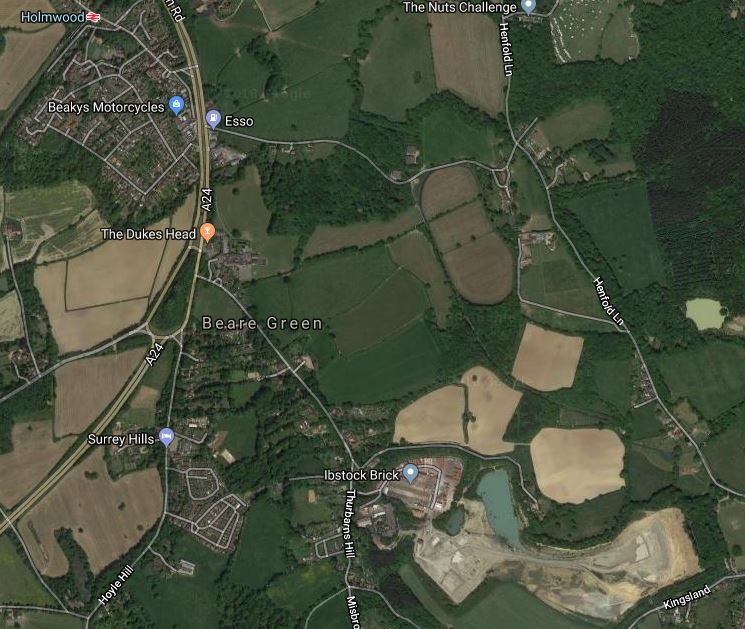
Note the Ibstock brick works. Could this be the site?
This Google Map shows its relationship to Gatwick Airport.

The distance is about nine miles, from the brick works in the top left of the map to the Airport.
According to the first map in this post, the route is mainly on the surface
Conclusion
The route is challenging, but I’m pretty sure, that it can be created.
How Would HS4Air Affect The Western Rail Approach to Heathrow?
The Western Rail Approach to Heathrow (WRAtH), is a proposed new rail route to Heathrow from Reading and Slough.
It has a similar objective to HS4Air’s connection to the Great Western Main Line at Iver.
Both railways would connect Reading and Slough to stations in the Airport.
But in my view the HS4Air approach has several advantages.
- HS4Air connects to both Heathrow and Gatwick airports and Ashford, whereas WRAtH only connects to Heathrow.
- It would connect high speed trains from Bristol, Cardiff, Oxford, South Wales and the West of England to Heathrow, Gatwick and Ashford for Continental services.
- As an example a direct Cardiff-Ashford service would take three hours twenty minutes.
- Trains would be faster, with an operating speed between Reading and Heathrow of at least 140 mph.
But perhaps most importantly, HS4Air could be a totally privately-funded project.
Conclusion
I feel Network Rail’s proposal for a Western Rail Approach to Heathrow is not needed, if HS4Air is built.
How Will HS4Air Affect Heathrow Southern Railway?
Heathrow Southern Railway will be an East-West railway through Heathrow using the existing tunnels, which will connect Basingstoke and Woking to Pasddington via Heathrow and Old Oak Common.
On the other hand HS4Air will be a North-South railway through Heathrow probably in a deep tunnel.
I suspect that numerous escalators, lifts and travelators will be the only connections between the two railways and the various terminals in the airport.
Conclusion
I can see no reason, why both railways can’t be built separately.
Co-operation could be useful to both railways.
If the two railways have a well-designed interchange under Heathrow, this would open up journey possibilities like Southampton-Paris with a change at the airport.
HS4Air is more than just a railway connecting airports and the North of England to the Channel Tunnel.
HS4Air And Heathrow Airport’s Third Runway
HS4Air will pass under Heathrow Airport in a tunnel, where there will be a new station.
Look at how Crossrail hasn’t resulted in major demolition in Central London.
For this and other reasons, I believe that HS4Air can be built underneath the Airport without affecting what Heathrow do on the surface.
The only effect that a possible third runway and an extra terminal at Heathrow, would be minor changes to the route of the tunnel and the layout of the station.
But I suspect that HS4Air will be built, so that it is totally future-proofed for all possible developments at Heathrow.
On the other hand, HS4Air might have effects on Heathrow Airport.
- Passengers from the North of England would be more likely to come by high speed train from Birmingham and Manchester.
- Passengers from South Wales and the West of England would be more likely to come by high speed train from Bristol and Cardiff.
- The transfer between Heathrow and Gatwick would be less than twenty minutes. HS4Air claim just fifteen.
- If there was sufficient demand there could be a Heathrow-Gatwick shuttle every 10-15 minutes.
Just as some of these effects will be positive for Heathrow, they will also be positive for Gatwick.
Conclusion
I am led to the conclusion, that some politicians, who are seriously against a third runway at Heathrow, could manage to get the runway blocked or delayed for a decade, by citing HS4Air and Gatwick as a viable alternative.
But that won’t matter, as Gatwick will build the much-needed runway for the South-East and it will be less than twenty minutes from Heathrow.
HS4Air’s Connections To HS2, The Great Western Main Line And Heathrow
This map clipped from the Expedition Engineering web site, shows the route of HS4Air to the West of London.
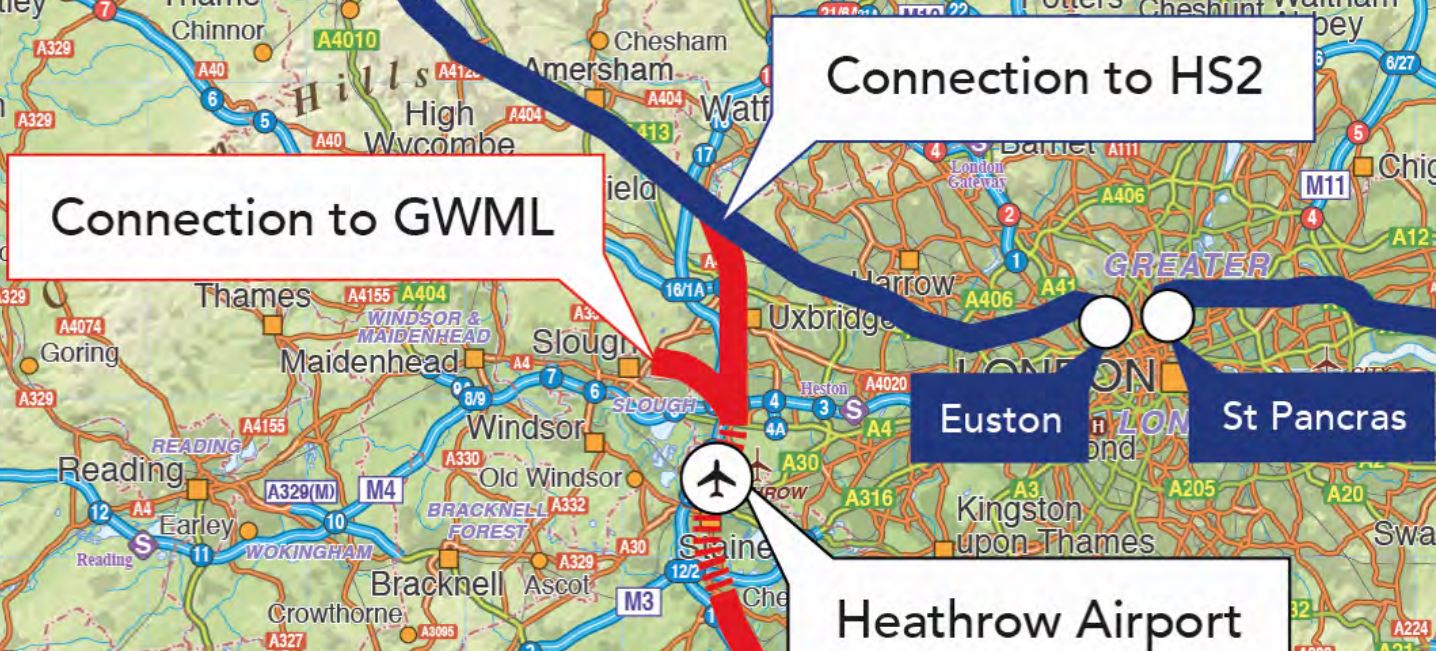
Note the M25 running North-South through the area.
The HS4Air And HS2 Junction
This Google Map shows the area, where HS4Air will join HS2.

Note.
- The M25 running North-South.
- The Chiltern Main Line running East-West.
- The two stations shown are Denham Golf Club and Denham.
- At the top of the map, just to the East of the M25 is a large quarry, which shows up in a beige colour.
The route of HS2 as it passes through the area from North-West to South-East is as follows.
- HS2 crosses the M25 in a tunnel, at the point where the lane crosses just below the M25 label, at the top of the map.
- HS2 then goes South East towards Denham on a mixture of cuttings, embankments and viaducts.
- HS2 then follows the Chiltern Main Line in a cutting towards London.
- HS2 goes into a tunnel just to the West of West Ruislip station.
It looks to me, that HS4Air will branch off HS2, just to the East of the M25, in the area of the quarry, which is shown in this Google Map.
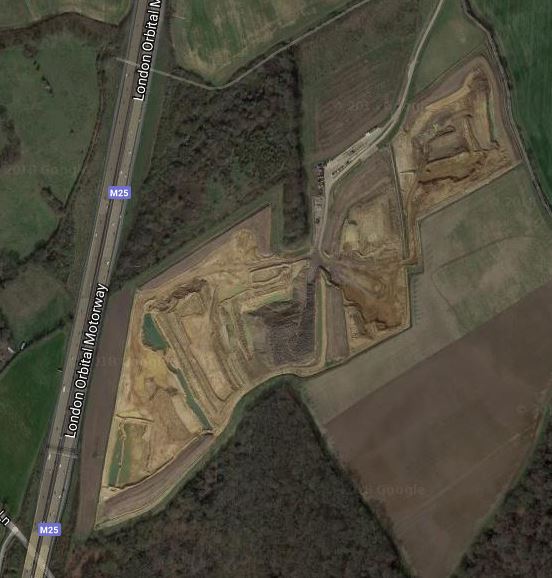
HS4Air would continue along the M25 motorway towards the South, whilst HS2 will continue in to the South East.
The HS4Air And Great Western Main Line Junction
This Google Map shows the area, where HS4Air crosses the Great Western Main Line.

Note.
- The M25 running North-South
- The M4 running East-West
- The Great Western Main Line running East-West.
- The two stations are Langley and Iver.
- Iver North Water Treatment Works sitting to the North East of where the M25 and the Great Western Railway cross.
This Google Map shows the area, where the M25 and the Great Western Main Line cross in more detail.

Consider.
- HS4Air would be following the M25 North-South.
- Two links to allow trains to go both ways from the Great Western to the Southbound HS4Air, would be needed.
- These links could loop over the Water Treatment Works.
- As the M25 will probably need widening, combining both projects would probably benefit both.
I think we could see a spectacular junction.
HS4Air North Of Heathrow
|As the first map shows HS4Air goes underneath Heathrow Airport in a tunnel, where there will be a station in the tunnel.
This map shows the M25 to the North of the Airport.
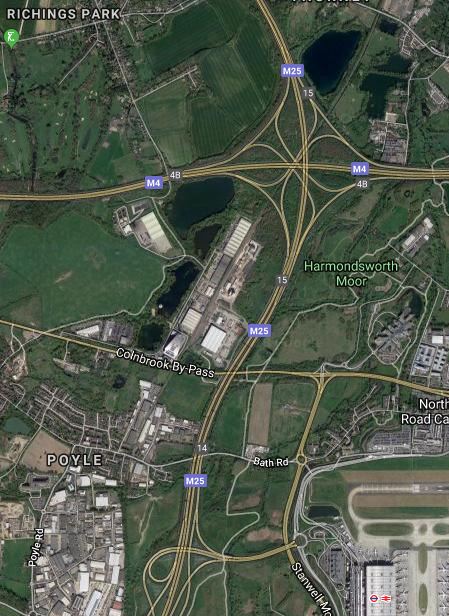
Terminal 5 at Heathrow is picked out with a station symbol.
I suspect that HS4Air will cross the massive M25/M4 junction on a viaduct and then descend into a tunnel for the Airport.
Or if the third runway at Heathrow is built, the railway could go into tunnel to the North of the motorway junction.
I suspect, the rail tunnels will be very deep under the airport, which will mean the following.
- They won’t disturb the existing airport.
- All the existing Crossrail design and construction expertise will be useful.
- The station could be as large as needed, with through and terminal platforms.
With its connections to Crossrail, it would also be West London’s high speed railway station.
HS4Air South Of Heathrow
South of Heathrow, the first map, shows that the Heathrow tunnel will emerge close to the M25, South of the major junction between the M25 and the M3.
This Google Map shows the area.
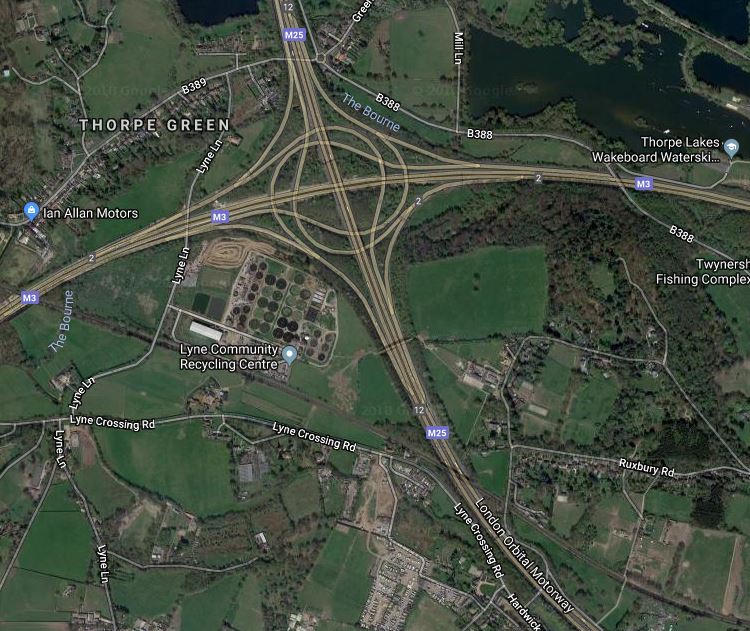
I will investigate where the Heathrow Tunnel emerges in HS4Air Between Heathrow And Gatwick Airports.
Conclusion
This section of HS4Air looks to be a railway that can be slotted through alongside the M25 with very little disturbance to existing traffic routes.
I doubt that few houses or other buildings will need to be demolished.
The two major junctions with HS2 and the Great Western Railway will cause little disruption during construction, as the former will be over a quarry and the second is by a sewage works, which could be moved if necessary.
This first section is so obvious, I am surprised it hasn’t been included with the building of HS2.
Plans Revealed For £10bn High-Speed Railway To Connect Britain’s Busiest Airports, HS1 and HS2
The title of this post is the same as this article on Global Rail News.
This is the first two paragraphs.
Developers are submitting plans for a new high-speed line to the UK’s Department for Transport (DfT) in response to a call for market-led proposals.
Named ‘HS4Air’, the proposed £10 billion railway will connect HS1 at Ashford to HS2 North West of London with stops at Heathrow and Gatwick airports and a spur connection to the Great Western main line.
This map from Expedition Engineering shows the route.

To minimise environmental disruption, the following should be noted.
- There is a North-South tunnel under Heathrow Airport.
- HS4Air follows the M25 to the South-West of London.
- Several miles of the route between Heathrow and Gatwick is in tunnel to the West of Horsham.
- There is a West-East tunnel under Gatwick Airport.
- The Ashford to Tonbridge Line would become part of HS4Air.
There will also be stations at Ashford, Tonbridge, Gatwick and Heathrow.
This further diagram from Expedition Engineering shows the various possible routes.
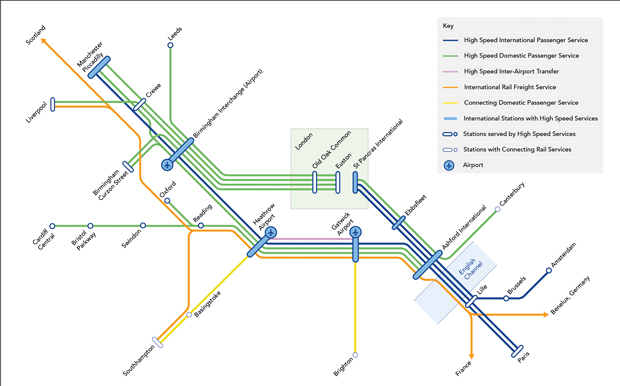
Note the following about HS4Air.
- Four major airports; Gatwick, Heathrow, Birmingham and Manchester, will be connected to the Channel Tunnel.
- Wikipedia suggests, that the line could be extended to a reopened Manston Airport.
- A Paris to Manchester passenger service via Gatwick, Heathrow and Birmingham, is proposed.
- High-speed connecting services from Cardiff, Oxford and Manchester to Ashford are proposed.
- HS2’s major interchanges of Birmingham International and Crewe, are served.
- Freight routes from Liverpool and Southampton to the Channel Tunnel will be enabled.
It looks a good basis to connect the rest of the UK to the services through the Channel Tunnel.
The article also gives some sample journey times.
- Ashford-Gatwick: 25 minutes
- Manchester-Heathrow: 1 hour 10 mins
- Heathrow-Gatwick: 15 minutes;
- Cardiff-Heathrow: 1 hour 40 mins
- Birmingham-Paris: 3 hours
- Manchester-Paris: 3 hours 40 minutes (My Estimate)
Intriguingly, the Manchester-Paris time, is the same as Eurostar’s current time between London and Amsterdam.
Conclusion
The plan seems to be well-thought out and it gives a good increase in connectivity from Wales, the West Country and the Midlands and North of England to Heathrow, Gatwick and the Channel Tunnel.
But I can see a few problems.
- Will the residents of the North Downs accept a high-speed railway through their area?
- If freight routes from Liverpool and Southampton to the Channel Tunnel are established, will residents object to masses of noisy freight trains?
- Will there be pressure for more tunnels?
On the other hand Expedition Engineering are saying that needed extensions to the UK’s electricity grid can be laid underground along the same route.
 The Anonymous Widower