Legal Challenge Against Gatwick Airport’s Second Runway To Begin
The title of this post is the same as that of this article on ITVX.
These four paragraphs add more details.
Plans to challenge a second runway at Gatwick Airport will be heard in the High Court next week.
The campaign and environmental group Communities Against Gatwick Noise Emissions (CAGNE) opposes Transport Secretary Heidi Alexander’s decision to grant development consent for the project.
In the hearing, which will run from 20 to 23 January 2026, CAGNE’s argues that the climate change impacts of the extra runway have not been properly assessed.
The planned expansion would see the repurposing of Gatwick Airport’s emergency runway for use as a second operational runway. The extra capacity is expected to lead to more than 100,000 more flights per year.
These two paragraphs give CAGNE’s case.
CAGNE says that this decision was flawed, arguing that there are numerous gaps in the environmental assessment of the airport expansion. These include a failure to adequately assess inbound flight emissions, the climate impact of non-carbon dioxide emissions, the handling of additional sewage, and noise pollution.
The group also argues that the second runway plans rely too heavily on the UK’s Jet Zero Strategy (JZS), which assumes ambitious improvements in the aviation industry in areas such as fuel efficiency.
My feelings are as follows.
- We need more runway capacity.
- Eventually all aircraft will be powered by electricity, hydrogen or sustainable aviation fuel (SAF).
- Because of the need for large amounts of renewable electricity to make hydrogen and SAF, the runway will need to be near offshore wind farms.
Only Doncaster Sheffield, Gatwick, Liverpool, Stansted and some Scottish airports are near the sea or could be connected to the coast by an easy-to-build cable or pipeline.
CAGNE may well win their case, but I fell Nimbys will also stop Heathrow getting a third runway.
Hotel Tycoon Reveals Heathrow Expansion Proposal
The title of this post is the same as that of this article on the BBC.
This is the sub-heading.
Hotel tycoon Surinder Arora has announced he is submitting a Heathrow expansion plan which rivals a proposal from the airport’s owners.
These three paragraphs add more details.
The billionaire’s Arora Group said the “primary benefit” of the plan it submitted to the government was a shorter new runway which would avoid the costly and disruptive need to divert the M25 motorway.
Building a 2,800-metre (9,200 ft) third runway instead of the full-length 3,500-metre (11,500 ft) runway planned by the airport would result in “reduced risk” and avoid “spiralling cost”, the company said.
The airport declined to comment on the Arora Group’s proposal.
Note.
- In Heathrow Willing To Build Shorter Runway After Airline Outcry Over Cost, I proved to my satisfaction, that a shorter third runway would work.
- Any scheme that involves diverting the M25, is not fit to get to be on the short list, as construction will be too disruptive.
- I also remember the problems of the M 25, during the construction of Terminal 5.
The last paragraph is the most important, as it illustrates Heathrow’s attitude to outside ideas.
- Was HS4Air, that I talked about in Ambitious £10bn Plans For Gatwick Heathrow HS4Air Rail Service Rejected properly considered?
- Was Heathrow Southern Railway, that I talked about in Why I Like The Heathrow Southern Railway Proposal, properly considered?
Perhaps, Heathrow’s management suffers from Not-Invented-Here Syndrome?
Conclusion
I suspect that Surinder Arora’s project will be a non-starter.
Heathrow Willing To Build Shorter Runway After Airline Outcry Over Cost
The title of this post, is the same as that of this article in The Telegraph.
This is the sub-heading.
BA and Virgin have objected to expansion plan that could see departure fees swell to as much as £100
These are the first two paragraphs.
Heathrow has said it is willing to build a shorter, cheaper third runway following an outcry from airlines over cost.
Europe’s busiest airport will indicate its readiness to negotiate with carriers over runway options when it submits a formal pitch to ministers next week, said Thomas Woldbye, the airport’s chief executive.
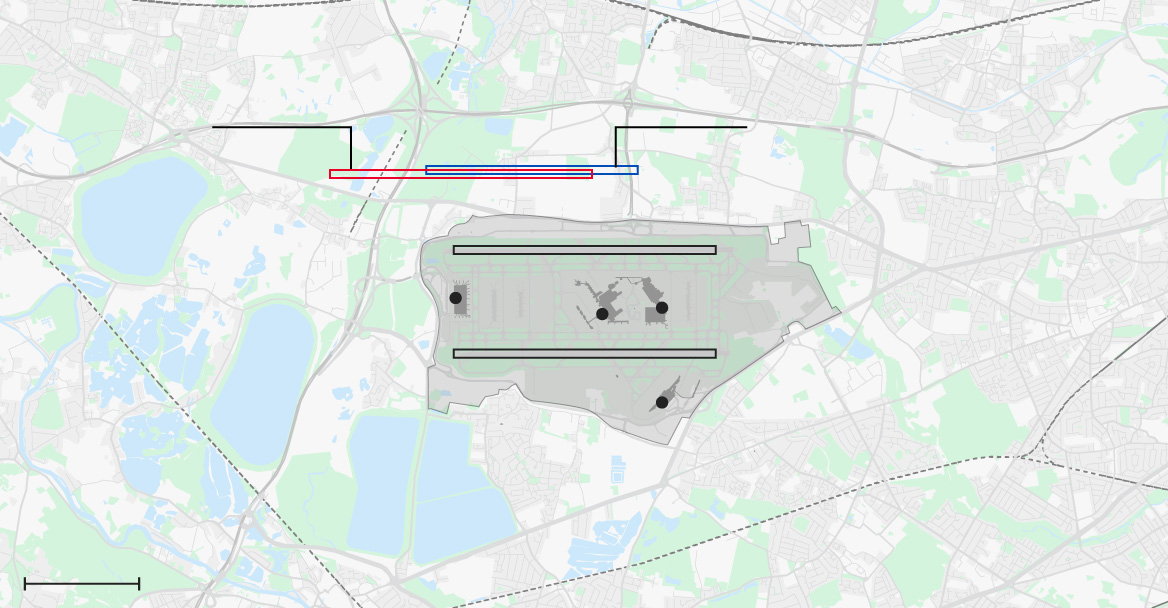
This is a map of the new proposal from the DfT.
Note.
- The current Northern and Southern runways, with terminals 5, 3 and 2 between them from West to East.
- Terminal 4 is South of the Southern runway.
- The runway shown in red to the North of the Northern runway is the current proposal for a full-length new runway.
- The runway shown in blue to the North of the Northern runway is the new proposal for a shorter-length new runway.
- The M25 can be picked out going North-South to the West of the current runways and the new shorter runway.
- But the M25 is crossed by the full-length new runway.
It would appear that the proposal for the new shorter runway will avoid putting the M25 in a tunnel.
So hopefully, it would reduce the cost and disruption incurred, by building the new shorter runway.
AI Could Make New Runways Obsolete
The title of this post, is the same as that of this article on Jewish News.
This is the sub-heading.
As Heathrow’s controversial third runway gets the green light and Gatwick looks on track for a second one, an Israeli tech innovation could reduce the need for such costly expansions.
These paragraphs add some detail.
IntellAct is a cutting-edge AI company that helps airports maximise efficiency, cut delays and save billions of pounds. By optimising ground operations and reducing aircraft turnaround times, it could spare airports the need for new runways entirely.
“The aviation industry is bleeding from a thousand cuts,” says Udi Segall, IntellAct’s founder and CEO. “Constant delays – with an average of 15.5 minutes per flight — add up to billions in costs. We saw a financial opportunity in how airlines manage their activities, and that’s where IntellAct comes in.”
IntellAct leverages big data and machine learning to provide airlines, airports and ground handling teams with real-time visibility into service performance bottlenecks and the ability to address them in a way that can yield significant operational improvements and a dramatic reduction in flight delays.
It’s an interesting thought.
I am reminded of a story from the 1960s, from ICI.
They had a polypropylene plant, that was notoriously inefficient, so a guy called Humphrey Bowen (?) used a discrete simulation program called HOCUS to create a board game of the chemical plant. This game was then played one Sunday, with beer and sandwiches between the various teams of production workers. It became heated at one point, but they did learn a lot about the behaviour of the plant and improved its efficiency.
I think it is true to say, that in the early 1970s, I worked with a bunch of interesting people at ICI Plastics.
These days, use might be made of a digital twin.
Gatwick’s Hydrogen Advantage Over Heathrow
The Future Of Hydrogen In Aviation
I believe that hydrogen will have a big future in aviation.
Powering Aircraft
It will be some years, but not as many as some people think, before we see hydrogen-powered aircraft in the air.
Airbus have produced this infographic of three possible hydrogen-powered aircraft.

Discover the three zero-emission concept aircraft known as ZEROe in this infographic. These turbofan, turboprop, and blended-wing-body configurations are all hydrogen hybrid aircraft.
I wrote a bit more about these three hydrogen-powered concepts in ZEROe – Towards The World’s First Zero-Emission Commercial Aircraft.
My best estimate is that we’ll see hydrogen-powered aircraft in the air by 2035.
Towing Aircraft Around
Most aircraft are very heavy and towing them around needs a lot of zero-carbon energy.
So I think it is likely, that at some time in the near future,tugs to tow large aircraft around an airport will be hydrogen powered.
If you type “hydrogen-powered aircraft tug” into Google, you get several sensible product developments, including ones from.
- Exeter Airport
- Teesside Airport
- The Royal Air Force.
- The US Air Force
Note.
- The involvement of the military.
- At least two of the tugs are conversions of existing equipment.
- The extra weight of the battery in an electric-powered tug, may make the realisation of a viable electric aircraft-tug difficult.
I suspect we’ll see hydrogen-powered aircraft tugs in use on airports around the world in the near future.
Long-Term Car-Park Buses
I would have thought that using hydrogen-powered or battery-electric buses to serve long-term car-parks at an airport would be an obvious application. But it does appear that airports using zero-carbon buses to serve long-term car-parks are not very common.
- Gatwick uses a large fleet of hydrogen buses to bring passengers and staff to the airport, but these don’t appear to be linked to car parking.
- Incheon Airport in Korea does appear to use hydrogen-powered buses.
Please let me know, if you know of any other uses of hydrogen-powered vehicles at airports.
Hydrogen For Heathrow
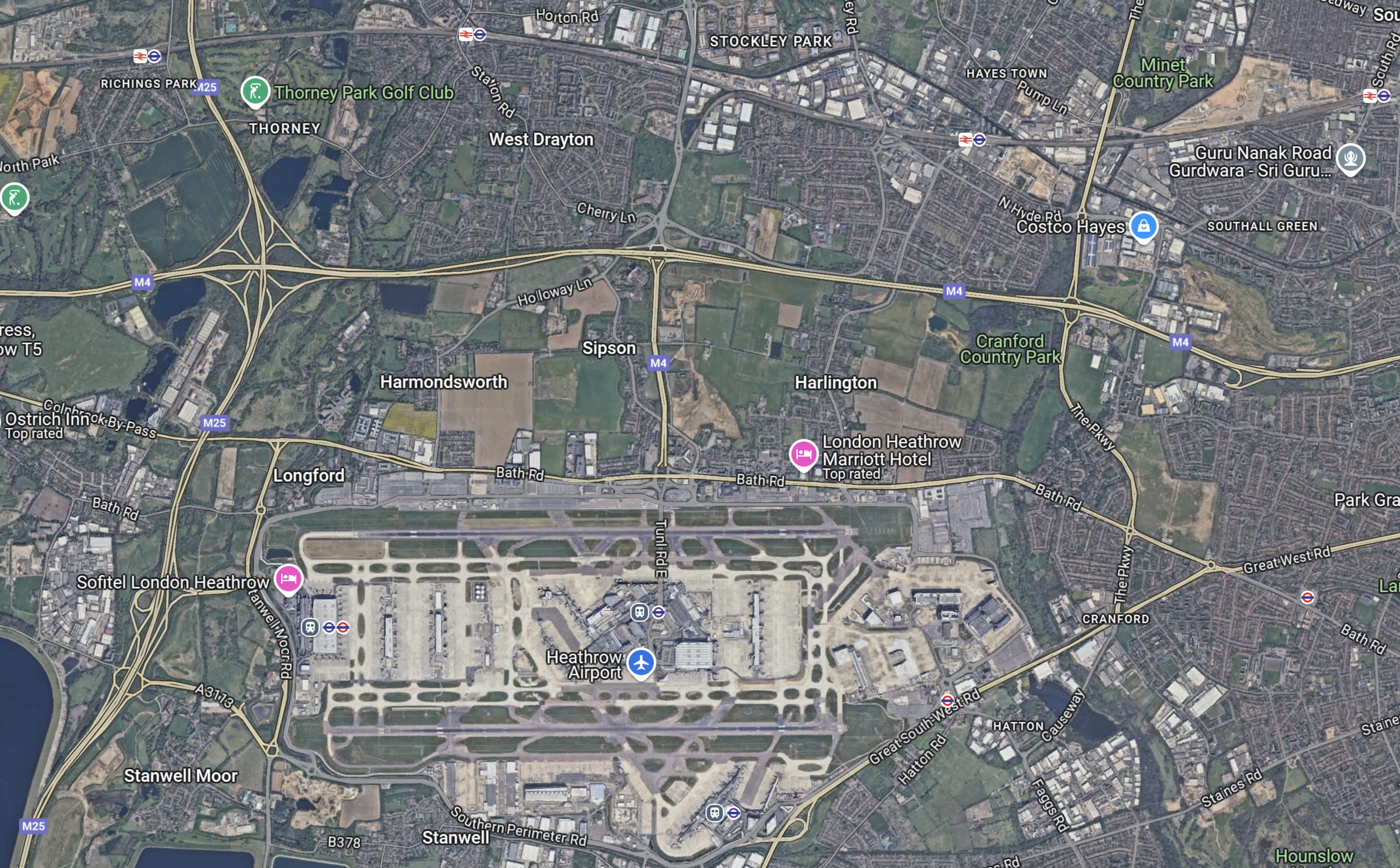
This Google Map shows Heathrow Airport.
Note.
- The M4 going across the map.
- The two main runways.
- A new third runway would go between the M4 and the Northern runway.
It is likely if the third runway goes ahead, the village of Harmondsworth will be flattened.
It is likely that supplying hydrogen to Heathrow will mean a hydrogen terminal somewhere South of the M4, which could be supplied by rail tankers.
Hydrogen For Gatwick
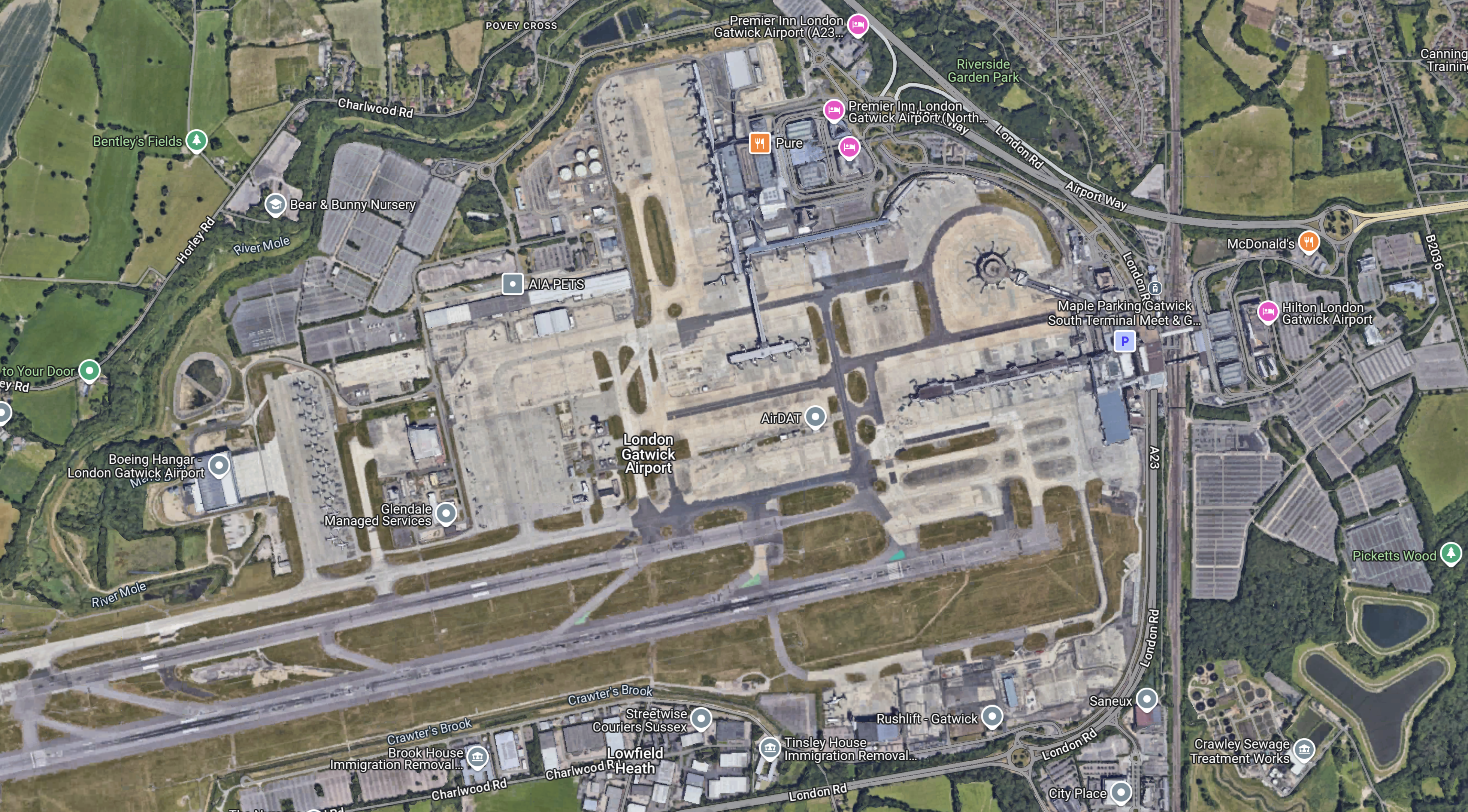
This Google Map shows Gatwick Airport.
Note.
- The current main runway with the emergency runway to its North.
- Because the runways are too close together they cannot be used simultaneously.
- To create a second runway, the two runways would be moved further apart and the current emergency runway would be enlarged.
- The Brighton Main Line runs North-South past the Eastern end of the main runway.
Gatwick’s expansion plan doesn’t appear to require any properties outside the airport boundaries to be demolished.
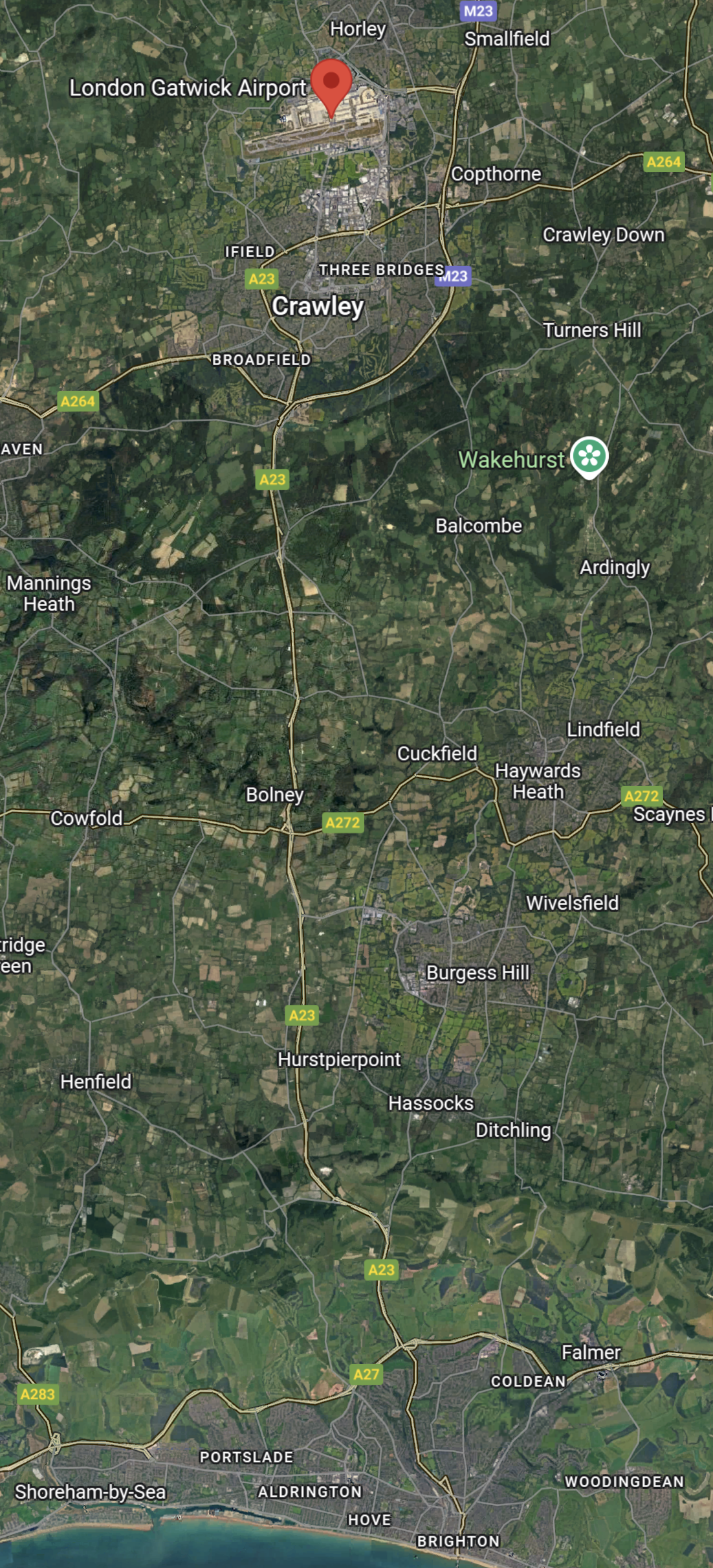
This Google Map shows Sussex between Gatwick Airport and Brighton.
Note.
- Gatwick Airport is indicated by the red arrow at the top of the map.
- Gatwick’s runways can be picked out under the red arrow.
- The South Coast is at the bottom of the map.
- The M23 and the Brighton Main Line connect Gatwick Airport and Brighton.
- Shoreham and Brighton are on the South Coast.
- Click the map to show on a larger scale.
Under current plans, the Ramplion offshore wind farm off the South Coast is going to be increased in size to 1.6 GW.
The simplest plan to provide large amounts of green hydrogen to Gatwick would be to build a large electrolyser in the Port of Shoreham and pipe it along the railway to Gatwick Airport. Hydrogen could also be shipped at night into the Airport using rail tankers.
There’s no doubt in my mind, that it will be much easier to supply large quantities of hydrogen to Gatwick, rather than Heathrow.
In 2023, I wrote Discover How Greater Brighton Is Championing The Transition To Hydrogen, which probably indicates that the locals and their politicians, would welcome the investment in hydrogen in their city.
It should also be noted that world class consultants Ricardo, who are very much involved in the development and promotion of hydrogen technology are based in Shoreham.
Liquid hydrogen could also be imported and distributed from the Port of Shoreham.
Brighton could end up as the South of England’s Hydrogen City.
Heathrow Third Runway Shelved As Airport Seeks To Be ‘Better Not Bigger’
The title of this post, is the same as that of this article in The Times.
This is the sub-heading.
Chief executive Thomas Woldbye exploring how to squeeze millions more passengers through the airport without expanding its footprint
These are the first two paragraphs.
Heathrow’s third runway has been shelved as leaked details of the airport’s “better not bigger” strategy can be revealed.
New chief executive Thomas Woldbye is understood to have begun disbanding Heathrow’s third runway team in favour of exploring how to squeeze millions more passengers through the airport without expanding its footprint.
Various strategies to increase the capacity are suggested.
- More buses to transport passengers from the terminal to the aircraft. This allows planes to be parked further from the terminal.
- More efficient use of the runway so that planes could take off and land closer together.
- Increasing the flight cap by five percent, if the Government agrees.
This paragraph indicates the number of passengers, Heathrow will be planning for.
Leaked details of the plans reveal that annual passenger numbers could hit 96 million by 2036, up from the record 80.9 million it welcomed in 2019, if all of its initiatives can be realised. A “core” case is understood to forecast a rise to 86 million passengers.
If the figure of 96 million passengers is correct, that would be a nearly twenty percent increase in passengers in just seventeen years.
 The Anonymous Widower