Albannach Island: Multi-Million Pound Green Energy Plans Would Create 300 Construction Jobs
The title of this post, is the same as that of this article on the Aberdeen Press and Journal.
This is the introductory paragraphs.
A multi-million pound green energy power venture – called Albannach Island – would give a much-needed jobs boost to Caithness.
Highview Power is behind the plans to build a liquid air energy storage plant in a disused part of a quarry in Spittal, adjoining the most northerly stretch of the A9.
The plant appears to be a 50MW/250 MWh CRYOBattery, that is probably similar in size to the one currently being built by Highview Power at Carrington, near Manchester.
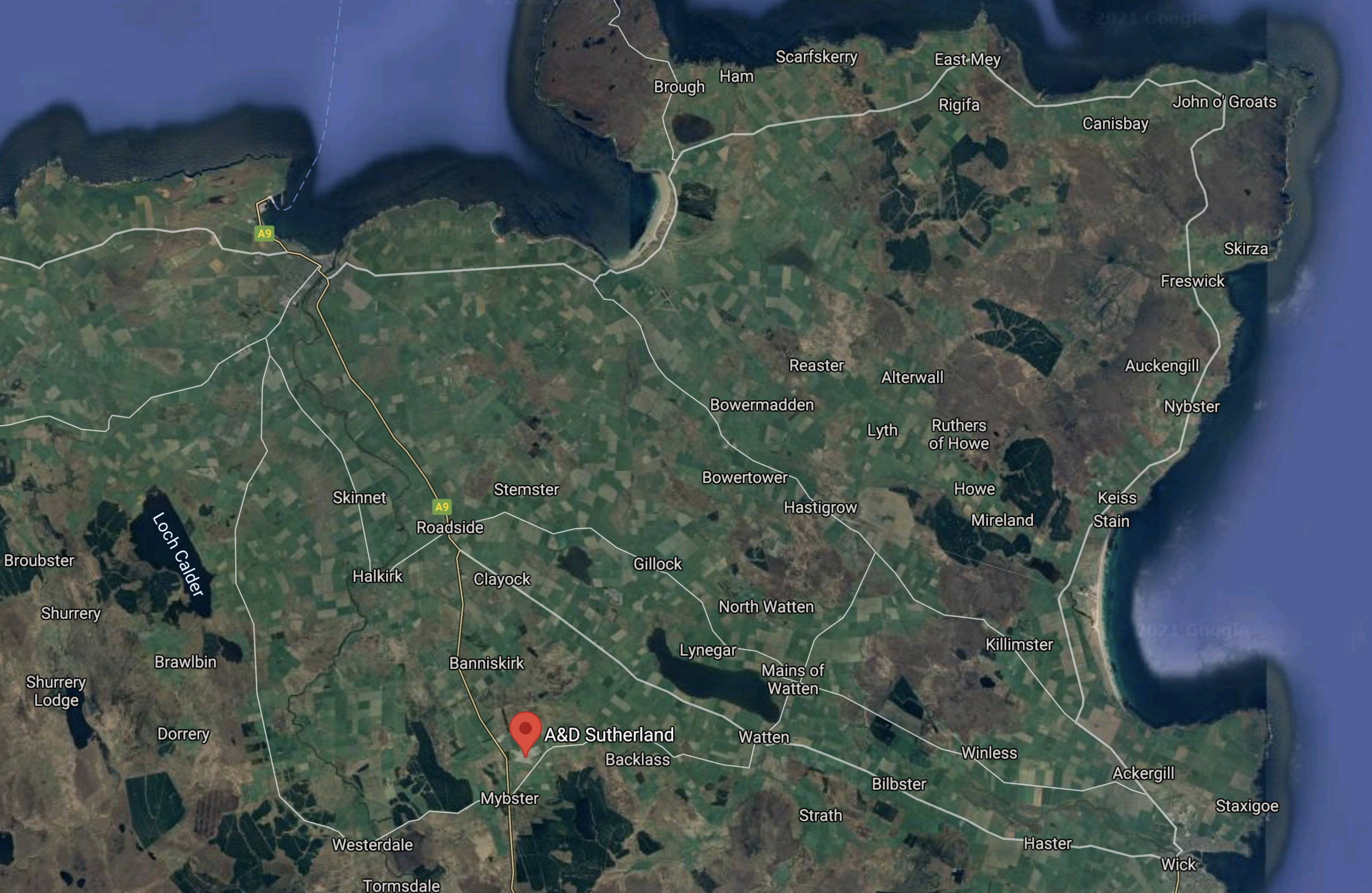
This Google map of the North-East corner of Scotland, shows the location.
Note.
- John O’Groats is in the North-East corner of the map.
- The red arrow shows the location of the A & D Sutherland quarry, where the Highview Power’s CRYOBattery will be located.
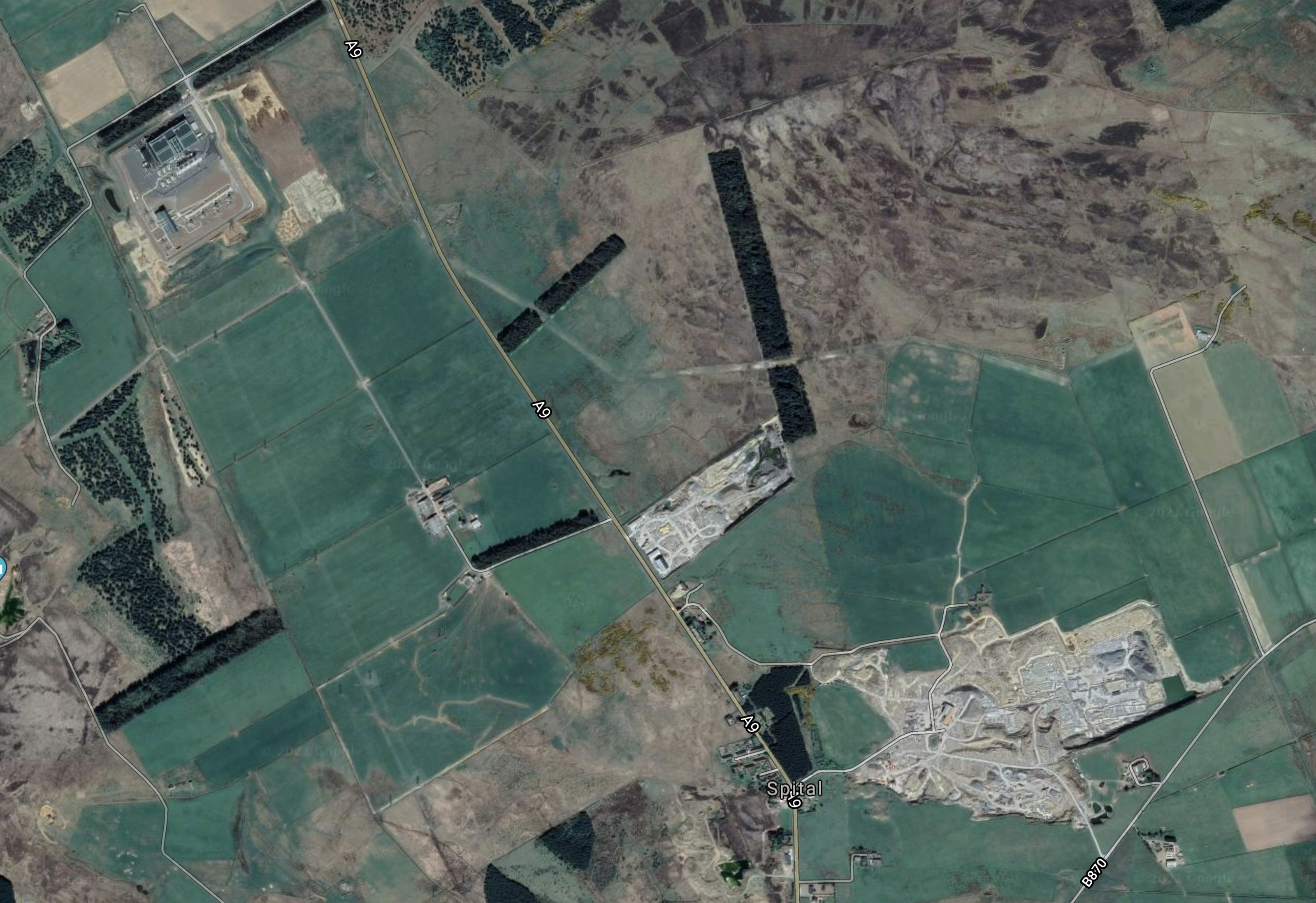
This second Google map shows the location in more detail.
Note.
- The A & D Sutherland quarry is in the South-East corner of the map.
- The CRYOBattery will use five acres at the North of the quarry site.
- In the North-West corner of the map is the Spittal sub-station.
The Spital sub-station is described like this on the Scottish and Southern Electricity Networks web site.
Spittal is a new electricity convertor station and is part of the £1.1bn Caithness-Moray project which represents the largest investment in the north of Scotland’s electricity network since the hydro development era of the 1950s and is the largest capital investment project undertaken by the SSE Group to date. It is also the largest Living Wage contract ever awarded in the UK, demonstrating SSEN’s strong commitment to ensure all employees working on its sites get a fair day’s pay for a fair day’s work.
It looks like the CRYOBattery will be the cherry on top of the very billion pound cake of the Caithness-Moray Link.
Conclusion
We’ll be seeing more battery installations like this to stabilise power.
Nothing is said in the article, about who is paying for the battery. The only clue is it talks about Highview as a London-based conglomerate.
I wonder, if the company has formed a partnership with one of the energy trusts or a battery site developer.
Bring Africa Out Of The Dark
The title of this post, is the same as that of this article on the Zimbabwean.
The article has been written by Humphrey Kariuki, who is a Kenyan businessman, who is on a mission to bring electricity to Africa.
He has teamed up with Highview Power to do it using batteries.
Read the article.
Alternative Energy Storage Technologies To Challenge Electrochemistry
The title of this post, is the same as that of this article on Battery and Energy Storage Magazine.
It gives a good summary of two energy storage system; Highview Power and Gravitricity, that I rate highly promising.
It also gives details of a Danish system called Stiesdal Storage Technologies, which is developing a hot rocks energy storage system.
The article says this about the system.
The pumped-heat ESS uses pea-sized crushed basalt, rock in insulated steel tanks with the stored energy released by turbine.
SST CEO Peder Riis Nickelsen said: “The cost of crushed stone is at a totally different level per unit of energy than practically any other material for energy storage. Our charging and discharging system can utilise well-known technologies that have been applied for a century within other industries and are well-suited for mass production.”
The cost of materials is estimated to be €10 ($12) per kWh.
The first demonstration project, a 1-2MW, 24h capacity unit, will be installed at a power plant in Denmark next year, and will operate commercially.
This page on the Striesdal web site, explains the technology.
It sounds like the system uses very similar principles to Siemens Gamesa ETES, with a different heat storage medium.
Conclusion
At my last count, there now appears to be upwards of half-a-dozen viable alternatives to chemical batteries and traditional pumped storage. Some of the technologies are also backed, by large companies, organisations and countries, who can afford to take a long-term view.
I hope those, who claim that renewables will never power the world, have at least got the recipe for the cooking of humble pie ready.
Form Energy Discloses A Small Amount
Form Energy has been a bit mysterious, but this article on Energy Storage News, which is entitled Renewables As Baseload Energy: Form Energy’s Multi-Day |Storage Seeks To Replace Gas And Coal.
Form Energy certainly have large ambitions, backing from organisations like Bill Gates’ Breakthrough Energy Ventures and an order for a 1 MW/150 MWh pilot for Great River Energy in Minnesota, and I suspect this is probably enough to ensure success in the mid-size market sector, which they share with the UK’s Highview Power, who are building their first grid-scale 50 MW/ 250 MWh at Carrington to the South of Manchester.
The article is certainly an interesting insight into one of the new energy storage ventures.
MAN Energy Partners With Highview Power On Liquid-Air Energy-Storage Project
The title of this post, is the same as that of this article on Renewable Energy Magazine.
This is the introductory paragraph.
Highview Power, a leader in long duration energy storage solutions, has selected MAN Energy Solutions to provide its LAES turbomachinery solution to Highview Power for its CRYOBattery™ facility, a 50 MW liquid-air, energy-storage facility – with a minimum of 250MWh – located in Carrington Village, Greater Manchester , U.K.
The article is almost a word-for-word copy of this press release from MAN Energy Solutions, which has a similar title to this post and the Renewable Energy Magazine article.
As an Electrical Engineer who has done a lot of work in Project Management, I find these two paragraphs significant.
Construction will proceed in two phases. Phase 1 will involve the installation of a ‘stability island’, to provide near-instantaneous energy grid stabilisation. This will be achieved using a generator and flywheel, among other components. Enabling short-term stabilisation will provide the basis for Phase 2 and the completion of the more complex liquid air energy storage system that includes various compressors, air expanders and cryogenic equipment.
Phase 2 will represent the integration of stability services with a full-scale long-duration energy storage system, and in doing so promote the full integration of renewable energy. The Carrington project will offer a blueprint for future projects and cement the partnership between MAN Energy Solutions and Highview Power.
I first became acquainted with the use of flywheels to stabilise energy, when I was working in Enfield Rolling Mills as a vacation job at sixteen.
The centerpiece of their factory was a rolling mill, which took heated copper wirebars about two metres long amd ten centimetres square and rolled them into thick copper wire just a few millimetres in diameter. The mill was driven by a powerful electric motor, to which it was connected with a 97 tonne flywheel perhaps four metres in diameter in between. The flywheel spun at probably 3000 revolutions per minute.
The wirebar used to meander through the rolling mill several times and at each turn, the head would be caught by a man with a pair of tongs and turned back through the mill.
Each time the wire-bar went through a new pair of rolls the energy needed increased, as there was more rolling to do. So this extra energy was taken from the flywheel!
The rolling mill incidentally had been built by Krupp before the First World War. It still had the Krupp trademark of three interlocked railway tyres all over it. It had ended up in Enfield as reparations after the First World War. Enfield Rolling Mills added a fourth ring to create their own trademark.
It would appear that the kinetic energy of that flywheel could be as high as 1.6 MWh. Flywheels also react very fast.
Flywheel energy storage would appear to be a feasible intermediate energy store for this type of application.
I always remember Shimatovitch, who was the Chief Engineer of the company had jokingly once said that if the flywheel came off its bearings, it would have ended up a couple of miles away and would have demolished all the houses in its path. But he was a man with a dark sense of humour, who had spent most of the Second World War in a Nazi concentration camp.
Could it be that Phase 1 is the installation of a similar system to that I saw working in the 1960s, but upgraded with modern electronics, which exchanges power with the grid to create the stability island referred to in the press release.
In Phase 2 electricity can be passed to and from the CRYOBattery.
Looking at the MAN Energy Solutions web site, I suspect that they don’t care what sort of energy store they connect to the grid.
They would appear to be an excellent choice of engineering partner for Highview Power.
I also wonder how many other applications and customers, they will bring into the partnership.
Conclusion
This looks like a very sensible and low-risk strategy to connect the CRYOBattery to the grid.
Highview Power Introduces Revolutionary Cryogenic Energy Storage Technology To The African Market
The title of this post, is the same as that of this article on the African Review.
This is the first paragraph.
Javier Cavada, CEO and President of Highview Power spoke to African Review about the company’s cryogenic (air liquefaction) battery storage solutions and why they are a perfect fit for the continent
It appears to me, that the story, which started in a garage in Bishops Stortford, is going to have a happy ending for the world.
The article is a must read and I particularly liked this paragraph.
Cavada also noted how cryogenic technology complemented this transition. He added, “The main energy companies call our technology ‘pumped hydro in a box’ and that is how we have been making it. You can deploy over 1GWh without geographical constraints. There is no combustion, no emissions and no rare materials needed. All it comprises is some piping work, compressors and a generator, so it is pretty simple. Our mission is to enable a world that is grid powered by solar and wind, not fossil fuels, and this technology will help us achieve this.”
This is the brightest shade of green!
Malta Inc Energy Storage Explained
Malta Inc first came to my notice in 2018 and I wrote Gates Among Billionaires Backing Alphabet Energy Spinoff.
But I couldn’t find much information at the time, but they now have a web site that gives a good explanation.
This page on the web site is entitled Our Solution.
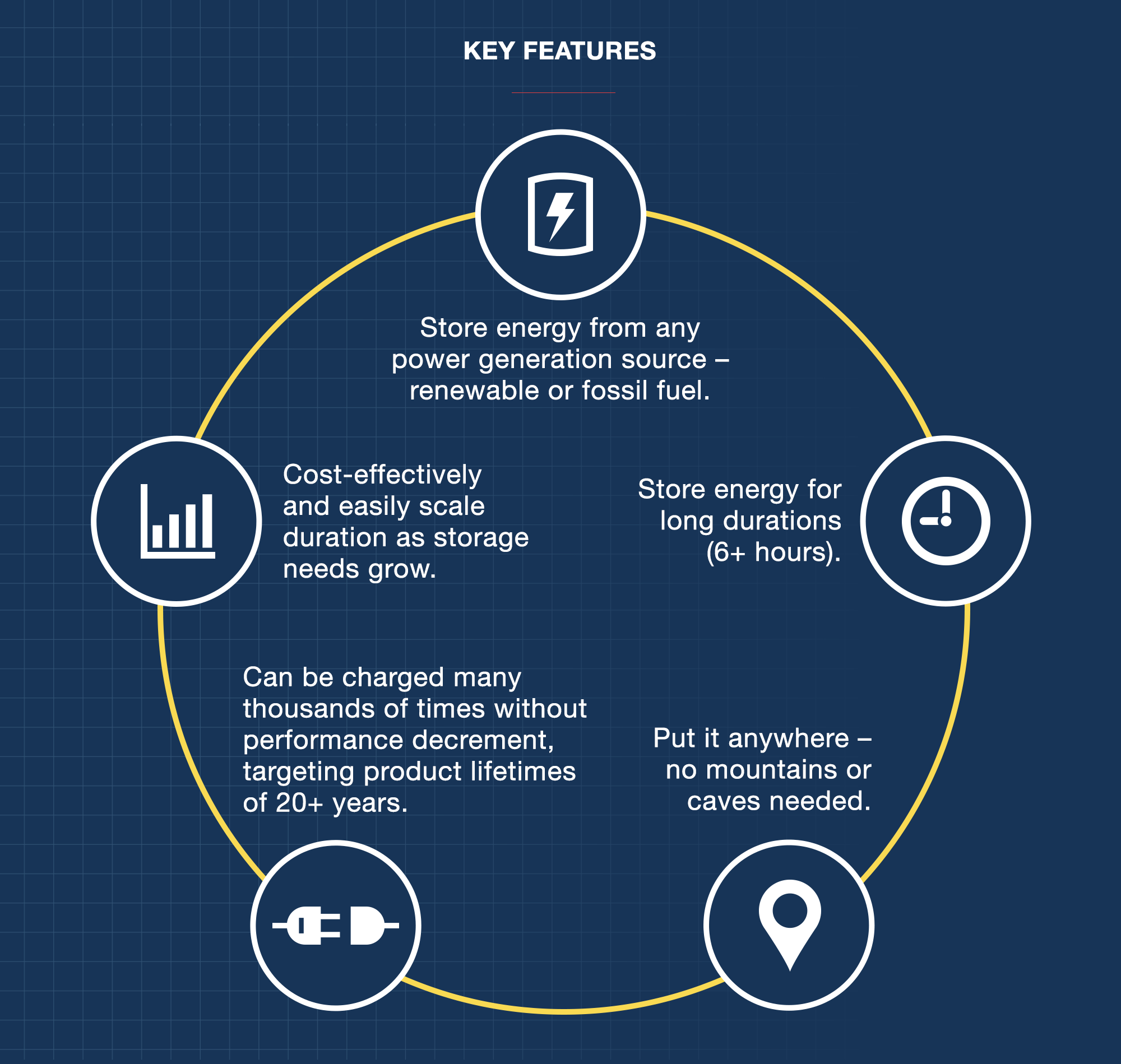
This infographic from the web page, lays out the key features.
This sentence outlines the method of operation.
The Malta energy storage system takes electricity, converts and stores that electricity as heat, and then converts it back to electricity to be redistributed on the electric grid. In charge mode, the system operates as a heat pump, storing electricity as heat in molten salt. In discharge mode, the system operates as a heat engine, using the stored heat to produce electricity.
The operation is explained in five stages.
- Collects – Energy is gathered from wind, solar, or fossil generators on the grid as electrical energy and sent to Malta’s energy storage system.
- Converts – The electricity drives a heat pump, which converts electrical energy into thermal energy by creating a temperature difference.
- Stores – The heat is then stored in molten salt, while the cold is stored in a chilled liquid.
- Reconverts – The temperature difference is converted back to electrical energy with a heat engine.
- Distributes – Electricity is sent back to the grid when it is needed.
Note.
- The operation of the system is based on well-understood thermodynamic principles.
- Entergy is stored as both heat and cold.
- It provides several hours of energy storage.
- Systems are built using standard components, that are readily available.
In some ways the Malta Inc PHES is based on similar principles to Highview Power’s CRYOBattery and Siemens Gamesa’s ETES.
Conclusion
This is a company to watch, as they seem to have got the technology right.
Highview Power Begins 2021 With 4 GWh Of CRYOBattery Storage In Global Pipeline
The title of this post, is the same as that of this article on Solar Builder.
Read the article to find out how Highview Power are progressing with partners, offices and projects all over the world.
Not bad for an idea, that was invented in a garage in Bishops Stortford.
The article points to this video produced by the BBC.
If there’s one new venture, I wish I’d have a share of, it is this one.
- One of the projects, I worked on at ICI was optimising the size of a new plant to make plastic granules. I learned a great deal about how process plants can be scaled and their mathematics and economics.
- I believe that Highview Power’s CRYOBaterries fit with everything I know and are just world-class process engineering arranged in a unique way, which means they can be built in any country, where modern process plant technology is available and can be run and serviced by skilled engineers and technologists.
- Their partnership with the likes of Sumitomo Heavy Industries means, Highview Power, probably has access to the best technology, for some of the components needed.
After reading the article in Solar Builder, I now feel that Highview Power are on their way!
One of the first places, I shall visit after lockdown ends is Carrington near Manchester, to take pictures of the site of Highview Power’s 50 MW/250 MWh system, that is being built at Carrington.
SSE Goes Global To Reap The Wind
The title of this article on This Is Money is Renewable Energy Giant SSE Launches Plan To Become Britain’s First Global Windfarm Business As it Invests Up To £15bn Over Next Decade.
The title is a good summary of their plans to build wind farms in Continental Europe, Denmark, Japan and the US, in addition to the UK and Ireland.
I can also see the company developing more integrated energy clusters using the following technologies.
- Wind farms that generate hydrogen rather than electricity using integrated electrolysers and wind turbines, developed by companies like ITM Power and Ørsted.
- Reusing of worked out gasfields and redundant gas pipelines.
- Zero-carbon CCGT power stations running on Hydrogen.
- Lots of Energy storage.
I talked about this type of integration in Batteries Could Save £195m Annually By Providing Reserve Finds National Grid ESO Trial.
In the related post, I talked about the Keadby cluster of gas-fired power stations, which are in large part owned by SSE.
Conclusion
I think that SSE could be going the way of Equinor and Ørsted and becoming a global energy company.
It is also interesting the BP and Shell are investing in renewable energy to match the two Scandinavian companies.
Big Oil seems to be transforming itself into Big Wind.
All these companies seem to lack grid-scale energy storage, although hydrogen can be generated and stored in worked-out gas fields.
So I would expect that some of the up-and-coming energy storage companies like Gravitricity, Highview Power and RheEnergise could soon have connections with some of these Big Wind companies.
Afruca: Highview Power Raises $70million For Renewable Energy Storage
The title of this post, is the same as that of this article on Afrik21.
This is the introductory paragraph.
Highview Power, a company specialising in electricity storage, has just raised 70 million dollars to distribute its solutions in Africa. The funds were raised from Janus Capital, the subsidiary of Janus Continental Group (JCG); Sumitomo Heavy Industries (SHI) and the Spanish group TSK.
It then says that Highview Power is launching the conquest of Africa. In Spanish Govt Approves Energy Storage Strategy, Sees 20 GW In 2030, I said this.
Highview Power’s liquid air systems would be another possibility, but I doubt, they’d perform as well in the heat of Spain, as a system based on hot rocks.
It would appear that Highview Power believe their system can work in the heat of Africa.
- Air is reasonably plentiful in Africa.
- Perhaps, the sun is an ideal low-grade heat source needed to warm up the liquid air, when the power is recovered.
- Highview’s CRYOBattery doesn’t seem to use many exotic difficult-to-source materials.
So it looks like I was wrong to doubt their performance in hot countries.
These last two paragraph say more about Highview’s plans.
According to the company, its system is capable of storing from 20 MW/80 MWh to more than 200 MW/1.2 GWh of electricity generated from renewable sources. This is a real asset for clean energy plants whose operation depends on variations in climatic conditions. JCG believes that its investment will enable the deployment of this solution on the African continent, particularly in the Great Lakes region where large solar and wind energy projects are currently being developed.
“JCG believes in a diversified energy solution for Africa, and technology such as Highview Power’s will facilitate increased use of renewable energy, reducing regional dependence on fossil fuels and bringing accessible energy to underserved communities,” says the conglomerate of companies investing in the energy, hospitality and real estate sectors.
Hopefully by the next time, I get to Manchester, there will be something to see of the 50 MW/250 MWh plant at Carrington.

