Highview Surpasses Half A Billion Pounds Of Funding With Latest £130m Capital Raise For Phase One Of Long Duration Energy Storage Facility At Hunterston, Ayrshire
The title of this post, is the same as that of this news story from Highview Power.
Funding Round Enables Build Of “Stability Island” Which Will Deliver Crucial Grid Stability Services; Represents Phase One Of LDES Facility At Hunterston
These two paragraphs outline the funding raised and where it will initially be used.
Highview has secured £130 million in funding to commence work on the first stage of its planned 3.2GWh hybrid long-duration energy storage solution in Hunterston, Scotland. This brings the total raised to commercialise and roll out Highview’s long duration storage solutions to over £500 million.
This latest investment round, involving Scottish National Investment Bank (SNIB), the British multinational energy and services company Centrica, and investors including Goldman Sachs, KIRKBI and Mosaic Capital, will fund construction of the first phase of the Hunterston project, a “stability island”, which will provide system support to the electricity grid.
The Concept Of The Stability Island
This paragraph describes the concept of the Stability Island.This stability island is a key component of Highview’s LDES system. It can operate independently of the energy storage elements and will deliver critical inertia, short circuit and voltage support to the UK power grid. The asset will support the grid at a location that faces considerable stability challenges. In turn, this will enable more power to be transmitted from the point of generation in Scotland to areas of high demand, preventing curtailment of wind energy across Scotland
A large amount of energy will be routed through Hunterston from Scotland to England, Wales and the island of Ireland and the stability island will tightly control the flow of energy.
The Facility At Hunterston
These two paragraphs describe the facility at Hunterston.
As well as the stability island, the facility at Hunterston will also eventually incorporate a hybrid long duration energy storage system, combining both liquid air storage and lithium-ion batteries for greater operational performance. This means that the entire facility will be able to send more power to the grid for longer, in a flexible way, maximising the asset for the benefit of the system operator.
The energy storage element of the Hunterston facility received significant validation recently, when it was named as an eligible project for Ofgem’s Cap and Floor support scheme for long duration energy storage, along with a planned facility at Killingholme, Lincolnshire.
I suspect the Stability Island will actually distribute the energy to where it is needed.
Permission Granted For Ayrshire Renewables Hub
The title of this post, is the same as that of this article on Scottish Construction Now.
This is the sub-heading.
Planning consent has been granted for a £150 million upgrade to an Ayrshire marine yard, paving the way for increased offshore wind power off the UK’s west coast.
These are the first three paragraphs.
Peel Ports Clydeport has secured permission for the complete redevelopment of the Hunterston marine yard as it prepares the site for major renewables infrastructure. The redevelopment works – which are expected to start in early 2025 and last for around two years – will include substantial upgrades to the marine yard, including infilling the current dry-dock basin and the creation of a new quay wall.
Highview Power recently announced it is to construct the world’s largest Liquid Air Energy Storage (LAES) facility at Hunterston, the latest in a string of renewables projects that are either underway, or in the pipeline, at the site.
The overall redevelopment of Hunterston is expected to attract £3.5 billion in inward investment and create over 5,000 jobs.
Note.
- The Highview Power battery will be 200 MW/3.25 GWh.
- There is also a 400 MW/400 MWh BESS being built at Hunterston.
- The 2 GW MacHairWind project is planned off the coast of Islay.
- According to their web site, MacHairWind will export its first power in the early 2030s.
More renewable infrastructure will surely follow.
Highview Power Releases More Details Of The Hunterston LDES
In a long and detailed press release, these are the first two paragraphs.
London, 15 October 2024: The First Minister for Scotland, John Swinney MSP, welcomed Highview Power Executives to Scotland House in London today as the company announced its intention to develop its Hunterston project in Scotland as part of its multi-billion-pound LDES programme. Hunterston will deliver five times Scotland’s current operational battery storage capacity and is strategically placed in the grid transmission network to maximise the use of Scottish-produced renewable electricity. This follows Highview Power’s funding round in June where it secured a £300 million investment for its 300MWh proprietary Liquid Air Energy Storage (LAES) technology at Carrington, near Manchester.
Supported by the Scottish Government, Hunterston is the first project in Highview Power’s second phase, which comprises four projects across Scotland and Northern England. The 2.5GWh LAES plant at Hunterston will deliver an 8-fold increase in storage capacity on Carrington – to deliver enough power 650,000 homes for 12.5 hours.
Note these important points.
- The Hunterston battery will be the first of four 200 MW/2.5 GWh batteries.
- Together, these four batteries will have a distributed 1600 MW/10 GWh capability.
- For comparison, Dinorwig pumped storage hydroelectric power station, in Snowdonia, which opened in 1984, has a 1600 MW/9.1 GWh capability.
- The second battery will be in Aberdeenshire.
- The Hunterston project will support 1,000 jobs onsite during construction and 650 jobs in the supply chain.
John Swinney, who is First Minister for Scotland, summed the project up like this.
The creation of the largest liquid air energy facility in the world, in Ayrshire, demonstrates just how valuable Scotland is in delivering a low carbon future as well as supporting the global transition to net zero.
Highview Power Plans To Develop 2.5GWh LDES Project In Scotland
The title of this post is the same as that of this article on Power Technology.
This is the sub-heading.
The liquid air energy storage plant at Hunterston is set to deliver a substantial increase in storage capacity
These first three paragraphs add a few more details.
Highview Power has announced plans to develop a long-duration energy storage (LDES) project in Ayrshire, Scotland, with a capacity of 2.5 gigawatt hours (GWh).
The project will be built at Peel Ports’ property at Hunterston, North Ayrshire and will provide five times the existing battery storage capacity of Scotland.
It is supported by the Scottish government and its strategic location optimises the use of renewable electricity produced in the country.
Note.
- Highview Power talks of 200MW/2.5GWh capacity batteries in Scotland on its web site, so I suspect this battery is one of those.
- This battery is as large as some pumped storage hydro systems.
- In UK Infrastructure Bank, Centrica & Partners Invest £300M in Highview Power Clean Energy Storage Programme To Boost UK’s Energy Security, I described the funding now behind Highview Power. The funding appears to be solid, as it includes the UK Infrastructure Bank, Centrica, Goldman Sachs and Rio Tinto.
This is a good start for Highview Power.
XLCC Obtains Planning Approval To Build UK’s First HVDC Cable Factory In North Ayrshire
The title of this post, is the same as that of this press release from XLCC.
These are the first three paragraphs.
On 29th June 2022, the North Ayrshire Council Planning Committee resolved to grant planning permission for XLCC’s HVDC subsea cable manufacturing operations in Hunterston, Scotland.
Breaking ground in the coming months, the brownfield site will create a new UK industry to support global decarbonisation targets. Once fully operational, the facility will support 900 jobs in the area, with thousands more in the wider supply chain.
XLCC’s first order is for four 3,800km long cables to connect solar and wind renewable power generation in the Sahara to the UK for the Xlinks Morocco-UK power project.
XLCC have also issued two other important press releases.
XLCC To Build New Cable Laying Vessel To Address Increase In Future Demand For HVDC Cable
These are the first paragraphs.
XLCC, the new HVDC, renewable energy focused business in the UK, has completed the concept design of an advanced, first-of-a-kind Cable Laying Vessel to be delivered in the first half of 2025.
As the world strives for Net Zero, the UK, EU and other world economies have set themselves ambitious targets for decarbonisation. The UK, for example, has stated that it will be powered entirely by clean energy by 2035 and that it will fully decarbonise the power system in the same time frame. This ambition is driving an exponential growth in high voltage cable demand as the increase in installation of offshore wind and interconnectors drive a forecast six times increase (2020 – 2027 over 2014 – 2020) for HVDC cable.
The planned delivery of the XLCC CLV will support the Morocco – UK Power Project, the first client project, through the delivery of four 3,800km subsea HVDC cables from a wind and solar generation site in Morocco to the UK.
This press release can be read in full here.
XLCC Signs UK Steel Charter For New Export-Led Cable Industry
These are the first paragraphs.
XLCC signed the UK Steel Charter at an event in Parliament on 19 April 2022, alongside representatives from politics, business and the trade union movement.
XLCC will create a new export-led HVDC cable manufacturing industry for the UK, nearly doubling the world’s current production. It aims to support renewable energy projects with the first factory planned for Hunterston, Scotland. XLCC will deliver its first project for the Xlinks Morocco-UK Power Project, consisting of four 3,800km long subsea cables, with the first phase between 2025-2027 connecting wind and solar power generated in Morocco exclusively to the UK in Devon.
Signing the UK Steel Charter shows a commitment to supporting existing and future jobs within the sector and the supply chain. Along with strengthening UK-based business, sourcing steel locally will cut transport emissions and seek to support decarbonisation in a sector dedicated to finding ways to minimise environmental impact of steel use.
This press release can be read in full here.
I have a few thoughts.
You Wait For A Large Interconnector Project To Come Along And Then Two Arrive Holding Hands
This paragraph introduces the Morocco-UK Power Project.
The Xlinks Morocco-UK Power Project will be a new electricity generation facility entirely powered by solar and wind energy combined with a battery storage facility. Located in Morocco’s renewable energy rich region of Guelmim Oued Noun, it will cover an approximate area of 1,500km2 and will be connected exclusively to Great Britain via 3,800km HVDC sub-sea cables.
XLCC have this mission statement on their home page.
XLCC will establish a new, export-led, green industry in the UK: world class HVDC subsea cable manufacturing.
Our mission is to provide the connectivity required for renewable power to meet future global energy needs.
Xlinks Morocco-UK Power Project and XLCC appear to be made for each other.
In some ways it takes me back to the 1970s, where large oil and gas projects in the North Sea were paired with platform building in Scottish lochs.
There Are Several Interconnector Projects Under Development
We will see a lot of undersea interconnectors in the next few years.
- Country-to-country interconnectors
- Interconnectors along the coast of the UK.
- Connections to offshore wind farms.
This capacity, with a ship to lay it, is being created at the right time.
Icelink
Icelink is a proposed interconnector between Iceland and the UK.
- It would be up to 1200 km long.
- It would have a capacity of around 1 GW
XLCC could spur the development of this project.
Floating Wind Farms Hundreds Of Miles Out To Sea
The developer of a floating wind farm, say a hundred miles out to sea, is not going to develop it, if there isn’t a secure supply of cable.
Where Will Finance Come From?
Wind farms have proven to be good investments for finance giants such as Aviva.
See World’s Largest Wind Farm Attracts Huge Backing From Insurance Giant, for Aviva’s philosophy.
As mathematical modelling for electrical systems get better, the estimates of the finance needed and the returns to be made, will indicate whether these mega-projects can be funded.
It was done with North Sea oil and gas and it can be done with offshore wind power and its interconnectors.
In The Times on the 4th of July 2022, there is this article, which is entitled Schroders Chief Buzzing To Take Finance Offshore Wind Farms.
It is a must-read!
Conclusion
XLCC and its cable factory will spur the expansion of zero-carbon electricity in the UK.
MacHairWind Wind Farm
MachairWind wind farm has its own page on the ScottishPower Renewables web site.
These are the two introductory paragraphs.
The MacHairWind project off the coast of Islay, which could deliver 2GW of cleaner renewable energy, will make a significant contribution to tackling climate change and achieving Net Zero, with the potential to generate enough clean electricity to power over 2 million homes in Scotland.
It will also build on ScottishPower’s long-standing presence and positive track record of investing in and working with local communities and businesses across Argyll & Bute to realise the benefits of renewable energy developments.
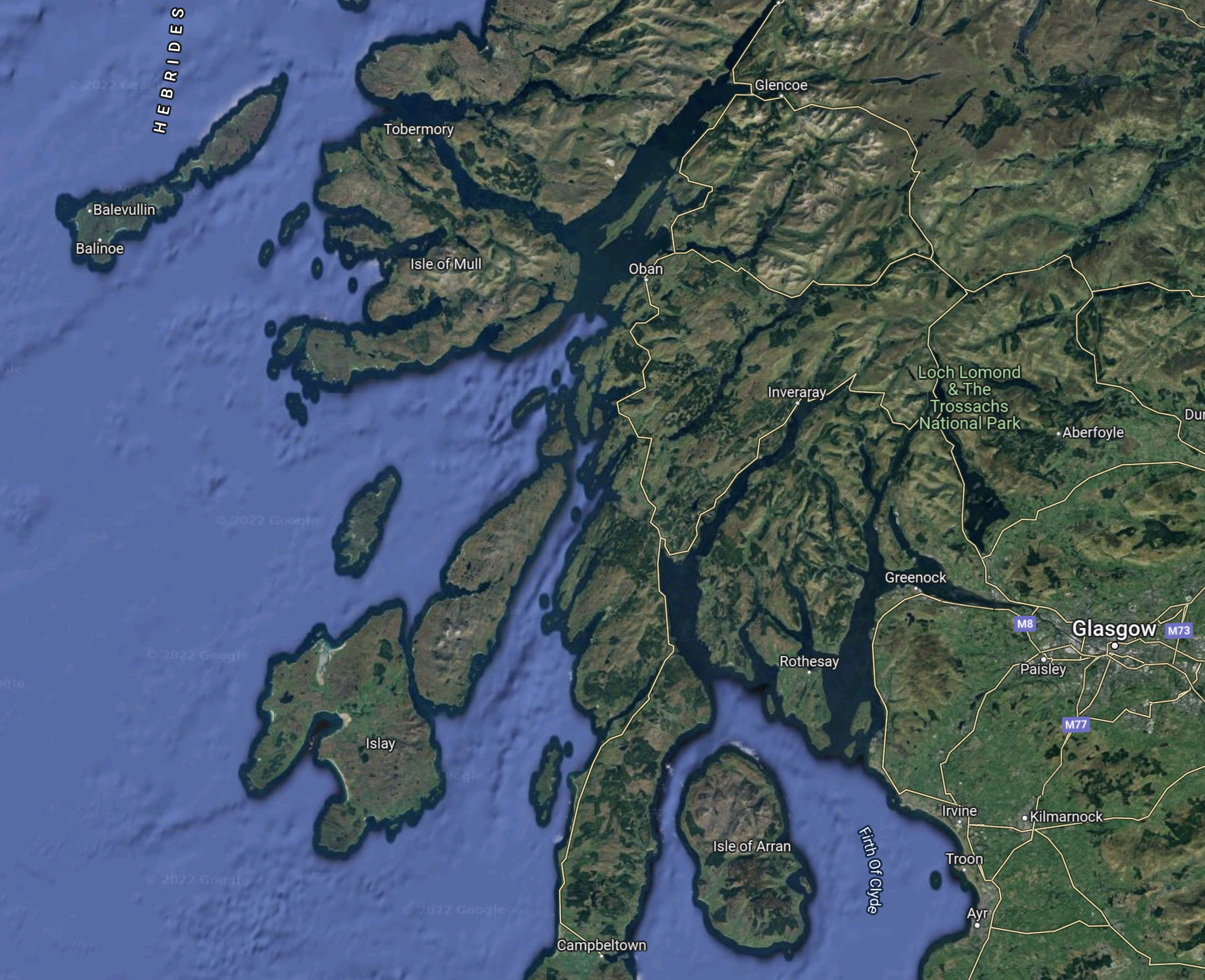
This Google Map shows the area of the wind farm, which is to the North West of the island of Islay.
Note.
- There certainly is a large space of empty sea to the North-West of Islay.
- Glasgow is not far away.
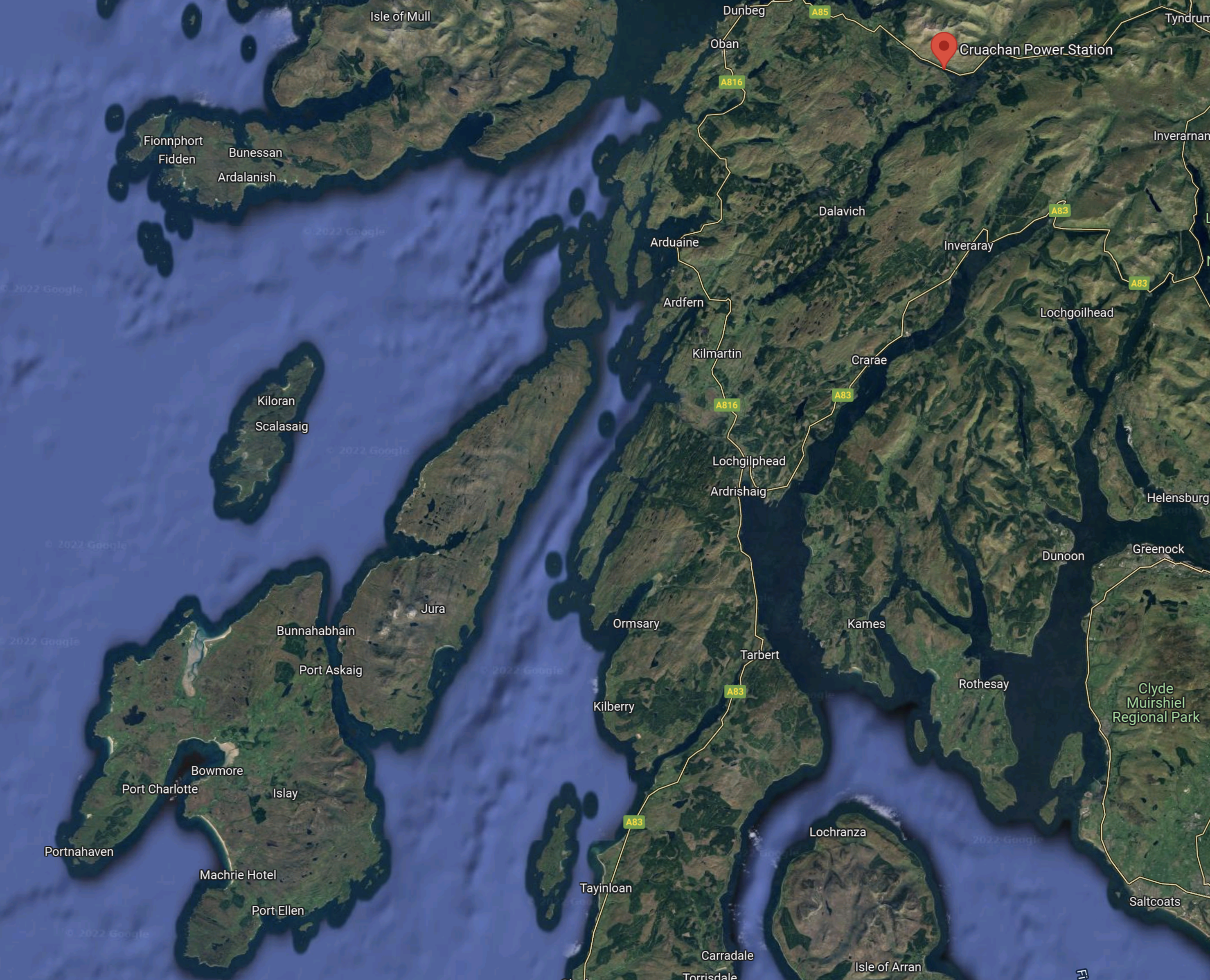
This second Google Map shows the area to the North-East of Islay.
Note.
- Islay is in the South-West corner of the map.
- Colonsay is the smaller island to the North.
- In the North-East corner of the map the red arrow indicate Cruachan pumped hydro power station.
- In the South-East corner of the map is the Clyde Estuary, where the two nuclear power stations at Hunterston were located.
- Hunterston is also the Northern end of Western HVDC Link to North Wales.
Wikipedia says this about the relationship of the Cruachan power station and Hunterston’s nuclear stations.
Construction began in 1959 to coincide with the Hunterston A nuclear power station in Ayrshire. Cruachan uses cheap off-peak electricity generated at night to pump water to the higher reservoir, which can then be released during the day to provide power as necessary.
Now that the two nuclear stations are being decommissioned, will the MacHairWind wind farm be used to pump water to Cruachan’s higher reservoir?
Conclusion
The MacHairWind wind farm seems a well-positioned wind farm.
- It is close to Glasgow.
- It can be used in tandem with the Cruachan pumped hydro power station.
- It will have access to the Western HVDC Link to send power to the North-West of England.
Is Scotland replacing the 1.2 GW Hunterston B nuclear power station with a 2 GW wind farm, with help from Cruachan and other proposed pumped storage hydro schemes to the North of Glasgow?
It also looks like increasing the power at Cruachan from the current 440 MW to a GW, by the building of Cruachan 2 would give the area even more energy security.
Amp Wins Consent For 800MW Scots Battery Complex
The title of this post, is the same as that of this article on renews.biz.
These are the first two paragraphs.
Canadian storage player Amp Energy has revealed that its 800MW battery portfolio in Scotland has secured planning consent.
The portfolio is due to be operational in April 2024 and will comprise two 400MW battery facilities, each providing 800 megawatt-hours of energy storage capacity.
Some other points from the article.
- The two facilities will be located at Hunterston and Kincardine.
- They will be the two largest grid-connected battery storage facilities in Europe.
- The two batteries will be optimised by Amp Energy‘s proprietary software.
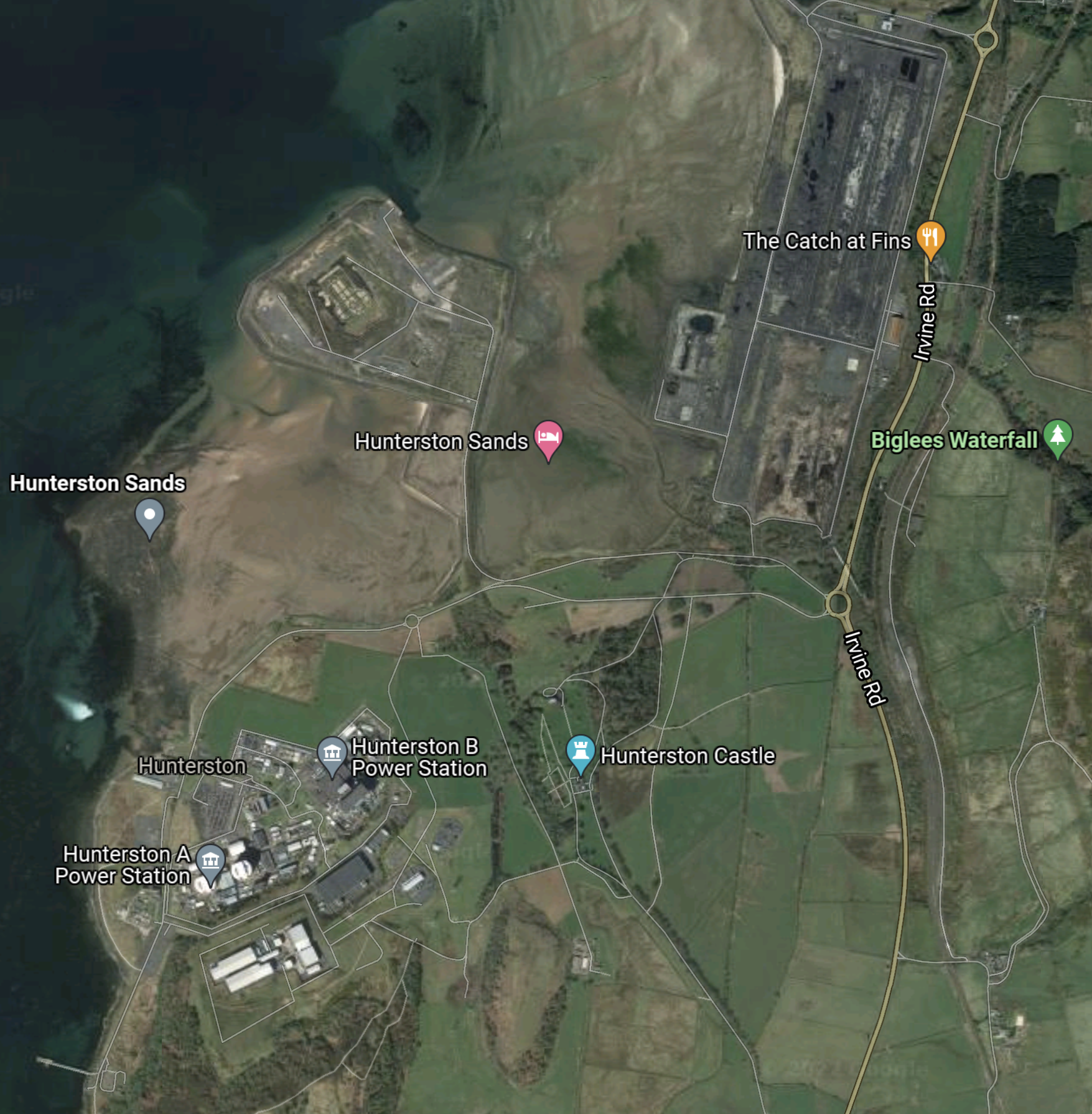
This Google Map shows the Hunterston area.
Note.
- The Hunterston A and Hunterston B nuclear power stations, which are both being decommissioned.
- Hunterston B only shut down on the 7th of January, this year.
- There is also a large brownfield site in the North-East corner of the map.
This second Google Map shows the South-East corner of the nuclear power station site.
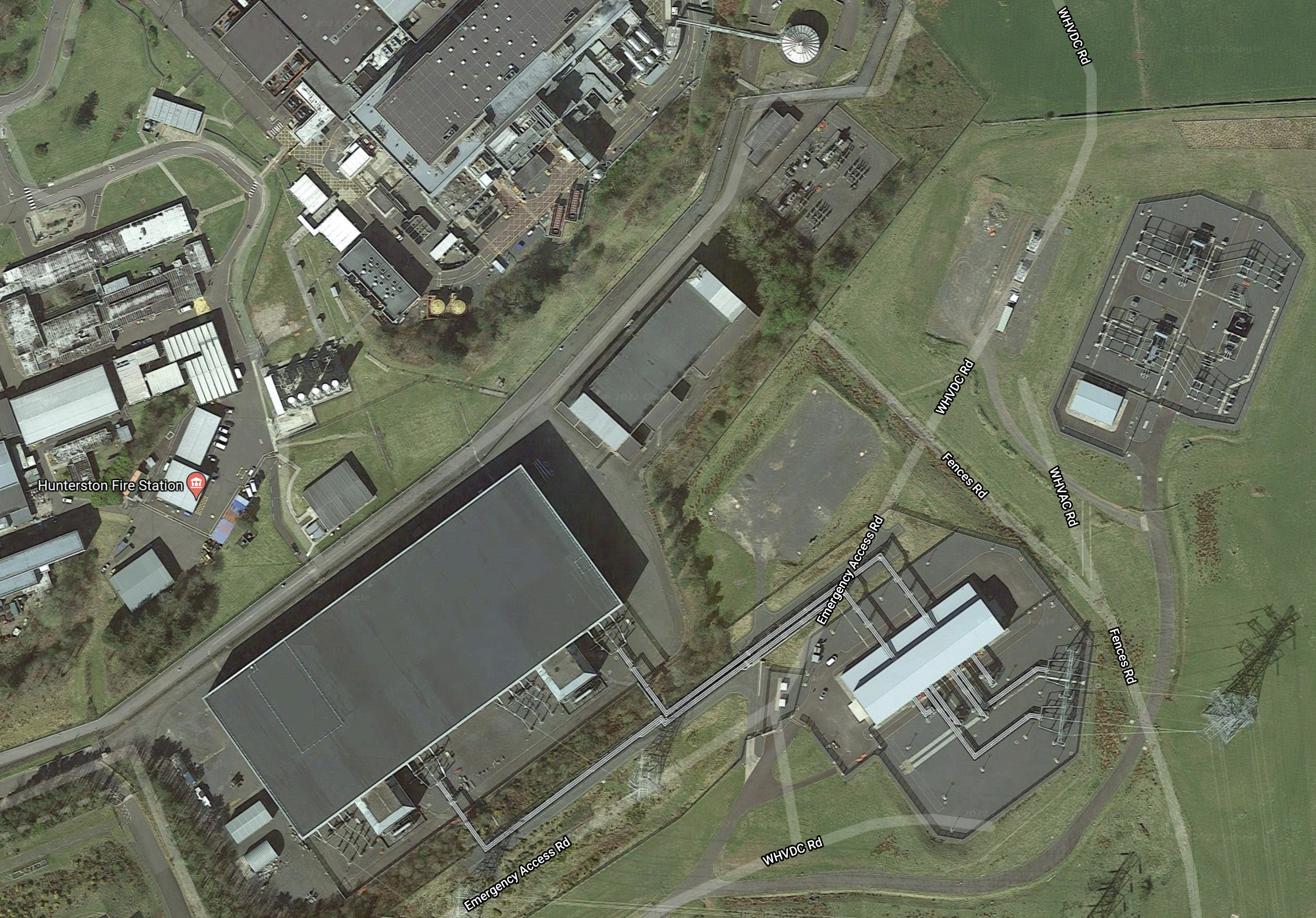
It’s certainly got a good grid connection.
But then it had to support.
- The Hunterston A nuclear power station rated at 360 MW.
- The Hunterston B nuclear power station rated at 1.2 GW.
- The Western HVDC Link, which is an interconnector to Connah’s Quay in North Wales, that is rated at 2.2 GW.
I’m sure that National Grid has a suitable socket for a 400 MW battery.
This Google Map shows the Kincardine area.
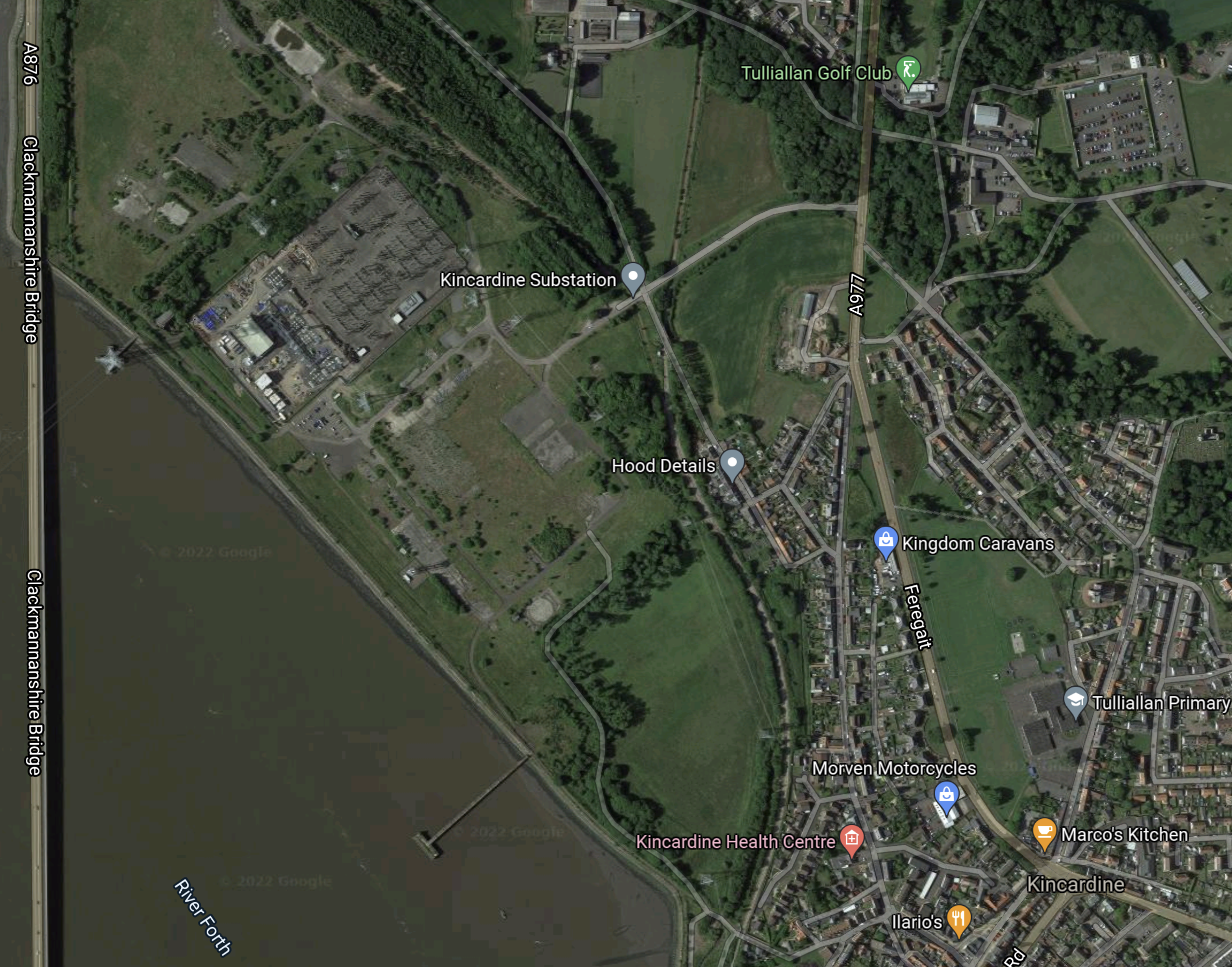
Note.
- The Clackmannanshire Bridge down the Western side of the map.
- The Kincardine Substation to the East of the bridge close to the shore of the River Forth.
- The 760 MW Kincardine power station used to be by the substation, but was demolished by 2001.
As at Hunterston, I’m sure that National Grid could find a suitable socket for a 400 MW battery.
Amp Energy’s Philosophy
As a trained Control Engineer I like it.
- Find a well-connected site, that can handle upwards of 400 MW in and out.
- Put in a 800 MWh battery, that can handle 400 MW in and out.
- Optimise the battery, so that it stores and supplies electricity as appropriate.
- Throw in a bit of artificial intelligence.
Old power station sites would seem an ideal place to site a battery. Especially, as many demolished coal, gas and nuclear stations are around 400-600 MW.
It should be noted that Highview Power are building a 50 MW/400 MWh CRYOBattery on an old coal-fired power station site in Vermont.
The Western HVDC Link
I mentioned earlier that the Northern end of the Western HVDC Link, is at Hunterston.
The Wikipedia entry for the Western HVDC Link, says this about the link.
The Western HVDC Link is a high-voltage direct current (HVDC) undersea electrical link in the United Kingdom, between Hunterston in Western Scotland and Flintshire Bridge (Connah’s Quay) in North Wales, routed to the west of the Isle of Man.[2] It has a transmission capacity of 2,250 MW and became fully operational in 2019.
The link is 262 miles long.
This Google Map shows the Connah’s Quay area in North Wales.
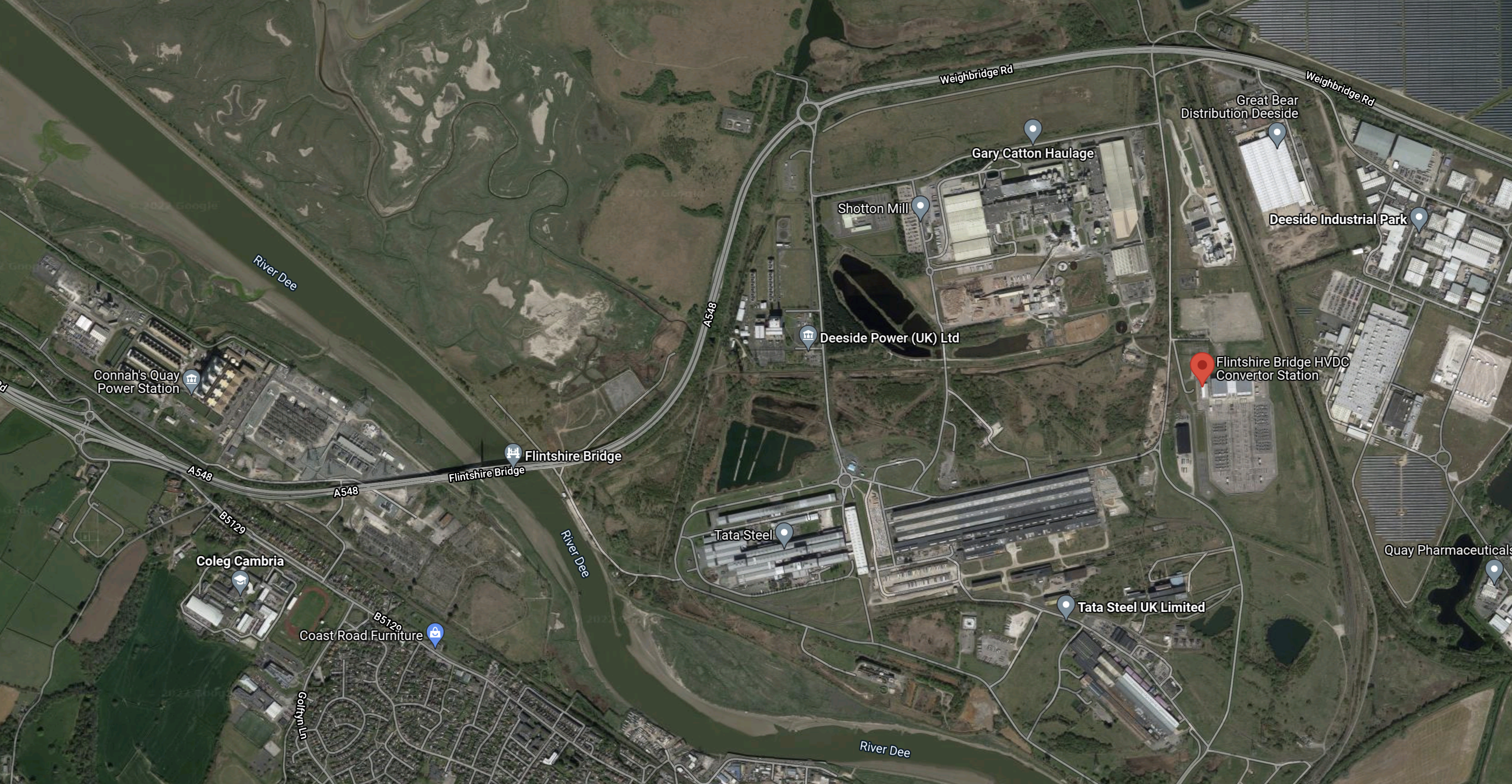
Note.
- The red arrow indicates the Flintshire Bridge HVDC converter station, which is the Southern end of the Western HVDC Link.
- The Borderlands Line between Liverpool and Chester, runs North-South to the East of the convertor station.
- To the East of the railway are two solar farms. The Northern one is Shotwick Solar Park, which at 72 MW is the largest solar farm in the UK.
- To the West of the converter station, just to the East of the A 548 road, is the 498 MW Deeside power station.
- Follow the A548 road to the West and over the River Dee, the road passes South of the 1420 MW Connah’s Quay Power station.
- The two power stations burn gas from Liverpool Bay.
- There are a lot of wind turbines along the North Wales Coast and Liverpool Bay.
The map also shows a lot of high electricity users like Tata Steel.
I can certainly see why the Western HVDC Link was built to connect Scotland and North Wales.
- There is a lot of renewable energy generation at both ends.
- There are heavy electricity users at both ends.
- The Scottish Central Belt is at the North.
- Greater Merseyside is at the South.
The Western HVDC Link is an electricity by-pass, that must have avoided expensive and controversial construction on land.
I wouldn’t be surprised to see another 400 MW/800 MWh battery at the Southern end.
Conclusion
The Canadians seem to have bagged two of the best battery sites in Europe.
- Both sites would appear to be able to handle 400 MW, based on past capabilities.
- There is lots of space and extra and/or bigger batteries can probably be connected.
- Scotland is developing several GW of wind power.
I can see Amp Energy building a series of these 400 MW sites in the UK and around Europe.
This is the big news of the day!
 The Anonymous Widower