Toyota Leads Multi-Million-Pound Micromobility Research Project
The title of this post, is the same as that of this news item from the Advanced Propulsion Centre.
These five paragraphs introduce the project.
he Advanced Propulsion Centre UK (APC) has announced the latest project funded through the UK Government’s DRIVE35 Collaborate programme.
Toyota will lead a consortium to research and develop a new lightweight battery electric vehicle in Derbyshire.
The project aims to meet the evolving needs of urban populations while accelerating the shift to zero tailpipe emission transport by validating a novel, lightweight battery electric vehicle (BEV) in the L6e category.
Underlining Toyota’s commitment to investing in the UK’s R&D capabilities, it will be manufactured at Toyota Manufacturing UK’s (TMUK) Burnaston site.
The vehicle addresses the growing demand for sustainable micro-mobility solutions and includes an integrated solar roof, increased connectivity, and lightweight sustainable materials supporting recovery and recycling.
Note.
- The vehicle will be light in weight.
- Toyota is investing in UK R & D.
- The vehicle will be built in Derbyshire at Burnaston.
I asked Google AI, what is an L6e Car and received this reply.
An L6e car is a light quadricycle in the EU vehicle classification system, defined as a light, four-wheeled vehicle with a maximum speed of 45 kph}) (28 mph)) and an unladen mass of no more than 425 kg. (excluding batteries for electric versions). It can be powered by small internal combustion engines or electric motors, and vehicles in this category are often used for urban commuting or small delivery tasks.
Note.
- Sir Alec Issigonis’s famous ADO15 Mini, which was launched in 1962, weighed 580 Kg, seated four and had an initial top speed of 75 mph.
- Sir Alec also designed racing cars and high performance Mini Coopers.
- Another partner in the project specialises in urban delivery vehicles.
I always wonder what sort of electric vehicle, the great car designer would have designed.
These are some further thoughts.
Do Toyota Build Microcars In Japan?
I asked Google AI, the question in the title of this section and received this answer.
Yes, Toyota builds microcars in Japan, and the Toyota C+pod is one example. While Toyota previously focused on larger vehicles, it now manufactures ultra-compact electric vehicles like the C+pod for the Japanese market to meet customer demand for small city cars.
The Toyota C+Pod has this Wikipedia entry, which gives these details.
- Two seats.
- 9.2 KW electric motor.
- 670-690 Kg weight.
- 37 mph.
- 93 mile range.
- The car has air conditioning, air-bags and heated seats.
The number of seats, speed and range would appear to be ideal for a city-car.
Could The Vehicle Be Hydrogen Powered?
I asked Google AI, if small lightweight hydrogen fuel cells exist and received this answer.
Yes, small, lightweight hydrogen fuel cells do exist and are commercially available for various applications, ranging from educational kits to power sources for drones and portable electronics.
I wouldn’t be surprised if the project needed a hydrogen fuel cell of a particular weight, size and power, someone could built it, by scaling an existing design.
Could The Vehicles Be Self Driving?
Not probably now, but as the technology gets more sophisticated, I suspect that it will happen.
Could The Vehicles Replace The Invacar?
This article in The Times is entitled Bring Back Three-Wheeled Cars For Disabled Drivers, Reform Urges.
I would expect that, if Toyota, the Advanced Propulsion Centre and their partners did a comprehensive job, then Toyota’s new car could serve the same purpose as an Invacar, much better in a zero-carbon manner.
There Is This Video Of A Toyota C-Pod.
Conclusion
I believe this project could come up with something special.
The End Of EVs Has Come, And It’s Toyota’s Fault – They’re Going To Change Everything, And It’s Going To Be Hydrogen
The title of this post, is the same as that of this article on El Diario 24.
These are the first two paragraphs.
The future of environmentally sustainable vehicles appears to be hydrogen based and Toyota is the frontrunner in developing this new technology.
The development of electric battery powered vehicles was a gamechanger for the industry and signified the first big shift since the introduction of fossil fuel powered vehicles all those years back. The current downside to electric vehicle, is of course, charging times as well as infrastructure to support charging stations. Japanese automaker, Toyota, has decided to switch lanes on the road to sustainability by investing research and funds into the development of a hydrogen powered system. This model has great potential in terms of environmental sustainability and user-friendliness but are the initial roll outs proving to be a success?
The article is from Argentina, which is a big country and range and charging could be a bigger factor, than in some countries.
But then Ricardo take a similar view to Toyota on hydrogen.
I also believe that hydrogen internal combustion engines will provide an alternative route to affordable zero-carbon vehicles, that are of all sizes.
I’m with Toyota on this one and the article is a must read.
This Hydrogen Engine From Kia And Hyundai Heralds A New Dawn In Automotive – Everything Will Change – Lagrada
The title of this post, is the same as that of this article on Hydrogen Central.
These are the first two paragraphs.
Hyundai and Kia recently unveiled in Korea a zero-emission hydrogen engine that could disrupt the EV market. Both automakers are at the forefront of the development of hydrogen technology, focusing on both fuel cell systems and investigating the possibilities of sophisticated hydrogen engines.
The future of sustainable mobility is being shaped by Hyundai and Kia’s continuous research and dedication to hydrogen as a clean transportation solution. An increasing number of manufacturers are developing hydrogen engines as an alternative to electric cars and vehicles that use polluting combustion engines.
These three paragraphs outline more details of the engine.
What’s more remarkable about this new hydrogen engine presented in Korea is that it solves all the problems of durability and large-scale viability that hydrogen engines have presented until now.
The project team successfully ensured that the Hyundai-Kia hydrogen engine, designed to burn hydrogen, could sustain high thermal efficiency throughout its operation by infusing hydrogen into the combustion chamber at a pressure of 30 bar.
Although the device’s performance was enhanced by the use of a turbocharger, it was found that the enhanced performance and lower pollution emissions of this kind of “direct injection” eliminated the problems that most automakers have with hydrogen engines. As the emissions of carbon dioxide and fine particles were reduced by 99% and 90%, the Hyundai-Kia hydrogen engine would be considered to have zero emissions.
Thirty years ago, I was involved with a company called DMW.
- The company’s first product was an aerosol valve, that instead of using CFCs or HCFCs as a propellent used nitrogen. The patent was sold to Johnson and Johnson, after being shown during the discussions, that led to the Montreal Protocol and the phase out of CFCs.
- This led to a deal with Glaxo to investigate if DMW’s technology could be used in a metred-dose-inhaler for asthma drugs.
- The successful idea was eventual sold to Boehringer Ingelheim and is now marketed as Respimat.
I can compare the Hyundai-Kia hydrogen injector and the Respimat inhaler
- Hyundai-Kia appear to be using a high pressure of 30 bar to sustain high-thermal efficiency.
- I know that the Respimat inhaler uses high pressure to obtain a fine mist of the drug.
It sounds to me, that both companies are using the same properties of applying high pressure to a small hole, to disperse one fluid in another.
Is A Small Hydrogen Fuel Cell Car Possible?
By small car, I’m meaning something like a Ford Fiesta or a Vauxhall Astra.
Consider.
- The car will have a power unit of about 100 KW.
- With four passengers the car would probably weigh about 1500 Kg.
Does A 100 KW Fuel Cell Suitable For A Car Exist?
Intelligent Energy is a British company based in Loughborough.
This is their mission statement on their web site.
Focused on the development of lightweight, high efficiency, hydrogen fuel cell systems.
They also have this product page for a 110 KW fuel cell tailored for automotive use, that weighs 240 Kg.
I suspect if Ford asked for a fuel cell for a hydrogen Fiesta, that Intelligent Energy could provide one.
And I suspect other fuel cell companies could!
How Much Is The Kinetic Energy Of A Car Like This At 100 mph?
Using Omni’s Kinetic Energy Calculator, I get a figure of 422 Wh.
This figure means a battery of perhaps 2 KWh would handle regenerative braking and provide stationary power to get the car started.
Conclusion
From what I have written here, I believe that a hydrogen-powered small car is possible.
Is This The World’s Smallest Hydrogen Car?
I typed “World’s smallest hydrogen car” into Google and found this web page.
This is the first paragraph of the product description.
The smallest hydrogen fuel-cell car ever commercialized. A small-scale model of a hydrogen fuel-cell application. A funny didactical toy for kids and… adults too!
But it only costs € 99 with the VAT included.
For something more useful, this web page details a ride-on hydrogen fuel-cell lawnmower.
When I find products, like these that can be bought on-line, it strengthens my belief, that at some time in the next few years, someone will demonstrate an Issigonis Mini-sized car that will run on hydrogen.
We must all remember, that engineering is the science of the possible, whereas politics is dreams of the impossible.
Centrica Set For Solar Boost With Acquisition Of Two Projects In South-West England
The title of this post, is the same as that of this press release from Centrica.
These three bullet points act as sub-headings.
- Two green energy schemes adding 32MW of solar and battery capacity – enough to power 7,800 homes per year
- Site in Dorset sees construction of a 16MW solar farm and 3MW of battery storage, with a second operational site in Wiltshire adding 13MW of solar capacity
- Investment part of Centrica’s £4bn green-focused investment plan by 2028
These four paragraphs give more details of the Dorset site.
In Dorset, the business has acquired development rights for the construction of a 16MW solar farm and 3MW battery storage plant near Winterborne Whitechurch.
The project breaks ground in early 2024, with the first power exported to the grid in 2025.
The site at Winterborne Whitechurch will be a co-located asset, with the solar farm and battery storage facilities using the same connection point to the grid, helping to maximise the grid connection.
The site is able to power 4,600 homes a year, supported by the battery that can deliver two-hours of energy for a similar number of properties.
But this is no bog-standard wind farm with an attached battery.
This web site introduces Blandford Hill Eco Hub.
This is the second paragraph on the web site’s home page.
The Blandford Hill Eco Hub project consists of an electric vehicle (EV) charging station, a 15 megawatt ground-mounted solar farm and a 3 megawatt battery storage faciality on land south of the A354 at Blandford Hill, Winterborne Whitechurch near Blandford Forum in Dorset. By combining green electricity generation, storage and charging, we’re maximising the green potential with charging for up to 19 EVs at a time.
Note.
- It’s rather a coincidence that the solar farm and battery are almost the same size to those in Centrica’s acquisition.
- The site appears to have been developed by a company called the Pegasus Group, that has used the trade name of Naturalis.
- It does look to me, that Centrica have bought this electric vehicle service station site.
- Centrica get a site to charge nineteen EVs at a time, with its own solar farm and battery.
- The location close to the village means that staff from the village could walk or cycle to work.
- All plans and planning permissions have been thought through and obtained.
- The site even has a dog-walking area, so you can walk the dog, whilst charging your car.
Perhaps, Centrica have a plan to roll out lots of electric vehicle service stations and it was cheaper to buy a innovative prototype, than do the research themselves?
Pegasus Group do seem to design quality projects.
This Google Map shows the location of the site.

Note.
- The village is Winterborne Whitechurch.
- The road going South-West and North-East is the A354 road, which runs between Dorchester in the South-West and Blandford Forum in the North-East.
- The electric vehicle service station appears to be in the large field to the South of the A 354.
It looks like the service station meets the three most important properties of a development; location, location and location.
Could This Site Be Updated To Hydrogen?
Consider.
- Centrica have a substantial interest in a company called HiiROC, who use a technique called plasma electrolysis to extract hydrogen from any hydrocarbon gas.
- The HiiROC process could be used to extract hydrogen from methane, where there is a reliable electricity supply.
- If Winterborne Whitechurch is connected to the gas grid, then I’m certain, that a HiiROC system connected to the solar farm/battery system should be able to fuel passing hydrogen-powered vehicles.
Updates like this could see hydrogen-powered vehicles finally increase their market share.
The Second Site In Wiltshire
This paragraph details the Wiltshire site.
In addition, the business has also acquired the operational Roundponds Solar Farm in Wiltshire. The 13MW solar farm was commissioned in 2015 and is capable of providing energy for around 3,200 homes every year.
This looks like one of those investments, where big companies let small companies get all the permissions and build the asset, before they buy it.
Conclusion
These two projects fit into Centrica’s future development plan.
The last paragraphs, gives a few details of some of Centrica’s new assets.
The Winterborne and Roundponds projects will contribute towards Centrica’s long-term plan to deliver a portfolio of green energy transition assets. They follow the construction of an 18MW solar farm at Codford, Wiltshire which was commissioned in 2023 and a 20MW hydrogen-ready gas-fired peaking plant in Worcestershire. In addition, Centrica is delivering a 50MW battery storage project in Brigg, Lincolnshire, which is nearing completion.
It will be interesting to see what other assets Centrica acquire in the next couple of years.
First Look Inside £2.2bn Silvertown Tunnel
The title of this post, is the same as that of this article on the BBC.
These are the first five paragraphs.
For the first time, Transport for London has invited journalists inside what is one of the most controversial infrastructure projects in the capital.
The Silvertown Tunnel is 1.4km (just under one mile) long and stretches from Silvertown in Newham to the Greenwich Peninsula.
Inside the tunnel, it is extremely wide. A lot bigger than other tunnels like the supersewer or Crossrail. Boring was finished a few weeks ago.
Transport for London (TfL) says the scheme will address queues at the Blackwall Tunnel and reduce pollution. But it has faced fierce opposition from those who think it will do the total opposite and increase pollution and congestion.
And the big question is – even with mitigation – can a road tunnel ever be green?
Note.
- There is a good picture, showing the width of the tunnel.
- It is very wide and can’t be much narrower than the four-lane Queensway Tunnel, which was opened under Mersey in 1934.
These are my thoughts.
I Am Against The Tunnel Being Built
My main reason I am against the Silvertown Tunnel is that Transport for London’s mathematical modelling of and rerouting of buses past my house has been some of the worst I’ve seen. I talk about the bus problems I now have in Is The Nightmare On The Buses Going To Get Worse?
So until the two tunnels; Blackwall and Silvertown are complete and open with tolling, I won’t trust any of Transport for London’s pronouncements.
I also feel that as the Silvertown Tunnel will allow trucks to pass though, there will be times, when they will cut through the East End to get to the Motorways going North.
But now, it’s more or less finished, we will probably need to use it.
How Is The Tunnel Being Paid For?
The Wikipedia entry for the Silvertown Tunnel has a section called Costs, where this is said.
In 2012, the cost was stated to be £600m. A consultation in 2015 stated that the cost of construction was estimated to be £1bn. In March 2020, the cost was increased again, to £1.2 billion. Operation, maintenance and financial costs of the tunnel over 25 years is expected to cost another £1bn.
The £2.2 billion will be repaid by tolls on both tunnels. Effectively, it’s a Private Finance Initiative or PFI.
Can A Road Tunnel Ever Be Green?
This is the question the BBC asked in the last paragraph of my extract.
Although, I am very much against this tunnel, I do believe this tunnel can be green.
- Suppose, the tunnels were made free for zero-carbon vehicles, that were powered by batteries, hydrogen or possibly ammonia.
- This might nudge vehicle owners and operations to go zero-carbon.
This extra number of zero-carbon vehicles would help to clean up London’s air.
I wonder which will be the preferred route for trucks associated with construction to go to and from sites in Central London?
- These trucks are major polluters in Central London.
- There are sensible moves to make construction sites zero-carbon.
If the Silvertown Tunnel didn’t have tolls for zero-carbon trucks, then surely this would nudge, this sizeable group of trucks to go zero-carbon to the benefit of everyone in Central London.
The only problem with making zero-carbon vehicles toll-free, is that it probably ruins the finances of the tunnels, from the point of view of the investors.
Conclusion
I can see lots of conflict starting over the operation of this tunnel.
Would You Buy A Battery Energy Storage System From Rolls-Royce?
I don’t often click on adverts that appear in web pages.
But I had to click on one from Rolls-Royce mtu, which advertised Battery Energy Storage Systems.
I wonder what the Honourable Charles Rolls would have thought of adverts on the Internet for the company he jointly founded?
I suspect he would have liked the idea, as Rolls was very much a promoter of motoring and aviation and opened one of the first car dealerships in the UK, according to his Wikipedia entry.
The Wikipedia entry for his business partner; Sir Henry Royce starts with this sentence.
Sir Frederick Henry Royce, 1st Baronet, OBE (27 March 1863 – 22 April 1933) was an English engineer famous for his designs of car and aeroplane engines with a reputation for reliability and longevity.
He is also described as a perfectionist.
This sentence from the Wikipedia entry, describes how he started the design of the legendary “R” engine.
In October 1928, he began design of the “R” engine while walking with some of his leading engineers on the beach at West Wittering, sketching ideas in the sand. Less than a year later, the “R” engine, designed in his studio in the village, set a new world air speed record of 357.7 miles per hour and won the Schneider Trophy of 1929.
Later with help from the maddest person my father ever met (his words, not mine!) ; Lady Houston, the Supermarine S.6B won the trophy in 1931 and then broke the world speed record at over 400 mph. Not bad for a seaplane. Take the floats off an S.6B and you almost have a Spitfire.
The Wikipedia entry also describes how the “R” engine was developed into what many engineers believe was the finest internal combustion engine of all time; the Rolls-Royce Merlin.
Following the success of the “R” engine, it was clear that they had an engine that would be of use to the Royal Air Force. As no Government assistance was forthcoming at first, in the national interest they went ahead with development of what was called the “PV-12” engine (standing for Private Venture, 12-cylinder). The idea was to produce an engine of about the same performance as the “R”, albeit with a much longer life. Rolls-Royce launched the PV-12 in October 1933 and the engine completed its first test in 1934, the year after Royce died. The PV-12 became the Rolls-Royce Merlin engine.
Where would we have been in the Battle of Britain without the Merlin engine?
Since 1969, the engineers at Rolls-Royce have followed Sir Henry’s example of perfection and developed the revolutionary RB-211 into the modern day Trent, which is now about to take a big leap into a low-carbon future with the UltraFan.
If the quality of Rolls-Royce mtu’s Battery Energy Storage System matches the levels of perfection Rolls-Royce achieved with the Merlin and the Trent, then I suspect that Sir Henry would have given his approval.
This picture is shown on the web page for the Battery Energy Storage System.

These two paragraphs introduce, what Rolls-Royce mtu are calling the mtuEnergyPack.
In today’s world of economic growth and increasing populations, the demand for electricity is soaring. Governments and industries globally shift to distributed renewable energy, challenging centralized grids. To adapt to this changing energy landscape, the mtuEnergyPack offers an ideal solution.
It integrates renewable sources like solar and wind power, paving the way for future-ready sustainable power systems. The mtu EnergyPack is a scalable, all-in-one solution for autonomous off-grid facilities. It ensures reliable power through peak shaving, load-shifting, and grid stabilization, making it suitable for various applications.
These are my thoughts.
What Is The Output And The Storage Capacity?
This paragraph on this page gives this answer.
It efficiently stores electricity from distributed sources and delivers on demand. The mtu EnergyPack is available in different sizes: The QS and the QL, ranging from 200 kVA to 2,000 kVA, and from 312 kWh to 2,084 kWh, and the QG for grid scale storage needs, ranging from 4,400 kVA and 4,470 kWh to virtually any size.
It seems that you specify your requirements and Rolls-Royce mtu should be able to satisfy it.
What Devices Can Be Connected?
This paragraph on this page gives this answer.
The mtu EnergyPack serves as a key component in enhancing the reliability and profitability of microgrids and energy systems. It stores electricity generated by distributed power sources, including gensets, wind turbines, or solar panels, and delivers it when needed.
In the 1970s, when I was working at ICI, others in the section were working on a system called MEDIA, where every sensor on a chemical plant was connected to the central computer, through its own analog-to-digital computer. It would now be called plug-and-play by some.
I believe that Rolls-Royce mtu are using similar ideas to connect equipment to the control computer.
These are my thoughts about connecting various equipment.
- Hydrogen-powered generators and electrolysers as Rolls-Royce mtu are using at Duisburg, which I wrote about in Rolls-Royce Makes Duisburg Container Terminal Climate Neutral With MTU Hydrogen Technology.
- Could Rolls-Royce’s beer keg-sized 2.5 MW electrical generator based on a Super Hercules engine, be connected?
- Could a Rolls-Royce Trent be connected?
- Could one of Rolls-Royce’s small modular nuclear reactors be connected?
- In Rolls-Royce To Play Key Role In US Department Of Defense Nuclear Microreactor Program, I talk about developing a 1-5 MW nuclear reactor for US Department of Defense. Could these be connected?
I don’t see why every device can’t work to the same protocol.
What Is The Power Density Like?
This paragraph on this page gives this answer.
The mtu EnergyPack’s compact battery system designs suit projects with limited space and logistical restrictions.
In ‘Spirit of Innovation’ Stakes Claim To Be The World’s Fastest All-Electric Vehicle, I talked about Rolls-Royce’s record-breaking electric plane called Spirit of Innovation.
Has what has been learned about energy storage in the confined spaces of an aeroplane been applied to a Battery Energy Storage System?
What Do Rolls-Royce mtu Consider To Be Important Features?
On this page, they list these features.
- Power Density
- Digitally Connected
- Multilevel Safety
- Black Start Capability
- Scalability
- Ultra-Fast Response
- Flexible Use
- Plug-And-Play Installation
The design seems to have everything covered.
Can Similar Systems Be Designed By Others?
I would expect that similar systems can be designed, as technology like batteries is available to all and the operation is only as good as the software controlling the various components of the system.
But similar systems will be without the famous Rolls-Royce logo.
Could One Of These Systems Decarbonise A Village?
I once lived in a village with about fifty houses and perhaps a hundred inhabitants.
- There was an old World War Two airfield, that could probably accommodate a small wind farm of perhaps 20 MW.
- There were a couple of barns and large sheds, that could have solar panels similar to those I described in Bedford Depot’s Massive Solar Roof Helps Thameslink On Way To Net Zero.
I suspect an mtuEnergyPack could control all these inputs and provide the village with the following.
- Enough electricity to power all the needs of the inhabitants, businesses and their vehicles.
- If an electrolyser were to be provided, it could probably produce enough hydrogen to power every boiler and hydrogen-powered vehicle.
Note.
- Farmers would like the local availability of hydrogen, as it will be ideal for tractors and agricultural machinery.
- I actually believe that if a village had a reliable and affordable hydrogen supply, that a large proportion of the inhabitants would switch to hydrogen-powered vehicles.
There would still be the National Grid there for backup.
Conclusion
If I needed an mtuEnergyPack, I’d certainly give one a close look.
Ricardo Develops Advanced Ranger HEX 6×6 Conversion With Hybrid Electric Drivetrain
The title of this post, is the same as that of this press release from Ricardo.
This is the sub-heading.
The new vehicle has been conceived to help improve the sustainability of future defence mobility while retaining the highest performance demanded by the toughest environments
This picture is from the press release.
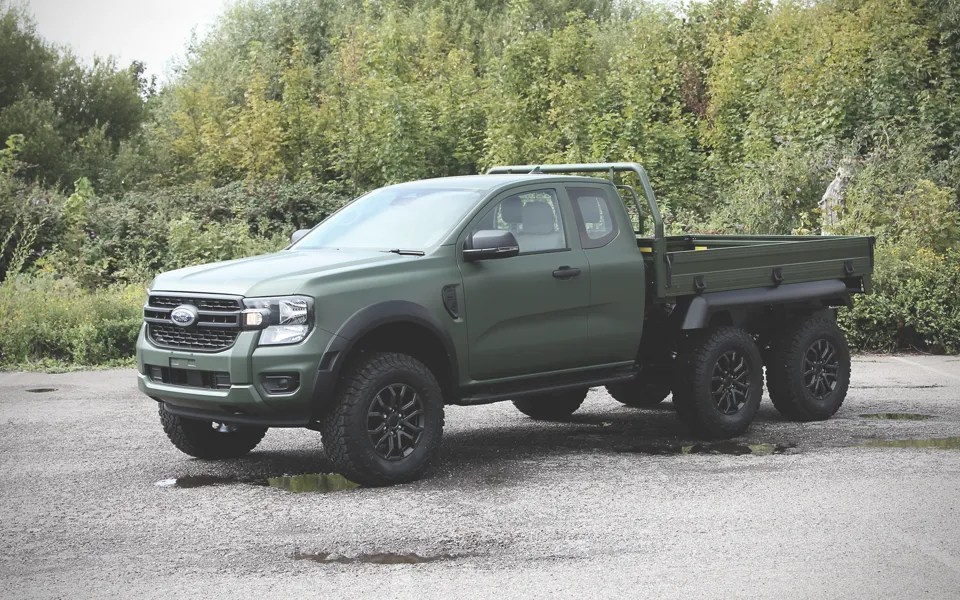
My first thought is that it looks the ultimate technical.
These two paragraphs introduce the vehicle.
Ricardo, a global strategic, environmental, and engineering consulting company, has developed the Ranger HEX, a 6×6 vehicle conversion designed to offer a significant improvement in payload of up to 3,800kg over the harshest of terrains. It comes with a hybrid drivetrain to maintain performance and improve fuel consumption.
This new conversion benefits from Ricardo’s expertise and experience in creating high quality, cost effective special vehicles for defence, security and utility applications. The vehicle will benefit from enhanced levels of capability, robustness and availability.
These three paragraphs describe the design.
The HEX solution differs from conventional conversions as it has been conceived as an overlay bolt-on system that does not require any alteration of the Ford Ranger base vehicle, which is Europe’s number one commercial pick-up platform. This ensures that the base vehicle retains all the robustness and quality of the standard vehicle and allows the system to be removed and re-installed on a different vehicle.
An electric rear drive system has been adopted that uses a production Ford drive unit to provide up to an additional 210kW of power, over and above the class leading 186kW of power from the existing 3.0L V6 diesel engine. The De Dion rear suspension design is not only weight efficient and robust but also provides better wheel control for improved traction and ride. In addition, the De Dion arrangement decouples the suspension and drive systems to allow a range of drive units to be used or deleted for a cost-effective 6×4 variant with maximum payload using an undriven ‘lazy’ axle.
The electric drive is designed as a self-contained through-the-road hybrid system. Braking energy is harvested under deceleration to charge the battery pack. This energy is then used to provide electric torque under acceleration to mitigate the usual drop in performance whist carrying a high payload. A selection of battery capacities are available, depending on customer requirements. All high voltage components are contained within a single integrated enclosure for safety and ease of maintenance and repair.
Note.
- The conversion would appear to bolt on to the standard Ford Ranger base vehicle.
- The vehicle has regenerative braking.
- It has a payload of 3.8 tonnes.
- It appears to have a very sophisticated rear suspension.
- Judging by the colour and the mention of the word defence in the article, I suspect this vehicle has been initially designed for a military application.
- Over 300,000 Rangers were sold worldwide in 2021.
- In the UK, it looks like a Ford Ranger will cost around £30,000 excluding VAT.
In addition I’ve read in this article on Autoweek that, the conversion itself has been designed as an overlay bolt-on modification that requires no alterations to the base vehicle, even preserving its existing warranty.
I have my thoughts.
Applications
The press release talks about high quality, cost effective special vehicles for defence, security and utility applications.
Use your imagination!
Perhaps.
- It is going to be used as the ultimate technical by the Ukrainians.
- A missile manufacturer has a system, that weighs around 3.5 tonnes and needs a launch vehicle.
- The RNLI needs an affordable vehicle to launch lifeboats from the beach.
- It is going to be used as rough terrain ambulance.
- It would make an excellent towing vehicle.
With all the problems in Morocco and Libya at the moment, it has been launched at the right time.
Zero-Carbon Operation
I believe that a zero-carbon version is essential. Especially, as the sub-heading mentions sustainable defence mobility.
The easiest way to achieve this would be to run on HVO or some form of biodiesel.
I suspect between them Ford and Ricardo have enough knowledge to create a hydrogen powered version.
Are There Autonomous Ford Rangers?
Google says, “Yes!”
This article on foresttech is entitled Ford Ranger Goes Fully-Autonomous, where this is said.
An Australian mining group has advanced the future of mobility (in mining at least) with the deployment of a fleet of fully-autonomous Ford Rangers at one of its mines.
Fortescue Metals Group has retrofitted four Rangers at its Christmas Creek mine in Western Australia with autonomous systems created by the company’s Technology and Automation team, to remove the need for fitters to make around 12,000 28-kilometre round trips each year to collect equipment and parts.
Of course, it’s not quite as ground-breaking as it sounds: mining operations don’t need to deal with road rules, pedestrians or many other vehicles, which hugely complicate the matter. Nevertheless, it’s still impressive.
Three applications suggest themselves.
- Delivering supplies in a disaster zone, after an earthquake, flooding,, landslide or volcanic eruption.
- Delivering supplies, including ammunition on a battlefield.
- Moving supplies along a long linear construction site, like a new railway or road.
Note.
In all three applications, six-wheel drive will be important, if ground conditions are bad.
- Could Fortescue Metals Group be behind this project?
- Disasters seem to be getting more common.
- Autonomous battlefield delivery must be safer for personnel.
I suspect there will be agricultural applications of an autonomous vehicle.
Toyota Unveils Prototype Hydrogen Fuel Cell Hilux
The title of this post, is the same as that of this article in The Engineer.
This is the sub-heading.
Toyota has today (September 5, 2023) unveiled a prototype hydrogen fuel cell-powered Hilux at Toyota Manufacturing UK’s Burnaston car plant in Derby.
This is the first paragraph.
The pick-up has been developed in a joint project with consortium partners Ricardo, ETL, D2H Advanced Technologies and Thatcham Research. and funding from the government via the Advanced Propulsion Centre (APC).
It would appear to be a consortium of some of the important great and good of British automobile engineering.
- Ricardo are a well-respected environmental and engineering consultancy, who probably know more about powering vehicles, than most companies have forgotten.
- Thatcham Research is the motor insurers’ automotive research centre.
- The Advanced Propulsion Centre collaborates with UK government, the automotive industry and academia to accelerate the industrialisation of technologies.
To my mind, the great advantage is that they are starting with a vehicle that has a formidable reputation.
When I outlined, the product to a friend, who had owned vehicles of this type, his reply was “Wow!”
Points from the article include.
- The expected driving range is more than 365 miles.
- The project began in early 2022 with a feasibility study undertaken by TMUK and Toyota Motor Europe with the consortium partners.
- Design and development started at July 1, 2022.
- Prototype construction began on June 5, 2023.
- The first vehicle was completed in three weeks.
- Ten preproduction examples will be produced before the end of the year.
- Ricardo supported preparations for the prototype build and will undertake complete evaluation of the vehicle over the coming months.
- Thatcham Research supported the project through the provision of sustainable repair consultancy and the preparation of hydrogen training for the repair market.
On paper, it looks like the consortium have taken an extremely useful vehicle and updated it for the 21st century.
Inly time will tell, if the design is right.
I have a few questions.
What Is The Towing Performance?
In my experience, many owners will want to tow heavy trailers, horse boxes or portable cafes and toilets for events like music festivals and agricultural and country shows.
If the towing performance matches that of a diesel Hilux, Toyota will probably have got it right.
How Many Miles Does The v Average Small Builder Or Smallholder Do In A Week?
Toyota must know this from servicing records of the diesel HiLux fleet.
I would suspect for many, 365 miles would allow a weekly or twice weekly refuelling!
Where Would Owners Refuel Their Hydrogen-Powered HiLux?
I suspect that Toyota dealerships Selling Hydrogen-Powered HiLux and Mirai, would make their own arrangements.
Would A Hydrogen-Powered HiLux Help To Decarbonise Work Sites?
I suspect it would and the electrical system could probably be used to power and charge small electrical tools.
Would A Hydrogen-Powered HiLux Be An Ideal Farm Runabout?
I am thinking about a friend of mine, who is a Suffolk farmer, who farms rare breed sheep.
He uses a big pick-up to tow a large trailer to take the sheep to market and shows and to move them around the country to other breeders. He has in the past used a golf buggy to check on his flocks and help with the welfare of the animals.
Some of his sheep are raised on the saltings, which gives them a unique flavour, but does involve the occasional accident, and sometimes needs a tricky recovery.
I spoke to him last night and he will be looking at this Toyota. His current vehicle does tend to frighten the sheep as it is too noisy.
Would A Hydrogen-Powered HiLux Work Well In Hot Countries?
The current HiLux is built in South Africa and those for Europe were generally made there.
So I would expect some African examples could have been made there.
Some hydrogen fuel cells need to be cooled, so would this be a problem in hot countries?
On the other hand , it does seem that hydrogen production in hot countries, with all that sun, might not be a problem.
Would A Hydrogen-Powered HiLux Make A Good Technical?
Diesel HiLux are popular as technicals and I suspect that the hydrogen-powered HiLux will be just as good.
Although the low-down mounting of the hydrogen tanks may make them susceptible to landmines.
Why Is It Not Called A HyLux?
I couldn’t resist asking that.
Conclusion
I like the hydrogen-powered HiLux and feel it will be a winner.
 The Anonymous Widower