Ricardo Develops Advanced Ranger HEX 6×6 Conversion With Hybrid Electric Drivetrain
The title of this post, is the same as that of this press release from Ricardo.
This is the sub-heading.
The new vehicle has been conceived to help improve the sustainability of future defence mobility while retaining the highest performance demanded by the toughest environments
This picture is from the press release.
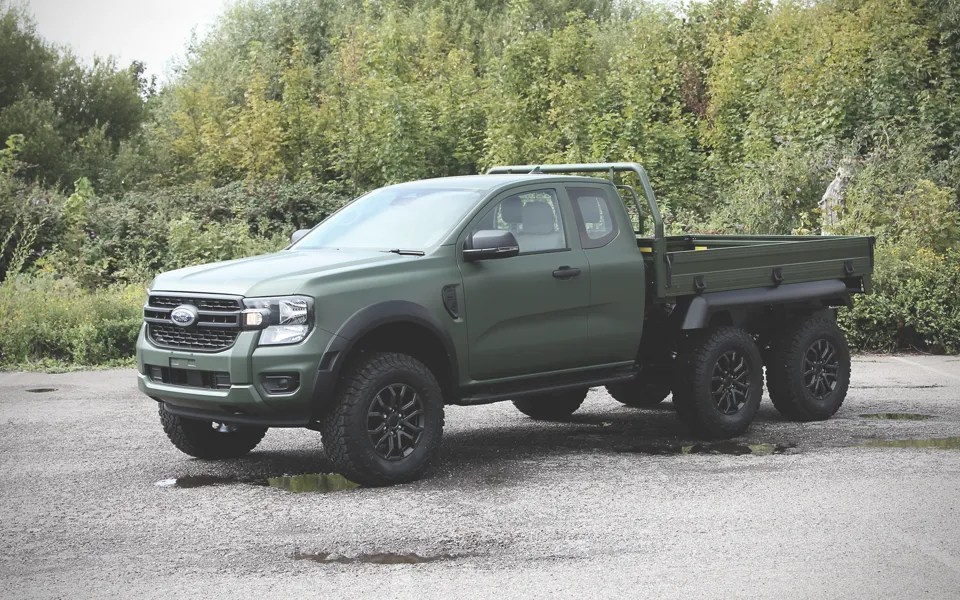
My first thought is that it looks the ultimate technical.
These two paragraphs introduce the vehicle.
Ricardo, a global strategic, environmental, and engineering consulting company, has developed the Ranger HEX, a 6×6 vehicle conversion designed to offer a significant improvement in payload of up to 3,800kg over the harshest of terrains. It comes with a hybrid drivetrain to maintain performance and improve fuel consumption.
This new conversion benefits from Ricardo’s expertise and experience in creating high quality, cost effective special vehicles for defence, security and utility applications. The vehicle will benefit from enhanced levels of capability, robustness and availability.
These three paragraphs describe the design.
The HEX solution differs from conventional conversions as it has been conceived as an overlay bolt-on system that does not require any alteration of the Ford Ranger base vehicle, which is Europe’s number one commercial pick-up platform. This ensures that the base vehicle retains all the robustness and quality of the standard vehicle and allows the system to be removed and re-installed on a different vehicle.
An electric rear drive system has been adopted that uses a production Ford drive unit to provide up to an additional 210kW of power, over and above the class leading 186kW of power from the existing 3.0L V6 diesel engine. The De Dion rear suspension design is not only weight efficient and robust but also provides better wheel control for improved traction and ride. In addition, the De Dion arrangement decouples the suspension and drive systems to allow a range of drive units to be used or deleted for a cost-effective 6×4 variant with maximum payload using an undriven ‘lazy’ axle.
The electric drive is designed as a self-contained through-the-road hybrid system. Braking energy is harvested under deceleration to charge the battery pack. This energy is then used to provide electric torque under acceleration to mitigate the usual drop in performance whist carrying a high payload. A selection of battery capacities are available, depending on customer requirements. All high voltage components are contained within a single integrated enclosure for safety and ease of maintenance and repair.
Note.
- The conversion would appear to bolt on to the standard Ford Ranger base vehicle.
- The vehicle has regenerative braking.
- It has a payload of 3.8 tonnes.
- It appears to have a very sophisticated rear suspension.
- Judging by the colour and the mention of the word defence in the article, I suspect this vehicle has been initially designed for a military application.
- Over 300,000 Rangers were sold worldwide in 2021.
- In the UK, it looks like a Ford Ranger will cost around £30,000 excluding VAT.
In addition I’ve read in this article on Autoweek that, the conversion itself has been designed as an overlay bolt-on modification that requires no alterations to the base vehicle, even preserving its existing warranty.
I have my thoughts.
Applications
The press release talks about high quality, cost effective special vehicles for defence, security and utility applications.
Use your imagination!
Perhaps.
- It is going to be used as the ultimate technical by the Ukrainians.
- A missile manufacturer has a system, that weighs around 3.5 tonnes and needs a launch vehicle.
- The RNLI needs an affordable vehicle to launch lifeboats from the beach.
- It is going to be used as rough terrain ambulance.
- It would make an excellent towing vehicle.
With all the problems in Morocco and Libya at the moment, it has been launched at the right time.
Zero-Carbon Operation
I believe that a zero-carbon version is essential. Especially, as the sub-heading mentions sustainable defence mobility.
The easiest way to achieve this would be to run on HVO or some form of biodiesel.
I suspect between them Ford and Ricardo have enough knowledge to create a hydrogen powered version.
Are There Autonomous Ford Rangers?
Google says, “Yes!”
This article on foresttech is entitled Ford Ranger Goes Fully-Autonomous, where this is said.
An Australian mining group has advanced the future of mobility (in mining at least) with the deployment of a fleet of fully-autonomous Ford Rangers at one of its mines.
Fortescue Metals Group has retrofitted four Rangers at its Christmas Creek mine in Western Australia with autonomous systems created by the company’s Technology and Automation team, to remove the need for fitters to make around 12,000 28-kilometre round trips each year to collect equipment and parts.
Of course, it’s not quite as ground-breaking as it sounds: mining operations don’t need to deal with road rules, pedestrians or many other vehicles, which hugely complicate the matter. Nevertheless, it’s still impressive.
Three applications suggest themselves.
- Delivering supplies in a disaster zone, after an earthquake, flooding,, landslide or volcanic eruption.
- Delivering supplies, including ammunition on a battlefield.
- Moving supplies along a long linear construction site, like a new railway or road.
Note.
In all three applications, six-wheel drive will be important, if ground conditions are bad.
- Could Fortescue Metals Group be behind this project?
- Disasters seem to be getting more common.
- Autonomous battlefield delivery must be safer for personnel.
I suspect there will be agricultural applications of an autonomous vehicle.
Toyota Unveils Prototype Hydrogen Fuel Cell Hilux
The title of this post, is the same as that of this article in The Engineer.
This is the sub-heading.
Toyota has today (September 5, 2023) unveiled a prototype hydrogen fuel cell-powered Hilux at Toyota Manufacturing UK’s Burnaston car plant in Derby.
This is the first paragraph.
The pick-up has been developed in a joint project with consortium partners Ricardo, ETL, D2H Advanced Technologies and Thatcham Research. and funding from the government via the Advanced Propulsion Centre (APC).
It would appear to be a consortium of some of the important great and good of British automobile engineering.
- Ricardo are a well-respected environmental and engineering consultancy, who probably know more about powering vehicles, than most companies have forgotten.
- Thatcham Research is the motor insurers’ automotive research centre.
- The Advanced Propulsion Centre collaborates with UK government, the automotive industry and academia to accelerate the industrialisation of technologies.
To my mind, the great advantage is that they are starting with a vehicle that has a formidable reputation.
When I outlined, the product to a friend, who had owned vehicles of this type, his reply was “Wow!”
Points from the article include.
- The expected driving range is more than 365 miles.
- The project began in early 2022 with a feasibility study undertaken by TMUK and Toyota Motor Europe with the consortium partners.
- Design and development started at July 1, 2022.
- Prototype construction began on June 5, 2023.
- The first vehicle was completed in three weeks.
- Ten preproduction examples will be produced before the end of the year.
- Ricardo supported preparations for the prototype build and will undertake complete evaluation of the vehicle over the coming months.
- Thatcham Research supported the project through the provision of sustainable repair consultancy and the preparation of hydrogen training for the repair market.
On paper, it looks like the consortium have taken an extremely useful vehicle and updated it for the 21st century.
Inly time will tell, if the design is right.
I have a few questions.
What Is The Towing Performance?
In my experience, many owners will want to tow heavy trailers, horse boxes or portable cafes and toilets for events like music festivals and agricultural and country shows.
If the towing performance matches that of a diesel Hilux, Toyota will probably have got it right.
How Many Miles Does The v Average Small Builder Or Smallholder Do In A Week?
Toyota must know this from servicing records of the diesel HiLux fleet.
I would suspect for many, 365 miles would allow a weekly or twice weekly refuelling!
Where Would Owners Refuel Their Hydrogen-Powered HiLux?
I suspect that Toyota dealerships Selling Hydrogen-Powered HiLux and Mirai, would make their own arrangements.
Would A Hydrogen-Powered HiLux Help To Decarbonise Work Sites?
I suspect it would and the electrical system could probably be used to power and charge small electrical tools.
Would A Hydrogen-Powered HiLux Be An Ideal Farm Runabout?
I am thinking about a friend of mine, who is a Suffolk farmer, who farms rare breed sheep.
He uses a big pick-up to tow a large trailer to take the sheep to market and shows and to move them around the country to other breeders. He has in the past used a golf buggy to check on his flocks and help with the welfare of the animals.
Some of his sheep are raised on the saltings, which gives them a unique flavour, but does involve the occasional accident, and sometimes needs a tricky recovery.
I spoke to him last night and he will be looking at this Toyota. His current vehicle does tend to frighten the sheep as it is too noisy.
Would A Hydrogen-Powered HiLux Work Well In Hot Countries?
The current HiLux is built in South Africa and those for Europe were generally made there.
So I would expect some African examples could have been made there.
Some hydrogen fuel cells need to be cooled, so would this be a problem in hot countries?
On the other hand , it does seem that hydrogen production in hot countries, with all that sun, might not be a problem.
Would A Hydrogen-Powered HiLux Make A Good Technical?
Diesel HiLux are popular as technicals and I suspect that the hydrogen-powered HiLux will be just as good.
Although the low-down mounting of the hydrogen tanks may make them susceptible to landmines.
Why Is It Not Called A HyLux?
I couldn’t resist asking that.
Conclusion
I like the hydrogen-powered HiLux and feel it will be a winner.
Is This The Way We’ll Drive Hydrogen-Powered Vehicles?
In Hydrogen Business Model / Net Zero Hydrogen Fund: Shortlisted Projects Allocation Round 2022, I listed all the hydrogen electrolyser projects on the shortlist for Government funding, if they pass the due diligence.
One project is from two companies H2 Energy and Trafigura, who are building a business model in West Wales, where you lease a hydrogen-powered truck for the same price as a diesel truck. You only pay for the miles you drive.
Their business model is explained in this must-watch Youtube video.
Consider.
- Hydrogen-powered vehicles have a long range.
- Fuelling time would be short compared to charging an electric truck.
- Are hydrogen-powered vehicles easy and low-cost to service?
- Cost of driver would be the same for operators.
- Would it be easier to recruit drivers for a hydrogen fuel-cell truck?
- Would cleaning costs be less for a hydrogen fuel-cell truck?
- Do the trucks come with sophisticated route planning software to cut mileage?
But as the video states, the upfront cost of the vehicle is higher.
I suspect the companies have driven the prices down, so that everybody gets an acceptable deal.
I wish the two companies all the best in their venture.
As I used to be half-owner of a vehicle leasing company, I feel that if the two companies can make a success of this hydrogen-powered truck leasing business, then I feel the model could be applied to the leasing of hydrogen-powered cars and other vehicles.
It could be a new way to buy your car.
SSE Becomes First Utility To Trial First Hydrogen Fuel Cell EV Van
hydrThe title of this post, is the same as that of this article on Hydrogen Central.
This is the first two paragraphs.
The low-carbon energy infrastructure company will be the first utility to trial the hydrogen-powered vehicle – and the first to put it to the test in real-life fleet operations by deploying the vehicle with SSE engineers.
The project will enable First Hydrogen’s team to gather data on fuel consumption, usage, and efficiency. The trials are being used to inform development of First Hydrogen’s Generation II series, currently in development, and will help enhance Total Cost of Ownership (TCO) data.
The deployment will take place in Aberdeen, as the city has some of the UK’s best hydrogen infrastructure.
The Mayor of London please note how being a hydrogen denier causes London to have more pollution.
Rolls-Royce Considering Switching From BEV To Hydrogen For Future Models
The title of this post, is the same as that of this article on INSIDEEVs.
This is the sub-heading
The luxury carmaker’s CEO rules out hydrogen combustion, but fuel cells are on the table.
This is the first paragraph.
Rolls-Royce is considering ditching all-electric powertrains in favor of fuel cell technology for its future zero-emissions models once the technology is mature enough and can be scaled to meet its demands, according to Autocar, quoting the luxury car brand’s CEO, Torsten Müller-Ötvös.
As the Rolls-Royce Spectre has a kerb weight of almost three tonnes, I suspect that the handling might make someone like Alec Issigonis, Colin Chapman or Stirling Moss have a good laugh.
But the smaller battery that the fuel cell technology would require, might give a better balance between acceleration, handling and performance.
It would be good fun to model the dynamics of such a heavy car.
I do think though that it is these dynamics, that have suggested a move to hydrogen.
Or Torsten Müller-Ötvös, may have made the statement to find out, what the sort of people, who would buy this car, might think!
Vauxhall-Maker Says UK Needs To Change Its Brexit Deal
The title of this post, is the same as that of this article on the BBC.
This is the sub-heading.
One of the world’s biggest carmakers has called on the government to renegotiate part of the Brexit deal or risk losing parts of its car industry
These four paragraphs explain the problem.
Stellantis, which makes Vauxhall, Peugeot, Citroen and Fiat had committed to making electric vehicles in the UK.
But it has now said it is no longer able to meet Brexit trade rules on where parts are sourced.
The government is “determined” that the UK will remain competitive in car manufacturing, a spokesperson said.
Stellantis called on the government to come to an agreement with the EU to keep rules as they are until 2027.
Because, there is not enough battery capacity in the UK and possibly the EU, everything has gone pear-shaped.
I think there are three possible solutions.
- Build more battery factories.
- Change the regulations.
- Develop hydrogen internal combustion engines.
Note.
- Could a battery factory be built fast enough? I doubt it!
- Could the regulations be changed? Possibly!
- Could hydrogen internal combustion engines be developed quickly enough? Ask Cummins, JCB, Ricardo and Toyota.
It is highly likely that there will be much higher demand for batteries, than anybody expects, as innovators develop more applications.
Electric Cars Are A Dead End!
When you introduce any product to the general population, you must think of all the consequences.
I found these statistics on the RAC Foundation web site.
There were 33.2 million cars (81.3 per cent), 4.63 million LGVs (11.3 per cent), 0.54 million HGVs (1.3 per cent), 1.46 million motorcycles (3.6 per cent), 0.15 million buses & coaches (0.4 per cent) and 0.84 million other vehicles (2 per cent) licensed at the end of September 2022.
Could anybody please tell me how the average guy or gal, who owns one of those 33.2 million cars is going to be able to afford to replace it, find a convenient place to park and charge it and go and visit their mum in say Scunthorpe from Plymouth?
We are going down a massive dead end!
The only sensible alternative is internal combustion engines running on hydrogen, many of which could be converted from existing diesel engines.
But only a few councils have a hydrogen policy, with the biggest disgrace being London, where the Mayor’s hydrogen policy, is to ignore it and hope it will go away.London has an air quality problem, which is not helped by large numbers of HGVs in the centre.
The technology exists to convert HGVs to hydrogen and it would be possible to insist that all vehicles over a certain weight were zero-carbon. But as London has no plans for hydrogen, it can’t happen.
Vote Hydrogen for Mayor in May 2024, to improve London’s air quality.
Notes.
- To replace 33.2 million cars with electric ones would cost 1660 billion pounds, assuming each electric car costs fifty grand.
- As most electric cars are not made in the UK, what would happen to our balance of payments?
- On average an electric car needs 63 kilos of lithium for its battery, so 33.2 million will need over two million tonnes of lithium.
First-Of-Its-Kind Electriq Powder Manufacturing Plant To Be Built In Amsterdam
The title of this post, is the same as that of this article on Hydrogen Fuel News.
This is the sub-heading.
The powder plant can provide a safe end-to-end hydrogen solution.
The home page of their web site has this bold statement.
Meet the Safe & Practical Hydrogen Powder
Underneath is this explanation.
Electriq is a hydrogen carrier that acts like coffee powder for a coffee machine – simplifying storage, transport, and use of hydrogen in off-grid applications and long-term storage.
Similar processes have been proposed for hydrogen in the past, but no-one has compared them to coffee before.
This Technology page gives a lot more details.
These two paragraphs outline the chemistry used.
Electriq’s Fuel and Release technologies turn hydrogen into a coffee-like powder form, then back into electricity through a proprietary catalyst and release system.
Our hydrogenation process reacts hydrogen gas with KBO2 to produce a powdery coffee-like compound (KBH4), ready for easy storage and transportation. Our dehydrogenation process releases the hydrogen – and KBO2 as a by-product – thus forming a full cycle.
The Electriq Release system uses a proprietary catalyst to release hydrogen from the Electriq Fuel, after mixing it with water. The dehydrogenation (release) process provides fuel-cell grade hydrogen and zero-emissions electricity.
Note.
- KBO2 is a chemical compound formed of one potassium, one boron and two oxygen atoms.
- KBH4 is a chemical compound formed of one potassium, one boron and four hydrogen atoms.
- As is with often the case with these processes, It appears that there may be a clever catalyst doing some hard work.
The Technology page finishes with a comparison with other methods of transporting hydrogen.
This Press & Insights page has more information on the company and some interesting videos.
It would certainly be something new, if you filled up your electric bike with a canister of dry powder.
But they have a video of that!
Racing Towards A Green Future
The title of this post, is the same as that of this article on Ricardo.
This is the first paragraph.
While Formula E and its sibling electric race series, Extreme E and RX2e, are burnishing battery-powered vehicles credentials, motorsport from Formula 1 down is actively pursuing how traditional internal combustion engine (ICE) race and rally cars can be made more environmentally acceptable.
The article, which is a must-read, then describes the various routes and options, that motorsport is taking towards zero-carbon.
The article finishes with this paragraph.
While motorsport technology can, and does, transfer to production cars, especially in the higher echelons, whether the path it is beating on AS fuels will convince legislators that battery electric vehicles are only an answer rather than the answer remains to be seen.
I believe that when an affordable small hatchback powered by hydrogen hits the road as it inevitably will, it will have Ricardo’s fingerprints all over it.
Birmingham Plays The Green Card
This article in The Times today is entitled Birmingham Airport Set For Hydrogen Take-Off.
These two paragraphs introduce the article.
Birmingham Airport aims to become the first in Britain to operate commercial zero-emission hydrogen-fuelled flights — and by as early as 2025.
The ambitious goal follows the signing of a partnership with the British start-up ZeroAvia whose first trial flight of a 19-seater passenger aircraft powered by hydrogen fuel cells took place last month.
Other points from the article include.
- ZeroAvia is also working with Rotterdam Airport.
- Initially, it is likely that the hydrogen-powered aircraft will be used for cargo.
- The government wants all UK domestic flights to be zero-carbon by 2040.
- Birmingham wants to be zero-carbon by 2033.
- ZeroAvia has received upwards of £20 million of matched-taxpayer funding.
- It has some big backers and well-known airlines, who have placed orders.
These are my thoughts.
ZeroAvia’s Airliners
This paragraph from The Times article describes their first two aircraft.
ZeroAvia is retrofitting turboprops, 19-seater Dornier and in future 80-seater De Havilland Canada Dash 8-400s, with tanks of hydrogen which is converted by fuel cell stacks to energy taken to electric motors that power the propellers. The only emission is water. It is talking to potential new-entrant airframe makers to build all-new hydrogen aircraft of the future.
Note.
- The Dornier 228 is a 19-seater airliner of which over three hundred have been built.
- The de Havilland Canada Dash 8-400 is an 80-seater airliner of which over six hundred have been ordered and over 1200 of all marques of Dash 8s have been built.
Both are workhorses of the smaller airlines all over the world.
As the paragraph from The Times indicates the power system is not conventional, but then most of this new breed of small electric/hydrogen/hybrid airliners have electric propulsion. I suspect that there’s been a marked improvement in the design and efficiency of electric motors.
Electric propulsion should have a substantial noise advantage over turboprops.
ZeroAvia are also retrofitting their two chosen airliners.
This offers advantages in the certifying of the airliners. Providing the changes made to the airframe are not significant, the various certifying authorities in the UK, US and EU will allow previous certification to be carried over.
This means that ZeroAvia only have to thoroughly test and certify the powerplant and its integration into the aircraft.
One of their competitors, the Eviation Alice is a completely new airframe with battery-electric power, so I suspect this aircraft will take longer to certify.
I think ZeroAvia have used this shorter certification time to aim to get their airliners in service first.
Those that don’t win, don’t get the same fame.
Hydrogen At Birmingham Airport
Hydrogen will be needed at Birmingham Airport to refuel ZeroAvia’s airliners.
But will hydrogen also be used on the airside to power some of the heavy vehicles you see on airports.
Look at this page on the Hawaii Technology Development Corporation, which shows a Hydrogen Fuel Cell U-30 Aircraft Tow Tractor. The specification indicates, that it can tow a C-17 or a Boeing 747.
I wouldn’t be surprised to see Birmingham Airport build their own electrolyser nearby both to supply hydrogen-powered aircraft and decarbonise the airside.
To And From Birmingham Airport
Consider.
- Birmingham Airport is connected to Birmingham International station by a free AirRail Link.
- Birmingham International station has an impressive number of services, many of which are electric.
- There will be a people mover to connect to Birmingham Interchange for High Speed Two.
- Birmingham Interchange will have five trains per hour (tph) to and from London, taking under forty minutes.
- There are plans to extend the West Midlands Metro to the airport, with journeys taking thirty minutes from the City Centre.
- Birmingham Airport is at the centre of the UK’s motorway network.
Most public transport to Birmingham Airport will be zero-carbon and the percentage that is will increase.
A Green Air Bridge To Ireland
Currently the fastest services between London and Birmingham International station take a few minutes over the hour.
But after High Speed Two opens, the service will improve.
- High Speed Two will take under forty minutes.
- There will be five tph.
- High Speed Two will connect to the Elizabeth Line and the London Overground at Old Oak Common station.
- Euston station will have better connectivity to the Underground.
This diagram shows High Speed Two services.
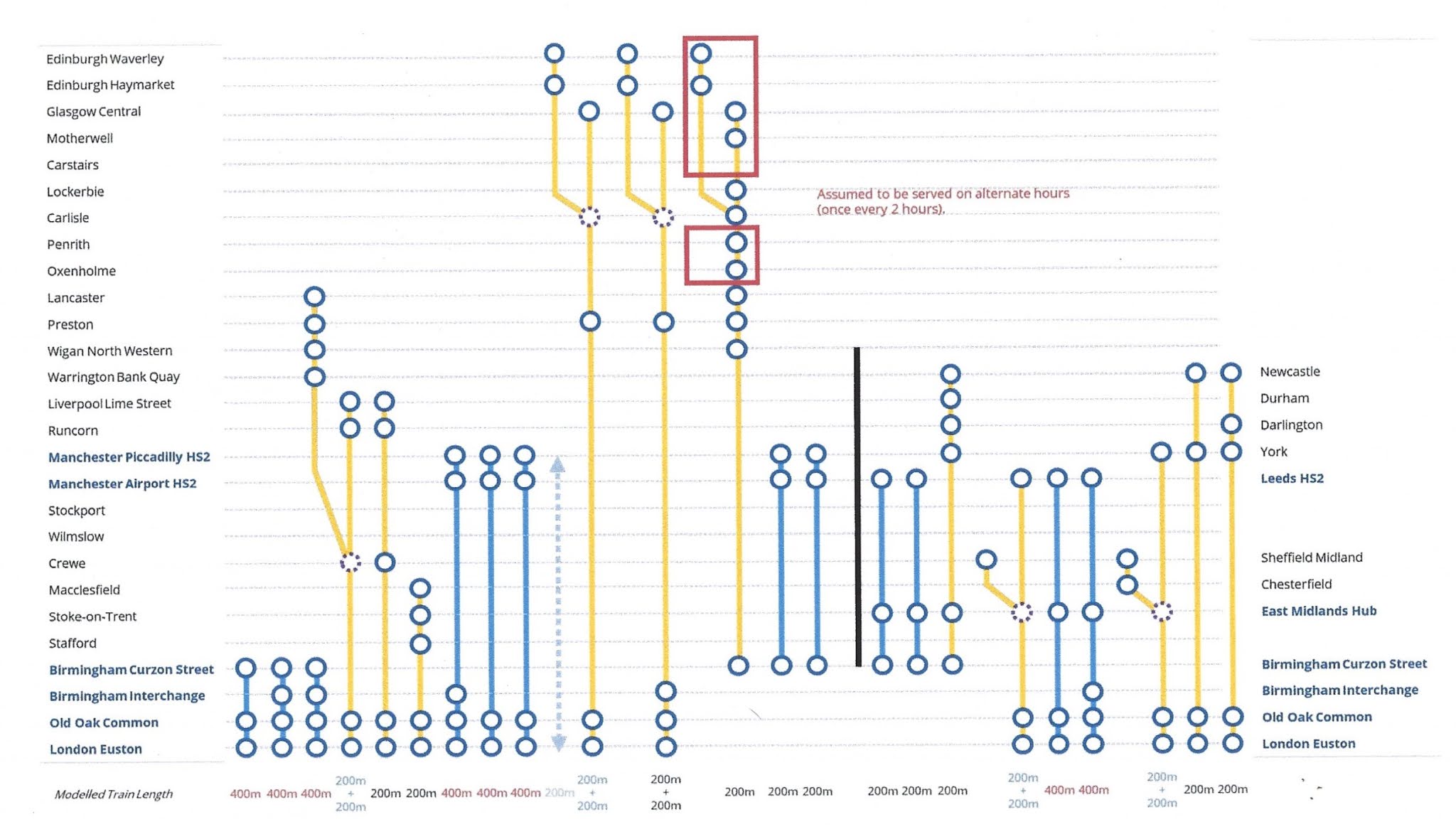
Consider.
- Birmingham Interchange has good connections in the North.
- I can see that Birmingham Airport could start to attract lots of passengers going between the islands of Great Britain and Ireland.
- And don’t forget Cardiff, Swansea, Exeter, Isle of Man and New Quay.
- Could Birmingham-Dublin and Birmingham-Belfast be run as frequent shuttles?
- Will there be AirRail tickets between Euston and Belfast and Dublin?
I also wonder if zero-carbon travel will attract passengers?
Zero-Carbon Air Cargo At Birmingham Airport
This article on Railway Gazette is entitled Varamis Rail Launches Regular Express Light Freight Service.
These three paragraphs outline the service from Varamis Rail.
Varamis Rail has launched a 160 km/h express freight service between Glasgow and Birmingham International using a converted electric multiple-unit.
The service is targeted at express parcels and third-party delivery companies seeking next day delivery of consumer goods.
Consignments arriving at the Glasgow hub by 17.30 from Monday to Friday can reach Birmingham at 23.00, with northbound freight arriving at the Birmingham site by 23.00 reaching Glasgow at 05.30 the next morning.
I think this service would interface well with cargo planes operating overnight from Birmingham Airport.
It seems to me, that Spokes at Speke could be reborn at Birmingham.
Conclusion
Birmingham Airport seems to be positioning itself to take advantage of aviation’s new breed of planes.

