How To Keep The Lights On When The Wind Doesn’t Blow
The title of this post, is the same as that of this article in The Times.
This is the sub-heading.
Britain came close to a blackout this month. Gas is being phased out and renewables are intermittent, so can energy storage stop us going dark?
These are the first two paragraphs.
It was 8.29pm on the first Tuesday in January when the alert was issued by the electricity control room. Freezing temperatures had coincided with unusually low wind speeds, and it was making the National Energy System Operator (Neso) jittery.
Engineers forecast a 1.6GW shortfall — the requirement for about 1.5 million homes — for a three-hour period from 4pm the following afternoon. “System operators are requested to notify Neso of any additional megawatt capacity,” the message said.
Luckily, the plea worked.
The article then goes on to describe the various technologies that are being deployed.
The article starts by talking about pumped storage hydroelectricity.
This paragraph gives a superb illustration about how things have changed in energy and energy storage in the UK in the last few decades.
In the past, when coal provided the bulk of British power, this system was used to meet fluctuating demand levels. But now it is also required to meet fluctuating supply levels from renewable sources. Martin Pibworth, chief commercial officer at SSE, started with the company as a trainee in 1998. “Back then, at our Foyers pumped storage plant [at Loch Ness] we would switch modes, from pumping to not pumping and back again, maybe 600 to 700 times a year. Last year we switched modes there 6,500 times. It’s an insight into how the market has changed and how much more flexibility is needed, and how responsive that has to be.”
We have to be more agile, with our handling of storage to back up the various methods of generation.
US DOE Offers US$1.76 billion Loan To Hydrostor For A-CAES California Project
The title of this post, is the same as that of this article on Energy Storage News.
These three paragraphs give more detail.
The US Department of Energy’s (DOE) Loan Programs Office (LPO) has made a conditional commitment for a loan to long-duration energy storage (LDES) developer and operator Hydrostor of up to US$1.76 billion.
If finalised, the loan would be used to help fund the Willow Rock Energy Storage Centre, a 500MW/4,000MWh, 8-hour advanced compressed air energy storage system (A-CAES) in Eastern Kern County, California, led by Hydrostor subsidiary GEM A-CAES.
Compressed air energy storage (CAES) charges by pressurising air and funnelling it into a storage medium, often a salt cavern, and discharges it by releasing the compressed air through a heating system, which expands air before it is sent through a turbine generator.
Note.
- Both the Canadian Hydrostor and the British Highview Power use air in their batteries, with the Canadians using compressed air, often in salt caverns and the British using liquid air in tanks.
- Highview Power’s first large scale battery will be 200MW/2.5GWh, which is about half the size of Hydrostor’s, which will be 500MW/4.0GWh.
- Having mathematically-modeled large tanks full of chemicals in the 1970s for ICI, I wouldn’t be surprised, if the Highview Power battery is more easily scalable.
This could be an interesting technological shootout.
Complicating matters could be Trump’s policies to big batteries.
This article on Utility Dive, which is entitled Potential Trump Policies Pose Risks For US Storage Sector, With Musk Impact Uncertain.
Analysts Say Gives A Reasoned.
Higher battery material tariffs and phased-down IRA tax credits threaten a 15% drop in U.S. storage deployment through 2035 in a “worst-case” scenario,
BNEF analysts said.
Out Of Thin Air: Solving The Dilemma Of Long-Duration Storage
The title of this post, is the same as that of this excellent article on the Australian Financial Review.
This is the sub-heading.
Two first-of-a-kind technologies in Australia are firming up as options to crack the tough nut of energy storage that lasts much longer than batteries.
This is the first paragraph.
Two competing technologies that use different forms of air to store energy are emerging as potential solutions for the thorny problem of long-duration storage needed to smooth out Australia’s bumpy transition to low-carbon energy.
The article then compares the two competing technologies.
- Hydrostor of Canada are developing the 200 MW/1600 MWh Silver City Energy Storage Centre at Broken Hill in New South Wales.
- Highview Power of the UK are proposing a 12-hour energy store for the Northern Territory.
Australia certainly has plenty of solar power to fill the energy storage.
First Offtake Deal Signed For 500MW/4,000MWh Advanced Compressed Air Energy Storage Project In California
The title of this post, is the same as that of this article on Energy Storage News.
These three paragraphs explain the deal.
Advanced compressed air energy storage (A-CAES) company Hydrostor has signed a power purchase agreement (PPA) for one of its flagship large-scale projects in California.
Central Coast Community Energy, one of California’s several dozen Community Choice Aggregator (CCA) non-profit energy suppliers, has signed a 200MW/1,600MWh energy storage PPA with a 25-year term with Toronto-headquartered Hydrostor for its Willow Rock Energy Storage Center.
That’s just under half of the output and capacity of the planned 8-hour, long-duration energy storage (LDES) facility, which is designed to be 500MW/4,000MWh. This is its first offtake deal, but the company is in discussion for others to take the rest of the plant’s available resource.
The article says that Hydrostor aim to have the plant online by 2028.
This segment describes their current projects.
It is currently working on large-scale projects with around 9GWh storage capacity in total across two sites in California as well as another in Australia.
Together with Willow Rock in Kern County, Hydrostor is developing the 400MW/3,200MWh Pechos Energy Storage Center in San Luis Obispo County, California, and the 200MW/1,500MWh Silver City Energy Storage Center in Broken Hill, New South Wales, Australia.
On its UK Projects page, Highview talks about a 200MW/2.5GWh facility in Yorkshire, which puts the two companies in similar markets, with Hydrostor appearing to have slightly larger systems under development.
Conclusion
It will be interesting to see how this technology progresses and which company does best in what is a very large energy storage market.
Longer Duration Energy Storage Demonstration Programme, Stream 1 Phase 1: Details Of Successful Projects
The title of this post, is the same as that of this document from the UK Government.
This is the introduction.
Stream 1 aims to accelerate commercialisation of innovative longer duration energy storage projects through to actual demonstrations. During Phase 1, projects will be expected to mobilise their proposed technologies to prepare for potential deployment on the UK energy system.
These are the projects.
Ballylumford Power-to-X
This is the description of this project in Northern Ireland.
B9 Energy Storage will receive £986,082 to mobilise a 20MW membrane free electrolyser green hydrogen project. Using otherwise curtailed wind power, hydrogen produced will be stored in local underground salt caverns for later use as a fuel in transport and electricity sectors, creating a full-cycle hydrogen economy (production, storage, distribution and usage) on site.
Note.
Ballylumford power station is a 600 MW gas-fired power station, that provides half of Northern Ireland’s electricity.
A 20 MW electrolyser will produce just under nine tonnes of hydrogen per day.
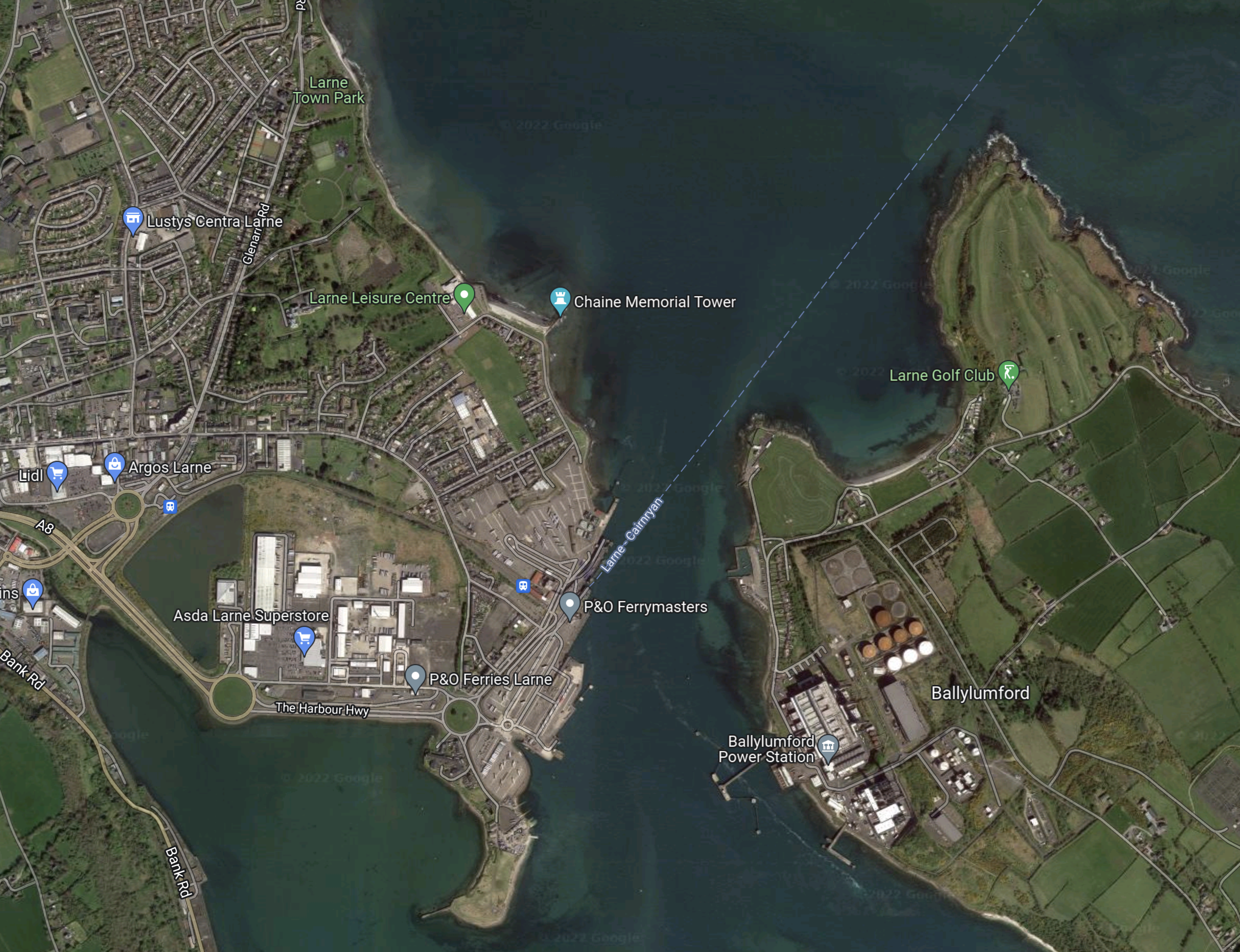
This Google Map shows the location of the power station opposite the port of Larne.
Note.
Ballylumford power station is clearly visible to the East of the channel towards the bottom of the map.
Ballylumford is also the Irish end of the HVDC Moyle interconnector from Scotland, which has a capacity of 500 MW.
Ballylumford would appear to have enough power for a large electrolyser.
Salt Beds In Northern Ireland
This document on the British Geological Survey web site is entitled Geological Storage In Northern Ireland.
The document discusses Irelands energy needs and gives a good description of using compressed air energy storage in salt caverns.
Then these two paragraphs describe the salt bed in Northern Ireland compare them to other deposits under Great Britain.
Thick halite deposits, found both onshore in Northern Ireland and immediately offshore in the North Channel, offer potential for salt cavern storage facilities. The salt deposits occur as bedded deposits with minor halokinesis (geological movement of salt) forming salt swells rather than pillows or domes so that the height of any cavern may be restricted by bed thickness. Pure salt beds tend to be thin (approximately 100-250 metres maximum thickness) compared to those used elsewhere and the presence of significant insoluble impurities and minor intrusive dolerite dykes or sills may reduce their suitability.
The Larne and Carrickfergus area of County Antrim is the only part of the whole island where thick salt beds occur. Elsewhere in the UK parts of Cheshire, Lancashire, Teesside, Humberside and Dorset have similar, or thicker, developments of salt beds and gas storage facilities are either in construction, or are already in operation.
It would appear that the thick salt beds in the Larne and Carrickfergus area could be suitable for gas storage.
Ballylumford might actually be on top of the salt beds, as Carrickfergus is a few miles to the South.
On a personal note, I used to work for ICI Mond Division and during that time and immediately afterwards, I met many people, who had been into the salt mines and worked with boreholes extracting the salt and the one thing everybody said about the salt mine, was that water must not get in.
Membrane-Free Electrolysis
I saw this in operation when I worked at ICI Mond. Most of their hydrogen and chlorine was produced using the main Castner-Kellner process at Castner-Kellner works in Runcorn. That is a nasty process that uses a lot of mercury, which got into the air and plant operators’ bodies.
But ICI also had a much smaller plant, where they used simple electrolysers, that had a metal cell, with a concrete top, with the anode and cathode going through the concrete into the brine. I seem to remember that its main purpose was to provide mercury-free hydrogen, chlorine and sodium hydroxide. I can remember seeing workers rebuilding the cells, as was done on a regular basis.
These were membrane free electrolysers and had been running successfully for many years.
Searching the Internet for “membrane free electrolyser” I found a company in Doncaster called CPH2.
The home page on their web site declares
Clean Power Hydrogen are the manufacturers of the unique Membrane-Free Electrolyser
Turning to the About page, this is said.
Being passionate about hydrogen as clean energy for the future, we wanted to find an alternative to PEM electrolysers as these had barriers to adoption. We realised that the cleanest way to produce hydrogen was by membrane-free water electrolysis, and in doing so, it would be a less expensive and more robust technology.
Dr. Nigel Williamson and Joe Scott established CPH2 (Ireland) in 2012 with the ambition to help clean up the environment for our children and future generations. Entering the green technology sector; a high growth and profitable market, they developed a Membrane-Free Electrolyser™ to produce hydrogen faster, more reliably, and more cost-effectively than other electrolysers.
They also have the ambition to be leading developer and manufacturer of green hydrogen technologies and an Irish connection.
My experience says that their technology will work. Especially, with the application of modern materials.
Have the Government backed the Ballylumford Power-to-X project, as they can back two promising technologies with one grant?
GraviSTORE
This is the description of this project.
Gravitricity Limited will receive £912,410.84 to design their multiweight energy store demonstrator project, which will store and discharge energy by lifting and lowering multiple weights in a vertical underground shaft.
Note.
- I like the Gravitricity concept and have invested through crowdfunding.
- The project will be based on a brownfield site in Northern England.
- Gravitricity’s current demonstrator in Edinburgh, which I wrote about in Gravitricity Celebrates Success Of 250kW Energy Storage Demonstrator, only uses a single weight, but this project talks about multiple weights.
According to other sources on the Internet, the demonstrator will have a storage capacity of 4 MWh and will be built on a brownfield site.
Will we see Gravitricity coming to a disused deep coal mine near you?
Long Duration Offshore Storage Bundle
This is the description of this project.
Subsea 7 Limited and FLASC B.V. will receive £471,760.00 to further develop the Long Duration Offshore Storage Bundle which will store energy as a combination of pressurised seawater and compressed air, using an innovative hydro-pneumatic technology.
Note.
- Subsea 7 Limited are a subsea engineering, construction and services company serving the offshore energy industry, domiciled in Luxembourg with headquarters in London.
- According to their web site, FLASC B.V. is a spin-off of the University of Malta, established in The Netherlands in 2019.
On the page on the FLASC web site, which is labelled The Technology, this is said.
FLASC is an energy storage device that can be integrated directly into a floating offshore platform. Energy is stored using a hydro-pneumatic liquid piston, driven by a reversible pump-turbine.
Charging Mode: electricity is used to pump water into a closed chamber containing pre-charged air.
Discharging Mode: the pressurised water is released through a hydraulic turbine to generate electricity.
FLASC leverages existing infrastructure and supply chains, along with the marine environment itself as a natural heatsink, resulting in a safe, reliable and cost-effective solution.
There is also this video.
The news page on the FLASC web site is a comforting read.
My knowledge of modelling vessel systems for chemical plants, tells my brain to like it.
Vanadium Flow Battery Longer Duration Energy Asset Demonstrator
This is the description of this project.
Invinity Energy Systems will receive £708,371 to demonstrate how a 40 MWh Vanadium Flow Battery could deliver long duration storage-enabled power on demand from UK-based solar generation.
Note.
- I wrote about Invinity Energy Systems in UK’s Pivot Power Sees First Battery On Line By 2021.
- Invinity Energy Systems was formed by a merger of RedT and Avalon Battery.
- The project appears to be located at Bathgate in Scotland.
This picture from EdF shows a large vanadian flow battery.
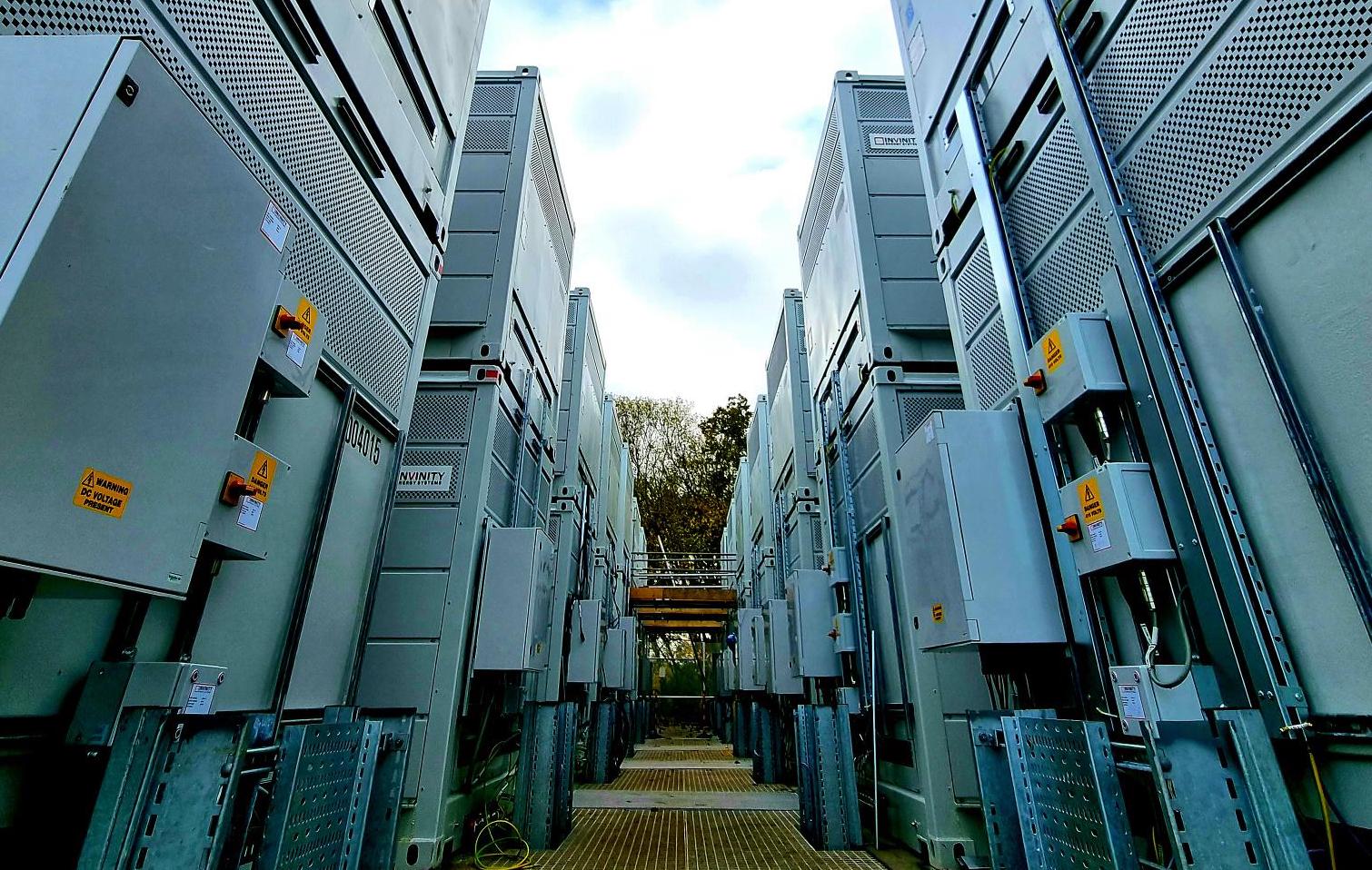
Invinity Energy Systems flow battery at Energy Superhub Oxford
If this project works out, vanadium flow batteries would be a good replacement for lithium-ion batteries.
Cheshire Energy Storage Centre
This is the description of this project.
io consulting will receive £1 million to enable its consortium to develop an electricity storage facility which could use mothballed EDF gas cavities in Cheshire utilising Hydrostor’s Advanced Compressed Air Energy Storage technology
Note.
- This is another project based on salt caverns.
- I wrote about Canadian company; Hydrostor in Gigawatt-Scale Compressed Air: World’s Largest Non-Hydro Energy-Storage Projects Announced.
- Hydrostor have received at least one large order for their system.
I have put Hydrostor on my list of tecnologies that should make it.
Conclusion
This is a well-balanced list of projects.
I would rate success as follows.
- Ballylumford Power-to-X – 60 %
- GraviSTORE – 80 %
- Long Duration Offshore Storage Bundle – 60 %
- Vanadium Flow Battery Longer Duration Energy Asset Demonstrator – 70 %
- Cheshire Energy Storage Centre – 80 %
But then all these projects are a bit of a gamble
Goldman Sachs Invests $250 million In Hydrostor To Advance Compressed Air Energy Storage Projects
The title of this post, is the same as that of this article on pv Magazine.
This is the introductory paragraph.
The investment is planned to support development and construction of Hydrostor’s 1.1GW, 8.7GWh of Advanced Compressed Air Energy Storage projects that are well underway in California and Australia, and help expand Hydrostor’s project development pipeline globally.
It certainly seems that the big beasts of finance are starting to back innovative energy storage.
How Long-Duration Energy Storage Will Accelerate The Renewable Energy Transition
The title of this post, is the same as that of this article on Renew Economy, which is an Australian publication.
It is very much a must-read and although it was part-written by the President of Hydrostor, who are a Canadian long duration energy storage company, who store energy by compressing air in underground caverns.
The article gives some details on how investment is flowing into long duration energy storage.
We’re also seeing significant and sustained levels of investment in long-duration energy storage happen beyond Australia’s borders.
For example; Saudi Aramco Energy Ventures invested in Energy Vault to accelerate its global deployment of its energy storage solution; Bill Gates and Jeff Bezos invested in iron-flow batteries via Breakthrough Energy Ventures; Sumitomo Corporation invested in UK-start up Highview Power and their cryogenic liquified air storage system; and our team at Hydrostor closed a financing round including a strategic partnership with infrastructure investor Meridiam.
Big players like these, generally don’t back losers. Or at least they pour in more money and expertise, to make sure they succeed.
This paragraph also describes Hydrostor’s sale to Australia.
In 2020, Hydrostor’s 200 MW and 8 hours (or 1,600 MWh) A-CAES system was selected by New South Wales’ Transmission Network Service Provider, TransGrid, as the preferred option in its RIT-T process for reliable supply for Broken Hill.
They are also developing a large system in California.
With Highview Power having sold perhaps ten systems around the world, it does appear that long duration energy storage is taking off for Highview and Hydrostor, who both use that most eco-friendly of storage mediums – air.
The article is fairly scathing about developing more of the most common form of long duration energy storage – pumped storage using water. Especially in Australia, where water can be scarce. But with the world getting warmer, I don’t think we need to design systems, where all our stored energy can evaporate.
Conclusion
I agree very much with the writers of the article, that more long duration energy storage is needed, but that pumped storage is not the long term answer.
Gigawatt-Scale Compressed Air: World’s Largest Non-Hydro Energy-Storage Projects Announced
The title of this post, is the same as that of this article on Recharge.
This is the opening paragraph.
The two 500MW/5GWh ‘advanced’ compressed-air projects in California would each be bigger than the current record holder.
They are certainly not small. On the Electric Mountain scale of energy storage, they are both 55 %.
Both appear to be from Canadian company; Hydrostor and will be built in California.
This explanatory video is from the company.
It appears to be a rather elegant solution.
Like Highview Power, the system appears to be based on proven process technology, is zero-carbon, can be built almost anywhere and doesn’t require large amounts of land.
Hydrostor is definitely one to watch.
My only worry about both Hydrostor and Highview systems, is that countries, who don’t recognise patents and design copyrights could develop other systems based on similar physical principles.
So, What Exactly Is Long-Duration Energy Storage?
The title of this post is the same as that of this article on Greentech Media.
This is the sub-title.
Everyone’s talking about it, and Californians are buying in. Here’s what you need to know about this emerging grid sector.
It describes what California is doing and the sector, with particular reference to Hydrostor, Form Energy and Highview Power.
The article finishes with a section entitled What’s The Catch?
This is the first two paragraphs.
The obvious barrier to a thriving long-duration storage industry is convincing generally conservative power plant customers that emerging technologies quite unlike anything the grid currently uses are safe bets for decades of operation.
Lab tests can reduce the risk, but nothing beats operational, megawatt-scale installations for proving that something works. That’s why the Form deal with Great River Energy is so crucial, as are early projects by Highview Power and Hydrostor. The big exception to technology risk is pumped hydro, which has been used at scale for decades. Those projects grapple instead with high capital expense and environmental concerns.
The article is a must-read and hopefully, this and more articles like it, will convince conservative energy company owners, regulators and governments, that long duration energy storage is the missing link between renewable power and electricity consumers.
At least, the current UK Government has backed two of the most promising British long duration energy storage companies; Gravitricity and Highview Power.
Zinc8 Seem To Be A Surprisingly Open Company
Several energy storage companies, that I have looked at for this blog are secretive companies.
In The Mysterious 150-hour Battery That Can Guarantee Renewables Output During Extreme Weather, where I pointed at an online article of the same name, the secrecy is in the headline. Look at the web site of the company involved; Form Energy and it reminds me of a term used in the 1970s and 1980s to refer to non-existent software – vapourware. Or one of my older favourite phrases – All fur coat and no knickers.
I have developed disruptively innovative software and other products and understand, the need for secrecy. But there is a need for a balance between secrecy and information.
As an example, one of the products, I have highlighted here, could be ideal for one of the followers of this blog. They will be investigating the product, as I have found enough information to enable them to decide, that contacting the company will not be a waste of time.
Some companies in innovative energy storage development like Highview Power and Hydrostor have posted informative YouTube videos about their technology, but others just rely on the same endlessly repeated phrases.
When I looked at the Zinc8 web site, I thought they were another company dealing in the same phrases, as there are two on the home page.
- Zinc8 is redefining long-duration energy storage.
- The leader in zinc-air battery technology.
But they are a lot more open, than the home page might suggest.
Looking up zinc-air battery on Wikipedia, gives a lot of information, that is understandable. This is the introductory paragraph.
Zinc–air batteries (non-rechargeable), and zinc–air fuel cells (mechanically rechargeable) are metal–air batteries powered by oxidizing zinc with oxygen from the air. These batteries have high energy densities and are relatively inexpensive to produce. Sizes range from very small button cells for hearing aids, larger batteries used in film cameras that previously used mercury batteries, to very large batteries used for electric vehicle propulsion and grid-scale energy storage.
I instantly thought, if a technology can be both non-rechargeable and rechargeable and useable in applications from hearing aids to vehicle propulsion and grid-scale energy storage, the technology must have something. I also worked in a non-ferrous metals factory as a teenager and know that zinc is easy to handle.
I then looked at their technology page
- There is a detailed explanation of the technology.
- They stress their patents and certification.
- They show how a system can be expanded.
- They list the major technological advantages of the system. Robust, safe, scalable etc.
- They claim 20,000 operating life hours and 8+ operating hours.
They also finish off by giving an energy capacity cost of $45 per kWh.
I tend to think, that they have found a quirk in zinc-air technology, that they are exploiting, by some good old-fashioned innovative engineering.
I shall be watching Zinc8 and the other zinc-air battery start-ups.
 The Anonymous Widower