Kraft Heinz And Freight Innovation
In the UK, we certainly need to get more freight on to the railways.
Recently, KraftHeinz were involved in an experiment. A lot of their product currently comes into the UK in containers, which are then taken by road from the ports by truck.
This report about the experiment was on this page of the Modern Railway’s web site.
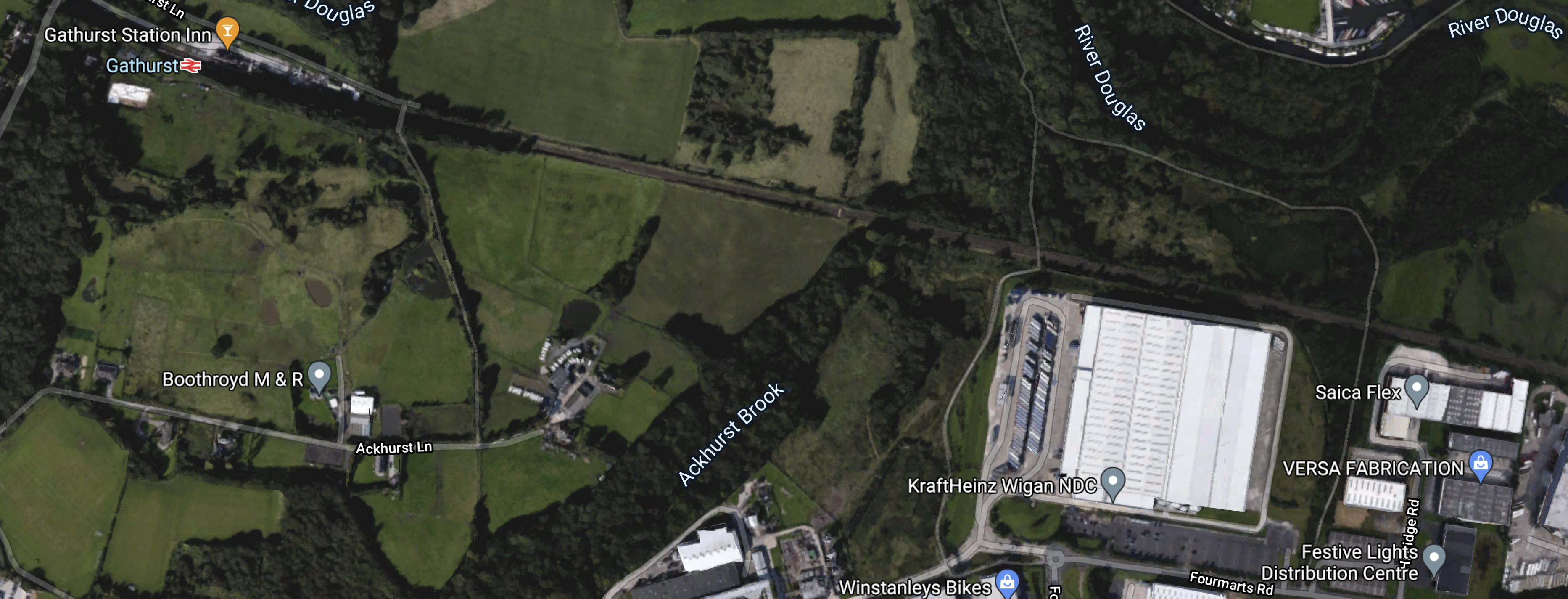
KraftHeinz’s distribution centre is in the Orrell district of Wigan, with the Wigan Wallgate to Southport route the closest railway line. The trial involved a container train that was sent from Crewe to the branch on an overnight working, with the notional offloading taking place from the running line close to Gathurst station. Also demonstrated was the feasibility of loco run round in this area. Network Rail signallers helped ensure the success of the trial by facilitating the use of a crossover at Parbold station for the run round (some signal alterations would be likely if this became a regular operation).
This Google Map shows the area.
Note.
- Gathurst station is in the North-West corner of the map.
- The KraftHeinz Distribution Centre is in the South-East corner of the map.
- The Wigan Wallgate and Southport Line runs between the two.
It was all very convenient for some intense night work.
I have some thoughts.
Where’s The Siding?
Years ago a lot of factories and distribution centres like this, would have had a siding.
Many have been sold off and built over, as many companies preferred to use road transport.
Using The Running Line
This was first used in the UK to load timber on to trains in the North of Scotland for transporting to markets in the South.
Surely, the only thing needed is ground strong enough alongside the track to support a container handling machine.
Were JCB Involved?
JCB are innovators and appeared a few days on this blog, in this a post entitled JCB Finds Cheap Way To Run Digger Using Hydrogen.
Although, that post wasn’t about cargo handling, it shows that the company thinks differently and I’m sure they can come up with a pollution-free container-handler to unload containers at night for companies like KraftHeinz.
Conclusion
Surely, if this freight movement were to be used regularly, the signalling changes and perhaps some concrete should be installed.
We need more cargo-handling experiments like this to get more trucks off the road.
New Hydrogen Engine Design Unveiled To Overcome Reliance On Fuel Cells
The title of this post, is the same as that of this article on Hydrogen Fuel News.
The article describes an innovative hydrogen-powered engine developed by an Israeli company called Aquarius Engines.
This is the sub-heading, that gives a little bit more information.
Aquarius Engines has developed a small 10kg emission-free unit operating entirely on H2.
It appears to be based on the company’s patented single-piston-linear-engine.
This page on the Aquarius web site describes the combustion technology in a short video.
Wikipedia also has an entry on the free-piston engine.
The power output of the Aquarius engine is not given.
Conclusion
I have a hunch, that Aquarius Engines might be on to something!
Light weight is so important in many applications.
Gravity, The Ultimate In Energy Storage
This is a must read article on explica.co.
It talks about three methods of storing energy using gravity.
Gravitricity
Gravitricity is under development in Edinburgh
Energy Vault
An image explaining the principle of Energy Vault is also shown.
The Energy Vault web site has some impressive video.
They could be a company to watch. Especially, when they have a battery working, where it can be viewed in action, as it will look like a gigantic many-armed robotic child, playing with thirty-five tonne concrete bricks.
Vázquez Figueroa
This writer from the Canaries has come up with an interesting idea, which combines an energy storage system with water desalination. This is his website. Unfortunately for me, it’s in Spanish only.
This is explica.co’s description of the idea.
Figueroa’s idea is conceptually very simple. Pumping water from the sea to an elevated reservoir, using renewable energy for the process when it is not in demand. Then, in a total win-win, the writer proposes to release that water into a vacuum (as in a traditional hydroelectric power station) which would move a turbine generating electricity. But also, and here’s the genius, that salty water could fall on a semi-permeable membrane, so that it desalinated. Clean electricity and fresh water for the same price. Who gives more?
It certainly sounds feasible.
It sounds to me, though it could be paired with another idea, I read about a couple of years ago.
- A reservoir would be built on a high place close to the sea.
- Pumps driven by the waves would pump seawater into the reservoir.
- When electricity is needed, water is released from the reservoir through turbines.
- There would be no reason, why the water discharged from the turbines couldn’t be desalinated.
Never underestimate the power of innovation. Especially, when it is fuelled by convivial company and appropriate beers!
Innovation In Action
I once broke an expensive allow wheel and tyre on one of Suffolk’s many potholes many years ago.
But now it appears those clever people from JCB have developed a quick fix!
|Except that it’s no bodged job.
Let’s all drink to innovation!
As that will get us out of the hole, that the covids have dug for us!
Will A British Bioelectric Hybrid Plane Really Take Off?
The title of this post, is the same as that of this article on The Guardian.
The article is a serious look from a serious newspaper at the Faradair BEHA.
- It will have a capacity of 18 passengers.
- It will have a cruising speed of 230 mph
- It will have a service ceiling of 14,000 feet.
The aircraft is a tri-plane based on a lightweight carbon-composite structure like many current Airbus designs and the Boeing 787 Dreamliner.
This image is copyright Faradair.

Note.
- The triple wing with the winglets.
- The conventional fuselage.
- The pusher fans at the rear of the fuselage.
It is not conventional.
Power
Power comes from a hybrid power unit consisting of a battery and the auxiliary power unit (APU) of an Airbus A 350 XWB. I wrote about the hybrid power unit in Honeywell Introduces Power Source For Hybrid-Electric Aircraft.
The power unit will run on sustainable aviation fuel produced from something like food, household or industrial waste.
As an experienced pilot and an experienced engineer and taking a few clues from the Guardian article, I believe the aircraft will fly a unique, but very sensible flight profile.
Many years ago, I wanted to fly my Cessna 340 A from Southend Airport to Naples Airport.
- I loaded as much fuel, as the tanks would take.
- I taxied to the runway,
- A fuel bowser followed me down and added extra fuel to make up what I’d used in taxiing.
- Take-off was on full power and I climbed at maximum rate to as high as I was allowed.
- Once over France, I climbed to Flight Level 195 (19,500 ft), which was the highest level allowed in a light aircraft in full visibility without a full instrument rating.
- The French Air Traffic Control handed me over to Italian Air Traffic Control at the same height.
- I flew down the West coast of Italy at around 200 mph.
- North of Naples, I descended slowly, trading height for speed and turned to come straight in to Naples airport.
Note.
- It had taken me six hours and forty minutes to fly around 1350 miles.
- What I had done in UK and French airspace was totally legal, but I suspect I broke the law in Italy.
- But the French ATC felt I was competent, so they just handed me over.
Sadly, I didn’t have a camera with me, as the views of Rome and the Italian coast were spectacular.
I believe that the Faradair BEHA will use a similar flight profile to that, which I used between Southend and Naples.
- The plane will leave the terminal or apron with a full battery.
- Before take-off, the hybrid power unit will make sure that the battery is full.
- Take-off will be on full power and the lift of three wings will be used to lift off quickly and climb at maximum rate to the service ceiling of 14,000 feet.
- The aircraft will build up speed to 230 mph using power in the battery or some extra power from the hybrid power unit.
- The aircraft would execute a low power approach at the destination.
Note.
- Unlike in my flight to Naples, an autopilot will probably fly the aircraft to the maximum range profile.
- The plane will be very aerodynamically efficient and I suspect fuel consumption will be very low in the cruise.
- The higher you go, the less the air resistance.
- Fuel consumption would be almost nothing in the descent, as just as I did in my Cessna potential energy would be converted into kinetic energy to keep the plane at the necessary flying speed.
Faradair have not disclosed the range, but I feel with development, it could be a thousand miles.
Conclusion
By 2030, many of us will be flying around a thousand miles in weird looking airliners with up to twenty-five seats.
The 317 miles between Stansted and Edinburgh will be a piece of cake!
Everybody should read the excellent Guardian article.
What Is The £150m Global Centre For Rail Excellence Scheme In South Wales?
The title of this post, is the same as that of this article on Business Live.
This sub-title is a good summary.
The Welsh Government project aims to create a world first in testing trains and rail infrastructure at the same facility
It looks like it will be very comprehensive and is a classic example of the sort of things we should do to attract world class companies to the UK.
This paragraph talks about one of the site’s uses.
Rail infrastructure cannot be tested on a live railway because there isn’t a safe way of doing it. The internal track will have a wagon travelling around at 40mph putting new infrastructure through its paces with rigorous assessment. When owner of the UK rail network Network Rail, which is committed to using the facility, want to test equipment it has to use the Pueblo testing centre in Colorado, as do equivalent organisations in Europe.
It’s surely easier to go from anywhere in Western Europe to Wales than Colorado. Especially, if you want to take some equipmement that might weigh several tonnes.
Conclusion
The Welsh seem to have done their homework and also come up with an innovative use for a worked-out open cast coal mine.
Energy Minister Angus Taylor Launches $50 million Fund For Carbon Capture Projects
The title of this post, is the same as that of this article on ABC News.
This is the first three introductory paragraphs.
The federal government has launched a $50 million fund to support the growth of carbon capture projects, which will include projects that reuse carbon dioxide emissions to make new products.
The launch of the Carbon Capture, Use and Storage fund was in Newcastle at the pilot site for Mineral Carbonisation International (MCI).
The company is using carbon dioxide (CO2) captured from a nearby ammonia plant to make building products like plasterboard and cement.
This sounds like a good idea to me!
They have a web site, which contains this YouTube video.
This could be a novel solution to decarbonisation.
Cardiff Bridge Avoids £40m Demolition Thanks To Electric Resistant Paint
When I first saw this headline on this press release on the Network Rail web site, I felt it sounded too good to be true.
This is the introductory paragraph.
In a world first, electric resistant paint combined with voltage-controlled clearance (VCC) has helped make a Victorian railway bridge usable by new electric trains, avoiding weeks of passenger disruption and train delays in the process.
I think this is the bridge.

Note.
- The South Wales Main Line runs East-West, with Cardiff Central station to the West.
- The track between Cardiff Queen Street and Cardiff Bay stations runs North-South, with Cardiff Queen Street station to the North.
- The two rail lines cross over a canal.
- The site is surrounded by new high-rise buildings.
- The clearance been the bridge and the main line underneath appeared to be too tight for electrification to be fitted.
But by using the combination of technologies, as stated in the introductory paragraph, Network Rail were able to squeeze the wires through, which didn’t need the bridge to be demolished and rebuilt on a tricky site.
I can see that railways and other places, where high-voltage cables are close to metal structures, will be able to find lots of uses for Southampton University’s “Magic Paint”
The Earth’s Energy: Switching Geothermal Power On
The title of this post is the same as that of this article on Power magazine.
This must-read article talks about the awakening of geothermal power, which even featured in Rolling Stone magazine last year.
This is a paragraph of the article.
The U.S. Department of Energy (DOE) lists a number of benefits offered by geothermal resources. Among them is that geothermal energy can provide baseload power, regardless of weather conditions. Geothermal power plants are also generally compact, using less land per GWh (404 m2) than coal (3,642 m2), wind (1,335 m2), or solar photovoltaic (3,237 m2) power plants, according to a study cited by the DOE.
The dinosaur brigades, who feel renewable power is only an intermittent source and a total waste of money, are always going on about baseload power. So could geothermal provide it?
The article also talks about Chevron and BP investing $40 million in Eavor Technologies, a Canadian geothermal company. This is said of their investment.
Big Oil is an especially important partner for the geothermal industry because “not only do they bring money and motivation,” Redfern said, they bring expertise “in global operations and project management, and knowledge of the subsurface and how you mitigate risks.”
It sounds like sensible diversification to me for Big Oil. It’s a bit like INEOS diversifying into hand-sanitiser during the pandemic, as they make the stuff and only needed to add a bottling plant. If you have the expertise use it!
This paragraph sums up how we bring geothermal to the world by drilling deeper.
To truly unlock the potential of geothermal energy, the industry must develop better drilling techniques that can “mine heat at much deeper depths,” said Vinod Khosla, an entrepreneur, investor, and co-founder of Sun Microsystems. Today, geothermal companies typically drill to depths of about five kilometers at most. “If we [can] go to 15 to 20 kilometers … then we will have limitless heat everywhere on the planet, or most places on the planet, with geothermal. And that would expand the market for geothermal 100-fold,” said Khosla, who describes himself as being “very, very bullish on geothermal.”
Khosla believes that new drilling techniques will get us to these awesome depths and has put his money, where his mouth is.
Read the article.
 The Anonymous Widower