Could East Midlands Railway Run A St. Pancras And Leeds Service?
East Midlands Railway’s new Class 810 trains have been designed, so that a pair will fit into one platform at St. Pancras.
If we assume one platform at St. Pancras is used for the Corby and Luton Airport Express services, that leaves three platforms for pairs of Class 810 trains to run expresses to the East Midlands.
This could be as many as twelve pairs of five-car trains per hour.
Where wioll they all terminate in the North?
Leeds station must be the obvious new destination.
- Leeds has the largest population and is the largest commercial and finance centre in Yorkshire and the North-East.
- Leeds would have gained three trains per hour (tph) from London, two tph from Birmingham and four tph from the East Midlands Hub at Nottinham.
- Leeds is getting a brand new metro.
- Leeds is a fully-electrified station, so it could charge the trains before they return to Sheffield, Leicester, Wigston junction and St. Pancras.
- Leeds and Wigston junction is 107.8 miles, which should be within the range of a battery-electric Class 810 train. If it is too far, an extended stop could be taken at Sheffield to top up the batteries.
- Note that Stadler hold the Guinness World Record for the greatest distance covered on one charge at 139 miles. Hitachi Rail, who are partnered with JCB’s battery-maker in Sunderland, should be able to smash that.
The Rail Minister; Lord Peter Hendy went to Leeds University.
Which Route Would The Trains Take Between Sheffield And Leeds?
Consider.
- The fastest trains between Sheffield and Leeds, go via Meadowhall, Barnsley and Wakefield Kirkgate stations.
- Trains take about an hour.
- The current frequency is two tph.
- The distance is 41.1 miles with no electrification.
A frequency of two additional tph between St. Pancras and Leeds would give the following.
- A nice round four tph between Yorkshire’s two most important cities.
- Four fast tph between Meadowhall, Barnsley and Wakefield Kirkgate stations, and Leeds and Sheffield.
- Two direct trains between Meadowhall, Barnsley and Wakefield Kirkgate, and Chesterfield, Derby, Long Eaton, East Midlands Parkway, Loughborough, Leicester and St. Pancras.
It would be complimentary to any Leeds Metro.
Could East Midlands Railways Also Serve Huddersfield?
Consider.
- Huddersfield is 36.4 miles further than Sheffield on the Penistone Line, which is not electrified.
- Wigston junctionand Huddersfield station is 105.3 miles.
- Huddersfield is a Grade I Listed station with two pubs in the middle of the town.
- Huddersfield station is being fully-electrified in connection with the TransPennine Upgrade.
- All trains from Sheffield, that use the Penistone Line terminate in Platform 2 at Huddersfield station.
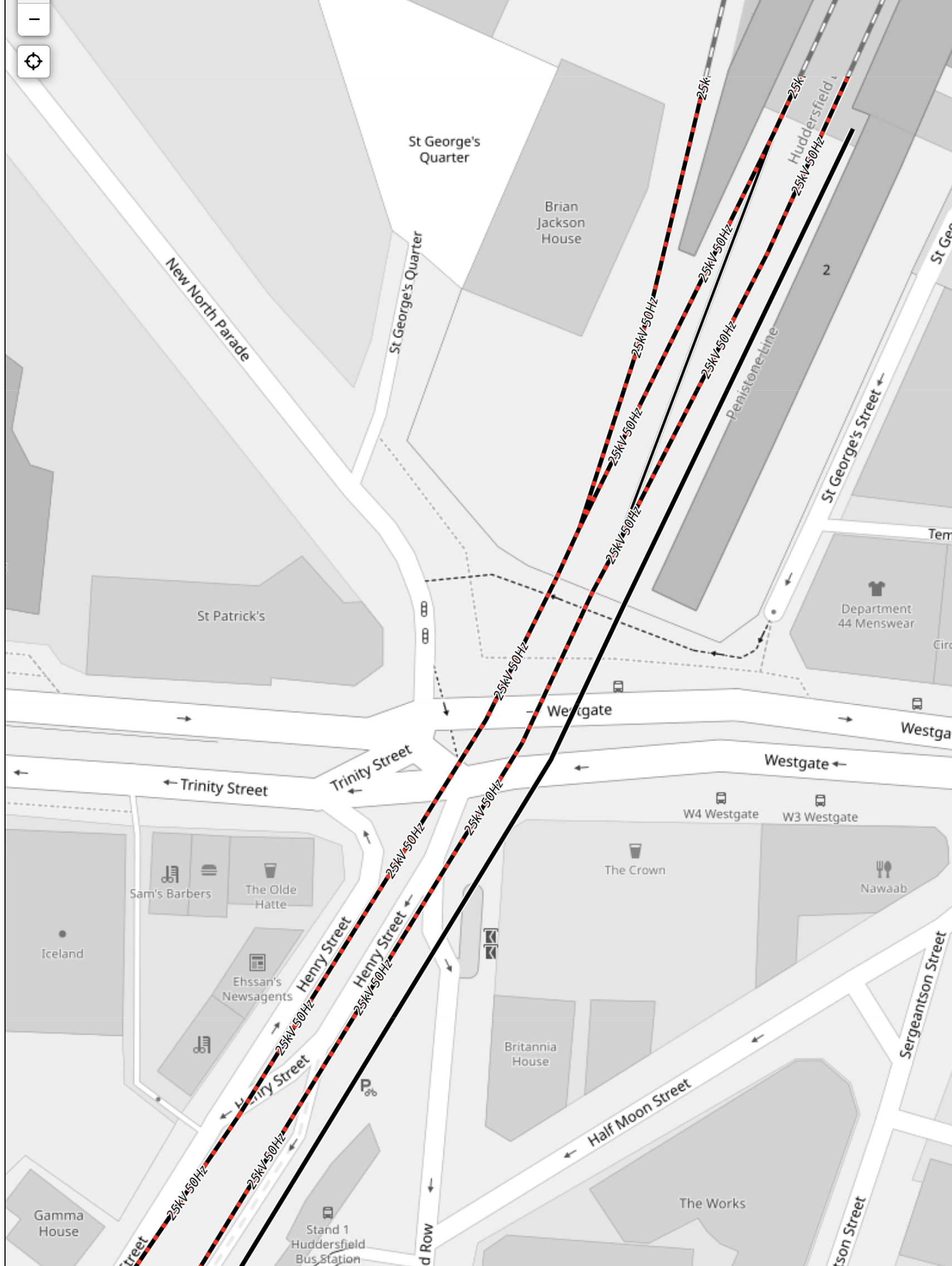
This OpenRailwayMap shows the position of Platform 2 in the station.
Note.
- The red-and-black dotted tracks are being electrified.
- The black tracks are not going to be electrified.
- Platform 2 is marked 2 in the top-right corner of the map.
- Platform 2 looks to be about 90 metres long.
- Five-car Class 810 trains are 120 metres long.
- From the map, it looks like the platform could be lengthened by the required thirty metres.
I suspect that some form of charger can be squeezed into the available space. After all, you don’t often get the chance to put charging into one of the most grand stations in Europe. Power supply would not be a problem, because of the electrification.
A frequency of twotph between St. Pancras and Huddersfield would give the following.
- Two fast tph between Meadowhall, and Barnsley, and Huddersfield and Sheffield.
- Two extra direct trains between Meadowhall and Barnsley, and Chesterfield, Derby, Long Eaton, East Midlands Parkway, Loughborough, Leicester and St. Pancras.
It would connect many stations to the TransPennine Route at Huddersfield station.
What Could The Sheffield and St. Pancras Look Like?
Consider that currently.
- There are two tph.
- Trains stop at Leicester, Loughborough (1tph), East Midlands Parkway (1tph), Long Eaton (1tph), Derby and Chesterfield.
- Trains are five- or seven-cars.
The simplest solution would probably be.
- A pair of five-car trains run all services.
- Trains split and join at Sheffield with one train going to Leeds and one going to Huddersfield.
I estimate that the Class 810 trains will offer about thirty more seats in every hour.
University Of Leeds Drills Test Boreholes For Geothermal Project To Heat Campus
The title of this post, is the same as that of this article on Ground Engineering.
This is the sub-heading.
A team of researchers at the University of Leeds has started to test the potential to use geothermal energy to heat buildings on campus in a bid to tackle its carbon emissions.
These three paragraphs outline the project.
The project involves drilling eight test boreholes into the ground at several locations on the campus at depths of between 150m to 250m. Work started last Monday (29 January) and will continue until May 2024.
Some of the holes will be water wells at around 50cm in diameter that will look for underground aquifers at the right temperature to use for geothermal heat. Other holes will be monitoring wells at around 15cm in diameter which the team will use to check what impact extracting heat from the ground has on the surrounding areas.
The geothermal project brings together the team responsible for the maintenance and development of the University estate and an academic team which includes professor of geo-energy engineering Fleur Loveridge, research fellow in geosolutions David Barns and lecturer in applied geophysics and structural geology Emma Bramham.
The Wikipedia entry for Geothermal Energy In The United Kingdom, is a very informing and ultimately surprising read.
This is the introductory paragraph.
The potential for exploiting geothermal energy in the United Kingdom on a commercial basis was initially examined by the Department of Energy in the wake of the 1973 oil crisis. Several regions of the country were identified, but interest in developing them was lost as petroleum prices fell. Although the UK is not actively volcanic, a large heat resource is potentially available via shallow geothermal ground source heat pumps, shallow aquifers and deep saline aquifers in the mesozoic basins of the UK. Geothermal energy is plentiful beneath the UK, although it is not readily accessible currently except in specific locations.
With more projects like that at the University of Leeds and the development of better technology, I am confident that over the next few years, we will extract more heat from beneath our feet.
The Integrated Rail Plan For The North And Midlands And The East Coast Main Line
Note that this is not a finished post.
To read the The Integrated Rail Plan For The North And Midlands (IRP), click this link.
There is a section in the IRP called Serving Leeds, York and North East England.
It is a section of six paragraphs and I shall describe their contents in detail separately.
Paragraph 3.41
This is said in the IRP.
Under the original plans, HS2 trains would have served Leeds, York and North East England via the West Midlands, with the Eastern Leg branching off from the Phase One line just north of Birmingham Interchange.
This is a significantly longer route than the current East Coast Main Line from King’s Cross, which goes directly up the eastern side of the country.
Due to capacity constraints north of Doncaster HS2 trains to Newcastle and York could also only be accommodated at the expense of existing services, potentially reducing or removing connections between the North East and Doncaster, Newark and Peterborough.
Unlike the West Coast Main Line, there is also potential to lengthen existing trains by up to three carriages, increasing the number of seats on those trains by around 40%.
Geography wins and I’ll discuss the train lengthening later.
Paragraph 3.42
This is said in the IRP.
The IRP has concluded in favour of a significant package of upgrades to the East Coast Main Line which could deliver similar journey times to London and capacity improvements for York and the North East as the original proposals – but many years sooner, and with operational carbon savings because trains will be taking a shorter route.
Speed is important in both project delivery and running of the trains.
Paragraph 3.43
This is said in the IRP.
We are therefore taking forward a substantial package of investment for the East Coast Main Line between London and Leeds and the North East, subject to future business case. Development work will consider interventions from both NPR designs undertaken by Network Rail, mainly focussed on York and northwards, and work undertaken by Mott MacDonald for the Department for Transport focused on the line south of York. North of York we will look to increase the number of paths for long distance high speed trains from 6 to 7 or 8 per hour. In addition to the already planned roll-out of digital signalling, work is expected to include looking at opportunities to improve rolling stock performance; power supply upgrades to allow longer and faster trains; route upgrades to allow higher speeds, including of up to 140mph on some sections; measures to tackle bottlenecks, for example south of Peterborough and at stations and junctions such as Newark, Doncaster, York, Northallerton, Darlington and Newcastle all of which limit speed and capacity; and to replace level crossings where needed.
We will ask Network Rail to now take forward these proposals, including considering any alternatives which may deliver better outputs and/or more cost-effective solutions.
I’ll discuss a lot of this later in more detail.
Paragraph 3.44
This is said in the IRP.
This package is intended to:
-
- Cut journey times from London to a range of destinations, including Leeds, Darlington, Northallerton, Durham, and Newcastle by up to 28 minutes, bringing journey times closer to those proposed by HS2, much earlier than previously planned;
- Allow the introduction of longer trains, increasing the number of seats;
- Provide 7–8 long distance high speed paths per hour north of York to Newcastle, compared to the current 6 paths (and so allowing a minimum of two fast Manchester to Newcastle services each hour alongside other ambitions);
- Improve performance and reliability, enabling faster and more reliable services for passengers.
I’ll discuss a lot of this later in more detail.
Paragraph 3.45
This is said in the IRP.
Journey times from London to Newcastle under this plan could be as little as 2 hrs 25-28 minutes (subject to stopping pattern), about 21-24 minutes faster than now and 8 minutes slower than under the full HS2 plans.
Journey times to York and Darlington under this plan would be about 15 minutes faster than now and 12-14 minutes slower than under the full HS2 plans.
Journey times from London to Leeds, at around 1 hour 53, would be about 20 minutes faster than now, but 32 minutes slower than under the full HS2 plans.
I’ll discuss a lot of this later in more detail.
Paragraph 3.46
This is said in the IRP.
Journey times from Birmingham to Leeds would be around 30 minutes faster than the current typical time, and, subject
to further analysis, York and the North East could be would be around 30 minutes faster than the current typical time,
via HS2 Western Leg, Manchester and NPR (based on indicative train service).
I’ll discuss a lot of this later in more detail.
My Thoughts
These are my thoughts.
Longer Trains
This is said in Paragraph 3.41
Unlike the West Coast Main Line, there is also potential to lengthen existing trains by up to three carriages, increasing the number of seats on those trains by around 40%.
The Hitachi Class 800, Class 801, Class 802 and Class 803 trains, that run the routes out of King’s Cross come in lengths of five, nine and ten coaches.
- The maximum length of an individual train is twelve cars according to this Hitachi document.
- All destinations with the possible exception of Harrogate, Lincoln and Middlesbrough can handle the current nine-car trains.
- Lengthening a five-car train by three cars would increase capacity by 60 %. You’d just run a current nine-car train.
- Lengthening a nine-car train by three cars would increase capacity by 33.3 %. Poor maths but possible.
- Lengthening a ten-car train by three cars would increase capacity by 30 %. Two trains would have to be lengthened, as ten-car trains are a pair of five-car trains.
It looks to me that the IRP is talking about running twelve-car trains.
- The Hitachi trains are all plug-and-play.
- The main stations on the route are Doncaster, Edinburgh, King’s Cross, Leeds, Newcastle and York.
- Some platforms would need to be lengthened, but some like Edinburgh, Leeds and York are probably already long enough.
But what about the important London terminus at King’s Cross?
These pictures show the Northern ends of the platforms at King’s Cross station.

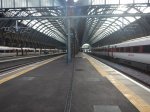
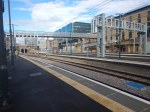
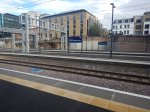
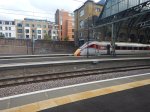
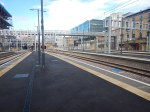
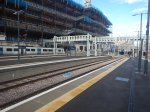
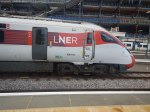
The two trains are both nine-car Hitachi Class 800 or Class 801 trains and I was standing in line with their noses.
I wonder what is the maximum length of trains that can be handled in these platforms.
- They can certainly handle ten-car trains, as LNER run these to Leeds.
- Looking at maps, I suspect that eleven-car trains could be the largest that can be handled.
I suspect it will be tight, but I suspect with a simple platform extension, twelve car trains could be accommodated in King’s Cross station.
Journey Times
These times come from High Speed Two’s Journey Planner and the IRP.
- London and Edinburgh – Three hours and forty-eight minutes – Four hours and nineteen minutes – Three hours and fifty-eight minutes – My estimate based on IRP figures
- London and Newcastle – Two hours and seventeen minutes – Two hours and forty-nine minutes – Two hours and 25-28 minutes
- London and Durham – Two hours and sixteen minutes – Two hours and fifty-five minutes – Two hours and forty minutes
- London and Darlington – One hour and fifty minutes – Two hours and twenty-two minutes – Two hours and seven minutes
- London and York – One hour and twenty-four minutes – Two hours and ten minutes – One hour and fifty-five minutes – My estimate based on IRP figures
- London and Leeds – One hour and twenty-one minutes – Two hours and thirteen minutes – One hour and fifty-three minutes
Note.
- The first time is that from High Speed Two, which assumes the Eastern Leg of High Speed Two has been built.
- The second time is the current best time via the East Coast Main Line.
- The third time is the IRP’s estimate via an upgraded East Coast Main Line.
- Where the estimates are mine it is noted.
London and York and London and Leeds are under two hours, London and Newcastle is under three hours and London and Edinburgh is under four hours.
Are these times fast enough for modal shift from the Air and Roads to Rail?
Project Delivery
Rail projects in the UK have a variable record in the delivering of projects on time and on budget.
I haven’t done the full analysis, but I do believe that smaller projects have a better record of delivery, based on media reports.
In Railway Restored: Regular Trains To Run On Dartmoor Line For First Time In 50 Years, Network Rail have delivered an important smaller project, for which I said.
Network Rail have set themselves a good precedent to open the line in nine months and £10 million under budget.
As the improvement of the East Coast Main Line is more of a succession of smaller projects, rather than one large project does this mean it is more likely to be delivered on time and on budget?
Extra Paths
This is said in Paragraph 3.43
North of York we will look to increase the number of paths for long distance high speed trains from 6 to 7 or 8 per hour.
One of the min reasons for building High Speed Two, but here we have extra capacity being created on the East Coast Main Line.
One extra path would be very good, but two would be excellent.
Power Supply Upgrades
In the last eighteen months, I’ve written two articles about updating of the power supply on the East Coast Main Line.
- East Coast Main Line Northern Power Supply Works Funded
- East Coast Main Line Electrification Research Agreement
The second article talks about the involvement of the University of Leeds to get the power supply to a high standard.
It does appear that Network Rail are doing all they can to enable the East Coast Main Line to handle the eight electric trains per hour
140 mph Running
There are several elements to the successful achievement of 140 mph running on a railway.
- The trains must be capable of running safely at 140 mph.
- The track must be able to support trains at that speed.
- The signalling must be in-cab and fully tested.
- The electrification must be designed for running at the required speed.
- The drivers must be fully trained.
Note.
- There are certainly 140 mph trains in service and there are tracks in the UK, where they can be tested at that speed.
- I wouldn’t be surprised as we have been running 140 mph InterCity 225 trains on the East Coast Main Line for thirty years, that a lot of the track is already profiled for 140 mph running.
- The digital signalling is being installed.
- The electrification on the East Coast Main Line has been dodgy for years, but is now being upgraded.
- Drivers are probably the least to worry about, as they probably know the route well and are honing their skills in simulators.
I can see 140 mph running being delivered in stages and on time.
Darlington Improvements
In First Phase Of ‘Transformational’ Darlington Rail Station Upgrade Approved, I said this about the improvements at Darlington station.
This upgrade is on the Eastern side of the current station and will include a new entrance, station building, concourse and three new platforms.
This design should allow the following.
-
- LNER, High Speed Two and other expresses not stopping at the Darlington station to pass through at speeds of up to 125 mph or more.
- Expresses stopping in the station will slow and accelerate in less time than they do now.
- It will probably allow more local trains to Bishops Auckland, Middlesbrough and Saltburn
A seventy-five percent increase in platforms probably offers other advantages.
This could knock several minutes off journey times.
York Improvements
I describe this problem and my solution in Improving The North Throat Of York Station Including Skelton Bridge Junction.
My solution won’t happen, as I advocate replacing the historic Skelton Bridge with a modern four-track bridge.
Effects On Lincoln Service
It will be interesting to see how the improvements to the East Coast Main Line effect LNER’s service between King’s Cross and Lincoln.
Any time improvements South of Newatk will surely be reflected in the time between King’s Cross and Lincoln.
Conclusion
The plan seems feasible to me.
Could Drax Power Station Solve The Carbon Dioxide Shortage?
Drax Power station is the largest power station in the UK, with a 2.6 GW capacity when burning biomass.
It has also been a regular target of environmental activists complaining of the power station’s carbon dioxide and other emissions.
But could it be an unlikely saviour to replace the carbon dioxide that comes from two fertiliser plants run by the CF Industries, that have been shut down by high gas prices?
I wrote about the shortage in Food Shortages Looming After Factory Closures Hit Production.
Two and a half years ago I wrote Drax Becomes First Wood-Burning Power Plant To Capture Carbon, which was based on an article in the Financial Times.
I said this about the report.
This news has been treated in a more sensationalist way by other news media and sites, but the FT gives it very straight.
Drax power station is running an experiment, that removes a tonne of carbon dioxide a day.
But that is only the start of the process and most of it is released to the atmosphere.
They are currently, looking for profitable and environmentally-friendly ways of disposal, including selling it to beer manufacturers.
Didn’t we have a carbon-dioxide shortage a few months ago?
Now is probably a good time to dig a little deeper into what Drax is doing.
The Wikipedia entry for Drax power station has a section called Carbon Capture And Storage.
This is the last paragraph of the section.
In May 2018, Drax announced a new carbon capture and storage pilot scheme that it would undertake in conjunction with the Leeds-based firm, C-Capture. The focus of this pilot will be on capturing carbon post combustion from the biomass burners as opposed to the coal burners. Drax will invest £400,000 into the project. The company, C-Capture, is a side company of the Department of Chemistry established at the University of Leeds. This would yield about 1-tonne (1.1-ton) of CO2 stored per day from the process, which could be sold on for use in the drinks industry. The pilot scheme was launched in February 2019. The capture of carbon from biomas burners is known as Bio Energy with Carbon Capture and Storage (BECCS).
Who are C-Capture?
Their web site is very informative and this page is called Our Story, which explains the project at Drax.
We designed, built, and installed a pilot plant and have been operating it on site, with real flue gas, since early 2019. The data gathered from this trial is feeding directly into the design process for a full-scale plant, with a target of 10,000 tonnes of CO2 per day captured from one of Drax’s four biomass fired boilers. A recent development has been the installation of equipment to bottle the captured CO2 to allow other organisations to test their own developing technologies with genuine Drax derived CO2.
That looks like a result to me for C-Capture.
This page is called Technology and has a very neat interactive guide to how the technology works.
Conclusion
This company has some very special technology, that has a lot of applications.
It is also significant that Drax and BP have taken a shareholding in C-Capture.
East Coast Main Line Electrification Research Agreement
The title of this post, is the same as that of this article on Railway Gazette.
These are the first two paragraphs.
An outline £10m co-investment agreement has been signed by the University of Leeds and the Rail Electrification Alliance which is undertaking the East Coast Main Line power supply upgrade programme.
The agreement provides for two years of research into the best and most efficient way of managing electrical power flow on the route, with the university’s scientists and engineers having access to data collected from lineside static frequency converters.
Sounds good to me. I have analysed countless projects and systems, in the early stages and in many cases, the budget and project time have been reduced or a better method of operation has been developed.
University Buys Land For ‘Game-Changing’ High-Speed Rail Institute In Leeds
The title of this post is the same as that of this article on Rail Technology Magazine.
I have read the article and feel it is an important development, as it will be co-located with High Speed Two’s rolling stock depot in Leeds.
 The Anonymous Widower