A Curious Link Between Pancreatic Cancer And COVID-19
i am involved in fund raising for pancreatic cancer research at Liverpool University, because my youngest son died of the awful disease, at just thirty-seven, leaving a widow and an eight-year-old daughter.
I am also a passionate analyser of data and databases.
For a few weeks now, I have had a feeling that there is a connection between pancreatic cancer and the old Austro-Hungarian Empire.
I found this simple description of the Austro-Hungarian Empire on this page on the Internet.
The former Austro-Hungarian Empire was spread over a large part of Central Europe, it comprises present Austria and Hungary as well as the Czech Republic, Slovakia, Slovenia, Bosnia, Croatia and parts of present Poland, Romania, Italy, Ukraine, Moldova, Serbia and Montenegro.
I had been looking at pancreatic cancer data on the World Life Expectancy database, which is based on World Health Organisation data.
I have built this table, which shows the top twenty countries for a death rate from pancreatic cancer.
These are the columns.
- Country
- Rate of pancreatic cancer deaths per 100,000 of the population.
- Quarantine or Travel Corridor based on this page of the Government web site.
- Member of the Austro-Hungarian Empire.
These are the top twenty countries.
- Hungary – 11.35 – Quarantine – AHE
- Uruguay – 10.72 – Quarantine
- Armenia – 10.34 – Quarantine
- Malta – 10.01 – Quarantine
- Czech Republic – 9.89 – Quarantine – AHE
- Estonia – 9.26 – Travel Corridor
- Iceland – 9.21 – Quarantine
- Israel – 9.18 – Quarantine
- Slovakia – 9.17 – Quarantine – AHE
- Austria – 9.13 – Quarantine – AHE
- Finland – 8.78 – Travel Corridor
- Japan – 8.74 – Travel Corridor
- Latvia – 8.72 – Travel Corridor
- Germany – 8.68 – Travel Corridor
- Slovenia – 8.55 – Quarantine – AHE
- Denmark – 8.51 – Quarantine
- Netherlands – 8.38 – Quarantine
- Croatia – 8.30 – Quarantine – AHE
- Lithuania – 8.21 – Travel Corridor
- Luxembourg – 8.15 – Quarantine
Note.
- I would hope that the Government’s Travel Corridor list has been devised in a scientifically-correct manner.
- Am I right to assume that the Travel Corridor list is a good measure of the level of Covid-19 in the country?
- The pancreatic cancer data is from 2018.
Of the countries I mentioned earlier, as being partly in the Austro-Hungarian Empire, only Montenegro is in the top thirty countries for pancreatic cancer deaths.
My Thoughts On The Data
These are my thoughts on the data.
The Significance Of The Austro-Hungarian Empire
Consider.
- All the countries that were fully or partly in the Austro-Hungarian Empire are on the Government Quarantine List, with the exception of Italy.
- Many will argue, including myself, that Italy, has too high a Covid-19 rate for a visit.
- Austria, Croatia, the Czech Republic, Hungary, Slovakia and Slovenia are in the top twenty countries for pancreatic cancer deaths.
It looks to me, that there is a correlation in there somewhere.
Germany And Japan Are The Odd Ones Out
The list of countries with high levels of pancreatic cancer, where there is no quarantine are.
- Estonia
- Finland
- Japan
- Latvia
- Germany
- Lithuania
If you eliminate the Baltic States and Finland from the worse countries for pancreatic cancer, you’re left with Germany and Japan.
Is There A Jewish Dimension?
I ask this question for these reasons.
- Israel is eighth on the pancreatic cancer list and has high levels of Covid-19 according to various news reports, like this one on the BBC, which is entitled Coronavirus: Israel Tightens Second Lockdown Amid Acrimony.
- I am not Jewish, but my great-great-great-grandfather from Konigsberg probably was and it looks like I inherited my coeliac disease from him and gave it to my son, who died from pancreatic cancer.
- The Baltic States and Finland, don’t seem to have large Jewish populations for various reasons and they have high levels of pancreatic cancer, but low levels of Covid-19.
- Germany has the third largest Jewish population in Europe, but seems to have done well in fighting Covid-19. Is that because their well-funded healthcare system has worked?
- Wikipedia states that, the Austro-Hungarian Empire was favourable to the Jews and even a sizeable numbers of its Army officers in Word War One were Jewish.
- According to reports locally and my observations, it appears that the Jewish community in Hackney, where I live has been badly hit by Covid-19.
I need an appropriate historian to give me answers.
Conclusion
I believe the correlation between pancreatic cancer and Covid-19 could be rather strong. More research needs to be done, as to why.
But I do wonder, if undiagnosed coeliac disease, as in my son, could be the alligator in the swamp.
Undiagnosed coeliacs seem to have poor immune systems, which makes them more susceptible to everything, that’s going around.
The more I learn about coeliac disease and its myriad effects on health, the more I’m convinced that it should be one of the diseases checked for in all young children.
It would certainly have changed my miserable always-ill childhood for the better.
ARM: Can ‘Crown Jewel’ Of UK Technology Be Protected?
The title of this post, is the same as that of this article on the BBC.
These are the introductory paragraphs.
The UK government is “looking at options” to protect and ensure future investment in Cambridge-based ARM Holdings, which is being bought by US tech giant Nvidia from Japan’s Softbank.
This is a much more relaxed attitude than the government took when Softbank bought the world-leading chip designer in July 2016. At that time, Softbank announced it had agreed to legally binding commitments to increase investment, headcount and preserve its headquarters in the UK.
It is not too late for the government to impose conditions, but conversations on whether to impose them or what they might be have not even started.
Some of the original founders of ARM Holdings, would appear to be not very happy.
I have followed the company for a number of years, as I was in the same class at Liverpool University with Robin Saxby, who was ARM’s first CEO.
At great surprise to myself, I made a nice sum of money by investing in the shares at the right time.
I am less unhappy, as I think two opposite outcomes would be good for the UK.
- It all goes pear-shaped and large numbers of talented engineers in Cambridge create several children of ARM.
- Nvidia decides that the ARM model and location is better and moves the headquarters of the group to the UK. Trump and his policies could make this likely, by picking fights with countries where Nvidia and ARM have large markets.
It will be interesting to see what happens.
A Railway Station At Liverpool University
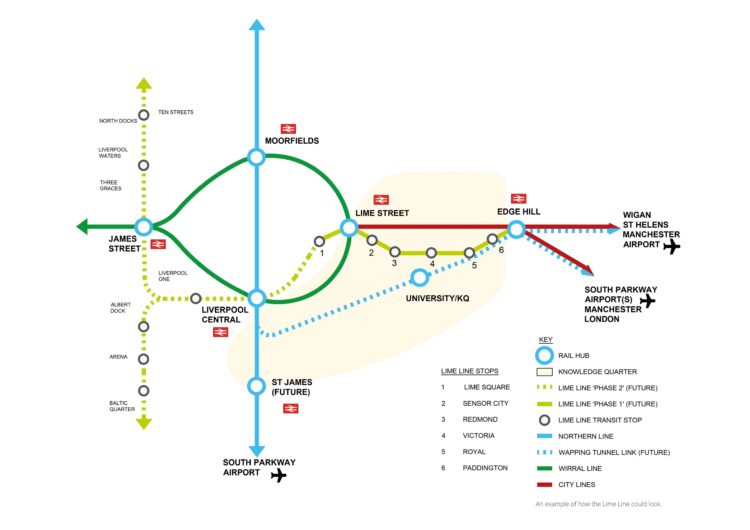
In Liverpool’s Forgotten Tunnel, I showed this map, which shows a proposed reopening of the Wapping Tunnel as a passenger route between Liverpool Central and Edge Hill stations.
Note.
- The map shows a station at University
- The Wapping Tunnel is shown as a dotted blue line.
- Between four and eight trains per hour (tph) would be running through University station.
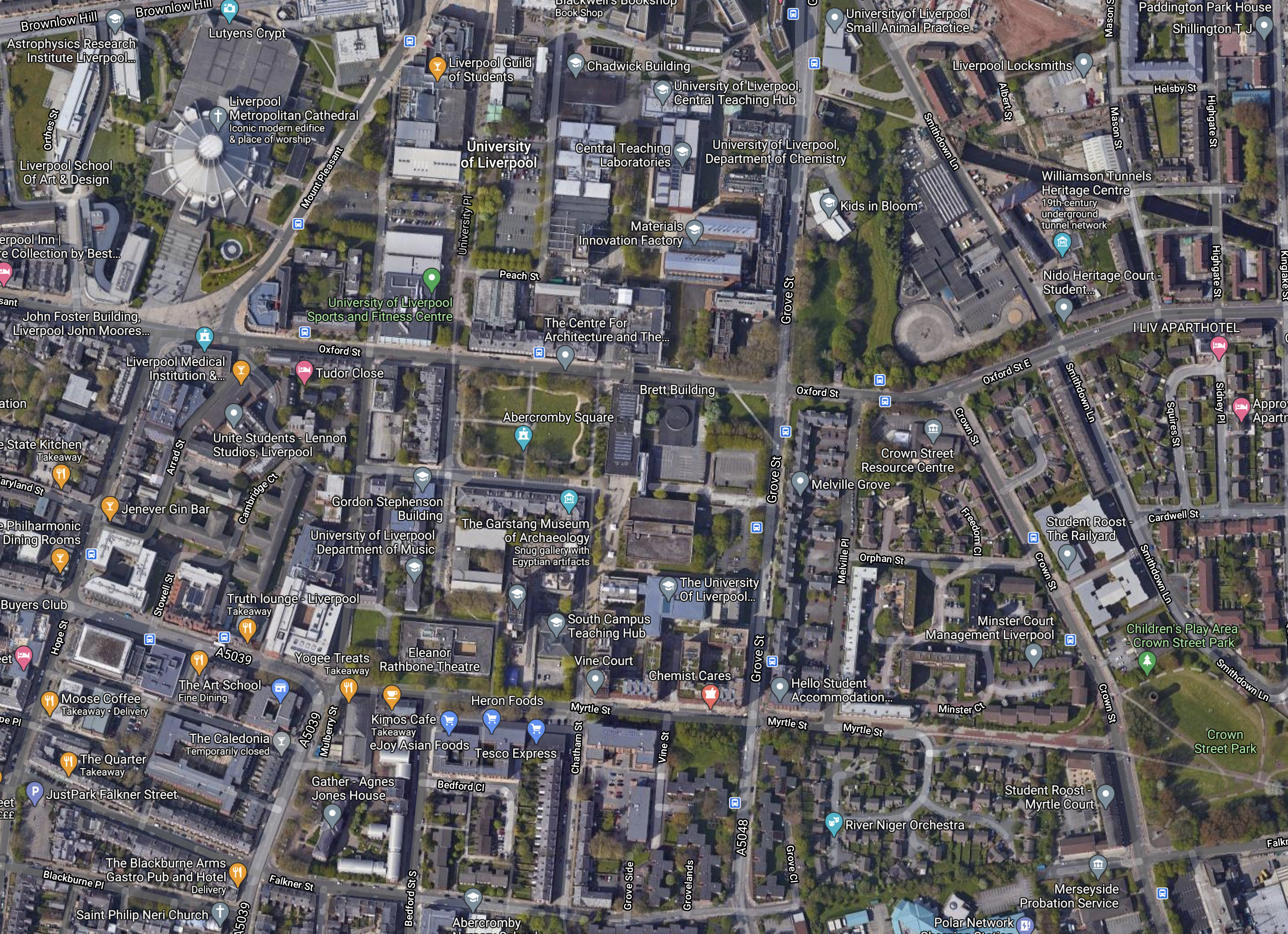
This Google Map shows the line of the tunnel.
Note.
- Liverpool Metropolitan Cathedral is in the North-West corner of the map.
- Much of area of the map is taken up by buildings of Liverpool University.
- Crown Street Park is in the South-East corner of the map and contains one of the ventilating shafts for the tunnel.
- Blackburne Place in the South-West corner of the map contains another ventilating shaft.
The location of the shafts, probably means that the tunnel runs vaguely along Myrtle Street.
Not knowing that area of the campus well, it could be where Grove and Myrtle Streets intersect.
This Google Map shows the area.

It should be noted that this area of Liverpool is built on sandstone and tunnelling isn’t the most challenging operation, so it might be possible to create a very passenger-friendly station.
Passenger Services Through The Station
I think that my best estimate of passenger service through the station would be as follows.
Frequency
The frequency would be between four and eight tph. These are quite low frequencies for a modern railway and Merseyrail exceeds this frequency in several places.
Westbound
Currently, trains on the Northern Line branches to Ormskirk and Kirkby appear to turnback at Liverpool Central station. So it would appear, that it would be more likely, that Westbound services at Liverpool University station would terminate at Kirkby or Ormskirk.
Passengers wanting to travel to and from stations on the Wirral Line, would need to change at Liverpool Central station.
Eastbound
Currently, local services out of Liverpool Lime Street, that are run by Northern, are as follows.
- Half hourly service to Manchester Oxford Road (via Warrington Central, most local stations)
- Hourly service to Manchester Airport (via Warrington Central and Manchester Piccadilly, limited stop)
- Hourly service to Blackpool North (limited stop)
- Half hourly service to Wigan North Western (via St Helens Central, all stations)
- Hourly service to Crewe (via Newton-le-Willows, Manchester Piccadilly and Manchester Airport, all stations)
- Hourly service to Warrington Bank Quay (via Earlestown, all stations)
Note.
- The services actually add up to eight tph.
- As Merseyrail’s new Class 777 trains will have a pantograph for 25 KVAC overhead electrification and a battery capability, they could be used on all routes.
- But I do think that the trains may not be suitable for all routes because of their 75 mph operating speed.
- It might be better to serve Blackpool North station by extending an hourly Ormskirk service to Preston and Blackpool North, with stops at all stations.
So could the services Eastbound from Liverpool University station be as follows.
- Half hourly service to Manchester Oxford Road (via Warrington Central, most local stations)
- Half hourly service to Wigan North Western (via St Helens Central, all stations)
- Hourly service to Warrington Bank Quay (via Earlestown, all stations)
The services add up to five tph and I would expect selective increases would balance the services, so that eight tph ran through Liverpool University and Edge Hill stations.
Liverpool Calls In Volunteer Student Doctors
BBC Breakfast has just run a report about how student doctors at Liverpool University are going to be used to help out in local hospitals.
According to the BBC report, two hundred students have volunteered.
The BBC also interviewed a senior Professor, who was very happy about it all.
I suspect other medical schools will volunteer and there are reports, that Cambridge already has, but I do think that this is the way to get better doctors.
A Personal Story
A few years ago, I was in a teaching hospital after suffering a collapse.
A senior tutor approached me and asked, if I would mind, if I was used for interview practice by final year students.
I hope the students benefited as much as I did, whilst they sorted out what was wrong with me!
Conclusion
We should look upon COVID-19, as something that will make us all better people and doctors.
Is COVID-19 for my generation and those younger than myself, our Second World War?
Why Are Liverpool Good At Transfers?
This question was asked on BBC Radio 5, about Liverpool Football Club.
As an alumni, I raise money for cancer research at Liverpool University.
I get the impression, the University has no problem getting the best researchers to come to the Second City of England!
Everybody in the World has heard of Liverpool!
Could Modern Energy Systems Have A Secondary Role?
Close to where I live is a small heat and power system, that I wrote about in The Bunhill Energy Centre.
I first went over the centre during Open House.
Several of these modern systems are very good demonstrations of the principles of maths, physics and engineering.
So do these innovative energy systems do their bit in educating the next generation of scientists and engineers?
Some of the modern systems, that are in development like Highview Power’s energy storage using liquid air would be ideal for a secondary education role!
Most too, are very safe, as there are no dangerous processes or substances.
And in the next few years, there will be more systems all over the country and many in the hearts of towns and cities. Some schools, colleges and especially universities, will have their own innovative energy sources.
Liverpool University already has a system, which is described here.
The Importance Of Libraries For Research
I went to a fund-raising event for Book Aid at the British Library on Monday evening.
The main purpose was to raise funds for the library in Mosul, which has been wrecked by IS.
The event made me think, about the number of times in the 1960s and 1970s, I used libraries for research.
- My undergraduate thesis was about analogue computing and I used information about how Lord Kelvin and his elder brother; James, were developing and using mechanical analogue computers in the late 1800s, that I had found in the Liverpool University library.
- A few years later, whilst working for ICI, I found that by properly searching Chemical Abstracts in their library, I could find the solution to difficult problems. Nowadays, you’d use the Internet!
- When I developed Artemis, I needed methods to improve the performance of the software. Some I developed myself, but one particular algoithm used for linking datasets together was found in a paper, written in the 1960s in IBM’s library. In those days, getting the maximum performance from not very powerful computers was more difficult and the algorithm was important.
- These days, with everything on the Internet I use libraries less. Although, I regularly visit Hackney’s Records Office near to where I live, to browse old images, reference books and maps.
Do we all underestimate the part books, play in our lives?
Algorithm Could Cut High Speed Rail Energy Use
The title of this post is the same as that of this article on the Railway Gazette.
This is the first paragraph.
Researchers at Xi’an Jiaotong-Liverpool University’s Suzhou campus have developed an algorithm intended to optimise the storage and reuse of braking energy.
Regenerative braking energy is stored on the trainand reused, rather than returned to the grid.
Ten percent savings are claimed.
I’ve always thought this was possible.
Have I Regressed To My Childhood?
Growing up in the early 1950s in London, I wasn’t the healthiest of children.
- At some time most winters, I would have several weeks off school with a severe cold with extras.
- I can remember my mother cutting up old sheets for hankerchiefs.
- These would be boiled after use in a large saucepan on the gas cooker.
- I would cough all night and a good part of the day.
- I would inhale steam from a large jug of hot water and Friar’s Balsam.
Dr. Egerton White was always round our house.
Things improved towards the end of the 1950s.
- The passing of the Clean Air Act in 1956.
- I would be given penicillin which seemed to help. Naughty! Naughty!
- At weekends we’d go to Felixstowe.
What finally improved my health was going to Liverpool University.
Now over fifty years later, I’ve got a cold like I had in the 1950s.
- I can’t stop coughing for more than ten or twenty minutes.
- Nothing seems to work to stop the cough!
- It’s gone on for eight days now!
- I’m not getting much sleep.
Could the pollution from all the diesel vehicles be the key?
Thoughts On a Red And Processed Meat Tax
This article on the BBC is entitled Should There Be A Tax On Red Meat?.
This is the first two paragraphs.
A “meat tax” could prevent almost 6,000 deaths per year in the UK, according to researchers, but should politicians be telling people what they can and can’t eat?
Scientists at the University of Oxford say governments should consider imposing price hikes on red meat – such as beef, lamb and pork – to reduce consumption.
They also go on to suggest these levels of tax, with examples.
In the UK, the study suggests a tax of 14% on red meat and 79% of processed meat.
This would mean the price of a 227g Tesco Sirloin Steak would increase from £3.80 to £4.33.
And for a pack of eight pork sausages from Sainsbury’s the price would increase from £1.50 to £2.69.
It is probably peer-reviewed research, but I doubt it would ever be introduced.
I have few questions.
Would I As A Coeliac Get Extra Tax Relief, As I Need To Eat Red Meat?
I don’t eat much red meat, but to keep my B12 at a good level, I need to eat a quality steak or burger.
Regular levels of B12 help to keep your immune system strong, which is the body’s first line of defence against cancer.
Why Do Coeliacs On A Gluten Free Diet Have A 25% Less Chance Of Getting Cancer?
Research at Nottingham University has shown this.
Being coeliac is unlikely to be beneficial, as whoever heard of a disease that let you live longer?
,So could it be the non-eating too of gluten?
Also, as many who eat a lot of red and processed meat, eat it with a bun or lots of bread,
Could this be significant?
Research needs to be done that considers consumption of red and processed meat, taking eating gluten into account.
How Would I Reduce Cancer?
There are other substances and circumstances that are proven to cause cancer.
- Smoking tobacco and other drugs.
- Eating too much and being obese
- Drinking too much.
- Too much sunbathing.
- Diesel and petrol vehicles
- Gas appliances in the home, not venting outside.
Some of these also cause other health problems.
I’d start with absolute bans on these.
- Diesel and petrol vehicles.
- Smoking tobacco
- Possession of illegal drugs.
- Gas appliances in the home, not venting outside.
- Sales of high strength alcohol.
- Jobs with a proven record of causing cancer like coal mining.
And these things would be compulsory or introduced.
- Everybody should keep a record in a smart-phone app of what they ate and their weight.
- Owning a diesel or petrol vehicle would need a special permit.
- Alcohol could only be bought in special licensed shops.
Obviously, other draconian measures could be introduced.
I doubt it will ever be acted upon, by any Government that wants to win an election.
So What Can We Do That Is Practical?
My view is that we have to nudge people into doing the right thing.
Diesel And Petrol Taxes To Subsidise Zero-Emission Vehicles
Note that I use the term zero-emission vehicle, which is a category that includes battery and hydrogen power at present. But it is a class, that could include other vehicles in future, that have yet to be invented.
If diesel and petrol taxes were to rise and the revenue were used to subsidise the purchase of zero-emission vehicles, then this might persuade more people to switch to zero-emission vehicles.
Money could also be allocated to research into zero-emission vehicles.
Zero-Emission Zones In All Towns And Cities
London is getting an Ultra Low Emission Zone, but this is only the start.
They should be Zero Emission Zones.
They should probably be paired with parking areas outside the zone and connected to it, by a zero-emission high quality rail or bus link.The link could be a segregated walking or cycling route.
The first town or city that uses this model to create healthy air quality will probably reap an enormous dividend.
From recent developments, I suspect it will be the City of London.
Smoking Would Only Be Allowed By Consenting Adults In Private
As smoking had a lot to do with the death of my son I feel strongly about this.
My wife also may have died from secondary lung cancer. But she had never smoked, although she got enough cigarette smoke from her tutor at University, who chain-smoked Capstan Full Strength.
Is There A Radical Approach?
Liverpool University Pancreatic Cancer Research Unit have one of the most impressive databases I have ever seen! It contains every pancreatic cancer case, that has been notified to the University.
They use it to look for links between factors, that might be a clue to what causes this terrible disease and for possible cures.
But imagine an enormous database of all UK cancer cases, that was processed to show how the cancers related to post codes, occupation, age, weight, smoking and drinking habits etc.
Access to an anonymised version of the database would be allowed through the Internet or a phone app.
Would access to the data, nudge people to change their bad habits?
I also know of ten-year-olds, who pester their parents to stop smoking, so imagine what a tech-savvy child would do, if given access to the app. Schools could teach them to use it responsibly.
Could it bring the whole country together to reduce levels of cancer?
 The Anonymous Widower