The London And Edinburgh Travel Market
This paragraph comes from of this article on Railway Gazette.
Lumo is aiming to carry more than 1 million passengers per year. It is particularly targeting people who currently fly between Edinburgh and London; in June it says there were 74 764 air journeys on the route, compared to 82 002 by rail.
Lumo’s million passengers per year, will equate to around 83,300 passengers per month.
What these figures don’t show is the number of rail journeys made to intermediate stations like Newcastle, York, Doncaster and Peterborough.
These are a few thoughts.
Rail Capacity Between London And Edinburgh
Consider.
- LNER is currently the only rail carrier offering a daytime service between London and Edinburgh.
- LNER run approximately 26 trains per day (tpd) in both directions between London and Edinburgh.
- A nine-car Class 801 train can carry 510 Standard Class passengers and 101 First Class passengers.
That means that LNER had a capacity of just over 950,000 seats in June.
It might seem poor to have only sold 82,002 seats in June between London and Edinburgh, which is just 8.6 % of the available seats.
On the other hand, LNER’s two trains per hour (tph) are a lot more than London and Edinburgh trains, as they connect towns and cities all the way up the East Coast Main Line between London and Aberdeen.
Lumo’s capacity of a million seats per year, works out at 83,300 seats per month, which is another 8.7 % of capacity.
- Lumo will sell seats on price initially and I suspect they’ll end up running about 85-95 % full.
- It has been stated that they need to run 80% full to break even.
- I also think, that they would like to have a few seats for late bookers.
But even so, they will surely affect LNER’s bookings.
What Will LNER Do?
Several of the things, that Lumo are doing can be easily copied by LNER.
- Early booking.
- Improve onboard service.
- Better seating.
They could even reduce prices.
I think it is very likely we could end up with a price and service war between LNER and Lumo.
Would The Airlines Be The Losers?
This could be an outcome of competition between LNER and Lumo.
We are now talking about times of around four hours and twenty-five minutes between London and Edinburgh, but there are improvements underway on the East Coast Main Line.
- The remodelling of the approach to Kings Cross station has not been reflected in the timetables.
- The Werrington Dive Under has not been completed yet.
- Digital signalling is being installed South of Doncaster.
- The power supply is being upgraded North of Newcastle.
When these and other improvements are complete, I can see journey times reduced below four hours.
But would that only be for starters?great b
If a 1970s-technology Intercity 225 train, admittedly running as a shortened train formation, could achieve a time of just under three-and-a-half hours for the 393.2 miles between Kings Cross and Edinburgh stations in September 1991, what could a modern Hitachi train do, if all of the improvements had been completed and perhaps half of the route could be run at 140 mph under the watchful eyes of full digital signalling and an experienced driver.
Consider.
- London and York is nearly two hundred miles of fairly straight railway, that is ideal for high speed.
- Current trains run the 393.2 miles in four hours 25 minutes, which is an average speed of 89 mph.
- A train running at 89 mph would take two hours and fifteen minutes to cover 200 miles.
- A train running at 125 mph would take one hour and thirty-six minutes to cover 200 miles.
- A train running at 140 mph would take one hour and twenty-six minutes to cover 200 miles.
When Network Rail, Great British Railways or the Prime Minister renames the East Coast Main Line as High Speed East Coast, I think we can be sure that trains between London and Edinburgh will be able to achieve three-and-a-half hours between the two capitals.
High Speed Two is only promising three hours and forty-eight minutes.
What About LNER’s New Trains?
LNER Seeks 10 More Bi-Modes, was written to explore the possibilities suggested by a short article in the December 2020 Edition of Modern Railways.
There has been no sign of any order being placed, but Hitachi have moved on.
- They are building the prototype of the Hitachi Intercity Tri-Mode Battery for testing on the Great Western Railway.
- They have completed some of the Class 803 trains for East Coast Trains, which has now been renamed Lumo. These trains have a battery for hotel power in case of catenary failure, but no diesel engines.
- They are building the Class 807 trains for Avanti West Coast, which appear to be designed for high speed and have no batteries or diesel engines.
- The latest versions of the trains will have a reshaped nose. Is it more aerodynamic at high speeds?
It does seem that there is an emphasis on speed, better acceleration and efficiency.
- Could the lessons learned be used to improve the performance of the existing trains?
- Could a small high performance sub-fleet be created to run LNER’s Scottish services?
There are certainly possibilities, that would cut journey times between London and Edinburgh.
Conclusion
I can see the airlines flying between London and Edinburgh suffering a lot of collateral damage, as the two train companies slug it out.
The Definitive Seating Layout Of Lumo’s Class 803 Trains
This article on Economy Class and Beyond is entitled Enter Lumo – The New East Coast Railway Competitor.
It contains a drawing from Lumo, which shows the layouts of the seats on the train.
- Coach A – 44 Standard seats – 8 Priority seats – 2 Wheelchair spaces – 2 Tip up seats – Accessible toilet – 56 Total seats
- Coach B – 84 Standard seats – 12 Priority seats – Bike store – Toilet – 96 Total seats
- Coach C – 84 Standard seats – 12 Priority seats – 96 Total seats
- Coach D – 84 Standard seats – 12 Priority seats – Bike store – Toilet – 96 Total seats
- Coach E – 52 Standard seats – 8 Priority seats – 2 Tip up seats – Accessible toilet – 62 Total seats
Note.
- This is a total of 406 seats.
- Judging by the position of the tip-up seats they are for staff and perhaps emergency use, if say a coffee gets spilled on a seat.
- Each car has a pair of tables, where four can sit. As Lumo’s business model allows early booking, if you and your partner want to take the kids to see granny on her birthday, you should be able to get a table, by booking early.
- There are two bike stores in Coaches B and D.
These are some further thoughts.
Toilet Provision
I was on an LNER Class 800 train earlier this week and needed to go to the toilet.
- I wasn’t sure which way I needed to go, as I couldn’t see a sign pointing me to the toilet, but in the end I struck lucky.
- You don’t have that problem with Lumo’s trains, as there appears to be a toilet at both ends of the three middle coaches, either in your car or the next.
- If you’re in one of the driver cars, there is an accessible toilet at the blunt end.
I don’t think anybody will argue with the toilet provision on Lumo’s trains.
Can The Trains Be Lengthened?
If you look at the diagram of the train, Coaches B and D appear to be identical with a toilet and a bike store at one end.
These ends are connected to the centre car, which doesn’t have its own toilet, but passengers can use the toilets in the next coaches.
One of the advantages of this layout is that although it is a five-car train, it only has four coach types, which must help in both manufacture and maintenance.
But it also helps, if the train service is successful and more capacity needs to be provided.
An extra coach just needs to have a toilet at one end and when it is slotted into the formation. The train software, then automatically acknowledges the additional car.
The rule of having a toilet at both ends of the centre coaches will not be broken.
These trains are certainly designed for a service that could be more successful, than the train operator has initially planned.
The maths of lengthening are very simple.
- Each new coach will add another 96 seats.
- The five trains (25 coaches) cost £100 million.
- That is £4 million per coach.
- All stations on the route are capable of handling at least nine-car trains.
Different lengths of trains would give the following increases.
- Six-car trains would hold 502 seats and increase capacity by 24 %.
- Seven-car trains would hold 598 seats and increase capacity by 47 %.
- Eight-car trains would hold 694 seats and increase capacity by 71 %.
- Nine-car trains would hold 790 seats and increase capacity by 94 %.
The ability to lengthen trains so easily, must mean that Lumo can match their train size to demand, without needing any extra expensive train paths.
Bicycle Storage
There are two bike storage racks in Coaches B and D.
As there has been complaints about bicycle storage on these Hitachi trains, I would assume that Lumo have got the provision right for the target market.
Wheelchair Travellers
These are positioned next to one of the accessible toilets, which is standard practice.
How Will These Trains Compare To Budget Airliners?
This is not a great picture of even a boring subject like the A14 going over the East Coast Main Line.
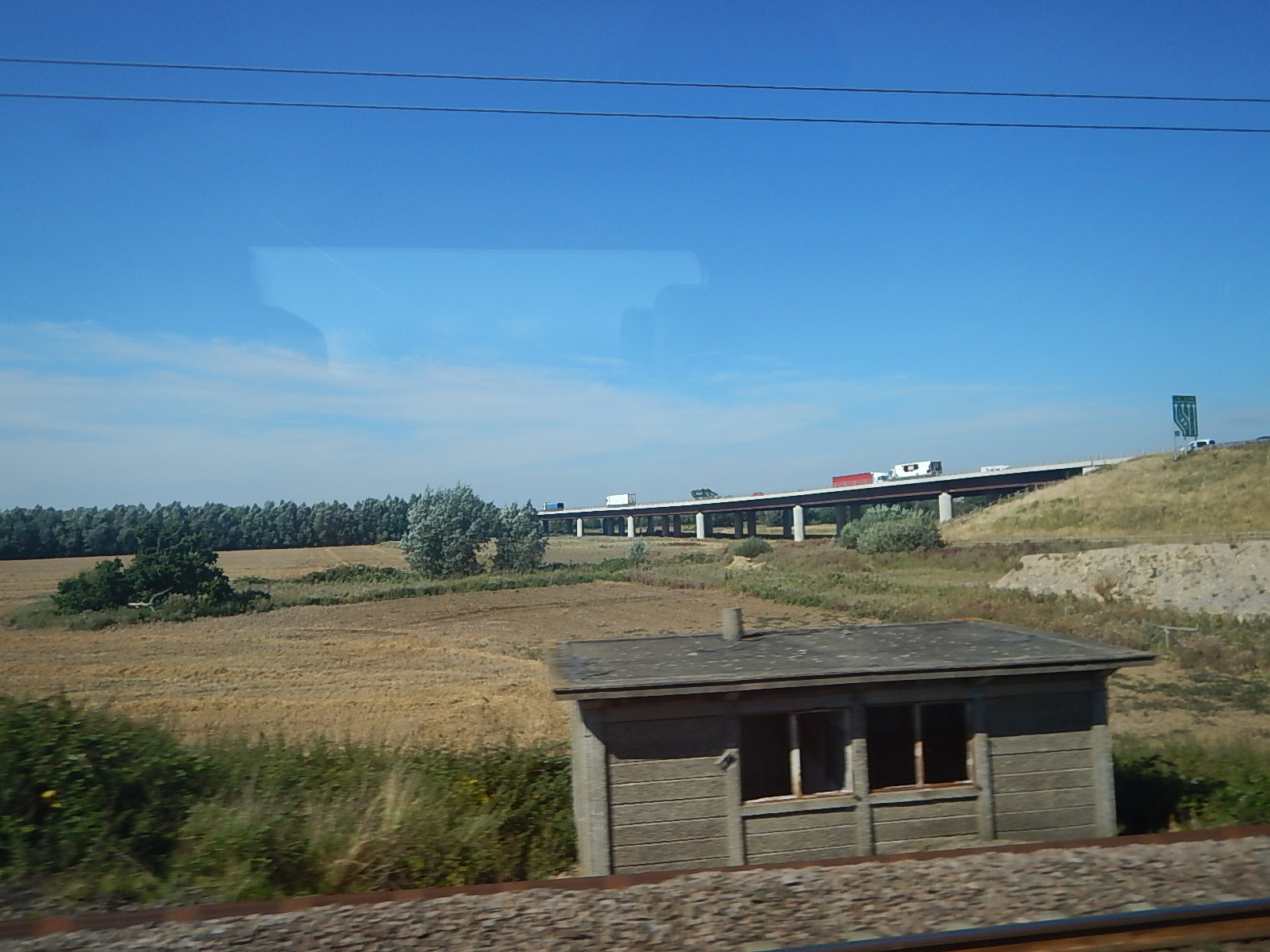
But it was taken from an airline-style seat through the wide window of an LNER Hitachi train, that is in the same family as the trains purchased by Lumo.
Try taking a decent picture through the porthole on a budget airliner.
If Lumo have used decent seats for the trains, they will have the budget airlines screwed, glued and tattooed on the London and Edinburgh route.
Conclusion
These are certainly trains designed for their market.
Lumo Aims To Be The Green Alternative To Edinburgh – London Flights
The title of this post, is the same as that of this article on Railway Gazette.
Some points from the article.
Lumo Is Targeting Flyers
This is a paragraph.
Lumo is aiming to carry more than 1 million passengers per year. It is particularly targeting people who currently fly between Edinburgh and London; in June it says there were 74 764 air journeys on the route, compared to 82 002 by rail.
I find it interesting that the number of passengers using air and rail are within nine percent. I thought it would have been more of a difference.
The Service Will Ramp Up
This is a paragraph.
Services will ramp up over a period of months to the planned timetable of five trains each way per day. A small increase is envisaged at the December timetable change, followed by full implementation in Q1 2022.
There is a lot of training to do and some more Class 803 trains to be delivered.
Viability Level
Industry sources are quoted that at the prices charged, the trains will need to be eighty percent full to be viable.
As a Control Engineer, who has built hundreds of mathematical models, I am fairly certain, that by adjusting ticket prices and getting the marketing right, they’ll hit that level.
Late Bookers
The eighty percent viability level probably means that they can afford to leave a few seats available for those that need to book the day before.
Yesterday, when I went to Spalding, I bought my ticket in the Booking Office half-an-hour before travel and got a seat with a window.
Seat allocation algorithms on LNER seem to be very good and I don’t think Lumo’s will be in any way inferior.
Early Bookers
The article says advance tickets can be bought earlier than the usual twelve weeks.
So say you always travel to Scotland for your mother’s birthday, you can buy the ticket early and not be hit by low availability, as it turns out later that Rangers are playing Celtic on the day you travel.
Mutual Support In Case Of Disruption
This is a paragraph.
Reciprocal contracts providing support in case of disruption have been signed with other operators, including LNER.
I think in all the troubles yesterday, that I wrote about in Azumas Everywhere!, LNER could have done with some help yesterday.
Lumo Want To Grow Rail
This is a quote from the company.
We want to grow rail and bring people to a more sustainable, environmentally way of travelling.
They also seem fairly relaxed if you want to travel in First on LNER.
Luggage
This is a paragraph.
Passengers will be able keep their luggage close by or, for an additional charge, have it delivered to their final station or destination.
Does that mean you’re going to Edinburgh to see the family at Christmas and the New Year, you can take a lot of luggage and get it delivered both ways?
Efficient Running North Of Newcastle
I particularly liked this paragraph.
The trainsets will be able to run with power draw limited to 80% of normal on the northern part of the East Coast Main Line where there is limited power supply, with modelling by FirstGroup’s engineers and Network Rail suggesting that for five-car sets this will not affect sectional running times and will allow electric trains to continue running.
If you’re on time, the passengers won’t mind, but the electricity saved is all profit.
As a Control Engineer, my philosophy would be to have an economy mode for 80 % power sections.
- Trains would enter these sections with a full battery, that had been charged earlier from the electrification.
- The battery would provide hotel power in these sections.
- Traction power would come from the electrification.
- Trains could leave these sections with an almost flat battery.
The battery is not used for traction, but because it is handling the hotel power, less power is drawn from the electrification for traction.
I always remember Freddie Laker was keen on getting his pilots to save fuel.
Charging The Hotel Power Battery
Obviously this can be charged from the overhead electrification, although I doubt they would charge it in sections where power supplies are limited.
But can the battery be charged using regenerative braking?
In Do Class 800/801/802 Trains Use Batteries For Regenerative Braking?, I tried to answer this question using the information in this document on the Hitachi Rail web site, which is entitled Development of Class 800/801 High-speed Rolling Stock for UK Intercity Express Programme , which was published in 2014 and contains this diagram of the traction system.

Note that BC in the diagram stands for battery charger. So even in 2014, Hitachi were thinking about batteries.
In this diagram it seems to me, that electricity for the Auxiliary Power Supply and charging any batteries, can come from these sources.
- The Electrification
- The Generator Unit, if fitted
- The Drive Converter if it can divert regenerative braking energy to the APS.
It is all very comprehensive.
Handling Engineering Blockades
This is a paragraph.
Lumo has looked at how to manage any engineering blockades involving diversions away from the wires, with options including transfers to Hull Trains or TPE services operated using bimode trainsets, transfer to buses if no alternatives are available, and even the cancellation of a service if passengers indicate they would prefer not to travel if their journey will be disrupted.
Being part of a larger group always helps.
Borrowing Trains
Yesterday, whilst waiting to leave Peterborough, I saw a TransPennine Express Class 802 train go through.
Peterborough isn’t exactly near the Pennines!
On checking today, it appears it was running in one of Lumo’s paths.
So was the train being borrowed for training purposes?
But I can envisage, when a difficult blockade say around Newark is to be enacted, that Lumo would borrow a bi-mode from TransPennine Express, so they could use diesel to run the service via Lincoln.
Conclusion
There’s a lot more to Lumo than has so far been disclosed.
In the meantime read the Railway Gazette article, as there’s more there for starters.
All Change As First Class Ditched By New Intercity Rail Service
The title of this post, is the same as that of this article on The Times.
These are the first two paragraphs.
Rail bosses signalled the end of the first-class carriage today with plans for a new all-standard intercity train service between London and Edinburgh.
The new budget service will operate on the east coast mainline from October 25, with one-way fares starting from £14.90. In all, 60 per cent of single tickets will be below £30.
I find it interesting that The Times is making the lack of First Class, the most important point in the story.
In Thoughts On Seating In East Coast Trains’ New Class 803 trains, I looked at what the seats could be like and decided they could be generous with lots of tables given the number of seats and the size of the train.
The Times article confirms my analysis.
Having travelled to Liverpool a couple of years ago in Standard Class with two senior guys from Legal and General, I suspect that many business travellers who want to read and chat could turn to East Coast Trains from the airlines.
The article does give some previously-unknown information.
The Service Will Be Called Lumo
The name is unusual, but it is short, memorable and lumo.co.uk was available and is now up and under development as the East Coast Trains web site.
Lumo has also been used for an energy provider, which has now been merged into OVO Energy and is also a video game.
The Service Starts On October 25th
The times are still as I said in Thoughts On Seating In East Coast Trains’ New Class 803 trains, with London and Edinburgh services as follows.
King’s Cross and Edinburgh
- 05:45 – Arrives 10:10 – 4 hours 25 minutes – Stops at Stevenage
- 10:45 – Arrives 15:17 – 4 hours 32 minutes
- 12:18 – Arrives 16:41 – 4 hours 23 minutes – Stops at Stevenage
- 14:36 – Arrives 19:15 – 4 hours 39 minutes
- 20:18 – Arrives 00:46 – 4 hours 28 minutes
Edinburgh and King’s Cross
- 06:14 – Arrives 10:51 – 4 hours 37 minutes
- 09:11 – Arrives 13:48 – 4 hours 37 minutes
- 11:14 – Arrives 15:46 – 4 hours 32 minutes
- 16:12 – Arrives 20:47 – 4 hours 35 minutes – Stops at Stevenage
- 19:58 – Arrives 01:05 – 5 hours 7 minutes – Stops at Stevenage
Note.
- Times appear to be in-line with those of LNER.
- East Coast Trains’ objective of arriving by 10:00 is not met.
- Paths exist for East Coast Trains from the 7th June.
I got these times from Real Time Trains.
The Lumo Web Site
I have also tried to book a ticket on their web site.
They accept Railcards and I was able to get a one-way ticket for £13.30. But as the site doesn’t appear to be complete, I didn’t buy the ticket.
But if you can go between London and Edinburgh for £13.30, that is certainly good value.
The First Group Press Release
This Press Release from First Group gives more details and was the source of The Times article.
New Rail Service From Newcastle To Edinburgh To Stop At These Northumberland Stations
The title of this post, is the same as that of this article on the Chronicle Live.
Details of the service are as follows.
- It will be run by TransPennine Express.
- It starts in December 2021.
- It will run five times per day (tpd)
- It will call at Cramlington, Morpeth, Widdrington, Alnmouth, Berwick-upon-Tweed, Reston and Dunbar.
It is planned to run at least until May 2023.
These are my thoughts.
What Trains Will TransPennine Express Use?
The service will probably need a single train, if it was run by a dedicated fleet of trains, that just shuttled between Edinburgh and Newcastle. TransPennine could use either an electric Class 802 train or a diesel Class 185 train.
The diesel train might not be a good idea for operational reasons as TransPennine’s current services to Newcastle and Edinburgh use Class 802 trains.
But this service wouldn’t need a Class 802 train, as the route is fully electrified, so TransPennine might use a Class 800 train, if one were available from another company in the First Group.
TransPennine could also extend selected Manchester Airport and Newcastle services to Edinburgh, which might be the most efficient ways of using both trains and platforms in Newcastle.
This would give those using the intermediate stations between Edinburgh and Newcastle a service to and from Manchester Airport and the intervening stations, with a change at Newcastle, which would involve staying on the same train.
I’d organise the service as five tpd between Manchester Airport and Edinburgh with calls at Manchester Piccadilly, Manchester Oxford Road, Manchester Victoria, Huddersfield, Dewsbury, Leeds, York, Northallerton, Darlington, Durham, Chester-le-Street, Newcastle, Cramlington, Morpeth, Widdrington, Alnmouth, Berwick-upon-Tweed, Reston and Dunbar.
The big advantage of this, is that TransPennine could use the existing Class 802 trains, although they may need one more.
Reston Station
It looks like it will be a much needed service, that will get the new Reston station up and running.
I suspect that, passenger numbers at Reston station will determine the calling pattern after May 2023.
Will Other Services Continue?
TransPennine Express only has one service that stops between Newcastle and Edinburgh and that is the hourly service between Liverpool Lime Street and Edinburgh stations and that only stops at Morpeth.
I doubt this service will be changed, although after May 2023, it may make some extra stops depending on passenger numbers on the new service.
It should be noted that CrossCountry and LNER call irregularly at Alnmouth, Berwick-upon-Tweed and Dunbar.
As LNER are in rather a mess over their new timetable, I suspect that after May 2023, there could be a bit of a sort out of services.
How Will The New Service Fit With The Reopened Northumberland Line?
Initially the Northumberland Line will run as far as Ashington and won’t open until 2023 at the earliest.
But plans exist to extend the Northumberland Line to Morpeth.
The new service would fit well with an extended Northumberland Line service.
How Will The New Service Fit With East Coast Trains New London And Edinburgh Service?
East Coast Trains will be running a new Open Access service between London and Edinburgh from this autumn.
- It will have a frequency of 5 tpd.
- It will stop at Newcastle, Morpeth and Stevenage.
- It will offer one way fares of £25.
East Coast Trains are another First Group company.
As both services are five tpd in both directions, will the two services co-ordinate stops, so that passengers between say London and Reston can take advantage?
Going North, the stopping train could follow the East Coast Trains express and going South the stopping train would be a few minutes in front of the express.
This would also help with maximising capacity between Edinburgh and Newcastle on the busy East Coast Main Line.
Conclusion
This new stopping service between Edinburgh and Newcastle looks to be a simple solution to improve passenger services for intermediate stations between the two important cities.
Should London Euston’s High Speed Two Station Have Ten Or Eleven Platforms?
This article on Ian Visits is entitled Call For A Rethink Of HS2’s Euston Station Plans.
These two paragraphs describe the current plan for Euston station.
The current plans for the HS2 station at Euston will see it delivered in two phases, with six platforms opened first to carry HS2 trains on the first stage of the railway up to the West Midlands. The second phase of the Euston station would open later, with an additional 5 platforms to manage demand when HS2 is extended to Crewe, Manchester and Leeds.
Phase one was scheduled for completion in 2026, and phase two in 2033.
This paragraph describes the latest idea from the Department for Transport.
However, the Oakervee review from last year called for a redesign of the station scaling back the station and increasing the amount of oversite development to fund it. Earlier this year it was revealed that the Department for Transport has instructed HS2 to refine the development to build it in one phase, but with just 10 platforms instead of 11 platforms.
There are now two camps arguing as to whether the station should be built with ten or eleven platforms.
I used to write project management software for four decades.
I have seen and heard of many arguments like these where money, time and resources push the design of a project one way or another.
My feeling is that Oakervee is right to recommend increasing the amount of oversite development to fund the station, as there are a lot of knockers of High Speed Two, who object to the amount of money being spent.
But this might mean that the station should be built in one phase, so that the oversite development can proceed at pace on the whole site, rather than just half at a time. I wasn’t involved in the planning of Canary Wharf, but it did seem to go up faster than other developments. And it was a large site!
So perhaps building the station in one phase will get it finished earlier in a better financial state.
But the downside of that, is the station will have ten platforms instead of eleven. But it will have ten platforms from the day it opens!
I would object to the reduction in the number of platforms, if it made High Speed Two more difficult to operate.But I do tend to believe those who say that High Speed Two can manage with ten platforms, as signalling, train design and operation is improving fast.
As an example, I think the next generation of high speed trains will be able to be turned faster in a terminal station.
The test of this statement will come in a few months, when I take a ride to Edinburgh on the new East Coast Trains service, which seems to be proposing to run to a tight timetable. This says to me, that they have found ways of running more efficiently!
Conclusion
I will let others choose the number of platforms at Euston, but I reserve the right to criticise their decision.
Although, I do believe that it could be better to build the station in one phase to maximise the oversite development and optimise the cash flow to pay for the project, both during the building and in the operation.
I would also hope to see some radical ideas for the uses of the oversite development. But I suspect, it will be more of the same.
A Day Trip On East Coast Trains
Over the years, I’ve done plenty of day trips to Scotland.
In the days of Artemis, I would regularly go North to sort out a problem and since I’ve retired, I’ve gone North for various reasons.
Usually, now I take the sleeper and then come back on the last train. After all, if I fall asleep travelling to King’s Cross, I would hope I get chucked out by staff and can take a ten-minute taxi home.
But in a few weeks, there will be another practical way.
- Take the 05:45 from King’s Cross and arrive in Edinburgh at 10:10.
- The last train home leaves Edinburgh at 19:58 and arrives in London at 01:05 on the next day.
And all for a total fare of £50 courtesy of East Coast Trains.
There will also be corresponding trains that run in the opposite direction.
- Take the 06:14 from Edinburgh and arrive in King’s Cross at 10:51.
- The last train North leaves King’s Cross at 20:18 and arrives in Edinburgh at 00:46 on the next day.
Combining one of East Coast Train’s services with a sleeper must surely give some interesting possibilities.
Catching The Blue Train
I’m off this morning to try to catch one of East Coast Trains‘ Class 803 trains, as it comes South through Oakleigh Park station around 13:30 today.
I managed to get these pictures.


Note.
- I’m afraid the train caught me a bit by surprise.
- The train is currently under test, prior to starting services in October this year.
It must be nearly 65 years since I first watched the trains at Oakleigh Park station.
Should All High Speed Long Distance Services To Newcastle Extend To Edinburgh?
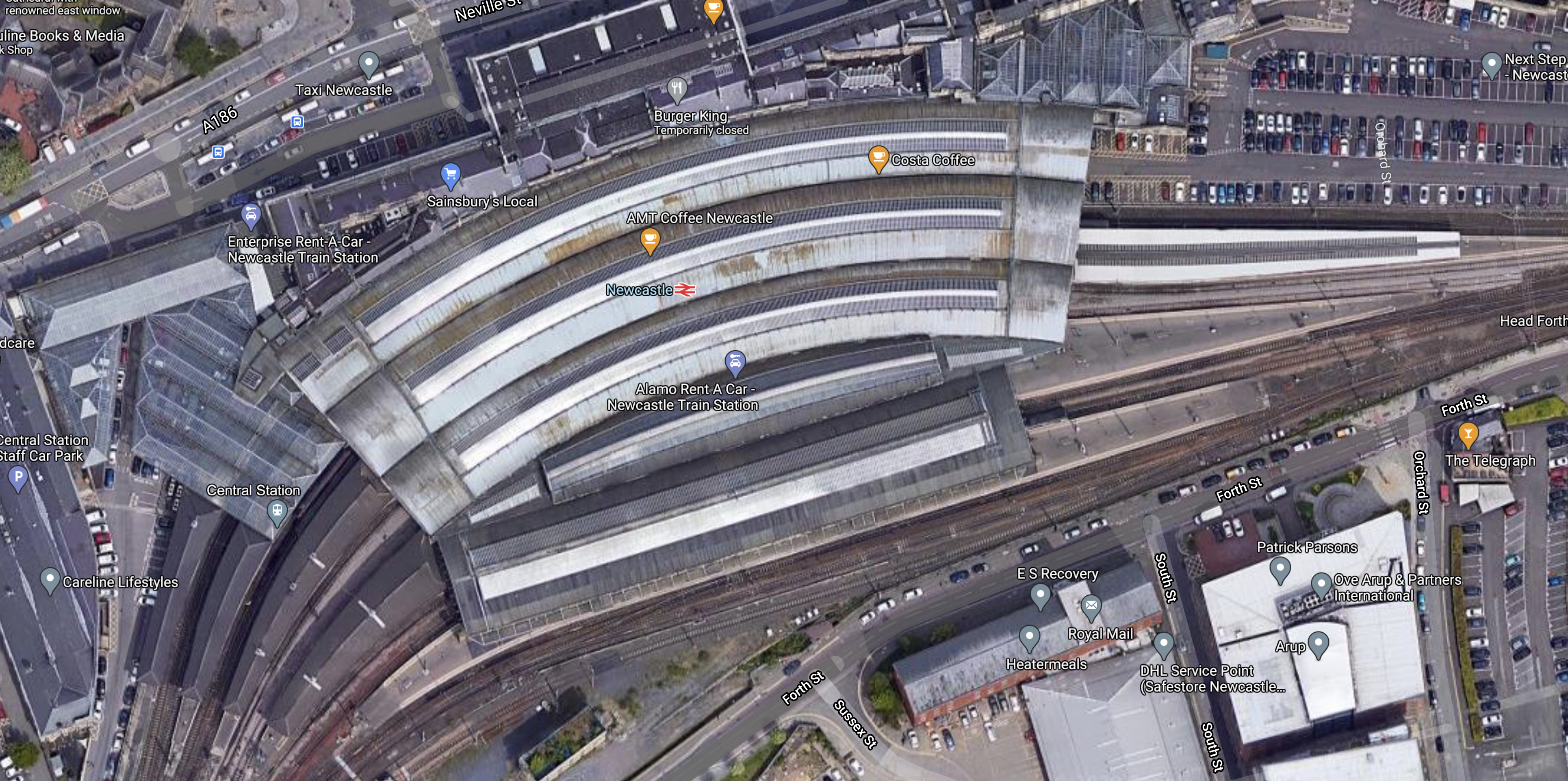
Look at this Google Map of Newcastle station.
Note.
- It is built on a curve.
- It is on a cramped site.
- Platforms are numbered from 1 at the top to 8 at the bottom.
- Platform 2 seems to be used for all express services going North.
- Platforms 3 and 4 seem to be used for all express services going South.
- Not all platforms would appear to be long enough for nine-car Class 80x trains.
I am certain, that any nation with a sophisticated railway system wouldn’t build a station on a curve with no avoiding lines like Newcastle these days.
Network Rail have a plan to sort out Darlington station and I’m sure they’d like to sort out Newcastle as well!
Current Long Distance Trains Through And To Newcastle
These include.
- CrossCountry – Plymouth and Edinburgh or Glasgow via Alnmouth, Berwick-upon-Tweed and Dunbar.
- CrossCountry – Southampton Central or Reading and Newcastle.
- LNER – King’s Cross and Edinburgh via Berwick-upon-Tweed
- LNER – King’s Cross and Edinburgh via Alnmouth
- TransPennine Express – Liverpool Lime Street and Edinburgh via Morpeth
- TransPennine Express – Manchester Airport and Newcastle.
Note.
- All have a frequency of one train per hour (tph)
- All trains call at Newcastle.
- Two tph terminate at Newcastle and four tph terminate at Edinburgh or beyond.
There is also a new and Edinburgh service from East Coast Trains, that will start this year.
- It will run five trains per day (tpd).
- It will call at Newcastle.
- It will stop at Morpeth between Newcastle and Edinburgh.
There will also be High Speed Two services to Newcastle in a few years.
- There will be two tph between Euston and Newcastle
- There will be one tph between Birmingham Curzon Street and Newcastle.
Note.
- All services will be run by 200 metre long High Speed Two Classic-Compatible trains.
- There is no High Speed Two service to Newcastle, that calls at Leeds.
- Only one High Speed Two service to Newcastle calls at East Midlands Hub.
I suspect High Speed Two services need a dedicated platform at Newcastle, especially, if another High Speed Two service were to be added.
Extra Paths For LNER
In the December 2020 Edition of Modern Railways, there is an article, which is entitled LNER Seeks 10 More Bi-Modes.
This is the last paragraph.
Infrastructure upgrades are due to prompt a timetable recast in May 2022 (delayed from December 2021), from which point LNER will operate 6.5 trains per hour out of King’s Cross, compared to five today. As an interim measure LNER is retaining seven rakes of Mk. 4 coaches hauled by 12 Class 91 locomotives to supplement the Azuma fleet and support its timetable ambitions until new trains are delivered.
There would certainly appear to be a path available if LNER wanted to increase the frequency of trains between King’s Cross and Edinburgh from the current two trains per hour (tph) to three.
I laid out how I would use this third path to Edinburgh in A New Elizabethan.
The Possible Long Distance Trains Through And To Newcastle
These trains can be summed up as follows.
- 1 tph – CrossCountry – Plymouth and Edinburgh or Glasgow via Alnmouth, Berwick-upon-Tweed and Dunbar.
- 1 tph – CrossCountry – Southampton Central or Reading and Newcastle.
- 1 tph – LNER – King’s Cross and Edinburgh via Berwick-upon-Tweed
- 1 tph – LNER – King’s Cross and Edinburgh via Alnmouth
- 1 tph – TransPennine Express – Liverpool Lime Street and Edinburgh via Morpeth
- 1 tph – TransPennine Express – Manchester Airport and Newcastle.
- 5 tpd – East Coast Trains – King’s Cross and Edinburgh via Morpeth
- 2 tph – High Speed Two – Euston and Newcastle
- 1 tph – High Speed Two – Birmingham Curzon Street and Newcastle
- 1 tph – LNER – King’s Cross and Edinburgh – Extra service
This is ten tph and the five tpd of East Coast Trains.
Capacity Between Newcastle And Edinburgh
I wonder what capacity and linespeed would be possible on the East Coast Main Line between Newcastle and Edinburgh.
There are a few freight trains and some suburban electrics at the Northern end, but I suspect that the route could handle ten tph with some upgrades.
Edinburgh As A Terminal
Consider.
- Not all trains terminate at Edinburgh, but several tpd go through to places like Aberdeen, Glasgow, Inverness and Stirling.
- Edinburgh has several shorter East-facing bay platforms, that can take five-car Class 802 trains.
- Edinburgh has undergone a lot of reconstruction in recent years, so that it can turn more trains.
I very much feel that Edinburgh could handle, at least ten tph from the South.
Conclusion
I think it would be possible to extend all trains to Newcastle to at least Edinburgh.
Would it increase passenger capacity between the two capitals?
It would certainly avoid the difficult and expensive rebuilding at Newcastle station.
Thoughts On Seating In East Coast Trains’ New Class 803 trains
This page on RailAdvent contains this YouTube video of one of East Coast Trains’ New Class 803 trains under test.
On this page on the First Group web site, they give some details of the service.
- Five trains per day, seven days per week in both directions.
- One class of travel
- Offer tickets at an average price of less than £25.
- At seat catering on every train.
- Introduce an additional 1.5 million seats on the route every year.
They also expect 80 % of passengers to be new to rail.
The internet doesn’t give the number of seats on the train, so I will estimate a number.
The number of trains per year will be at least 365 * 2 * 5, which is an easy 3650 trains.
Dividing this into 1.5 million gives 410.9 seats per train. I’ll call that 411.
After I made that estimate, I found this page on the Beacon Rail Leasing web site.
It gives this information.
- Power – 4.5 MW
- Speed – 125 mph
- Passenger Capacity – 400
- Weight – 228.5 tonnes
Using the figure of 400 passengers and 3650 trains per year, that gives a total number of 1,460,000 passengers per year, which is probably within the margin of error for the arithmetic of marketing experts.
If you watch the video, the following can be ascertained.
- The two driver cars have six large windows each.
- The three centre cars have nine large windows each.
- It looks like the seating in the train is three on one side and two on the other.
This picture shows the Standard Class seating bay layout on a Great Western Railway Class 802 train.
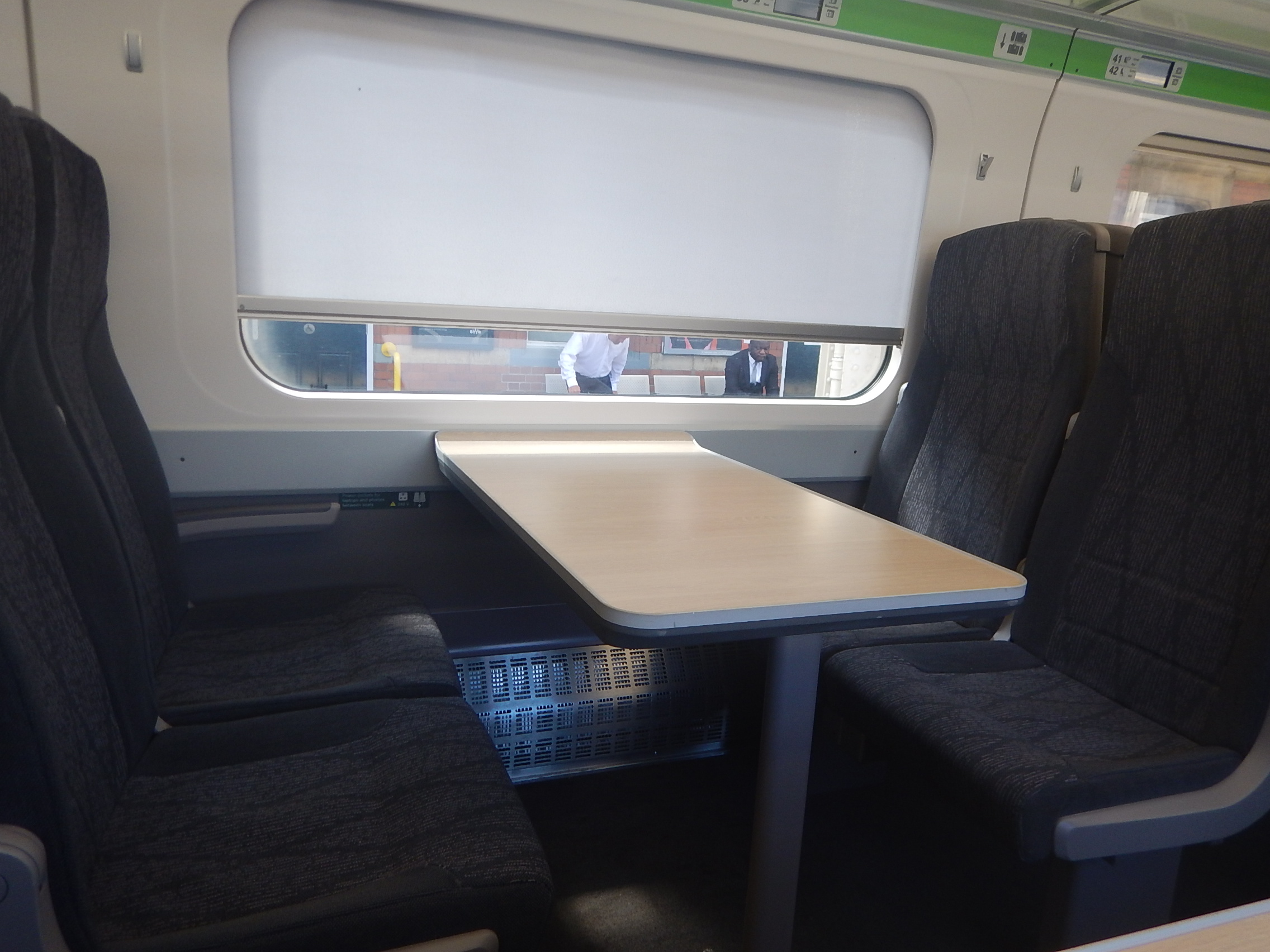
Note.
- The seats are arranged either side of the window.
- There are lots of tables.
- If the blind was up, passengers will get a good view.
If as I surmised from the video, seating is two+three and there are 39 bays, that means that the train has a base seating capacity of 390 seats.
That leaves ten seats to find places for, or just two per car.
With two+two seating, there would be 312 seats in the bays under windows, so there would be a need to fit in another 86 seats.
It appears to me that to meet their objective of 1.5 million additional seats that a two+three layout is needed.
But it could be that most passengers will get a proper table and possibly reasonable leg room. Try getting that on a budget airline!
A Few Questions
These are a few questions.
When Will The Service Start?
Your guess is as good as mine, but First Group are saying Autumn 2021.
Is The Service Geared For Group Or Family Travel?
Each train has thirty-nine groups of six seats and the same number of groups of four seats.
If say it was granny’s birthday in Edinburgh or a group of six friends were going to Scotland-England at Murrayfield, the layout would accommodate groups and families well.
They certainly need a good seat allocation algorithm.
Will I Be Able To Use My Railcard?
I would suspect not!
But then it would only save £8.33!
What About Delay Repay?
This will be automatic! I can’t ever be bothered to claim otherwise!
Will There Be Disabled Toilets?
It’s the law! But I have seen some much smaller ones that are well-designed and meet all aspects of the law in some new trains, so I would expect to find innovative designs.
Will There Be Single Seats?
I can sleep anywhere and regularly find myself returning to London curled in the corner of my seat fast asleep.
A single seat in the corner of the carriage might be ideal for some passengers.
Will Everybody Get A Table?
If I’m right about each seating bay having a table, then it would look like around ninety-seven percent of passengers would get a proper table. Not big enough for a copy of the Daily Telegraph, but they should have enough space for a laptop and/or a few beers.
What Food And Drink Will Be Offered?
I suspect, it will mainly be drinks and snacks like crisps or nutrition bars, which can be easily served from a trolley.
It should be noted that the three major stations on the route King’s Cross, Newcastle and Edinburgh all have a good selection of places to buy a carry-on!
But unlike at an airport, I suspect passengers won’t turn up two or three hours before departure, so will be unlikely to eat before departure.
I do think, that we could see improvements in the food offerings for taking on the train at Stevenage and Morpeth.
East Coast Trains may also contribute to the development of carry-on shops at some stations.
Will The Trains Accept Bicycles?
This is a tricky one and personally I feel that offering a decent bike hire service could be better value all round.
Using The Fleet Of Five Trains
Wikipedia and other sources indicate that the fleet is just five trains.
We know these facts or proposals.
- King’s Cross and Edinburgh are 393.15 miles apart.
- LNER run trains between King’s Cross and Edinburgh in four hours and twenty minutes (4 stops) and four hours and forty minutes (9 stops)
- The record time between King’s Cross and Edinburgh was set in 1991 by a shortened all-electric InterCity 225 train at three hours twenty-nine minutes and thirty seconds, which represented an average speed of 112.5 mph.
- Trains start leaving King’s Cross and Edinburgh about 05:45.
- The Werrington Dive-Under will, be completed in 2021.
- The King’s Cross Remodelling should be completed this year.
- Full digital in-cab signalling is being installed between King’s Cross and Doncaster. This will allow 140 mph running and as a Control Engineer, I believe it could ease the bottlenecks at Newark and over the Digswell Viaduct.
- East Coast Trains’ Class 803 trains appear to have been designed for sparkling acceleration.
- East Coast Trains will only make three stops.
- East Coast Trains intend to compete with the budget airlines.
- East Coast Trains intend their first train to arrive in London by 10:00. Does that mean Edinburgh as well?
I have just checked on Real Time Trains and this East Coast Trains timetable can be found.
King’s Cross and Edinburgh
- 05:45 – Arrives 10:10 – 4 hours 25 minutes – Stops at Stevenage
- 10:45 – Arrives 15:17 – 4 hours 32 minutes
- 12:18 – Arrives 16:41 – 4 hours 23 minutes – Stops at Stevenage
- 14:36 – Arrives 19:15 – 4 hours 39 minutes
- 20:18 – Arrives 00:46 – 4 hours 28 minutes
Edinburgh and King’s Cross
- 06:14 – Arrives 10:51 – 4 hours 37 minutes
- 09:11 – Arrives 13:48 – 4 hours 37 minutes
- 11:14 – Arrives 15:46 – 4 hours 32 minutes
- 16:12 – Arrives 20:47 – 4 hours 35 minutes – Stops at Stevenage
- 19:58 – Arrives 01:05 – 5 hours 7 minutes – Stops at Stevenage
Note.
- Times appear to be in-line with those of LNER.
- East Coast Trains’ objective of arriving by 10:00 is not met.
- Paths exist for East Coast Trains from the 7th June.
I believe this timetable is based on what is possible today without the improvements at King’s Cross and Werrington, and the digital signalling.
What Could Be Possible?
Consider.
- The improvements that are underway will help to reduce journey times.
- I also believe that by being clever, East Coast Trains could reduce turn-round times at King’s Cross and Edinburgh.
I think it is likely, that East Coast Trains could probably run between King’s Cross and Edinburgh in a time of around four hours.
I can also see a turn-round time of five minutes, if East Coast Trains use all their First Group experience.
Could this mean, a train starting from King’s Cross doing the following trips in a day?
- 05:50 – King’s Cross to Edinburgh – Arrives 09:50
- 09:55 – Edinburgh to King’s Cross – Arrives 13:55
- 14:00 – King’s Cross to Edinburgh – Arrives 18:00
- 18:05 – Edinburgh to King’s Cross – Arrives 22:05
- 22:10 – King’s Cross to Edinburgh – Arrives 02:10
Note.
- A second train would mirror this time-table starting in Edinburgh.
- Every minute saved on each journey between King’s Cross and Edinburgh will bring the final arrival forward.
- There is tremendous potential to speed up services.
This time-table would be straight out of Michael O’Leary’s notebook about making assets sweat.
Conclusion
I think that East Coast Trains have done a Ryanair and designed the train to accommodate the maximum number of passengers. But the quoted £25 fare does appear to be good value.
I am certain that two+three seating will be used.
 The Anonymous Widower