A Very Busy Paddington – 4th July 2023
On my trip to Marsh Barton station, Paddington was very busy, as these pictures show.

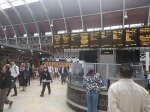



Note.
- Trains were leaving to Cheltenham Spa, Great Malvern. Newquay and Paignton, in addition to the more expected destinations of Bristol Temple Meads, Cardiff and Swansea.
- I took the Elizabeth Line to the station and it was very busy.
I feel, that action needs to be taken to increase the capacity of the station for both passengers and trains.
These are my thoughts.
Catching Trains From Reading
Recently, if I want to go somewhere, that is within an hour West of Reading station, I’ve started taking the Elizabeth Line to Reading using my Freedom Pass and then buying an Off Peak Day Return ticket from Reading.
- It saves a few pounds.
- I can catch the Elizabeth Line train at Moorgate direct to Reading, after having breakfast on Moorgate.
- Moorgate is an easy bus ride from outside my house.
I suspect some other Freedom Pass holders will start to use Reading station to go West.
The only disadvantages are that you miss the Reading train and have to wait half-an-hour for another and that buying tickets at Reading means leaving the station.
Improvements, I would make would include.
- Four trains per hour (tph) between Whitechapel and Reading.
- A ticket machine on the bridge at Reading station, so that those needing a ticket can buy one without leaving the station.
I suspect other improvements could also improve this option.
A Second Concourse At The Western End Of Paddington Station
If you go to Paddington station on the Hammersmith and City Line of the Underground, you can walk across the top of the main station and take stairs down to the platform for your departing train.
There has been talk of improving this area of the station, so that passengers using that route from the Underground have an easier route with more facilities like cafes, shops and toilets.
I’m all for this improvement.
What Is The Point Of Heathrow Express?
On my trip, I watched a Heathrow Express arrive in Paddington and just a few people got off.
I am utterly certain, that the Elizabeth Line is giving Heathrow Express a good kicking, as it is so much better connected to the important destinations within London, like Bond Street, Canary Wharf, Farringdon for Thameslink, Liverpool Street for The City, Stratford for events and Whitechapel for the East London Line.
Discussions of the future of Heathrow Express, must also include the Western Rail Link to Heathrow, which is currently being planned by Network Rail.
This page on the Network Rail web site gives more details, including these benefits for the link.
- Reduce rail journey times between Reading and Heathrow by delivering a new, faster, frequent, more reliable direct train service to Heathrow with four trains per hour in each direction. All trains would call at Reading and Slough and alternate trains at Twyford and Maidenhead. Journey times could be as short as 26 minutes from Reading and 6 to 7 minutes from Slough.
- Significantly improve rail connectivity to Heathrow from the Thames Valley, South Coast, South West, South Wales and West Midlands.
- Provide an alternative form of transport for passengers and the large number of people who work at the airport who are currently travelling by road.
- Ease congestion on some of the UK’s busiest roads, the M4, M3 and M25 resulting in lower CO2 emissions equivalent to approximately 30 million road miles per year, helping to deliver the UK’s climate change and carbon reduction targets.
- Generate economic growth and new jobs across the Thames Valley and surrounding areas.
- Reduce passenger congestion at London Paddington.
There is then the question of who should run the service; Heathrow Express, the Elizabeth Line or both.
At the present time, trains from London to Heathrow are.
- Elizabeth Line – 2 tph – Shenfield and Terminal 5
- Elizabeth Line – 4 tph – Abbey Wood and Terminal 4
- Heathrow Express – 4 tph – Paddington and Terminal 5
Note.
- All trains also serve Heathrow Terminals 2 and 3.
- The Piccadilly Line also serves all Heathrow Terminals.
- It appears that Terminal 4 is only served by the Elizabeth Line.
- Terminal 5 has 6 tph, but the Western Rail Link will be at a frequency of four tph.
Because of the mismatch at Terminal 5 and that two tph will stop at Slough, Maidenhead and Twyford, I suspect we might see the following services on the Western Rail Link
- Elizabeth Line – 2 tph – Terminal 5 and Reading via Slough, Maidenhead and Twyford
- Heathrow Express – 2 tph – Terminal 5 and Reading via Slough.
Note.
- This would give Reading and Central London, a much-needed four tph on the Elizabeth Line. Two tph would be direct and two tph would be via Heathrow.
- It would not require any more paths in the Elizabeth Line Central Tunnel, as the 2 tph between Shenfield and Terminal 5 will just be extended to Reading.
- Heathrow Express has Western access with a connection to Reading.
It looks like this service pattern could be a good compromise.
I also suspect that this would improve passenger numbers for Heathrow Express.
Could Heathrow Express Run Its Service Using One Platform At Paddington?
I am fairly certain that this would be possible, if passenger access to the platforms at Paddington station were to be improved, by the building of a second concourse at the Western end of the station.
It is also likely, that full digital signalling will be applied between Paddington and Reading and this will surely improve the ease of running four tph into one platform at London Paddington for Heathrow Express.
I can see, that a reorganisation of Heathrow Express after the building of a second Western concourse at Paddington and the Western Rail Link to Heathrow, that Heathrow Express could be able to release a platform.
Could Great Western Railway Reorganise Suburban Services?
These are Great Western Railway’s suburban services, that terminate at Paddington.
- 1 tph – London Paddington and Oxford via Reading and Didcot Parkway
- 2 tph – London Paddington and Didcot Parkway via Slough, Maidenhead, Twyford, Reading, Tilehurst, Pangbourne, Goring & Streatley and Cholsey
- 1 tph – London Paddington and Newbury via Reading, Theale and Thatcham
Note.
- The Oxford services, are run by Class 800 trains, running as either five-car, nine-car or ten-car trains.
- Oxford is also served by the hourly Paddington and Great Malvern service.
- All of the other services, are run by Class 387 trains, running as either four-car or eight-car trains.
- There doesn’t seem to be any pattern to the platforms used by these services.
I find the last point very surprising, as my extensive scheduling experience says that it is easier to schedule several similar processes, rather than a number of different ones.
This OpenRailwayMap shows the platforms at Paddington station.
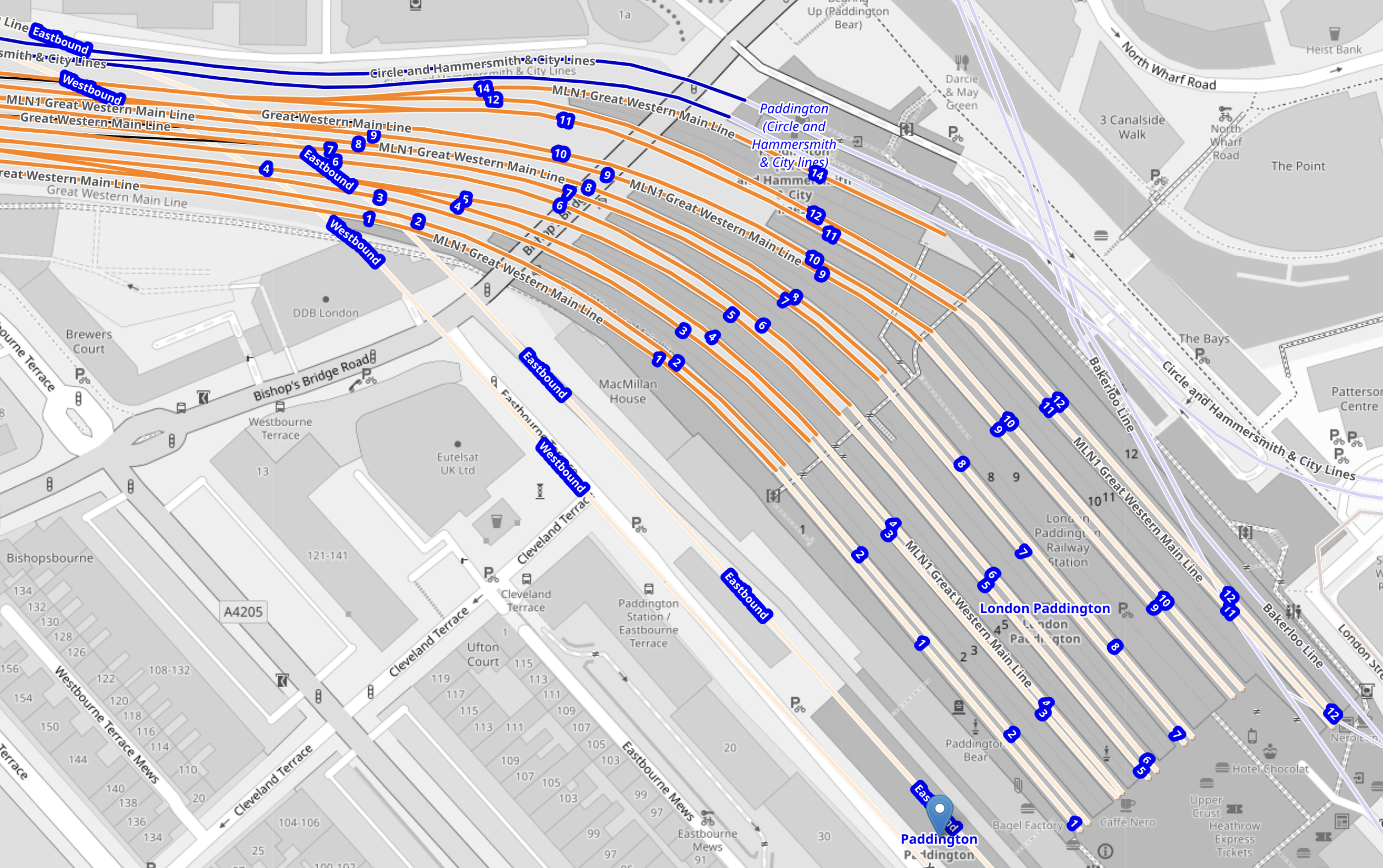
Note.
- The platforms are numbered 1 to 14 from South-West to North-East.
- Platforms 1 to 12 all appear to long platforms about the same length.
- As some platforms can take ten-car Class 800 trains, I wouldn’t be surprised to find out all platforms 1-12 can.
- The only short platform is platform 14, which can accommodate an eight-car Class 387 train, which is 163 metres long.
It looks to me, with twelve long similar platforms, they can schedule the platforms on the fly, so perhaps this explains, the randomness of platform allocations.
I think in an ideal world, I would try and organise these services as follows.
- The Oxford and Great Malvern services could share a platform at Paddington, which would help passengers to find the next Oxford train.
- The Didcot Parkway and Newbury services could also share a platform at Paddington, for the same reason.
- Unless Didcot Parkway and Newbury services are occasionally run by a twelve-car train, they could even use the short platform 14.
This would surely be a more efficient use of the platforms at Paddington station.
Could Didcot Parkway Services Become Another Elizabeth Line Destination?
Consider.
- Didcot Parkway to London Paddington services appear to use the same tracks as Elizabeth Line services between Reading and Southall West Junction, where they change to the main line for Paddington.
- London Paddington to Didcot Parkway services appear to use the main line from Paddington to Dolphin Junction, which is just to the East of Slough station, where it joins the same tracks as Elizabeth Line services to Reading.
- Nine-car Class 345 trains are forty metres longer than an eight-car Class 387 train.
- Class 345 trains are 90 mph trains.
- Class 387 trains are 110 mph trains.
- Class 387 trains wouldn’t fit the platform edge doors in the Elizabeth Line Central Tunnel.
It would appear that the Didcot Parkway and London Paddington services could be moved to the Elizabeth Line, by doing the following.
- The Class 387 trains would be replaced by Class 345 trains.
- Trains to London would go straight on at Southall West Junction and through the Elizabeth Line Central Tunnel.
- Trains from London would emerge from the Elizabeth Line Central Tunnel on the right track for Reading.
- There might be a need to lengthen a few platforms.
Note.
- The Didcot Parkway to London Paddington services would not need to use the main line.
- 2 tph would be removed from Paddington station.
As one electric train is being replaced by another, there would probably be no need for more electrification.
Could Newbury Services Become Another Elizabeth Line Destination?
Consider.
Freight trains appear to be able to go from Theale station to Platform 5 at Slough station, through Platform 15 at Reading station, which is a possible route that a Newbury to the Elizabeth Line Central Tunnel train would take.
Freight trains appear to be able to go from Platform 4 at Slough station to Theale station, through Platform 15 at Reading station, which is a possible route that an Elizabeth Line Central Tunnel to Newbury train would take.
It would appear that the Newbury and London Paddington services could be moved to the Elizabeth Line, by doing the following.
- The Class 387 trains would be replaced by Class 345 trains.
- Trains through Reading would follow the freight route.
- There might be a need to lengthen a few platforms.
Note.
- The Newbury to London Paddington services would not need to use the main line.
- 1 tph would be removed from Paddington station.
As one electric train is being replaced by another, there would probably be no need for more electrification.
Conclusion
It looks like the capacity of Paddington station can be increased by the following.
- Building a new second concourse at the Western end of the station.
- Heathrow Express releasing a platform.
- Oxford and Great Malvern services could share a platform at Paddington
- Moving Didcot Parkway and Newbury services to the Elizabeth Line.
No new electrification would be required.
Marsh Barton Station – 4th July 2023
The main purpose of my trip to Devon was to visit the new Marsh Barton station, on the Riviera Line.

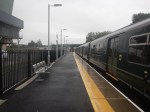
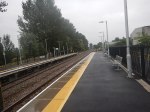
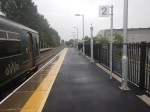
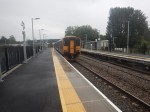
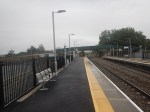
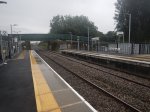
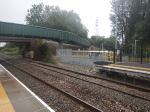
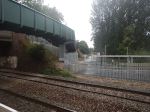
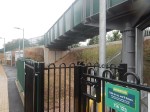
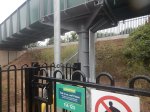
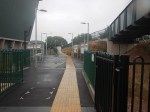
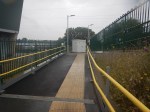
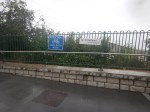
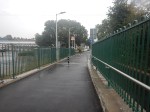
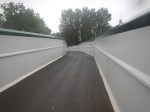
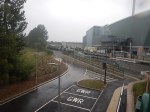
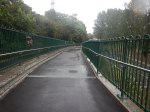
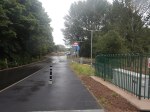
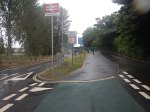
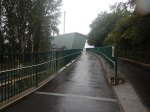
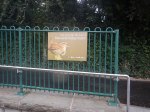
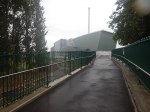
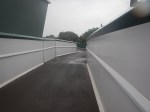
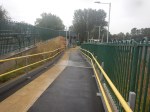
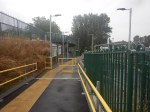
These are my thoughts about the station.
The Overall Design
This Google map shows Marsh Barton station under construction.
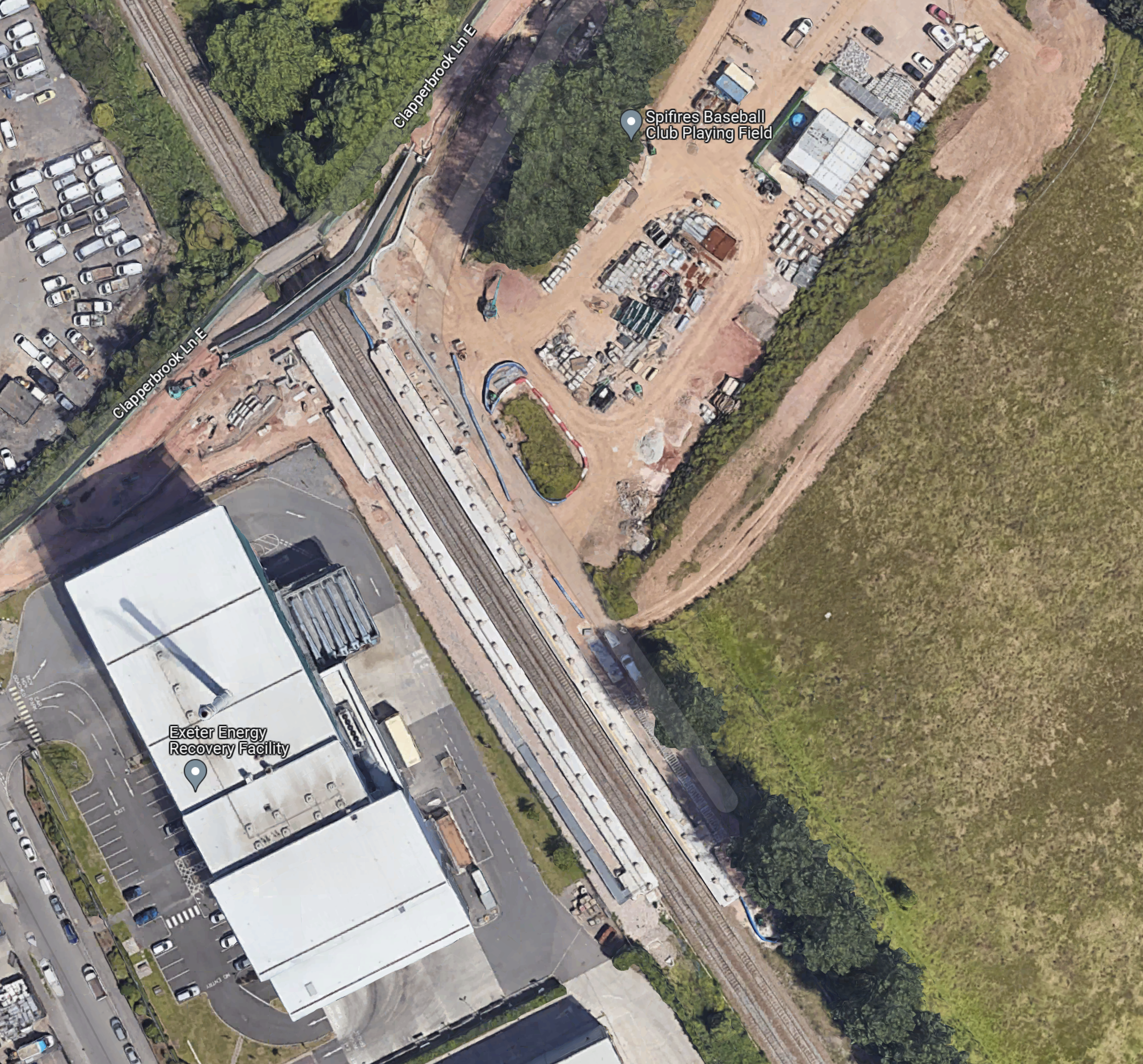
The station is built on a narrow lane by an industrial estate, which features a large waste-to-energy facility, which is in the South-West corner of the map.
The station is a basic two platform design with everything you need on the platforms and a gently sloping bridge over the top to give full step-free access.
I’ve never been to a station, which uses this form of step-free access, either in the UK or Europe.
I think it works because of the unusual site.
Car Parking
The station’s page on the GWR web site, says this about parking.
The station only has disabled parking bays for blue badge holders in order to encourage more sustainable transport use to and from the station.
Staff
The station is unstaffed.
Refreshments
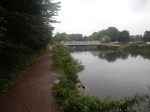
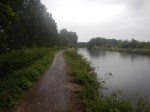
When I arrived, I was hungry and needed a drink, so I asked a guy with a dog, if there was a cafe or pub nearby.
He said, the cafe shut the day before, but there was a pub called Double Locks about three or four minutes away on the canal.
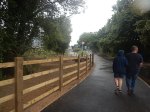
These pictures show the walk.


And this map shows the location of the pub and the station.
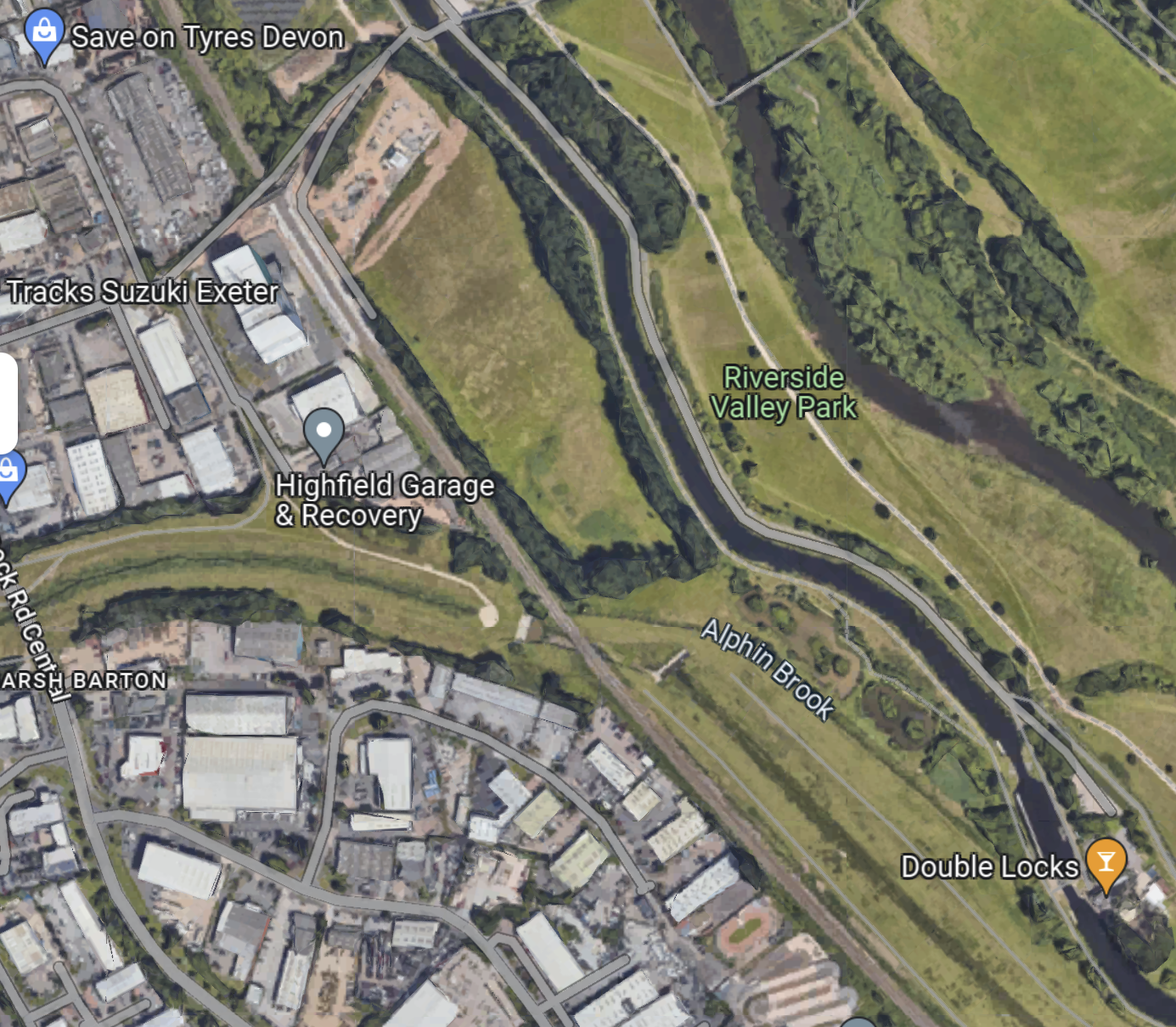
Are country minutes like country miles and a lot longer than those everybody else uses?
In the end, as I was getting soaked, I made a retreat back to the station.
Service Frequency
Currently, the trains are only hourly. Is that enough?
Exeter St. Davids To Dawlish – 4th July 2023
I took these pictures as I travelled between Exeter St.Davids and Dawlish stations.




























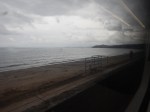
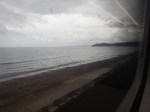
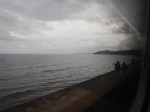
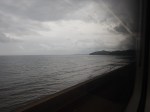

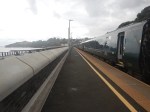
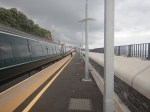
This OpenRailway map shows the route of the line between Exeter St. Davids and Plymouth stations.

Note.
- The line is shown in orange.
- Exeter St. Davids station is at the top of the map.
- The blue arrow marks the position of the new Marsh Barton station, which opened to the public today.
- Stations in order from the North on the line are Starcross, Dawlish Warren, Dawlish, Teignmouth and Newton Abbot.
- The line follows the Western bank of the River Exe to the sea.
- On my view, it is one of the most spectacular rail lines in the UK.
But the sea can get very angry, as I saw in An Angry Sea At Dawlish.
Marsh Barton Station Will Open On Tuesday, 4th July 2023
This is said on this page on the Great Western Railway web site.
The station is due to open on Tuesday 4 July 2023.
This Google map shows Marsh Barton station under construction.
Note.
- The two five-car platforms.
- The pedestrian and cycle bridge over the tracks at the Northern end of the station.
- I would assume, that the bridges have been made high enough over the tracks for electrification.
The page on the Great Western Railway web site also has a couple of videos showing construction of the station.
Services
The page on the Great Western Railway web site also says this about services at the station.
Marsh Barton will be served by our local services between Paignton and Exmouth which run through the heart of Exeter.
We aim to provide hourly off-peak services to the station with additional trains stopping at peak times.
Currently, there is an hourly train that stops at all stations between Exmouth and Paignton, which will probably be the main service.
In addition five long distance services will pass through Marsh Barton station.
- Two trains per day (tpd) – London Paddington and Paignton via Reading, Newbury, Hungerford, Pewsey, Westbury, Castle Cary, Taunton, Tiverton Parkway, Exeter St. Davids, Dawlish, Teignmouth, Newton Abbot, Torre and Torquay
- Three tpd – London Paddington and Plymouth via Reading, Newbury, Hungerford, Pewsey, Westbury, Castle Cary, Taunton, Tiverton Parkway, Exeter St. Davids, Dawlish, Teignmouth, Newton Abbot, Totnes and Ivybridge
- One train per two hours (tp2h) – London Paddington and Plymouth via Reading, Taunton, Tiverton Parkway, Exeter St Davids, Newton Abbot and Totnes.
- One tp2h – London Paddington and Penzance via Reading, Taunton, Tiverton Parkway, Exeter St Davids, Newton Abbot, Totnes, Plymouth, Liskeard, Bodmin Parkway, Par, St Austell, Truro, Redruth, Camborne and St Erth.
- One tp2h – Cardiff Central and Penzance via Newport, Severn Tunnel Junction, Patchway, Filton Abbey Wood, Bristol Temple Meads, Nailsea & Backwell, Yatton, Worle, Weston-super-Mare, Highbridge & Burnham, Bridgwater, Taunton, Tiverton Parkway, Exeter St Davids, Dawlish, Teignmouth, Newton Abbot, Totnes, Ivybridge, Plymouth, Devonport, Dockyard, Keyham, St Budeaux Ferry Road, Saltash, St Germans, Menheniot, Liskeard, Bodmin Parkway, Lostwithiel, Par, St Austell, Truro, Redruth, Camborne, Hayle and St. Erth
Note.
- The fifth train is definitely what you would call a stopping train.
- All the through expresses stop at Taunton, Tiverton Parkway, Exeter St Davids and Newton Abbot.
- The stopping service, the Paignton trains and some Plymouth trains stop at Dawlish and Teignmouth.
- All trains stopping at Plymouth, stop at Totnes.
- The Paignton and Plymouth services are run using Class 802 trains.
- The fifth stopping service is run by a GWR Castle.
- Marsh Barton station has been built for five-car Class 802 trains.
As the GWR Castles are being retired and will probably be replaced by more Class 802 trains, we are very likely to see more Hitachi trains working between Taunton and Penzance via Tiverton Parkway, Exeter St Davids, Dawlish, Teignmouth, Newton Abbot, Totnes, Plymouth, Liskeard, Bodmin Parkway, St Austell, Truro, Redruth, Camborne and Hayle.
Over 10,000 People Use Reopened Dartmoor Line In First Two Weeks
The title of this post, is the same as that of this press release from the Dartmoor Line.
These are the first three paragraphs of the press release.
More than 10,000 people have travelled on the Dartmoor Line in the first two weeks since its reopening.
The line reopened for regular year-round, all-week passenger services on Saturday 20 November and demand for the trains linking Okehampton and Exeter has continued to remain high.
The reopening of the Dartmoor Line is the first of the Government’s Restoring Your Railway schemes, made possible thanks to over £40 million Government investment.
All concerned must be very pleased, especially as it was delivered £10 million under budget and within nine months, ahead of time.
I described my first use of the new route to Okehampton in A Few Hours In Okehampton, where I came to this conclusion.
Exeter and Okehampton is a well-thought out reopening, that will be welcomed in the South West of England.
It would appear the passenger numbers confirm my conclusion.
Since my visit to Okehampton, I have wondered, whether the apparent success of the Okehampton reopening, would have any other effects.
In the December 2021 Edition of Modern Railways, there is an article, which is entitled South West Seeks More Reopenings, with a sub-title of Okehampton Service Could Be A Precursor.
The article details a number of projects.
Marsh Barton Station
A new Marsh Barton station is under construction and has a December 2022 opening date.
Edginswell Station
A new Edginswell station is being planned to serve Torbay Hospital on the Riviera Line, with a possible opening of 2025.
Collumpton And Wellington Stations
The last budget chipped in five million, so that preferred options and a full business case can be developed for these two new stations.
- Collumpton station will probably be developed at the site of the old station, which is close to Collumpton Services on the M5.
- Wellington station will probably be on a new site at Longworth Farm, where five hundred houses are being developed.
The Modern Railways article also says this about housing.
Thousands of houses are expected to be built in both towns in the next decade, making provision of railway stations highly desirable to avoid soaring road congestion.
Network Rail and Great Western Railway also seem to be experimenting with different service patterns through the two stations.
- Both hourly and two-hourly services have been tested.
- In the December 2021 timetable there is now a two-hourly GWR Castle service over the Taunton and Exeter stretch, that will call at the two new stations, when they open.
- To have an hourly service there will also be a Taunton and Exeter shuttle.
This service would provide access to education and employment in Exeter, Taunton and Bristol.
The cost benefit ratio is above the Government’s limit for backing of two.
Opening of the two new stations is pencilled in for 2025.
Barnstaple And Axminster
The Modern Railways article also says this.
As part of the Devon Metro concept, Devon County Council aspires to extend further eastwards the hourly Barnstaple services that currently terminate at Exeter Central, perhaps as far as Axminster.
This would need track improvements East of Pinhoe station.
The current timings of the two sections are as follows.
- Exeter Central and Axminster – 37 minutes
- Exeter Central and Barnstaple – 74 minutes
These timings probably mean that a round trip between Axminster and Barnstaple can be done in a convenient four hours, so an hourly service would need four trains.
From sometime next year, when the frequency of the Exeter Central and Okehampton service becomes hourly, the services along the route will be as follows.
- Exeter St. Davids and Axminster – Hourly
- Exeter Central and Barnstaple – Hourly
- Exeter Central and Okehampton – Hourly
There is also a service, that runs every thirty minutes between Exmouth and Paignton via Exeter Central and Exeter St. Davids, Newton Abbot and Torquay.
The frequencies on the various sections would be as follows.
- Barnstaple and Crediton – One tph
- Okehampton and Crediton – One tph
- Crediton and Exeter St. Davids – Two tph
- Paignton and Exeter St. Davids – At least two tph
- Exeter St. Davids and Exeter Central – Five tph
- Exeter Central and Axminster – One tph
- Exeter Central and Exmouth – Two tph
Note.
- tph is trains per hour.
- Other services run between Exeter St. Davids and Paignton stations.
- In recent years a new station at Cranbrook has opened between Exeter Central and Axminster.
Extending the Barnstaple and Exeter Central service to Axminster would double the frequency on the Exeter Central and Axminster section.
Axminster station is shown in this Google Map.
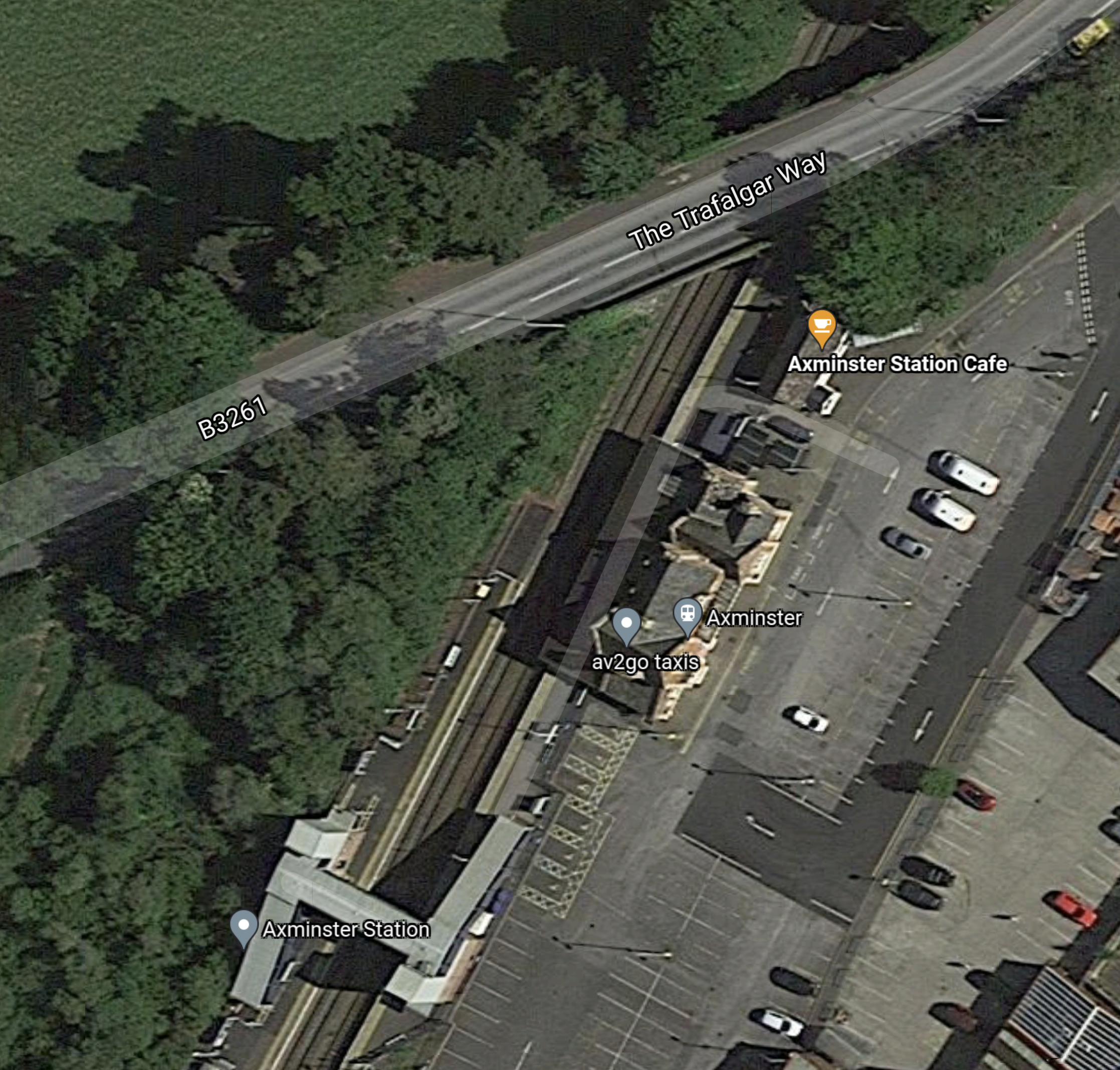
Note.
- The station has two platforms.
- The station appears to have a bridge with lifts.
- The station has a good road connection and the parking could probably be extended.
Axminster station could certainly handle a fast train between London and Exeter, a stopping train to Barnstaple and all the passengers.
Devon Metro
It does appear that the services of the Devon Metro are coming together.
- Paignton and Exmouth is already running.
- Barnstaple and Exeter Central is already running.
- Okehampton and Exeter Central has just started.
- Exeter St. Davids and Taunton via new stations at Collumpton and Wellington is being planned.
- Barnstaple and Exeter Central needs to be extended to Axminster.
How many other cities in the UK could benefit from a metro of this quality?
Bere Alston And Tavistock
The Modern Railways article also says this.
Meanwhile, further west on the former Southern network, restoration of services from Bere Alston to Tavistock has long been proposed, giving Tavistock a rail link to Plymouth. Christian Irwin, Network Rail’s Industry Programme Manager (South West), who oversaw the Okehampton reopening that came in early and underbudget, says he is keen to repeat the trick on the Tavistock route.
It is probably more difficult than at Okehampton.
- The trackbed is mainly intact, but the track has been lifted.
- The track to be laid is shorter than at Okehampton.
- Two structures at the Southern end need to be replaced.
- A new station needs to be built at Tavistock.
Devon County Council seems to be in control of the land needed.
Proposed services seem to be as follows.
- Plymouth and Gunnislake via Bere Alston – One train per two hours (tp2h)
- Plymouth and Tavistock via Bere Alston – One tph
Overall it looks like the Tavistock project will be more expensive than that at Okehampton, but there would appear to be more contributions from developers.
Devon County Council are hoping that the Tavistock link could be build in the next decade.
Tavistock And Okehampton
After the reconnection of Tavistock to the National Rail network, the council would hope to complete the link between Tavistock and Okehampton.
This would give the following benefits.
- Improved public transport connectivity in West Devon and North Cornwall.
- Improve revenue potential at Okehampton and Tavistock stations.
- Create an easier freight route.
- Create an alternative route, if the coastal route is closed.
It is a challenging project, but I feel it will be possible by perhaps 2035.
Marsh Barton Station – A Ride-To-Work Station
According to this article on pbctoday, work has started at the new Marsh Barton station in Exeter.
This first paragraph from the article makes it clear.
Graham has commenced works on the construction of the new £16m Marsh Barton railway station in Exeter.
This Google Map shows the location.
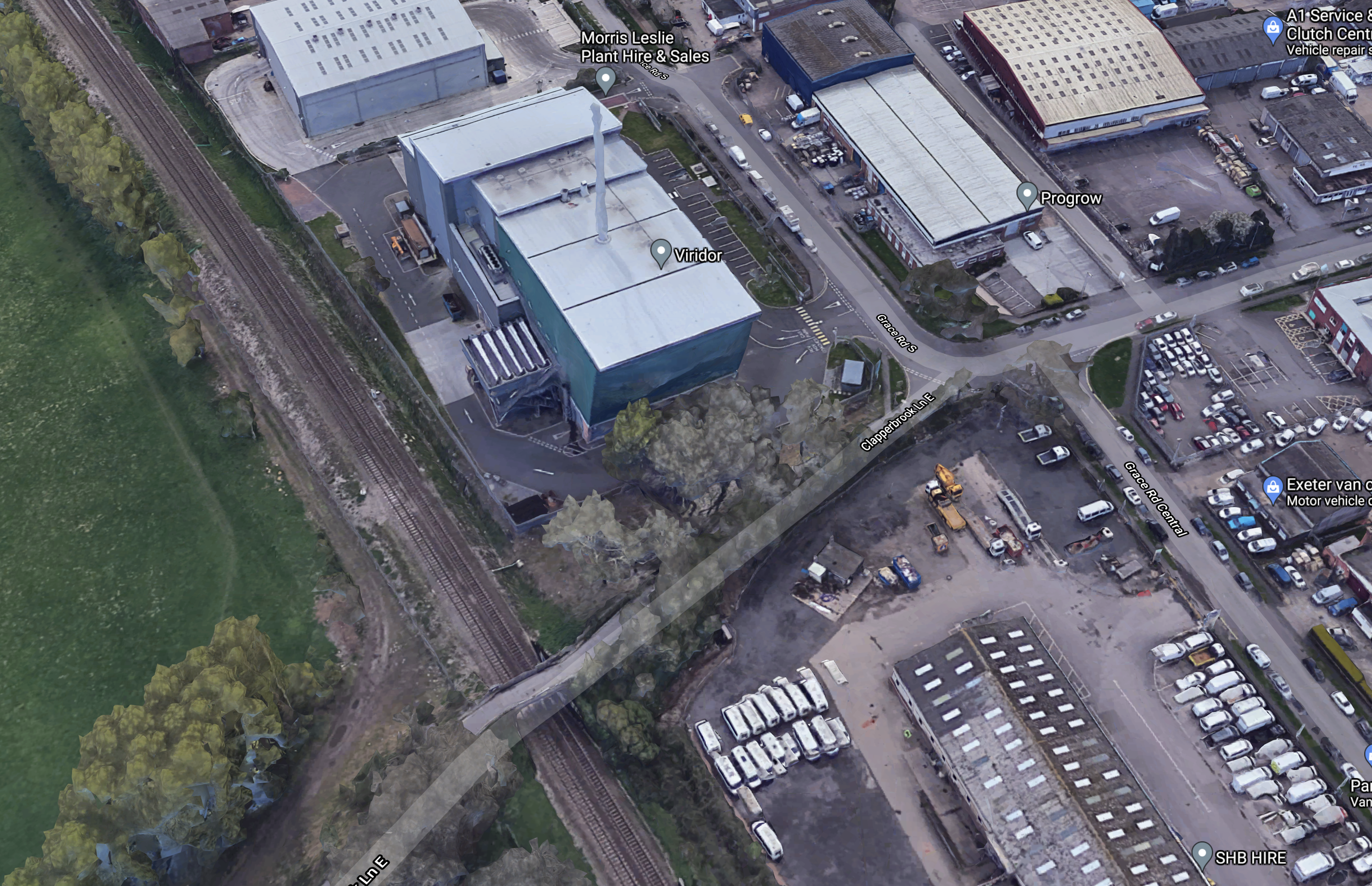
Note.
- The Riviera Line between Paignton and Exeter towards the Western side of the map.
- Clapperbrook Lane running to the South-West corner of the map over the railway.
- The large blue-clad building with the chimney, is the Viridor energy-from-waste plant.
- Marsh Barton itself is a large trading estate to the North-East of the railway.
The station will be built where Clapperbrook Lane crosses the railway,
This document of the Devon County Council (DCC) web site gives more details about the station.
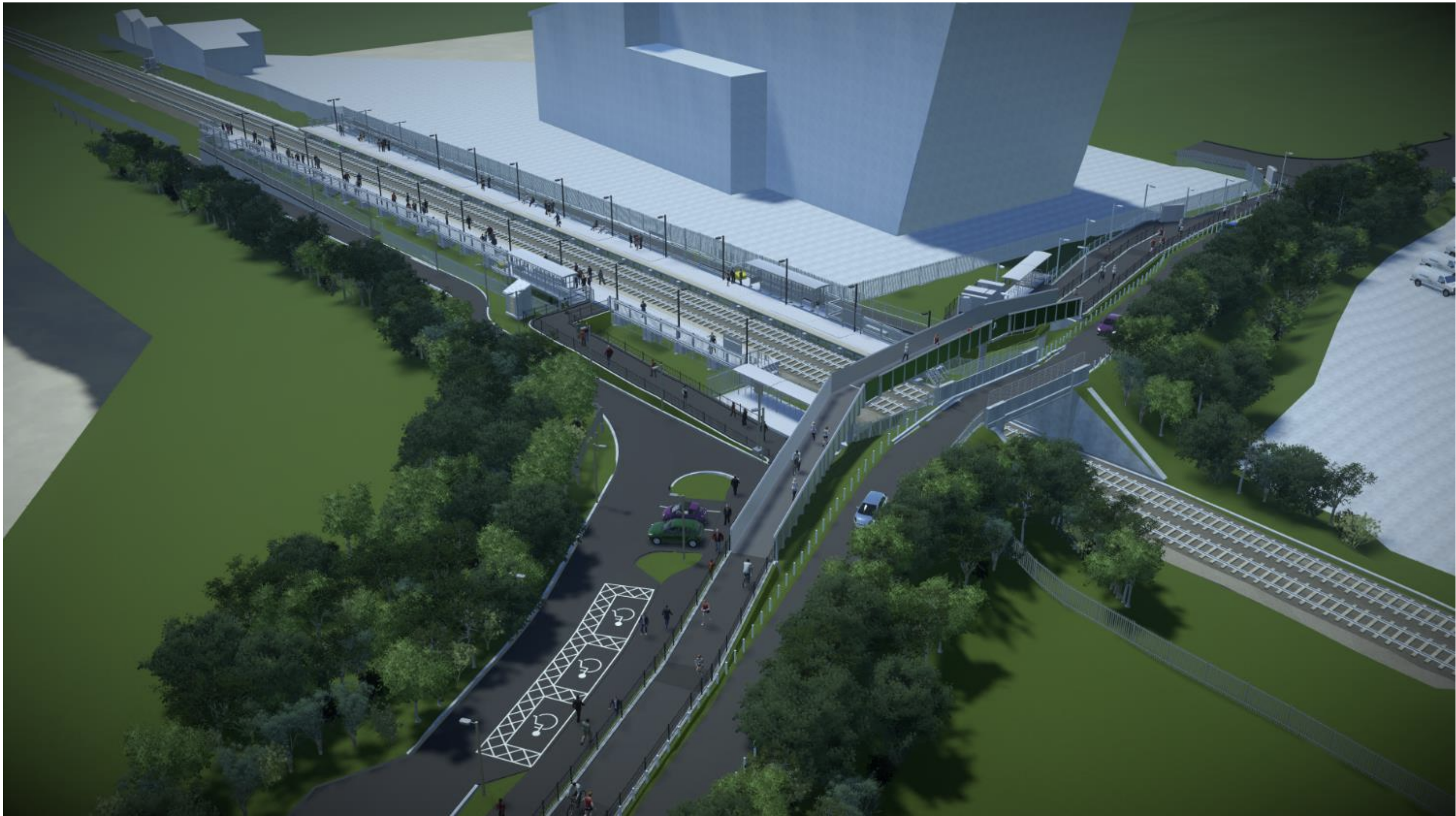
This image from the DCC document shows how the completed station will look.
These are my thoughts.
Crossing The Tracks
A cycle and foot bridge will be built parallel to the current Clapperbrook Lane East Bridge over the railway.
The DCC document says this about the bridge.
The key changes from the previous proposal relates to the ramps and access
between the two platforms. The previous design included ramps running parallel to
the railway, with long ramps and imposing structures due to Network Rail
requirements for their asset. The redesign now includes the ramps and a new bridge
constructed parallel to Clapperbrook Lane. This will instead be a Devon County
Council-owned asset and allows Devon County Council standards to be applied for
their pedestrian bridges. This is more in line with preferences expressed by disability
groups who supported shorter length but slightly steeper gradient with resting
platforms.
It looks to me that the final design will be much more aesthetically-pleasing than some of the structure Network Rail have erected lately.
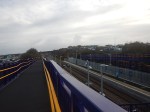
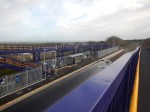
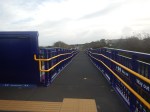
These pictures show Network Rail’s traditional approach at Horden station.

I feel the Devonian approach could be better, when I see it.
From the Google Map 3D image of the station, it looks like the bridge could be already under construction, so I don’t think, I’ll have long to wait.
The Platforms
The DCC document says that there will be two 124 metre long platforms, which will take six-car local trains.
- 3 x 2-car Class 150 trains will be 120.2 metres long
- 3 x 2-car Class 156 trains will be 138.2 metres long
- 2 x 3-car Class 165 trains will be 137.1 metres long
- 1 x 5-car Class 800 train is 130 metres long
It strikes me that although 124 metres can accommodate a formation of three Class 150 trains, it might be too short in the future.
Especially, as trains likely to be available in battery-electric versions, which will surely be used to decarbonise the Riviera Line in the future, all have cars of 23 metres or longer.
Both platforms appear to have just a single waiting shelter.
Cycle Parking
There are twenty parking spaces for cycles on each side of the line.
The DCC document says this about local housing and cycling.
The station will be within reasonable cycling distance of the 2,500 dwelling South
West Exeter strategic allocation and Alphington village and so forms an important
part of mitigating traffic impacts on routes on the western side of the city.
Is there enough provision for the secure storage of cycles?
Disabled Parking
There are just three parking spaces for disabled passengers.
Car Parking
There are no generally-available car parking spaces.
The DCC document says this about car parking.
The scheme will also support aims for low-car development aspirations as part of the
emerging Liveable Exeter housing plans, which includes proposals for strategic
levels of housing in the Marsh Barton area, all within easy walking distance of the
station.
But will the station persuade local residents to forgo driving into Exeter and use the train?
Who Will Use The Station?
The DCC document talks of Marsh Barton station being a destination station for those who work in the area.
It also says this about leisure use.
In addition, the existing Clapperbrook Lane adjacent to the station provides an important link into the Riverside Valley multi-use trail network for leisure trips as well as commuter journeys to RD&E and County Hall, within a short walk/cycle distance of the station. Being located adjacent to a high quality, attractive cycle network offers huge potential to improve integration between rail and cycling.
Currently the lane is very popular with over 400 cyclists per day recorded crossing the rail bridge; however, it is narrow with poor visibility and although lightly trafficked is not suitable for all young families, people with disabilities or people less confident on bicycles.
I have a feeling that the station will need some extra facilities to attract more passengers. Ideas like a drop-off and pick-up facility, a warm place to wait and perhaps a local shuttle bus come to mind.
But as I said in the title it is very much a Ride-To-Work station.
Conclusion
The station has an interesting feature in the bridge over the railway, which gives full step-free access.
But I do feel that some of the details of the station will need some extra thought.
From other pages on the web, it appears the station is being constructed under a Design and Build contract with experienced station builder; Graham Construction. So hopefully, the details will be properly sorted.
The proof of the quality of the design will be in the usage figures.
 The Anonymous Widower