First ‘717’ In UK In June
The title of this post is the same as that of a short article in the May 2018 Edition of Modern Railways.
This is the first paragraph.
The first Class 717 EMU, built by Siemens for Govia Thameslink Railway’s Great Northern suburban services into Moorgate, is due to arrive in the UK in June.
The article also makes these statements, about the new Class 717 trains.
- The first unit is planned to enter service in September.
- The full fleet of 25 x 6-car units will be deployed in Winter 2018.
- The current Class 313 trains will be replaced.
- The new trains will have no toilets or First Class.
- The new trains will have power points and wi-fi.
By virtue of the cross-platform connection between the Northern City Line and Victoria Line, these trains will improve a valuable link between North East London and the City of London.
When Crossrail opens in December 2018 at Moorgate station, the Northern City Line will have a step-free below-ground connection to Liverpool Street station and all the Underground lines serving the two stations.
Ducking and diving will move to a whole new level.
What Will The New Trains Do For Me?
For my own part, if the frequency on the Northern City Line is increased, I shall use the line from Essex Road station to get to Moorgate for Crossrail and the Central Line.
I suspect my house will go up in value!
How Will The New Trains Affect The Service?
The New Trains Are Faster
The current Class 313 trains are 75 mph trains, whereas the new Class 717 trains are 100 mph trains.
This increased operating speed will have two effects, when running on the East Coast Main Line and to Letchworth Garden City.
- Time might be saved.
- As their operating speed is the same as Thameslink’s closely-related Class 700 trains, they might make keeping to time easier.
Time savings on the Hertford Loop Line, will be more difficult, as the line only has a 75 mph operating speed.
However, speed improvements on the Hertford Loop Line would surely result in faster trains to Hertford, Letchworth Garden City and Stevenage.
The New Trains Could Change Voltage Faster
Trains on the Northern City Line need to change voltage at Drayton Park station. I have observed Class 700 trains, do this on Thameslink and they do it without fuss and very reliably.
The Class 717 trains will probably use the same pantograph, so we could be seeing a smoother and faster changeover.
The New Trains Will Probably Be Ready For ERTMS
The Class 700 trains are fitted for ERTMS, so they can work the Thameslink tunnel under Automatic Train Operation.
As this method of signalling and control will be fitted to the East Coast Main Line to improve caacity, the new Class 717 trains will probably be ERTMS-ready.
It should be noted that the Hertford Loop Line has been used as an ERTMS test track and I suspect engineers know the performance improvement ERTMS would bring to the line.
I suspect in a few years, the Northern City Line and services out of Moorgate will be run automatically, with the driver monitoring the system.
The New Trains Will Stop In A Shorter Time At Stations
The new Class 717 trains will have the these advantages of modern trains over the current ones.
- They will be able to accelerate to line speed in a shorter time.
- They will be able to brake faster.
- Wider doors and larger lobbies will enable shorter loading and unloading times.
- The trains will have better systems to help the driver.
These will all result in time savings at each stops.
Currently, the four destinations have the number of stops to Moorgate.
- Hertford North – 49-53 minutes – 12 stops
- Letchworth Garden City – 75 minutes – 19 stops
- Stevenage – 68-72 minutes – 14 stops
- Welwyn Garden City – 47-48 minutes – 16 stops
Because of the high number of stops, saving a minute at each stop would speed up the train service.
Less Trains Could Be Needed For The Current Service
As an example, take the Moorgate to Letchworth service.
The current service is one train per hour (tph), which takes 75 minutes. In its simplest form, allowing for turnround at both ends, trains take up to three hours for the round trip, so three trains are needed for the service.
But if the faster Class 717 trains can save a minute at each stop and run faster on the East Coast Main Line, it might be possible to reduce the round trip to several minutes under two hours. If that is possible, then only two trains would be needed for the route.
Improve The Hertford Loop Line
With its low operating speed of 75 mph, the new Class 717 trains can’t take full sadvantage of their increased speed.
There are already plans for new bay platforms at Gordon Hill and Stevenage stations, so what other plans are being progressed to improve the Hertford Loop Line?
The New Trains Could Have Less Seats And More Capacity
I can only give a rough estimate for this as I can’t find the capacity of a Class 717 train.
These are cars, car length and capacity for various trains.
- Class 707 trains -five x 20 m. – 275 seats + 533 standing
- Class 717 trains – six x 20.2 m. – No figures.
- Class 313 trains – three x 20.2 m. – 232 seats
- 2 x Class 313 trains – six x 20.2 m. 464 seats
A rough calculation for the Class 717 train using the figures for a similar Class 707 train and adjusting for another ytailer carriage gives the following.
339 seats + 657 standing = 996 total
Incidemtally, I’ve stood on a crowded Class 707 train, and it was not an unpleasant experience, as there were plenty of handholds.
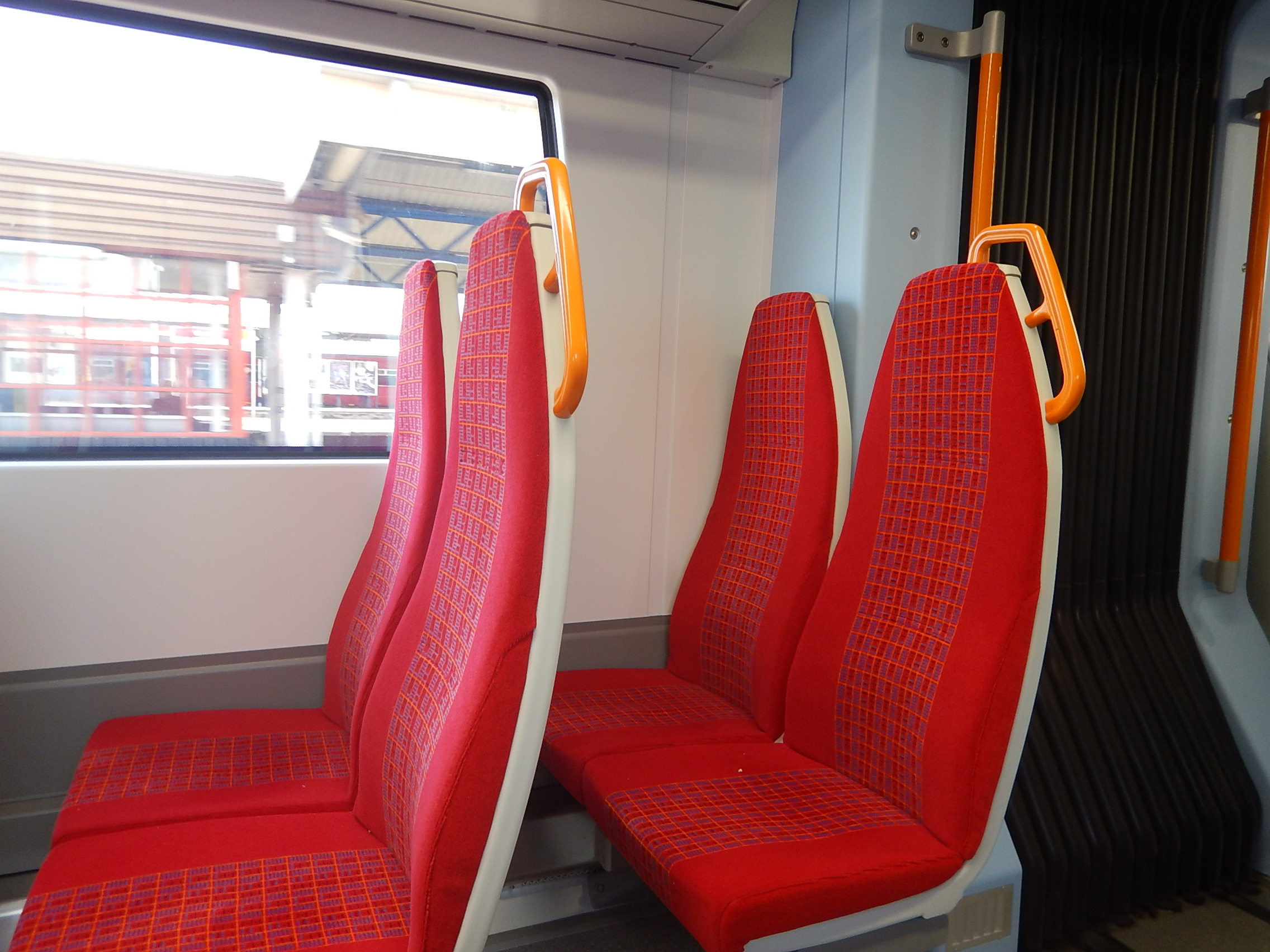
This picture shows handholds on the seats and between carriages.
I hope the Class 717 trains have 2 + 2 seating, like the Class 707 trains.
Improved Services To And From Moorgate
Current services to and from Moorgate station are as follows.
- Three tph to Welwyn Garden City
- Three tph to Hertford North, with one tph extended to Letchworth Gsrden City.
This means that there are six tph between Alexandra Palace and Moorgate stations.
From the May 2018 timetable change, the service levels will become.
- Four tph to Welwyn Garden City
- Five tph to Hertford North, with two tph extended to Stevenage or Watton-at-Stone.
- No direct services will run to Letchworth Garden City. Change seems to be a cross-platform interchange at Finsbury Park.
The service termination at Watton-at-Stone station is only temporary until Network Rail build a new bay platform at Stevenage station.
These changes mean that there will be nine tph between Alexandra Palace and Moorgate stations.
This frequency is already achieved in the Peak, from Monday to Friday. But it now appears, it will be running all day from the May 2018 timetable change.
I found this document on the Rail Delivery Group web site, which is entitled 6,400 Extra Trains A Week To Run To More Places, More Often.
It says these services will be added in 2019.
- An increase of 2 Hertford Loop trains per hour, Moorgate-Hertford
- An increase of 1 Hertford Loop train per hour, Moorgate-Stevenage
- An increase of 1 train per hour, Moorgate-Welwyn Garden City
In the May 2018 edition of Modern Railways, this is said.
New Class 717 EMUs will eplace the current Class 313s on these services from the autumn, with a further frequency boost planned in May 2019.
Adding this all together gives the following.
- Five tph to Welwyn Garden City
- Seven tph to Hertford North, with three tph extended to Stevenage.
This means that there will be twelve tph between Alexandra Palace and Moorgate stations. Or a train every five minutes.
It would appear that the overall effect of what Govia Thameslink Railway is doing is as follows.
- Restricting the running of Moorgate services on the East Coast Main Line.
- Provide a five tph Turn-Up-And-Go service from Welwyn Garden City.
- Provide a seven tph Turn-Up-And-Go service from Hertford North.
- Provide a six tph Turn-Up-And-Go Thameslink service from Stevenage.
- Provide a three tph service to Moorgate from Stevenage and Watton-at-Stone. Could it be expanded to a Turn-Up-And-Go four tph.
- Stations North of Stevenage will be served by Thameslink services to Cambridge and Peterborough.
- Thameslink services will stop at Stevenage and Finsbury Park for interchange with Moorgate services.
Will all of of this, downgrade Welwyn North station, by offering better services at Knebworth, Stevenage, Watton-at-Stone and Welwyn Garden City stations?
Consider.
- Welwyn North station handles about 600.000 passengers a year.
- Welwyn North station only has a service of two tph.
- Welwyn North station lies on the double-track section of the East Coast Main Line over the Digswell Viaduct.
- Knebworth station handles 600,000 passengers a year, but is on a four-track section of the line.
- Watton-at-Stone station, which is perhaps four kilometres to the East handles 100,000 passengers a year, but appears to be short of car parking.
I’m pretty certain, that if Welwyn North station could be closed, then the notorious bottleneck of the Digswell Viaduct could be eased.
So are Network Rail and Govia Thameslink Railway working towards a situation, where this will be able to happen.
They could do the following.
- Provide more car parking at Knebworth, Stevenage, Watton-at-Stone and Welwyn Garden City stations.
- Build a new Park-And-Ride station in South Stevenage on the Hertford Loop Line.
- Improve timings between Stevenage and Moorgate.
- Extend more Hertford North services to Stevenage. Six tph would probably be the limit for a single bay platform at Stevenage.
Shutting Welwyn North station would be controversial and heavily resisted.
How Many Trains Will Be Needed?
In May 2019, I think the service will be as follows.
- Five tph to Moorgate to Welwyn Garden City
- Four tph to Moorgate to Hertford North,
- Three tph Moorgate to Stevenage.
I’ll now look at each separately.
Moorgate To Welwyn Garden City
Trains take just under around 47-48 minutes and there are sixteen intermediate stops.
Currently, I suspect a train takes two hours to do a round trip, which would allow up to 12-13 minutes to turn round at each end.
- Three tph would need six trains.
- Four tph would need eight trains.
- Five tph would need ten trains.
But supposing the Class 717 trains, with faster running on the East Coast Main Line and faster stops could reduce this to under thirty minutes with a round trip of an hour.
- Four tph would need four trains.
- Five tph would need five trains.
Note.
- Currently, all trains are turned in Platform 4.
- Will Platform 4 be able to handle four tph after the May 2018 timetable change?
- Will Platform 4 be able to handle five tph after the May 2019 timetable change?
- There are sidings easily accessible to the North of Platform 4.
- Trains leaving Welwyn Garden City for Moorgate use a flyover to cross to the Up Slow line.
If five tph with just five trains is possible, it’s well worth achieving. But it could be a hard ask!
Moorgate To Hertford North
Trains take around 49-53 minutes and there are twelve intermediate stops.
This service would be another two hour round trip.
- Three tph would need six trains.
- Four tph would need eight trains.
- Five tph would need ten trains.
The new Class 717 trains couldn’t probably do the trip in thirty minutes, but a ninety minute round-trip would surely be possible.
- The proposed four tph would need six trains.
Note.
- Four tph is the frequency that will be running from May 2019.
- Four tph could also be easily handled in the bay platform at Hertford North station.
Any track improvement would help.
Moorgate To Stevenage
Trains take around 68-72 minutes and there are fourteen intermediate stops.
The new Class 717 trains with their faster running and faster stops, should be able to do this trip under the hour, with a possible two-hour round trip.
If this could be achieved the service would need the following trains.
- The proposed three tph would need six trains.
- Four tph would need eight trains.
Improving the Hertford Loop Line, so that the Class 717 trains could fully use their 100 mph operating speed could be key.
Summarising The Trains Needed
Summarising gives.
- Three tph between Moorgate and Stevenage would need six trains.
- Four tph between Moorgate and Hertford North would need eight trains with a two hour round trip.
- Cut that to a ninety-minute round trip and six trains could be needed.
- Five tph between Moorgate and Welwyn Garden City could possibly be run with five trains or need as many as ten.
A pessimistic answer for the number of trains could be as high as 24, which fits well with a fleet of twenty five trains.
But an optimistic solution might need.
- Six trains for Stevenage
- Six trains for Hertford North
- Five trains for Welwyn Garden City
This would leave several trains for increasing frequency.
Increasing The Service After May 2019
Improving The Hertford Loop Line
If the Class 717 trains could use their speed, this would enable faster journeys and could allow extra paths for more trains.
ERTMS On The Moorgate Lines
It is already used by Thameslink and is scheduled to be used on the East Coast Main Line.
Will it be added to the Hertford Loop Line and on the Northern City Line?
ERTMS and a degree of Automatic Train Control, could be a game changer.
Fitting the necessary equipment to the Class 717 trains, shouldn’t be the most difficult of jobs, as the system is already fitted to Thameslink’s Class 700 trains.
Increased Frequency Into Moorgate
Consider.
- Currently, in the Peak, the Class 313 trains running under control of conventional signalling manage 11 tph at times.
- From May 2019, Gover Thameslink Railway will be running 12 tph into Moorgate all day.
- Thameslink and Crossrail should be handling 24 tph, by the end of 2019.
- Brixton station on the Victoria Line handles upwards of thirty tph with two platforms.
- Transport for London and Londoners have a lot of experience about loading and unloading trains.
Look at this schematic of the vast Crossrail complex linking Liverpool Street and Moorgate stations.
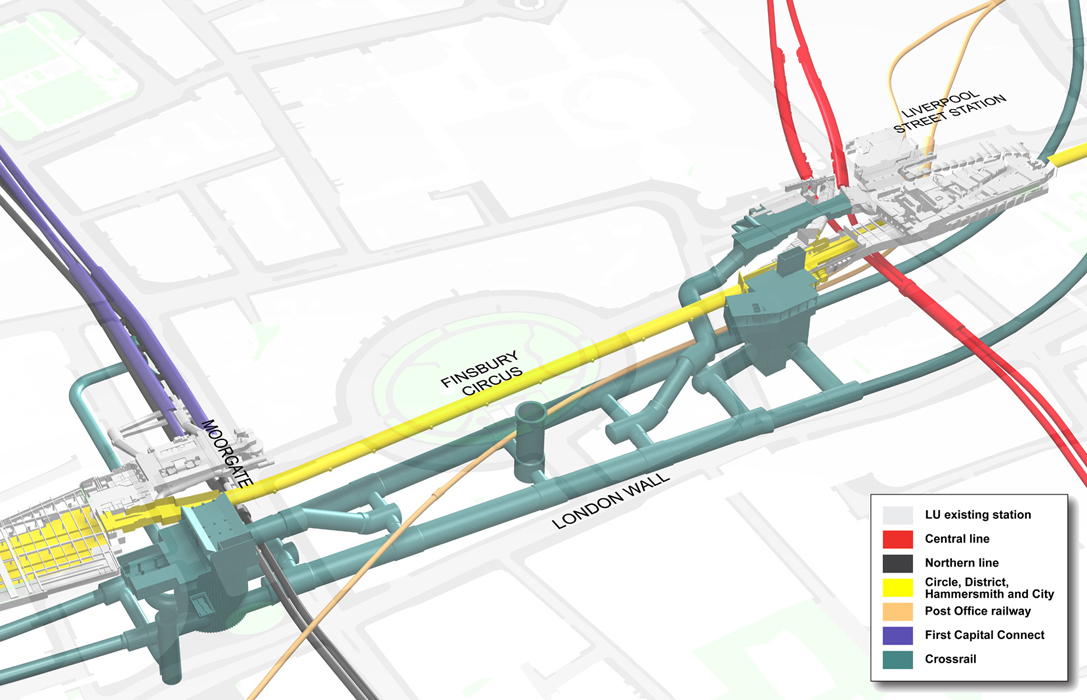
Note the Northern City Line in dark blue at the left, with a new pedestrian tunnel linking to Crossrail. This will help handle the passenger flows between Crossrail and the Northern City Line.
With ERTMS and Automatic Train Control, I wonder what, is the maximum number of trains that can be handled at Moorgate?
Twelve is obviously possible with the current infrastructure, as it is only one more than what is currently achieved in the Peak.
My experience says that with good electronic and organisational systems, that fifteen tph should be possible in both directions between Moorgate and Finsbury Park stations.
An Extra Train To Stevenage
Current plans envisage three tph between Moorgate and Stevenage.
The new bay platform at Stevenage would easily handle four tph and if the sufficient trains are available, I could see this extra service implemented.
The following frequencies would be achieved.
- Four tph – Stevenage and Watton-at-Stone.
- Eight tph – Hertford North.
The Northern City Line would obviously need to be able to handle the extra train.
Gordon Hill Station As An Extra Terminus
Gordon Hill station is sometimes used as an extra terminus to turn trains from Moorgate in the Peak.
I can see this continuing, as surely it increases the capacity at the Moorgate end of the line.
Conclusion
It will be interesting to swee how this line develops in the future.
Thameslink Should Be On The Tube Map
Consider.
- Cambridge and Gatwick Airport are two of the most important destinations within an hour of Central London.
- The outer branches of Thameslink to East Croydon, St. Albans, Welwyn Garden City and Wimbledon act in a similar manner to Underground Lines.
- The central core of Thameslink will be used by many as just another Underground Line.
- The London Overground is on the Tube Map.
- Crossrail will be on the Tube Map.
For these and other reasons, the London sections of Thameslink should be on the Tube Map.
If Thameslink should be added, what about the Northern City Line?
London Has A New Underground Line
On Friday, I went between Brighton and Cambridge stations on one of the first Thameslink services on the route.
I wrote about it in Observations On Thameslink Between Brighton And Cambridge.
That journey took me on London’s new Underground Line between London Bridge and Finsbury Park stations.
The following trains are going North from London Bridge to Finsbury Park.
- 11:29 – Horsham to Peterborough – Arrives at Finsbury Park at 11:52
- 12:49 – Brighton to Cambridge – Arrives at Finsbury Park at 13:13
- 15:04 – Horsham to Peterborough – Arrives at Finsbury Park at 15:27
- 15:34 – Brighton to Cambridge – Arrives at Finsbury Park at 15:57
And the following trains are going South from Finsbury Park to London Bridge.
- 10:59 – Peterborough to Horsham – Arrives at London Bridge at 11:24
- 12:09 -Cambridge to Brighton – Arrives at London Bridge at 12:37
- 14:29 – Peterborough to Horsham – Arrives at London Bridge at 14:55
- 15:11 – Cambridge to Brighton – Arrives at London Bridge at 15:37
All journeys take around 23-25 minutes, with stops at Blackfriars, City Thameslink, Farringdon and St. Pancras International stations.
It may officially be part of Thameslink, but it will function like a convewntional Underground Line, but with bigger trains.
The Underground Alternative
If you look at Transport for London’s Journey Planner, this give a time of twenty minutes for a journey between London Bridge and Finsbury Park, using the Northern and Victoria lines with a change at Euston.
That is also not a step-free or wheel-chair friendly route.
Obviously, at the moment, most passengers have no choice, as there is only four trains per day in each direction on the new Thameslink route.
But when a Full Service is running, with a train every ten minutes, things will be very different.
My Access To Thameslink
Timings to Thameslink stations from my house are as follows.
- Finsbury Park – 15 mins by 141 Bus and Piccadilly Line
- London Bridge – 25 mins by 21 or 141 Bus
- London Bridge – 31 mins using Transport for London’s Journey Planner’s recommended route via Dalston Junction and Canada Water.
The latter probably explains why Londoners are generally Grade 1 Duckers-And-Divers!
I suspect, when I go to Gatwick Airport, I’ll go via Finsbury Park, using the mini-cab from around the corner or a black cab, as both will be quicker.
I suspected right. Returning from Finsbury Park station to home this evening, took ten minutes and cost a tenner.
A Preview Service
Thameslink are only running a preview service between London Bridge and Finsbury Park at the current time.
On my Friday trip, it was particularly noticeable, that passengers were thin on the ground between the two stations.
- But then passengers probably didn’t know about the service and may have been confused seeing a train going to Cambridge.
- It’s also not shown on the Tube Map.
- I didn’t notice any advertising for the new route.
So how do you use something that you don’t know about?
The Full Service
This route will have the following characteristics, when Thameslink open it fully.
The Route Will Serve The City of London Well
These factors will help this section of Thameslink serve the City of London.
- Step-free stations at Farringdon, City Thameslink and London Bridge ring the South and West of the City of London.
- Crossrail with an interchange with Thameslink at Farringdon also gives a quick route to the East of the City of London and Canary Wharf.
- The City of London is also planning a lot of pedestrianisation.
Other developments like Crossrail and the expansion of Bank station and the Docklands Light Railway, will make London’s financial district, one of the best connected by public transport in the World.
The Route Will Have Tourist Attractions
The route could have been designed for tourists.
- London Bridge station has London and Tower Bridges, Southwark Cathedral, Borough Market, HMS Belfast and the Shard.
- But the most spectacular modern architecture at London Bridge, is the station itself, with its lifts, escalators, fifteen platforms and a shopping centre.
- Blackfriars is a unique station, as it spans the Thames with entrances on both banks, and it is the world’s largest solar-powered bridge.
- Blackfriars station is a short walk along the river from the Tate Modern and the Millennium Bridge.
- Many good walks along the river start from Blackfriars.
- City Thameslink station dates from 1990 and it shows, but it is close to St. Paul’s Cathedral, the Old Bailey, so it attracts visitors at both ends of the moral spectrum.
- Farringdon station will be a major interchange, where Crossrail and Thameslink connect, so don’t let unsuitable organisations build all the hotels this area will attract.
- Farringdon is close to two of London’s iconic markets; Smithfield meat market and the attached wife market.
- Saint Pancras International station is a fur coat and no knickers station, as although it looks good, it’s practicality is suspect.
- If they’d given the job to the architect, who updated Kings Cross station next door, they would have got a a more practical station.
- Finsbury Park station is a place, where you go and explore the local area, which is vibrant and full of history.
- You may even get as far as Alexandra Palace or Manor House, where I saw John Mayall and the Bluesbreakers with a very drunk Eric Clapton in the 1960s.
It is a line to explore London.
Six Trains Per Hour
There will be six trains per hour (tph), which will run All Day.
- Two tph – Peterborough to Horsham – twelve-car
- Two tph – Cambridge to Brighton – twelve-car
- Two tph – Cambridge to Maidstone East – eight-car
This gives a six tph service between Finsbury Park and London Bridge and also a four tph service to East Croydon and Gatwick Airport.
Two Additional Trains Per Hour In The Peak
In the Peak, there will be two tph, that run from Welwyn Garden City to Sevenoaks.
But they will go via Elephant and Castle rather than London Bridge.
Thameslink must have their reasoning behind this service, but I have some questions.
- Would commuters in the Peak prefer to go to London Bridge?
- Would passengers from Sevenoaks and Welwyn Garden City like an All Day service?
These questions and others will be answered in the next few years, as hameslink develops.
Full Step-Free Access At London Bridge Station
London Bridge station has full step-free access for all the following services.
- Thameslink
- Services to and from Cannon Street station
- Services to and from Waterloo East and Charing Cross stations.
- Jubilee and Northern Lines of the Underground
- Terminating services at London Bridge
- Several bus routes, including my bus home!
Note.
- Passengers will use the escalators to get to the right destination.
- Thameslink passengers will use the island platform to reverse direction.
- It took me just two minutes to change from Platforms 2/3 to Platforms 8/9.
- Going from Platform 6/7 to the bus station was under three minutes and a 141 Bus was just getting ready to leave.
- Passengers can walk across London Bridge to the City of London.
There are few stations better than London Bridge anywhere in the world!
Full Step-Free Access at Finsbury Park Station
Finsbury Park station is being updated to have full step-free access for the following services.
- Thameslink
- Great Northern Services to Cambridge, Kings Lynn and Peterborough
- Northern City Line services to and from Moorgate station
- Piccadilly and Victoria Lines. of the Underground.
There will also be same-platform interchange between Thameslink and Northern City Line services.
The Improved Northern City Line At Finsbury Park Station
The Northern City Line will be substantially improved.
- New Class 717 trains have been ordered.
- This could mean an increased All Day service of perhaps 10-12 tph.
- Moorgate station will be on Crossrail.
- There will be a same-platform interchange with Thameslink at Finsbury Park station.
- Hopefully, the terrible stations on the route will be improved.
This line will change from being a crowded, outdated backwater of the UK rail system to an important modern link to the City of London and Crossrail from large parts of North and North-East London.
The Link To Crossrail
The link between Thameslink and Crossrail at Farringdon station will probably be heavily used, if it is well-designed and fully-step free. Which I suspect it will be, until proven otherwise!
Don’t forget too, the link to the Metropolitan and Circle Lines at this key station, which is much better than the link at St. Pancras
Step-Free Access At All The Intermediate Stations Between London Bridge and Finsbury Park
Access at Blackfriars, City Thameslink, Farringdon and St. Pancras stations are all fully step-free.
The Fastest Way To Gatwick Airport And Brighton From North London
My friend lives in Walthamstow and always goes to Gatwick Airport by using the Victoria Line and Gatwick Express.
- This takes twenty-three minutes for the Victoria Line and thirty minutes for the train.
- The Thameslink route via Finsbury Park, takes nine minutes for the Victoria Line and an hour for the train.
Note.
- Both trains will run every fifteen minutes, when the full Thameslink service is running.
- The Thameslink timing is only the time of the Preview Service. Will the Full Service be faster?
- Finsbury Park and Victoria will both be fully step-free within a year or so.
- The trains on Gatwick Express will be more comfortable.
- The walk at Finsbury Park is shorter than at Victoria.
- The Thameslink route will be more affordable.
Everybody will have their own preference.
The biggest winners will be.
- Those living on the Northern reaches of the Piccadilly Line, who will have a full step-free interchange to Thameslink at Finsbury Park
- Those living on the Northern City Line, who will have a same-platform interchange to Thameslink at Finsbury Park.
- Those who walk, cycle or take a bus or cab to Finsbury Park.
Gatwick Airport could be a big winner, as a whole area of North London and Hertfordshire now has a new excellent direct connection to the Airport.
What Still Needs To Be Done?
It is a well-thought out route, but some things still need to be done.
Is Six Tph Enough Trains Between London Bridge And Finsbury Park?
I ask this question, with my scheduling hat on!
At the moment of the 24 tph through the Snow Hill Tunnel, two-thirds of the trains go up the Midland Main Line, with just a third on the East Coast Main Line.
I think that, when Thameslink increase the frequency through the central core, that they will increase the frequency through Finsbury Park.
Could Two Tph From The Sutton Loop Go To Welwyn Garden City?
Curremtly, four tph start at St. Albans City station, go through London, then round the Sutton Loop, before returning to St. Albans City.
Would it be desirable to start two of these services from Welwyn Garden City station?
It will all depend on operational issues and the routes passengers take.
City Thameslink And St. Paul’s Stations Need A Connection
I believe this is possible and I wrote about it in A Pedestrian Connection Between City Thameslink Station And St. Paul’s Tube Station.
Should The Docklands Light Railway Be Extended To City Thameslink, Euston And St. Pancras?
I wrote about this extension in detail in A Connection Between City Thameslink Station And The Docklands Light Railway.
Could Thameslink Connect To The Waterloo And City Line?
I wrote about this connection in Could The Waterloo And City Line Have An Intermediate Station At Blackfriars?
Development of new trains for the Underground, will make this link possible.
Should Thameslink Be On The Tube Map
I wrote about this in Thameslink Should Be On The Tube Map.
All Of Thameslink Should Be In The Oystercard Area
Gatwick Airport is already in the Oystercard area, but it is silly that Oyster cards and contsctless cards can’t be used on all Thameslink services.
Conclusion
The possibilities for Thameslink and the effects it will have will be enormous.
Could A Lea Valley Metro Be Created?
Crossrail 2 envisages these developments and level of service North along the Lea Valley.
- A four-track West Anglia Main Line between Tottenham Hale and Broxbourne stations.
- Step-free stations
- A service running between Tottenham Hale and Broxbourne stations.
- 10-15 trains per hour (tph)
Crossrail 2 also envisages that at Tottenham Hale station, the line will enter a tunnel for Central and South West London.
But there is an unused alternative terminal, that could handle perhaps 16 tph with modern signalling.
Look at this map from carto.metro.free.fr of the lines at Stratford.
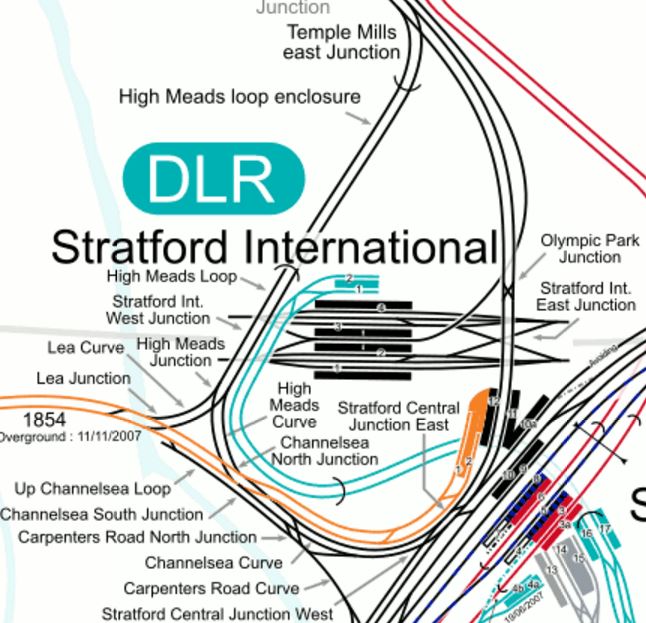
Note the double-track loop that encircles Stratford International station and goes through Platforms 11 and 12 at Stratford station.
Consider.
- Loops like this can easily handle 12 tph, as they do in Liverpool with the Wirral Line.
- Stratford is well-connected to the Central, Great Eastern Main, Jubilee and North London Lines, Crossrail and the Docklands Light Railway.
- The Loop could be connected to Stratford International station for Southeastern Highspeed services.
- There’s probably enough capacity to allow a couple of Stansted services to terminate in the loop.
- There is a massive development going on at Meridian Water, where a new station is being built.
- Liverpool Street station lacks capacity.
I can’t believe that a viable 12 tph service is not possible.
The major works would be as follows.
- Four-tracking the West Anglia Main Line into two fast and two slow lines.
- Making all stations step-free.
- Removing the level crossings.
- Creating a flyover at Coppermill Junction to connect the fast lines to Liverpool Street and prepare for Crossrail 2.
If Crossrail 2 is built in the future, the Metro service would be diverted into the central tunnel at Tottenham Hale station.
Integration With The London Overground
The Chingford, Cheshunt and Enfield Town services of the London Overground will not only offer alternative routes during the four-tracking of the West Anglia Main Line, but they could be better connected to a Lea Valley Metro.
- Tne Class 710 trains could enable four tph on each branch.
- The Class 710 trains will enable faster services on each branch.
- A reinstated Hall Farm Curve would connect Chingford and Walthamstow to Stratford.
- Creation of a step-free Cheshunt station would ease transfer between the London Overground and the Lea Valley Metro.
The new trains will be key and may open up more possibilities.
Note too, that moving services to Stratford from Liverpool Street will release capacity at Liverpool Street, that will be well-used by Greater Anglia and London Overground.
Dear Old Vicky
She’s always there when you need her and engineers keep coming up with ways to keep the Victoria Line giving more.
Currently, the frequency of trains between Walthamstow Central and Brixton is 36 tph.
I can’t believe that the engineers working on the line, don’t want to squeeze another four tph out of her, to achieve the fabulous forty.
This might be possible with the trains, tracks and signalling, but the problem is the capacity of some of the 1960s-built stations.
- Many stations have an empty space, where a third escalator could be.
- Lifts are few and far between.
- Some stations don’t have ceilings in the platform tunnels.
These stations could be improved.
Walthamstow Central Station
Walthamstow Central station gets desperate in the Peak, but it could be given a third escalator, a second entrance at the other end of the platforms and a much better step-free connection to the Chingford Branch of the Overground.
Blackhorse Road Station
Blackhorse Road station could be finished and given a third escalator to cope with the extra passengers that will transfer to and from an electrified Gospel Oak to Barking Line.
Tottenham Hale Station
Tottenham Hale station is being rebuilt to increase capacity. Will it get the missing third escalator and ceilings?
Seven Sisters Station
Seven Sisters station will be a Crossrail 2 station and will need updating to cope with an expected eight tph on the Overground. Expect a major project here.
Finsbury Park Station
Finsbury Park station is one of London’s stations designed by Topsy. Improvements are underway to cope with the extra passengers from Thameslink and an upgraded Northern City Line.
Highbury and Islington Station
Highbury and Islington station suffered worst at the hands of the Nazis and 1960s cost cutting, when the Victoria Line was built. This made it one of London’s worst stations.
However help is at hand.
- Plans are being prepared for a second entrance to the station on the other side of the Holloway Road.
- The frequency on the Northern City Line is being upgraded to twelve tph with new larger capacity Class 717 trains.
- There is space for a third escalator to be added to connect the Overgriound with the deep-level Victoria and Northern City Lines.
It should be born in mind, that Highbury and Islington station is busier than either Manchester Piccadilly or Edinburgh Waverley stations.
But with an upgrade, because it has cross-platform interchange between the Victoria and Northern City Lines, it could be an upgrade that increases the passenger capacity of the Victoria Line.
Euston Station
Euston station will be upgrqaded for HS2.
Oxford Circus Station
Oxford Circus station is desperately in need of more capacity, especially as there will be an upgrade to the Bakerloo Line in the future.
The opportunity at Oxford Circus is that some of the buildings around the junction are tired and some probably need to be replaced.
So will we see a development like Bloomberg Place, that will create a new entrance to Bank station, at Oxford Circus?
Could it also have an subterranean connection to Crossrail’s Hanover Square entrance for Bond Street station?
Victoria Station
Victoria station is in the process of being upgraded.
It certainly appears to be a case of so far so good!
South Of The River
Vauxhall and Brixton stations have rather undeveloped interchanges with the National Rail lines and these could surely be improved.
Under Possible Future Projects in the Wikipedia entry for the Victoria Line, this is said.
For many years there have been proposals to extend the line one stop southwards from Brixton to Herne Hill. Herne Hill station would be on a large reversing loop with one platform. This would remove a critical capacity restriction by eliminating the need for trains to reverse at Brixton. The Mayor of London’s 2020 Vision, published in 2013, proposed extending the Victoria line “out beyond Brixton” by 2030.
This would surely be the last upgrade to squeeze even more out of Dear Old Vicky.
Conclusion
A Lea Valley Metro can be created and eventually, it can be the Northern leg of Crossrail 2, when and if that line is built.
Before Crossrail 2 is completed, it will have great help in the following ways.
- In North East London from the London Overground.
- Across London from the Victoria Line.
Don’t underestimate how Crossrail and an updated Northern City Line will also contribute.
Lothbury
In Taxis And Bank Junction, I mentioned that the Northern City Line was originally authorised to Lothbury station .
These pictures were taken at the junction of Lothbury, Moorgate and Prine’s Street.

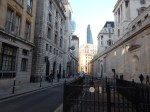

It strikes me, that a station here would have been a good Edwardian addition.
This map from carto.metro.free.fr shows the lines North of Bank station.

The interesting thing is the dates on the lines.
- Northern Line – 25/02/1900
- Central Line – 28/07/1912
As the Northern City Line opened in 1904, there would have been a lot of construction going on in the area.
Around 1913, plans were made to connect the Northern City Line with the nearby Waterloo and City Line.
The Bank of England Building is relatively modern dating from the 1920s.
So probably all of this building meant that the extension to Lothbury just got in the way.
But interestingly note, how the two lines of the Northern Line cross over in probably the area where the new station would have gone. This would surely have made more tunnelling difficult.
So was it just too complicated as well?
I don’t know!
But it is probably true to say that if we wanted to extend the line today, we could probably do it.
Especially, as the Northern Line tunnels are being realigned when Bank station is rebuilt in the next few years.
But I doubt we will do it, as the new massive Moorgate-Liverpool Street for Crossrail will finally give the Northern City Line, the connectivity it needs.
The Great Northern Metro
Govia Thameslink Railway have just announced their proposals to create a Great Northern Metro.
This was something I speculated about in A North London Metro.
GTR’s Proposals
This document on their web site gives these outline proposals.
- 2018 timetable will provide new connections and increase capacity.
- More frequent trains to provide a ‘true’ metro service.
- New air-conditioned trains from 2018.
It looks like I got those right
These are other proposals.
14 Trains Per Hour To/From Moorgate in The High Peak
Currently, a maximum of 12 trains per hour (tph) can get in and out from Moorgate station in the High Peak.
Raising it by two to 14 tph surprised me, but it says that they have found a way with the new trains to save time possibly by using better technology to change the voltage quicker at Drayton Park.
Effectively, the headway between trains is being reduced from five minutes to four and a half minutes.
One big advantage for people like me, who live close to a Southern station on the line, as I do with Essex Road station, is that going North in the morning rush and South in the evening rush, will be easy.
Services To/From Moorgate in The Off Peak
This is a summary of the changes in the Off Peak.
- 6 tph to Hertford North – Up from 3 tph
- 4 tph to Welwyn Garden City – Up from 3 tph
- 2 tph to Stevenage – Up from 1 tph
- Sunday services are 4 tph to both branches and 2 tph to Stevenage.
On the other hand, it appears there will now be no direct trains between Moorgate and Letchworth Garden City.
My local station is Essex Road and I regularly use the line to go North and South between Moorgate and Alexandra Palace.
Instead of a measly six tph, I’ll now be getting 10 tph all day, with 8 tph on Sundays.
I thought it would be four tph to Hertford North and Welwyn Garden City, so they’re actually going to do better than I thought they would.
An Eastward Shift In Services
The two branches used to be treated fairly equally with 3 tph on each.
But now it appears that Hertford North gets preference.
But then the East Coast Main Line will be getting Thameslink services.
- 6 tph stopping at Finsbury Park
- 0 tph stopping at Alexandra Palace
- 2 tph stopping at Potters Bar
- 2 tph stopping at Welwyn Garden City
- 6 tph stopping at Stevenage
Note that these are very much a summary.
Problem! – Will Thameslink Stop At Alexandra Palace?
,I do hope that Thameslink services not stopping at Alexandra Palace, when they stop at places like Oakleigh Park is a typo.
Consider.
- Alexandra Palace is the last station before the Hertford Loop Line splits from the East Coast Main Line.
- Alexandra Palace has an attraction that passengers might want to visit.
- Alexandra Palace station may well be served by Crossrail 2.
But most importantly, Alexandra Palace could have a cross-platform and/or same-platform interchange between Great Northern Metro services on both routes and Thameslink.
So it would be a good interchange for eighty-year-old Aunt Mabel going from Enfield Chase to Gatwick Airport with her suitacse full of presents for her grandchildren.
My Link To Thameslink Going North
I laid this out in My Links to Thameslink and I suspect from 2018, I’ll take bus to Essex Road station and then take the Great Northern Metro to Finsbury Park.
I don’t think I’ll be alone, in using the Great Northern Metro to get access to Thameslink to go North.
My Link To Thameslink Going South
I laid this out in My Links to Thameslink and I suspect from 2018, I accept what GTR offer or take the Essex Road and Finsbury Park route.
- Highbury And Islington Station
But what would help everybody within a couple of miles or so of Highbury and Islington station, is to upgrade the station to the Twentieth Century.
- Provide a second entrance on the North side of Highbury Corner roundabout, where there is a disused station entrance.
- Provide a better connection between the Northbound and Southbound deep-level platforms.
- Provide full step-free access to the deep-level platforms.
- Improve the lighting and ambience in the deep-level platforms.
Talking to someone who works in the station and is obviously familiar with the tunnels, he felt, as I do, that there are fairly simple solutions to sorting out the deep-level platforms.
I would do the following.
- Open up the second entrance.
- Create a subway under Holloway Road.
- Improve the walking routes and access to buses outside the station.
- Put lift access from the new entrance to a passage that would cross all four deep-level lines.
- Provide step-free access from the cross-passage to the four deep-level lines.
- Replace the stairs connecting the two Southbound platforms
Unfortunately, I suspect that the new road bridge over the railway in front of the station has probably been built without leaving space for the subway.
The Link To Crossrail
In Liverpool Street Crossrail Station Disentangled, I showed that changing between Crossrail and the Northern City Line at Moorgate could be easy.
Now that the service into Moorgate will be 10 tph all day, with 8 tph on Sundays, the line will become an important link to Crossrail for a large area of North London.
Consider.
- The Piccadlly Line has no connection with Crossrail, so changing at Finsbury Park for Moorgate might be the quickest way to get to the new line.
- The Victoria Line has no connection with Crossrail, but there is cross-platform interchange at Highbury and Islington with the Great Northern Metro.
- The North London Line connects to the Great Northern Metro at Highbury and Islington.
Taken together, the Piccadilly Line, Victoria Line and the Great Northern Metro, with help from more local transport methods like bikes and buses, will certainly improve the link to Crossrail for a large area of Enfield, Hackney, Haringey, Islington and Waltham Forest.
My only worry, is that as the Great Northern Metro gives such good access to Crossrail for such a wide area of London and South Hertfordshire, that the planned 10 tph into Moorgate all day, with 8 tph on Sundays, will be too low.
At least the improvements to the service are coming in around 2018, which would be before Crossrail opens in 2019.
Once Crossrail opens, I suspect, it will give me a better link to Thameslink, especially when I need to go South.
Conclusions
The service is a great improvement on the current one. But I predicted that!
The service is going to meet what I suspect, GTR hope it will.
As an average punter on the Northern City route from Essex Road, I will get a lot more trains.
I shall certainly use Essex Road and Finsbury Park to get to Cambridge.
It’s a pity it doesn’t help to use Thameslink in the difficult direction to the South.
Related Posts
GTR’s 2018 Timetable Consultation
Liverpool Street Crossrail Station Disentangled
Could A Reversing Siding Be Built At Alexandra Palace?
I have recently suggested two new or uprated services.
- In Could Passenger Services Be Run On The Canonbury Curve?, I talked how a Finsbury Park to East Croydon service could be a valuable part of London’s rail infrastructure.
- In A North London Metro, I talked about how Northern City Line services out of Moorgate station could be developed into a high-capacity link to Crossrail.
Both of these services could benefit with the ability to turn trains before the Hertford Loop Line splits from the East Coast Main Line.
A Reversing Siding At Alexandra Palace
One possibility is to create a reversing siding at Alexandra Palace station, which would allow the station to be used as a terminus from services from the South.
This map from carto.metro.free.fr shows the lines at the station.
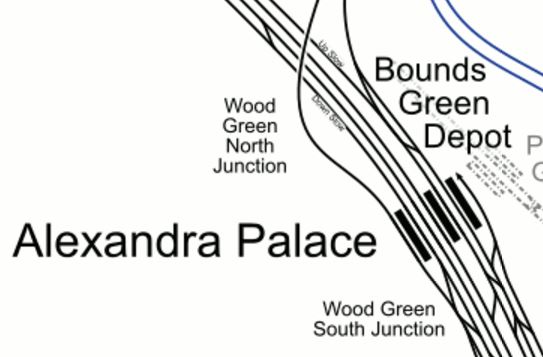
Alexandra Palace Station
Note.
- The fast lines of the East Coast Main Line run through the middle of the station, with the main slow lines on either side.
- The two widely separated tracks going North are the Hertford Loop Line.
- Ignore the blue line, which is the Piccadilly Line.
- The platforms are numbered from East to West and there are four usable faces.
- The most Westerly face is numbered 4 and serves trains going to the Hertford Loop Line.
- Sharing the island with platform 4, is platform 3, which handles direct stopping trains to Welwyn Garden City and the North.
- The layout of platforms 3 an 4 means that there is a step-across interchangebetween trains going on the different routes.
- Platforms 1 and 2 are on the Eastern side of the station and most of the trains from both go to Moorgate.
- Thameslink services will probably use platform 3 going North and one of platform 1 or 2 going South.
- There are a large number of crossovers South of the station to sort the trains between various combinations of routes and platforms.
It is an simple and efficient layout, which keeps local services away from the fast lines in the middle.
But look at this Google Map, which shows Wood Green North Junction, where the East Coast Main Line and the Hertford Loop Line split.
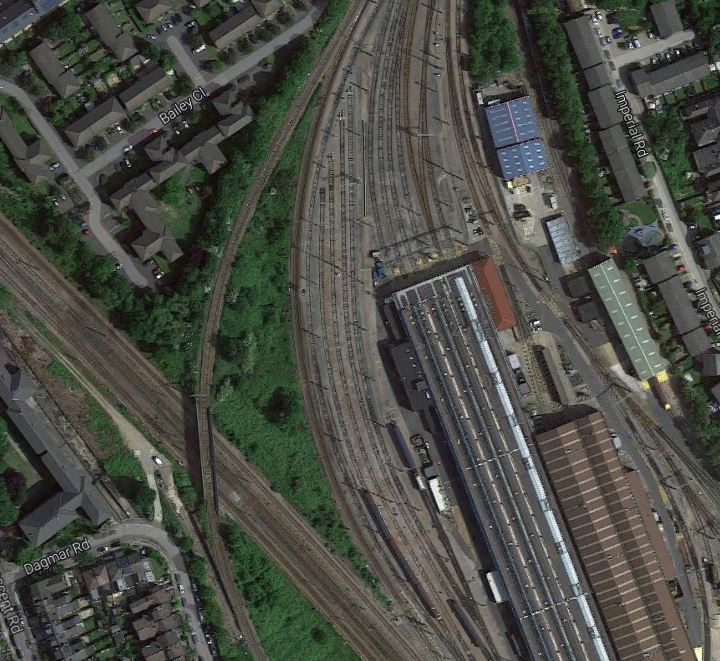
Word Green North Junction
After the down line of the Hertford Loop Line crosses over the East Coast Main Line on a viaduct, it runs through an area of green, with the up line on the other side. Surely, it would be possible to shoe-horn one or even two reversing sidings into this plot, that could at least take six-car trains.
These are some pictures of the area

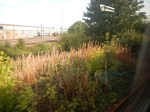


Probably only the resident wildlife find it attractive.
So a train reversing at Alexandra Palace station would go through the following procedure.
- The train would arrive in the down Hertford Loop Line platform 4 at Alexandra Palace.
- Any passengers still left, would leave the station or catch another train.
- The train would then proceed to the reversing siding between the two lines of the Hertford Loop Line.
- The train would then start its return journey in the up Hertford Loop Line platform 1 or 2 at Alexandra Palace.
Note.
- The train would have been able to reverse without affecting traffic on the fast lines.
- As a maximum of perhaps six trains per hour will be using the Hertford Loop line, there is plenty of spare capacity for extra trains.
- Reversing sidings are always useful when there are problems like failed trains or blockades.
- If it could take an eight-car Class 700 train, it might have uses for Thameslink.
It is one of those small lengths of railway, that if it were properly designed could have a lot more uses than is obvious.
I am also very surprised that as the space is there between the tracks of the Hertford Loop Line, that it hasn’t been used for something productive before.
The Existing Reversing Siding At Bowes Park Station
Bowes Park station is the first station on the Hertford Loop Line. This is said in the Wikipedia entry for the station.
To the north of the station is a single siding in between the two running tracks which is occasionally used to turn around East Coast InterCity 225 and 125 trains heading for Bounds Green Depot just north of Alexandra Palace..
There is a good image on the Railway Herald web site, of an InterCity 125 using the Bowes Park Reversing Siding from August 2016.
Looking at the picture, I wonder if there is space for more than one reversing siding.
The Future Of Bowes Park Station
Bowes Park station is a long wide island platform with rather rudimentary buildings in the middle and stairs up to a bridge over the line.
It must be due a rebuilding to at least add step-free access to the station.
But as it is a valid out-of-station interchange to the Piccadilly Line at Bounds Green station and it has a reversing platform to the North, could this station be in for something more substantial?
Conclusion
I would suspect that Network Rail and the various train operators, are looking at a comprehensive solution in this area that is to everyone’s satisfaction.
At least they start from a good base.
- Alexandra Palace station has a good layout of platforms.
- Interchange between all down services at Alexandra Palace station, uses a single island platform with two faces.
- Up services have two platforms. connected by a bridge.
- There is already a long reversing siding at Bowes Park.
- Trains for the Hertford Loop from the South cross the East Coast Main Line on a flyover.
But above all there is no shortage of space
Related Posts
A Numerical Analysis Of Great Northern’s Class 717 Trains
Could A Reversing Siding Be Built At Alexandra Palace?
Could A Reversing Siding Be Built At Alexandra Palace?
Liverpool Street Crossrail Station Disentangled
A North London Metro
My Memories Of The Lines Out Of Moorgate And Kings Cross
I grew up in North London and I can remember when the suburban services into Kings Cross were hauled by N2 tank engines and later when these were replaced by the Class 105 diesel multiple units.
Around 1970, I used to commute to Welwyn Garden City from Kings Cross and I regularly got Cambridge trains, that were coaches with compartments pulled by the then ubiquitous Class 31 diesel locomotives.
All changed in 1976, when the Northern City Line out of Moorgate and the East Coast Main Line out of Kings Cross were electrified and Class 313 trains started to work the lines.
They still do!
The Current Route
The East Coast Main Line, running North through Finsbury Park is four-tracked with separate fast and slow lines.
There is also the Hertford Loop Line, which effectively gives the route a second set of slow lines between Alexandra Palace and Stevenage.
The two lines have a network of fourteen suburban stations,, where each links with a rather measly three tph into Moorgate.
The line has a few good features.
- The Hertford Loop has grade-separated junctions at both ends and is electrified throughout.
- There are decent termini for the services at Gordon Hill, Hertford North, Letchworth Garden City and Welwyn Garden City.
- There is a flyover at Welwyn Garden City to enable prompt turnaround of the trains.
- The lines allow the trains to use their maximum speed.
- Interchange between the two services at Finsbury Park and Alexandra Palace is generally good.
But the route has the problem of a voltage change between the tunnel to Moorgate and the rest of the line at Drayton Park station, which adds a couple of minutes to every journey.
The Current Service
The current service is three trains per hour (tph) that trundle as fast as their 75 mph top speed and age will allow to the two main destinations of Welwyn Garden City and Hertford North stations. One of the trains from Hertford North in every hour continues to Letchworth Garden City.
This is not the frequent service that attracts new passengers and at least an extra train per hour is needed.
As an example, I can get a direct bus every two or three minutes or so to Essex Road station, from where I can get trains to the North.
But three tph to the two destinations and six tph to Alexandra Palace is not the sort of service on a commuter route out of London. Four trains would reduce my maximum wait for say a Hatfield train from twenty to fifteen minutes.
But there are reasons for this level of service.
- There probably aren’t enough trains.
- Their performance is inadequate.
- The complications of the route, which involves changing voltage at Drayton Park station, slows the service.
Even so they do manage to squeeze 12 tph into Moorgate in the rush hours.
Service Improvements In 2018
In the Wikepedia entry for Bowes Park station, the following is said.
From 2018, the pattern is due to change when Moorgate services via the Hertford loop are curtailed at Stevenage using a new terminating platform there:
- 2 tph Great Northern service Moorgate – Stevenage
- 2 tph Great Northern service Moorgate – Hertford North
This information is not given elsewhere, so I suspect it’s either from someone, who’s got good knowledge or wrong. There is no reference to the source of the information.
But, 2018 is when the new trains will start serving the line. So the Hertford Loop Line could be getting an extra train per hour.
Infrastructure Improvements
There are various infrastructure improvements that need to be done to squeeze the maximum capacity out of the system.
- The archaic voltage change at Drayton Park should be replaced with one using the best modern technology and practice.
- The maximum line-speed on the Hertford Loop Line should be increased to 100 mph wherever possible.
- Platforms should be improved to ease getting on and off trains and facilitate easy interchanges between trains.
- It looks like a bay platform is being built at Stevenage to serve the Hertford Loop Line.
- Would there be any advantage in creating a passing loop or adding a fourth platform at Gordon Hill station?
In addition, I do think that there are opportunities for new stations on the Hertford Loop Line.
The New Class 717 Trains
New Class 717 trains have been ordered to send the Class 313 trains to the scrapyard.
These are similar to the Class 700 and Class 707 trains, so I think we can assume.
- They will have a top speed of 100 mph, where the track allows it.
- They will brake and accelerate faster than the current trains and with better door machinery should save time at every stop.
But I would also suspect that they will handle the voltage change at Drayton Park more efficiently.
It would appear from my calculation in A Numerical Analysis Of Great Northern’s Class 717 Trains, that there are enough Class 717 trains on order for a four tph service to all stations, with 2 tph onwards to Letchworth Garden City or more likely Stevenage.
As the Wikipedia entry for Bowes Park station says 4 tph from 2018, I think it is reasonable to expect that Welwyn Garden City gets the same treatment.
This would produce an eight tph service between Alexandra Palace and Moorgate.
Current timings from Moorgate are.
- Hertford North – 50 minutes
- Welwyn Garden City – 51 minutes
- Stevenage – 63 minutes
So this means one shorter round trip could be done in two hours and a combination of a short and Long one in four.
This would mean.
- 4 tph to Welwyn Garden City would require 8 trains
- 6 tph to Welwyn Garden City would require 12 trains
- 4 tph to Hertford North/Stevenage would require 8 trains
- 6 tph to Hertford North/Stevenage would require 12 trains
But because the Class 717 trains are faster, have a better stopping performance and would probably save time in changing voltages, I wonder if the shorter round trip could be reduced to ninety minutes, with the combined trip at three hours.
This would mean.
- 4 tph to Welwyn Garden City would require 6 trains
- 6 tph to Welwyn Garden City would require 9 trains
- 4 tph to Hertford North/Stevenage would require 6 trains
- 6 tph to Hertford North/Stevenage would require 9 trains
So if the trains and the drivers can perform, it might be possible to have enough trains for a six tph service on both branches with a 12 tph service between Moorgate and Alexandra Palace.
One consequence of running 12 tph into Moorgate all day, might be that there would be no room for extra trains in the Peak. But the service in the Peak of twelve six-car tph would still have the same capacity as the current one
I think that Great Northern’s objective is to run twelve trains into Moorgate all day, with half serving each branch.
The full service to and from Moorgate would probably need 18 trains.
In A Numerical Analysis Of Great Northern’s Class 717 Trains, I said that a 2 tph service between Kings Cross and Foxton would require six trains, that would see the fleet fully utilised.
The Link To Crossrail
In Liverpool Street Crossrail Station Disentangled, I showed that changing between Crossrail and the Northern City Line at Moorgate could be easy.
I have a feeling that with eight or even twelve tph running into Moorgate, many passengers will change at Moorgate to and from Crossrail, even if they want to go to and from places like Hatfield or Potters Bar, for which they can also use Thameslink and a change at Farringdon.
Consider.
- Running twelve tph into a two-platform terminal like Moorgate is way below the frequency of the Victoria Line at Walthamstow Central.
- Half of all trains at Moorgate will go up the East Coast Main Line, with the other half taking the Hertford Loop Line.
- Only one-in-four trains at Farringdon will go up the East Coast Main Line.
- The Moorgate service will stop at all stations to Welwyn Garden City.
- There is a split with suburban trains out of Moorgate and Thameslink out of Farringdon.
- Farringdon to a station on the Hertford Loop Line, would need a second change.
- Canary Wharf to North London and Hertfordshire would be a single change at Moorgate.
Never underestimate the capacity of Londoners to duck and dive to find their best route.
All of this could lead to a lot of passengers on the trains between Moorgate and Alexandra Palace.
The Great North London Metro And Thameslink
If you take the Welwyn Garden City branch of the routes out of Moorgate, it could be running four or possibly six tph between Finsbury Park and Welwyn Garden City. On the same route, according to their latest plans Thameslink will also be running six tph.
Even if they don’t run alternatively, there will certainly be plenty of opportunities to choose to go to Moorgate or take the main Thameslink route.
You might even argue that the Hertford Loop Line and the Northern City Line are just branch lines from Thameslink, with cross- or same-platform interchanges.
But however you put it, the two lines are strongly bound together.
Conclusions
Four tph on both branches with eight tph into Moorgate is certainly possible with the fleet of new trains.
But if the trains can save time at each stop and there are some signalling, voltage-changing and track improvements, I feel it could be possible to run six tph on each branch with twelve tph into Moorgate.
Those sort of frequencies would transform the services out of Moorgate.
They would create a frequent link, which would serve at the Southern end
- Crossrail
- Northern Line
- The City of London
- Canary Wharf
And at the Northern end.
- Thameslink
- Victoria Line
- Piccadilly Line
- North London
- Hertfordshire
It would truly be a Great North Northern Metro.
Related Posts
A Numerical Analysis Of Great Northern’s Class 717 Trains
Could A Reversing Siding Be Built At Alexandra Palace?
Liverpool Street Crossrail Station Disentangled
Liverpool Street station on Crossrail is a massive double-ended beast that stretches as far as Moorgate station, where it has a second entrance.
At the Liverpool Street end, it will connect to the following in addition the the Main Line services out of the station.
- Central Line
- Circle Line
- Hammersmith and City Line
- Metropolitan Line
At the Moorgate end, it will connect to the following lines.
- Circle Line
- Hammersmith and City Line
- Metropolitan Line
- Northern Line
- Northern City Line
This is a visualisation of how Moorgate station will look after it has been rebuilt for Crossrail, that I found on this web page from May 2009, so it may be out-of-date and wrong.
Liverpool Street-Moorgate Station Schematic
Note.
- The royal blue line is labelled at First Capital Connect, for which I use the term Northern City Line.
- Turquoise is used for new Crossrail work, with red and yellow for the Central and sub-surface lines.
- If you enlarge the image by clicking on it, you can clearly see the escalators, that currently connect the Northern City and Northern Lines to the ticket hall.
- Crossrail appears to have an escalator connection to an enlarged Moorgate ticket hall
- The deep level Northern Line, which is shown in black, passes over Crossrail, but underneath the escalators that lead down.
I have since seen a cross-section of the station from Liverpool Street to Moorgate and it would appear that a few improvements have been made.
- A pedestrian tunnel is now planned to run between the Crossrail platforms, which will effectively link the escalators at both ends, which connect into the station entrances and ticket halls upstairs.
- It could be possible that the entrance to the station has been moved towards the East.
The interchanges possible at the combined station are best described as comprehensive.
Changing Between Crossrail And The Northern Line
The Northern Line crosses the Moorgate end of the Crossrail platforms at a right angle and it would appear to have a short escalator or step connection to a cross-passage between the two Crossrail platforms.
The only problem, is that you’ll have to make sure, you’re at the Western end of the Crossrail train.
Changing Between Crossrail And The Northern City Line
It would appear that Crossrail and the Northern City Lines are at roughly the same level and are very well connected.
- Passengers would appear to be able to take an escalator or lift from one set of platforms to the ticket hall and then take another set down to the other line.
- There also appears to be another independent passage, which starts midway down the Northern City Line platforms and takes a circuitous route to the Crossrail platforms.
- There may be another convenient route, where you go via the Northern Line and reappear on the other set of platforms.
It certainly won’t be a difficult interchange for passengers, although you’ll have to remember to position yourself at the Western end of the Crossrail train.
Changing Between Crossrail And The Central Line
The Central Line crosses the Liverpool Street end of the Crossrail platforms at a right angle and it would appear to have a short escalator or step connection to a cross-passage between the two Crossrail platforms.
The connection is not as neat as the Northern Line one at the other end of the Crossrail platforms
The only problem, is that you’ll have to make sure, you’re at the Eastern end of the Crossrail train.
Changing Between Liverpool Street And Moorgate
I’ve read somewhere, that the double-ended station is designed so that passengers can walk easily between the two ends of the station.
My view of the cross-section of the station from Liverpool Street to Moorgate confirms it is a feasble route.
- Passengers at Liverpool Street will descend to an intermediate level, from where the Central Line can be accessed.
- A walk of perhaps fifty metres will take you under the Central Line tunnels and to an escalator, that will descend to a wide passage between the Crossrail platforms.
- A walk of perhaps a hundred metres will give several entrances to the Crossrail platforms and take you to an escalator, which takes you to the intermediate level at Moorgate station.
- A level walk of perhaps thirty metres or so, will take you over the Northern Line tunnels and to an escalator, that gives direct access to the booking hall at Moorgate.
So a passenger from perhaps Ipswich to Hatfield on a very wet day, will dive on arrival at Liverpool Street into the Crossrail station and use it as a dry walking route to the Northern City platforms at Moorgate.
I suspect that an Oyster card or a contactless bank card will give free access to the route.
The same route will give Moorgate passengers access to the Central Line and Liverpool Street passengers access to the Northern Line.
Related Posts
A Numerical Analysis Of Great Northern’s Class 717 Trains
Could A Reversing Siding Be Built At Alexandra Palace?
Could A Reversing Siding Be Built At Alexandra Palace?
Could Passenger Services Be Run On The Canonbury Curve?
Could Passenger Services Be Run On The Canonbury Curve?
The Canonbury Curve is described like this in the Wikipedia entry for Canonbury station.
To the west of the station is the Canonbury curve, a freight-only connection through the Canonbury tunnel to the East Coast Main Line at Finsbury Park.
The curve is an electrified single-track.
This picture shows where the curve joins and leaves the North London Line.

The Canonbury Curve To The East Coast Main Line
I don’t know how much traffic uses the line, but I think it is only a few freight trains.
This map from carto.metro.free.fr shows the track layout of the Canonbury Curve.
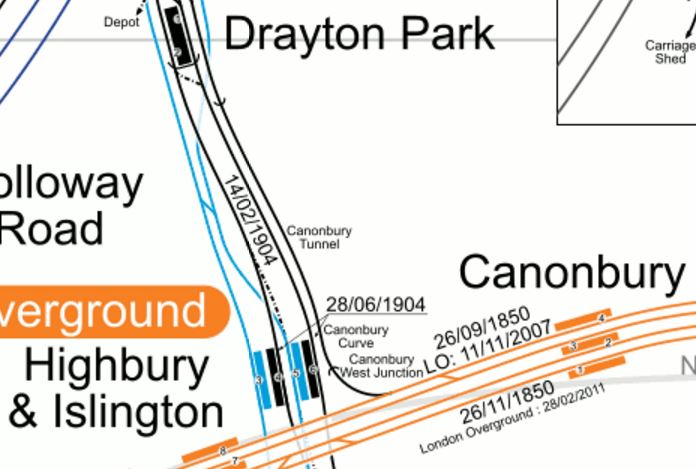
The Canonbury Curve
Note that it only has a connection to the North London Line, which is the more Northerly of the two pairs of lines. The East London Line is the other pair of lines and only carries third-rail electric services to Dalston Junction and on to the South.
In order for trains to go between Finsbury Park and the East London Line, there would need to some changes to Canonbury West Junction.
This Google Map shows Canonbury West Junction in detail.
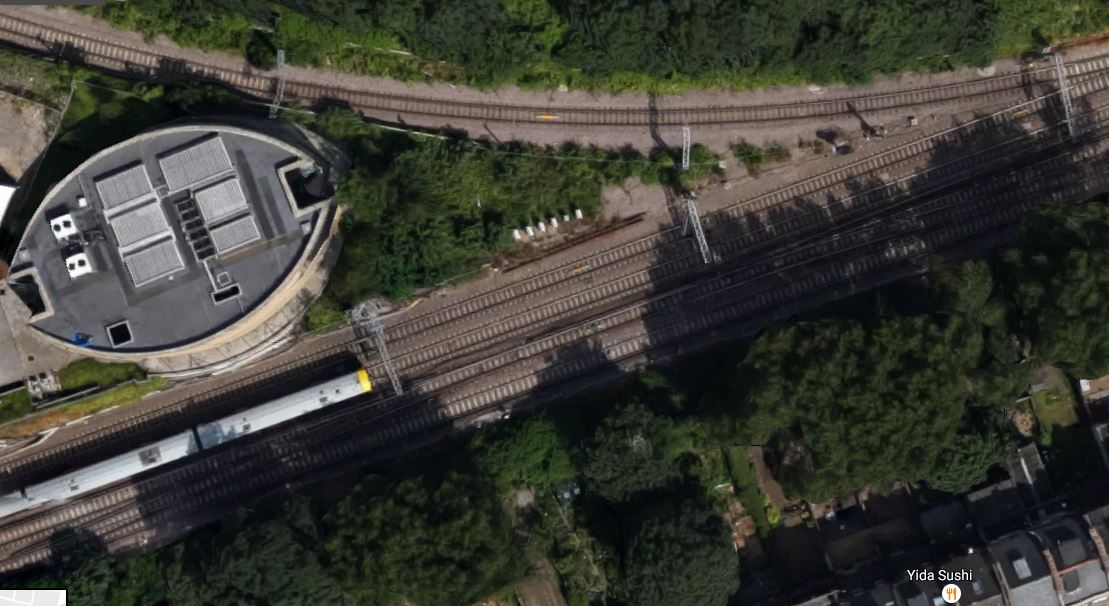
Canonbury West Junction
The elliptical-shaped tower is an evacuation and vent shaft for the Channel Tunnel Rail Link.
There does seem to be space between the lines and I suspect that it would be possible to modify Canonbury West Junction.
The line is also visible as it passes by Drayton Park station to the South of Arsenal’s Emirates Stadium.
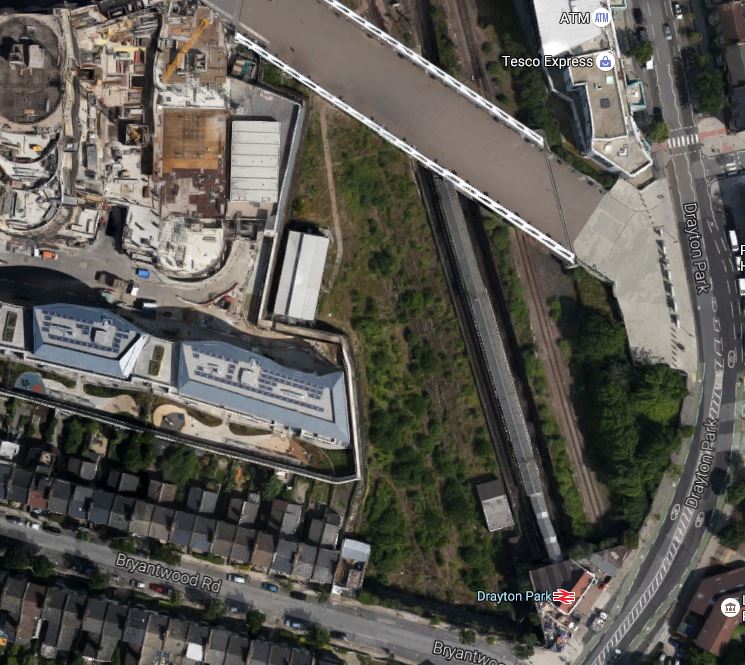
Drayton Park Station
The line is the single track line to the right of the platform roof of the station. This image doesn’t show a true picture, as the line is at a higher level than the Northern City Line.
I think it is true to say, that there is quite a bit of space around Drayton Park station.
When the line gets to Finsbury Park station, the track seems to be extremely complicated, but I’m sure that it is possible to run a passenger train between Canonbury and Finsbury Park stations, as freight trains already make the journey.
A Second Thameslink Route Between Finsbury Park And East Croydon
I feel that a train service could be run between Finsbury Park and East Croydon stations via the Canonbury Curve and the East London Line.
It would require the appropriate political and commercial wills. Some track modifications would be needed.
In the next few sections, I will describe the various issues that will effect, whether such a service is created.
Objectives Of The Route
As a passenger from the East, I see the major objective is to link all those, who travel to and from London’s Eastern boroughs, like Bromley, Croydon, Greenwich, Hackney, Haringey, Lewisham, Tower Hamlets and Waltham Forest, with a better North-South railway.
But Govia Thameslink Railway, London Overground and Sadiq Khan may see things differently.
The East London Line may terminate in a decent purpose-built terminal at Highbury and Islington station, with these connections.
- North London Line to the West.
- Northern City services to the North.
- Victoria Line services to the West End and four major stations.
- Victoria Line to Waltham Forest.
But the termini in the South mean there is often a second change to get where you actually want to go.
- Many passengers want to go to East Croydon station rather than West Croydon station.
- There is no direct link to Thameslink, with all the extra destinations that would bring.
- Getting to London Bridge, Gatwick Airport, Kent and the South Coast is not easy.
I’m not the only one who is unhappy, as there has been a petition to the London Assembley to get Thameslink to call at Norwood Junction.
I think a lot of the problems were caused by the following.
- The East London Line was designed after Thameslink.
- Thameslink designers thought the East London Line was a short route from Whitechapel to New Cross and New Cross Gate.
- Thameslink is a National Rail project, whereas the East London Line is promoted by Transport for London.
On the other hand, East London does particularly well with two branches of Crossrail, so the connection to the East London Line at Whitechapel, will truly be a Jewel In The East.
Extending the East London Line to Finsbury Park in the North would give the following improvements.
- Links to the Piccadilly and Victoria Lines
- Links to Great Northern services to Hertford North, Welwyn Garden City, Letchworth Garden City and Cambridge
- Links to Thameslink services to Peterborough and Cambridge.
Connecting to East Croydon in the South would also be valuable.
- Links to Outer London suburban services to places like Epsom, Caterham and Oxted.
- Links to Thameslink services going to Gatwick Airport, Brighton and the South Coast.
- Links to London Tramlink across South London.
This connectivity at the North and South termini will not only make it better for those living in East London, but visitors and commuters needing to go to the area will find their journey much improved.
Now is the time to properly link Thameslkink and the East London Line to the benefit of users of both systems!
It could be the third line in London’s Crossrail/Thameslink network.
Advantages For Myself
I wouldn’t be being totally honest, if I didn’t point out my personal advantages of a Finsbury Park to East Croydon service.
I live within walking distance of Dalston Junction station and I would get single-change access to places like Brighton, Cambridge, Gatwick Airport and Peterborough.
But then so would the hundreds of thousands of people, who or work live near stations between Canonbury and Norwood Junction on the East London Line.
Thameslink, The Northern City Line And The Canonbury Curve
Thameslink, the Northern City Line to Moorgate and the line through the Canonbury Curve all come together at Finsbury Park station.
There would be opportunities to create a cross- and same-platform interchange between all three services.
I do think that the Northern City Line will because of its important link to Crossrail at Moorgate grow into a high-capacity link between Crossrail, the City of London and Canary Wharf at its Southern end and Finsbury Park, North London and Hertfordshire at its Northern end.
Added together Thameslink and the Moorgate trains could create a 12 tph service up the East Coast Main Line, as far as Welwyn Garden City.
My thoughts on this line are laid out in A North London Metro.
How Many Trains Would Be Needed To Run A Service Between Finsbury Park And East Croydon?
As things stand the current Class 717 trains, that have been ordered for the Northern City Line, couldn’t work the route, as the route is only able to accept five-car trains, but it could probably be run by the following.
- Five-car versions of the Class 717 trains.
- London Overground’s Class 378 trains
- Appropriate versions of the new Class 710 trains.
Current timings on the various sections are.
- Finsbury Park to Highbury and Islington – 4 minutes – Great Northern
- Highbury and Islington to New Cross Gate – 26 minutes – London Overground
- New Cross Gate to East Croydon – 22 minutes – Southern
So this would give a timing of 52 minutes, which could probably be beaten by a direct modern train, that could change current collection on the fly and took the Canonbury Curve short cut.
Any time around fifty minutes, would mean that a train could do the round trip in two hours and that eight trains being needed to run a 4 tph service.
The Design Of An Ideal Terminus
The branches of the East London Line at Clapham Junction, Crystal Palace, Dalston Junction, Highbury and Islington and New Cross end in their own dedicated bay platforms. At West Croydon, a reversing siding is used, as I wrote about in The Bay Platform And The Reversing Siding At West Croydon.
As rarely do any operational problems surface, I feel that a single platform or reversing siding would be sufficient for a route, that is not much longer than Highbury and Islington to West Croydon.
Passengers would also require.
- Decent step-free interchange between services.
- Lots of useful connecting trains and buses.
- Shops, kiosks and cafes.
- An attraction like a market, museum, shopping centre or an entertainment venue.
Perhaps even a place to sit in the sun, like the park at Crystal Palace or Dalston Square at Dalston Junction.
Looking at this, what idiot thought about using the dreadfully dreary and totally useless West Croydon?
An interesting concept is that the last two or three stations are used as a joint terminus, to give passengers more choice of onward routes, either by foot or by train, tram or bus.
You have Cannon Street, which is the actual terminus, but all services will also stop at London Bridge, when Thameslink is complete.
Other pairs include.
- Liverpool Street and Stratford
- Charing Cross, Waterloo East and London Bridge
- Edinburgh Waverley and Edinburgh Haymarket
- Birmingham New Street and Birmingham International
- Manchester Piccadilly and Manchester Oxford Road.
- Highbury and Islington and Dalston Junction
Some have been purposely designed that way, whilst others have just happened.
In the case of choosing the two termini for the Finsbury Park to East Croydon route, they must be within a time that allows the train operator to to use a sensible operating policy to run trains.
It looks like, that if the trip time is fifty minutes or less, that is ideal, as the round trip can be two hours. But even if it’s a few minutes longer, you just add another train into the fleet and work on a two hours fifteen minutes cycle say.
The Northern Terminus
In this example, I have used Finsbury Park station as a Northern Terminus, but I think that as long as Finsbury Park is served by the route, a station to the North could be used instead.
A few thoughts.
- Using Drayton Park could mean an extra change for passengers.
- Crossrail 2 could be coming to New Southgate and/or Alexandra Palace in the future
- A terminus North of where the Hertford Loop Line joins the East Coast Main Line might be confusing and/or annoying for passengers.
- There needs to be space for an elegant solution to the step-free change of train.
I think there are two main possibilities; Finsbury Park and Alexandra Palace.
In some ways, Alexandra Palace would work better as there is more space.
In Could A Reversing Siding Be Built At Alexandra Palace?, I examined the possibility of building a reversing siding at Alexandra Palace station.
I came to the conclusion that it is feasible and also found out that one already exists at Bowes Park station.
So a train reversing at the Northern end of the new route would go through the following procedure.
- The train from the South, would arrive at a down interchange platform in Finsbury Park, where all down Thameslink and local services call, probably with Main Line services on one platform face and Hertford Loop Line services on the other.
- Reversing trains would probably use the Hertford Loop Line platform.
- After discharging passengers, it would proceed to the down Hertford Loop Line platform 4 at Alexandra Palace.
- Any passengers still left, would leave the station or catch another train.
- The train would then proceed to the reversing siding between the two lines of the Hertford Loop Line.
- The train would then start its return journey in the up Hertford Loop Line platform 1 or 2 at Alexandra Palace.
- The train would then return to Finsbury Park.
- It would call in the up interchange platform, before continuing on its way.
Effectively, the route would have a two station terminus with interchange to other trains at both Finsbury Park and Alexandra Palace, with train reversing at the latter.
Note.
- As a maximum of six tph will be using the Hertford Loop line, there is plenty of spare capacity to fit in another four trains.
- Reversing sidings are always useful when there are problems like failed trains or blockades.
- It could be used by Northern City services to Moorgate.
- If it could take an eight-car Class 700 train, it might have uses for Thameslink.
It is one of those small lengths of railway, that if it were properly designed could have a lot more uses than is obvious.
I am also actually surprised that as the space is there between the tracks of the Hertford Loop Line, that it hasn’t been used for something productive before.
The Southern Terminus
Just as the Northern end of the route must serve Finsbury Park, the Southern end must serve East Croydon, as so many services call at the station.
- Thameslink
- Gatwick Express
- Southern services all over the South.
- Tramlink
Another possibility would be to perhaps have a dedicated bay platform at South Croydon station, with services calling at East Croydon before reversing in a dedicated bay platform or a reversing siding at South Croydon.
South Croydon station also has form as a past Southern terminus for the West London Line route to Milton Keynes Central.
This Google Map shows the South Croydon station and the area immediately to the South.
South Croydon Station
At a quick look, it would appear that fitting a bay platform into the Northern end of the station could be difficult.
But, there could be space in the tangle of lines South of the station to create a reversing siding.
There’s certainly more space than there is at East Croydon.
Perhaps, if the station was to be properly sorted as a Southern terminus for the East London Line, it could also become the terminus for an uprated service on the West London Line to the West Coast Main Line.
Drayton Park Station
This map from carto.metro.free.fr shows the lines through Drayton Park station.
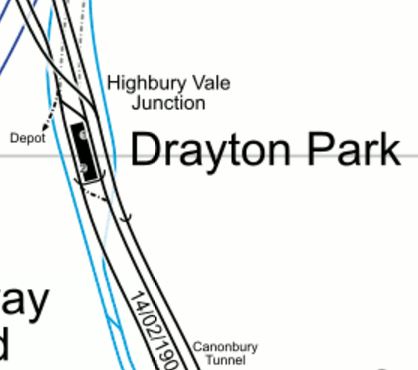
Drayton Park Station
The lines either side of the island platform are the two tracks of the Northern City Line to Moorgate.
The line on the right in the map, links Finsbury Park station to the Canonbury Curve through the Canonbury Tunnel. This line is at a higher level, as this picture taken looking South along the platform at Drayton Park station shows.

Drayton Park Station
The line is behind the retaining wall at the left. It’s position is betrayed by the overhead wires visible in the picture.
If a platform was to be put on this connecting line at Drayton Park, it would not be simple.
But help could be at hand!
In the map of the tracks at the station, there is a disused track labelled Depot. There is quite a large area of land around the station and any housing built on the site, should surely incorporate a new station underneath, with provision for a platform on the connecting line.
It would be a disaster, if housing was built all over the Drayton Park station site, without leaving provision for a station on the Canonbury to Finsbury Park Line.
The Canonbury Curve
As I pointed out earlier, the Canonbury Curve would need modification to enable trains to get between Finsbury Park and Canonbury stations.
This map from carto.metro.free.fr shows the Overground through Canonbury and the two Dalston stations.
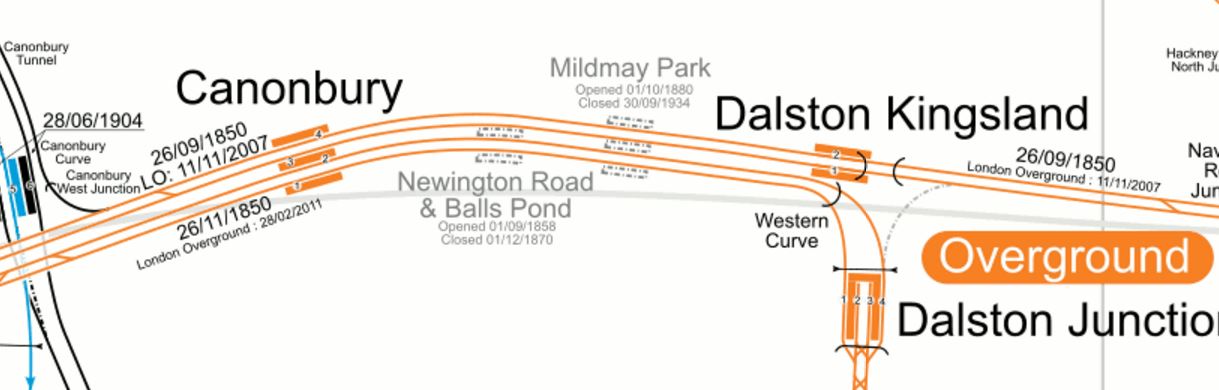
North And East London Lines Through Canonbury And Dalston
The various East-West tracks through the area from North to South are.
- The Eastbound North London Line to Stratford
- The Westbound North London Line to Highbury and Islington and Richmond.
- The Southbound East London Line to Dalston Junction and Croydon
- The Northbound East London Line to Highbury and Islington
A Finsbury Park to Dalston Junction service would do something like the following.
- Take the Canonbury Curve to the Eastbound North London Line.
- Stop in Plstform 4 at Canonbury station.
- Cross over to the Southbound East London Line using two new crossings.
- Continue South after stopping in Platform 4 at Dalston Junction station.
A service going the other way would do something like the following.
- Call in Platform 1 at Dalston Junction station.
- Cross over to the Westbound North London Line using two new crossings. (One would probably be used both ways.)
- Stop in Platform 3 at Canonbury station.
- After leaving Canonbury station take the existing crossover to the Eastbund North London Line.
- Take the Canonbury Curve to Finsbury Park station.
I don’t know whether my route would be possible, but I’m sure that an expert at Network Rail could come up with a workable and very safe solution.
At least there are factors that help.
- The line has been rebuilt in the last few years, so it must be well-documented.
- There are a lot of crossovers South of Dalston Junction station.
- The signalling is capable of handling bi-directional running.
But the most important factor is that to the East of the former Mildmay Park station, there is space for more track, as it would sappear there was an island platform between the pairs of lines. It is actually shown on the map of the lines through Canonbury and Dalston, earlier in this section.
These are some pictures of the lines between the Canonbury Curve and Mildmay Park.




I was really surprised to see how much space there is between Dalston and Highbury and Islington and I don’t believe it would be an impossible task to create a route between Dalston Junction and Finsbury Park stations via the Canonbury Curve.
I think the biggest problem could be where to switch from the third-rail electrification of the East London Line to the overhead electrification of the North London Line and the Canonbury Curve.
One of the solutions would be to use trains with on-board energy storage and they would automatically deploy pantograph or pick-up shoe, once they were on the electrified sections.
Six-Car Trains On The East London Line
Over the years there have been mixed messages about whether six-car trains will ever run on the East London Line.
The problems of lengthening some of the platforms at stations like Shadwell, Wapping and Rotherhithe mean that the current five-car trains need to use selective door opening.
But as this is probably the only problem to running longer trains, I suspect that running six-car Class 378 trains through the Thames Tunnel, is still an option to increase capacity on the East London Line.
So if six-car Class 378 trains with selective door opening can run from Dalston Junction to Surrey Quays and several stations in the South, surely six-car Class 717 trains could do the same, if they had selective door opening fitted.
As both trains are walk-through trains, selective door opening is not a great inconvenience to passengers, as with comprehensive information on the train, the passengers move to doors that open.
I can’t see any reason, why with a few simple modifications, Great Northern’s Class 717 trains could not use the East London Line to connect North and South London.
Frequency Between Finsbury Park And East Croydon
London Overground’s services on the East London Line and some other lines is based on the rule of four.
If you provide at least four tph, then passengers will turn up and go.
So there must be at least four trains between Finsbury Park and Croydon in both directions in every hour.
The upper limit to the frequency would probably be determined by two main questions.
- How many trains could negotiate through the Canonbury Curve and Canonbury station in an hour?
- How many spare paths exist through the Thames Tunnel?
The question also has to be asked if four tph were going to East Croydon, do four tph still need to go to West Croydon?
I think all this will mean that the probable frequency will be four tph.
Alternative Routes
I have been parochial and have concentrated on the core service between Finsbury Park and East Croydon, which would be of the greatest benefits to those like me, who live on the current East London Line.
But if trains can work the route profitably, why does there have to be a limit of where they can go?
Possible termini in the North include all of the current ones used as termini by services into Moorgate.
- Alexandra Palace
- Gordon Hill
- Hertford North
- Letchworth Garden City
- Welwyn Garden City
I have added Alexandra Palace, as it could have a reversing siding and could be invaluable in maintaining the stability of the service. It is also the last station on the route, that serves both Northern branches.
In the South, the possible termini include the following.
- Caterham, which was a Thameslink possible and has now been discarded.
- Gatwick Airport, because it likes to have its fingers in everything.
- Purley, because Southern are using it as a station to split Caterham and Tattenham Corner services.
- South Croydon, because it has form and is in a convenient location.
- Tattenham Corner, which was a Thameslink possible and has now been discarded.
I calculated the core time between Finsbury Park and East Croydon using these current journeys.
- Finsbury Park to Highbury and Islington – 4 minutes – Great Northern
- Highbury and Islington to New Cross Gate – 26 minutes – London Overground
- New Cross Gate to East Croydon – 22 minutes – Southern
This gives a time of 52 minutes, between Finsbury Park and East Croydon which until proven otherwise is a good base time.
It is also the current scheduled time for London Overground’s Highbury and Islington to West Croydon service.
The following should be borne in mind.
- New trains could shave a twenty seconds or so from each of the nineteen stops.
- Cutting the corner using the Canonbury Curve should save time.
- Modern trains would be able to change voltage quicker.
I would think that a sub-fifty minute time between Finsbury Park and East Croydon is possible.
The times between Finsbury Park and my possible Northern termini are.
- Alexandra Palace – 7 minutes
- Gordon Hill – 21 minutes
- Hertford North – 37 minutes
- Letchworth Garden City – 62 minutes
- Welwyn Garden City – 20 minutes
And those between East Croydon and possible Southern termini are.
- Caterham – 25 minutes
- Gatwick Airport – 15 minutes
- Purley – 6-9 minutes
- South Croydon – 3 minutes
- Tattenham Corner – 33 minutes
When linked to passenger statistics and the capacity on the various routes, I suspect that some routes could be shown to be a lot better than others.
Conclusions
If the following projects can be successfully delivered.
- A suitable Northern terminal platform or other arrangement.
- A suitable Southern terminal platform or other arrangement.
- An updated Canonbury Curve to connect the East London Line to Finsbury Park station.
- The procurement of suitable dual-voltage trains.
I can see no reason why a train service from Finsbury Park to East Croydon couldn’t be successfully run via the Canonbury Curve.
It would give the following benefits.
- Extra connectivity for those going to and from stations between Finsbury Park and East Croydon.
- Better access to Canary Wharf, Dalston, Gatwick Airport and Shoreditch.
- It would take some of the pressure off Moorgate services, if Crossrail loads them up.
- Development of a quality Southern terminus, might enable a better service from East Croydon to Old Oak Common and the West Coast Main Line using the West London Line.
Perhaps though, the biggest benefit would be that more trains could be running on the East London Line, without needing extra platform capacity at the current termini.
O
 The Anonymous Widower