Take A 360° Tour Of World’s Largest Offshore Wind Farm In Operation
The title of this post, is the same as that of this article on offshoreWIND.biz.
This is the sub-heading.
Located some 89 kilometres off the Yorkshire Coast, the UK, the 1.3 GW Hornsea Two comprises 165 Siemens Gamesa 8 MW wind turbines and is currently the world’s largest fully commissioned offshore wind farm.
The article has a link to an excellent Ørsted video, about they access and service the wind farm.
Crown Estate Scotland Joins Scapa Flow Deepwater Port Plan
The title of this post is the same as that of this article on Riviera Maritime Media.
This is the sub-heading.
Orkney Islands Council (OIC) and Crown Estate Scotland have signed an agreement to work together in developing a deepwater quay at Scapa Flow
The picture and the words, indicate it is not a small facility.
The final comment of Crown Estate Scotland’s director of marine Colin Palmer, are a strong statement of intent about how Crown Estate Scotland will help Scotland towards net-zero.
Scotland’s Largest Offshore Wind Farm Stands Complete
The title of this post, is the same as that of this article on offshoreWIND.biz.
This is the sub-heading.
The final turbine has been installed at Scotland’s largest offshore wind farm, Seagreen, off the coast of Angus.
These two paragraphs describe the wind farm.
Once fully operational, the Seagreen project, owned by TotalEnergies and SSE Renewables, will reach almost 1.6 GW.
76 of the 114 Vestas V164-10.0 MW turbines are now energised at the site, which is located 27 kilometres from the Angus coast.
The article also says, that the units are now producing more than two-thirds of Seagreen’s full capacity power to the grid.
It seems like the Seagreen wind farm has got off to a good start.
30 MW Offshore Wind Turbines Being Considered For New Project In Sweden
The title of this post, is the same as that of this article on offshoreWIND.biz.
This is the sub-heading.
Freja Offshore, a joint venture between Hexicon and Mainstream Renewable Power, has submitted an application for an offshore wind farm in Sweden that could have an installed capacity of between 2 GW and 2.5 GW and, according to the project’s consultation document, could feature wind turbines of up to 30 MW per unit.
This paragraph, indicates how turbines have grown over the last two decades.
The wind turbines in the future will probably be taller, the rotor diameter larger and the turbines more powerful, the joint venture says in the consultation document, and compares the largest wind turbines launched in 2011, which have a rotor diameter of 164 metres and an installed capacity of 8 MW, with those launched 10 years later, featuring a rotor diameter of 236 metres and an output of 15 MW.
Moving on a few years to 2030 and it doesn’t seem unreasonable that turbine size will double again to 30 MW.
I could see them becoming the standard turbine, providing they aren’t too heavy for the fixed foundations or floats.
It would be an interesting exercise to model the costs of wind farms, as the turbines get bigger.
With North Sea oil and gas, I was told several times, by Artemis users, that as cranes got larger, which allowed bigger lifts, the costs of offshore infrastructure decreased.
Note.
SSE Renewables Calls For More Use Of Non-Price Criteria In Offshore Wind Auctions
The title of this post, is the same as that of this article on offshoreWIND.biz.
This is the sub-heading.
SSE Renewables is calling on European governments and regulators and internationally to make greater use of non-price criteria (NPC) in offshore wind energy auctions, whether for seabed or for contracts for difference (CfD).
This is the first paragraph.
The renewable energy company said that the use of non-price criteria in auctions for new offshore wind can help support a sustainable renewable energy sector that delivers long-term value for society.
This document on the SSE Renewables web site is entitled Non-Price Criteria In Renewables Auctions and these are the points from the Executive Summary from the document.
- Use of non-price criteria (NPC) in auctions is important to deliver renewables projects which are deliverable, on time and on budget, and provide long term value to society and the environment.
- NPC must be well-designed, carefully implemented, with transparent assessment and monitoring of commitments to avoid overcomplication and risk of legal challenges.
- Seabed leasing auctions for offshore wind are best suited for use of NPC, as it is early enough in the development stage for commitments to be delivered; and avoids having to rely on purely financial bidding which risks adding to the cost of offshore wind.
- The most appropriate NPC are track record and deliverability of projects. Beyond that, criteria related to sustainability (circularity; workforce and skills); ecological protection and enhancement; and supply chain development.
- NPC in new offshore wind markets should be focused on deliverability and track record, and included as a pre-requisite to participate, rather than a point of competition.
- More diverse non-price criteria are best suited to mature offshore wind markets where there will generally be more competition from developers to build a project.
- It is more complicated to apply non-price criteria into offtake (CfD) auctions, with re-ranking of bidders the best approach to properly incentivise the right behaviour.
- It is important that there is transparency of how successful bidders were scored against NPC; what commitments have been made and how they will be held accountable for delivery at different milestones.
Note.
- It is good to see phrases like “track record and deliverability of projects” being embedded in this list of points.
- As a designer of successful project management software, I know the importance of this.
- I believe, that SSE Renewables are right to desire wider criteria for offshore wind energy auctions.
I suspect too, that there are software ideas in my past, that would make the development of offshore wind easier and more predictable.
Shell And Eneco Joint Venture Looks To Build Greener Offshore Wind Farm
The title of this post, is the same as that of this article on offshoreWIND.biz.
This is the sub-heading.
Ecowende, the joint venture (JV) of Shell and Eneco, has unveiled plans for building an offshore wind farm that will be in harmony with nature, with minimal impact on birds, bats, and marine mammals.
This is the first paragraph.
Ecowende, which presented its holistic approach at WindDay 2023, said it is going to implement various innovations, large-scale mitigating and stimulating ecological measures, and an extensive above and under-water monitoring and research programme.
This is all good stuff.
These two paragraphs outline some ideas that will be tried.
Specific measures include increasing the height of the lowest tip of the rotor blades, creating a corridor to Natura 2000 area by placing the turbines extra far apart, and an option to bring the turbines to a standstill that adapts to the flight movements of birds in the wind farm.
This way, Ecowende expects to minimise the number of bird and bat collisions.
The Natura 2000 areas are described in this web site.
Other innovative ideas are described in these two paragraphs.
Biodegradable reef structures are being constructed using fruit trees sourced from Dutch fruit farms. These tree reefs offer a place for fish to shelter and reproduce, according to the press release.
Ecowende said it will also install various forms of eco-friendly erosion protection and the oyster larvae network will be expanded to spread the native flat oyster population.
It certainly looks like Ecowende are making sure, that Just Stop Oil’s offshoot; Just Stop Wind doesn’t take root!
UK Offshore Wind Pipeline Now At 98 GW, Second Only To China – Report
The title of this post, is the same as that of this article on offshoreWIND.biz.
This is the sub-heading.
The UK’s pipeline of offshore wind projects has reached 97,944 MW, up from 91,287 MW a year ago, while the global pipeline topped 1.23 TWh, an increase of nearly 400 GW in the last year, according to RenewableUK’s latest EnergyPulse market intelligence data report.
These are the first two paragraphs.
The pipeline includes projects at every stage of development, including operational, under construction, consented, or planned.
The UK total pipeline was second globally at 98 GW, second only to China with 157 GW, followed by the USA in third place with 82 GW, Sweden is fourth with 75 MW, and Brazil fifth with 63 GW.
These is also a pie-chart saying in which part of the UK, wind energy is being developed.
- North Sea (Scotland) – 41,977 MW
- North Sea (England) – 33,845 MW
- Irish Sea – 8,659 MW
- North Atlantic Ocean – 7,435 MW
- Celtic Sea – 4,428 MW
- English Channel – 1,600 MW
As Cilla would say. “What a lorra, lorra lot of wind!”
Run Larger, Multi-Site Offshore Wind Tenders, French Energy Commission Recommends To Gov’t
The title of this post, is the same as that of this article on offshoreWIND.biz.
This is the sub-heading.
The French Energy Regulatory Commission (CRE) has recommended that the government conducts larger offshore wind tenders, inviting bids for several sites. This is according to the latest update from CRE, which has now published specifications for the country’s AO5 tender for a floating wind farm in southern Brittany.
Looking at the building of large numbers of wind turbines and their fixed or floating foundations, I am drawn to the conclusion, that it might be better if all were as identical as possible.
I should also note, that we were very successful selling Artemis project management systems in France. Our manager in the country, said it was because all the country’s top managers had been to the same schools and universities and passed the best solutions around themselves.
So perhaps a standard solution appeals to the French psyche?
In the UK, BP are currently designing and planning these fixed foundation wind farms.
- Mona – 1500 MW – 35 m. depth – 30 km. offshore
- Morgan – 1500 MW – 35 m. depth – 30 km. offshore
- Morven – 2907 MW – 65-75 m. depth – 60 km. offshore
Given that Mona and Morgan are in the Irish Sea and Morven is North-East of Aberdeen, I wouldn’t be surprised to find that BP treat these three projects as two separate 3 GW projects, which could share the same turbine design and fixed foundation designs, that were very similar.
I’m sure BP would save money, if they used a similar design philosophy on all three projects.
Stackable Floating Wind Platform Gets DNV Approval
The title of this post, is the same as that of this article on offshoreWIND.biz.
This is the sub-heading.
DNV has awarded Bassoe Technology an Approval in Principle (AiP) for a 17 MW D-Floater floating wind foundation, designed to withstand extreme 50-year typhoon conditions in the South China Sea.
I wrote about this technology in An Elegant Solution.
This visualisation shows five D-floaters being transported on a ship.
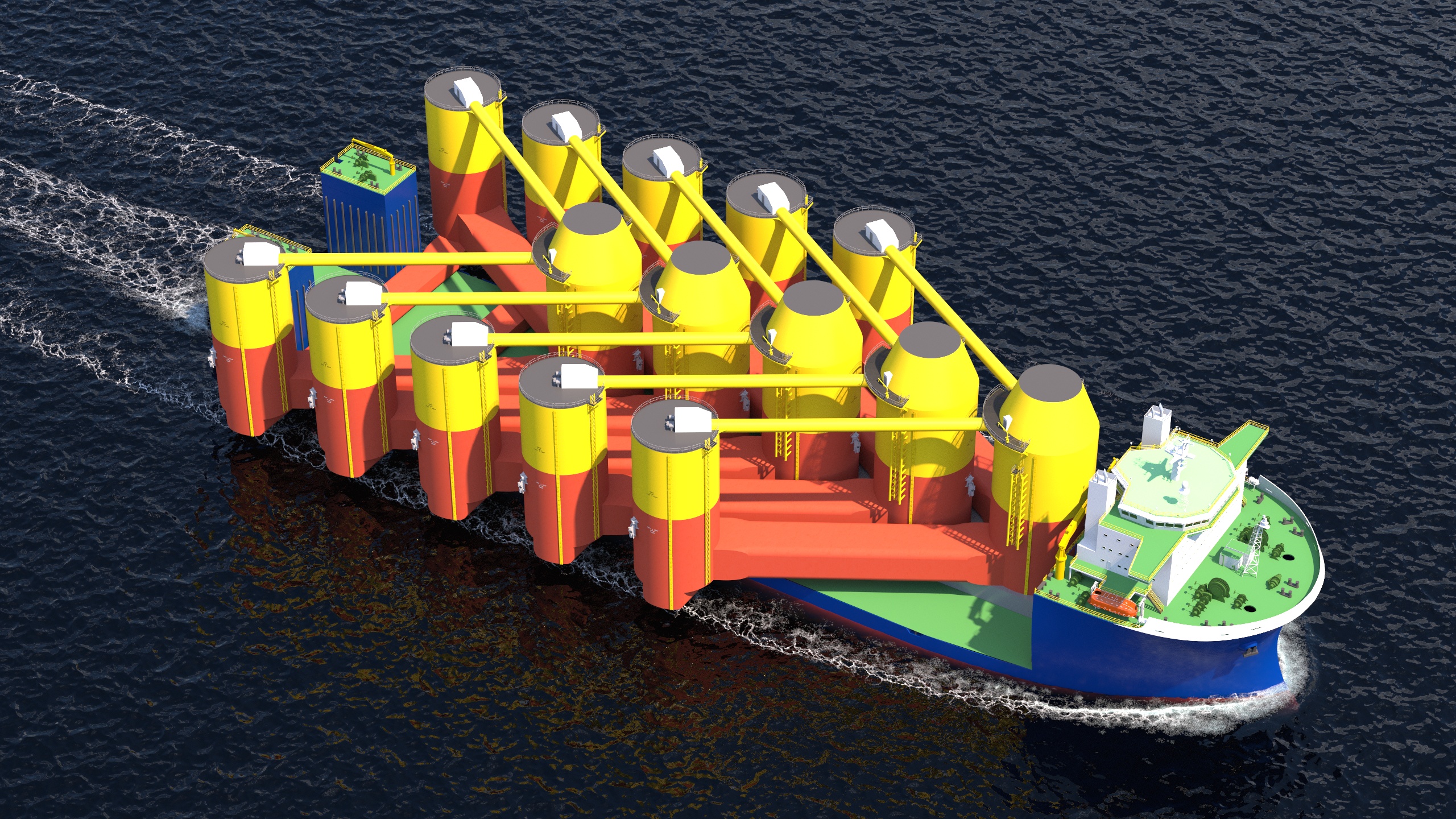
DNV Approval makes it more likely that the design will be deployed in the near future.

