Neptune Energy, Ørsted And Goal7 Explore Powering Integrated Energy Hubs With Offshore Wind
The title of this post, is the same as that of this press release from Neptune Energy.
These four paragraphs outline the agreement.
Neptune Energy today announced it has signed a Memorandum of Understanding with Ørsted and Goal7 to explore powering new integrated energy hubs in the UK North Sea with offshore wind-generated electricity.
Integrated energy hubs have the potential to combine multiple energy systems, including existing oil and gas production assets, carbon storage and hydrogen production facilities. They could extend the life of producing fields and support the economic case for electrification with renewable energy, to keep carbon emissions low.
The agreement will see the companies examine the potential to supply renewable electricity from Ørsted’s Hornsea offshore windfarm projects to power future Neptune-operated hubs in the UK North Sea.
Goal7 will provide project management support and technical input.
Note.
- Neptune Energy has three oil and gas fields in the UK North Sea; Cygnus (operational), Isabella (exploration) and Seagull (development)
- Gas from Cygnus comes ashore at the Bacton Gas Terminal.
- Ørsted owns the Hornsea wind farm, which when fully developed will have a capacity of around 6.5 GW.
- Cygnus and Hornsea could be not much further than 50 km apart.
- Seagull and Isabella are further to the North and East of Aberdeen.
- Ørsted has an interest in the Broadshore wind farm, which was numbered 8 in the ScotWind Leasing round.
These are my thoughts.
The Cygnus Gas Field And The Hornsea Wind Farm
This could be like one of those stories where boy meets the girl next door and they hit it off from the first day.
This page on the Neptune web site says this about the Cygnus gas field.
The biggest natural gas discovery in the southern North Sea in over 30 years is now the largest single producing gas field in the UK, typically exporting over 250 million standard cubic feet of gas daily. Cygnus contributes six per cent of UK gas demand, supplying energy to the equivalent of 1.5 million UK homes. It has a field life of over 20 years.
Two drilling centres target ten wells. Cygnus Alpha consists of three bridge-linked platforms: a wellhead drilling centre, a processing/utilities unit and living quarters/central control room. Cygnus Bravo, an unmanned satellite platform, is approximately seven kilometres northwest of Cygnus Alpha.
In 2022, we plan to drill two new production wells at Cygnus, with the first of these expected to come onstream in 4Q. The second well is due to be drilled in the fourth quarter and is expected onstream in the first quarter of 2023, with both wells helping to maintain production from the field and offset natural decline.
Gas is exported via a 55 km pipeline. Cygnus connects via the Esmond Transmission System (ETS) pipeline to the gas-treatment terminal at Bacton, Norfolk. Neptune Energy has a 25% minority interest in ETS.
Note.
- Cygnus with a twenty year life could be one of the ways that we bridge the gap until we have the two Cs (Hinckley Point and Sizewell) and a few tens of offshore wind gigawatts online.
- The two extra wells at Cygnus will help bridge the gap.
- The gas field has a pipeline to Bacton.
So what can the gas field and the wind farm, do for each other?
Hornsea Can Supply The Power Needs Of Cygnus
Typically, ten percent of the gas extracted from the wells connected to a gas platform, will be converted into electricity using one or more gas-turbine engines; which will then be used to power the platform.
So, if electricity from the Hornsea wind farm, is used to power the platform, there are two benefits.
- More gas will be sent through the pipeline to Bacton.
- Less carbon dioxide will be emitted in recovering the gas.
Effectively, electricity has been turned into gas.
Electricity Can Be Stored On The Sea-Bed
The Hornsea One wind farm has an area in the order of 150 square miles and it is only one wind farm of four, that make up the Hornsea wind farm.
I would argue that there is plenty of space between the turbines and the wells of the Cygnus gas field to install some form of zero-carbon underwater battery to store electricity.
But does this technology exist?
Not yet! But in UK Cleantech Consortium Awarded Funding For Energy Storage Technology Integrated With Floating Wind, I described a technique called Marine Pumped Hydro, which is being developed by the STORE Consortium.
- Energy is stored as pressurised water in 3D-printed hollow concrete spheres fitted with a hydraulic turbine and pump.
- The spheres sit on the sea-bed.
- This page on the STORE Consortium web site, describes the technology in detail.
- The technology is has all been used before, but not together.
I think it is excellent technology and the UK government has backed it with £150,000 of taxpayers’ money.
I also believe that Marine Pumped Hydro or something like it, could be the solution to the intermittency of wind farms.
Excess Electricity Can Be Converted Into Hydrogen
Any spare electricity from the wind farm can drive an electrolyser to convert it into hydrogen.
The electrolyser could be mounted on one of the Cygnus platforms, or it could even float.
The hydrogen produced would be blended with the gas and sent to Bacton.
Carbon Dioxide Can Be Stored In The Depleted Cygnus Gas Field
As the gas field empties of natural gas, the gas pipes to the Cygnus gas field can be reversed and used to bring carbon dioxide to the gas field to be stored.
The Cygnus gas field has gone full circle from providing gas to storing the same amount of carbon that the gas has produced in its use.
These are two paragraphs from the press release.
Neptune Energy’s Director of New Energy, Pierre Girard, said: “The development of integrated energy hubs is an important part of Neptune’s strategy to store more carbon than is emitted from our operations and the use of our sold products by 2030.
“Neptune has submitted three applications under the recent Carbon Dioxide Appraisal and Storage Licensing Round, and securing the licences would enable us to develop future proposals for integrated energy hubs in the UK North Sea.
I can envisage a large gas-fired power-station with carbon capture being built in Norfolk, which will do the following.
- Take a supply of natural gas from the Cygnus gas field via the Bacton gas terminal.
- Convert the hydrogen in the gas into electricity.
- Convert the carbon in the gas into carbon dioxide.
- Store the carbon dioxide in the Cygnus gas field via Bacton.
- I also suspect, that if a Norfolk farmer, manufacturer or entrepreneur has a use for thousands of tonnes of carbon dioxide, they would be welcomed with open arms.
Would the ultra-greens of this world, accept this power station as zero-carbon?
The Isabella And Seagull Gas Fields And The Broadshore Wind Farm
Could a similar set of projects be applied to the Isabella and Seagull gas fields, using the Broadshore wind farm?
I don’t see why not and they could work with the Peterhead power stations.
Vattenfall Hails Uncrewed Vessels
The title of this post, is the same as that of this article on offshoreWIND.biz.
This is the sub-heading.
Swedish energy company Vattenfall conducted large-scale seabed surveys with uncrewed surface vessels at several of its offshore wind farms in Denmark, Sweden, and the UK earlier this year.
The article is a must-read and is describes how automation will be used in the future in the offshore wind industry.
Scotland’s Renewable Energy Jackpot: Hydrogen Exports Alone Could Be worth £25 Billion A Year By 2045
The title of this post, is the same as that of this article on the Edinburgh News.
This is the sub-heading.
Scotland is a phenomenally energy rich country. For decades the largest oil-producing nation in the European Union, it is now set to trail-blaze as a leader in renewable energy.
The title and sub-heading say it all for Scotland.
But these words could equally well apply to Anglesey, Cornwall, Devon, East Anglia, Humberside, Liverpool and Morecambe Bays, the Severn Estuary and Pembrokeshire.
We also mustn’t forget the Dogger Bank!
Vattenfall Boosts Capacity For Norfolk Offshore Wind Zone
The title of this post, is the same as that of this article on offshoreWIND.biz.
This is the sub-heading.
Vattenfall is increasing the capacity for the Norfolk Offshore Wind Zone off the UK from 3.6 GW to over 4.2 GW, meaning that an additional 700,000 homes will be powered by the zone, the energy company said.
This is a sixteen percent increase in capacity.
In this article in the Eastern Daily Press, this is said.
Rob Anderson, project director of Vattenfall’s Norfolk Zones, said that the increase is due to the project using “innovative” technology and being “able to maximise its design”.
Moving from 12 MW to 14 MW turbines would give the planned increase.
This article on offshoreWIND.biz, is entitled Siemens Gamesa Ships Out First Set Of 115-Metre Wind Turbine Blades.
This is said about the two Norfolk Zone wind farms.
The SG 14-236 DD model will be commercially available in 2024 and has so far been selected as a preferred option for the Norfolk Vanguard and Boreas wind farms offshore the UK, as well as for the MFW Bałtyk II and MFW Bałtyk III wind farms in the Polish Baltic Sea.
It looks to me that Siemens Gamesa have got a success in the making.
It should be noted that the offshore floating wind farm named Ossian could increase from 2.6 GW to 3.6 GW, which I wrote about in Ossian Floating Wind Farm Could Have Capacity Of 3.6 GW.
A similar effect of size increases happened in North Sea Oil and Gas in the 1970s, as the cranes got larger and the techniques got better.
Is history repeating itself?
Ramboll To Develop Offshore Wind-To-Hydrogen Concept
The title of this post, is the same as that of this article on offshoreWIND.biz.
This is the sub-heading.
Ramboll has been selected to investigate the feasibility of producing hydrogen offshore at a multi-gigawatt scale with NortH2 in the Dutch part of the North Sea.
Note.
- NortH2 has a web site.
- There is a very rich About NortH2 page.
- NortH2 is a consortium made up of Equinor, Eneco, Gasunie, Groningen Seaports, RWE and Shell Netherlands.
- The consortium aims to use 4 GW to produce hydrogen by 2030 and 10 GW by 2040.
The world needs more ambitious projects like this.
Offshore Wind Turbines Need To Be Standardised, Energy Transition Industrialised To Reach Targets, Says Siemens Energy VP For Western Europe
The title of this post, is the same as that of this article on offshoreWIND.biz.
This is the sub-heading.
Governments need to move from talking about policies to implementation, the offshore wind industry needs to employ standardisation, and clear rules and regulations need to be set for green hydrogen in order to move faster with large-scale deployment and achieve meaningful progress in limiting global warming to 1.5 degrees Celsius.
The guy has a point, as mass production of anything is generally more efficient and creates more units in a given time.
But can a diverse group of politicians, agree on a standard for turbines, fixed foundations, floaters, cables and sub-stations and then make sure all are identical and clip together like Lego? I doubt it!
And how would you fit innovative designs like TwinHub into a standard.
This image shows one of their TwinHub turbine installations being towed into place.
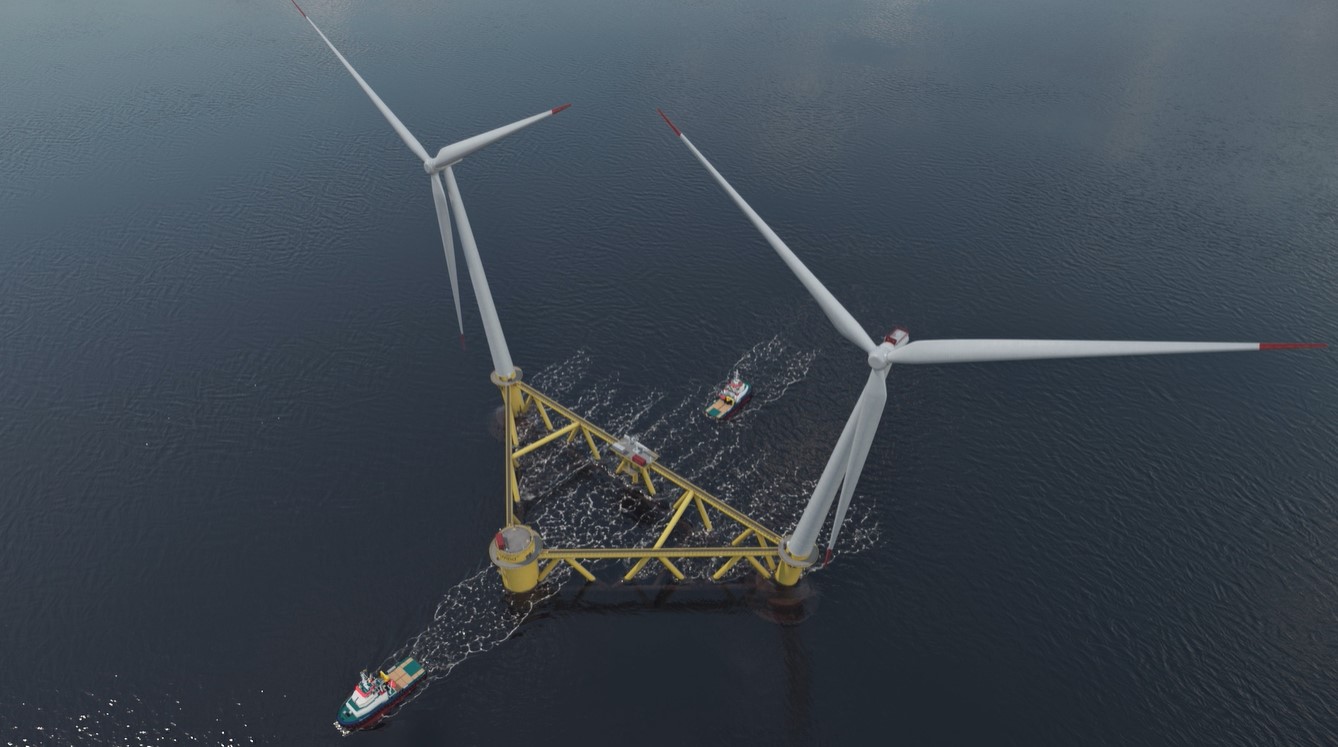
At least it could be built to hold two standard turbines.
Crown Estate Accelerates Celtic Sea Floating Offshore Wind Surveys
The title of this post, is the same as that of this article on offshoreWIND.biz.
This is the sub-heading.
The Crown Estate has announced the awarding of the first contracts for its first major investment in surveys to help with the construction of floating offshore wind farms in the Celtic Sea.
These two paragraphs describe the contracts.
Contracts have now been signed for the initial phase of metocean surveys, which look at wind, wave, and current patterns, to begin in Spring 2023. The Crown Estate is progressing the procurement of the remaining surveys over the coming weeks and months, subject to further commercial discussions.
By investing in these surveys at an early stage and making the data freely available to successful bidders, the Crown Estate is aiming to accelerate the delivery of the projects, making it easier for developers to take early decisions and manage risk while supporting future project-level Environmental Impact Assessments (EIAs) as part of the planning process.
It looks like a good idea to me, as it could make the bidding process much quicker and bidders with special expertise may be able to get contracts more suited to their expertise.
UK and NSEC Strengthen Offshore Renewables Ties
The title of this post, is the same as that of this article on offshoreWIND.biz.
This is the sub-heading.
Members of the North Seas Energy Cooperation (NSEC), the UK, and the European Commission have signed a memorandum of understanding (MoU) to strengthen their cooperation for the development of offshore renewable energy.
The article is based on this article on the European Commission web site, which is entitled North Seas Energy Cooperation And UK Establish Cooperation Framework To Facilitate The Development Of Offshore Renewable Energy.
The full signed text is also in this document on the web site, which is entitled Memorandum of Understanding on offshore renewable energy cooperation.
I have read the MoU and it seems a sensible document for one with eleven signatures.
It lists the following areas of cooperation.
- Hybrid and joint projects
- Maritime and spacial planning
- Support framework and finance
- Best practice in respect of onshore and offshore grid practice
- Sharing of information on new technologies
- Exchange of best practices in relation to the relevant rules, regulations and technical standards
The MoU expects any problems to be resolved by consultations in good faith.
Offshore Wind Developers Answer Scotland’s Call For Innovation, Oil And Gas Decarbonisation
The title of this post, is the same as that of this article on offshoreWIND.biz.
This is the sub-heading.
Crown Estate Scotland has received a total of 19 applications for its Innovation and Targeted Oil and Gas (INTOG) offshore wind leasing process.
INTOG
Note that there are two sections to INTOG.
This document on the Crown Estate Scotland web site, is entitled INTOG – Public Summary and it defines the two sections.
Innovation:
- To enable projects which support cost reduction in support of commercial deployment of offshore wind including alternative outputs such as Hydrogen.
- To further develop Scotland as a destination for innovation and technical development which will lead to risk reductions and supply chain opportunity.
Applications in this section should be no more than 100 MW in capacity.
Targeted Oil and Gas:
- To maximise the role of offshore wind to reduce emissions from oil and gas production.
- To achieve target installed capacity in a way that delivers best value for Scotland, creating supply chain opportunity in alignment with Just Transition principles.
A rough estimate is that powering rigs by using offshore wind would increase gas production by around ten percent.
The Applications
The article says this about the applications.
Of the 19 applications, ten are for the Innovation part, while nine have been submitted for the TOG element.
It is expected that up to 500 MW will be awarded to innovation projects and around 4 GW for projects looking to decarbonise oil and gas assets.
The article also lists the known bidders.
Conclusion
I believe that there is going to be some outstanding applications for leases under the INTOG scheme.
I have already written about Cerulean Winds ambitious proposal in Cerulean Winds Is A Different Type Of Wind Energy Company, which could result in 6 GW of wind turbines installed amongst the oil and gas fields to provide electricity and decarbonise the platforms and rigs.
DEME Returns To Scotland, Announces Offshore Wind Industry Firsts
The title of this post, is the same as that of this article on offshoreWIND.biz.
This is the sub-heading.
DEME has won the contract to install foundations at the 882 MW Moray West wind farm offshore Scotland.
The industry firsts are described in these paragraphs.
In an industry breakthrough, the Moray West project will be the first time XXL monopiles will be installed in the winter period, and DEME will deploy its double-staged, motion-compensated pile gripper, the company said.
Moray West will also be the first time a vibro-hammer is being utilised for the XXL monopiles to overcome weaker soil layers.
Note.
- The water depth at Moray West wind farm is 35-54 metres, which necessitates the XXL monopiles.
- Working offshore in winter can be challenging.
- DEME’s gripper sounds just like what the engineers wanted.
This is just like with North sea oil and gas, where everything got bigger and more capable over time. But it did speed construction!
 The Anonymous Widower