Cornwall Insight Forecasts Lower Household Energy Bills In January
The title of this post, is the same as that of this article on Solar Power Portal.
This is a paragraph from the article.
The Default Tariff Cap is set by the UK’s energy regulator Ofgem as the maximum rate per unit and standing charge that can be billed to customers for their energy use. Cornwall Insight’s latest forecast predicts the cap will fall to £1,733 a year for a typical dual fuel household in the first quarter of 2026.
Consider.
- I am on a dual-fuel tariff for gas and electricity.
- At present, I pay £159 per month or £1,908 per year.
If I was on the new price cap, I’d pay £144.42 per month or about 10 % less.
Underground Hydrogen Storage Pilot Gets Funding Boost
The title of this post is the same as that of this article on Energy Live News.
This is the sub-heading.
New hydrogen storage tech could boost grid resilience and emissions cuts
These first three paragraphs add some details.
National Gas and Gravitricity have secured £500,000 from Ofgem to develop a new type of underground hydrogen storage.
The H2FlexiStore system, designed by Edinburgh-based energy storage firm Gravitricity, aims to store up to 100 tonnes of green hydrogen in lined geological shafts.
The technology, which could see a demonstrator built in 2026, is intended to offer a flexible, resilient solution to future hydrogen network needs.
The article also has an excellent graphic.
Note that it takes 55.2 MWh of electricity to generate a tonne of hydrogen, so a hundred tonnes of hydrogen would store 5.52 GWh of electricity as hydrogen.
Race For Clean Power Surges Ahead As New Electricity Superhighway Greenlit
The title of this post, is the same as that of this press release from Ofgem.
These three paragraphs, explain the infrastructure.
Flagged by the National Energy System Operator (NESO) as an essential element in achieving the Government’s Clean Power 2030 ambition, Eastern Green Link 1 (EGL1As part of its mission to rapidly upgrade the energy system with a minimum cost to customers, Ofgem has identified over £43m of savings which have been cut from the project costs without impacting delivery or quality. Communities that host the infrastructure in Scotland and North-East England are also set to benefit from a £7.9m social value and community benefit fund.) is a high voltage electricity superhighway able to transport 2 gigawatts of homegrown wind generated electricity between Torness, East Lothian and Hawthorn Pit, County Durham. A gigawatt (GW) is equivalent to one billion watts, and one gigawatt hour (GWh) of electricity is enough to power one million homes for one hour. Most of the 196km cable will be under the North Sea, with the remaining 20km of cables underground linking the cable to substations and converter stations in Scotland and England.
The project will reduce Great Britain’s reliance on volatile international gas markets by further harnessing the power of homegrown North Sea wind. NESO’s recent Clean Power 2030 Report has also shown that the project will deliver annual saving of over £870m by reducing the need to compensate British wind generators who are currently asked to turn off production during times of high wind due to lack of grid capacity. This in turn will help drive down consumer bills.
Note.
- Eastern Green Link 1 (EGL1) is a high voltage electricity superhighway able to transport 2 gigawatts of homegrown wind generated electricity between Torness, East Lothian and Hawthorn Pit, County Durham.
- This is the second down the eastern side of the UK.
- In Contracts Signed For Eastern Green Link 2 Cable And Converter Stations, I described how contracts were signed for EGL2 from Peterhead in Scotland to Drax in England .
- Most of the 196km cable will be under the North Sea, with the remaining 20km of cables underground linking the cable to substations and converter stations in Scotland and England.
There are another two 2 GW cables to follow in the current plan!
UK To Fund Hydro Energy Storage Projects
The title of this post, is the same as that of this article on The Times.
This is the sub-heading.
New infrastructure aims to help balance the electricity system after the rapid growth in renewables
These three paragraphs infrastructure the article.
Projects that use water to store and release energy are to be given government support, in an attempt to help manage the volatility in supply and demand as more green power enters the grid.
From next year, pumped hydro storage projects will be able to apply for government subsidies, which will be provided via a “cap and floor” mechanism. These would guarantee revenues if prices drop below a certain floor but prevent providers from charging above a ceiling when power prices are high.
Like other government support schemes, any cost will be levied on energy bills, while consumers will be paid back any money generated above the cap. It is yet to be decided precisely how the cap and floor will be set.
I feel it is reasonable to expect the system to be a success, as a similar system is used for interconnectors and this article on Offshore Energy is entitled Over $86 million To Be Split Between UK and Belgium Consumers As 1 GW Subsea Interconnector’s ‘Remarkable’ Revenues Exceed Ofgem’s Cap.
It looks like Ofgem played this right for interconnectors and the Nemo Link is making a substantial payment.
It will be interesting to see what happens when “cap and floor” contracts are assigned.
This move by Ofgem will probably have effects in two areas.
- SSE, Statera and Statkraft, who are typically developing systems at the high end with a size of about 1.5 GW/25 GWh could find money is easier to come by.
- At the lower end, companies like Highview Power, who have systems of 50 MW/300 MWh and 200 MW/2.5 GWh under development, will also benefit.
My Control Engineering thoughts are leaning towards the 200 MW/2.5 GWh systems being the popular ones. Especially as they would appear to be close to the right size to support a 1 GW wind farm for two hours.
A Highview Power Two-Hour Liquid Air Battery could fit nearly with a fleet of Two-Hour BESS.
It should be noted that CAF use a little-and-large approach to theit battery-electric trams in the West Midlands.
A large lithium-ion battery is the main storage device.
A supercapacitor handles the high-frequency response and keeps the power steady.
Pairing a Highview Power Two-Hour Liquid Air Battery and a Two-Hour BESS could achieve the same performance and possibly result in some cost savings.
Funding Awarded For Study On Hydrogen Storage Potential In The East Midlands
The title of this post, is the same as that of this article on the British Geological Survey.
This is the sub-heading.
A new study has been awarded funding to explore the underground hydrogen storage potential in the East Midlands.
These are the first three paragraphs.
East Midlands Storage (EMstor), a consortium led by Cadent and partnered with BGS, Star Energy Group, Net Zero Strategy and the University of Edinburgh, has been awarded discovery funding by Ofgem’s Strategic Innovation Fund to undertake a new study to evaluate geological storage potential in the East Midlands.
The EMstor study is the first of its kind in the region. It will undertake a feasibility assessment of the East Midlands’ geology to evaluate its potential to host storage technologies, allowing expansion of Cadent’s proposed 100 per cent hydrogen pipeline.
The East Midlands has numerous depleted oil reservoirs, which may have potential to store hydrogen. The study will characterise the potential geological reservoir to establish if it is suitable for hydrogen storage at scale in the local area.
The oilfields of the East Midlands Oil Province have their own Wikipedia entry, which gives full details of the dozens of small oil fields in the area.
- It may not be the world’s largest oil resource, but it certainly helped us during the Second World War.
- Experienced Texan oil-men were even imported, to help boost production.
- It used to be possible to spot the occasional lonely nodding donkey, as you passed through the area.
Surely, if some of the oilfields can be converted to hydrogen stores, this would be very useful.
£9.2m Electricity Research Project To Save 39,000 Tonnes Of C02 Gets Go-Ahead
The title of this post, is the same as that of this press release on National Grid.
These four paragraphs detail the project.
National Grid Electricity Transmission (NGET) has been successful in securing £8.12m of funding from Ofgem’s Network Innovation Competition (NIC) to research the uprating of overhead lines, with the remainder being funded by National Grid.
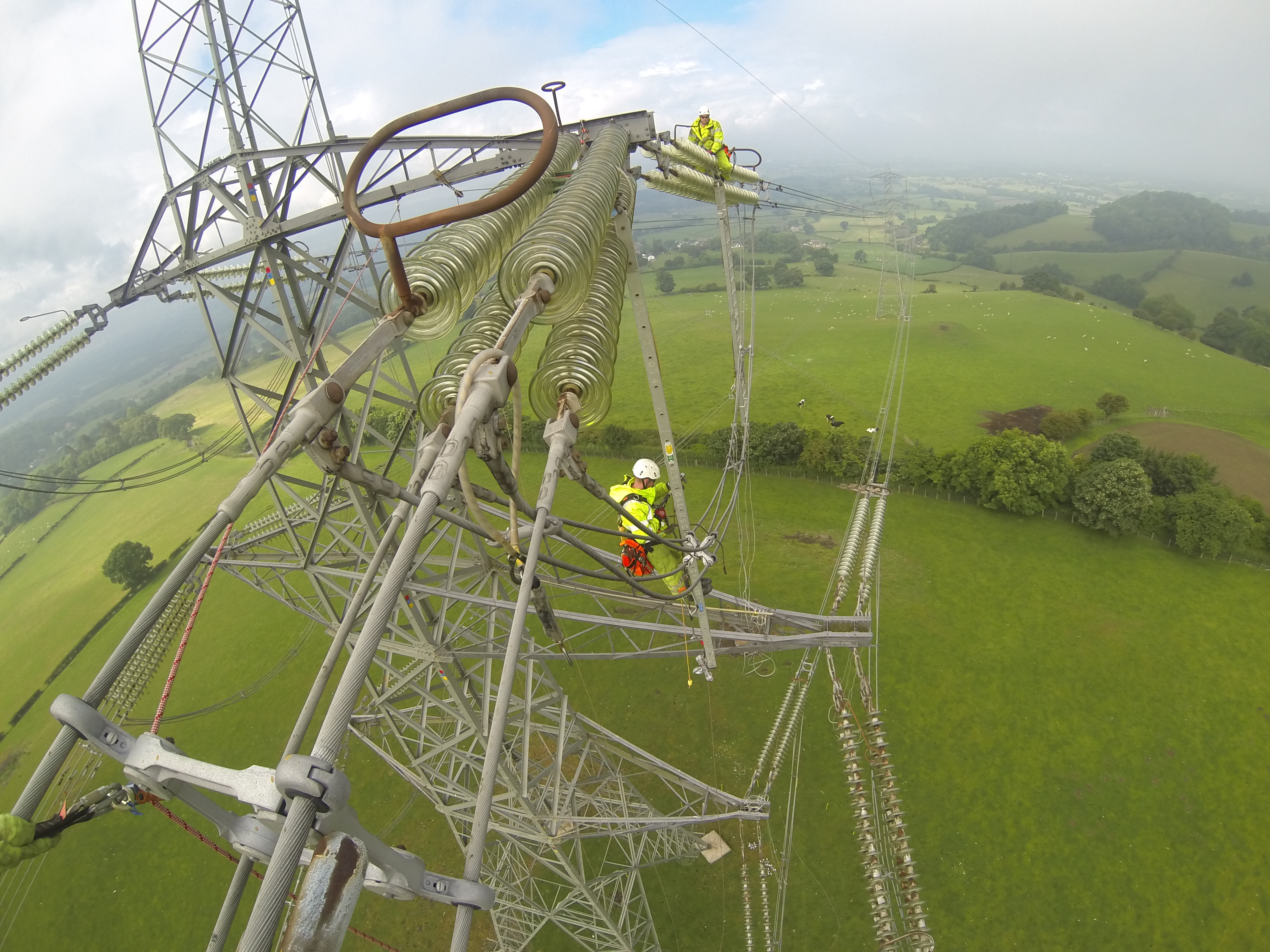
The RICA (Retro-Insulated Cross-Arms) research project will commence in early 2021 and aims to develop an innovative method for uprating overhead lines, allowing the voltage on 275kV overhead lines to be increased to 400kV. This potentially paves the way for uprating 400kV lines to 550kV in the future.
By removing the suspended insulators on these overhead lines and instead insulating the cross arms, the wires will be held higher and further apart, thereby enabling an increased voltage to be carried.
Uprating lines in this way could allow 45% more power to be carried on some existing routes and support significant reductions in UK CO2 emissions – 39,000 tonnes. This could deliver up to £286m of efficiencies to consumers and with future development, it could open the door to ultra-high voltage networks in the UK.
This is a National Grid picture of fitters installing the new system.
Note.
- Surely, if you can increase the capacity of an electricity line by 45 %, by using innovation and just changing the insulators, this would be much cheaper, than adding another high voltage line.
- It would also incur less legal costs and disruption, than a second line.
I like this idea and hopefully it will please the Nimbies.
More About RICA
This web page is the RICA web site.
This document gives a lot more information.
Conclusion
It appears to be a simple solution to increasing the capacity of the grid.
I’d like to see some recent results.
£400k For National Grid Innovation Projects As Part Of Ofgem Fund To Help Shape Britain’s Net Zero Transition
The title of this post, is the same as that, of this press release from National Grid.
These three bullet points, act as sub-headings.
- Three transmission and distribution network innovation projects receive green light
- Funding kickstarts projects for the discovery phase of Ofgem innovation scheme
- 14 National Grid projects worth £4m have won innovation funding since scheme began
These are the three projects.
HIRE – Hybrid-Network Improvement & Reliability Enhancement
This is National Grid’s description of the £135,000 project.
Researching new state-of-the-art condition monitoring to improve the commissioning and operation of offshore cables. This new, robust system will mitigate the risk of failure, overcome the limitations of existing techniques (e.g. cable length) and aid network operators in decision making for a more flexible grid. PROJECT PARTNERS: University of Manchester, DNV, Monitra, SSEN Transmission.
With all the offshore cables, that have been laid around the UK, Europe and the world in recent years, I am surprised that such a system has not been developed before.
But I suspect, that the project partners know that if they can develop a superior cable monitoring system, then it could be a nice little earner in addition to its job with UK offshore cables.
According to their web site, Monitra seem to be the monitoring experts.
This is the mission statement on their home page.
Our aim is to maximise the uptime of every high voltage asset worldwide.
I like this company’s attitude and it should make the world a better place.
I certainly think that the £135,000 will be well spent.
REACH – Rural Energy And Community Heat
This is National Grid’s description of the £120,000 project.
Working with rural community energy groups to develop a modular rural energy centre that will help communities make cost effective decarbonisation plans. The solution will offer shared low carbon heating, rapid EV charging, and renewable generation in areas not served by commercial markets, and where there is limited electricity network capacity.
Rolls-Royce mtu seem to have a system, that might go some way to satisfy National Grid’s ambitions, that I wrote about in Would You Buy A Battery Energy Storage System From Rolls-Royce?.
Road to Power
This is National Grid’s description of the £140,000 project.
Developing specific tools to forecast future energy consumption and infrastructural impact of works, to support the street and road works sector as it decarbonises 7.8TWh of energy demand across 700,000 major works in the sector’s pivotal transition to net zero by 2030.
This sounds like an excellent idea. Especially, if it makes street and road works quieter and less polluting.
Conclusion
I like these three projects and have already added them to my list of Google Alerts.
‘Phantom’ Power Projects Are Holding Back The UK’s Energy Security – Centrica Report
The title of this post, is the same as that of this press release from Centrica.
These are the three bullet points.
- New report shows queue for new energy projects is blocked by developers that may not even have land rights and haven’t applied for planning consents
- Estimated size of these power projects in the queue is 62GW, roughly one fifth of all power in the queue
- Centrica CEO argues such ‘phantom’ projects should have Construction Agreements terminated if developers miss key milestones – and urges Ofgem to give National Grid ESO the power to remove projects from the existing grid queue
This is the first two paragraphs.
A new independent report, commissioned by Centrica, has revealed the extent of the power projects holding back the UK’s energy security and creating risk around hitting net zero.
The report examined the UK’s existing queue for Transmission Entry Capacity (TEC) – the queue for connecting new projects to the transmission grid – and discovered that it is up to four times oversubscribed. Not only that, but this oversubscription has become significantly worse in the last few years.
The report found these three totals.
- There are currently 371GW of projects in the queue, enough to significantly improve the UK’s energy security.
- Around 114GW worth of projects have listed their connection date as before 2029.
- But around 62GW of these projects are only in the scoping phase and developers may not even have secured land rights or applied for planning consent.
This is both good and bad news!
Here Is The Good News!
Currently, the UK is using 37 GW of electricity, of which 32 GW are generated in the UK, 5 GW is being imported through interconnectors and around 6 GW are coming from renewables.
So this means that when we build all the 371 GW in the queue, we’ll have around eleven times the electricity we are using today.
Of the 114 GW of projects listed for connection before 2029, it looks like 62 GW won’t be delivered, as they haven’t secured land rights or applied for planning consent.
But that still means that as much as 52 GW could be delivered by 2029.
Even this reduced level of new projects still increases the amount of electricity that can be generated by nearly 150 %.
If I’m being ultra pessimistic, I would say that the average capacity factor of the extra capacity was 50 %, so we’d only be adding 26 GW, so the electricity, that can be generated would only rise by around 70 %.
I suspect all in the UK can live with these paltry increases.
Here Is The Bad News!
This is a paragraph from the report.
The report suggests that the oversubscribed queue, and longer wait for connections. has a damaging effect on the investments that could drive the UK’s energy transition and energy security.
Developers and investors will decamp to countries, where they be sure of getting a return on their time and money.
Think of having two supermarkets close to you live, where one is professional and one is chaotic. Where would you shop?
The congestion caused by phantom projects must be solved.
Ofgem’s Solution
This is the solution in the press release.
Ofgem is exploring rule changes (CMP376) to address queue issues and is expected to decide these before 10 November. These rule changes would grant the ESO the ability to remove projects from the queue if they miss key milestones. Ofgem is currently considering whether to apply this rule change to just new projects entering the queue, or whether the rule change should also be applied to projects already in the queue.
They can probably come up with a solution.
An Alternative Method From My Past
In 1969, I worked for ICI, where one of my jobs was building specialist instruments for chemical plants.
Most instruments, that were designed by the group I belonged to, included a chassis on which the components and electronics were mounted. So we had a workshop and about seven or eight staff at our disposal to build the chassis and the parts outside of our skills. As they were used by several groups in the building, where we were all based, the workshop was very busy and everything was delivered late.
Eventually, a manager decided to get a grip on the situation.
He insisted, that the workshop would not do what you wanted if your delivery date was as soon as possible, rather than a date agreed by both parties.
The results were amazing and everything was delivered on the agreed date.
With the renewable energy connection queue, I am sure, that if a procedure was developed, that only allowed fully-planned projects with an agreed completion date to enter the queue, then the problems of phantom projects would be solved.
It might also reduce the cost of developing these renewable projects.
 The Anonymous Widower